
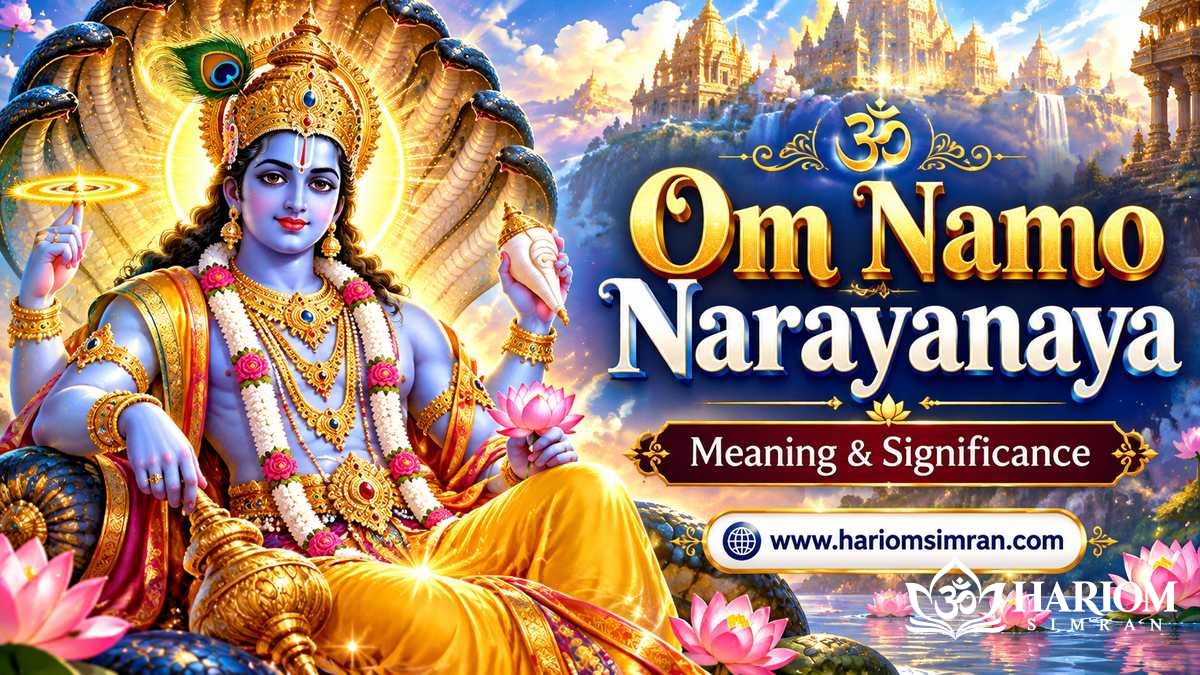
Om Namo Narayanaya is one of the most revered mantras associated with Lord Vishnu and Narayana in Hindu devotional traditions.
The mantra is written in Sanskrit as:
ॐ नमो नारायणाय
Om Namo Narayanaya
At its simplest, the mantra means:
“Om, I bow to Narayana.”
Yet its spiritual meaning goes much deeper than a literal translation. For devotees, Om Namo Narayanaya expresses reverence, humility, remembrance and surrender to the Divine.
Chanting the mantra can become a simple way to bring the mind back toward devotion during prayer, Japa, meditation or everyday life.
Narayana is closely associated with Vishnu in Vaishnava traditions. Readers who want to understand this Divine form more deeply can explore Lord Vishnu: Meaning, Avatars and Sacred Wisdom.
What Does Om Namo Narayanaya Mean?
Understanding the mantra word by word helps reveal its devotional meaning.
Om
Om is one of the most sacred sounds in Hindu spiritual traditions.
It is associated with ultimate reality, consciousness and the Divine. Om is found throughout Hindu prayer, meditation, philosophy and mantra practice.
Namo
Namo expresses reverence, salutation or bowing.
Spiritually, it represents humility. Instead of approaching the Divine through ego, the devotee offers respect and surrender.
Narayanaya
Narayanaya means “to Narayana” or “unto Narayana.”
Narayana is one of the sacred names associated with Lord Vishnu and holds an especially important place in Vaishnava devotional traditions.
Together, Om Namo Narayanaya may be understood devotionally as:
“I offer my reverence and surrender to Narayana.”
Who Is Narayana?
Narayana is an important Divine name in Hinduism, particularly within Vaishnava traditions.
In many Vaishnava schools, Narayana is understood as the Supreme Divine Reality and is closely identified with Lord Vishnu.
Vishnu is widely associated with the preservation of Dharma, protection of creation and restoration of balance when Adharma becomes powerful.
Hindu traditions are diverse, however, and different Sampradayas may explain the relationship between Vishnu, Narayana, Krishna and other Divine forms in different theological ways.
This diversity is an important part of Sanatana Dharma.
Readers beginning their spiritual study can explore What Is Hinduism? Meaning, Beliefs, Origins & Core Teachings for a broader understanding of Hindu philosophy and devotional traditions.
Why Is Om Namo Narayanaya Called Ashtakshara?
Om Namo Narayanaya is traditionally known as the Ashtakshara Mantra.
The Sanskrit word Ashta means eight, while Akshara can refer to a syllable or sacred sound-unit.
The mantra is traditionally understood through eight sacred syllables:
Om – Na – Mo – Na – Ra – Ya – Na – Ya
This is why it is commonly described as the eight-syllabled mantra of Narayana.
Its importance, however, does not come simply from the number eight.
Within Vaishnava devotional traditions, the mantra represents remembrance of Narayana, reverence for the Divine and spiritual surrender.
How Do You Pronounce Om Namo Narayanaya?
A simple pronunciation guide is:
Om Na-mo Naa-raa-ya-naa-ya
Sanskrit:
ॐ नमो नारायणाय
Transliteration:
Oṁ Namo Nārāyaṇāya
Pronunciation may vary slightly according to language, region and spiritual lineage.
A beginner should not become anxious about having a perfect accent from the first day.
Learning respectfully, understanding the meaning and chanting with awareness are more valuable than repeating the words quickly without understanding them.
What Is the Spiritual Meaning of the Mantra?
At the heart of Om Namo Narayanaya is surrender.
Human life naturally brings ambition, attachment, fear, uncertainty and moments when we feel everything depends entirely on us.
The mantra offers another perspective.
It reminds the devotee that sincere effort and spiritual surrender can exist together.
A person can fulfil responsibilities honestly while remembering that life and the Divine are greater than the individual ego.
In this sense, chanting the mantra may become an inner movement:
-
From ego toward humility
-
From distraction toward remembrance
-
From restlessness toward spiritual attention
-
From fear toward trust
-
From mechanical routine toward devotion
These are devotional interpretations, not guaranteed material results.
Om Namo Narayanaya and Bhakti
Bhakti is often translated simply as devotion, but Hindu Bhakti traditions are much deeper.
Bhakti can involve love, prayer, remembrance, service, surrender, trust and dedication to the Divine.
Om Namo Narayanaya fits naturally within this devotional path.
The mantra may be chanted during:
-
Morning prayer
-
Evening prayer
-
Puja
-
Japa
-
Meditation
-
Temple worship
-
Quiet reflection
-
Moments of spiritual remembrance
The outer setting may change, but the central purpose remains the same: remembering Narayana with sincerity.
How to Chant Om Namo Narayanaya
A beginner does not need to make mantra practice unnecessarily complicated.
Choose a Peaceful Place
Sit comfortably in a clean and peaceful location where you are unlikely to be disturbed.
Settle Your Attention
Take a few natural breaths and allow the mind to become quieter.
You do not need to force every thought away. Simply bring your attention into the present moment.
Remember Narayana
Bring your awareness toward Lord Vishnu or Narayana according to your devotional understanding.
Chant Slowly
Repeat:
Om Namo Narayanaya
Avoid rushing.
Listen to the mantra as you chant and remain conscious of its meaning.
Return When the Mind Wanders
The mind naturally moves toward different thoughts.
When this happens, gently return your attention to the mantra instead of becoming frustrated.
Finish With Gratitude
After chanting, remain quiet for a short time.
You may conclude with a prayer, Namaskar or simple feeling of gratitude.
How Many Times Should You Chant It?
Many Hindu Japa traditions use 108 repetitions, often with a mala.
However, a beginner does not have to begin with 108 repetitions.
You may start with:
-
9 repetitions
-
11 repetitions
-
21 repetitions
-
108 repetitions
or another number according to your devotional practice.
The number should not become more important than the devotion.
Eleven sincere repetitions with awareness can be more meaningful than mechanically completing a large number without attention.
Specific Vaishnava Guru lineages or Sampradayas may have their own instructions, and those traditions should be respected.
Can Om Namo Narayanaya Be Chanted Daily?
Yes. Many devotees include Narayana or Vishnu remembrance in their daily spiritual practice.
The mantra may be chanted during morning worship, evening prayer, meditation or Japa.
There is no requirement that every devotee follow exactly the same routine.
Hindu devotional practices may vary according to family tradition, region, Guru lineage and Sampradaya.
Consistency and sincerity are more important than turning mantra chanting into a mechanical obligation.
Do You Need a Mala?
A mala can be helpful for Japa, but it is not compulsory for every form of devotional chanting.
Traditional Japa malas help practitioners maintain count and rhythm.
A devotee may also chant Om Namo Narayanaya without a mala during personal prayer or spiritual remembrance.
External objects can support spiritual practice, but they do not replace attention, understanding and devotion.
What Do Hindu Scriptures Teach About Mantras?
Mantra traditions form part of the much wider spiritual and scriptural heritage of Hinduism.
Hindu sacred literature includes the Vedas, Upanishads, Bhagavad Gita, Ramayana, Mahabharata, Puranas and many other devotional and philosophical texts.
Different scriptures and traditions approach prayer, sacred sound, meditation and devotion in different ways.
To understand how these texts connect within Sanatana Dharma, explore Hindu Scriptures: Sacred Texts and Their Teachings.
Understanding the wider scriptural context is important because a mantra should not be treated merely as an isolated phrase found on social media.
It belongs to a much deeper spiritual tradition.
Om Namo Narayanaya and Om Namah Shivaya
People sometimes ask whether they should chant Om Namo Narayanaya or Om Namah Shivaya.
The two mantras belong to different devotional traditions.
Om Namo Narayanaya is associated with Narayana and Lord Vishnu.
Om Namah Shivaya is associated with Lord Shiva.
There is no reason to turn these sacred traditions into a competition.
Hinduism contains many paths of devotion, and a person's spiritual practice may depend on their Ishta Devata, family tradition, Guru or Sampradaya.
Those interested in Shiva devotion can also read Om Namah Shivaya: Meaning and Spiritual Significance.
Can Anyone Chant Om Namo Narayanaya?
Om Namo Narayanaya is widely known and used devotionally.
At the same time, Hindu mantra traditions contain different levels of practice.
General devotional chanting and formal initiated mantra practice within a particular spiritual lineage are not necessarily the same thing.
Someone who follows a specific Guru or Vaishnava Sampradaya should respect the guidance of that tradition.
For general devotional remembrance, the mantra can be approached with sincerity, humility and respect.
Does the Mantra Guarantee Wealth or Success?
No sacred mantra should be presented as a guaranteed method for obtaining money, success, health or every personal desire.
Such claims can reduce a spiritual practice to a transaction.
Om Namo Narayanaya is fundamentally a mantra of devotion and remembrance.
Mantra chanting may support a person's spiritual routine, concentration and reflection, but it should accompany responsible action, Dharma and ethical conduct.
It should never replace necessary medical treatment, professional advice or practical responsibility.
Why Is This Ancient Mantra Relevant Today?
Modern life constantly competes for our attention.
Phones, notifications, work, responsibilities and worries can keep the mind occupied throughout the day.
A sacred mantra creates a small space in which attention can move away from constant mental noise and return toward spiritual remembrance.
This does not mean escaping daily responsibilities.
Instead, spiritual practice can help a devotee return to everyday life with greater awareness, humility and perspective.
That is one reason ancient mantra traditions continue to remain meaningful today.
Key Takeaway
Om Namo Narayanaya is one of the most respected sacred mantras associated with Narayana and Lord Vishnu.
Its simple meaning is:
“Om, I bow to Narayana.”
Its deeper devotional message centers on humility, remembrance, reverence and surrender.
The mantra may be included in prayer, meditation, Japa or simple moments of spiritual reflection.
The most important part of chanting is not speed, volume or the number of repetitions.
It is the sincerity and awareness with which the devotee remembers the Divine.
How to Chant This Mantra
Follow these steps to experience the full benefits of chanting this sacred mantra:
1. Find a Quiet Space
Choose a peaceful, clean place where you can sit comfortably without distractions.
2. Sit in a Comfortable Posture
Sit with your spine straight, cross-legged on the floor or on a chair with feet flat.
3. Focus on Your Breath
Take a few deep breaths to center yourself and calm your mind before beginning.
4. Chant with Devotion
Chant the mantra slowly and clearly, focusing on its meaning and vibrations.
5. Practice Daily
Consistency is key. Try to chant at the same time each day for best results.