


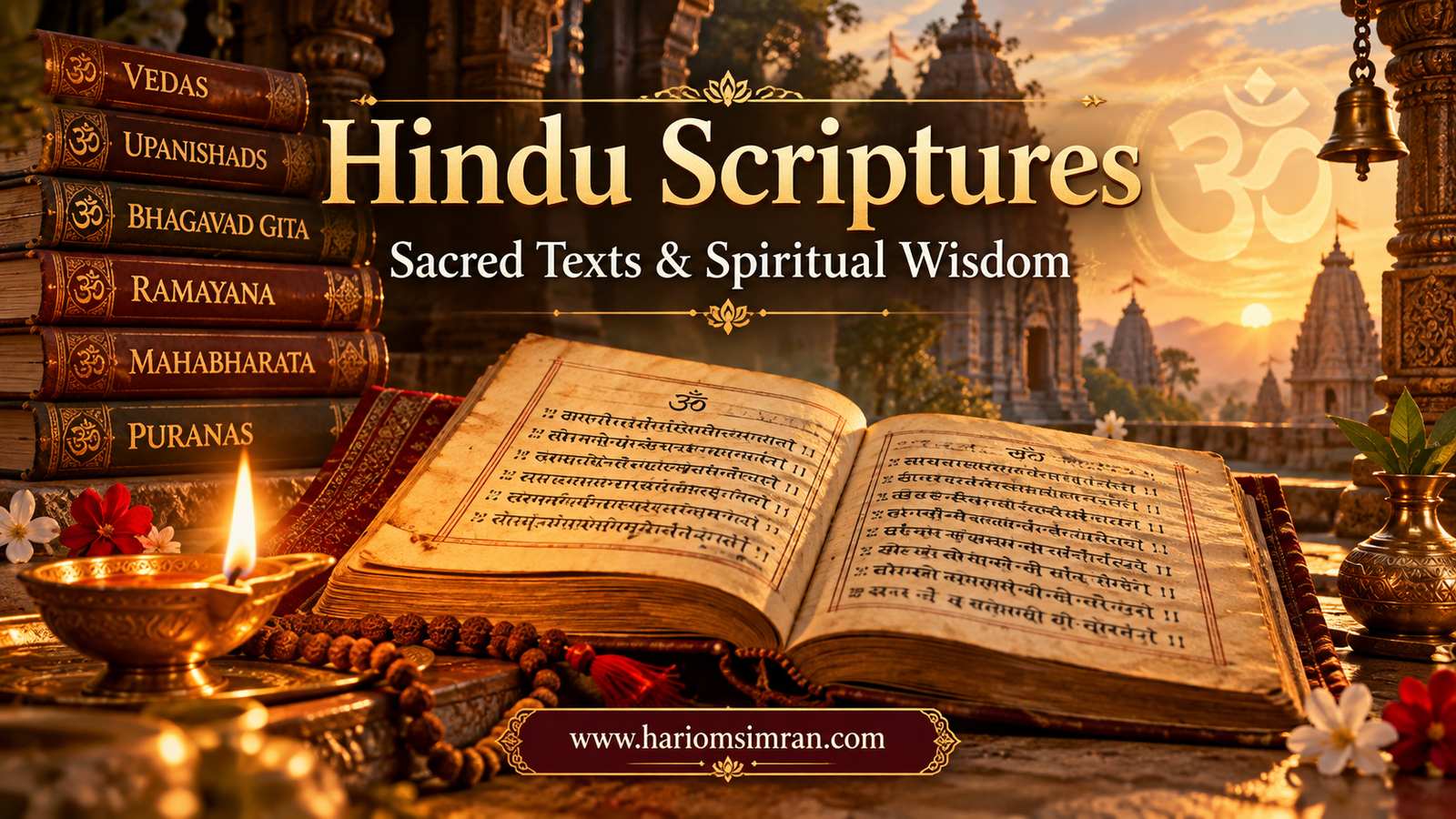
What Are Hindu Scriptures?
Hindu scriptures are a vast collection of sacred, philosophical, devotional and traditional texts that have shaped Hindu spiritual thought for thousands of years.
Unlike religions centered around one single holy book, Hinduism has a rich library of sacred literature.
These texts explore some of life’s deepest questions:
Who are we? What is Dharma? What is the nature of the Divine? Why do our actions matter? What happens after death? And how can a person attain spiritual freedom?
Hindu scriptures approach these questions through many forms — sacred hymns, philosophical conversations, spiritual teachings, epic stories, devotional traditions, rituals and reflections on the meaning of life.
Among the best-known Hindu sacred texts are the Vedas, Upanishads, Ramayana, Mahabharata, Bhagavad Gita and Puranas.
Each has its own place and purpose within Hindu tradition.
If you are beginning your journey, you can also explore the broader Hinduism section and the growing Hindu Scriptures library on HariOmSimran.
Does Hinduism Have One Holy Book?
No. Hinduism does not have one single holy book that defines every Hindu tradition.
Instead, Hindu sacred literature developed over a very long period and includes many different kinds of texts.
Some focus on sacred hymns and rituals.
Others explore philosophy, meditation and the nature of reality.
Some teach through stories and dialogue.
Others focus on devotion, Dharma, Yoga, temple worship or spiritual discipline.
This diversity reflects Hinduism itself.
Hinduism has no single founder and no single central authority that determines one universal interpretation for every Hindu community.
Understanding Hindu scriptures therefore means learning how different texts fit into the wider Hindu tradition.
How Are Hindu Scriptures Classified?
One of the most important traditional distinctions is between Shruti and Smriti.
These terms help explain the traditional character and status of different Hindu texts.
Shruti
Shruti means “that which is heard.”
The term is traditionally associated with the Vedic revelation.
The Vedas and the textual traditions connected with them form the foundation of Shruti literature.
The Upanishads, which belong to the wider Vedic tradition, explore profound questions about Atman, Brahman, consciousness, knowledge and liberation.
Smriti
Smriti means “that which is remembered.”
Smriti includes a wide body of sacred and traditional literature that developed within Hindu civilization.
Texts commonly associated with the broader Smriti tradition include:
- Ramayana
- Mahabharata
- Bhagavad Gita
- Puranas
- Dharma literature
- Other philosophical and devotional works
Shruti and Smriti should not simply be understood as “important” and “less important.”
Both have played major roles in Hindu spiritual, philosophical and cultural life.
The Vedas — Foundation of Vedic Sacred Literature
The Vedas are among the oldest sacred texts of Hindu tradition.
There are four Vedas:
Rigveda
Samaveda
Yajurveda
Atharvaveda
Each Veda has its own character and traditional role.
The Rigveda is especially known for its collection of ancient hymns.
The Samaveda is closely associated with sacred chanting and musical recitation.
The Yajurveda contains material connected with ritual performance.
The Atharvaveda includes hymns and teachings related to religious and everyday concerns.
The Vedas are not simply four ordinary books. They belong to a larger textual tradition that developed in several layers.
HariOmSimran will explore each Veda separately as the Scriptures library grows.
Understanding the Structure of Vedic Literature
Vedic literature is commonly discussed through four important textual layers:
Samhitas, Brahmanas, Aranyakas and Upanishads.
Samhitas
The Samhitas contain collections of hymns, mantras and sacred formulas associated with the Vedas.
They form the core collections most people think of when they hear the names of the four Vedas.
Brahmanas
The Brahmanas contain explanations related especially to Vedic rituals, ceremonies and the use of sacred formulas.
Aranyakas
The Aranyakas are associated with reflection on ritual meaning and more contemplative approaches to spiritual understanding.
Upanishads
The Upanishads move deeply into philosophical inquiry.
They explore questions about:
The Self, ultimate reality, consciousness, knowledge, bondage and liberation.
Understanding this structure is important because texts such as the Bhagavad Gita, Ramayana and Mahabharata should not be classified as Vedas.
They belong to different parts of Hindu sacred literature.
The Upanishads — Wisdom of the Self and Reality
The Upanishads are among Hinduism’s most influential philosophical texts.
They explore questions that remain central to spiritual inquiry:
Who am I?
What is the true Self?
What is Brahman?
What is consciousness?
What causes bondage?
What is Moksha?
How can spiritual knowledge transform a person?
Important Upanishads include the:
Isha Upanishad
Kena Upanishad
Katha Upanishad
Mundaka Upanishad
Mandukya Upanishad
Taittiriya Upanishad
Chandogya Upanishad
Brihadaranyaka Upanishad
Different Upanishads approach spiritual knowledge from different perspectives.
Their teachings later became central to many schools of Vedanta.
Ramayana and Mahabharata — The Great Itihasas
The Ramayana and Mahabharata are traditionally associated with Itihasa.
These works are much more than ancient stories.
They explore some of the most difficult questions of human life:
What is Dharma when duties conflict?
How should a ruler behave?
What does loyalty mean?
How should power be used?
What happens when pride, desire or injustice overcome wisdom?
Because these teachings are expressed through memorable characters and events, the Ramayana and Mahabharata have influenced Hindu culture, philosophy, festivals, literature and family traditions for centuries.
The Ramayana
The Ramayana is traditionally associated with Maharishi Valmiki.
It tells the sacred story of Shri Rama, Mata Sita, Lakshmana, Hanuman and many other important figures.
At the heart of the Ramayana is the idea of Dharma.
The story explores duty, sacrifice, loyalty, leadership, devotion and moral responsibility.
Shri Rama became one of the most revered figures in Hindu tradition.
HariOmSimran readers can also explore the story of Lord Rama and learn more about the deeper meaning of Dharma.
The Mahabharata
The Mahabharata is one of the largest and most influential epics in Hindu tradition.
Its central narrative follows the conflict between the Pandavas and Kauravas, ultimately leading to the Kurukshetra war.
But the Mahabharata is not simply a story of conflict.
It examines:
Dharma, justice, leadership, family responsibility, human weakness, loyalty, morality and spiritual wisdom.
Its characters frequently face situations where the right course of action is difficult to determine.
That complexity is one reason the Mahabharata remains deeply relevant to discussions about Dharma.
The Bhagavad Gita
The Bhagavad Gita is one of the most widely studied Hindu spiritual texts.
It forms part of the Mahabharata.
The Gita presents a dialogue between Shri Krishna and Arjuna on the battlefield of Kurukshetra.
Arjuna faces a profound moral and spiritual crisis.
Through their conversation, Shri Krishna explains important teachings concerning:
- Dharma
- Karma
- Yoga
- Bhakti
- Spiritual knowledge
- The nature of the Self
- Disciplined action
- Liberation
The Bhagavad Gita contains 18 chapters, traditionally associated with different dimensions of Yoga and spiritual understanding.
Because its teachings bring together action, knowledge and devotion, the Gita has been interpreted by many Hindu philosophical traditions.
The Puranas — Sacred Stories and Devotional Traditions
The Puranas form another vast body of Hindu sacred literature.
They contain teachings and narratives relating to:
- Creation and cosmology
- Gods and Goddesses
- Sacred places
- Pilgrimage
- Devotion
- Dharma
- Genealogies
- Spiritual practices
- Religious traditions
The Puranas have had a particularly strong influence on Hindu devotional life.
Many familiar sacred stories involving Vishnu, Krishna, Shiva, Devi and other divine forms are preserved or developed through Puranic literature.
Traditionally, 18 Mahapuranas are commonly recognized.
Important examples include:
Bhagavata Purana
Vishnu Purana
Shiva Purana
Markandeya Purana
Skanda Purana
Padma Purana
Garuda Purana
Future HariOmSimran articles will explore these texts individually rather than treating every Purana as though it belongs to the same theological tradition.
The Bhagavata Purana
The Bhagavata Purana, widely known in many traditions as the Shrimad Bhagavatam, is especially influential within Vaishnava devotional traditions.
It contains extensive teachings about Bhakti, devotion and the Divine.
Its narratives connected with Shri Krishna have profoundly influenced Hindu worship, poetry, music, festivals and spiritual culture.
It is a powerful example of how Hindu scripture can combine theology, philosophy, sacred storytelling and devotion.
Shiva and Shakta Scriptures
Hindu sacred literature also includes major traditions centered around Lord Shiva and Devi or Shakti.
The Shiva Purana contains narratives and teachings associated with Lord Shiva and Shaiva traditions.
The Devi Mahatmya, found within the Markandeya Purana, became especially influential in Shakta traditions.
It presents the Divine Feminine as supreme sacred power and includes celebrated narratives connected with Goddess Durga.
These traditions later became deeply connected with worship, festivals and devotional practices.
What Are the Agamas?
The Agamas are important bodies of sacred literature associated especially with temple worship, ritual, theology, meditation and sacred architecture.
Different Agamic traditions developed within:
Shaivism
Vaishnavism
Shaktism
These texts have influenced the construction and consecration of temples, forms of worship, mantras and ritual practice.
Because Agamic traditions are diverse, they should not be treated as one single scripture.
Hindu Dharma Literature
Hindu literature also includes texts dealing with:
Dharma, ethics, social responsibility, conduct, duties and law.
These works emerged in particular historical and social contexts.
This is important when reading ancient Dharma texts today.
A responsible study of Hindu scripture should distinguish between:
spiritual principles, historical social practices and later interpretations.
HariOmSimran aims to explain such texts with context rather than presenting every ancient statement as a universal rule for all Hindus today.
Sutras and Philosophical Texts
Hindu philosophical traditions also developed important works written in concise Sutra form.
Among the best known are the Brahma Sutras and Yoga Sutras of Patanjali.
The Brahma Sutras became foundational to Vedanta traditions.
The Yoga Sutras became one of the major classical texts associated with Yoga philosophy.
Sutras are often extremely concise.
Traditionally, they are studied alongside commentaries because a short Sutra can contain ideas that require extensive explanation.
Why Are Commentaries Important?
Hindu scriptures have been interpreted by generations of Acharyas, Gurus, philosophers and spiritual teachers.
The same scripture can therefore receive different interpretations.
The Bhagavad Gita is a good example.
Different Vedantic traditions may understand some of its teachings differently.
This does not mean the scripture has no meaning.
It means that Hindu intellectual tradition includes centuries of serious interpretation and debate.
HariOmSimran aims to distinguish between:
The original scripture
Traditional commentary
Philosophical interpretation
Modern explanation
This helps readers understand both the text and the tradition surrounding it.
Why Do Hindu Scriptures Sometimes Seem Different?
Hindu sacred literature developed over thousands of years.
Different texts were created or transmitted in different spiritual, philosophical and ritual contexts.
A Vedic hymn may have a very different purpose from a Puranic story.
An Upanishad may explore metaphysical questions.
The Ramayana may teach Dharma through sacred narrative.
The Bhagavad Gita may present spiritual philosophy through dialogue.
An Agama may focus on temple worship and ritual practice.
These differences should not automatically be considered contradictions.
Often, the texts are addressing different questions and different dimensions of spiritual life.
Context is essential.
How Should Beginners Start Reading Hindu Scriptures?
Hindu sacred literature is enormous, so beginners do not need to read everything at once.
A useful first step is to understand the major categories.
Readers interested in philosophy and practical spiritual questions may begin with the Bhagavad Gita.
Those interested in sacred narrative, Dharma and devotion may begin with the Ramayana.
Readers interested in deeper philosophical inquiry can gradually explore the Upanishads.
The Vedas can then be studied with appropriate historical, linguistic and ritual context.
There is no single reading order that is right for everyone.
A person's starting point may depend on whether they are most interested in:
Bhakti, philosophy, Yoga, Dharma, sacred stories, ritual or spiritual knowledge.
Are Hindu Scriptures Still Relevant Today?
Yes.
Hindu scriptures continue to influence the spiritual and cultural lives of people around the world.
Their teachings remain part of discussions about:
Dharma, responsibility, devotion, self-discipline, knowledge, compassion, leadership and the purpose of life.
At the same time, reading ancient texts responsibly requires context.
A scripture written or transmitted in an ancient society should not always be interpreted as though every social custom described within it must be followed identically today.
Understanding the difference between timeless spiritual ideas and historical circumstances allows readers to engage with sacred literature more thoughtfully.
Hindu Scriptures and Different Traditions
Not every Hindu tradition gives equal emphasis to every scripture.
Vaishnava traditions may place particular importance on texts related to Vishnu, Krishna or Rama.
Shaiva traditions may give greater emphasis to Shiva-centered scriptures and Agamas.
Shakta traditions may emphasize scriptures connected with Devi and Shakti.
Vedantic traditions traditionally give great importance to the Upanishads, Bhagavad Gita and Brahma Sutras.
These differences are part of the richness of Hinduism.
They should be understood rather than erased.
Learn Hindu Scriptures With HariOmSimran
HariOmSimran is building a structured digital knowledge library to help readers explore Hindu sacred literature step by step.
Our aim is not simply to publish short summaries.
We want readers to understand:
What a scripture is
Where it belongs
What it teaches
How it is structured
Why it matters
How Hindu traditions interpret it
How it connects with other sacred texts and spiritual concepts
You can begin with the Hindu Scriptures library and the Bhagavad Gita.
For a broader understanding of the tradition behind these texts, explore Hinduism.
Key Takeaway
Hinduism does not have one single holy book. It has a vast sacred library representing thousands of years of spiritual inquiry, philosophy, devotion, ritual and storytelling.
The Vedas form the foundation of Vedic sacred literature.
The Upanishads explore profound philosophical questions.
The Ramayana and Mahabharata communicate Dharma and spiritual wisdom through epic narratives.
The Bhagavad Gita presents one of Hinduism's most influential spiritual dialogues.
The Puranas preserve devotional, theological and sacred traditions.
Agamas, Sutras and other texts contribute additional dimensions of Hindu worship, philosophy and spiritual practice.
Together, these works form one of the world's richest traditions of sacred literature.
Learn • Explore • Understand • Preserve
Continue Exploring
Continue your journey through the Hindu Scriptures, explore the teachings of the Bhagavad Gita, understand the deeper meaning of Dharma, or explore the wider foundations of Hinduism.
As new scripture guides are published, HariOmSimran will connect the Vedas, Upanishads, Ramayana, Mahabharata, Puranas and other sacred texts so readers can move naturally from introductory knowledge to deeper study.
Key Teachings
This scripture reveals profound wisdom and guidance for our spiritual journey. Below are the key teachings and principles derived from this sacred text.
Core Principles
These teachings provide guidance for living a life of faith, compassion, and spiritual growth.
- Spiritual Growth
- Divine Wisdom
- Sacred Teachings
- Faith Journey

Study Resources
Explore these resources to deepen your understanding of this scripture and apply its teachings to your daily life.
📖 Study Guide
Comprehensive study materials to help you understand the context, meaning, and application of this scripture.
🙏 Reflection Questions
Thought-provoking questions to help you reflect on the teachings and apply them to your personal spiritual journey.
📝 Journal Prompts
Guided journaling prompts to help you document your insights, prayers, and spiritual growth.
👥 Discussion Topics
Engaging discussion topics for group study and fellowship, fostering deeper understanding and community.
Frequently Asked Questions
Hindu scriptures are sacred, philosophical and devotional texts that preserve Hindu spiritual teachings, traditions, stories and philosophy. Major examples include the Vedas, Upanishads, Ramayana, Mahabharata, Bhagavad Gita and Puranas.
No. Hinduism does not have one single holy book. It has a large body of sacred literature developed across different periods and spiritual traditions.
Shruti refers primarily to the Vedic revelation, while Smriti refers to a broad body of remembered and transmitted Hindu sacred and traditional literature.
The four Vedas are the Rigveda, Samaveda, Yajurveda and Atharvaveda.
The principal Upanishads belong to the wider Vedic textual tradition and contain important philosophical teachings concerning Atman, Brahman, knowledge and liberation.
No. The Bhagavad Gita is not one of the four Vedas. It forms part of the Mahabharata and presents a dialogue between Shri Krishna and Arjuna.
No. The Ramayana and Mahabharata are traditionally associated with Itihasa, not the four Vedas.
The Puranas are a large body of Hindu sacred literature containing stories, theology, cosmology, pilgrimage traditions, teachings about deities and other religious knowledge.
There is no mandatory starting point. The Bhagavad Gita is often approachable for those interested in philosophy and spiritual practice, while the Ramayana provides an accessible introduction to Dharma and devotion through sacred narrative.
Hinduism developed over thousands of years through many philosophical, devotional and ritual traditions. Different texts address different spiritual questions and aspects of religious life.