


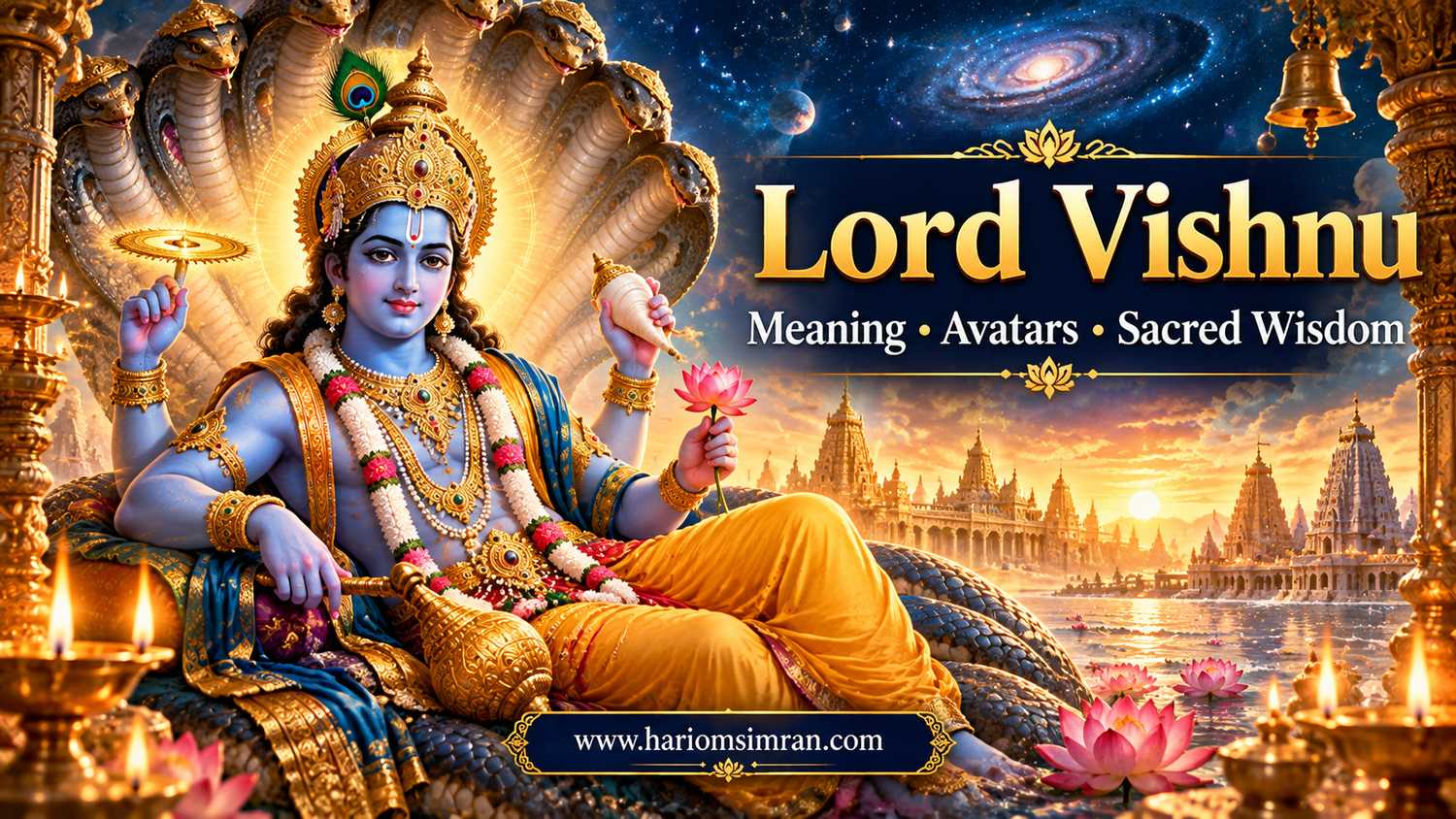
Who Is Lord Vishnu?
Lord Vishnu is one of the most revered deities in Hinduism and is especially central to Vaishnava traditions. He is widely associated with the preservation and protection of cosmic order, Dharma and life.
Within many Hindu traditions, Vishnu is understood as the Divine who protects creation whenever balance is disturbed and Dharma declines.
One of the best-known ideas connected with Vishnu is that he manifests through avatars—divine descents or forms that appear for particular purposes.
Among the most widely worshipped avatars of Vishnu are Shri Rama and Shri Krishna.
Lord Vishnu is therefore not only an important deity in Hindu worship; he is also connected with some of Hinduism's most influential scriptures, stories, festivals, temples and philosophical traditions.
To understand the wider religious tradition in which Vishnu is worshipped, explore Hinduism.
What Does the Name Vishnu Mean?
The Sanskrit name Vishnu is traditionally associated with the idea of pervading, extending or being present everywhere.
This reflects an important theological understanding of Vishnu as a Divine presence that sustains and supports existence.
Different Hindu philosophical traditions explain Vishnu's nature in different ways.
Within many Vaishnava traditions, Vishnu is worshipped as the Supreme Divine Reality.
Other Hindu traditions may understand Vishnu as one of the great manifestations of the Divine within a broader theological framework.
This diversity is important because Hinduism does not have only one theological interpretation shared identically by every tradition.
Lord Vishnu and the Preservation of Dharma
Vishnu is commonly described as the Preserver or Protector.
This does not simply mean protecting the physical universe.
His role is closely connected with maintaining Dharma, harmony and cosmic order.
When injustice, disorder or Adharma become powerful, Hindu traditions describe Vishnu as manifesting in different forms to restore balance.
This idea is expressed especially strongly through the tradition of Vishnu's avatars.
To understand this concept more deeply, read about Dharma.
Lord Vishnu in the Trimurti
A widely known Hindu theological concept is the Trimurti, commonly associated with:
Brahma — creation
Vishnu — preservation
Shiva — transformation
This is a useful introductory framework, but Hindu theology is more diverse than this simple three-part model.
Different traditions understand Brahma, Vishnu and Shiva differently, and not every Hindu philosophical school gives the Trimurti the same theological importance.
Within Vaishnavism, Vishnu is generally understood in a much more central and supreme role than the basic “Preserver” description alone suggests.
What Is Vaishnavism?
Vaishnavism is one of the major devotional traditions within Hinduism.
Vaishnavas worship Vishnu or forms associated with Vishnu as the Supreme Divine.
Important forms and avatars include:
Vishnu, Narayana, Rama, Krishna, Narasimha, Vamana and others.
Vaishnava traditions developed rich systems of philosophy, Bhakti, temple worship, sacred literature, Mantras and Guru lineages.
Different Vaishnava schools may also understand the relationship between Vishnu, Krishna and other divine forms differently.
HariOmSimran will explore these traditions individually rather than presenting every Vaishnava community as identical.
What Does Lord Vishnu Look Like?
Lord Vishnu is traditionally depicted with a calm and majestic appearance.
He is commonly shown with four arms carrying important sacred symbols.
These usually include:
Shankha — the conch
Sudarshana Chakra — the sacred discus
Gada — the mace
Padma — the lotus
Each symbol carries layers of traditional and spiritual meaning.
Vishnu is often shown wearing royal ornaments and a crown, representing Divine sovereignty.
His complexion is frequently depicted as blue, a color often associated symbolically with vastness, infinity and the all-pervading nature of the Divine.
The Shankha — Sacred Conch
The Shankha, or conch shell, is one of Lord Vishnu's most recognizable symbols.
The sound of the conch has long been associated with sacred beginnings, worship and spiritual awakening.
In Hindu ritual traditions, the conch may be sounded during Puja and temple ceremonies.
For Vishnu, it represents Divine authority and sacred sound.
Sudarshana Chakra
The Sudarshana Chakra is the sacred discus associated with Lord Vishnu.
Its name is often understood in relation to clear or auspicious vision.
In sacred narratives, the Chakra appears as a powerful Divine weapon used to protect Dharma.
Symbolically, it may also represent Divine order, protection, spiritual clarity and the power that overcomes Adharma.
Kaumodaki Gada
Lord Vishnu's mace is traditionally known as Kaumodaki.
It represents Divine power and strength.
Within symbolic interpretations, the Gada may also be connected with the strength required to overcome ignorance and disorder.
The Lotus
The Padma, or lotus, is another important symbol held by Vishnu.
The lotus is widely used in Hindu spiritual symbolism.
It can represent purity, spiritual awakening and the ability to remain inwardly pure even while living in the world.
The lotus is also closely connected with several other Hindu deities, including Goddess Lakshmi.
Goddess Lakshmi and Lord Vishnu
Goddess Lakshmi is traditionally regarded as the Divine consort of Lord Vishnu.
Lakshmi is associated with prosperity, abundance, good fortune, grace and spiritual well-being.
In Vaishnava traditions, Vishnu and Lakshmi are often understood together in a deeply theological and devotional relationship.
Their connection represents not simply material prosperity but also Divine grace, protection and harmony.
As HariOmSimran's Deities library grows, Lord Vishnu and Goddess Lakshmi will be strongly connected through internal learning paths.
Vishnu and Shesha
Lord Vishnu is frequently depicted resting upon the cosmic serpent Shesha, also called Ananta.
Ananta means “endless” or “infinite.”
This imagery carries profound cosmic symbolism.
Vishnu resting upon the endless serpent in the cosmic ocean is often understood as representing the Divine foundation upon which creation rests.
From this cosmic imagery emerge important Hindu traditions concerning creation, preservation and the cycles of existence.
What Are the Avatars of Vishnu?
One of the most important ideas associated with Lord Vishnu is Avatar.
An avatar is commonly understood as a Divine descent or manifestation.
Vishnu is traditionally believed to manifest in different forms when Dharma requires protection or restoration.
A well-known grouping is the Dashavatara, meaning the ten avatars of Vishnu.
Commonly listed avatars include:
- Matsya
- Kurma
- Varaha
- Narasimha
- Vamana
- Parashurama
- Rama
- Krishna
- Buddha or Balarama in different traditions
- Kalki
It is important to note that Dashavatara lists are not identical in every Hindu tradition.
Some traditions include Buddha, while others include Balarama or use different arrangements.
HariOmSimran will explain these variations rather than presenting one list as the only Hindu tradition.
Matsya Avatar
Matsya, the fish avatar, is associated with traditions involving protection during a great flood and the preservation of sacred knowledge.
The story emphasizes Divine protection and the preservation of life and wisdom.
Kurma Avatar
Kurma, the tortoise avatar, is closely associated with the famous story of Samudra Manthan, the churning of the cosmic ocean.
Vishnu takes the form of a great tortoise to support Mount Mandara during the churning.
This story also connects with Goddess Lakshmi and many other important Hindu traditions.
Varaha Avatar
Varaha, the boar avatar, is traditionally described as rescuing the Earth from cosmic danger.
The Earth is personified as Bhumi Devi.
The story symbolizes Divine protection and the restoration of cosmic balance.
Narasimha Avatar
Narasimha appears in a form that is part human and part lion.
His story is closely connected with the devotee Prahlada and the powerful ruler Hiranyakashipu.
Narasimha's appearance represents the protection of devotion and the defeat of destructive pride and tyranny.
Vamana Avatar
Vamana appears as a dwarf Brahmin in the famous story of King Bali.
The narrative explores themes of humility, generosity, Divine sovereignty and Dharma.
King Bali himself remains an important and respected figure in several Hindu traditions.
Parashurama
Parashurama is traditionally described as a warrior sage and avatar of Vishnu.
His stories are connected with Dharma, power, responsibility and the consequences of misuse of authority.
Shri Rama
Shri Rama is one of the most beloved avatars of Vishnu.
His life is central to the Ramayana.
Rama is deeply associated with Dharma, righteous leadership, duty, courage and devotion.
You can explore the story of Lord Rama on HariOmSimran.
Shri Krishna
Shri Krishna is another of the most widely worshipped divine forms associated with Vishnu.
His life and teachings occupy an enormous place in Hindu Bhakti, philosophy and sacred literature.
One of the most important teachings associated with Krishna appears in the Bhagavad Gita.
There, Krishna teaches Arjuna about Dharma, Karma, Yoga, Bhakti, knowledge and spiritual liberation.
Kalki
Kalki is traditionally described as a future avatar associated with the restoration of Dharma.
Unlike Rama or Krishna, Kalki belongs primarily to an expected future sacred narrative rather than a past historical or epic setting.
Descriptions of Kalki appear within Puranic traditions.
Lord Vishnu in Hindu Scriptures
Lord Vishnu appears across many layers of Hindu sacred literature.
Vishnu is present in the Vedic tradition and becomes increasingly central within later Vaishnava theology and devotional literature.
Important texts associated with Vishnu traditions include:
Vedas
Upanishads
Mahabharata
Bhagavad Gita
Vishnu Purana
Bhagavata Purana
Ramayana, through Shri Rama
Other Vaishnava scriptures and Agamic traditions also play important roles.
Explore the wider Hindu Scriptures library to understand how these texts fit into Hindu tradition.
Lord Vishnu and the Bhagavad Gita
The Bhagavad Gita is especially important for understanding Vaishnava philosophy and the teachings associated with Shri Krishna.
In the Gita, Krishna explains paths involving:
Karma Yoga
Bhakti Yoga
Jnana
Meditation
Dharma
Surrender to the Divine
Different Vedantic traditions have interpreted the Gita in different ways.
This makes it one of Hinduism's richest sources for philosophical discussion.
Important Names of Lord Vishnu
Lord Vishnu is worshipped through many sacred names.
Some widely known names include:
Narayana
Hari
Govinda
Vasudeva
Madhava
Keshava
Padmanabha
Janardana
Trivikrama
Achyuta
Each name may reflect a particular quality, sacred story, theological meaning or devotional tradition.
The Vishnu Sahasranama, the thousand names of Vishnu, is one of the most important devotional texts associated with these sacred names.
Mantras Associated With Lord Vishnu
Several important Mantras are associated with Vishnu and Vaishnava devotion.
Among the best known are:
Om Namo Narayanaya
and
Om Namo Bhagavate Vasudevaya
These Mantras have deep devotional importance within different Vaishnava traditions.
When HariOmSimran's Mantra library expands, dedicated guides will explain their Sanskrit form, pronunciation, traditional context and meaning.
How Is Lord Vishnu Worshipped?
Vishnu worship varies between regions and Vaishnava traditions.
Common devotional practices may include:
Puja, Mantra Japa, Bhajan, Kirtan, temple Darshan, scripture reading, offering flowers, lighting a diya and observing sacred festivals.
Some devotees worship Vishnu directly as Narayana or Vishnu.
Others primarily worship Rama, Krishna, Venkateswara, Jagannath or another form associated with Vishnu.
This variety reflects the richness of Vaishnava Bhakti.
Major Festivals Connected With Vishnu
Many important Hindu festivals are associated with Vishnu or his avatars.
These include celebrations connected with:
Rama Navami
Janmashtami
Narasimha Jayanti
Vamana Jayanti
Vaikuntha Ekadashi
Gita Jayanti
Diwali, through important traditions associated with Shri Rama and Goddess Lakshmi
Festival traditions can vary considerably by region.
HariOmSimran's Hindu Calendar is designed to help readers explore Hindu observances and sacred dates.
Important Vishnu Temples
Lord Vishnu and his forms are worshipped in many famous temples.
Important Vaishnava sacred places include traditions associated with:
Tirumala Venkateswara
Badrinath
Jagannath Puri
Dwarka
Srirangam
Guruvayur
Udupi
Vrindavan
Ayodhya
As the HariOmSimran Temple library grows, these sacred places will receive dedicated educational guides.
What Does Lord Vishnu Teach Spiritually?
The spiritual meaning of Vishnu goes far beyond a single image or story.
Vishnu represents the protection of Dharma, harmony and spiritual order.
His avatar traditions repeatedly communicate themes such as:
Protecting Dharma
Standing against injustice
Responding to sincere devotion
Acting with responsibility
Restoring balance
Serving the greater good
Through Rama, Krishna, Narasimha and other forms, these teachings appear in different ways.
Is Vishnu the Supreme God in Hinduism?
There is no single theological answer shared by all Hindu traditions.
Within Vaishnavism, Vishnu or a form associated with Vishnu is generally worshipped as the Supreme Divine.
Within Shaiva traditions, Shiva may occupy the supreme position.
Within Shakta traditions, Devi or Shakti may be understood as Supreme.
Other Hindu philosophical traditions understand the relationship among divine forms differently.
HariOmSimran respects this diversity and does not present the theology of one Hindu tradition as though every Hindu school teaches exactly the same thing.
Why Is Lord Vishnu Important Today?
For devotees, Vishnu continues to represent protection, stability, Dharma and Divine grace.
The stories of his avatars remain relevant because they raise timeless questions:
How should we respond to injustice?
How should power be used?
What does Dharma require?
Why does devotion matter?
How can spiritual knowledge guide everyday action?
These questions are as meaningful today as they were to earlier generations.
Learn About Lord Vishnu With HariOmSimran
HariOmSimran aims to help readers understand Lord Vishnu through interconnected knowledge rather than isolated information.
You can explore the Bhagavad Gita, discover Hindu Scriptures, learn about Dharma, or read the story of Lord Rama.
As the platform grows, this page will also connect with Vishnu Mantras, Vishnu Purana, Bhagavata Purana, Vishnu temples, avatars and Vaishnava festivals.
Key Takeaway
Lord Vishnu is one of the central divine figures of Hinduism and the primary focus of Vaishnava traditions.
He is widely associated with the preservation of Dharma and cosmic order.
His sacred symbols include the Shankha, Sudarshana Chakra, Gada and Lotus.
His avatar traditions include some of Hinduism's most revered divine figures, especially Shri Rama and Shri Krishna.
Spiritual Significance
This deity holds profound spiritual importance in Hindu tradition. Below are the key aspects of worship and significance.
Worship Practices
Devotees worship this deity through various rituals and practices that deepen their spiritual connection.
- Devotion
- Spiritual Growth
- Sacred Rituals
- Divine Blessings

Worship & Rituals
Explore the various ways devotees connect with this deity through prayer, rituals, and spiritual practices.
🙏 Daily Prayers
Daily prayers and mantras dedicated to this deity help devotees maintain a strong spiritual connection.
🕯️ Festival Celebrations
Special festivals and celebrations honor this deity, bringing communities together in devotion.
📿 Sacred Offerings
Traditional offerings and rituals that express devotion and seek divine blessings.
📖 Sacred Texts
Scriptures and hymns that describe the glory and teachings associated with this deity.
Frequently Asked Questions
Lord Vishnu is one of the most revered deities in Hinduism and the central Divine figure of many Vaishnava traditions. He is widely associated with preserving Dharma and protecting cosmic order.
Lord Vishnu commonly represents preservation, protection, Dharma, stability and the restoration of spiritual and cosmic balance.
A common Dashavatara list includes Matsya, Kurma, Varaha, Narasimha, Vamana, Parashurama, Rama, Krishna, Buddha or Balarama depending on tradition, and Kalki.
Goddess Lakshmi is traditionally regarded as the Divine consort of Lord Vishnu. She is associated with prosperity, grace, abundance and well-being.
Lord Vishnu is traditionally depicted holding the Shankha or conch, Sudarshana Chakra or discus, Gada or mace, and Padma or lotus.
Yes. Shri Rama and Shri Krishna are widely worshipped as major avatars of Lord Vishnu within many Hindu traditions.
Vaishnavism is one of Hinduism's major devotional traditions. It centers worship on Vishnu or divine forms associated with Vishnu, including Rama and Krishna.
Important texts include the Bhagavad Gita, Vishnu Purana, Bhagavata Purana, Mahabharata and other Vaishnava scriptures and traditions.
Om Namo Narayanaya is one of the best-known Mantras associated with Lord Vishnu and Narayana.
Within many Vaishnava traditions, Vishnu or a related divine form is understood as Supreme. Other Hindu traditions have different theological understandings of the Supreme Divine.