
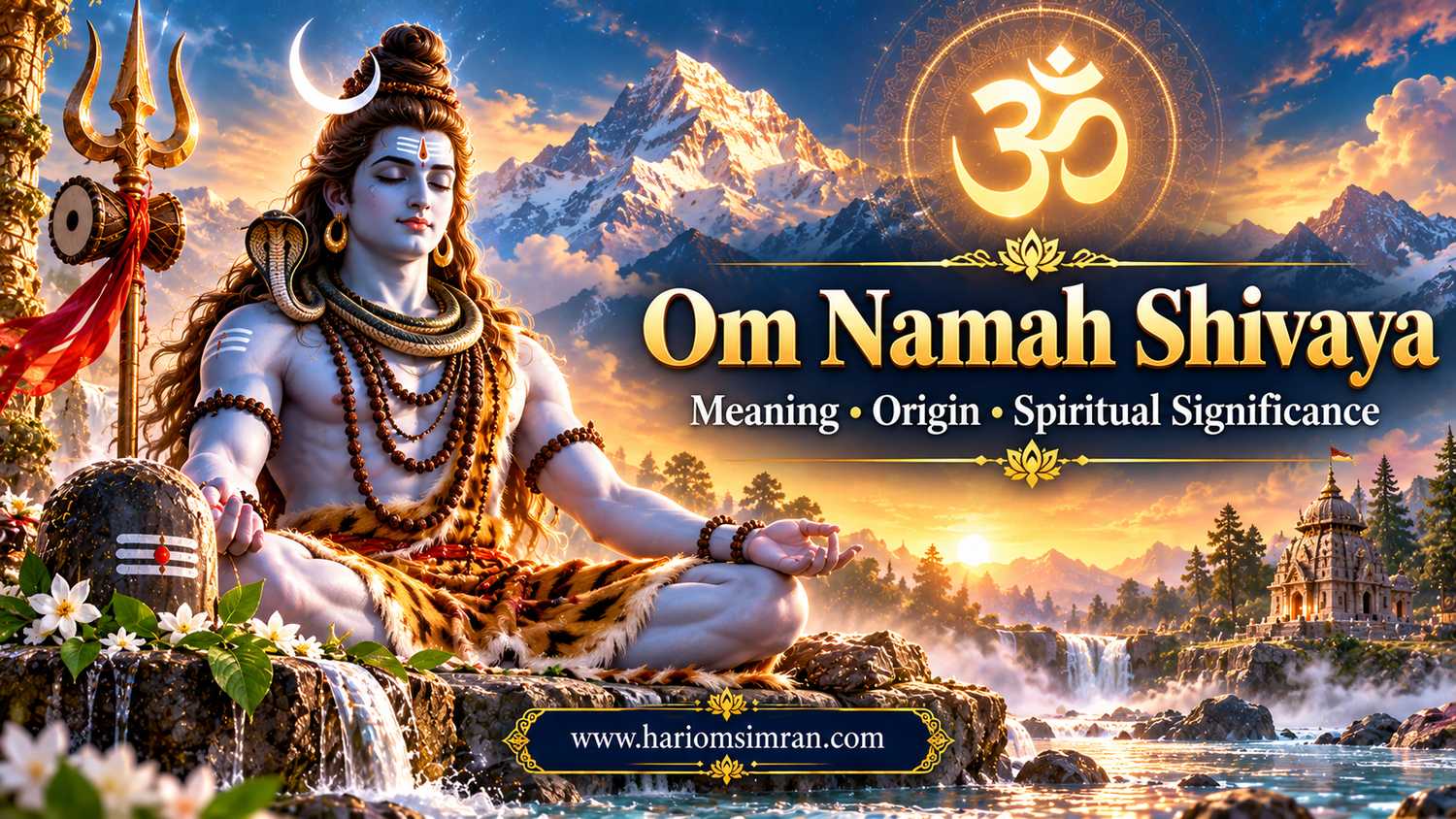
What Is Om Namah Shivaya?
Om Namah Shivaya is one of the most widely known and revered mantras associated with Lord Shiva.
It is commonly chanted in Shaiva devotional traditions as an expression of reverence, surrender, remembrance and spiritual focus.
The mantra is usually written as:
ॐ नमः शिवाय
Om Namah Shivaya
At its simplest, the mantra can be understood as:
“I bow to Shiva.”
But its spiritual meaning is much deeper than a literal translation.
For many devotees, chanting Om Namah Shivaya is a way of turning attention inward, remembering the Divine and cultivating humility, devotion and awareness.
HariOmSimran explores such mantras in the wider context of Hinduism and Hindu spiritual practice.
What Does Om Namah Shivaya Mean?
The mantra can be understood word by word.
Om
Om is one of the most sacred sounds in Hindu tradition.
It is associated with ultimate reality, consciousness and the sacred vibration of existence in many Hindu philosophical traditions.
Om appears in several important Hindu scriptures and is deeply connected with meditation, prayer and spiritual practice.
Namah
Namah means bowing, salutation or reverence.
It expresses humility and surrender.
Rather than approaching the Divine through ego, the devotee offers respect and acknowledges something greater than the individual self.
Shivaya
Shivaya means “to Shiva” or “unto Shiva.”
The name Shiva is commonly associated with auspiciousness, benevolence and the Divine principle of transformation.
So the mantra can be translated simply as:
“Om, I bow to Shiva.”
Or more devotionally:
“I offer my reverence to Lord Shiva.”
How Do You Pronounce Om Namah Shivaya?
A simple pronunciation guide is:
Om Na-mah Shi-vaa-ya
The Sanskrit form is:
ॐ नमः शिवाय
Transliteration:
Oṁ Namaḥ Śivāya
The “ḥ” in Namaḥ represents a soft breath-like sound in Sanskrit pronunciation.
In everyday devotional chanting, pronunciation can vary slightly depending on region, language and tradition.
The most important thing is to chant respectfully and with awareness rather than becoming overly anxious about accent.
Is Om Namah Shivaya a Vedic Mantra?
The core expression “Namah Shivaya” is closely connected with the Sri Rudram, an important hymn associated with the Krishna Yajurveda.
The famous phrase:
Namaḥ Śivāya
appears within this Vedic Rudra tradition.
The commonly chanted form Om Namah Shivaya places the sacred syllable Om before the phrase and became deeply established in Shaiva devotional and mantra traditions.
This makes the mantra especially important because it connects later Shiva devotion with ancient Vedic sacred tradition.
Readers interested in the wider structure of Hindu sacred literature can explore the Hindu Scriptures section.
Why Is Om Namah Shivaya Called Panchakshara?
The core mantra Namah Shivaya is traditionally known as the Panchakshara Mantra.
“Pancha” means five, and “Akshara” means syllable or sacred sound-unit.
The five sacred syllables are commonly understood as:
Na – Ma – Shi – Va – Ya
When Om is added before Namah Shivaya, the mantra is often described in traditional contexts as a six-syllabled form.
This distinction is useful because people often use the names Panchakshara Mantra and Om Namah Shivaya interchangeably in everyday devotional practice.
Who Is Lord Shiva?
Lord Shiva is one of the most important Divine figures in Hinduism and the central deity of Shaiva traditions.
Shiva is associated with:
Transformation
Meditation
Detachment
Inner stillness
Compassion
Destruction of ignorance
Renewal
Shiva is often depicted as a great Yogi in deep meditation.
He is also associated with Mount Kailash, the sacred river Ganga, the crescent moon, Trishul, Damru and the third eye.
Within Shaivism, Shiva may be understood as the Supreme Divine Reality.
Other Hindu traditions understand Shiva within different theological frameworks.
HariOmSimran will explore Lord Shiva in a dedicated Deities article as the platform expands.
What Is the Spiritual Meaning of Om Namah Shivaya?
The mantra can be understood as much more than a name repeated during worship.
At its heart, it represents humility before the Divine.
When a devotee chants “Namah,” the act symbolically places ego aside.
“Shivaya” turns attention toward Shiva — the auspicious and transformative Divine presence.
For many practitioners, the mantra therefore becomes a reminder to move away from:
Ego
Anger
Attachment
Fear
Restlessness
and toward:
Awareness
Humility
Devotion
Inner discipline
Spiritual reflection
These are devotional and philosophical interpretations rather than guaranteed outcomes from chanting.
Om Namah Shivaya and the Five Elements
In some Shaiva traditions, the five syllables of Na-Ma-Shi-Va-Ya are symbolically associated with the five great elements, or Pancha Mahabhutas.
These are commonly described as:
Na — Earth
Ma — Water
Shi — Fire
Va — Air
Ya — Space
This symbolism presents Shiva as connected with the fundamental elements of creation.
Interpretations can vary between traditions, so this association should be understood as part of Shaiva spiritual symbolism rather than as the only explanation of the mantra.
Om Namah Shivaya and Inner Transformation
Shiva is often associated with transformation.
In Hindu spiritual symbolism, destruction does not necessarily mean something negative.
It can also represent the removal of:
Ignorance
Ego
Attachment
Old patterns
so that spiritual understanding can grow.
This is one reason Om Namah Shivaya is often connected with inner transformation.
The mantra invites the practitioner to remember Shiva while reflecting on what needs to be released, purified or transformed within oneself.
How Is Om Namah Shivaya Traditionally Chanted?
There is no single universal method followed by every Shaiva tradition.
The mantra may be chanted:
Aloud
Softly
Mentally
During Puja
During meditation
During Japa
In temples
During Shiva festivals
Some devotees use a Mala while repeating the mantra.
Others simply chant it during prayer or while sitting quietly.
Traditional practice varies depending on family tradition, Guru lineage and personal devotional practice.
How Many Times Should Om Namah Shivaya Be Chanted?
A common devotional practice is to repeat a mantra 108 times using a Japa Mala.
However, there is no requirement that every person must always chant Om Namah Shivaya exactly 108 times.
A person may chant it:
Once
A few times
11 times
21 times
108 times
or according to their own devotional tradition.
The spiritual purpose is not simply to complete a number.
Attention, sincerity and devotion are more meaningful than mechanical repetition.
Can Om Namah Shivaya Be Chanted Daily?
Yes. In many Hindu devotional traditions, Om Namah Shivaya is commonly chanted as part of daily prayer or meditation.
It may be recited in the morning, evening or whenever a devotee wishes to remember Lord Shiva.
Unlike certain specialized mantras that may belong to specific initiated traditions, Om Namah Shivaya is widely used in public Shaiva devotion.
Still, people following a particular Guru or Sampradaya may choose to follow the instructions of their own tradition.
Is a Guru Required to Chant Om Namah Shivaya?
Om Namah Shivaya is widely chanted by devotees and is not generally treated as a mantra that ordinary worshippers are forbidden to recite without initiation.
However, Hindu mantra traditions are diverse.
Some Shaiva lineages may teach particular methods, deeper interpretations or formal forms of mantra initiation through a Guru.
HariOmSimran therefore distinguishes between:
General devotional chanting
and
formal initiated mantra practice within a specific tradition
Both can exist within Hinduism.
Om Namah Shivaya in Meditation
The mantra is also commonly used as a focus during meditation.
A practitioner may sit quietly and repeat:
Om Namah Shivaya
while bringing attention back to the mantra whenever the mind wanders.
This can provide a simple point of spiritual focus.
In devotional practice, the purpose is not merely relaxation.
The mantra is connected with remembrance of Shiva and the cultivation of inward spiritual awareness.
Om Namah Shivaya During Puja
During Shiva Puja, devotees may repeat Om Namah Shivaya while making offerings.
Depending on tradition, offerings may include:
Water
Flowers
Bilva leaves
Incense
Diya
The mantra may also be chanted during Abhisheka of a Shiva Linga.
Specific Puja practices vary by region and tradition, so no single method should be presented as universally required.
Why Are Bilva Leaves Offered to Shiva?
Bilva leaves hold special devotional significance in Shiva worship.
They are frequently offered to the Shiva Linga during Puja.
The three-part shape of the leaf is interpreted symbolically in different ways across Shaiva traditions.
When Om Namah Shivaya is chanted during such offerings, the mantra becomes part of an act of Bhakti rather than simply spoken words.
Om Namah Shivaya and Maha Shivaratri
Maha Shivaratri is one of the most important Hindu observances associated with Lord Shiva.
On this sacred occasion, devotees may:
Fast
Visit Shiva temples
Perform Abhisheka
Offer Bilva leaves
Remain awake in prayer
Chant Shiva mantras
Om Namah Shivaya is among the best-known mantras recited during Shiva devotion.
Festival traditions vary by region, community and temple.
Important observances can also be explored through the Hindu Calendar.
Om Namah Shivaya and Shiva Linga
The Shiva Linga is one of the most important sacred forms associated with Shiva worship.
Within Shaiva traditions, it represents Shiva in a profound symbolic and sacred form.
Om Namah Shivaya may be chanted before a Shiva Linga during:
Puja
Abhisheka
Meditation
Temple Darshan
Rather than treating the Linga merely as an object, Hindu tradition understands it through layers of theological and spiritual symbolism.
Does Om Namah Shivaya Have Health Benefits?
It is important to separate spiritual tradition from medical claims.
Mantra chanting may be experienced by some people as calming or meditative, but Om Namah Shivaya should not be presented as a medical treatment or as a guaranteed cure for illness.
HariOmSimran does not claim that chanting a mantra will cure disease, guarantee success or produce a particular material result.
Instead, this mantra should be understood in its authentic religious context:
Devotion to Shiva, spiritual remembrance, meditation and inner reflection.
Does Om Namah Shivaya Bring Wealth or Success?
Hindu devotional practice should not be reduced to guaranteed material promises.
Om Namah Shivaya is traditionally associated with Shiva devotion and spiritual practice, not with a guaranteed formula for money, career success or instant results.
Some devotees may pray for help in life's difficulties, but the deeper purpose of mantra practice is spiritual rather than transactional.
This distinction helps preserve the dignity and authenticity of Hindu spiritual teachings.
What Is the Difference Between Om Namah Shivaya and Mahamrityunjaya Mantra?
Both are important Shiva mantras, but they are different.
Om Namah Shivaya is a concise mantra of reverence and devotion to Shiva.
The Mahamrityunjaya Mantra is a longer Vedic mantra associated with Tryambaka, a form or epithet of Rudra-Shiva, and has its own textual and ritual context.
HariOmSimran will create a separate detailed guide for the Mahamrityunjaya Mantra.
The two should not be treated as interchangeable simply because both are associated with Shiva.
Om Namah Shivaya and Bhakti
At its heart, this mantra can be a simple expression of Bhakti.
A devotee does not necessarily need complex philosophical knowledge to say:
Om Namah Shivaya
with reverence.
The mantra brings the attention back to Shiva.
That simplicity is one reason it has remained so powerful in Hindu devotional culture.
Respecting Different Shaiva Traditions
Shaivism contains many different traditions.
These include distinct philosophies, temple traditions, Agamas, Guru lineages and devotional practices.
The exact interpretation of Om Namah Shivaya may therefore differ.
Some traditions emphasize its relationship with the five elements.
Some emphasize Shiva as the Supreme Self.
Others approach the mantra primarily through Bhakti and surrender.
HariOmSimran aims to preserve these differences rather than force every Shaiva tradition into one explanation.
Learn About Shiva Mantras With HariOmSimran
HariOmSimran is building a structured Mantra library where each sacred mantra can be studied in its proper context.
Rather than simply publishing a mantra and promising results, our aim is to explain:
Its original form
Pronunciation
Meaning
Traditional source
Associated deity
Spiritual significance
How it is traditionally used
Its relationship with Hindu scriptures and festivals
You can explore the broader Hinduism tradition, study the Hindu Scriptures, or learn about important sacred dates through the Hindu Calendar.
As the HariOmSimran knowledge library grows, this page will connect with Lord Shiva, Maha Shivaratri, Shiva Purana, Mahamrityunjaya Mantra and important Shiva temples.
Key Takeaway
Om Namah Shivaya is one of the most important and widely recited mantras associated with Lord Shiva.
Its core meaning is:
“I bow to Shiva.”
The mantra expresses reverence, humility and devotion.
Its core phrase has roots in the Vedic Rudra tradition, while its devotional use became deeply established within Shaivism.
For practitioners, its significance lies not in guaranteed material results but in remembering Shiva, cultivating Bhakti and turning the mind toward spiritual awareness.
Om Namah Shivaya.
How to Chant This Mantra
Follow these steps to experience the full benefits of chanting this sacred mantra:
1. Find a Quiet Space
Choose a peaceful, clean place where you can sit comfortably without distractions.
2. Sit in a Comfortable Posture
Sit with your spine straight, cross-legged on the floor or on a chair with feet flat.
3. Focus on Your Breath
Take a few deep breaths to center yourself and calm your mind before beginning.
4. Chant with Devotion
Chant the mantra slowly and clearly, focusing on its meaning and vibrations.
5. Practice Daily
Consistency is key. Try to chant at the same time each day for best results.