
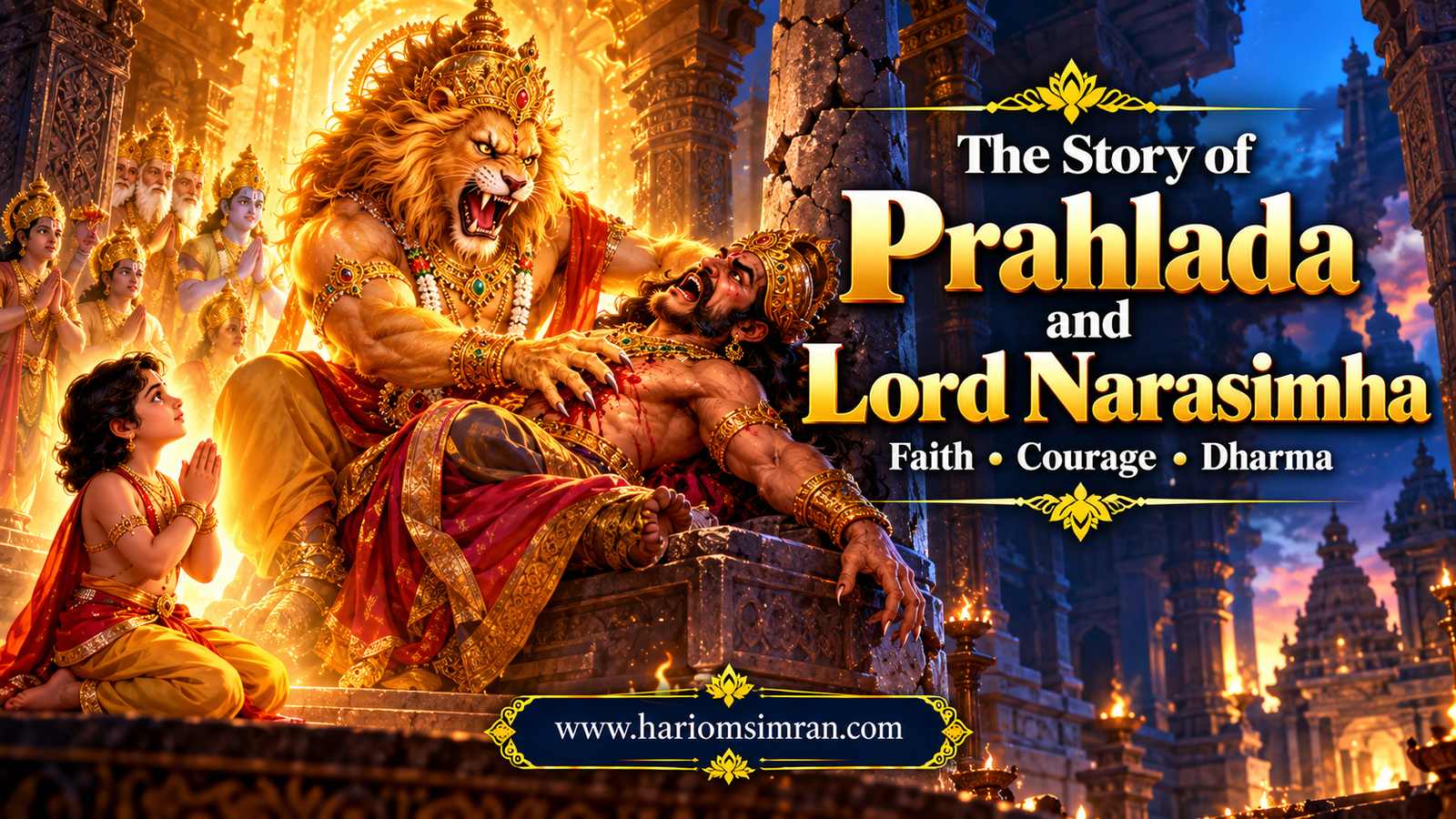
The Story of Prahlada and Lord Narasimha
The story of Prahlada and Lord Narasimha is one of Hinduism's most powerful narratives about faith, courage, Dharma and Divine protection.
At the center of the story is Prahlada, a young devotee whose unwavering devotion to Lord Vishnu remains strong even when he faces opposition from his own father, Hiranyakashipu.
The story reaches its dramatic turning point when Lord Vishnu manifests as Narasimha, a remarkable form that is neither fully human nor fully lion.
Beyond its dramatic events, the story raises timeless spiritual questions:
What happens when worldly power turns against Dharma?
Can inner faith remain strong during fear?
What is the difference between authority and righteousness?
Why is humility important even for the powerful?
The story is especially important within Vaishnava traditions and is closely associated with the teachings of Bhakti.
To understand the broader tradition surrounding this story, explore Hinduism.
Where Does the Story of Prahlada Come From?
The Prahlada and Narasimha narrative appears within Hindu sacred literature, particularly Puranic traditions.
One of its best-known presentations is found in the Bhagavata Purana, where Prahlada's devotion and the appearance of Narasimha receive significant attention.
The story is also associated with other Hindu textual traditions, including the Vishnu Purana.
Different scriptures, retellings and regional traditions may contain variations in detail.
However, the central message remains remarkably consistent:
Prahlada remains devoted to Vishnu despite persecution, and Divine power ultimately protects Dharma.
Readers can explore the wider world of sacred texts through Hindu Scriptures.
Main Characters in the Story
Prahlada
Prahlada is a young prince and devoted follower of Lord Vishnu.
Despite being born into the family of Hiranyakashipu, he develops deep devotion to Vishnu.
His character represents:
Bhakti
Faith
Courage
Humility
Steadfastness
Trust in the Divine
Prahlada does not become spiritually significant because of physical strength or political power.
His strength comes from his conviction.
Hiranyakashipu
Hiranyakashipu is Prahlada's father and a powerful ruler.
In the sacred narrative, he becomes extremely proud of his power and demands submission to his authority.
His opposition to Vishnu creates the central conflict of the story.
Hiranyakashipu represents what can happen when:
Power becomes arrogance
Authority rejects Dharma
Ego becomes stronger than wisdom
Control replaces humility
His story is therefore not merely about a powerful enemy.
It is also a warning about uncontrolled pride.
Lord Vishnu
Lord Vishnu is central to Prahlada's devotion.
In Hindu traditions, Vishnu is widely associated with the preservation of Dharma and cosmic order.
When Prahlada is placed in extreme danger, Vishnu eventually manifests in the extraordinary form of Narasimha.
Lord Narasimha
Narasimha means a form combining characteristics of a human and a lion.
The name is commonly understood from:
Nara — human
Simha — lion
Narasimha is traditionally regarded as an avatar of Lord Vishnu.
His appearance represents powerful Divine intervention when ordinary categories and expectations are no longer sufficient to protect Dharma.
Background of the Story
According to the sacred tradition, Hiranyakashipu belonged to a powerful Asura lineage.
His brother Hiranyaksha had been defeated by Vishnu in the form of Varaha.
This contributed to Hiranyakashipu's hostility toward Vishnu.
Hiranyakashipu then undertook intense austerities and received extraordinary protections through a boon.
Traditional versions describe the boon as giving protection against death under a series of specific conditions.
These conditions commonly include protection from being killed:
By a human or ordinary animal
During day or night
Inside or outside
On the ground or in the sky
By conventional weapons
Traditional retellings vary in the exact wording and number of conditions.
Hiranyakashipu eventually believed that these protections had made him virtually undefeatable.
His power grew.
So did his pride.
Hiranyakashipu's Growing Arrogance
With extraordinary power, Hiranyakashipu established his authority over a vast realm.
But instead of becoming more humble, the sacred narrative describes him becoming increasingly arrogant.
He demanded recognition of his own supremacy.
This created a deep conflict when his own son Prahlada refused to abandon devotion to Vishnu.
Prahlada respected his father as a parent, but he would not accept the idea that worldly power was greater than the Divine.
This distinction is central to the story.
Prahlada's resistance is not presented simply as rebellion.
It is rooted in Bhakti and Dharma.
Prahlada's Devotion to Lord Vishnu
From a young age, Prahlada displayed extraordinary devotion to Vishnu.
While his father wanted him to accept a different worldview centered on Hiranyakashipu's authority, Prahlada continued to remember and praise Vishnu.
His faith was not dependent on comfortable circumstances.
Even under pressure, Prahlada remained spiritually focused.
This makes him one of Hindu tradition's most famous examples of steadfast Bhakti.
Prahlada teaches that devotion is not meaningful only when life is easy.
Faith becomes especially significant when it is tested.
Hiranyakashipu Questions Prahlada
Hiranyakashipu became angry when he learned that Prahlada continued worshipping Vishnu.
He repeatedly questioned his son.
Why did Prahlada continue praising Vishnu?
Who had taught him this devotion?
Why would he worship someone Hiranyakashipu considered an enemy?
Prahlada remained calm.
He continued to explain that Divine reality was greater than worldly power.
For Hiranyakashipu, this answer was unacceptable.
For Prahlada, abandoning Vishnu was equally impossible.
Attempts to Harm Prahlada
As Hiranyakashipu's anger increased, sacred traditions describe several attempts to frighten or kill Prahlada.
Different retellings contain different sequences and details.
Prahlada is traditionally described as facing dangers such as:
Poison
Weapons
Wild animals
Being thrown from great heights
Fire
Other forms of persecution
Yet Prahlada survives.
The spiritual point is not simply that each dangerous event becomes a miracle story.
The deeper focus remains Prahlada's unwavering devotion despite fear and suffering.
He does not abandon Vishnu merely to protect his own comfort.
Prahlada and the Presence of Vishnu
One of the most important teachings associated with Prahlada is his belief that Vishnu is not limited to one particular place.
The Divine presence, he explains, exists everywhere.
This eventually leads to the most famous moment in the story.
Hiranyakashipu challenges Prahlada's claim.
If Vishnu is everywhere, is Vishnu also present in a pillar?
Prahlada's answer remains rooted in faith.
Yes.
Is Vishnu in This Pillar?
In the famous climax of the story, Hiranyakashipu points toward a pillar and challenges Prahlada's belief.
If Vishnu truly exists everywhere, then Vishnu must also exist there.
Hiranyakashipu strikes the pillar.
Then something extraordinary happens.
From the pillar emerges Narasimha.
Neither an ordinary human nor an ordinary animal.
A Divine form beyond the categories Hiranyakashipu had expected.
This moment transforms the entire story.
The Appearance of Lord Narasimha
Narasimha appears with the characteristics of both man and lion.
His manifestation is traditionally understood as Vishnu's response to both:
Prahlada's devotion
and
Hiranyakashipu's misuse of power
Narasimha's form is especially significant because it avoids the ordinary categories covered by Hiranyakashipu's protections.
The Divine response comes in a form the ruler had not anticipated.
How Narasimha Overcomes Hiranyakashipu's Boon
The climax of the story is built around the conditions of Hiranyakashipu's protection.
Traditional accounts commonly explain that Narasimha defeats him:
At twilight — neither fully day nor night
At a doorway or threshold — neither fully inside nor outside
On Narasimha's lap — neither ground nor sky
As Narasimha — neither ordinary human nor ordinary animal
Using his claws — rather than a conventional weapon
The symbolism is powerful.
Hiranyakashipu had tried to create security by controlling every category.
But Divine reality could not be contained within those categories.
Exact details of the boon and their fulfillment can vary slightly across traditional retellings.
Why Did Vishnu Take the Narasimha Form?
Narasimha's unusual form is central to the meaning of the story.
Vishnu does not simply appear as an ordinary warrior.
The Divine manifestation specifically answers the limitations created by Hiranyakashipu's boon.
Spiritually, this suggests that Dharma cannot always be understood through rigid human expectations.
Narasimha represents Divine power operating beyond ordinary categories.
The form also demonstrates that arrogance based on perceived invulnerability can eventually fail.
What Happened After Hiranyakashipu Was Defeated?
Traditional accounts describe Narasimha remaining extremely powerful and fierce after defeating Hiranyakashipu.
The gods and other beings approach with reverence.
Prahlada eventually comes before Narasimha.
Unlike those who are frightened by the Divine form, Prahlada approaches with devotion.
This moment is important.
The same Narasimha who appears terrifying against Adharma becomes a source of protection and grace for the devotee.
Prahlada offers prayers and devotion.
Narasimha blesses him.
Prahlada Does Not Ask for Material Rewards
One of the most meaningful aspects of Prahlada's story is his attitude after receiving Divine grace.
His devotion is not primarily transactional.
He does not worship Vishnu simply to gain wealth, power or status.
Traditional teachings surrounding Prahlada emphasize Nishkama Bhakti — devotion that is not based purely on material reward.
This gives the story an important spiritual lesson:
True devotion is not merely a bargain with the Divine.
Prahlada's Compassion
Another powerful aspect of Prahlada's character is compassion.
Despite the suffering caused by his father, Prahlada does not become defined by hatred.
Traditional narratives emphasize his concern for spiritual welfare rather than revenge.
This makes his character more complex than simply “the good son against the evil king.”
Prahlada demonstrates that courage does not require hatred.
A person can resist Adharma without allowing Adharma to reshape their own heart.
What Does Prahlada Represent?
Prahlada represents faith that survives pressure.
His spiritual strength comes from several qualities:
Bhakti
He remains devoted to Vishnu.
Courage
He refuses to abandon his beliefs despite danger.
Humility
He does not become arrogant because of Divine protection.
Compassion
He does not base his spiritual life on revenge.
Steadfastness
His beliefs remain consistent even when circumstances become difficult.
What Does Hiranyakashipu Represent?
Hiranyakashipu can be understood symbolically as representing uncontrolled ego and attachment to power.
His problem is not simply that he possesses power.
The deeper problem is that he begins to treat power as absolute.
His story warns against believing that:
Authority equals truth
Strength equals righteousness
Control equals wisdom
Material power makes someone invulnerable
In this sense, Hiranyakashipu's greatest weakness is not physical.
It is spiritual arrogance.
What Does Narasimha Represent?
Narasimha represents several interconnected ideas.
Protection of Dharma
Narasimha appears when ordinary power has become oppressive and Dharma requires protection.
Divine Protection
The story emphasizes the protection of Prahlada's devotion.
Limits of Ego
Hiranyakashipu believes he has escaped all vulnerability.
Narasimha reveals the limits of that belief.
Divine Reality Beyond Categories
Narasimha is neither simply human nor simply animal.
His unusual form symbolizes a Divine reality that cannot be confined to rigid expectations.
Prahlada and Bhakti
Prahlada's story is particularly important for understanding Bhakti.
Bhakti means devotion or loving relationship with the Divine.
Prahlada demonstrates a form of devotion that does not depend upon:
Comfort
Reward
Social approval
Political power
Even fear cannot completely break his spiritual commitment.
This is why Prahlada continues to be remembered as one of Hindu tradition's great devotees.
Prahlada and Dharma
The story also raises an important question about Dharma.
A child ordinarily owes respect to a parent.
But what happens when authority itself opposes righteousness?
Prahlada continues to recognize his father, but he does not accept that paternal or political authority can replace Divine truth.
The narrative therefore distinguishes:
Respect for authority
from
blind obedience to Adharma
To explore this concept more deeply, read about Dharma.
The Pillar as a Symbol
The pillar is one of the story's most memorable symbols.
To Hiranyakashipu, it appears ordinary and empty.
To Prahlada, Vishnu's presence is not limited by appearance.
When Narasimha emerges from the pillar, the story dramatically expresses the idea that Divine presence cannot always be judged by what human eyes initially perceive.
In devotional interpretation, the pillar becomes a symbol of faith in Divine presence even where nothing extraordinary seems visible.
The Threshold as a Symbol
Narasimha defeats Hiranyakashipu at a threshold.
A threshold exists between two spaces.
It is neither completely inside nor completely outside.
This fits the conditions of the sacred narrative, but it also carries powerful symbolism.
A threshold is a place of transition.
The story itself is a transition:
From arrogance to humility
From oppression to protection
From fear to Divine revelation
From Adharma toward restored Dharma
Twilight as a Symbol
The event traditionally takes place at twilight.
Twilight is neither fully day nor fully night.
Like the threshold and Narasimha's own form, it exists between categories.
The repeated use of these “in-between” conditions reinforces an important message:
Human categories cannot completely limit Divine possibility.
Does the Story Teach That Faith Prevents All Suffering?
Not exactly.
Prahlada experiences fear, hostility and repeated danger.
The story does not suggest that a devotee will never encounter hardship.
Instead, Prahlada represents the possibility of maintaining spiritual conviction through hardship.
This distinction is important.
Hindu devotional stories should not be turned into promises that anyone who chants or worships will automatically avoid every difficulty.
Their deeper purpose is spiritual teaching.
Narasimha Jayanti
The appearance of Lord Narasimha is commemorated in the Hindu festival of Narasimha Jayanti.
The observance is connected with Vishnu devotion and remembrance of the Narasimha story.
Practices vary between communities and temples.
As HariOmSimran's Festival library expands, Narasimha Jayanti can receive its own dedicated article with its traditional Tithi, worship traditions and spiritual significance.
Exact annual dates should be determined through the Hindu Calendar rather than permanently attaching the festival to one Gregorian date.
Different Versions of the Prahlada Story
Like many Hindu sacred narratives, the story of Prahlada has been preserved through:
Scriptures
Temple traditions
Regional storytelling
Bhajans
Drama
Oral traditions
Devotional literature
Certain details may differ between versions.
For example, the exact sequence of attempts against Prahlada or the precise wording of Hiranyakashipu's boon may vary.
These differences do not necessarily change the central message.
The core themes remain:
Bhakti
Dharma
Humility
Courage
Divine protection
The limits of arrogance
What Can We Learn From Prahlada Today?
Prahlada's story remains meaningful because its questions are timeless.
How should we behave when pressured to abandon our values?
Can we remain calm when someone more powerful disagrees with us?
Can courage exist without hatred?
Can faith survive uncertainty?
How should power be used?
When does confidence become arrogance?
The story does not require everyone to face the dramatic circumstances of Prahlada.
Its lessons can apply to ordinary life.
Spiritual Lessons From the Story
The Prahlada and Narasimha story offers several important teachings.
Faith requires steadiness.
Prahlada remains devoted even when circumstances change.
Power should remain connected to Dharma.
Hiranyakashipu's downfall is connected with power becoming arrogance.
Humility protects wisdom.
The belief that one has become completely invulnerable can itself become a weakness.
Courage does not require hatred.
Prahlada resists without becoming consumed by revenge.
The Divine cannot be confined to human expectations.
Narasimha appears beyond the categories Hiranyakashipu believed he had controlled.
Learn the Story With HariOmSimran
HariOmSimran aims to connect Hindu stories with their scriptures, deities, philosophy and festivals.
The story of Prahlada and Narasimha naturally connects with:
Lord Vishnu
Lord Narasimha
Bhagavata Purana
Vishnu Purana
Bhakti
Dharma
Narasimha Jayanti
Vaishnavism
Readers can currently explore Hinduism, study Hindu Scriptures, learn about Dharma, and use the Hindu Calendar for Hindu observances.
As new pages are published, this story can be connected directly with Lord Narasimha, Prahlada, Bhakti, Narasimha Jayanti and the Bhagavata Purana.
Key Takeaway
The story of Prahlada and Lord Narasimha is a powerful Hindu teaching about Bhakti, courage, Dharma and the limits of arrogance.
Prahlada remains devoted to Lord Vishnu despite intense pressure.
Hiranyakashipu represents power that has become dominated by ego.
Narasimha represents Divine protection and the restoration of Dharma in a form beyond ordinary expectations.
The story ultimately teaches that:
Power is not greater than Dharma.
Faith can remain strong during difficulty.
Courage does not require hatred.
Arrogance can never make someone truly invulnerable.
Divine reality cannot be confined by human categories.
Key Characters
The characters in this story play significant roles in conveying its spiritual message:
Main Protagonist
The central character who embarks on a journey of discovery and learning.
Supporting Characters
Other characters who guide, challenge, and support the protagonist's journey.
Story Timeline
🌅 Beginning
The story begins with the introduction of the characters and setting.
⚡ Conflict
The main conflict or challenge that the characters must face.
🌟 Resolution
How the characters overcome the challenge and what they learn.