Dharma Meaning in Hinduism
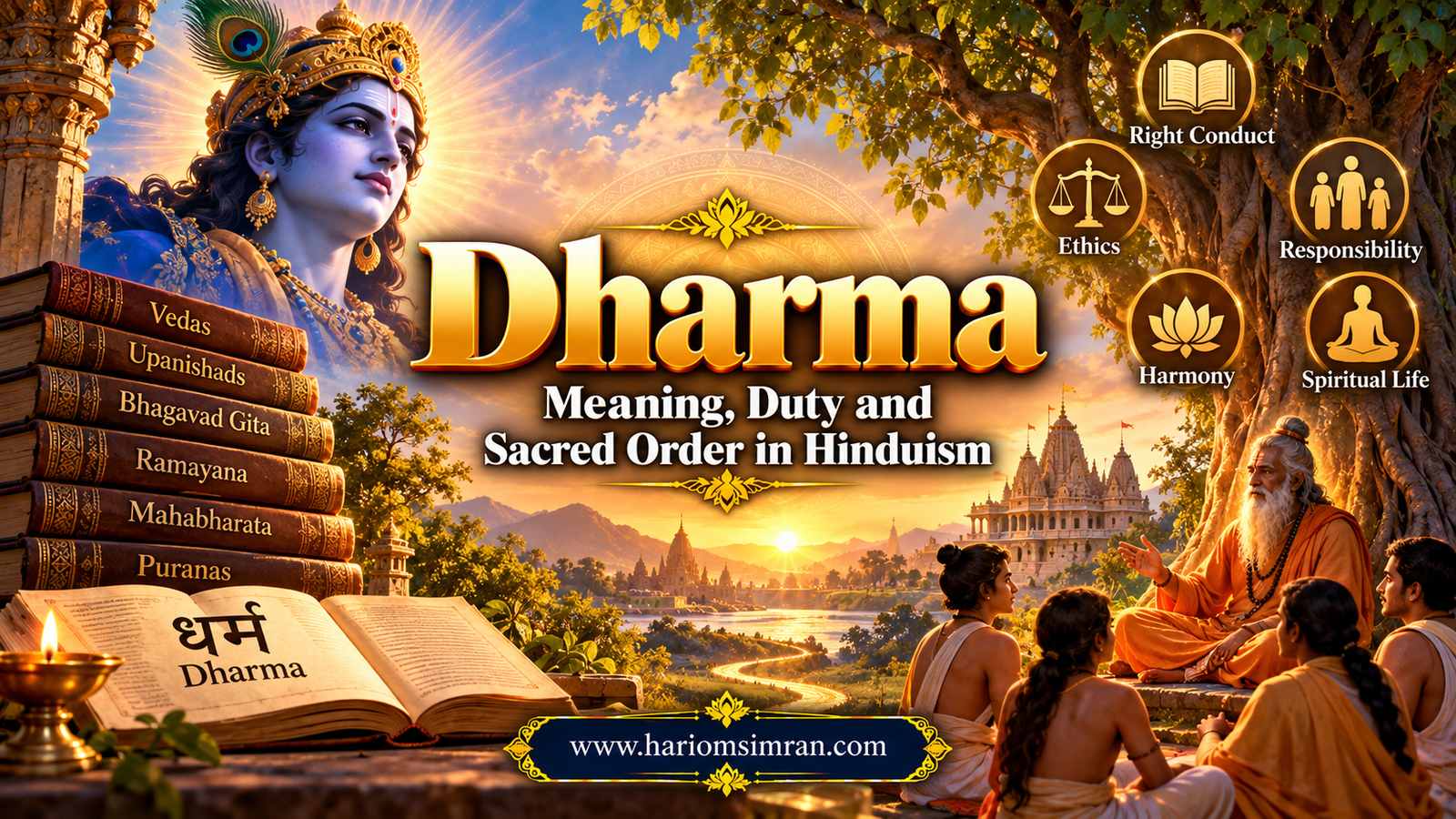
Dharma is one of the most important and wide-ranging concepts in Hinduism.
There is no single English word that fully captures its meaning.
Depending on context, Dharma can refer to:
Right conduct
Duty
Ethical responsibility
Moral order
Sacred law
Righteous living
The principles that sustain harmony
At a deeper level, Dharma concerns how a person, community and society can live in a way that supports truth, responsibility, harmony and spiritual order.
It is therefore much broader than simply “religion” or “duty.”
To understand Dharma properly, it must be studied within the wider framework of Hinduism.
Dharma in Sanskrit
The Sanskrit word is:
धर्म
Transliteration:
Dharma
Simple pronunciation:
Dhar-ma
The word is traditionally connected with the Sanskrit root dhṛ, meaning:
To hold
To support
To sustain
This helps explain one of Dharma's deepest meanings:
That which supports or sustains order.
Dharma can therefore describe principles that help sustain:
Individual life
Family
Society
Nature
Ethical behavior
Spiritual order
What Is the Simple Meaning of Dharma?
A simple definition is:
Dharma is the principle of living and acting in the right way according to truth, responsibility and one's circumstances.
But “right way” does not always mean following one fixed rule.
Hindu scriptures often present situations where duties conflict.
A person may have responsibilities toward:
Family
Society
Profession
Truth
Compassion
Spiritual life
Sometimes these responsibilities can create difficult choices.
This is one reason Dharma is such an important subject in Hindu philosophy.
Is Dharma the Same as Religion?
Not exactly.
The English word religion describes only part of what Dharma can mean.
Dharma can include religious practice, but it can also refer to:
Ethics
Duty
Responsibility
Right conduct
Justice
Social order
Spiritual principles
The nature or proper function of something
For this reason, translating Dharma only as “religion” can oversimplify the concept.
Is Dharma the Same as Duty?
Duty is one important meaning of Dharma, but Dharma is broader.
For example, Dharma may involve fulfilling one's responsibilities honestly and responsibly.
But it can also involve:
Compassion
Truthfulness
Justice
Self-discipline
Respect for life
Spiritual practice
Maintaining harmony
So “duty” is useful as an introductory translation, but it does not explain the whole concept.
Dharma and Cosmic Order
In early Hindu and Vedic thought, ideas of cosmic and moral order are closely connected with the concept of Rta.
Rta refers to an underlying order or harmony within existence.
Over time, Dharma became one of the major concepts used to describe the ethical, social and spiritual principles that support order.
This helps explain why Dharma is not only about private morality.
It can also concern the relationship between:
Human beings
Society
Nature
Cosmic order
Divine principles
Dharma in Hindu Scriptures
Dharma appears throughout Hindu sacred literature.
Important discussions of Dharma can be found across:
Vedas
Upanishads
Ramayana
Mahabharata
Bhagavad Gita
Puranas
Dharma Shastra traditions
Different texts approach Dharma from different perspectives.
Some focus on spiritual wisdom.
Some explore moral dilemmas.
Some discuss social duties and traditional norms.
Others examine Dharma through stories and philosophical dialogue.
Explore the wider Hindu Scriptures library to understand these different textual traditions.
Dharma in the Bhagavad Gita
The Bhagavad Gita contains one of Hinduism's most influential discussions of Dharma.
The teaching takes place when Arjuna faces a profound moral crisis.
He must decide how to respond to a conflict involving:
Family
Duty
Justice
Violence
Responsibility
Spiritual values
Arjuna's confusion shows that Dharma is not always easy.
The Bhagavad Gita explores how action, duty, knowledge, devotion and detachment can relate to one another.
This makes Dharma a central concept in understanding the Gita.
What Is Svadharma?
Svadharma can be understood as one's own Dharma or appropriate responsibility.
The prefix sva means:
One's own
Svadharma therefore concerns the responsibilities that arise from one's particular situation, role, abilities and circumstances.
The concept reminds us that Dharma may not look identical for every person.
For example, the responsibilities of:
A parent
A teacher
A student
A judge
A doctor
A spiritual practitioner
may differ.
The deeper question is:
What is the responsible and righteous action appropriate to this situation?
Dharma and Personal Responsibility
Dharma places strong emphasis on responsibility.
It asks people to consider not only:
What do I want?
but also:
What should I do?
Who may be affected by my actions?
What is fair?
What supports truth and harmony?
What are my responsibilities?
This makes Dharma a practical ethical concept as well as a spiritual one.
Dharma and Karma
Dharma and Karma are closely related, but they are not the same concept.
Dharma concerns right action, responsibility and ethical order.
Karma concerns action and its consequences.
In simple terms:
Dharma asks: What is the right thing to do?
Karma reminds us: Actions have consequences.
A person's choices may therefore involve both Dharma and Karma.
Acting according to Dharma is traditionally understood as a way of bringing one's actions into greater harmony with ethical and spiritual principles.
Dharma and Adharma
The opposite of Dharma is commonly described as Adharma.
Adharma can refer to:
Unrighteousness
Injustice
Disorder
Harmful conduct
Actions against ethical or spiritual order
Many Hindu sacred stories revolve around the tension between Dharma and Adharma.
The struggle is not always simply between “good people” and “bad people.”
Often the stories explore difficult choices, mixed motives and complicated responsibilities.
Dharma in the Ramayana
The Ramayana explores Dharma through relationships, leadership, loyalty, family responsibilities and sacrifice.
Characters such as:
Shri Rama
Sita
Lakshmana
Bharata
Hanuman
face different responsibilities and difficult circumstances.
For this reason, the Ramayana is not only a sacred story.
It is also an important reflection on how Dharma operates in human life.
Dharma in the Mahabharata
The Mahabharata is especially famous for showing how difficult Dharma can become.
Characters frequently face situations where:
One duty conflicts with another.
Personal loyalty conflicts with justice.
Promises create unexpected consequences.
Rules appear correct but lead to harmful outcomes.
This complexity is one of the Mahabharata's greatest philosophical strengths.
It teaches that understanding Dharma often requires:
Wisdom
Context
Reflection
Discernment
rather than mechanical rule-following.
Dharma and Lord Krishna
Lord Krishna plays a central role in discussions of Dharma in the Mahabharata and Bhagavad Gita.
His teachings to Arjuna explore how a person can act responsibly without becoming completely controlled by attachment to results.
Krishna's teachings connect Dharma with:
Karma Yoga
Bhakti
Knowledge
Self-discipline
Spiritual awareness
Lord Krishna is therefore one of the most important figures for understanding how Dharma relates to action.
Dharma and Lord Vishnu
Lord Vishnu is widely associated with the preservation of Dharma and cosmic order.
Hindu traditions describe Vishnu manifesting in different avatars when Dharma requires protection or restoration.
This idea is especially associated with avatars such as:
Rama
Krishna
Narasimha
You can explore Lord Vishnu to understand this connection more deeply.
Dharma in the Story of Prahlada
The story of Prahlada and Lord Narasimha provides a powerful example of Dharma.
Prahlada faces a conflict between:
Respect for his father
and
Faithfulness to Divine truth.
The story distinguishes between respecting authority and blindly following Adharma.
This raises an important principle:
Authority alone does not automatically make an action righteous.
Dharma requires moral and spiritual discernment.
Dharma and the Four Purusharthas
Hindu philosophy commonly describes four broad aims of human life known as the Purusharthas:
Dharma — righteous living and responsibility
Artha — material well-being and resources
Kama — desire, enjoyment and emotional fulfillment
Moksha — spiritual liberation
Dharma plays an important balancing role.
Artha and Kama are not automatically rejected.
Instead, traditional Hindu thought often teaches that the pursuit of material well-being and legitimate desires should remain guided by Dharma.
Dharma and Artha
Artha relates to material security, resources, prosperity and practical life.
Hindu thought does not necessarily treat material success as spiritually wrong.
The important question is:
How is prosperity obtained and used?
Dharma encourages wealth and resources to be pursued through ethical and responsible means.
Material success achieved through exploitation or injustice can conflict with Dharma.
Dharma and Kama
Kama includes desire, pleasure, affection and enjoyment.
These are recognized as part of human life.
But Dharma provides an ethical framework.
The principle is not simply:
“Never desire anything.”
Instead, it asks that desires be pursued responsibly and without unnecessary harm.
Dharma and Moksha
Moksha means liberation from the cycle of Samsara.
Dharma and Moksha are related but distinct.
Dharma helps guide righteous and responsible living within the world.
Moksha concerns ultimate spiritual liberation.
Different Hindu philosophical traditions explain their relationship in different ways.
For many practitioners, living ethically and spiritually can support the wider journey toward self-knowledge and liberation.
Dharma and Ahimsa
Ahimsa, or non-harming, is an important ethical principle in Hindu traditions.
It is closely related to Dharma.
However, Hindu scriptures also show that ethical decisions can become complicated when responsibilities conflict.
For example:
How should society respond to injustice?
When is protection necessary?
How should rulers defend others?
How should harm be minimized?
This is another reason Dharma cannot always be reduced to one simple rule.
Dharma and Satya
Satya means truth or truthfulness.
Truth is an important element of Dharma.
A Dharmic life generally values:
Honesty
Integrity
Reliability
Faithfulness to truth
At the same time, Hindu stories sometimes explore situations where truth, compassion and other responsibilities appear to conflict.
These narratives encourage ethical reflection rather than superficial rule-following.
Dharma and Seva
Seva means selfless or devoted service.
Helping others can be an expression of Dharma when it is done with:
Compassion
Respect
Responsibility
Humility
Service should protect the dignity of the person receiving help.
This connects Dharma with practical action in everyday life.
Dharma and Family Life
Dharma is not limited to temples or spiritual retreats.
It can also apply to ordinary relationships.
Family Dharma may involve:
Caring for children
Respecting parents
Supporting a spouse
Fulfilling commitments
Practicing honesty
Resolving conflict responsibly
Different family circumstances naturally create different responsibilities.
Dharma therefore operates within real human relationships.
Dharma and Professional Life
Dharma can also be applied to work.
Professional Dharma may include:
Honesty
Competence
Fair treatment
Keeping commitments
Avoiding corruption
Protecting others from harm
Using authority responsibly
A person's job title alone does not define Dharma.
The ethical quality of how responsibilities are fulfilled also matters.
Dharma and Leadership
Hindu sacred literature often discusses the Dharma of rulers and leaders.
Leadership is not presented merely as privilege.
It includes responsibility.
A leader is expected to consider:
Justice
Protection
Public welfare
Fairness
Truth
Responsible use of power
Stories of both righteous and unrighteous rulers demonstrate that power without Dharma can become destructive.
Dharma Changes With Context
One of the most important things to understand about Dharma is that context matters.
The appropriate action can depend on:
Time
Place
Role
Circumstances
Consequences
Competing responsibilities
This does not mean Dharma has no principles.
Rather, it means applying principles may require wisdom.
Two situations that look similar on the surface may involve different responsibilities.
Is Dharma Always the Same for Everyone?
Not necessarily.
Some principles, such as truthfulness, compassion and avoiding unnecessary harm, are widely valued.
But specific responsibilities can differ.
A parent and a child do not have exactly the same responsibilities.
A doctor and a patient have different duties.
A judge and an ordinary witness have different roles.
This is where the idea of Svadharma becomes important.
What Is Sanatana Dharma?
Sanatana Dharma is an important term associated with Hindu tradition.
“Sanatana” can mean:
Eternal
Enduring
Timeless
Sanatana Dharma can therefore be understood in relation to timeless spiritual and ethical principles.
Today, many Hindus also use Sanatana Dharma as a traditional name for Hinduism.
However, the term carries different historical, philosophical and devotional meanings depending on context.
HariOmSimran will explore Sanatana Dharma in its own dedicated glossary article.
Dharma and Social Tradition
Historical Hindu Dharma literature also contains discussions about:
Social roles
Family duties
Law
Customs
Life stages
Community responsibilities
These texts were written within specific historical and social contexts.
Not every rule found in every historical Dharma text should automatically be treated as a universal instruction for all Hindus today.
Interpretation, historical context and different Hindu traditions matter.
This distinction is important for responsible learning.
Dharma and the Four Ashramas
Traditional Hindu thought describes four Ashramas, or stages of life:
Brahmacharya — student stage
Grihastha — household life
Vanaprastha — gradual withdrawal
Sannyasa — renunciation
Different responsibilities were traditionally associated with these stages.
This reflects the broader principle that Dharma may change as a person's circumstances and responsibilities change.
Dharma and Varna
Historical Hindu literature also discusses Varna in relation to Dharma.
This subject is complex and has been understood differently across texts, traditions, historical periods and modern communities.
Varna, Jati and modern caste realities should not automatically be treated as identical concepts.
Because the subject involves significant historical and social complexity, HariOmSimran should explain it separately and carefully rather than reducing Dharma to caste-based duties.
Dharma itself is much broader than caste.
Is Dharma a Fixed Set of Rules?
No single rulebook defines Dharma for every Hindu in every situation.
Hindu traditions contain:
Scriptures
Philosophical teachings
Stories
Commentaries
Regional customs
Guru traditions
These sources can help people reason about right action.
Dharma therefore combines enduring principles with contextual discernment.
How Can Someone Practice Dharma Today?
Practicing Dharma does not require living in ancient times.
Its principles can apply to modern daily life.
Examples include:
Being honest
Keeping commitments
Treating people fairly
Caring for family
Helping people in need
Using money responsibly
Respecting nature
Avoiding unnecessary harm
Fulfilling professional responsibilities
Reflecting before acting
Dharma becomes meaningful when spiritual principles are expressed through actual behavior.
Dharma and Difficult Decisions
One of the greatest strengths of the concept of Dharma is that it acknowledges moral complexity.
Sometimes there is no easy choice.
A person may need to balance:
Truth with compassion
Family with public responsibility
Personal benefit with fairness
Loyalty with justice
Tradition with changing circumstances
In such situations, Dharma encourages thoughtful discernment rather than impulsive action.
Common Misunderstandings About Dharma
“Dharma simply means religion.”
This is incomplete. Religion can be part of Dharma, but the concept is broader.
“Dharma means blindly obeying rules.”
Not necessarily. Hindu scriptures themselves contain debates and dilemmas about what Dharma requires.
“Dharma is exactly the same for everyone.”
Some ethical principles may be widely shared, but responsibilities often depend on context.
“Dharma is only about caste.”
No. Dharma is a much broader concept involving ethics, responsibility, spiritual order and righteous conduct.
“Doing Dharma guarantees success.”
Dharma is about right action, not guaranteed material reward.
Dharma in Everyday Life
Dharma becomes easier to understand when translated into practical questions.
Before making an important decision, a person might ask:
Is this honest?
Is it fair?
Could this unnecessarily harm someone?
Am I fulfilling my responsibility?
Am I acting only from ego or anger?
What are the consequences for others?
Does this action support harmony or create injustice?
These questions do not automatically solve every dilemma.
But they reflect a Dharmic way of thinking.
Why Is Dharma Important Today?
Modern life creates new technologies, professions and social situations that ancient texts did not describe directly.
But Dharma remains relevant because the underlying questions continue:
How should power be used?
What do we owe our families?
What responsibilities do businesses have?
How should wealth be earned?
How should people respond to injustice?
How should we treat nature?
What makes an action right?
Dharma offers a framework for thinking about these questions through responsibility, ethics and spiritual awareness.
Dharma in HariOmSimran's Knowledge Library
Dharma connects almost every major HariOmSimran module.
It connects with:
Hinduism
Bhagavad Gita
Ramayana
Mahabharata
Lord Vishnu
Lord Rama
Lord Krishna
Prahlada and Lord Narasimha
Karma
Moksha
Bhakti
Seva
Purusharthas
Readers can explore Hinduism, Hindu Scriptures, Lord Vishnu, and the wider HariOmSimran knowledge library.
As more glossary terms are added, Dharma should become one of the central internal-linking hubs of the website.
Key Takeaway
Dharma is one of the foundational concepts of Hinduism.
It cannot be translated perfectly by only one English word.
Depending on context, Dharma can mean:
Right conduct
Duty
Responsibility
Ethical order
Righteousness
The principles that sustain harmony
Dharma asks a fundamental question:
What is the right and responsible way to live and act?
Its answer may depend on circumstances, but the wider goal remains connected with truth, responsibility, justice, harmony and spiritual awareness.