
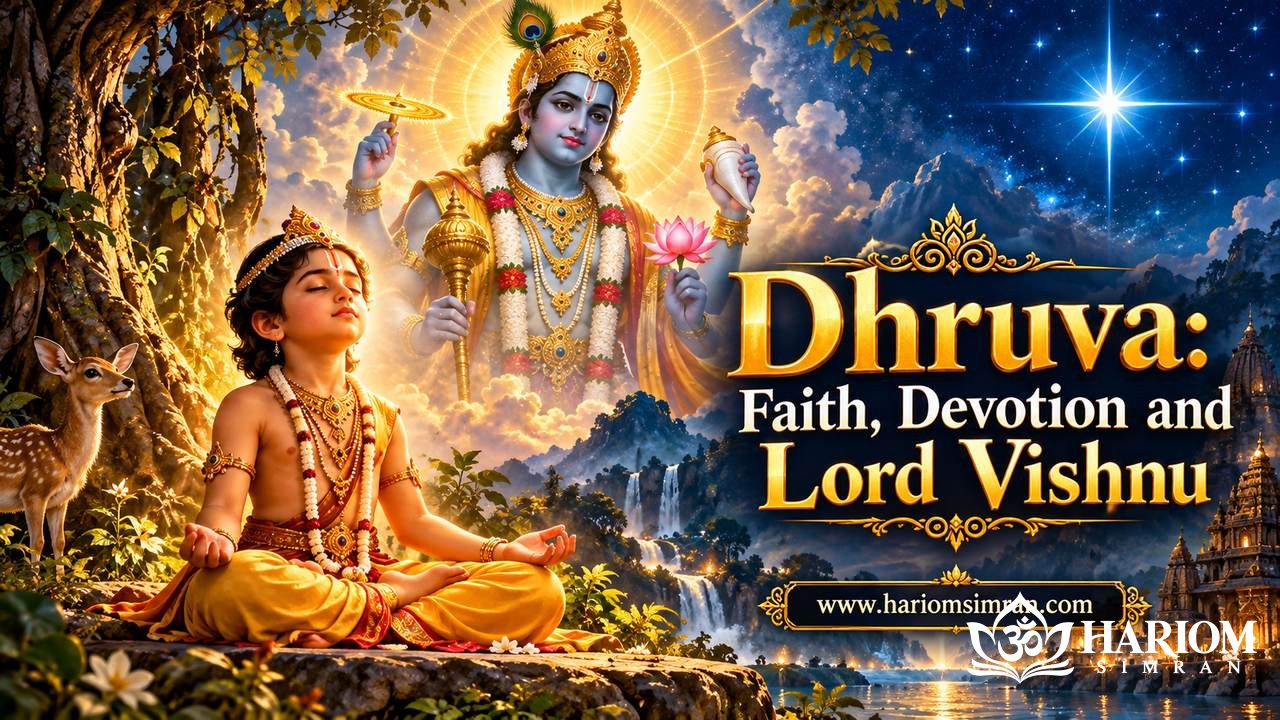
The story of Dhruva is one of Hindu tradition’s most moving stories about rejection, determination, devotion and spiritual transformation.
Dhruva begins his journey as a young child who feels deeply hurt.
He wants affection from his father.
He wants acceptance.
He wants recognition.
Instead, he experiences rejection.
That painful moment could have turned into lifelong bitterness.
But Dhruva’s story takes another direction.
With the guidance of his mother Suniti, the wisdom of Sage Narada, disciplined Tapasya and devotion to Lord Vishnu, Dhruva gradually transforms his pain into spiritual strength.
His story teaches an important lesson:
We cannot always control how others treat us, but we can choose what our pain eventually becomes.
Dhruva’s journey moves from:
- Rejection to devotion
- Anger to discipline
- Comparison to self-understanding
- Restlessness to concentration
- Desire for recognition to spiritual realization
He later becomes associated with Dhruva Tara, a powerful symbol of steadiness and unwavering devotion.
Explore more sacred narratives through Hindu Stories.
Who Was Dhruva?
Dhruva was a young prince whose sacred story is especially associated with the Bhagavata Purana tradition.
He was the son of King Uttanapada and Queen Suniti.
The king also had another queen, Suruchi, whose son was Uttama.
The royal family’s relationships created emotional tension.
Dhruva experienced unequal treatment and deeply felt that he was not receiving the affection and recognition he desired from his father.
This emotional beginning is one reason the story remains relatable.
Dhruva does not begin as an advanced spiritual seeker.
He begins as a hurt child.
To understand the sacred literature behind Hindu stories, explore Hindu Scriptures.
Dhruva’s Family
Dhruva’s story involves several important figures:
- King Uttanapada: Dhruva’s father
- Queen Suniti: Dhruva’s mother
- Queen Suruchi: Another queen of Uttanapada
- Uttama: Suruchi’s son
- Sage Narada: Dhruva’s spiritual guide
- Lord Vishnu: The Divine focus of Dhruva’s devotion
The story begins in a royal palace, but its deepest message is not about political power.
It is about the human need for love and the spiritual search for something more permanent than approval.
The Moment That Changes Dhruva’s Life
One day, young Dhruva sees his brother receiving affection from their father.
Dhruva also wants to sit on his father’s lap.
For a child, this is a natural desire.
But the moment represents much more than physical closeness.
It represents:
- Acceptance
- Love
- Belonging
- Recognition
- Emotional security
According to the sacred narrative, Queen Suruchi prevents Dhruva from receiving what he seeks.
Her words deeply hurt him.
Why Was Dhruva So Hurt?
Children naturally look to their parents for acceptance.
When Dhruva feels rejected, he does not experience it as a small political disagreement.
He experiences it personally.
Human beings of every age can understand this feeling.
We may feel rejected by:
- Family
- Friends
- Teachers
- Employers
- Society
- Someone whose approval matters to us
The story does not pretend rejection is painless.
Dhruva is deeply affected by it.
Dhruva Goes to His Mother Suniti
After the painful incident, Dhruva goes to his mother Suniti.
She understands his hurt.
But she does not encourage him to seek revenge.
She does not tell him to become more powerful than Suruchi.
Instead, she redirects his attention toward the Divine.
This becomes the first major turning point of the story.
Suniti’s Wisdom
Suniti cannot instantly change the palace.
She cannot force other people to behave differently.
But she can influence how her son responds.
Her guidance helps Dhruva move away from:
- Bitterness
- Jealousy
- Revenge
- Hopelessness
and toward:
- Faith
- Reflection
- Spiritual seeking
- Inner strength
This makes Suniti one of the most important characters in Dhruva’s story.
A Lesson for Parents
Dhruva’s story also contains a valuable parenting lesson.
Parents cannot remove every difficulty from a child’s life.
Children may experience:
- Rejection
- Failure
- Comparison
- Unfairness
- Disappointment
What parents can do is help children process these experiences constructively.
Suniti gives Dhruva something more valuable than immediate revenge:
Direction.
Pain Can Move in Two Directions
Pain carries energy.
That energy can become:
- Anger
- Revenge
- Jealousy
- Self-pity
- Destructive ambition
Or it can become:
- Reflection
- Discipline
- Courage
- Growth
- Spiritual maturity
Dhruva’s journey shows the second possibility.
His pain does not disappear immediately.
Instead, it is gradually transformed.
Dhruva Decides to Seek Lord Vishnu
Dhruva becomes determined to seek the Divine.
His original motivation is not completely free from personal desire.
He still wants a position so great that nobody can deny his worth.
This makes the story psychologically realistic.
People do not always begin spiritual life with perfectly selfless motives.
Sometimes they begin because they are:
- Hurt
- Afraid
- Confused
- Desperate
- Looking for success
- Seeking peace
Dhruva’s greatness lies in what happens to his desire as his spiritual journey deepens.
Sage Narada Meets Dhruva
During Dhruva’s journey, he meets Sage Narada.
Narada appears throughout Hindu sacred literature as a spiritual teacher, devotee and guide.
At first, Narada questions Dhruva’s decision.
Dhruva is very young.
The spiritual path he wants to follow is demanding.
Narada’s response is not rejection.
It is discernment.
Why Does Narada Test Dhruva?
A wise teacher does not simply approve every emotional decision.
Sometimes a teacher asks:
Is this determination temporary, or are you genuinely committed?
Dhruva remains firm.
His determination impresses Narada.
Narada then helps redirect Dhruva’s emotional energy toward disciplined devotion.
Determination Needs Direction
Dhruva already has determination.
But determination by itself is not enough.
A person can be highly determined and still move in the wrong direction.
Narada gives Dhruva something essential:
Guidance.
This creates an important formula:
Determination + Wisdom + Discipline = Meaningful Progress
Narada Becomes Dhruva’s Spiritual Guide
Narada teaches Dhruva how to direct his mind toward Lord Vishnu.
Traditional accounts connect Dhruva’s spiritual practice with:
- Meditation
- Bhakti
- Mantra
- Concentration
- Tapasya
- Remembrance of Lord Vishnu
The important point is not that every devotee must copy Dhruva’s exact austerities.
The deeper teaching is that strong emotion becomes more constructive when it receives spiritual direction.
Dhruva and Mantra
A sacred Vishnu Mantra traditionally associated with Dhruva’s story is:
Om Namo Bhagavate Vasudevaya
The Mantra expresses devotion and reverence toward the Divine.
In Dhruva’s journey, Mantra represents:
- Focus
- Remembrance
- Bhakti
- Discipline
- Direction of the mind
Mantra should not be presented as a magical guarantee of wealth, status or immediate results.
Explore wider sacred sound traditions through Mantras.
Dhruva Begins Tapasya
Dhruva begins intense spiritual discipline, traditionally described as Tapasya.
Tapasya is often translated as austerity, but its spiritual meaning can be broader.
It involves disciplined effort.
In Dhruva’s story, Tapasya reflects:
- Concentration
- Consistency
- Self-control
- Commitment
- Patience
- Spiritual determination
What Does Tapasya Really Mean Here?
The most useful modern lesson is not extreme physical hardship.
It is learning not to obey every impulse.
A disciplined person does not immediately abandon a meaningful goal because:
- It becomes difficult
- Motivation drops
- Distractions appear
- Results take time
Dhruva develops extraordinary steadiness.
From Hurt Child to Spiritual Seeker
This transformation is the heart of the story.
Dhruva begins with:
“I want to prove my worth.”
But devotion gradually changes the question.
His spiritual practice takes him beyond the original palace conflict.
The rejection that once seemed like the center of his world becomes smaller compared with the Divine reality he is seeking.
Spirituality Can Transform Desire
Dhruva’s story does not simply teach:
Ask the Divine for something and you will receive it.
Its deeper message is more profound.
Spiritual life can change the person doing the asking.
At first, Dhruva wants external recognition.
As his devotion grows, his priorities begin to change.
This is one of the most important themes in Bhakti.
The Power of Concentration
Dhruva becomes a symbol of extraordinary concentration.
A distracted mind moves constantly from one desire to another.
A focused mind can develop depth.
This is highly relevant today.
Modern attention is constantly interrupted by:
- Notifications
- Messages
- Social media
- Videos
- News
- Work pressure
- Endless information
Dhruva’s story asks:
Can we remain focused long enough to understand what truly matters?
Dhruva and Lord Vishnu
Dhruva’s unwavering devotion eventually leads to a Divine encounter with Lord Vishnu.
The sacred narrative describes Vishnu appearing before Dhruva.
This is the central spiritual moment of the story.
Dhruva has spent his journey turning his attention toward Vishnu.
Now the Divine presence he had been contemplating stands before him.
Explore the wider Hindu Divine tradition through Deities.
What Happens When Lord Vishnu Appears?
Dhruva is overwhelmed.
The child who originally wanted recognition from his father now encounters the Divine.
This moment reveals how much his consciousness has changed.
The reward that once seemed extremely important no longer appears as great as before.
This is one of the story’s deepest lessons.
Dhruva’s Desire Changes
Dhruva began his journey wanting something greater than what others possessed.
But after experiencing Lord Vishnu’s presence, his understanding changes.
This reflects a profound spiritual idea:
Sometimes we seek something small because we have not yet discovered what is greater.
What Does Dhruva Learn?
Dhruva discovers that:
- External recognition is temporary.
- Status does not permanently remove insecurity.
- Spiritual experience can transform desire.
- Devotion can change the seeker.
- Inner steadiness is greater than constant comparison.
This is why the story remains much more than a tale about receiving a Divine reward.
Lord Vishnu Blesses Dhruva
Lord Vishnu blesses Dhruva.
The sacred narrative eventually associates him with an exalted and enduring position represented by Dhruva Tara.
This ending connects perfectly with Dhruva’s transformation.
The child who began emotionally disturbed becomes a symbol of steadiness.
What Is Dhruva Tara?
Dhruva is traditionally associated with Dhruva Tara, commonly understood in Hindu cultural tradition as the steadfast northern star.
The religious symbolism is especially important.
Dhruva Tara represents:
- Stability
- Steadfast devotion
- Constancy
- Direction
- Inner firmness
Why Is Dhruva Tara a Powerful Symbol?
Life constantly changes.
People change.
Jobs change.
Relationships change.
Success changes.
Failure changes.
Our own emotions change.
The story of Dhruva asks:
What remains steady within us while everything around us changes?
Dhruva Tara becomes a symbol of that inner center.
Meaning of the Name Dhruva
The Sanskrit name Dhruva carries meanings connected with:
- Fixed
- Firm
- Constant
- Stable
- Steadfast
The name beautifully reflects the entire story.
Dhruva begins emotionally shaken.
He becomes remembered for spiritual steadiness.
The Real Victory of Dhruva
Dhruva’s greatest victory is not defeating another person.
He does not defeat Suruchi.
He does not defeat his brother.
He defeats something deeper:
The instability created by his own hurt.
His transformation moves from:
- Rejection to Bhakti
- Anger to discipline
- Restlessness to concentration
- Comparison to inner strength
- Desire to spiritual understanding
Dhruva and Bhakti
Dhruva’s story is fundamentally about Bhakti.
But his devotion is active rather than passive.
His Bhakti requires:
- Effort
- Patience
- Discipline
- Trust
- Concentration
- Perseverance
This challenges the idea that devotion means weakness.
Bhakti Requires Strength
It can take more strength to transform anger than to express anger.
It can take more courage to control jealousy than to feed it.
It can take more discipline to remain focused than to follow every distraction.
Dhruva shows that Bhakti can develop inner strength.
Dhruva and Dharma
Dhruva’s story also connects with the wider Hindu idea of Dharma.
Dharma is not only about social rules.
It also includes living with responsibility, self-control and spiritual awareness.
Dhruva gradually moves away from emotional reaction and toward disciplined spiritual action.
Explore the concept through Dharma.
Dhruva and Karma
The story also invites reflection on Karma.
Dhruva does not control how Suruchi treats him.
But he still has control over how he responds.
This is a useful principle:
We cannot control every event, but our response becomes part of what happens next.
Dhruva and Rejection
Rejection is one of the most painful human experiences.
It can happen in:
- Families
- School
- Friendships
- Careers
- Relationships
- Society
Dhruva’s story does not tell us to pretend rejection does not hurt.
Instead, it asks:
What will you do with that hurt?
Do Not Let Rejection Define Your Worth
Dhruva originally believes his value depends on another person recognizing him.
His spiritual journey gradually changes that.
This creates an important modern lesson:
Your worth should not depend completely on another person’s approval.
External validation is unstable.
Character is deeper.
Dhruva and Comparison
Comparison is also central to the beginning of Dhruva’s story.
Another child receives something he wants.
That creates pain.
Modern life makes comparison easier than ever.
People compare:
- Salaries
- Careers
- Homes
- Grades
- Followers
- Appearance
- Relationships
- Success
Dhruva reminds us:
Comparison can become an obstacle when it determines our identity.
Dhruva’s Lesson for Children
Dhruva’s story can help children understand difficult emotions such as:
- Feeling left out
- Jealousy
- Rejection
- Wanting approval
- Feeling unfairly treated
The story teaches children that emotions are real, but they do not have to control every decision.
Dhruva’s Lesson for Parents
Parents can learn from Suniti.
When a child is hurt, useful responses may include:
- Listening
- Reassurance
- Perspective
- Guidance
- Healthy encouragement
- Teaching resilience
Simply saying:
“Forget about it.”
may not help a child process what happened.
Suniti helps Dhruva turn pain toward growth.
Dhruva’s Lesson for Students
Students can learn several practical lessons from Dhruva:
- Build concentration.
- Do not let one failure define you.
- Avoid excessive comparison.
- Seek guidance when confused.
- Develop discipline.
- Stay patient with difficult goals.
- Remember that grades are not your entire worth.
- Turn disappointment into learning.
Dhruva’s Lesson for Career and Work
Adults face rejection too.
You may:
- Fail an interview
- Lose a promotion
- Be ignored
- Receive criticism
- Watch someone else advance faster
Dhruva’s story encourages a healthier response:
- Learn from the experience.
- Improve what you can.
- Seek wise guidance.
- Stay disciplined.
- Do not become consumed by bitterness.
Dhruva and Persistence
Dhruva represents remarkable persistence.
But healthy persistence should not mean repeating a bad strategy forever.
Dhruva’s persistence becomes meaningful because Narada gives him direction.
This gives us an important principle:
Persistence + Guidance is stronger than stubbornness.
Dhruva and Meditation
Meditation plays an important role in Dhruva’s spiritual discipline.
It helps transform scattered emotional energy into focused awareness.
Different Hindu traditions use different meditation methods.
No single practice should be treated as universally required for every devotee.
Should People Copy Dhruva’s Extreme Tapasya?
No.
Dhruva is an exceptional sacred figure.
The story should inspire:
- Discipline
- Focus
- Devotion
- Determination
It should not encourage unsafe physical austerities.
Spiritual practices should respect:
- Health
- Age
- Personal capacity
- Family responsibility
- Appropriate guidance
Dhruva and Divine Grace
Dhruva makes extraordinary effort.
But his story also emphasizes Divine grace.
This balance is important.
Spiritual traditions frequently bring together:
Human Effort
and
Divine Grace
Dhruva acts.
Lord Vishnu blesses.
Does Dhruva’s Story Promise Every Wish Will Come True?
No.
Reducing the story to:
“Do Tapasya and get whatever you want”
would miss its deepest message.
Dhruva’s spiritual growth actually changes the importance of his original wish.
The greater miracle in the story is not simply receiving something.
It is the transformation of the seeker.
Dhruva in the Digital Age
Modern digital life constantly invites external validation.
People may measure themselves through:
- Likes
- Followers
- Comments
- Views
- Rankings
- Online attention
Dhruva begins by seeking external recognition.
He ends as a symbol of inner steadiness.
That contrast makes his story particularly relevant today.
External Validation Is Unstable
Online approval changes quickly.
One post gets attention.
Another receives none.
One person praises us.
Another criticizes us.
Dhruva’s journey suggests:
Do not build your entire identity on unstable approval.
Dhruva and Emotional Strength
Emotional strength does not mean never feeling hurt.
Dhruva is hurt.
He is angry.
He is disappointed.
The strength appears in transformation.
He does not remain forever imprisoned inside the original emotion.
Dhruva and Forgiveness
Dhruva’s spiritual journey also invites reflection on forgiveness.
Forgiveness does not necessarily mean:
What happened was acceptable.
It can mean:
I refuse to let what happened control the rest of my life.
That is a powerful form of freedom.
Dhruva and Inner Stability
Dhruva Tara represents inner stability.
A stable mind does not mean:
Nothing affects me.
A healthier meaning is:
I can return to balance after being disturbed.
That makes Dhruva’s symbolism practical rather than unrealistic.
Important Symbols in Dhruva’s Story
The story contains several powerful spiritual symbols:
- Palace: External position and recognition
- Father’s Lap: Desire for acceptance
- Suniti: Wise parental guidance
- Forest: Inner journey
- Narada: Guru and spiritual direction
- Mantra: Focused remembrance
- Tapasya: Discipline and persistence
- Lord Vishnu: Divine grace and spiritual realization
- Dhruva Tara: Stability and steadfast devotion
Together, these symbols describe a journey from emotional instability to spiritual steadiness.
What Can Modern Readers Learn From Dhruva?
Dhruva’s story offers timeless lessons:
- Do Not Let Rejection Define You: Pain is something you experience, not your entire identity.
- Seek Wise Guidance: Strong emotion needs direction.
- Build Discipline: Transformation takes consistency.
- Avoid Constant Comparison: Another person’s success does not reduce your worth.
- Stay Focused: Scattered attention makes meaningful progress difficult.
- Transform Desire: Spiritual growth can change what you think you need.
- Develop Inner Stability: External circumstances will continue changing.
- Respect Bhakti: Devotion can strengthen character.
- Learn From Pain: Difficult experiences can become opportunities for growth.
- Remain Humble: Spiritual growth should reduce ego.
- Recognize Grace: Effort and Divine grace work together.
- Value Inner Worth: Approval from others is not the only measure of your value.
Common Misunderstandings About Dhruva
Is Dhruva’s Story Only About Getting a Reward?
No. Its deeper meaning lies in Dhruva’s transformation from a hurt and ambitious child into a disciplined devotee whose priorities change through spiritual experience.
Did Dhruva Never Feel Anger or Hurt?
No. His spiritual journey begins precisely because he feels deeply rejected and hurt. The important part is how those emotions are transformed.
Does Dhruva’s Story Teach Children to Perform Extreme Tapasya?
No. Dhruva is an exceptional sacred figure. The practical lessons are determination, guidance, devotion, concentration and inner transformation.
Does Bhakti Guarantee Every Personal Desire?
No. Dhruva’s story actually shows that deeper Bhakti can transform the desires and priorities of the person who is praying.
What Does Dhruva Tara Represent?
Dhruva Tara represents steadiness, constancy, direction and unwavering devotion. It symbolizes the inner stability Dhruva develops through his spiritual journey.
Why Dhruva’s Story Still Matters
Dhruva’s story remains relevant because human beings still struggle with exactly the same emotional forces:
Rejection
Comparison
Jealousy
Desire for approval
Insecurity
Distraction
His story does not tell us that these feelings never occur.
It shows that they do not have to define us permanently.
Dhruva begins by asking:
“Why am I not receiving the same recognition?”
His journey eventually leads to a deeper question:
“What is truly worth seeking?”
That transformation is the real heart of the story.
Explore More Hindu Stories With HariOmSimran
Continue your learning journey through:
These internal links help readers naturally move from Dhruva’s story into Lord Vishnu, Bhakti, Hindu scriptures, Mantras and the wider teachings of Dharma.
Learn • Explore • Understand • Preserve
Key Takeaway
Dhruva begins as a young child hurt by rejection and seeking recognition.
With the guidance of Suniti and Sage Narada, his emotional pain becomes disciplined devotion to Lord Vishnu.
His journey moves from:
- Rejection to Bhakti
- Anger to discipline
- Comparison to inner strength
- Restlessness to concentration
- External validation to spiritual understanding
His association with Dhruva Tara becomes the perfect symbol of his transformation.
Dhruva’s timeless message is:
Do Not Let Rejection Decide Your Worth. Seek Wise Guidance, Turn Pain Into Growth and Build an Inner Center That Remains Steady Through Life’s Changes.
Key Characters
The characters in this story play significant roles in conveying its spiritual message:
Main Protagonist
The central character who embarks on a journey of discovery and learning.
Supporting Characters
Other characters who guide, challenge, and support the protagonist's journey.
Story Timeline
🌅 Beginning
The story begins with the introduction of the characters and setting.
⚡ Conflict
The main conflict or challenge that the characters must face.
🌟 Resolution
How the characters overcome the challenge and what they learn.