

When people begin exploring Hindu scriptures, one question appears again and again:
What are the Vedas?
The Vedas are among the oldest and most foundational sacred texts of the Hindu tradition.
They preserve ancient hymns, prayers, ritual knowledge, philosophical reflection, sacred sound, cosmological ideas, and spiritual inquiry.
But the Vedas are not one single book.
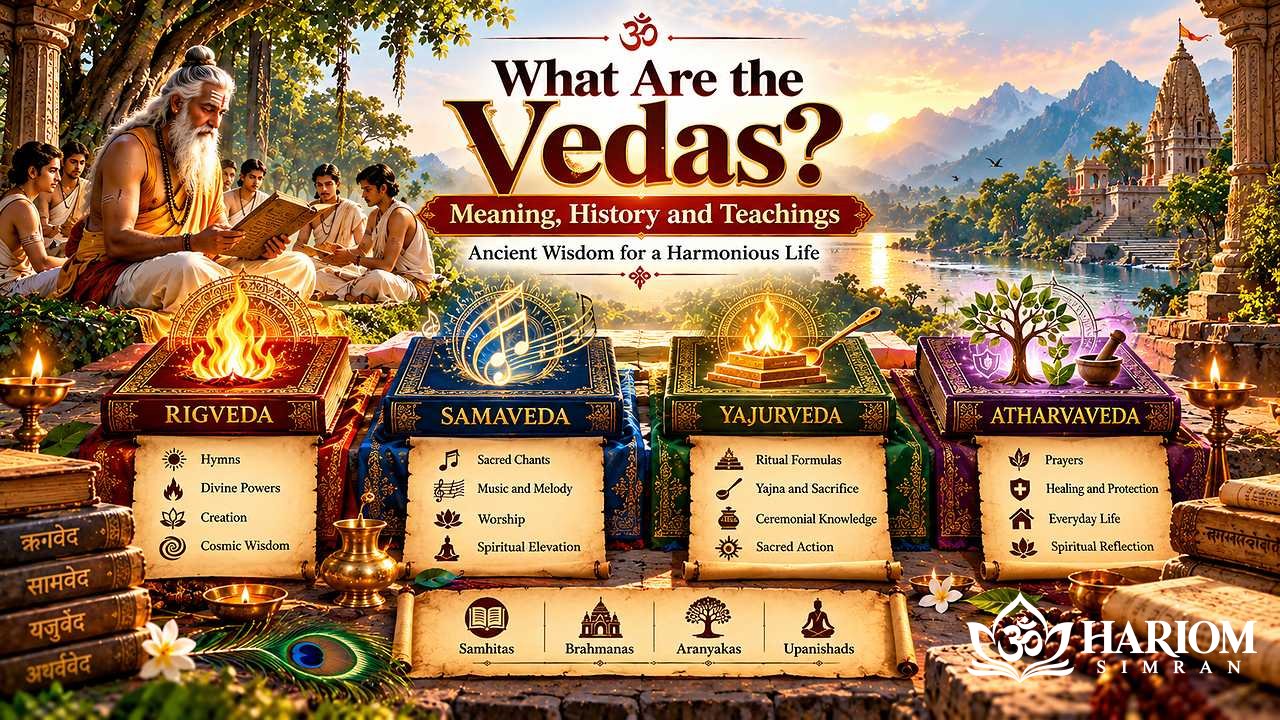
They are a vast body of sacred literature connected with four principal Vedic collections:
- Rigveda
- Samaveda
- Yajurveda
- Atharvaveda
Each Veda contains its own material and developed through different textual layers.
These layers include:
- Samhitas
- Brahmanas
- Aranyakas
- Upanishads
Together, they form one of the foundations of Hindu sacred knowledge.
To understand the larger structure of Hindu sacred literature, explore the Hindu Scriptures section.
What Does the Word Veda Mean?
The Sanskrit word Veda is connected with knowledge.
It is commonly understood as:
Knowledge
or
Sacred Knowledge
The Vedas therefore represent more than a collection of ancient religious writings.
They preserve a tradition of sacred knowledge transmitted across generations.
This knowledge includes questions about:
- The Divine
- Nature
- Cosmic Order
- Sacrifice
- Prayer
- Human Responsibility
- Life and Death
- Consciousness
- Ultimate Reality
Over time, Vedic thought developed from hymns and ritual traditions into increasingly deep philosophical reflection.
This development is especially visible in the Upanishads.
Why Are the Vedas Important in Hinduism?
The Vedas hold a foundational place in Hindu sacred tradition.
They are traditionally classified as Shruti, meaning:
“That Which Is Heard.”
In traditional Hindu understanding, the Vedic Mantras were not simply invented as ordinary literature.
Ancient Rishis are understood as seers who perceived or received sacred knowledge.
This is why the Vedas have traditionally been given a special status within Hindu scriptural thought.
Their influence can be seen across:
- Hindu Philosophy
- Ritual Traditions
- Mantra Practice
- Temple Traditions
- Yoga
- Vedanta
- Dharma
- Meditation
- Devotional Traditions
Even Hindu traditions that do not involve direct daily Vedic study often developed within a larger religious world shaped by Vedic ideas.
Are the Vedas One Book?
No.
This is one of the most common misunderstandings.
The Vedas are not one single book.
There are four principal Vedic collections:
Rigveda
Samaveda
Yajurveda
Atharvaveda
Each Veda has a distinct character and purpose.
Their contents include hymns, chants, ritual formulas, prayers, philosophical ideas, and other sacred material.
The Vedic tradition is therefore better understood as a large sacred corpus rather than one individual text.
The Four Vedas
Each of the four Vedas contributes something distinctive to the larger Vedic tradition.
1. Rigveda
The Rigveda is a collection of ancient Vedic hymns.
It contains hymns addressed to deities and sacred powers associated with the Vedic religious world.
Important themes include:
- Creation
- Cosmic Order
- Prayer
- Sacred Fire
- Divine Powers
- Human Aspiration
- Nature
- Ritual
- Mystery of Existence
Important Vedic deities appearing in the Rigveda include:
- Agni
- Indra
- Soma
- Surya
- Varuna
- Ushas
- Ashvins
The Rigveda contains both devotional and philosophical dimensions.
Some hymns praise particular deities.
Others ask profound questions about creation and existence.
This diversity makes the Rigveda much more than a ritual collection.
What Makes the Rigveda Important?
The Rigveda preserves some of the oldest layers of Vedic sacred poetry.
It provides valuable insight into ancient Vedic religion, ritual, cosmology, language, and spiritual thought.
Several famous Vedic hymns come from the Rigvedic tradition, including hymns later discussed in relation to:
Creation
Cosmic Person
Sacred Order
Divine Reality
and
The Mystery of Existence
Future HariOmSimran articles will explore important Rigvedic Suktas individually.
2. Samaveda
The Samaveda is closely associated with sacred chanting and musical recitation.
Many of its verses are connected with material also found in the Rigvedic tradition.
However, the distinctive importance of the Samaveda lies in the way verses are arranged and performed as sacred chants.
This makes sound especially important.
The Samaveda shows that sacred knowledge is not only about:
What Is Said
but also:
How It Is Recited
Music, tone, rhythm, and liturgical performance became important aspects of this tradition.
Why Is the Samaveda Connected With Music?
The Samaveda developed around sung recitation used in Vedic ritual.
Its tradition therefore became strongly connected with sacred melody.
This does not mean the Samaveda is simply a modern music book.
Its chanting belongs to a specific sacred ritual tradition.
The importance of voice and sound helps us understand why oral transmission played such a central role in preserving the Vedas.
3. Yajurveda
The Yajurveda is closely connected with Vedic ritual performance.
It contains sacred formulas and ritual material used in the performance of sacrifices and ceremonies.
While the Rigveda is especially known for hymns, the Yajurveda is closely associated with the practical performance of ritual.
Its material helps explain:
- Ritual Actions
- Sacred Formulas
- Offerings
- Ceremonial Procedures
- Priestly Roles
- Symbolic Meaning
Different traditions of the Yajurveda preserve different textual arrangements.
The two major broad traditions are commonly known as:
Shukla Yajurveda
and
Krishna Yajurveda
These traditions developed their own recensions and textual lineages.
4. Atharvaveda
The Atharvaveda preserves a wide variety of material related to both sacred and everyday concerns.
Its contents can include themes related to:
- Prayer
- Protection
- Household Life
- Healing Traditions
- Royal Ritual
- Prosperity
- Peace
- Spiritual Reflection
- Philosophical Ideas
This makes the Atharvaveda particularly interesting because it reflects many dimensions of human life.
Its material reminds us that Vedic religion was not limited only to large ceremonial rituals.
It also engaged with concerns experienced in ordinary life.
How Are the Vedas Structured?
The Vedic corpus is commonly understood through four major textual layers:
- Samhitas
- Brahmanas
- Aranyakas
- Upanishads
These layers do not simply represent four separate books.
They show different dimensions of Vedic sacred knowledge.
1. Samhitas — Hymns, Mantras and Sacred Formulas
The Samhitas form the core collections associated with the four Vedas.
They contain sacred material such as:
- Hymns
- Mantras
- Chants
- Ritual Formulas
- Prayers
When people commonly speak about the Rigveda, Samaveda, Yajurveda, or Atharvaveda, they often have the Samhita collections in mind.
However, the complete Vedic tradition extends beyond the Samhitas.
2. Brahmanas — Understanding Ritual
The Brahmanas provide explanations connected with Vedic ritual.
They discuss:
- Sacrificial Procedures
- Ritual Meaning
- Symbolism
- Ceremonial Interpretation
- Connections Between Ritual and Cosmic Order
These texts help us understand the intellectual world behind Vedic ritual.
A ritual action was not always treated as an isolated physical act.
It could carry symbolic and cosmological meaning.
3. Aranyakas — From Ritual Toward Reflection
The Aranyakas occupy an important place in Vedic literature.
They are often associated with a movement from external ritual toward more contemplative and symbolic interpretation.
Their teachings can explore deeper meanings behind rituals and sacred ideas.
For this reason, the Aranyakas are sometimes described as a bridge between:
Ritual Thought
and
Upanishadic Philosophy
They help show how Vedic spirituality gradually developed increasingly inward forms of reflection.
4. Upanishads — Philosophical Inquiry
The Upanishads contain some of the most influential philosophical teachings in Hindu history.
They explore questions such as:
Who Am I?
What Is Atman?
What Is Brahman?
What Is Ultimate Reality?
What Is Consciousness?
What Is Moksha?
What Is the Relationship Between the Individual and the Supreme Reality?
These questions later became central to Vedanta.
The Upanishads demonstrate that Vedic literature is not limited to ritual.
It also contains profound spiritual and philosophical inquiry.
Are the Upanishads Part of the Vedas?
Yes.
The principal Upanishads belong to the broader Vedic corpus and are traditionally associated with particular Vedic traditions.
Because many Upanishads occur toward the concluding philosophical portions of Vedic literature, they became closely associated with the term:
Vedanta
which literally carries the sense of the end or culmination of the Veda.
Over time, Vedanta also became the name of major philosophical traditions based on interpretation of the Upanishads, Bhagavad Gita, and Brahma Sutras.
How Old Are the Vedas?
The Vedas developed in ancient India over a long period.
Scholars generally understand different portions of the Vedic corpus as belonging to different historical stages rather than having been created at one single moment.
The Rigvedic hymns represent some of the oldest surviving layers of Vedic literature.
Later Vedic literature includes the Brahmanas, Aranyakas, and early Upanishads.
Traditional Hindu understanding and modern historical scholarship may approach questions of origin and dating differently.
HariOmSimran therefore distinguishes between:
Traditional Religious Understanding
and
Historical Academic Study
when discussing the origins of Hindu scriptures.
The central point is clear:
The Vedas represent an exceptionally ancient and long-preserved sacred tradition.
Who Wrote the Vedas?
From the traditional Hindu perspective, the Vedas are not treated as ordinary books written by a single author.
The Vedic Mantras are associated with ancient Rishis.
Rishis are traditionally understood as seers who perceived sacred knowledge.
Individual hymns can be associated with particular Rishis or Rishi lineages.
This differs from the modern idea of an author creating a book entirely from personal imagination.
Traditional Hindu thought often describes the Vedas as Apaurusheya, meaning that they are not considered products of ordinary human authorship.
Different Hindu philosophical schools have explained this idea in different ways.
What Does Apaurusheya Mean?
Apaurusheya is commonly understood as:
“Not of Human Authorship”
or
“Not Produced by an Ordinary Human Author.”
This concept is especially important in certain Hindu philosophical traditions when explaining the authority of the Vedas.
It should be understood within its traditional philosophical context.
Modern historians may study Vedic texts through language, culture, textual development, and historical chronology.
Traditional Hindu philosophy approaches their sacred authority differently.
Both contexts should be clearly distinguished.
How Were the Vedas Preserved?
One of the most remarkable features of Vedic tradition is its oral preservation.
For generations, Vedic texts were transmitted through highly disciplined systems of memorization.
Students learned directly from teachers.
The process required attention to:
- Exact Words
- Pronunciation
- Accent
- Pitch
- Sequence
- Rhythm
- Recitation
This was not casual memorization.
Different recitation methods developed to preserve textual accuracy.
The oral tradition helped transmit sacred material with extraordinary attention to sound.
Why Was Oral Transmission So Important?
In Vedic tradition, sound itself carries sacred importance.
A Mantra is not understood only as written information.
How it is pronounced can matter.
This means that writing down a Vedic verse does not necessarily capture every aspect of its traditional recitation.
Oral teaching preserved features such as:
Accent
Sound
Rhythm
Pronunciation
and
Sequence
This strong oral culture became one of the defining characteristics of Vedic learning.
Explore sacred sound more broadly through the Mantras section.
What Is a Vedic Mantra?
A Vedic Mantra is a sacred utterance found within the Vedic tradition.
Depending on the context, Vedic Mantras may be used for:
- Prayer
- Invocation
- Praise
- Ritual
- Contemplation
- Sacred Recitation
Some Vedic Mantras later became widely known beyond their original ritual settings.
However, not all Vedic Mantras have the same purpose.
Some belong to specific ritual contexts.
Others contain philosophical or devotional reflection.
Understanding the original context of a Mantra helps avoid oversimplification.
Is Om Found in the Vedic Tradition?
Om, also written as Aum, became one of the most important sacred sounds in Hindu spirituality.
It is especially significant in the Upanishadic and later Hindu philosophical traditions.
The sound is connected with profound reflection on:
- Ultimate Reality
- Consciousness
- Meditation
- Sacred Sound
- Brahman
Different texts interpret Om in different ways.
It later became deeply embedded in Yoga, Vedanta, Mantra, and devotional traditions.
What Do the Vedas Teach?
There is no single sentence that can summarize everything contained in the Vedas.
Vedic literature developed over a long period and includes many layers.
Important themes include:
- Sacred Order
- Prayer
- Ritual
- Divine Powers
- Nature
- Human Responsibility
- Creation
- Sacrifice
- Truth
- Cosmic Harmony
- Meditation
- The Self
- Ultimate Reality
The emphasis changes across different texts.
Early hymns often focus strongly on praise, ritual, deities, and cosmic order.
Later Vedic texts increasingly explore symbolic and philosophical questions.
Rita — The Idea of Cosmic Order
One important Vedic concept is Rita.
Rita is associated with cosmic order, truth, regularity, and the principle by which the universe functions harmoniously.
The concept appears prominently in early Vedic thought.
It is connected with:
- Cosmic Order
- Truth
- Natural Regularity
- Right Conduct
- Sacred Responsibility
The relationship between Rita and later ideas of Dharma is an important subject in the study of Hindu thought.
To explore Dharma more deeply, read the HariOmSimran guide to Dharma.
Vedic Deities
Vedic literature refers to many deities and sacred powers.
Some prominent examples include:
Agni
Sacred fire and an important mediator in Vedic ritual.
Indra
A major Rigvedic deity associated with strength, victory, and cosmic battles.
Soma
Connected both with a sacred ritual substance and a divine principle within Vedic tradition.
Varuna
Associated with cosmic and moral order in important Vedic hymns.
Surya
Connected with the Sun and divine illumination.
Ushas
The Vedic Goddess of dawn.
Ashvins
Divine twins associated with help, vitality, and restoration in Vedic hymns.
Understanding these deities requires reading them within their Vedic context rather than assuming that every later Hindu interpretation was already identical in the earliest texts.
Explore the wider Hindu Divine tradition through Deities.
Did Vedic Religion Stay the Same?
No.
Hindu religious tradition developed across many centuries.
Vedic religion, later philosophical traditions, epic Hinduism, Puranic traditions, temple worship, Bhakti, Tantra, Yoga, and regional traditions all contributed to what we now broadly call Hinduism.
Some Vedic concepts continued.
Others developed new interpretations.
Certain deities became more prominent in later periods.
New theological and devotional traditions emerged.
This means Hinduism should be understood as a living tradition with both:
Continuity
and
Development
How Are the Vedas Connected With Hinduism Today?
Most Hindus today do not organize their entire religious life around direct study of Vedic texts.
Yet Vedic influence remains significant.
It can be seen in:
- Mantras
- Ceremonies
- Marriage Rituals
- Fire Rituals
- Prayer
- Temple Traditions
- Philosophy
- Vedanta
- Yoga
- Sacred Sound
Many familiar Hindu ideas developed through long conversations between Vedic and later traditions.
So the Vedas remain foundational even when a person's daily spiritual practice is centered more strongly on:
Bhagavad Gita
Ramayana
Puranas
Bhakti
Puja
or
Temple Worship
How Are the Vedas Different From the Bhagavad Gita?
This is an important distinction.
The Vedas belong to Shruti.
The Bhagavad Gita belongs broadly to Smriti because it appears within the Mahabharata.
The Vedas preserve ancient sacred hymns, ritual knowledge, and philosophical traditions.
The Bhagavad Gita presents a spiritual dialogue between Shri Krishna and Arjuna addressing:
- Dharma
- Karma
- Bhakti
- Jnana
- Yoga
- Action
- Detachment
- Moksha
Both are deeply important, but they belong to different textual contexts.
How Are the Vedas Different From the Puranas?
The Vedas and Puranas have different roles.
The Vedas
Belong to Shruti and preserve foundational Vedic sacred knowledge.
The Puranas
Belong broadly to Smriti and communicate religious teachings through narratives, cosmology, genealogies, sacred geography, devotion, and stories of deities.
The Puranas became enormously important in later Hindu devotional and temple traditions.
Both contribute to Hindu sacred knowledge, but they should not be treated as identical kinds of texts.
Did the Vedas Teach One God or Many Gods?
This question requires nuance.
Vedic hymns address many deities and divine powers.
At the same time, some hymns contain reflections that move toward deeper unity behind diverse divine expressions.
Different Hindu philosophers later interpreted Vedic passages in different ways.
Some emphasized:
Ultimate Unity
Others emphasized:
Personal Divine Reality
Others developed different theological approaches.
It is therefore inaccurate to force the entire Vedic corpus into a simple modern label without recognizing its diversity.
Creation in the Vedas
Vedic literature contains more than one approach to creation.
It does not provide only one simple creation story.
Different hymns reflect on cosmic origins in different ways.
Some describe divine creative principles.
Others use symbolic imagery.
Some ask philosophical questions about whether the ultimate beginning can even be fully known.
This diversity is especially visible in famous creation hymns of the Rigveda.
Future HariOmSimran articles will separately explore texts such as the Nasadiya Sukta and Hiranyagarbha Sukta.
The Vedas and Nature
Vedic poetry is deeply connected with the natural world.
It contains powerful imagery connected with:
- Fire
- Sun
- Dawn
- Rain
- Wind
- Rivers
- Sky
- Earth
- Night
- Cosmic Space
Nature is not merely background scenery.
Natural forces often carry sacred, symbolic, or divine meaning.
This relationship between spirituality and the natural world is one of the striking characteristics of Vedic poetry.
The Vedas and Dharma
The later Hindu concept of Dharma has deep roots in earlier Vedic ideas concerning order, responsibility, ritual correctness, and harmony.
The Vedic concept of Rita is particularly significant in this development.
Across later Hindu literature, Dharma becomes one of the most important principles of life.
It eventually includes questions related to:
- Ethics
- Duty
- Responsibility
- Right Conduct
- Social Life
- Spiritual Practice
This development shows how Hindu ideas evolved while maintaining links with earlier sacred traditions.
Explore Dharma for a detailed introduction.
The Vedas and Upanishadic Philosophy
The Vedic tradition does not end with hymns and rituals.
The Upanishads move toward deep philosophical inquiry.
Important concepts include:
Atman
Brahman
Moksha
Knowledge
Consciousness
Meditation
Ultimate Reality
This transition is extremely important.
It shows how questions about ritual and the cosmos gradually opened into questions about consciousness and the Self.
These teachings later became foundational for Vedanta.
Do Hindus Need to Read the Vedas?
There is no universal requirement that every Hindu must personally read all four Vedas.
Hindu traditions are diverse.
People may learn through:
- Family Tradition
- Guru
- Temple
- Bhagavad Gita
- Ramayana
- Puranas
- Bhajans
- Mantras
- Satsang
- Philosophical Study
- Devotional Practice
The Vedas have foundational importance, but Hindu spiritual life developed through many forms of teaching and practice.
A beginner does not need to feel that they must understand every Vedic text before learning anything else about Hinduism.
How Should a Beginner Start Learning About the Vedas?
A practical learning order is:
Step 1
Understand what the four Vedas are.
Step 2
Learn the difference between Samhitas, Brahmanas, Aranyakas, and Upanishads.
Step 3
Study important themes such as Rita, Yajna, Mantra, and sacred sound.
Step 4
Explore important Vedic hymns individually.
Step 5
Move into the major Upanishads and their philosophical teachings.
This approach gives context before entering highly complex texts.
HariOmSimran will build this learning path step by step.
Common Misunderstandings About the Vedas
Misunderstanding 1: The Vedas Are One Book
No.
There are four principal Vedas and a broad body of associated Vedic literature.
Misunderstanding 2: The Vedas Contain Only Rituals
No.
Ritual is important, but Vedic literature also contains prayer, sacred poetry, cosmology, symbolism, and philosophy.
Misunderstanding 3: The Upanishads Are Completely Separate From the Vedas
The principal Upanishads belong to the broader Vedic tradition.
Misunderstanding 4: Every Hindu Reads the Vedas Daily
No.
Different Hindu traditions engage with scriptures in different ways.
Misunderstanding 5: Every Part of the Vedas Teaches Exactly the Same Thing
The Vedic corpus contains different historical layers, literary styles, ritual contexts, and philosophical developments.
Its diversity should be recognized.
Why the Vedas Still Matter Today
The Vedas continue to matter because they preserve some of the deepest roots of Hindu sacred tradition.
They help us understand the historical and spiritual development of:
Mantra
Ritual
Dharma
Sacred Sound
Yoga
Vedanta
Atman
Brahman
Moksha
and
Hindu Philosophy
They also preserve questions that remain meaningful today:
Where Did the Universe Come From?
What Makes Life Meaningful?
What Is Our Relationship With the Divine?
What Is the Nature of Reality?
How Should Human Beings Live?
These questions help explain why Vedic knowledge continues to inspire study thousands of years after its earliest formation.
Explore Vedic Knowledge With HariOmSimran
HariOmSimran is developing its Scripture section as an interconnected Hindu knowledge library.
Continue exploring:
The next Vedic articles will explore:
The Four Vedas
Rigveda
Samaveda
Yajurveda
Atharvaveda
Samhitas
Brahmanas
Aranyakas
Upanishads
and important Vedic Suktas in greater depth.
Learn • Explore • Understand • Preserve
Key Takeaway
The Vedas are among the oldest and most foundational sacred texts of Hindu tradition.
The four principal Vedas are:
Rigveda — Sacred Hymns
Samaveda — Sacred Chants
Yajurveda — Ritual Formulas and Ceremonial Knowledge
Atharvaveda — Prayers, Everyday Concerns, Sacred Knowledge, and Reflection
The broader Vedic tradition also includes:
Samhitas
Brahmanas
Aranyakas
and
Upanishads
Together, these texts preserve a remarkable journey from sacred hymn and ritual toward philosophical inquiry about the Self, consciousness, reality, and spiritual liberation.
The Vedas are therefore not simply ancient books.
They are a foundational layer of Hindu sacred knowledge whose influence continues across Hindu philosophy, Mantra, ritual, Yoga, Vedanta, and spiritual life.
Key Teachings
This scripture reveals profound wisdom and guidance for our spiritual journey. Below are the key teachings and principles derived from this sacred text.
Core Principles
These teachings provide guidance for living a life of faith, compassion, and spiritual growth.
- Spiritual Growth
- Divine Wisdom
- Sacred Teachings
- Faith Journey

Study Resources
Explore these resources to deepen your understanding of this scripture and apply its teachings to your daily life.
📖 Study Guide
Comprehensive study materials to help you understand the context, meaning, and application of this scripture.
🙏 Reflection Questions
Thought-provoking questions to help you reflect on the teachings and apply them to your personal spiritual journey.
📝 Journal Prompts
Guided journaling prompts to help you document your insights, prayers, and spiritual growth.
👥 Discussion Topics
Engaging discussion topics for group study and fellowship, fostering deeper understanding and community.
Frequently Asked Questions
The Vedas are ancient sacred texts of Hindu tradition containing hymns, Mantras, ritual knowledge, prayers, philosophical ideas, and spiritual teachings. They form the foundation of Vedic sacred literature.
The four Vedas are Rigveda, Samaveda, Yajurveda, and Atharvaveda. Each has its own emphasis, including hymns, chants, ritual formulas, prayers, and sacred knowledge.
The Vedas belong to Shruti, traditionally understood as “That Which Is Heard.” Shruti holds a foundational place in Hindu scriptural tradition.
Yes. The principal Upanishads belong to the broader Vedic corpus and represent its philosophical and contemplative dimensions.
Traditional Hindu understanding does not treat the Vedas as ordinary books written by one author. Ancient Rishis are regarded as seers of Vedic Mantras, and the Vedas are traditionally described as Apaurusheya.
The Vedas remain important because they preserve foundational Hindu ideas concerning sacred sound, ritual, Dharma, cosmic order, the Divine, the Self, reality, and spiritual inquiry.