

The Vedas stand at the foundation of the Vedic sacred tradition, but many people first encounter them simply as four names:
Rigveda
Samaveda
Yajurveda
Atharvaveda
Knowing the names is only the beginning.
Each Veda developed around a particular form of sacred knowledge.
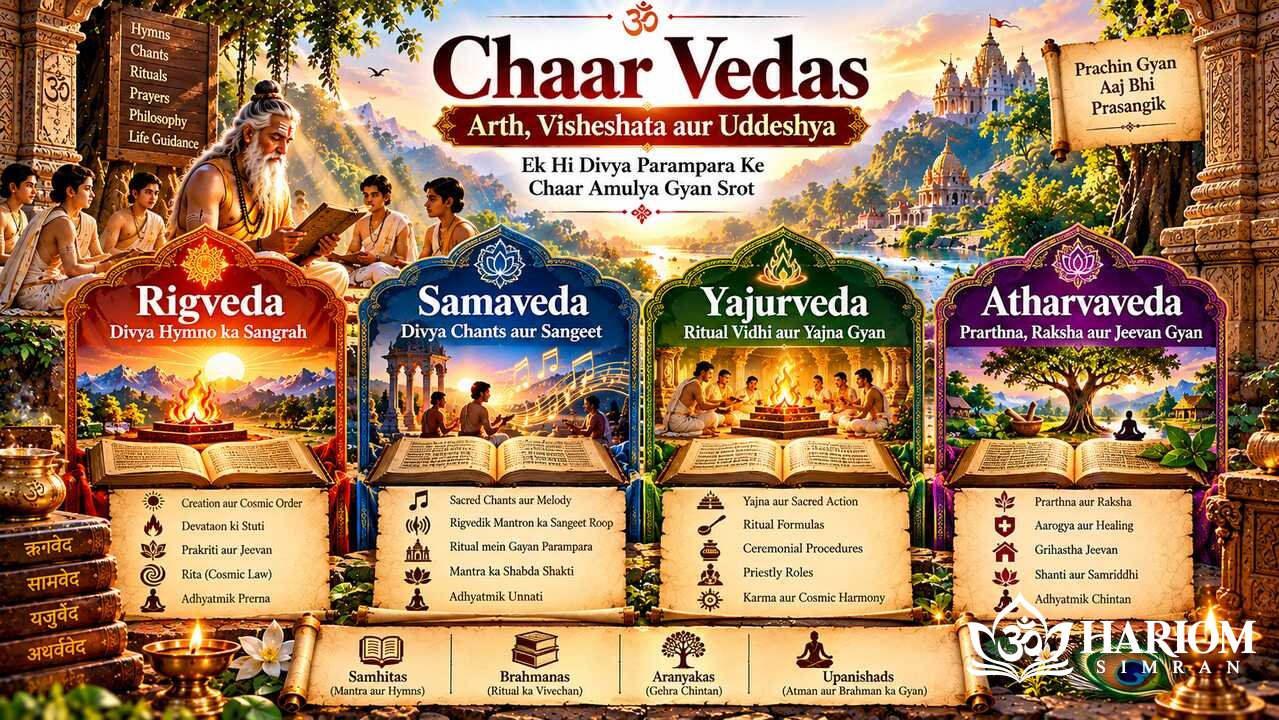
The Rigveda is especially known for hymns.
The Samaveda is closely associated with sacred chanting.
The Yajurveda is strongly connected with ritual performance.
The Atharvaveda includes prayers and teachings connected with many dimensions of human life.
Together, the four Vedas preserve a remarkable world of sacred poetry, ritual, sound, philosophy, prayer and spiritual reflection.
They are traditionally regarded as Shruti, meaning sacred knowledge that was heard or perceived by ancient Rishis.
To understand the larger structure of Hindu sacred literature, explore the Hindu Scriptures section.
What Are the Four Vedas?
The four principal Vedas are:
- Rigveda
- Samaveda
- Yajurveda
- Atharvaveda
These are not simply four versions of the same book.
Each Veda has its own emphasis, textual tradition and role.
A simple way to understand them is:
Rigveda: Sacred Hymns
Samaveda: Sacred Chants
Yajurveda: Ritual Formulas and Ceremonial Knowledge
Atharvaveda: Prayers, Everyday Concerns and Spiritual Reflection
This summary is useful for beginners, but each Veda is much richer than a single description.
Why Are There Four Vedas?
The Vedic tradition developed different collections for different sacred functions.
Vedic ritual involved different kinds of recitation and priestly responsibilities.
Some sacred verses were recited as hymns.
Some were sung.
Some accompanied ritual actions.
Other prayers addressed personal, household, social and spiritual concerns.
Over time, these traditions became associated with distinct Vedic collections.
The four Vedas therefore represent different dimensions of one larger sacred tradition.
1. Rigveda
The Rigveda is one of the most important collections of ancient Vedic hymns.
It contains sacred poetry addressed to different deities and cosmic powers.
Its hymns explore questions about:
- Creation
- Nature
- Prayer
- Sacred Fire
- Cosmic Order
- Divine Power
- Human Aspiration
- Sacrifice
- Truth
- Existence
The Rigveda is especially important because it preserves some of the earliest surviving layers of Vedic sacred poetry.
What Does Rigveda Mean?
The term Rigveda is connected with sacred verses or hymns.
The Rigveda is therefore often understood as a collection of sacred hymns.
Its verses were composed in Vedic Sanskrit and transmitted through disciplined oral traditions.
The hymns are arranged into collections known as Mandalas.
How Is the Rigveda Structured?
The Rigveda Samhita is traditionally organized into 10 Mandalas.
These Mandalas contain more than a thousand hymns, commonly called Suktas.
The hymns vary greatly in subject.
Some praise particular deities.
Some accompany rituals.
Some reflect on creation.
Some explore profound questions about existence.
This variety is one of the reasons the Rigveda remains such an important source for understanding early Vedic thought.
Important Deities in the Rigveda
Several Vedic deities appear prominently in the Rigveda.
Agni
Agni is associated with sacred fire.
Fire played an essential role in Vedic ritual because offerings were made through the ritual fire.
Agni was therefore understood as an important connection between worshippers and the divine realm.
Indra
Indra is one of the most frequently praised deities in the Rigveda.
He is associated with:
- Strength
- Victory
- Storms
- Heroic Power
- Cosmic Battles
Several hymns celebrate Indra's victories over forces that obstruct cosmic and natural order.
Soma
Soma has a complex role in Vedic literature.
The term can refer to a sacred ritual substance as well as a divine figure associated with it.
Soma hymns connect ritual, sacred experience and divine power.
Varuna
Varuna is strongly associated with cosmic and moral order in important Vedic hymns.
His connection with Rita, the principle of cosmic order, makes him especially significant in the ethical and cosmological dimensions of Vedic thought.
Surya
Surya represents the Sun and divine illumination.
Solar imagery appears throughout Hindu sacred traditions and continues to influence later Hindu worship and spiritual symbolism.
Ushas
Ushas is the Goddess of Dawn.
The hymns dedicated to Ushas are known for their poetic beauty and their celebration of light, renewal and the beginning of a new day.
Important Ideas in the Rigveda
The Rigveda contains several ideas that became important in later Hindu thought.
These include:
- Rita
- Yajna
- Mantra
- Sacred Sound
- Divine Powers
- Cosmic Unity
- Creation
- Truth
The Rigveda is especially interesting because it does not present every spiritual question through one single explanation.
Different hymns approach existence from different perspectives.
Creation in the Rigveda
The Rigveda includes several hymns that reflect on creation.
One of the most famous is the Nasadiya Sukta, often called the Hymn of Creation.
Instead of giving a simple creation story, the hymn raises philosophical questions.
It reflects on what may have existed before creation and whether the deepest origin of the universe can be fully known.
Another important hymn is the Hiranyagarbha Sukta, associated with the idea of a cosmic source or golden embryo.
HariOmSimran will explore these Suktas separately in future articles.
2. Samaveda
The Samaveda is especially associated with sacred chanting.
Many verses in the Samaveda are closely related to verses found in the Rigveda.
However, their role and arrangement are different.
The Samaveda adapts sacred verses for musical and liturgical recitation.
This makes it particularly important for understanding the role of sound, melody and performance in Vedic tradition.
What Does Samaveda Mean?
The word Sama is associated with chant or melody.
The Samaveda can therefore be understood as the Veda of sacred chanting.
Its importance lies not only in the words of the verses but also in how they are sung.
This makes oral transmission especially important.
A written version alone cannot fully communicate every aspect of a traditional sacred chant.
Why Is the Samaveda Important?
The Samaveda demonstrates a fundamental feature of Vedic spirituality:
Sacred knowledge is not always only about meaning. Sound itself can carry importance.
The exact performance of a sacred chant may involve:
- Pitch
- Tone
- Rhythm
- Melodic Pattern
- Pronunciation
- Sequence
This strong attention to sound influenced later Hindu understandings of Mantra and sacred recitation.
Explore related traditions through the Mantras section.
Is Samaveda the Origin of Indian Music?
The Samaveda is often associated with the ancient roots of Indian musical traditions because of its strong emphasis on melodic chanting.
However, it is better to describe it carefully.
The Samaveda preserves an ancient sacred musical tradition.
Indian music developed through many historical stages and traditions.
So it would be too simple to say that all Indian music came directly from one text.
The connection is important, but it should not be exaggerated.
Samaveda and Ritual
Samavedic chants were used within Vedic ritual contexts.
Specific priests were responsible for singing particular chants.
The role of music was therefore not entertainment in the modern sense.
It was part of sacred ceremonial performance.
This shows how Vedic ritual combined:
Words
Sound
Action
Offering
and
Sacred Intention
into an integrated practice.
3. Yajurveda
The Yajurveda is especially connected with ritual formulas and ceremonial action.
While the Rigveda preserves many hymns and the Samaveda focuses strongly on sacred chanting, the Yajurveda is closely tied to the performance of ritual.
It provides formulas and instructions used alongside sacred actions.
What Does Yajurveda Mean?
The word Yajus is associated with sacrificial or ritual formulas.
The Yajurveda therefore preserves sacred material connected with Yajna, or Vedic ritual sacrifice.
Its texts help us understand how Vedic ceremonies were actually performed.
What Is Yajna?
Yajna is an important Vedic concept related to sacred offering and ritual.
Fire commonly plays a central role.
Offerings may be placed into the sacred fire while Mantras are recited.
Yajna developed many meanings within Hindu tradition.
At its Vedic level, it was strongly connected with ritual action, sacred reciprocity and cosmic order.
Later Hindu traditions sometimes interpret Yajna more broadly, including forms of spiritual offering, service and disciplined action.
Shukla and Krishna Yajurveda
The Yajurveda has two major traditional divisions:
- Shukla Yajurveda
- Krishna Yajurveda
These are sometimes translated as:
White Yajurveda
and
Black Yajurveda
The distinction relates to how ritual formulas and explanatory material are arranged within their respective textual traditions.
Shukla Yajurveda
The Shukla Yajurveda presents its Mantra material in a more distinct arrangement from the explanatory prose associated with ritual.
Important textual traditions are connected with it.
Krishna Yajurveda
The Krishna Yajurveda often combines Mantra material and explanatory ritual material more closely.
Several important recensions and texts belong to this tradition.
The differences between these branches show that even within one Veda, multiple textual traditions developed.
What Does the Yajurveda Teach?
The Yajurveda is especially important for understanding:
- Yajna
- Ritual Procedure
- Sacred Formula
- Offerings
- Priestly Responsibility
- Sacred Action
- Symbolic Meaning
- Cosmic Order
It helps reveal that Vedic ritual was not merely a physical ceremony.
Ritual action could represent relationships between human beings, the cosmos and sacred powers.
4. Atharvaveda
The Atharvaveda has a distinctive character among the four Vedas.
It contains material connected with many aspects of everyday life as well as spiritual and ritual concerns.
Its texts include prayers and formulas relating to:
- Health
- Protection
- Peace
- Household Life
- Prosperity
- Royal Concerns
- Spiritual Reflection
- Social Life
- Philosophy
This broad range makes the Atharvaveda especially valuable for understanding how sacred traditions interacted with ordinary human concerns.
What Does Atharvaveda Mean?
The Atharvaveda is traditionally associated with ancient priestly and Rishi traditions connected with Atharvan.
Its content differs in emphasis from the other three Vedas.
It includes many prayers and sacred formulas addressing situations people might encounter in daily life.
Healing and Protection in the Atharvaveda
Some Atharvavedic material deals with healing, protection and well-being.
These teachings belong to an ancient religious and cultural context.
They should not be presented as replacements for modern medical care.
Their importance lies in understanding how ancient communities connected health, prayer, sacred words and spiritual concerns.
This distinction helps us respect the historical tradition without making modern medical claims.
Household Life in the Atharvaveda
The Atharvaveda contains material connected with:
- Marriage
- Family
- Peace
- Prosperity
- Social Relationships
- Protection
This gives scholars and spiritual readers important insight into the religious life of ancient communities.
Sacred knowledge was not limited to temples or major ceremonies.
It also entered homes and everyday life.
Philosophical Ideas in the Atharvaveda
The Atharvaveda also contains deeper philosophical reflection.
Some hymns explore:
Creation
Life
Death
Cosmic Power
Ultimate Reality
These ideas contributed to the wider development of Vedic philosophy.
The Four Vedas at a Glance
| Veda | Main Emphasis | Common Association |
|---|---|---|
| Rigveda | Sacred Hymns | Prayer, Deities, Creation, Cosmic Order |
| Samaveda | Sacred Chants | Music, Melody, Liturgical Recitation |
| Yajurveda | Ritual Formulas | Yajna, Ceremonies, Sacred Action |
| Atharvaveda | Prayers and Everyday Concerns | Protection, Household Life, Peace, Reflection |
This table gives a beginner-friendly overview.
Each Veda contains much more than one single theme.
Do All Four Vedas Have the Same Structure?
The broader Vedic tradition is commonly understood through four kinds of literature:
Samhitas
Brahmanas
Aranyakas
Upanishads
However, the exact textual relationships differ between Vedic traditions.
Not every Veda has identical surviving material or exactly the same structure.
This is why Vedic literature should be studied as a network of related textual traditions rather than four perfectly identical sets of books.
Samhitas
The Samhitas contain the core collections of hymns, chants, Mantras and ritual formulas associated with the Vedas.
The Rigveda Samhita, Samaveda Samhita, Yajurveda Samhitas and Atharvaveda Samhita represent the primary collections people most commonly mean when referring to the four Vedas.
Brahmanas
The Brahmanas explain rituals and their meanings.
They discuss:
- Ritual Procedures
- Sacred Symbolism
- Sacrificial Practices
- Cosmic Connections
- Ceremonial Interpretation
These texts provide important insight into how ancient Vedic communities understood ritual.
Aranyakas
The Aranyakas move increasingly toward symbolic and contemplative interpretation.
They are commonly associated with a transition between ritual-centered texts and the philosophical concerns of the Upanishads.
Upanishads
The Upanishads explore some of Hindu philosophy's deepest questions.
These include:
What Is Atman?
What Is Brahman?
What Is Reality?
What Is Consciousness?
What Is Moksha?
Their teachings later became especially important to Vedanta.
Are the Four Vedas Shruti?
Yes.
The four Vedas belong to the Shruti tradition.
Shruti means:
“That Which Is Heard.”
Traditional Hindu understanding holds that sacred Vedic knowledge was perceived by Rishis.
This distinguishes Shruti from Smriti, which includes remembered and transmitted traditions such as the Ramayana, Mahabharata and Puranas.
You can explore the broader classification of Hindu scripture through Hindu Scriptures.
Who Were the Rishis of the Vedas?
Vedic hymns are traditionally associated with Rishis and Rishi families.
A Rishi is commonly understood as a seer.
In traditional Hindu thought, the Rishis did not simply invent Vedic revelation in the ordinary literary sense.
They perceived sacred knowledge.
Several families and lineages are associated with portions of the Rigveda.
The role of Rishis illustrates the importance of spiritual perception, oral teaching and lineage in Vedic tradition.
Were There Women Rishis?
Yes.
Vedic tradition preserves associations with female seers, often referred to as Rishikas.
Names traditionally associated with Vedic hymns include women such as:
Lopamudra
Ghosha
and others.
This is an important aspect of Vedic literature and deserves its own detailed treatment in future HariOmSimran content.
How Were the Four Vedas Preserved?
The Vedas were preserved primarily through disciplined oral transmission for generations.
Students learned directly from teachers.
Accuracy was extremely important.
Training included careful attention to:
- Pronunciation
- Sound
- Accent
- Sequence
- Pitch
- Rhythm
Different recitation patterns developed as safeguards against textual corruption.
This sophisticated oral tradition is one of the most remarkable aspects of Vedic preservation.
Why Was Exact Pronunciation Important?
Vedic tradition gives sacred sound special importance.
Changing pronunciation or accent could affect traditional recitation.
Therefore, learning involved much more than memorizing the basic meaning of words.
Students learned the precise sound pattern.
This is one reason Vedic transmission remained closely connected with the Guru Shishya tradition.
What Is the Connection Between the Four Vedas and Mantras?
The Vedas preserve many sacred Mantras.
However, not every Mantra belongs to the same context or purpose.
Some are prayers.
Some praise deities.
Some accompany rituals.
Some are used for contemplation.
Some later became widely used in Hindu spiritual traditions.
Vedic Mantras should therefore be understood within their textual and ritual context.
Explore the wider subject through Mantras.
Which Veda Contains the Gayatri Mantra?
The famous Gayatri Mantra is associated with the Rigvedic tradition.
It is one of the most widely recognized Vedic Mantras in Hinduism.
Its traditional significance is connected with Savitr and spiritual illumination.
Because the Gayatri Mantra deserves careful explanation, HariOmSimran should eventually have a dedicated article covering its:
Text
Meaning
Context
Traditional Significance
and
Practice
without making exaggerated spiritual claims.
Which Veda Is the Most Important?
There is no need to turn the four Vedas into a competition.
Each has a distinct role.
The Rigveda is especially important for ancient hymns.
The Samaveda preserves a sacred chanting tradition.
The Yajurveda is central to understanding ritual action.
The Atharvaveda preserves material related to many practical and spiritual areas of life.
Together, they form the fourfold Vedic tradition.
Are the Four Vedas Different Religions?
No.
They are different sacred collections within the wider Vedic tradition.
They share religious, ritual and cultural connections.
Their functions differ, but they form part of the same broader sacred world.
How Are the Four Vedas Connected With Later Hinduism?
The influence of the Vedas continued far beyond the early Vedic period.
Vedic ideas influenced later developments such as:
- Vedanta
- Yoga
- Dharma
- Mantra
- Puja
- Yajna
- Philosophy
- Sacred Sound
- Meditation
Later Hindu traditions also developed many new forms of worship, theology and devotional practice.
Therefore, modern Hinduism contains both Vedic continuity and later historical development.
The Four Vedas and Hindu Deities
Vedic literature contains many divine figures.
Some remained important in later Hindu traditions.
Others changed in prominence.
Later Hindu traditions increasingly centered on deities such as:
Vishnu
Shiva
Devi
Krishna
Rama
Ganesha
and others.
Understanding this historical development helps prevent the mistake of assuming that Hindu religious life always looked exactly the same in every period.
Explore Hindu Divine traditions through Deities.
The Four Vedas and Dharma
Vedic concepts contributed to the development of later Hindu ideas about Dharma.
One especially important concept is Rita, associated with cosmic order and truth.
Over time, Dharma became a broader concept covering:
- Responsibility
- Ethics
- Duty
- Right Conduct
- Social Life
- Spiritual Living
To understand this development more clearly, explore Dharma.
The Four Vedas and the Upanishads
The philosophical development within the Vedic tradition eventually reaches some of its deepest expression in the Upanishads.
The Upanishads ask questions such as:
What Is the Self?
What Is Ultimate Reality?
What Is the Relationship Between Atman and Brahman?
What Is Liberation?
Different Upanishads are associated with different Vedic traditions.
This is one reason the study of the four Vedas naturally leads into the study of the Upanishads.
Common Misunderstandings About the Four Vedas
Misunderstanding 1: The Four Vedas Are Four Chapters of One Book
No.
They are distinct Vedic collections with their own textual traditions.
Misunderstanding 2: All Four Vedas Contain the Same Material
No.
Their content and functions differ, although they are connected.
Misunderstanding 3: Rigveda Is the Only Important Veda
No.
The Rigveda is extremely important, but the Samaveda, Yajurveda and Atharvaveda each preserve essential aspects of Vedic tradition.
Misunderstanding 4: The Vedas Contain Only Ritual Instructions
No.
They also contain sacred poetry, prayer, theology, cosmology, symbolism and philosophy.
Misunderstanding 5: Modern Hindu Practice Comes Only From the Vedas
No.
Modern Hinduism developed through many layers, including Vedic literature, Upanishads, epics, Puranas, Agamas, Tantra, Bhakti and regional traditions.
How Should Beginners Study the Four Vedas?
A beginner does not need to begin by trying to read every Vedic passage.
A better learning path is:
Step 1
Understand the purpose of each Veda.
Step 2
Learn about Samhitas, Brahmanas, Aranyakas and Upanishads.
Step 3
Study the Rigveda, Samaveda, Yajurveda and Atharvaveda individually.
Step 4
Explore important Vedic concepts such as Rita, Yajna and Mantra.
Step 5
Study major Vedic Suktas.
Step 6
Move into the principal Upanishads.
This gives the reader context before entering more complex material.
Why the Four Vedas Still Matter
The four Vedas remain important because they preserve foundational layers of Hindu sacred knowledge.
They help us understand the historical and spiritual development of:
Sacred Sound
Mantra
Yajna
Dharma
Cosmology
Prayer
Philosophy
Yoga
Vedanta
and
Spiritual Inquiry
They also preserve questions that human beings continue to ask:
Where Did the Universe Come From?
What Is Sacred?
How Should We Live?
What Is Our Relationship With Nature?
What Is the Nature of Reality?
The language and context may be ancient, but many of the questions remain deeply human.
Explore Vedic Knowledge With HariOmSimran
HariOmSimran is developing the Scripture section as a structured knowledge journey.
Continue exploring:
The next articles in this Scripture series will explore each Veda separately, beginning with Rigveda: Meaning, Structure and Teachings.
After that, we can move systematically through Samaveda, Yajurveda and Atharvaveda.
Learn • Explore • Understand • Preserve
Key Takeaway
The four Vedas represent four major dimensions of Vedic sacred knowledge.
Rigveda: Sacred Hymns and Spiritual Poetry
Samaveda: Sacred Chants and Musical Recitation
Yajurveda: Ritual Formulas and Ceremonial Knowledge
Atharvaveda: Prayers, Everyday Life and Spiritual Reflection
Together, they preserve ancient Hindu teachings related to prayer, sacred sound, ritual, nature, cosmic order and philosophical inquiry.
The four Vedas are not competing books.
They are interconnected parts of a larger sacred tradition whose influence continues throughout Hindu philosophy and spiritual life.
Key Teachings
This scripture reveals profound wisdom and guidance for our spiritual journey. Below are the key teachings and principles derived from this sacred text.
Core Principles
These teachings provide guidance for living a life of faith, compassion, and spiritual growth.
- Spiritual Growth
- Divine Wisdom
- Sacred Teachings
- Faith Journey

Study Resources
Explore these resources to deepen your understanding of this scripture and apply its teachings to your daily life.
📖 Study Guide
Comprehensive study materials to help you understand the context, meaning, and application of this scripture.
🙏 Reflection Questions
Thought-provoking questions to help you reflect on the teachings and apply them to your personal spiritual journey.
📝 Journal Prompts
Guided journaling prompts to help you document your insights, prayers, and spiritual growth.
👥 Discussion Topics
Engaging discussion topics for group study and fellowship, fostering deeper understanding and community.
Frequently Asked Questions
The four Vedas are Rigveda, Samaveda, Yajurveda and Atharvaveda. They preserve different forms of sacred knowledge including hymns, chants, ritual formulas, prayers and philosophical reflection.
The Rigveda contains some of the oldest surviving layers of Vedic sacred literature and is generally regarded as the earliest of the four principal Vedic collections.
The Rigveda is especially associated with hymns, the Samaveda with sacred chanting, the Yajurveda with ritual formulas and the Atharvaveda with prayers and teachings connected with many dimensions of life.
Yes. Rigveda, Samaveda, Yajurveda and Atharvaveda belong to the Shruti tradition and hold a foundational place in Vedic sacred literature.
The broader Vedic traditions include Upanishads associated with particular Vedas. The Upanishads represent an important philosophical and contemplative dimension of Vedic literature.
A beginner can start with a general understanding of all four Vedas and then study the Rigveda in more detail before moving through the Samaveda, Yajurveda and Atharvaveda.