


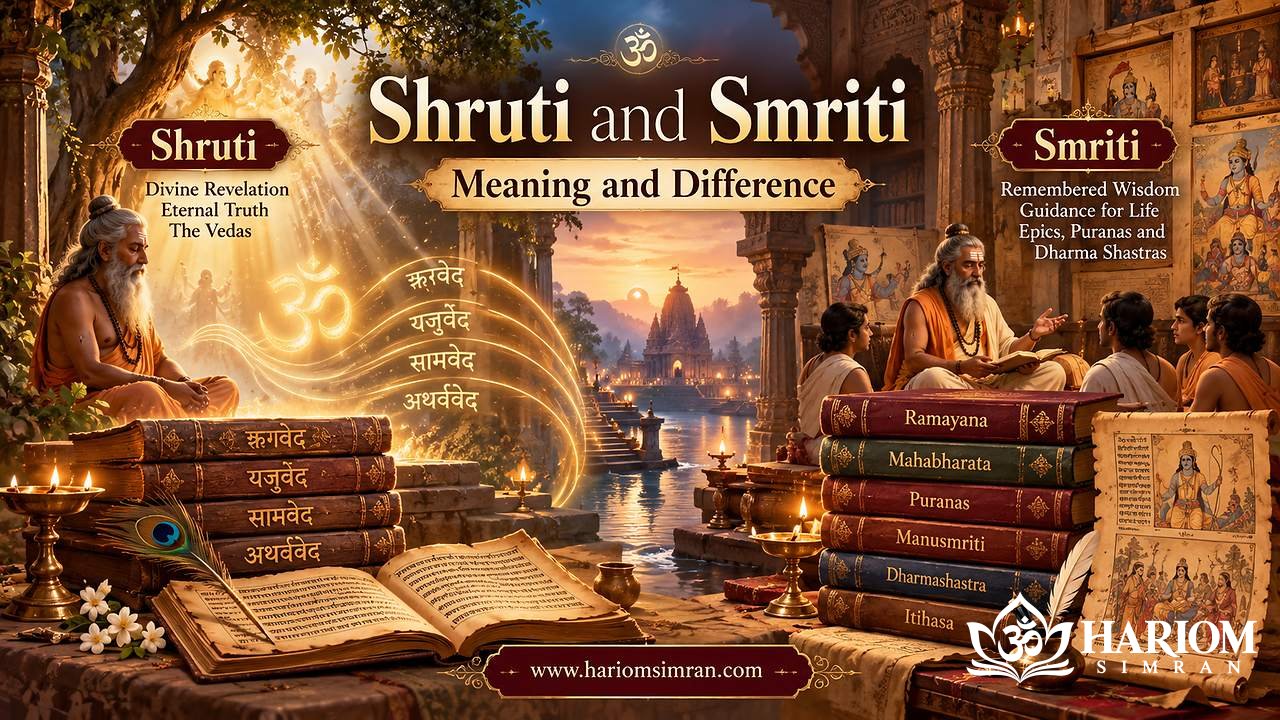
Hinduism has a vast and diverse body of sacred literature.
Unlike religious traditions centered around one single holy book, Hinduism developed through many layers of sacred knowledge, philosophy, ritual traditions, epics, devotional literature, law, stories, and spiritual teachings.
One of the most important ways Hindu texts are traditionally understood is through the distinction between:
Shruti
and
Smriti
These two terms help explain how different Hindu scriptures have been classified and understood.
In simple terms:
Shruti means “That Which Is Heard.”
Smriti means “That Which Is Remembered.”
But the difference goes much deeper than these translations.
Shruti traditionally refers to the Vedic revelation, while Smriti refers to a broad body of remembered, transmitted, interpreted, and composed tradition.
Understanding this distinction gives readers a strong foundation for exploring the Hindu Scriptures tradition in greater depth.
What Is Shruti?
The Sanskrit word Shruti means:
“That Which Is Heard.”
In traditional Hindu understanding, Shruti refers primarily to the Vedas and the literature belonging to the Vedic corpus.
Shruti is traditionally regarded as sacred knowledge that was heard or directly perceived by ancient Rishis, rather than simply invented as ordinary human literature.
The Rishis are therefore often understood as seers of the Vedic Mantras, rather than authors in the modern literary sense.
This traditional understanding gives Shruti a special place within Hindu sacred literature.
Which Scriptures Are Considered Shruti?
The four Vedas form the foundation of Shruti:
- Rigveda
- Samaveda
- Yajurveda
- Atharvaveda
Each Veda developed with different textual layers.
These commonly include:
- Samhitas
- Brahmanas
- Aranyakas
- Upanishads
Together, these form the broader Vedic tradition.
This means Shruti is not limited only to collections of Mantras.
It also contains ritual explanations, symbolic interpretations, contemplative teachings, and profound philosophical inquiry.
We will explore each of these layers separately in future HariOmSimran articles.
The Four Vedas
The four Vedas form the heart of the Shruti tradition.
Rigveda
The Rigveda contains ancient hymns dedicated to various Vedic deities and cosmic principles.
Its hymns explore themes such as:
- Creation
- Prayer
- Sacred Order
- Divine Powers
- Human Aspiration
- Ritual
- Cosmic Mystery
It is one of the foundational texts of the Vedic tradition.
Samaveda
The Samaveda is especially connected with sacred chanting and musical recitation.
Many of its verses are drawn from the Rigvedic tradition, but they are arranged for liturgical singing.
Its importance lies not merely in words, but in the sacred tradition of how those words are sung and transmitted.
Yajurveda
The Yajurveda is closely connected with ritual formulas and the performance of Vedic ceremonies.
It includes instructions and Mantras associated with ritual action.
Different recensions of the Yajurveda preserve important variations within the Vedic tradition.
Atharvaveda
The Atharvaveda contains material connected with many dimensions of life, including prayers, household concerns, healing traditions, protection, royal themes, spiritual reflection, and philosophical ideas.
It shows that Vedic literature was concerned with both sacred ritual and everyday human life.
What Are the Four Layers of Vedic Literature?
A useful way to understand Shruti is through four major textual layers.
1. Samhitas
The Samhitas contain collections of Vedic hymns, Mantras, chants, and sacred formulas.
They form the earliest core collections associated with each Veda.
2. Brahmanas
The Brahmanas explain ritual practices, ceremonial meaning, and the symbolic significance of Vedic sacrifices.
They help readers understand the ritual world connected with the Samhitas.
3. Aranyakas
The Aranyakas, sometimes associated with forest traditions, often move from external ritual toward deeper symbolic and contemplative interpretation.
They can be seen as an important bridge between ritual thought and philosophical reflection.
4. Upanishads
The Upanishads contain some of the deepest philosophical discussions in Hindu thought.
They explore questions such as:
What Is the Self?
What Is Ultimate Reality?
What Is Brahman?
What Is Atman?
What Is Moksha?
What Is the Relationship Between the Individual and Ultimate Reality?
These questions later became central to Vedanta and many other streams of Hindu philosophy.
You can continue exploring this tradition through Hindu Scriptures.
Why Is Shruti Considered Important?
Shruti has traditionally held a foundational position because it represents the Vedic source of Hindu sacred knowledge.
Its importance comes from several factors.
Shruti preserves:
- Ancient Vedic Mantras
- Ritual Traditions
- Sacred Chants
- Cosmological Ideas
- Philosophical Inquiry
- Concepts of Dharma
- Meditative Knowledge
- Teachings About Atman and Brahman
Many later Hindu traditions developed their theology, philosophy, ritual, and interpretation in conversation with the Vedic tradition.
However, different Hindu communities may give different practical emphasis to Shruti in everyday religious life.
A devotee may be deeply influenced by the Bhagavad Gita, Ramayana, Puranas, or devotional literature even if they do not personally study the Vedas in detail.
This distinction between foundational authority and daily religious accessibility is important.
What Does Smriti Mean?
The Sanskrit word Smriti means:
“That Which Is Remembered.”
Smriti refers to a very broad category of Hindu literature transmitted through remembered tradition, interpretation, composition, teaching, and cultural preservation.
Unlike Shruti, Smriti literature is associated more directly with human authorship, sages, compilers, teachers, and traditional transmission.
Smriti is extraordinarily diverse.
It contains some of the most widely read and loved Hindu texts.
Which Hindu Texts Are Considered Smriti?
Smriti is a large category and can include different types of literature.
Important examples include:
- Ramayana
- Mahabharata
- Bhagavad Gita
- Puranas
- Dharma Shastras
- Smriti Texts
- Some Sutra Traditions
- Later Spiritual and Devotional Literature
Different traditions and scholarly systems may classify some texts in more specific ways, so not every Hindu text fits neatly into one simple modern list.
The broad distinction remains useful:
Shruti refers to Vedic revelation.
Smriti refers to remembered and transmitted tradition built around interpretation, narrative, Dharma, philosophy, and practice.
Is the Bhagavad Gita Shruti or Smriti?
The Bhagavad Gita is generally classified within Smriti because it forms part of the Mahabharata.
However, this does not mean it is spiritually unimportant.
The Bhagavad Gita became one of the most influential Hindu texts in history.
It addresses:
- Dharma
- Karma
- Bhakti
- Jnana
- Yoga
- Atman
- Action
- Detachment
- Divine Reality
- Moksha
Its enormous authority demonstrates an important point:
Smriti does not mean “unimportant.”
It simply refers to a different traditional category of sacred literature.
Is the Ramayana Shruti or Smriti?
The Ramayana belongs broadly to the Smriti tradition.
Traditionally attributed to Maharishi Valmiki, it tells the sacred story of Shri Rama and explores themes such as:
- Dharma
- Duty
- Family
- Leadership
- Devotion
- Sacrifice
- Loyalty
- Courage
- Righteous Conduct
The Ramayana has shaped Hindu religious and cultural life for generations.
Its influence extends far beyond literary study.
It appears in:
Temple traditions
Festivals
Bhajans
Drama
Storytelling
Family teachings
Regional literature
and
Devotional practice
This shows how strongly Smriti literature can shape lived Hindu tradition.
Is the Mahabharata Shruti or Smriti?
The Mahabharata is also generally understood within the Smriti tradition.
Traditionally associated with Maharishi Vyasa, it is one of the world's great epic traditions.
The Mahabharata explores complex questions about:
- Dharma
- Justice
- Leadership
- Family Conflict
- Duty
- Power
- War
- Loyalty
- Human Weakness
- Spiritual Wisdom
Rather than presenting Dharma as always simple, the Mahabharata repeatedly shows how difficult ethical decisions can become when responsibilities conflict.
Its most famous spiritual dialogue is the Bhagavad Gita.
Explore related sacred traditions through the Hindu Stories section.
Are the Puranas Smriti?
Yes, the Puranas are generally included within the broader Smriti tradition.
The Puranas preserve an enormous range of religious knowledge.
They may include:
- Stories of Deities
- Cosmology
- Genealogies
- Sacred Geography
- Pilgrimage Traditions
- Creation Narratives
- Dharma
- Bhakti
- Temple Traditions
- Spiritual Teachings
Major Puranic traditions include texts associated with Vishnu, Shiva, Devi, Krishna, sacred places, and many other aspects of Hindu religious life.
They have played an especially important role in communicating sacred teachings through narrative.
Readers can explore Hindu Divine traditions through Deities.
Shruti and Smriti: What Is the Main Difference?
The simplest distinction is:
Shruti
That Which Is Heard
Traditionally associated with sacred Vedic revelation.
Smriti
That Which Is Remembered
Associated with remembered, interpreted, transmitted, and composed sacred tradition.
But there are several important differences.
| Aspect | Shruti | Smriti |
|---|---|---|
| Meaning | That Which Is Heard | That Which Is Remembered |
| Core Tradition | Vedic Revelation | Remembered and Transmitted Tradition |
| Major Examples | Vedas and Vedic Corpus | Ramayana, Mahabharata, Puranas, Dharma Texts |
| Traditional Status | Foundational Vedic Authority | Derived and Interpretive Tradition |
| Style | Hymns, Ritual, Philosophy, Contemplation | Epics, Stories, Dharma, Philosophy, Devotion |
| Transmission | Strong Oral Preservation | Oral and Written Transmission |
| Practical Role | Foundational Sacred Knowledge | Applies, Explains, Narrates, and Transmits Teachings |
This table gives a useful overview, but Hindu textual traditions are complex and should not be reduced to a rigid modern hierarchy.
Is Shruti More Important Than Smriti?
Traditionally, Shruti has a higher foundational status in many systems of Hindu interpretation.
However, saying simply:
“Shruti is important and Smriti is less important”
would be misleading.
Smriti texts have profoundly shaped everyday Hindu life.
For many devotees, texts such as:
Bhagavad Gita
Ramayana
Mahabharata
and
Puranas
may be more familiar in daily religious practice than direct Vedic study.
So two things can be true at the same time:
Shruti can hold foundational scriptural authority.
And:
Smriti can have enormous spiritual, devotional, cultural, and practical influence.
How Are Shruti and Smriti Connected?
Shruti and Smriti should not necessarily be understood as competing categories.
Smriti often helps explain, interpret, expand, narrate, or apply principles associated with the broader Hindu tradition.
For example:
The Vedic tradition contains foundational concepts.
Later texts explore those concepts through:
Stories
Dialogues
Philosophy
Ethics
Devotional Traditions
Social Teachings
Spiritual Practice
In this way, Hindu sacred knowledge develops as an interconnected tradition rather than simply as isolated books.
Shruti, Smriti and Dharma
The concept of Dharma appears across Hindu sacred literature.
Shruti contains early Vedic foundations connected with sacred order, ritual, and right conduct.
Smriti literature develops Dharma in many different contexts.
For example:
The Ramayana explores Dharma through Shri Rama and other characters.
The Mahabharata explores Dharma through difficult moral conflicts.
The Bhagavad Gita discusses Dharma in relation to responsibility, action, spiritual knowledge, and liberation.
Dharma texts discuss social, ethical, ritual, and legal traditions within their historical contexts.
To understand the concept in greater depth, explore the HariOmSimran guide to Dharma.
Shruti, Smriti and the Oral Tradition
One of the most remarkable aspects of Hindu sacred history is the importance of oral transmission.
For generations, Vedic knowledge was preserved through highly disciplined systems of memorization and recitation.
The preservation of:
- Pronunciation
- Accent
- Sound
- Sequence
- Rhythm
- Recitation Pattern
was considered extremely important.
Different methods of Vedic recitation developed to help preserve textual accuracy.
This reminds us that Hindu sacred knowledge was not preserved only by writing books.
It was also preserved through:
Teacher and Student
Guru and Shishya
Listening
Memorization
Recitation
and
Living Tradition
Why Does Sound Matter in Shruti?
The word Shruti itself emphasizes hearing.
In the Vedic tradition, sacred sound carries special significance.
A Vedic Mantra is not treated only as ordinary written information.
Its pronunciation, rhythm, accent, and traditional recitation can be important parts of its transmission.
This helps explain why Vedic education historically placed great emphasis on listening carefully and repeating accurately.
The relationship between sacred sound and spiritual practice continues in many Hindu traditions today.
You can explore Mantra traditions through the Mantras section.
Does Smriti Change Over Time?
Smriti is closely connected with remembered and interpreted tradition.
This means historical context becomes especially important.
Different Smriti texts emerged in different times and social circumstances.
Their teachings may address:
- Dharma
- Family
- Society
- Law
- Leadership
- Ritual
- Devotion
- Ethics
Because Hindu history spans many centuries and regions, the application and interpretation of Smriti traditions have also varied.
This is especially important when reading Dharma Shastra or historical social texts.
A statement from one historical text should not automatically be presented as a rule followed identically by every Hindu community in every period.
HariOmSimran will therefore explain such texts with historical and philosophical context rather than treating them as timeless social instructions without explanation.
Are All Smriti Texts Equally Authoritative?
No.
Smriti is an extremely broad category.
Different traditions give different texts different levels of importance.
For example:
A Vaishnava community may place strong emphasis on certain Vaishnava texts.
A Shaiva tradition may prioritize Shaiva scriptures and commentarial traditions.
A Shakta tradition may emphasize Devi-centered literature.
Different Vedanta traditions may interpret the Bhagavad Gita and Upanishads through different philosophical commentaries.
Regional traditions may also have beloved sacred literature in Sanskrit or other Indian languages.
Therefore, there is no single universal ranking of every Smriti text that represents all Hindu traditions.
Shruti, Smriti and Hindu Diversity
Understanding Shruti and Smriti also helps explain why Hinduism has such a diverse scriptural tradition.
Hindu sacred literature includes:
Vedic Hymns
Philosophical Dialogues
Epic Narratives
Devotional Stories
Temple Traditions
Dharma Literature
Yoga Texts
Philosophical Sutras
Bhakti Poetry
Different traditions use these forms in different ways.
This diversity does not necessarily mean the tradition has no structure.
Shruti and Smriti provide one important framework for understanding that structure.
Does Hinduism Have One Holy Book?
No single text functions as the only holy book for all Hindu traditions.
This is one of the major differences between Hinduism and religions centered around one canonical scripture.
Hindu sacred knowledge developed through a large family of texts.
The Vedas hold foundational importance as Shruti.
At the same time, texts such as the Bhagavad Gita, Ramayana, Mahabharata, Puranas, Agamas, Sutras, and devotional works have shaped Hindu thought and practice in profound ways.
This is why asking:
“What is the Hindu holy book?”
often requires a more detailed answer.
A better question is:
“What are the major Hindu scriptures, and what role does each tradition play?”
That is the approach HariOmSimran uses in its Hindu Scriptures knowledge library.
Shruti and Smriti in Hindu Philosophy
The distinction between Shruti and Smriti became especially important in philosophical interpretation.
Different Hindu schools developed ways of interpreting scriptural authority.
For example, Vedanta traditions give great importance to texts such as:
Upanishads
Bhagavad Gita
and
Brahma Sutras
Together, these are often discussed within the broader Vedantic scriptural tradition.
However, different Vedanta schools interpret them differently.
Advaita, Vishishtadvaita, Dvaita, and other traditions do not necessarily agree on every philosophical conclusion.
This reminds us that sharing sacred texts does not always mean sharing the same interpretation.
Shruti and the Upanishads
The Upanishads are particularly important because they represent the philosophical and contemplative dimension of the Vedic tradition.
They investigate questions such as:
What Is Reality?
What Is Consciousness?
What Is Atman?
What Is Brahman?
What Happens When Ignorance Is Removed?
What Is Spiritual Liberation?
These questions influenced centuries of Hindu philosophical development.
Future HariOmSimran articles will explore the principal Upanishads individually and explain their teachings in accessible language.
Smriti and the Bhagavad Gita
The Bhagavad Gita provides an excellent example of how a Smriti text can achieve extraordinary spiritual authority.
Set within the Mahabharata, the Gita presents a dialogue between Shri Krishna and Arjuna.
It addresses:
Dharma
Karma
Bhakti
Knowledge
Meditation
Atman
Divine Reality
and
Moksha
Its teachings have been interpreted by numerous Hindu philosophical traditions.
Different commentators may disagree on philosophical details while still treating the Gita as a deeply important spiritual text.
Smriti and Sacred Stories
Smriti literature often communicates spiritual wisdom through stories.
Stories can make complex ideas easier to remember and understand.
Through sacred narratives, people encounter themes such as:
- Dharma
- Bhakti
- Courage
- Compassion
- Sacrifice
- Ego
- Justice
- Devotion
- Spiritual Transformation
This is one reason stories have remained such an important way of transmitting Hindu knowledge across generations.
Explore traditional narratives through Hindu Stories.
Shruti and Smriti in Daily Hindu Life
Most people do not divide every daily religious activity into “Shruti” and “Smriti.”
These categories are especially useful for understanding scriptural tradition.
Daily Hindu life may combine teachings drawn from many sources.
A family might:
Recite a Vedic Mantra
Read the Bhagavad Gita
Listen to the Ramayana
Perform Puja
Visit a Temple
Celebrate Diwali
Sing Bhajans
Listen to a Guru or Spiritual Teacher
These practices may draw from different layers of Hindu tradition.
Together, they form a living religious culture.
Explore related practices through Temples, Festivals, and Mantras.
Common Misunderstandings About Shruti and Smriti
Misunderstanding 1: Smriti Means Unimportant
This is incorrect.
Some of Hinduism's most influential texts belong broadly to the Smriti tradition.
Misunderstanding 2: Shruti Means One Single Book
Shruti refers to the Vedic corpus, not one single modern book.
Misunderstanding 3: Every Hindu Studies the Vedas Directly
Not necessarily.
Hindu religious life has always included many forms of transmission, including stories, Puja, Bhakti, festivals, temple traditions, and regional teachings.
Misunderstanding 4: Every Smriti Text Has the Same Authority
No.
Different texts have different roles and importance across traditions.
Misunderstanding 5: Hindu Scripture Has No Structure
Hindu scripture is diverse, but that does not mean it is unstructured.
Shruti and Smriti are among the important frameworks used to understand its organization.
Why Shruti and Smriti Still Matter Today
Understanding Shruti and Smriti helps modern readers avoid several common mistakes.
It prevents us from treating every Hindu text as though it has exactly the same role.
It helps explain why the Vedas hold a special foundational place.
It also helps us understand why the Bhagavad Gita, Ramayana, Mahabharata, Puranas, and other traditions remain deeply influential.
Most importantly, the distinction reveals that Hindu sacred knowledge developed through multiple forms:
Revelation
Oral Preservation
Reflection
Interpretation
Storytelling
Philosophy
Devotion
and
Living Practice
This layered structure is one of the defining features of Hindu scriptural tradition.
Explore Hindu Scriptures With HariOmSimran
HariOmSimran is developing its Scripture section as an interconnected Hindu knowledge library.
Continue exploring:
The next Scripture articles will explore the Vedas, Four Vedas, Vedic Literature, Upanishads, Ramayana, Mahabharata, Bhagavad Gita, Puranas, Agamas, Darshanas, and Vedangas in greater depth.
Learn • Explore • Understand • Preserve
Key Takeaway
Shruti and Smriti are two important traditional categories for understanding Hindu sacred literature.
Shruti means “That Which Is Heard” and primarily refers to the Vedic revelation, including the Vedas and their associated textual traditions.
Smriti means “That Which Is Remembered” and includes a broad range of remembered and transmitted Hindu literature such as the Ramayana, Mahabharata, Bhagavad Gita, Puranas, and Dharma traditions.
Shruti traditionally holds foundational Vedic authority, while Smriti helps interpret, communicate, apply, and preserve Hindu teachings through philosophy, stories, ethics, devotion, and lived tradition.
Together, they help us understand the remarkable depth and diversity of Hindu sacred knowledge.
Key Teachings
This scripture reveals profound wisdom and guidance for our spiritual journey. Below are the key teachings and principles derived from this sacred text.
Core Principles
These teachings provide guidance for living a life of faith, compassion, and spiritual growth.
- Spiritual Growth
- Divine Wisdom
- Sacred Teachings
- Faith Journey

Study Resources
Explore these resources to deepen your understanding of this scripture and apply its teachings to your daily life.
📖 Study Guide
Comprehensive study materials to help you understand the context, meaning, and application of this scripture.
🙏 Reflection Questions
Thought-provoking questions to help you reflect on the teachings and apply them to your personal spiritual journey.
📝 Journal Prompts
Guided journaling prompts to help you document your insights, prayers, and spiritual growth.
👥 Discussion Topics
Engaging discussion topics for group study and fellowship, fostering deeper understanding and community.
Frequently Asked Questions
Shruti means “That Which Is Heard” and primarily refers to the Vedic revelation. Smriti means “That Which Is Remembered” and refers broadly to remembered, transmitted, interpreted, and composed Hindu tradition.
The four Vedas Rigveda, Samaveda, Yajurveda, and Atharvaveda—belong to the Shruti tradition and form the foundation of Vedic sacred literature.
The Bhagavad Gita is generally classified within Smriti because it forms part of the Mahabharata. Despite this classification, it is one of the most influential spiritual texts in Hinduism.
Both the Ramayana and Mahabharata are generally understood within the Smriti tradition. They communicate Dharma, spiritual wisdom, devotion, and ethical teachings through epic narratives.
Shruti traditionally holds foundational scriptural authority, but Smriti texts have enormous spiritual, cultural, ethical, and devotional importance. Their roles are different rather than simply “important” versus “unimportant.”
Understanding Shruti and Smriti helps readers see how Hindu scriptures are organized, why the Vedas have a special foundational status, and how later sacred literature communicates and develops Hindu philosophy, Dharma, devotion, and spiritual practice.