What makes a human life meaningful?
Should we focus only on spiritual growth?
Is earning wealth wrong?
Can relationships, happiness, and enjoyment also be part of a spiritual life?
And how do we balance personal desires with responsibility?
Hindu philosophy explores these questions through an important framework known as the Purusharthas.
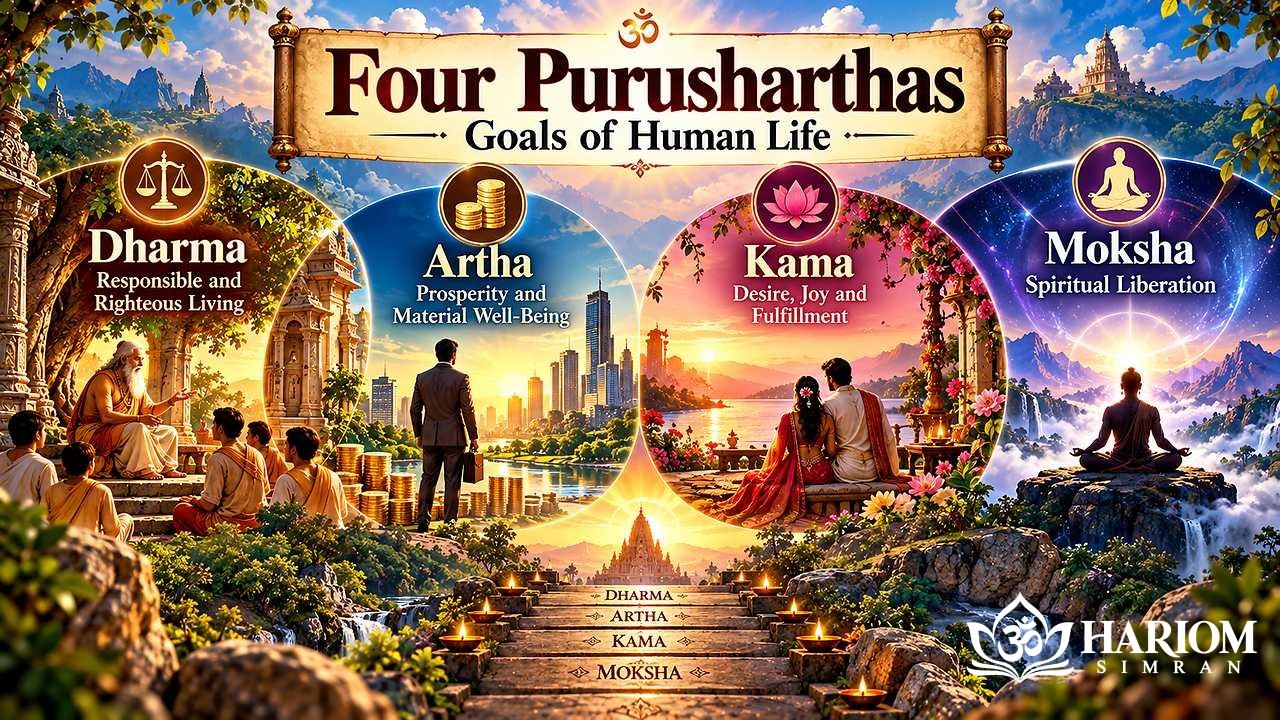
The four Purusharthas are:
- Dharma — Responsible and Righteous Living
- Artha — Prosperity and Material Well-Being
- Kama — Legitimate Desire, Joy, and Fulfillment
- Moksha — Spiritual Liberation
Together, these four goals offer a balanced understanding of human life.
They recognize that people live within families, careers, relationships, communities, and material circumstances while also having the capacity for spiritual growth.
The message is not that ordinary life must be rejected.
The deeper question is:
How can ordinary life be lived wisely, responsibly, and spiritually?
If you are beginning your study of Hindu philosophy, start with What Is Hinduism? Meaning, Beliefs, Origins & Core Teachings.
What Does Purushartha Mean?
The Sanskrit term Purushartha is commonly understood as a goal, purpose, or aim of human life.
The four Purusharthas help explain different dimensions of human existence.
They are not four completely separate goals.
They are connected.
A person needs ethical direction.
A family may need financial stability.
Human beings naturally seek love, companionship, beauty, comfort, and happiness.
At the same time, Hindu philosophy also asks whether human life has a deeper spiritual purpose beyond temporary success and enjoyment.
The four Purusharthas are:
- Dharma
- Artha
- Kama
- Moksha
Together, they help us reflect on one of life's most important questions:
How can we live responsibly, meaningfully, and spiritually?
1. Dharma — The Foundation of Responsible Living
Dharma is one of the most important concepts in Hindu philosophy.
There is no single English word that fully captures its meaning.
Depending on the context, Dharma may refer to:
- Righteous Conduct
- Responsibility
- Ethical Living
- Justice
- Proper Action
- Duty
- Spiritual Principles
- The Order That Supports Life
Dharma provides ethical direction.
It helps us think about not only what we want, but also what is right.
This is especially important when we pursue the other goals of life.
In simple terms:
Artha should ideally be pursued through Dharma.
Kama should ideally remain guided by Dharma.
This means that wealth and enjoyment are not automatically rejected.
What matters is how they are pursued.
A person may earn money honestly or dishonestly.
A person may enjoy relationships responsibly or selfishly.
A person may use power to help others or exploit them.
Dharma helps us distinguish between these possibilities.
To understand Dharma in greater depth, explore the HariOmSimran guide to Dharma.
Why Does Dharma Come First?
Imagine a person becomes wealthy through dishonesty, exploitation, or deception.
Financially, that person may appear successful.
But from a Dharmic perspective, the way that wealth was obtained also matters.
The same principle applies to desire.
Enjoying life is not automatically wrong.
But pursuing pleasure without considering its effect on others can lead to selfishness and harm.
Dharma encourages us to ask:
Is this action honest?
Is it fair?
Am I fulfilling my responsibilities?
Does this unnecessarily harm someone?
Am I acting from wisdom, or only from greed and ego?
This is why Dharma acts as a moral foundation for the other Purusharthas.
2. Artha — Prosperity and Material Well-Being
Artha refers to the material resources and practical stability needed to live in the world.
It can include:
- Livelihood
- Financial Security
- Wealth
- Property
- Professional Success
- Resources
- Social Stability
- Material Support for Family Life
Hindu philosophy does not automatically treat earning money as spiritually wrong.
Material resources are part of ordinary life.
A family needs food.
Children need education.
People need housing.
Communities require institutions.
Charitable work also needs resources.
The deeper question is not:
“Should a person have wealth?”
The better question is:
“How is that wealth earned, used, and understood?”
Is Wealth Wrong in Hinduism?
No.
Artha is itself recognized as one of the legitimate goals of human life.
The problem begins when wealth becomes disconnected from Dharma.
Money can be used for:
- Family Welfare
- Education
- Healthcare
- Community Development
- Temple Support
- Charity
- Seva
- Preserving Knowledge
- Creating Opportunities for Others
But wealth can also become a source of greed, exploitation, pride, and attachment.
The issue is therefore not simply possession.
The deeper issue is our relationship with possession.
Artha and Responsibility
A balanced approach to Artha encourages both practical stability and ethical responsibility.
A person may ask:
Am I earning honestly?
Am I providing responsibly for my family?
Am I harming others for financial gain?
Do I use everything only for myself?
Can some of my resources help others?
These questions transform Artha from simple accumulation into responsible prosperity.
3. Kama — Desire, Joy, and Fulfillment
The word Kama is often misunderstood.
Many people reduce it only to sexual desire.
However, within the broader Purushartha framework, Kama has a much wider meaning.
It may include:
- Love
- Affection
- Relationships
- Companionship
- Beauty
- Music
- Art
- Joy
- Emotional Fulfillment
- Legitimate Pleasure
Human beings naturally seek happiness.
We form relationships.
We appreciate beauty.
We enjoy festivals, music, art, food, friendship, and family life.
Hindu philosophy recognizes this human dimension rather than pretending desire does not exist.
Is Desire Wrong in Hinduism?
Not necessarily.
The important question is whether desire is healthy, balanced, and responsible.
A desire can be natural.
But when desire becomes uncontrolled attachment, obsession, or selfishness, it can create suffering.
This distinction is important.
The goal is not always to reject enjoyment.
Instead, Hindu philosophy encourages us to ask whether we are enjoying life consciously or being controlled by our desires.
Kama Under the Guidance of Dharma
Kama becomes balanced when it remains within an ethical framework.
For example:
Love should involve respect.
Relationships should involve responsibility.
Personal enjoyment should not depend on exploiting someone else.
Pleasure should not automatically override family or social responsibilities.
This leads to an important principle:
Dharma should guide Kama.
Enjoyment can be part of a meaningful life without becoming the entire purpose of life.
4. Moksha — Spiritual Liberation
Moksha is the fourth Purushartha and is considered by many Hindu traditions to be the highest spiritual goal.
Moksha means liberation or spiritual freedom.
It is commonly associated with freedom from:
- Samsara
- Spiritual Ignorance
- Attachment
- Bondage
- False Identification
- Limitations That Prevent Spiritual Realization
Dharma, Artha, and Kama are closely connected with life in the world.
Moksha asks something deeper:
Is there a form of freedom beyond temporary success, possessions, and pleasure?
Everything in worldly life changes.
Money can be gained and lost.
Relationships change.
The body ages.
Status changes.
Pleasure passes.
Moksha points toward spiritual freedom that does not depend entirely on temporary conditions.
Why Is Moksha Different?
Artha can improve material circumstances.
Kama can provide joy.
Dharma can guide responsible living.
Moksha, however, concerns spiritual liberation itself.
A person may have wealth, family, comfort, and success and still ask:
Who am I ultimately?
What is permanent?
Why does attachment create suffering?
What is the true nature of the Self?
What is my relationship with the Divine?
These questions move beyond ordinary achievement and enter the realm of spiritual inquiry.
You can explore these ideas more deeply through Hindu Scriptures.
How Are the Four Purusharthas Connected?
The Purusharthas become much easier to understand when we see them together.
Dharma
How Should I Live?
Artha
What Practical Resources Do I Need?
Kama
What Brings Legitimate Joy and Fulfillment?
Moksha
What Is Ultimate Spiritual Freedom?
These goals do not always oppose one another.
They can support one another when approached wisely.
For example, a person may earn income through honest work.
That is:
Artha Guided by Dharma
They may use that income to care for their family or support others.
That connects:
Artha, Dharma, and Seva
They may enjoy relationships, celebrations, music, and family life.
That can be:
Kama Within Dharma
At the same time, they may pray, study sacred teachings, meditate, or practice Bhakti.
That opens the path toward:
Moksha
This is a balanced understanding of life.
Does Moksha Mean Artha and Kama Are Unimportant?
Not necessarily.
The Purushartha framework recognizes that people have different responsibilities.
A householder may need to earn money.
A parent must care for children.
Families form relationships and celebrate important occasions.
Communities require material support.
Spiritual growth can happen within this ordinary life.
The problem begins when Artha or Kama become the only goals.
If wealth becomes the entire purpose of life, greed can grow.
If pleasure becomes the only goal, responsibility can disappear.
Moksha reminds us that human existence may have a deeper spiritual dimension.
Dharma as the Balancing Principle
Dharma plays a special role among the four Purusharthas.
Without Dharma:
Artha Can Become Greed
Kama Can Become Uncontrolled Desire
With Dharma:
Artha Can Support Family, Society, and Seva
Kama Can Remain Connected With Respect and Responsibility
Moksha then provides a deeper spiritual direction.
This is why the Purushartha framework is not simply a list of four goals.
It is a framework of balance.
Purusharthas in Everyday Life
The four Purusharthas can be applied to ordinary decisions.
Imagine someone receives a job offer with a higher salary but less time for family.
The decision may involve:
Artha — Financial Stability
Dharma — Responsibility Toward Family
Kama — Personal Satisfaction
and perhaps:
Spiritual Priorities
There may not be one answer that is correct for everyone.
The value of the Purushartha framework is that it helps us recognize all the dimensions involved.
Purusharthas and Family Life
Family life provides a practical example of how the Purusharthas can work together.
A parent may pursue Artha to provide:
- Food
- Shelter
- Education
- Security
Family life can also include Kama in the broader sense:
- Love
- Affection
- Companionship
- Joy
At the same time, family life requires Dharma:
- Responsibility
- Care
- Patience
- Honesty
- Sacrifice
A spiritually aware household may also include prayer, Puja, sacred learning, Seva, and reflection.
In this way, ordinary family life can involve all four Purusharthas.
Purusharthas and Work
Work is another useful example.
Many people think of employment only as a way to earn money.
The Purushartha framework encourages deeper reflection.
Artha
Does My Work Provide a Stable Livelihood?
Dharma
Is My Work Honest and Responsible?
Kama
Does It Provide Satisfaction, Creativity, or Meaningful Relationships?
Moksha
Does My Career Completely Define Who I Am, or Do I Recognize a Deeper Spiritual Dimension to Life?
These questions make the Purushartha framework relevant even in modern professional life.
Purusharthas and Wealth
Wealth becomes especially interesting when viewed through all four goals.
Artha recognizes the importance of material stability.
Dharma asks how money is earned and used.
Kama allows resources to support legitimate enjoyment.
Moksha reminds us that wealth is not the final purpose of existence.
A balanced approach may include:
- Earning Responsibly
- Saving Wisely
- Supporting Family
- Enjoying Life Without Excess
- Helping Others
- Avoiding Greed
- Remembering That Possessions Are Temporary
Hindu philosophy does not necessarily require poverty for spirituality.
It asks for wisdom in our relationship with material life.
Purusharthas and Hindu Festivals
Hindu festivals often bring several Purusharthas together naturally.
During a festival, families may:
- Perform Puja
- Spend Time Together
- Prepare Food
- Give Gifts
- Decorate Their Homes
- Visit Temples
- Support Charity
- Listen to Sacred Stories
These activities can reflect:
Dharma Through Worship and Responsibility
Artha Through Material Preparation and Giving
Kama Through Joy, Beauty, and Celebration
Moksha Through Spiritual Reflection
Explore more Hindu traditions through Festivals.
Purusharthas and Hindu Scriptures
Ideas related to Dharma, Artha, Kama, and Moksha appear across a wide range of Hindu texts and traditions.
The Mahabharata repeatedly explores Dharma and difficult moral decisions.
The Bhagavad Gita examines action, responsibility, attachment, and spiritual liberation.
The Upanishads explore the Self and ultimate reality.
Other Hindu traditions discuss household life, ethical conduct, governance, devotion, and liberation.
This breadth shows that Hindu philosophy is not only concerned with escaping the world.
It also asks:
How Should Life in the World Be Lived?
Explore these teachings through Hindu Scriptures.
Purusharthas and the Bhagavad Gita
The Bhagavad Gita does not simply present the four Purusharthas as a modern checklist.
However, its teachings directly engage with several questions connected to this framework.
Arjuna faces a crisis involving:
- Dharma
- Responsibility
- Action
- Attachment
- Spiritual Liberation
Shri Krishna teaches the importance of acting without excessive attachment to personal results.
This gives us an important insight:
Participation in life and spiritual growth do not always have to oppose each other.
A person can act responsibly while also developing inner detachment and spiritual awareness.
Purusharthas and the Ashramas
The Purusharthas are often discussed alongside the traditional Ashrama system.
The four Ashramas are commonly described as:
- Brahmacharya — Student Stage
- Grihastha — Householder Stage
- Vanaprastha — Gradual Withdrawal or Transition
- Sannyasa — Renunciation
These ideas should not be treated as rigid rules that every Hindu follows in exactly the same way today.
However, historically and philosophically, they offer another framework for understanding how priorities can change throughout life.
For example, the householder stage naturally involves major responsibilities related to Dharma, Artha, and Kama.
Later life may place increasing emphasis on Moksha and spiritual reflection.
HariOmSimran will explore the four Ashramas separately in a dedicated article.
Are the Four Purusharthas Equally Important?
Different Hindu traditions may emphasize them differently.
A common interpretation is:
Dharma Guides Life
Artha and Kama Support Legitimate Worldly Living
Moksha Represents the Highest Spiritual Freedom
This does not mean everyone must immediately abandon practical responsibilities to pursue Moksha.
Hindu traditions recognize many forms of spiritual life, including householders, devotees, teachers, and renunciants.
A person's responsibilities and spiritual path can vary.
Context matters.
Are Artha and Kama Obstacles to Moksha?
Not automatically.
They may become obstacles when excessive attachment develops.
Money is not the same as greed.
Pleasure is not the same as addiction.
Relationships are not automatically spiritual bondage.
The real question is whether these experiences control us and prevent deeper understanding.
A person can participate fully in family and professional life while gradually developing:
- Self-Discipline
- Bhakti
- Seva
- Wisdom
- Detachment
- Spiritual Awareness
Bhakti and the Purusharthas
For many Hindus, Bhakti brings daily life into relationship with the Divine.
A devotee may:
Work honestly.
Care for family.
Enjoy festivals.
Perform Puja.
Repeat Mantras.
Serve others.
Remember Bhagwan.
Through Bhakti, ordinary actions can take on deeper spiritual meaning.
Different Hindu traditions understand and worship the Divine in different ways.
Explore them through Deities.
Mantra, Puja, and Spiritual Balance
Practices such as Puja, Prayer, Japa, and Mantra can create space for spiritual reflection within a busy life.
A person may be occupied with:
- Work
- Family
- Finances
- Responsibilities
Yet still maintain a spiritual routine.
Even a short period of prayer, meditation, or Mantra practice can remind us that life is more than material achievement.
Explore sacred sounds and devotional practices through Mantras.
Seva and the Four Goals
Seva creates an especially meaningful connection between material life and spiritual values.
Suppose someone develops financial stability through Artha.
They may then use part of their time, resources, or knowledge to help others.
In this way:
Artha Can Serve Dharma
Seva can also reduce excessive self-centeredness and support spiritual growth.
Service may include:
- Helping Someone in Need
- Supporting Education
- Caring for Elders
- Serving at a Temple
- Feeding People
- Sharing Useful Knowledge
- Volunteering
- Using Professional Skills to Help Others
Spirituality becomes practical when values influence action.
Purusharthas Are About Balance, Not Perfection
One of the most helpful ways to understand the Purusharthas is through balance.
People do not always make perfect decisions.
Sometimes money receives too much attention.
Sometimes responsibilities are neglected.
Sometimes desire becomes stronger than wisdom.
Sometimes spiritual life receives very little time.
The Purusharthas provide a framework for reflection.
We can ask ourselves:
Is My Life Balanced?
Am I Pursuing Prosperity Ethically?
Are My Desires Controlling Me?
Am I Fulfilling My Responsibilities?
Am I Making Space for Spiritual Growth?
These questions can be revisited throughout life.
Why the Four Purusharthas Still Matter Today
Modern life is full of competing priorities.
People constantly try to balance:
- Career
- Money
- Relationships
- Family
- Enjoyment
- Inner Peace
- Spiritual Meaning
The Purushartha framework speaks directly to this challenge.
Dharma says:
Live Responsibly.
Artha says:
Build the Practical Stability Needed for Life.
Kama says:
Recognize Legitimate Joy and Fulfillment.
Moksha says:
Do Not Forget the Deeper Spiritual Purpose of Life.
Together, they provide a view of human life that is neither purely material nor entirely world-rejecting.
It is a search for:
Balance, Responsibility, Meaning, and Spiritual Depth.
Explore Hindu Philosophy With HariOmSimran
HariOmSimran is building an interconnected Hindu knowledge platform where readers can move naturally from foundational concepts to deeper philosophy, scriptures, worship, and traditions.
Continue exploring:
Future Hinduism articles will explore the Four Ashramas, Paths of Yoga, Atman, Brahman, Bhakti, Puja, and Moksha in greater depth.
Learn • Explore • Understand • Preserve
Key Takeaway
The Four Purusharthas provide a Hindu framework for understanding a balanced and meaningful human life.
Dharma — Live Responsibly and Ethically
Artha — Build Legitimate Prosperity and Material Stability
Kama — Experience Responsible Joy, Relationships, and Fulfillment
Moksha — Move Toward Spiritual Freedom
The deeper teaching is not that material life must always be rejected.
Instead:
Artha and Kama should ideally remain guided by Dharma, while Moksha reminds us that human life has a spiritual dimension beyond temporary success and pleasure.