

He is worshipped as Mahadeva, the Great God, and is associated with profound themes such as:
- Transformation
- Meditation
- Detachment
- Compassion
- Destruction of ignorance
- Spiritual knowledge
- Time
- Yoga
- Cosmic balance
- Inner stillness
Shiva can appear in many seemingly opposite forms.
He is an ascetic absorbed in meditation.
He is also a loving husband and father.
He is associated with cremation grounds, yet he is worshipped as the source of auspiciousness.
He represents stillness, yet as Nataraja he performs the cosmic dance.
He destroys, yet his destruction is often understood not simply as an ending but as part of transformation and renewal.
This combination makes Shiva one of the deepest and most philosophically rich Divine figures in Hinduism.
To understand the wider Hindu Divine tradition, explore Deities.
Who Is Lord Shiva?
Lord Shiva is a major deity in Hinduism and the central Divine reality of Shaivism, one of Hinduism's major traditions.
The Sanskrit word Shiva is commonly associated with meanings such as:
Auspicious
Gracious
Benevolent
Shiva is known by many names, each expressing a particular aspect of his Divine nature.
Some widely known names include:
- Mahadeva: The Great God
- Maheshvara: The Great Lord
- Shankara: One who brings auspiciousness or well-being
- Shambhu: Source of happiness or benevolence
- Bholenath: The innocent or easily pleased Lord in popular devotional tradition
- Pashupati: Lord of beings
- Neelkanth: The blue-throated one
- Nataraja: Lord of Dance
- Dakshinamurti: Shiva as the spiritual teacher
- Rudra: A powerful Vedic Divine form closely connected with later Shiva traditions
Different Shaiva traditions may understand Shiva's ultimate nature in different theological and philosophical ways.
Shiva in Hinduism
Shiva occupies an important place across Hindu traditions.
For devotees within many Shaiva traditions, Shiva is not simply one deity among many.
He may be understood as:
- Supreme Reality
- Supreme Lord
- Source of creation
- Preserver of cosmic order
- Transformer of the universe
- Inner Self
- Lord of Yoga
- Source of spiritual knowledge
Other Hindu traditions may understand Shiva in relation to Vishnu, Devi or Brahman differently.
HariOmSimran should therefore present these teachings without suggesting that every Hindu philosophical tradition defines Shiva in exactly the same way.
Shiva and the Trimurti
Shiva is popularly associated with the Trimurti, a theological framework involving:
- Brahma: Creation
- Vishnu: Preservation
- Shiva: Transformation or dissolution
This framework is useful for understanding one major Hindu theological model.
However, Hindu traditions are diverse.
Shaiva scriptures and traditions may present Shiva as the Supreme Reality from whom creation, preservation and dissolution all arise.
Similarly, Vaishnava and Shakta traditions may interpret ultimate reality through their own theological frameworks.
The Trimurti should therefore be explained as an important Hindu concept, not as the only possible Hindu understanding of the Divine.
What Does Shiva Represent?
Lord Shiva carries several layers of meaning.
Among the most important are:
- Transformation: What has completed its purpose must sometimes change.
- Detachment: Freedom from excessive attachment to temporary things.
- Meditation: Turning inward toward deeper awareness.
- Knowledge: Destruction of spiritual ignorance.
- Compassion: Shiva repeatedly appears in sacred narratives as responding to devotees and protecting creation.
- Balance: Ascetic life and family life appear together in Shiva.
- Fearlessness: Shiva is associated with realities that humans often fear, including death and impermanence.
- Inner Silence: His meditative form points toward spiritual stillness.
These themes explain why Shiva remains meaningful to devotees, philosophers, Yogis and spiritual seekers.
Shiva as Mahadeva
One of Shiva's most famous names is Mahadeva.
It means broadly:
The Great God
or
The Great Divine Lord
The title reflects Shiva's supreme status in Shaiva traditions.
Devotees commonly address Shiva as:
Har Har Mahadev
The devotional expression celebrates Shiva and the greatness of the Divine.
Interpretations and devotional uses may vary across regions and communities.
Shiva as Mahayogi
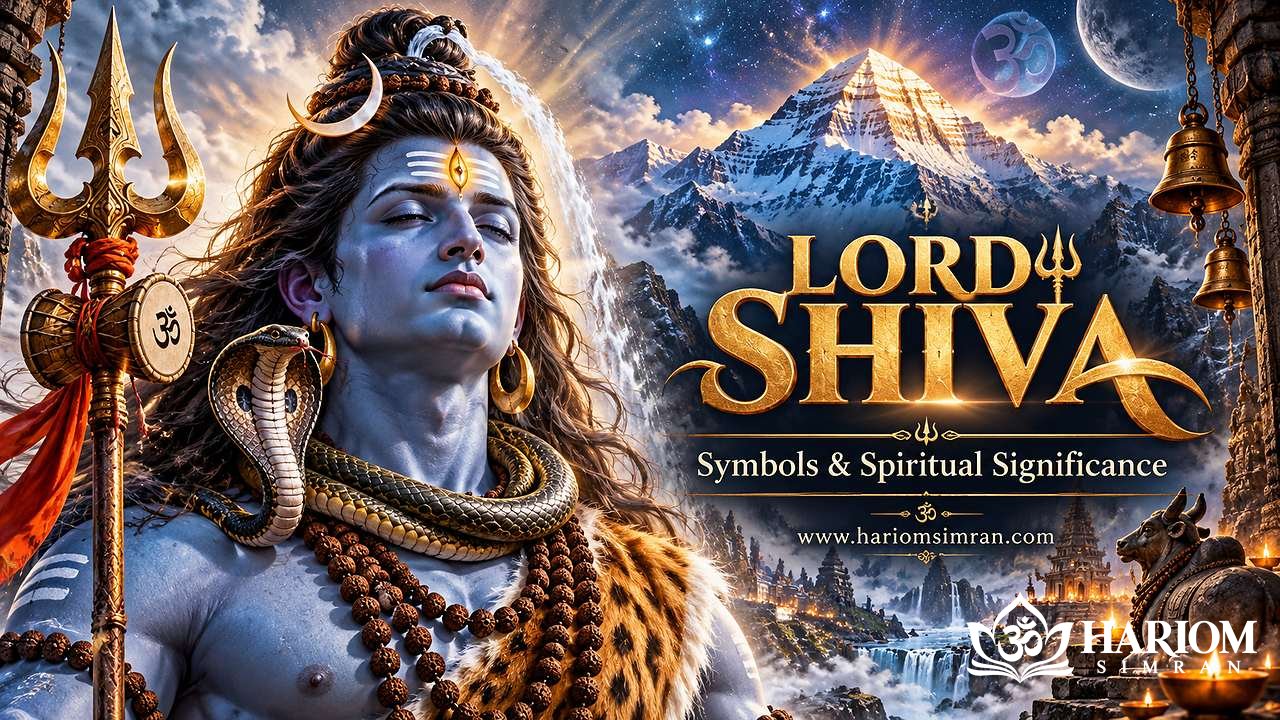
One of Shiva's most recognizable forms is the Mahayogi, the great Yogi.
He is often shown:
- Sitting in meditation
- On or near Mount Kailash
- With matted hair
- Wearing Rudraksha
- With ash on his body
- In deep inner stillness
This form expresses the ideal of spiritual mastery.
Shiva as Yogi represents control over:
- Desire
- Ego
- Mental distraction
- Fear
- Attachment
His meditation reminds seekers that spiritual freedom begins with understanding the inner world.
Shiva and Mount Kailash
Mount Kailash holds profound sacred importance in Hindu tradition.
It is traditionally regarded as the abode of Shiva and Goddess Parvati.
Kailash symbolizes more than a physical mountain.
Spiritually, the mountain can represent:
- Stability
- Stillness
- Spiritual height
- Inner ascent
- Detachment from distraction
The image of Shiva meditating on Kailash has become one of Hinduism's most powerful visual symbols.
Shiva and Goddess Parvati
Shiva's relationship with Goddess Parvati reveals another dimension of his nature.
Shiva is often presented as the supreme ascetic.
Yet he is also a householder.
Parvati represents Divine feminine power, devotion, strength and Shakti in many traditions.
Together, Shiva and Parvati can symbolize:
- Consciousness and energy
- Stillness and activity
- Asceticism and family life
- Masculine and feminine Divine principles
- Complementarity within creation
Different philosophical and devotional traditions interpret this relationship differently.
Shiva and Shakti
An important principle in many Hindu traditions is the relationship between Shiva and Shakti.
Shiva can represent pure consciousness.
Shakti can represent Divine energy or power.
A common philosophical idea is that consciousness and energy are inseparable.
Without Shakti, Shiva is sometimes symbolically described as inactive.
Without consciousness, energy lacks its deeper spiritual ground.
This relationship becomes particularly important in Shakta and Tantric traditions.
Ardhanarishvara
One of the most profound forms associated with Shiva is Ardhanarishvara.
The form combines Shiva and Parvati in one Divine figure.
One side appears masculine.
The other appears feminine.
Ardhanarishvara can symbolize:
- Unity of Shiva and Shakti
- Complementarity of masculine and feminine principles
- Wholeness
- Interdependence
- Unity beyond apparent duality
The image should not be reduced simply to modern categories without understanding its traditional theological context.
Shiva as a Family Deity
Shiva is also worshipped within a Divine family.
His family is commonly associated with:
- Goddess Parvati
- Lord Ganesha
- Lord Kartikeya, also known by names such as Skanda or Murugan
This family dimension gives Shiva a very different image from the isolated ascetic.
It shows that Hindu spirituality does not necessarily place meditation and family responsibility in opposition.
A person can seek spiritual depth while participating in relationships and responsibilities.
Lord Ganesha and Shiva
Lord Ganesha is widely revered as the son of Shiva and Parvati.
Ganesha is associated with:
- Wisdom
- Auspicious beginnings
- Removal of obstacles
- Intellect
- Learning
Stories about Shiva, Parvati and Ganesha vary across Puranic and regional traditions.
These sacred narratives often contain symbolic, devotional and ethical teachings.
Explore the wider Hindu Divine tradition through Deities.
Lord Kartikeya and Shiva
Lord Kartikeya is also associated with the family of Shiva.
He is known by several names, including:
- Skanda
- Murugan
- Subrahmanya
- Kartikeya
He receives especially strong devotion in South Indian traditions.
Kartikeya is associated with:
- Courage
- Spiritual victory
- Divine knowledge
- Leadership
- Protection
This demonstrates the regional richness of Hindu devotional traditions.
The Appearance of Lord Shiva
Shiva's traditional iconography contains many symbols.
Common visual elements include:
- Third eye
- Crescent Moon
- Ganga flowing from his hair
- Matted locks
- Blue throat
- Trishul
- Damru
- Snake
- Rudraksha
- Sacred ash
- Tiger skin
- Nandi
- Shiva Linga
Each symbol has developed important religious and philosophical meanings.
Shiva's Third Eye
Shiva is famous for his third eye.
The two ordinary eyes see the visible world.
The third eye is often interpreted as representing:
- Spiritual insight
- Higher knowledge
- Inner perception
- Destruction of ignorance
- Awareness beyond ordinary appearance
In sacred narratives, opening Shiva's third eye can represent intense transformative power.
What Does the Third Eye Teach?
The third eye can become a powerful spiritual metaphor.
Human beings often judge reality only through surface appearances.
The third eye suggests:
Look Deeper.
Do not see only:
- Physical appearance
- Wealth
- Status
- Social identity
- Temporary circumstances
Spiritual insight asks us to see beyond surface reality.
The Crescent Moon
A crescent Moon is often shown in Shiva's matted hair.
The Moon has been interpreted through several symbolic meanings.
It can represent:
- Time
- Cycles
- Mind
- Rhythms of nature
- Control over changing experience
Shiva wearing the Moon can symbolize mastery over time and changing mental states.
Ganga in Shiva's Hair
A famous sacred narrative connects the River Ganga with Shiva's matted hair.
According to the traditional story, the powerful descent of Ganga required Shiva to receive and regulate her force before the waters reached Earth.
The image symbolizes themes such as:
- Divine compassion
- Controlled power
- Purification
- Sacred rivers
- Balance
Ganga herself is revered as a sacred river and Goddess in Hindu traditions.
Shiva's Matted Hair
Shiva's matted locks, or Jata, are closely associated with ascetic life.
They symbolize:
- Renunciation
- Spiritual discipline
- Detachment
- Yogic practice
- Freedom from conventional appearance
Yet the same hair also holds the sacred Ganga.
This again shows how Shiva combines stillness with extraordinary cosmic power.
Why Is Shiva's Throat Blue?
One of Shiva's famous names is Neelkanth, meaning broadly:
The Blue-Throated One
The name is associated with the sacred story of the Samudra Manthan, the churning of the cosmic ocean.
During the churning, a dangerous poison known as Halahala emerged.
According to the sacred narrative, Shiva took the poison to protect creation.
The poison was contained in his throat, which became blue.
Spiritual Meaning of Neelkanth
The Neelkanth story can symbolize:
- Sacrifice
- Protection
- Compassion
- Strength
- The ability to contain negativity without spreading it
A practical spiritual lesson may be:
Do not allow every negative experience to enter deeply into your identity, and do not automatically pass negativity to others.
The sacred story should be respected as religious narrative rather than reduced only to metaphor.
The Snake Around Shiva
Shiva is often shown with a serpent around his neck.
The snake can symbolize several ideas, including:
- Power
- Fearlessness
- Death
- Time
- Transformation
- Spiritual energy
Snakes shed their skin, making them a natural symbol of renewal and transformation.
Shiva wearing the serpent may also express mastery over fear.
Shiva and Sacred Ash
Shiva is commonly associated with Vibhuti or sacred ash.
Ash carries profound symbolism.
Everything physical eventually changes.
Fire reduces many forms to ash.
Vibhuti can therefore remind the devotee of:
- Impermanence
- Mortality
- Detachment
- Spiritual purification
- Freedom from ego
The teaching is not pessimistic.
Remembering impermanence can help a person value life more wisely.
Shiva and the Tiger Skin
Traditional images often show Shiva sitting on or wearing tiger skin.
The tiger can symbolize powerful instinctual forces.
Shiva's position over the tiger skin may represent mastery over:
- Desire
- Aggression
- Pride
- Instinct
- Uncontrolled impulses
The imagery presents the Yogi as one who has disciplined powerful inner energies.
The Trishul
The Trishul, or trident, is one of Shiva's most recognized symbols.
It has three points.
Different traditions interpret these three points in various ways.
They may symbolize:
- Creation, preservation and transformation
- Past, present and future
- Body, mind and spirit
- Three Gunas
- Different dimensions of existence
There is no need to insist that only one symbolic explanation is correct.
Shiva's Damru
Shiva often carries a small drum called the Damru.
The Damru is associated with:
- Sacred sound
- Rhythm
- Creation
- Cosmic vibration
- Dance
- Language
In the Nataraja tradition, the drum represents the rhythm through which cosmic manifestation unfolds.
Sacred sound is deeply important across Hinduism.
Explore Mantras for wider teachings on sacred sound.
Shiva and Rudraksha
Rudraksha beads are strongly associated with Shiva and Shaiva traditions.
Devotees may wear Rudraksha or use the beads in Japa and meditation.
Rudraksha carries devotional and spiritual significance.
Traditionally it can symbolize:
- Connection with Shiva
- Spiritual discipline
- Meditation
- Devotion
- Remembrance of the Divine
Health or medical benefits should not be guaranteed without appropriate scientific evidence.
Shiva Linga
One of the most important forms of Shiva worship is the Shiva Linga, also called Shivalinga or Lingam.
The Linga is worshipped in countless Shiva temples.
It is one of Hinduism's oldest and most profound sacred symbols.
The word Linga can carry meanings connected with:
Mark
Sign
Symbol
The Shiva Linga represents Shiva in an aniconic form, meaning a sacred representation that does not depend on a human-like image.
What Does the Shiva Linga Represent?
Different traditions explain the Shiva Linga in several ways.
It can symbolize:
- Shiva
- Formless Divine reality
- Infinite consciousness
- Cosmic principle
- Creation and transcendence
- Shiva and Shakti in unity
The Linga should not be reduced to one simplistic modern interpretation.
Its religious meaning is much broader and deeply rooted in Shaiva theology and temple worship.
Shiva Linga and Yoni
Many Shiva Lingas are installed within a base known as the Yoni or Pitha.
In many theological interpretations, this combination represents:
Shiva and Shakti
or
Consciousness and Divine Creative Power
Together, they symbolize the unity through which manifestation becomes possible.
Interpretations can vary across Shaiva and Tantric traditions.
Jyotirlingas
A particularly important Shaiva tradition concerns the Jyotirlingas.
Traditionally, twelve major Jyotirlinga temples are especially revered.
They are associated with Shiva as a Divine pillar or manifestation of light.
The twelve commonly recognized Jyotirlingas are:
- Somnath
- Mallikarjuna
- Mahakaleshwar
- Omkareshwar
- Kedarnath
- Bhimashankar
- Kashi Vishwanath
- Trimbakeshwar
- Vaidyanath
- Nageshwar
- Rameshwaram
- Grishneshwar
Traditional lists and some location-related details can vary in certain cases.
Explore the wider sacred geography of Hinduism through Temples.
Shiva as Nataraja
One of Shiva's most famous forms is Nataraja, the Lord of Dance.
In this form Shiva performs the cosmic dance.
The Nataraja image is one of the richest visual symbols in Hindu philosophy.
The dance can represent:
- Creation
- Preservation
- Transformation
- Concealment
- Grace
- Cosmic rhythm
The image expresses a universe that is dynamic rather than static.
The Nataraja Image
Traditional Nataraja iconography often includes:
- A circle of flames
- A raised foot
- One foot on a dwarf-like figure
- Damru
- Fire
- Protective hand gesture
- Flowing hair
Each element contributes to the teaching.
The Circle of Flames
The surrounding circle can symbolize the universe and the constant movement of existence.
Everything changes.
Stars form and disappear.
Bodies are born and die.
Thoughts arise and fade.
Civilizations rise and fall.
Shiva's dance takes place within this rhythm of transformation.
The Dwarf Under Shiva's Foot
The figure beneath Nataraja's foot is commonly associated with Apasmara, connected with ignorance or spiritual forgetfulness.
Shiva dancing upon Apasmara symbolizes mastery over ignorance.
The deeper message is:
Ignorance Must Not Rule Consciousness.
The Raised Foot of Nataraja
The raised foot is often associated with:
- Grace
- Liberation
- Refuge
- Spiritual freedom
While one aspect of the dance confronts ignorance, another offers release.
This combination shows that transformation and grace operate together.
Shiva as Dakshinamurti
Dakshinamurti is Shiva as the supreme teacher.
He is traditionally represented seated beneath a tree, surrounded by seekers.
This form symbolizes:
- Spiritual wisdom
- Guru principle
- Silence
- Self-knowledge
- Vedantic teaching
- Inner realization
Dakshinamurti is particularly important in traditions that emphasize Shiva as the source of spiritual knowledge.
Teaching Through Silence
Dakshinamurti is often associated with a profound idea:
The deepest truth may go beyond words.
Words can guide.
Scriptures can teach.
Teachers can explain.
But direct realization may transcend verbal explanation.
This does not make scripture unnecessary.
Instead, it recognizes the limits of language.
Shiva as Pashupati
Another important name is Pashupati, commonly understood as:
Lord of Beings
The term has deep historical roots.
In later Shaiva traditions, Pashupati becomes an important theological title of Shiva.
It emphasizes his relationship with living beings and Divine lordship.
Shiva as Rudra
The Vedic deity Rudra is closely connected with the later development of Shiva traditions.
Rudra appears in Vedic literature as a powerful and complex Divine figure.
He is associated with:
- Fierce power
- Healing
- Protection
- Nature
- Storm-like energy
Over time, Rudra and Shiva become deeply integrated within Hindu religious development.
For wider Vedic context, explore Hindu Scriptures.
Shiva in the Vedas
The historical development of Shiva traditions has connections with Vedic Rudra.
Important Vedic material includes hymns and later Yajurvedic traditions associated with Rudra.
The famous Shri Rudram became especially significant in Shaiva worship.
However, the fully developed Puranic imagery of Shiva appears across later layers of Hindu sacred literature.
Shiva in the Puranas
Shiva plays a central role in several Puranic traditions.
Important texts associated with Shiva include:
- Shiva Purana
- Linga Purana
- Skanda Purana
- Kurma Purana and other Puranic materials containing Shaiva narratives
Puranic stories develop many familiar aspects of Shiva, including:
- Shiva and Parvati
- Ganesha
- Kartikeya
- Samudra Manthan
- Tripura
- Daksha
- Jyotirlingas
- Devotees of Shiva
These narratives combine devotion, theology and spiritual symbolism.
Shaivism
Shaivism is one of Hinduism's major religious traditions.
Its followers worship Shiva as the central or Supreme Divine reality.
Shaivism itself contains many diverse traditions.
Historically important Shaiva traditions include:
- Shaiva Siddhanta
- Kashmir Shaivism
- Pashupata traditions
- Nath traditions
- Lingayat or Virashaiva traditions
- Various regional devotional Shaiva traditions
These traditions do not all teach exactly the same philosophy.
Diversity Within Shaivism
Some Shaiva systems emphasize:
- Devotion
- Temple worship
- Ritual
- Yoga
- Mantra
- Meditation
- Nondual philosophy
- Dual or qualified relationships between soul and Shiva
- Guru initiation
This diversity reflects the wider richness of Hinduism.
Shiva and Yoga
Shiva is deeply associated with Yoga.
He is frequently called:
Adiyogi
meaning the primordial or first Yogi in popular Shaiva and Yogic traditions.
He represents complete mastery of the inner life.
Yoga in this context goes far beyond physical posture.
It concerns:
- Discipline
- Meditation
- Awareness
- Self-mastery
- Spiritual realization
- Freedom from attachment
Is Shiva the Founder of Yoga?
Within several traditional narratives, Shiva is revered as the original teacher of Yoga.
Historically, however, Yoga developed through many textual, philosophical and practice traditions.
Therefore, the devotional title Adiyogi should be presented as part of sacred tradition rather than a modern historical claim that can be verified in the same way as the biography of an ordinary founder.
Shiva and Meditation
Shiva's meditative image is one of Hinduism's strongest symbols of inner stillness.
Meditation connected with Shiva may involve:
- Mantra Japa
- Contemplation
- Breath awareness within appropriate traditions
- Shiva Linga worship
- Devotional concentration
- Inner silence
Exact practices vary by lineage.
Om Namah Shivaya
One of the most famous Shiva Mantras is:
Om Namah Shivaya
It is widely revered across Shaiva traditions.
Broadly, the mantra expresses reverence or salutation to Shiva.
Its deeper interpretations vary according to tradition.
It is associated with the sacred five-syllable form:
Na Ma Shi Va Ya
when considered without the Om prefix.
Explore the wider tradition through Mantras.
Panchakshara Mantra
Namah Shivaya is commonly known as the Panchakshara Mantra, or five-syllabled Mantra.
The syllables are:
- Na
- Ma
- Shi
- Va
- Ya
Traditional Shaiva interpretations give profound meanings to these syllables.
Different lineages may connect them with elements, spiritual principles or aspects of Shiva.
Mahamrityunjaya Mantra
The Mahamrityunjaya Mantra is another highly revered Mantra associated with Shiva and Vedic Rudra.
It appears in Vedic tradition and is used devotionally in many Hindu communities.
The Mantra is associated with prayer, spiritual protection and overcoming fear of mortality.
It should not be presented as a guaranteed cure for disease or substitute for medical treatment.
Shiva and Maha Shivaratri
The most important festival especially associated with Shiva is Maha Shivaratri.
Devotees may observe it through:
- Fasting according to personal tradition and health
- Night vigil
- Shiva Puja
- Abhishekam
- Mantra chanting
- Temple visits
- Meditation
- Reading sacred stories
- Offering Bilva leaves
Practices differ by family, temple, region and Sampradaya.
Explore Hindu celebrations through Festivals.
Why Is Maha Shivaratri Celebrated?
Different Hindu traditions connect Maha Shivaratri with different sacred meanings and stories.
These may include:
- Shiva's Divine manifestation
- Shiva and Parvati
- The Jyotirlinga tradition
- Spiritual night vigil
- Meditation and inner awakening
There is not always one single narrative accepted identically everywhere.
Bilva Leaves and Shiva
Bilva, or Bael leaves, are strongly associated with Shiva worship.
They are commonly offered during Puja.
The three-part structure of the leaf receives various symbolic interpretations.
It may be connected with:
- Shiva's three eyes
- Trishul
- Three Gunas
- Other triadic spiritual principles
Symbolic explanations may vary by tradition.
Abhishekam
A common form of Shiva worship is Abhishekam, in which the Shiva Linga is ritually bathed.
Offerings may include substances such as:
- Water
- Milk
- Other traditional substances according to temple or family practice
The ritual can express:
- Devotion
- Purification
- Surrender
- Reverence
- Sacred offering
Practices vary across traditions.
Nandi
Nandi, the sacred bull, is closely associated with Shiva.
Nandi is commonly depicted facing the Shiva Linga in Shiva temples.
Nandi is traditionally understood as Shiva's Vahana and devoted attendant.
He symbolizes qualities such as:
- Devotion
- Strength
- Patience
- Loyalty
- Dharma
- Focus
Why Does Nandi Face Shiva?
Nandi's position facing Shiva can become a devotional teaching.
The symbolism suggests:
Keep Your Attention Directed Toward the Divine.
Nandi's stillness and focus can represent concentrated devotion.
Shiva and Death
Shiva's imagery frequently brings the seeker close to themes of death and impermanence.
Cremation grounds.
Ash.
Skulls in some traditions.
Transformation.
These symbols may initially appear frightening.
But Shiva's teaching can be understood as confronting the reality humans often avoid.
Everything embodied changes.
Recognizing mortality can deepen spiritual wisdom.
Is Shiva the God of Destruction?
Calling Shiva simply the “God of Destruction” is incomplete.
A better word is often:
Transformation
In Hindu cosmology, dissolution is necessary for renewal.
An old form may end so something new can arise.
Therefore Shiva's transforming power can represent:
- Ending of cycles
- Destruction of ignorance
- Dissolution of ego
- Release from attachment
- Cosmic renewal
Destruction of Ignorance
One of Shiva's deepest spiritual meanings is the destruction of Avidya, or ignorance.
The greatest transformation may not be destruction of physical objects.
It may be destruction of false identity.
For example:
- Ego
- Arrogance
- Greed
- Hatred
- Fear
- Attachment
- Spiritual confusion
In this sense, Shiva's transformative power becomes deeply internal.
Shiva and Detachment
Shiva owns little in his ascetic form.
He does not depend upon:
- Palace
- Luxury
- Status
- Decorative wealth
- Social approval
His image becomes a strong symbol of detachment.
This does not mean every devotee must abandon family or possessions.
The deeper lesson is:
Possessions Can Be Used Without Allowing Them to Own the Mind.
Shiva and Family Life
At the same time, Shiva is a husband and father.
This creates a beautiful balance.
Spiritual life can include:
- Meditation
- Family
- Responsibility
- Love
- Discipline
- Devotion
Shiva therefore cannot be reduced simply to world-rejection.
Shiva and Compassion
Many sacred narratives portray Shiva responding quickly to devotion.
This contributes to popular names and devotional images emphasizing his compassion and accessibility.
At the same time, sacred stories also warn that power must be approached wisely.
Receiving a boon does not guarantee that the recipient will use it responsibly.
Bholenath
Bholenath is a widely loved devotional name for Shiva.
It expresses the image of Shiva as simple-hearted, accessible and easily pleased by sincere devotion.
This devotional understanding is especially strong in popular Hindu practice.
It should be explained as a loving devotional title rather than a philosophical definition of Shiva's entire nature.
Shiva and the Devotee
Shaiva Bhakti can take many forms:
- Mantra Japa
- Puja
- Temple worship
- Meditation
- Singing Bhajans
- Reading sacred stories
- Abhishekam
- Fasting
- Seva
- Pilgrimage
The most important element is sincere devotion rather than public display.
Shiva and Inner Silence
Among Shiva's many symbols, perhaps one of the deepest is silence.
Modern life is filled with constant input:
Notifications.
Messages.
News.
Videos.
Work.
Opinions.
Noise.
Shiva's meditative form asks:
What Happens When the Mind Becomes Quiet?
The question remains deeply relevant today.
What Modern Readers Can Learn From Lord Shiva
Shiva's symbolism can offer several practical reflections:
- Accept Change: Everything in life changes.
- Control Ego: Spiritual growth requires humility.
- Value Silence: Constant mental noise can hide deeper understanding.
- Practice Detachment: Use possessions without becoming controlled by them.
- Transform Negativity: Do not simply pass anger and pain to others.
- Look Beyond Appearances: The third eye symbolizes deeper insight.
- Balance Life: Spirituality and responsibility can coexist.
- Face Impermanence: Awareness of mortality can make life more meaningful.
- Seek Knowledge: Destruction of ignorance is one of the deepest transformations.
- Practice Devotion Sincerely: External display is less important than inner Bhakti.
Shiva in Daily Spiritual Life
Not every devotee needs to become an ascetic.
Shiva's teachings can inspire ordinary daily practices such as:
- Taking time for quiet reflection
- Speaking more carefully
- Reducing unnecessary ego conflicts
- Remembering the temporary nature of possessions
- Practicing Mantra with understanding
- Serving family responsibly
- Showing compassion
- Visiting a temple
- Studying sacred texts
- Practicing gratitude
Spirituality becomes meaningful when it influences conduct.
Shiva and Dharma
Shiva's stories repeatedly intersect with questions of:
- Responsibility
- Devotion
- Knowledge
- Power
- Ego
- Consequences
- Compassion
These connect naturally with the wider Hindu concept of Dharma.
Dharma helps spiritual knowledge become ethical action.
Shiva in Hindu Stories
Numerous sacred narratives about Shiva appear across Hindu literature.
Important story themes include:
- Shiva and Parvati
- Ganga's descent
- Samudra Manthan
- Ganesha's origin
- Kartikeya
- Daksha
- Tripurasura
- Ravana and Shiva
- Markandeya
- Jyotirlingas
- Bhasmasura
- Devotees of Shiva
These stories should be studied with attention to their source traditions because versions may vary.
Explore Hindu sacred narratives through Hindu Stories.
Shiva and Temples
Shiva temples can be found throughout India and across Hindu communities worldwide.
Many temples center worship around a Shiva Linga.
Some of the most important Shaiva sacred traditions include:
- Jyotirlingas
- Panch Bhoota Sthalas
- Himalayan Shiva temples
- South Indian Shiva temples
- Ancient regional Shaiva pilgrimage centers
Each temple may have its own sacred history and local traditions.
Explore Temples for HariOmSimran's growing temple knowledge section.
Shiva and the Five Elements
Some Shaiva traditions connect Shiva worship with the Pancha Bhootas, the five great elements:
- Earth
- Water
- Fire
- Air
- Space
The famous Panch Bhoota Sthala temple tradition in South India is associated with these elements.
The concept emphasizes the sacred relationship between the Divine and the natural world.
Shiva Beyond One Image
An important lesson is that Shiva cannot be reduced to one visual form.
He can be contemplated as:
- Shiva Linga
- Mahayogi
- Nataraja
- Ardhanarishvara
- Dakshinamurti
- Neelkanth
- Pashupati
- Mahadeva
- Family deity
- Cosmic reality
Different forms reveal different spiritual dimensions.
Is Shiva a Historical Person?
Hindu sacred tradition understands Shiva as Divine, not simply as an ordinary historical personality.
Claims attempting to identify one exact archaeological or historical individual as “the original Shiva” should be approached cautiously.
The historical development of Shiva worship is complex and spans Vedic, Puranic, Agamic and regional traditions.
Is Shiva Male?
Shiva is usually represented in masculine Divine form.
However, Hindu theology can go beyond ordinary human gender categories.
The Ardhanarishvara form especially demonstrates unity of masculine and feminine Divine principles.
Different philosophical traditions may understand Divine gender symbolically, devotionally or metaphysically.
Is Shiva Different From Brahman?
The answer depends on the philosophical tradition.
In some Shaiva traditions, Shiva is understood as Supreme Brahman.
Other Vedanta and Hindu traditions explain the relationship differently.
Therefore, there is no single answer that represents every Hindu school.
Is Shiva and Shankar the Same?
Shankara or Shankar is a widely used name of Shiva.
However, the name should not automatically be confused with Adi Shankaracharya, the historical philosopher associated with Advaita Vedanta.
Context makes the distinction clear.
Is Shiva Linga Only a Symbol of Creation?
That is too narrow.
The Shiva Linga has many theological meanings.
It can represent Shiva, formless Divine reality, infinite consciousness and the unity of Shiva and Shakti.
Reducing it to only one biological interpretation misrepresents the breadth of Shaiva tradition.
Common Misunderstandings About Lord Shiva
Shiva Is Only the God of Destruction
This is incomplete. Shiva's role includes transformation, dissolution of ignorance, meditation, grace, Yoga, knowledge and renewal.
Shiva Linga Has Only One Physical Meaning
No. The Linga is a profound sacred symbol with theological, cosmic and philosophical meanings across Shaiva traditions.
Shiva Rejects Family Life
No. Shiva is both Mahayogi and householder, traditionally worshipped with Parvati, Ganesha and Kartikeya.
All Shaiva Traditions Teach Exactly the Same Philosophy
No. Shaivism includes several philosophical, devotional, Yogic and ritual traditions with different understandings of Shiva and the soul.
Chanting a Shiva Mantra Guarantees Miracles
No. Mantras are sacred spiritual practices, but guaranteed health, wealth or supernatural outcomes should not be promised.
How Should Beginners Learn About Lord Shiva?
A structured approach can make Shiva's vast tradition easier to understand:
- Begin with Shiva's meaning and major names.
- Study the relationship between Shiva, Parvati and Shakti.
- Understand Shiva's main symbols.
- Learn the meaning of the Shiva Linga.
- Study Shiva as Mahayogi.
- Explore Nataraja and cosmic dance.
- Understand Dakshinamurti and the Guru principle.
- Learn about Vedic Rudra.
- Explore Shaivism and its different traditions.
- Study Om Namah Shivaya and other Shiva Mantras.
- Learn about Maha Shivaratri.
- Explore Jyotirlingas and major Shiva temples.
- Read Puranic Shiva stories with awareness that versions can vary.
This approach moves from accessible symbolism toward deeper theology and philosophy.
Why Lord Shiva Still Matters
Lord Shiva remains meaningful because his imagery addresses realities that every human being eventually faces:
Change
Attachment
Fear
Death
Ego
Relationships
Responsibility
Silence
Knowledge
Transformation
Shiva does not represent a life where difficulties disappear.
His symbolism points toward a different possibility:
Transform the way we relate to difficulty.
The third eye asks us to see deeper.
The ash reminds us that physical forms are temporary.
The Ganga represents controlled Divine power.
The blue throat symbolizes the capacity to confront poison without spreading it.
The Trishul represents mastery and balance.
The Damru represents cosmic rhythm.
Nataraja turns change itself into a Divine dance.
The Shiva Linga directs attention beyond limited form.
The meditating Shiva points toward inner stillness.
Together, these symbols make Lord Shiva one of Hinduism's most profound representations of spiritual transformation.
Explore Hindu Divine Wisdom With HariOmSimran
HariOmSimran is developing the Deities section as a structured educational journey through Hindu Divine traditions.
Continue exploring:
For the Deities module, a strong sequence after Lord Vishnu and Lord Shiva would be:
- Lord Brahma
- Lord Krishna
- Lord Rama
- Lord Ganesha
- Lord Hanuman
- Lord Kartikeya
- Surya Deva
Then we can develop the Goddess category with:
- Goddess Durga
- Goddess Lakshmi
- Goddess Saraswati
- Goddess Parvati
- Goddess Kali
- Goddess Sita
- Goddess Radha
Learn • Explore • Understand • Preserve
Spiritual Significance
This deity holds profound spiritual importance in Hindu tradition. Below are the key aspects of worship and significance.
Worship Practices
Devotees worship this deity through various rituals and practices that deepen their spiritual connection.
- Devotion
- Spiritual Growth
- Sacred Rituals
- Divine Blessings

Worship & Rituals
Explore the various ways devotees connect with this deity through prayer, rituals, and spiritual practices.
🙏 Daily Prayers
Daily prayers and mantras dedicated to this deity help devotees maintain a strong spiritual connection.
🕯️ Festival Celebrations
Special festivals and celebrations honor this deity, bringing communities together in devotion.
📿 Sacred Offerings
Traditional offerings and rituals that express devotion and seek divine blessings.
📖 Sacred Texts
Scriptures and hymns that describe the glory and teachings associated with this deity.
Frequently Asked Questions
Lord Shiva is a major Hindu deity and the central Divine reality of many Shaiva traditions. He is associated with meditation, transformation, spiritual knowledge, Yoga, detachment, compassion and the destruction of ignorance.
Shiva is commonly associated with meanings such as auspicious, gracious or benevolent. He is also known by many names including Mahadeva, Shankara, Neelkanth, Pashupati and Nataraja.
The Shiva Linga is a sacred aniconic representation of Shiva. Different traditions connect it with Shiva, formless Divine reality, infinite consciousness, cosmic principles and the unity of Shiva and Shakti.
Shiva's third eye is widely interpreted as a symbol of spiritual insight, higher knowledge and the power to destroy ignorance. Sacred narratives also associate its opening with intense transformative energy.
Om Namah Shivaya is one of the most revered Shiva Mantras. Broadly, it expresses reverence or salutation to Shiva. Namah Shivaya is traditionally known as the Panchakshara, or five-syllabled, Mantra.
Lord Shiva is important because his teachings and symbols explore transformation, meditation, impermanence, spiritual knowledge, devotion, Yoga, Divine grace and freedom from ignorance.