


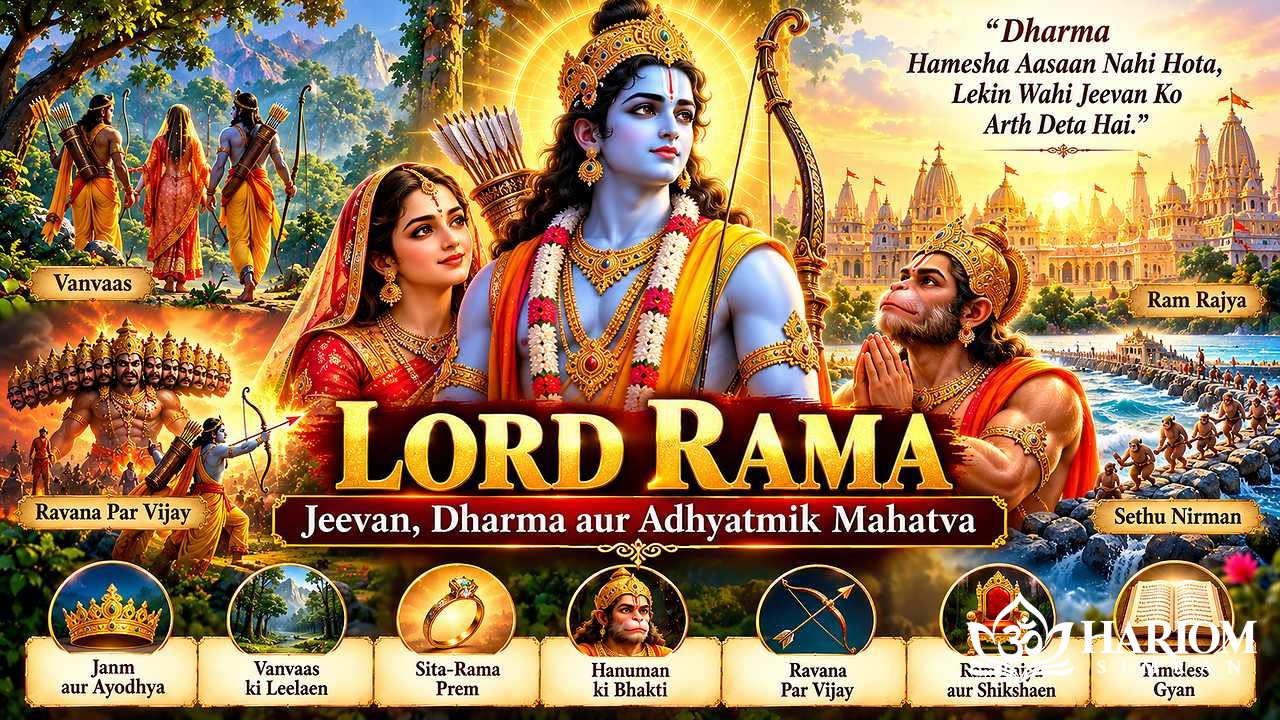
Lord Rama is one of the most revered Divine figures in Hinduism.
He is remembered as:
- A devoted son
- A loving husband
- A loyal brother
- A courageous warrior
- A compassionate leader
- A protector of Dharma
- A king associated with justice
- An Avatar of Lord Vishnu in many Hindu traditions
- The central figure of the Ramayana
Rama's life is not remembered only because he defeats Ravana.
His deeper importance lies in the way he responds to difficult situations.
Again and again, Rama faces choices involving:
Duty
Family
Truth
Leadership
Sacrifice
Justice
Loyalty
Compassion
Personal suffering
His life therefore raises one of Hinduism's most important questions:
How should a person live when doing what is right is difficult?
Lord Rama's story shows that Dharma is not always comfortable.
Sometimes Dharma requires sacrifice.
Sometimes leadership requires self-control.
Sometimes courage means accepting hardship without abandoning one's principles.
This is why Rama is often remembered as Maryada Purushottama, broadly understood as the ideal or supreme person who lives within the boundaries of Dharma and righteous conduct.
To explore the wider Hindu Divine tradition, visit Deities.
Who Is Lord Rama?
Lord Rama is a major Hindu Divine figure and the central hero of the Ramayana.
Many Hindu traditions worship Rama as an Avatar of Lord Vishnu.
He is especially important within Vaishnava traditions and Rama Bhakti movements.
Rama is commonly associated with:
- Dharma
- Truth
- Duty
- Courage
- Compassion
- Leadership
- Loyalty
- Self-discipline
- Justice
- Devotion
- Sacrifice
- Ideal conduct
His sacred story is deeply connected with:
- Ayodhya
- King Dasharatha
- Queen Kaushalya
- Sita
- Lakshmana
- Bharata
- Shatrughna
- Hanuman
- Sugriva
- Ravana
- Lanka
- Ram Rajya
What Does the Name Rama Mean?
The Sanskrit name Rama has deep devotional significance.
Traditional interpretations connect the name with ideas such as:
Joy
Delight
One who gives spiritual happiness
The Divine Name Rama itself has enormous importance in Hindu devotional traditions.
For many devotees, repeating Rama's name is itself a form of Bhakti.
Rama and Lord Vishnu
In many Hindu traditions, Rama is worshipped as one of the principal Avatars of Lord Vishnu.
Within the Dashavatara tradition, Rama is commonly included among Vishnu's major incarnations.
The theological purpose of an Avatar is often connected with restoring Dharma when disorder increases.
Rama's sacred life therefore becomes an expression of Divine presence within human circumstances.
However, some Rama-centered traditions worship Rama directly as the Supreme Divine Lord.
As with Krishna, HariOmSimran should preserve this theological diversity rather than forcing one interpretation.
Rama as Maryada Purushottama
One of Rama's most famous titles is:
Maryada Purushottama
The phrase is often understood as the supreme person who embodies ideal conduct and lives according to Dharma.
The word Maryada can refer to:
- Proper boundaries
- Ethical conduct
- Responsibility
- Social order
- Discipline
- Respect for duty
Rama's greatness therefore does not come only from Divine power.
It also comes from the way he conducts himself during difficult situations.
Lord Rama and the Ramayana
The Ramayana is one of Hinduism's great sacred epics.
The Sanskrit epic is traditionally attributed to Maharishi Valmiki.
It tells the story of Rama's:
- Birth
- Youth
- Marriage to Sita
- Exile
- Forest life
- Sita's abduction
- Alliance with Hanuman and the Vanaras
- Journey to Lanka
- Battle with Ravana
- Return to Ayodhya
- Kingship
The Ramayana is not simply an adventure story.
It explores:
- Dharma
- Family loyalty
- Leadership
- Friendship
- Devotion
- Justice
- Sacrifice
- Good and harmful use of power
- Human emotion
- Spiritual responsibility
Explore the wider sacred tradition through Hindu Scriptures.
Different Ramayana Traditions
The Ramayana exists in many sacred, literary and regional traditions.
Important versions and retellings include:
- Valmiki Ramayana
- Ramcharitmanas
- Kamba Ramayanam
- Adhyatma Ramayana
- Regional Ramayanas
- Southeast Asian Ramayana traditions
- Folk and temple traditions
Details can vary across texts.
HariOmSimran should therefore distinguish between:
The broader Rama tradition
and
Specific versions of individual stories
This helps avoid presenting every popular retelling as though all texts describe events identically.
The Birth of Lord Rama
Rama is traditionally remembered as the son of King Dasharatha and Queen Kaushalya of Ayodhya.
Dasharatha had several queens, including:
- Kaushalya
- Kaikeyi
- Sumitra
The royal family includes four famous brothers:
- Rama
- Bharata
- Lakshmana
- Shatrughna
Their relationships become central to the Ramayana's teachings on family, loyalty and Dharma.
Rama Navami
Lord Rama's birth is celebrated through Rama Navami.
The festival is one of the major Hindu celebrations connected with Rama.
Devotees may observe it through:
- Rama Puja
- Temple visits
- Ramayana reading
- Ramcharitmanas recitation
- Bhajan and Kirtan
- Rama Nama Japa
- Fasting according to personal tradition and health
- Sita Rama worship
- Community celebrations
Practices vary across regions and Sampradayas.
Explore Hindu celebrations through Festivals.
Rama's Childhood and Education
Rama is raised as a prince of Ayodhya.
His education includes:
- Sacred learning
- Martial training
- Dharma
- Royal responsibility
- Discipline
- Respect for elders
The Ramayana presents Rama's youth not merely as preparation for power.
It is preparation for responsibility.
A future leader must develop both:
Ability
and
Character
Vishvamitra and Rama
An important early episode involves the sage Vishvamitra.
Rama and Lakshmana accompany Vishvamitra and protect sacred rites from disruptive forces.
These events introduce Rama as a young protector of Dharma.
The relationship with Vishvamitra also emphasizes:
- Guru guidance
- Discipline
- Courage
- Sacred responsibility
- Preparation before leadership
Rama and Ahalya
The story of Ahalya is another important Ramayana episode.
Versions and interpretations vary across texts and traditions.
The episode is often associated with:
- Restoration
- Grace
- Redemption
- Liberation from a difficult condition
Because details vary considerably between retellings, dedicated story articles should identify the source tradition being discussed.
Sita Swayamvara
Rama's marriage to Sita is one of the most celebrated events in the Ramayana.
Sita is traditionally associated with King Janaka of Mithila.
At her Swayamvara, Rama successfully handles or breaks the great bow associated with Shiva, depending on how the episode is described in the tradition being followed.
Rama and Sita then marry.
Their relationship becomes one of Hindu tradition's most iconic Divine partnerships.
Sita and Rama
Sita Rama devotion is central to many Hindu traditions.
Together, Sita and Rama represent themes such as:
- Dharma
- Loyalty
- Love
- Sacrifice
- Partnership
- Responsibility
- Devotion
- Shared hardship
Sita should not be treated merely as a supporting character in Rama's story.
She has her own profound spiritual significance and deserves a dedicated Goddess article.
Sita as a Divine Figure
Sita is revered as a Divine figure in her own right.
In many Vaishnava traditions, she is associated with Lakshmi.
Her sacred life expresses:
- Strength
- Patience
- Courage
- Dignity
- Devotion
- Endurance
- Moral conviction
A future HariOmSimran article on Sita should explore her independently rather than only through Rama.
Rama and Lakshmana
Lakshmana is one of Rama's closest companions throughout the exile.
His loyalty is extraordinary.
He leaves royal comfort and accompanies Rama into the forest.
Lakshmana represents:
- Brotherly devotion
- Service
- Courage
- Loyalty
- Protection
- Sacrifice
The relationship between Rama and Lakshmana shows that Dharma is often supported by faithful relationships.
Rama and Bharata
The relationship between Rama and Bharata is one of the Ramayana's strongest examples of brotherly love.
Bharata does not celebrate Rama's exile.
Instead, he rejects the idea of taking Rama's rightful place out of personal ambition.
In many traditional retellings, Bharata rules only as Rama's representative, keeping Rama's sandals as a symbol of legitimate kingship.
This story represents:
- Loyalty
- Humility
- Renunciation of selfish power
- Respect for rightful duty
- Brotherly love
Bharata's Lesson on Power
Bharata teaches an important lesson:
Power does not have to be seized simply because it becomes available.
Modern people often associate success with taking every opportunity.
Bharata represents another possibility:
Principle can be more important than personal advantage.
Rama's Exile
One of the defining moments of the Ramayana is Rama's exile.
King Dasharatha had earlier granted Queen Kaikeyi two boons.
She later asks that:
- Bharata be made king
- Rama go into exile for fourteen years
The situation creates enormous emotional conflict.
Rama nevertheless accepts exile.
Why Does Rama Accept Exile?
Rama's decision is traditionally understood through themes such as:
- Respect for his father's word
- Dharma
- Family responsibility
- Truthfulness
- Self-control
- Sacrifice
This does not mean every difficult command from authority should always be followed blindly.
The episode belongs to a specific sacred narrative and ethical context.
The deeper lesson concerns commitment to one's principles even when personal loss is involved.
Rama's Exile and Leadership
Rama could have fought for the throne.
Instead, he accepts hardship rather than create immediate conflict within Ayodhya.
This reveals a major leadership principle:
Not every right must be defended through immediate confrontation.
Sometimes restraint itself can be strength.
Sita Chooses to Accompany Rama
Sita chooses to accompany Rama into exile.
Her decision expresses her own agency within the sacred narrative.
She refuses the comfort of the palace while Rama faces hardship.
Her choice represents:
- Commitment
- Courage
- Partnership
- Shared responsibility
- Love
The exact interpretation of Sita's role should respect both traditional devotion and serious attention to the text.
Lakshmana Joins the Exile
Lakshmana also accompanies Rama.
The forest journey therefore becomes a shared path involving:
- Rama
- Sita
- Lakshmana
Their exile is filled with encounters with:
- Sages
- Forest communities
- Rakshasas
- Sacred places
- Spiritual teachings
- Ethical challenges
Rama in the Forest
The forest is not simply a location of punishment.
It becomes a place of transformation.
Royal life had structure and protection.
Forest life demands:
- Adaptation
- Courage
- Simplicity
- Alertness
- Spiritual maturity
Rama's exile reminds us that unexpected hardship can become a place of learning.
Shurpanakha
The encounter with Shurpanakha becomes one of the events leading toward the conflict with Ravana.
Different Ramayana traditions describe details differently.
The episode involves:
- Desire
- Rejection
- Anger
- Violence
- Escalation
It should be treated carefully because simplified retellings can remove important context.
The Golden Deer
One famous episode involves a magical golden deer associated with Maricha.
Sita is attracted by the unusual deer and asks Rama to pursue it.
The episode becomes part of the sequence that leaves Sita vulnerable to Ravana's plan.
The story can inspire reflection on:
- Appearance
- Deception
- Desire
- Distraction
- Manipulation
Not everything attractive is trustworthy.
Ravana Abducts Sita
The abduction of Sita by Ravana, king of Lanka, is the central crisis of the Ramayana.
Ravana is an extraordinary and complex figure.
He is represented as:
- Powerful
- Learned
- Devoted in certain ways
- Politically capable
- Possessing great knowledge
Yet his power does not protect him from serious moral failure.
This makes Ravana spiritually important.
Ravana's Central Failure
Ravana shows that knowledge alone does not guarantee wisdom.
A person can possess:
- Education
- Power
- Intelligence
- Spiritual practice
- Authority
and still be defeated by:
- Ego
- Desire
- Pride
- Lack of self-control
- Abuse of power
The contrast between Rama and Ravana is therefore deeper than simply hero versus villain.
It is also:
Disciplined power versus uncontrolled power.
Rama's Search for Sita
After Sita's abduction, Rama begins the search for her.
This part of the Ramayana reveals another side of Rama.
He experiences grief.
He feels loss.
He searches desperately.
This is significant.
The Divine hero is not portrayed as emotionally indifferent.
Rama's grief makes the narrative deeply human.
Rama and Shabari
The story of Shabari is beloved in Rama Bhakti traditions.
Shabari waits devotedly for Rama.
Her story has become a powerful symbol of:
- Bhakti
- Patience
- Simplicity
- Devotion
- Divine accessibility
Popular retellings often include the offering of berries, though details and emphasis can vary by textual tradition.
The central devotional lesson is that sincere Bhakti is not limited by social status.
Rama and Hanuman
The meeting of Rama and Hanuman is one of Hinduism's most important devotional relationships.
Hanuman becomes Rama's extraordinary devotee and servant.
Their relationship represents:
- Bhakti
- Seva
- Loyalty
- Strength
- Humility
- Courage
- Complete dedication
Hanuman's devotion to Rama becomes a model of Dasya Bhava, devotion through loving service.
Hanuman as the Ideal Devotee
Hanuman possesses enormous strength.
Yet he does not use power for ego.
His strength is directed toward Seva.
This is one of his greatest teachings.
Real strength can serve:
- Dharma
- Compassion
- Protection
- Divine purpose
A dedicated HariOmSimran article on Hanuman should explore this relationship in much greater depth.
Rama and Sugriva
Rama forms an alliance with Sugriva, one of the Vanara leaders.
Their relationship includes mutual responsibility.
Rama helps Sugriva.
Sugriva helps Rama search for Sita.
This reflects an important principle:
Dharma often requires cooperation.
Even a Divine hero does not act alone.
Vali and Sugriva
The conflict involving Vali and Sugriva is one of the Ramayana's most discussed ethical episodes.
Rama's actions here have been debated and interpreted across traditions and commentaries.
HariOmSimran should not oversimplify such episodes.
Instead, future dedicated articles should present:
- Narrative context
- Rama's stated reasoning
- Ethical questions
- Major traditional interpretations
The Ramayana contains difficult moral questions, and that complexity is part of its enduring importance.
Hanuman's Journey to Lanka
Hanuman's leap to Lanka becomes one of the Ramayana's most iconic episodes.
His mission demonstrates:
- Faith
- Courage
- Intelligence
- Discipline
- Devotion
- Problem-solving
Hanuman does not rely only on physical strength.
He also uses judgment.
This combination of strength and wisdom is central to his character.
Hanuman Meets Sita
In Lanka, Hanuman finds Sita.
He gives her Rama's message and a sign of recognition.
This moment represents:
- Hope
- Faith
- Devotion
- Loyalty
- Divine reassurance
Sita's courage during captivity remains one of the most important dimensions of the Ramayana.
The Burning of Lanka
Hanuman's mission eventually leads to the famous burning of parts of Lanka.
The episode demonstrates both his extraordinary power and the escalation toward the coming war.
As with many epic events, different retellings emphasize different details.
The Bridge to Lanka
Rama's forces eventually build a bridge across the sea toward Lanka.
The sacred tradition remembers this as Rama Setu.
The bridge symbolizes:
- Collective effort
- Faith
- Leadership
- Cooperation
- Determination
- Overcoming seemingly impossible obstacles
One of the beautiful lessons is that Rama's mission succeeds through teamwork.
Rama Does Not Fight Alone
The Ramayana repeatedly shows Rama receiving help from:
- Lakshmana
- Hanuman
- Sugriva
- Jambavan
- Vibhishana
- The Vanara forces
- Other allies
This is an important spiritual lesson.
Strength does not mean refusing help.
Leadership includes recognizing the value of others.
Vibhishana
Vibhishana, Ravana's brother, eventually joins Rama.
His story raises an important question:
What should a person do when loyalty to family conflicts with Dharma?
Vibhishana chooses to oppose Ravana's wrongdoing.
He represents the principle that family loyalty does not automatically justify harmful conduct.
Rama and Ravana
The final conflict between Rama and Ravana is one of the most famous battles in Hindu sacred literature.
Rama ultimately defeats Ravana.
The victory symbolizes much more than military success.
It can represent:
- Dharma over Adharma
- Self-control over uncontrolled desire
- Humility over arrogance
- Justice over abuse of power
- Truth over deception
Ravana as a Complex Character
Ravana should not be reduced to a cartoon villain.
Traditional narratives portray him as possessing extraordinary qualities.
He is learned.
Powerful.
Capable.
In some traditions, deeply devoted to Shiva.
Yet his virtues do not cancel his wrongdoing.
This makes the lesson more powerful:
Great ability cannot substitute for ethical discipline.
Vijayadashami and Dussehra
Rama's victory over Ravana is widely connected with Vijayadashami, or Dussehra, in many Hindu traditions.
Celebrations may include:
- Ram Lila
- Ravana effigies
- Ramayana recitation
- Temple worship
- Community events
- Celebration of Dharma's victory
Regional meanings and practices vary.
Explore Festivals.
Deepavali and Rama's Return
In many popular Hindu traditions, Diwali is associated with Rama, Sita and Lakshmana returning to Ayodhya after exile and Ravana's defeat.
Ayodhya is remembered as welcoming them with lamps.
However, Diwali has multiple sacred meanings across Hindu traditions.
Different regions connect Diwali with:
- Rama
- Lakshmi
- Krishna
- Kali
- Mahavira in Jain tradition
- Other regional sacred histories
HariOmSimran should preserve this diversity.
Rama Returns to Ayodhya
Rama's return to Ayodhya marks the end of the long exile.
He assumes kingship.
This leads to the ideal of:
Ram Rajya
Ram Rajya becomes a powerful symbol of righteous governance.
What Is Ram Rajya?
Ram Rajya broadly refers to the idealized kingdom or rule of Rama.
In devotional and ethical imagination, it can represent governance based on:
- Justice
- Dharma
- Responsibility
- Welfare
- Protection
- Social order
- Ethical leadership
- Care for the people
The idea has been interpreted in many religious, social and political contexts.
HariOmSimran should keep the focus on its Hindu ethical and spiritual meaning rather than partisan political use.
Leadership According to Rama's Example
Rama's kingship encourages reflection on what leadership should be.
A leader should ideally:
- Place responsibility above ego
- Listen to the people
- Protect the vulnerable
- Uphold justice
- Exercise self-discipline
- Avoid selfish use of power
- Think about long-term consequences
Leadership becomes Seva rather than simply authority.
Rama and Difficult Ethical Questions
The Ramayana also includes episodes that modern readers find difficult.
Some later parts of the Rama tradition raise questions involving:
- Sita
- Public opinion
- Kingship
- Personal duty
- Social responsibility
- Justice
- Individual suffering
These episodes have been debated for centuries.
HariOmSimran should not hide these discussions or offer simplistic explanations.
A responsible educational approach should distinguish:
- Textual version
- Historical commentary
- Devotional interpretation
- Modern ethical questions
Rama Is Not a Simple Character
It is tempting to present Rama only as an ideal figure who never experiences conflict.
But the Ramayana is more meaningful than that.
Rama's life involves:
- Grief
- Separation
- Difficult responsibility
- Loss
- Uncertainty
- War
- Public duty
- Personal sacrifice
His spiritual importance lies partly in how he carries responsibility through hardship.
Rama and Dharma
Lord Rama is one of Hindu tradition's strongest Divine figures for studying Dharma.
His life repeatedly asks:
- What is my duty?
- What happens when duties conflict?
- When should personal desire be sacrificed?
- What does righteous leadership require?
- How should power be used?
- What does loyalty mean?
- When does family loyalty need to yield to higher Dharma?
Explore the wider concept through Dharma.
Rama and Satya
Truthfulness is closely connected with Rama's sacred character.
The Ramayana repeatedly values:
- Keeping one's word
- Honesty
- Integrity
- Reliability
- Moral consistency
But the epic also shows that ethical life can be complicated.
Truth and duty may exist within difficult circumstances.
This is why Dharma requires wisdom.
Rama and Sacrifice
Rama's life contains repeated sacrifice.
He sacrifices:
- Immediate kingship
- Royal comfort
- Personal convenience
- Safety
- Peace
Sacrifice alone is not automatically virtuous.
But Rama's sacrifices are remembered because they are connected with Dharma and responsibility.
Rama and Self-Control
One of Rama's defining qualities is self-control.
He does not allow:
- Anger
- Desire
- Pride
- Immediate emotion
to constantly dominate his decisions.
This does not mean he has no emotions.
It means he does not allow every emotion to become action.
That is a powerful lesson for modern life.
Rama and Compassion
Rama's story includes strong themes of compassion.
He forms relationships across different communities and backgrounds.
He accepts allies based on character and Dharma rather than simply status.
Traditions remember his interactions with:
- Shabari
- Hanuman
- Sugriva
- Vibhishana
- Forest sages
- Different communities
These relationships contribute to Rama's image as an accessible and compassionate Divine Lord.
Rama and Friendship
Rama's alliances show that friendship involves:
- Trust
- Mutual responsibility
- Loyalty
- Action
Friendship is not only emotional support.
It also requires showing up when help is needed.
Rama and Family
The Ramayana is deeply concerned with family relationships.
It explores:
- Parent and child
- Husband and wife
- Brothers
- Loyalty
- Jealousy
- Sacrifice
- Responsibility
- Grief
This is one reason the epic remains relatable.
Its spiritual teachings unfold through relationships rather than abstract philosophy alone.
Rama and Hanuman Bhakti
Many devotees approach Rama through Hanuman.
Hanuman's Bhakti is so strong that Rama and Hanuman devotion often appear together.
The sacred expression:
Jai Shri Ram
and
Jai Hanuman
carry strong devotional significance across many communities.
Bhakti should be expressed with reverence and not used to demean other traditions.
Rama Nama
The Divine Name Rama itself has enormous importance.
Devotees may practice:
- Rama Nama Japa
- Ram Ram
- Shri Ram
- Sita Ram
- Jai Shri Ram
- Shri Ram Jai Ram Jai Jai Ram
Exact practices vary by lineage and family tradition.
Explore sacred sound through Mantras.
Shri Ram Jai Ram Jai Jai Ram
One widely known devotional Rama Mantra is:
Shri Ram Jai Ram Jai Jai Ram
It is used in Japa, Bhajan and devotional remembrance in many communities.
The spiritual focus is remembrance of Rama and surrender to Divine grace.
Sita Ram
The Divine Names Sita Ram are widely repeated together.
This is important.
Rama devotion is often inseparable from Sita.
Sita Ram represents the Divine couple and brings together:
- Dharma
- Love
- Strength
- Devotion
- Partnership
- Grace
Ramcharitmanas
One of the most influential Rama texts is Ramcharitmanas, traditionally composed by Goswami Tulsidas.
Written in Awadhi, it became central to Rama Bhakti across large parts of North India.
Its influence appears in:
- Temple worship
- Household recitation
- Ram Lila
- Bhajans
- Festivals
- Popular devotional culture
It should be distinguished from the Sanskrit Valmiki Ramayana even though both narrate Rama's sacred story.
Ram Lila
Ram Lila is the dramatic performance of Rama's story.
It can include scenes from:
- Rama's birth
- Sita Swayamvara
- Exile
- Forest episodes
- Sita's abduction
- Hanuman's journey
- Lanka battle
- Rama's return
Ram Lila serves as:
- Devotion
- Education
- Cultural preservation
- Community gathering
- Sacred storytelling
Rama Temples
Lord Rama is worshipped in temples across India and worldwide.
Rama temples may feature:
- Rama
- Sita
- Lakshmana
- Hanuman
Important Rama-related sacred traditions are associated with places such as:
- Ayodhya
- Chitrakoot
- Panchavati
- Rameswaram
- Bhadrachalam
- Orchha
- Various regional Rama temples
Explore Hindu sacred places through Temples.
Ayodhya
Ayodhya is one of the most sacred places associated with Lord Rama.
It is traditionally remembered as:
- Rama's birthplace
- Capital of King Dasharatha
- The city from which Rama goes into exile
- The city to which Rama returns
- Center of Rama Bhakti
Ayodhya remains central to Rama devotional geography.
Chitrakoot
Chitrakoot is deeply associated with Rama's exile.
Rama, Sita and Lakshmana are traditionally believed to have spent part of their forest life there.
The region is important in Rama pilgrimage traditions.
Panchavati
Panchavati is associated with an important phase of Rama's forest exile.
Many major events leading toward Sita's abduction are connected with this region in the sacred narrative.
Rameswaram
Rameswaram is strongly associated with Rama traditions and the journey toward Lanka.
The sacred geography connects Rama with Shiva worship in important traditions.
This creates a beautiful example of the interconnected nature of Hindu devotion.
Rama and Shiva
Rama and Shiva devotion are not necessarily opposites.
Many Hindu traditions honor both.
Sacred stories often show:
- Rama honoring Shiva
- Shiva honoring Rama
Different theological traditions interpret their relationship differently.
This mutual reverence is an important reminder that Hindu Divine traditions often overlap rather than exist as isolated religious systems.
Rama and Vaishnavism
Rama is central to several Vaishnava traditions.
Rama Bhakti emphasizes:
- Divine Name
- Dharma
- Devotion
- Sita Rama
- Hanuman
- Ramayana
- Seva
- Surrender
- Grace
Different Rama Sampradayas may have distinct philosophical and ritual traditions.
Rama Bhakti
Rama Bhakti can be practiced through:
- Nama Japa
- Ramayana reading
- Ramcharitmanas recitation
- Temple worship
- Bhajan
- Kirtan
- Sita Rama worship
- Hanuman devotion
- Seva
- Festival observance
The heart of Bhakti is sincere remembrance and loving connection with the Divine.
Rama and Ideal Conduct
Rama is often described as ideal in several relationships:
- Ideal son
- Ideal brother
- Ideal husband in devotional tradition
- Ideal friend
- Ideal king
- Protector of Dharma
However, some Ramayana episodes raise complex ethical debates.
Therefore, “ideal” should not become an excuse to avoid serious study.
The richness of the tradition lies in examining the difficult questions too.
What Can Modern Readers Learn From Lord Rama?
Rama's life offers powerful lessons for contemporary life:
- Keep Your Word: Reliability builds trust.
- Place Dharma Above Ego: Personal preference is not always the highest value.
- Control Anger: Emotion should not automatically determine action.
- Respect Family: Relationships carry responsibility.
- Choose Loyal Friends: Hanuman and Sugriva show the power of trustworthy alliances.
- Use Power Responsibly: Ravana shows what happens when ability is separated from ethics.
- Accept Help: Strong leaders do not succeed alone.
- Practice Patience: Rama's journey is long and difficult.
- Face Hardship With Discipline: Exile becomes a test of character.
- Value Seva: Hanuman shows that service can be spiritually powerful.
- Lead Through Responsibility: Ram Rajya symbolizes duty toward society.
- Stay Humble: Power without humility can become destructive.
Rama's Lesson for Leadership
Rama's life is especially relevant to leadership.
A leader should ask:
Am I serving people or serving my ego?
Do I use power responsibly?
Can I accept sacrifice for the greater good?
Do I listen before acting?
Can I remain calm in crisis?
These questions make Rama's leadership symbolism timeless.
Rama's Lesson for Family Life
The Ramayana shows that family relationships are sacred but also complex.
Love does not remove disagreement.
Duty does not remove pain.
Family decisions can have long consequences.
The epic therefore teaches:
- Communication matters
- Promises matter
- Loyalty matters
- Jealousy can be destructive
- Sacrifice has consequences
- Dharma must guide relationships
Rama's Lesson for Difficult Times
Rama's exile provides a powerful reflection for anyone facing sudden change.
A person may lose:
- Position
- Comfort
- Security
- Expectations
- Plans
The question becomes:
Who do I become when life no longer follows my plan?
Rama's story encourages:
- Discipline
- Patience
- Courage
- Responsibility
- Hope
Rama's Lesson on Power
Rama and Ravana present contrasting models of power.
Rama's power is ideally directed toward Dharma.
Ravana's power becomes increasingly dominated by ego and desire.
The lesson is:
Power does not make a person righteous.
The ethical use of power matters more than possession of power.
Rama and the Digital Age
Rama's teachings remain relevant in a world of:
- Instant reactions
- Online anger
- Public pressure
- Social comparison
- Leadership crises
- Information overload
His example invites:
- Think before reacting
- Keep commitments
- Control ego
- Use influence responsibly
- Protect dignity
- Choose Dharma over popularity
- Practice patience
Ancient teachings remain meaningful when their principles are thoughtfully applied rather than artificially presented as modern technology predictions.
Lord Rama's Main Symbols
Lord Rama is commonly represented with several recognizable symbols.
These include:
- Bow: Readiness to protect Dharma
- Arrow: Focus, action and responsibility
- Royal Crown: Kingship and leadership
- Lotus-like composure: Purity and calm
- Sita: Divine partnership and Dharma
- Lakshmana: Loyalty and brotherhood
- Hanuman: Bhakti and Seva
- Ayodhya: Righteous kingship and sacred homeland
- Rama Nama: Devotional remembrance
Rama's Bow
The bow is perhaps Rama's most recognizable symbol.
It represents:
- Courage
- Protection
- Discipline
- Preparedness
- Dharma
- Warrior responsibility
A weapon in sacred symbolism is not automatically a celebration of violence.
Its meaning depends on how and why power is used.
Rama's Arrow
The arrow can symbolize:
- Focus
- Precision
- Determination
- Directed action
Once a decision has been made through Dharma and discernment, action must sometimes follow.
Common Misunderstandings About Lord Rama
Rama Is Only a Warrior King
No. Rama is also remembered as a son, brother, husband, friend, spiritual figure and protector of Dharma. His life is as much about ethical responsibility as battle.
The Ramayana Has Only One Version
No. The Rama tradition includes Valmiki Ramayana, Ramcharitmanas, regional Ramayanas, temple traditions and many other retellings. Details can vary.
Dharma Means Blindly Following Every Rule
No. The Ramayana itself contains situations where duties conflict. Dharma requires responsibility, context and discernment.
Ravana Was Uneducated or Weak
No. Ravana is traditionally portrayed as powerful and learned. His downfall emphasizes that knowledge and ability without self-control and ethics can become destructive.
Rama Bhakti Is Separate From Hanuman Bhakti
Not necessarily. Hanuman is one of Rama's greatest devotees, and Rama and Hanuman devotion are deeply interconnected in many Hindu traditions.
How Should Beginners Learn About Lord Rama?
A structured learning path can make Rama's vast tradition easier to understand:
- Begin with Rama's birth and Ayodhya.
- Understand the four brothers and royal family.
- Study Vishvamitra and Rama's early training.
- Explore Sita Swayamvara and Sita Rama.
- Understand the circumstances of Rama's exile.
- Study Bharata's response and loyalty.
- Follow Rama, Sita and Lakshmana through the forest.
- Learn about Shabari.
- Study Sita's abduction and Ravana's role.
- Explore Rama's meeting with Hanuman and Sugriva.
- Study Hanuman's journey to Lanka.
- Understand Vibhishana's choice.
- Explore Rama Setu and the Lanka war.
- Study Rama's return to Ayodhya.
- Understand the idea of Ram Rajya.
- Compare Valmiki Ramayana and later Rama traditions.
- Study difficult ethical episodes with proper source context.
- Explore Rama Mantras, festivals and temples.
This approach preserves both devotion and serious understanding.
Why Lord Rama Still Matters
Lord Rama remains important because his story deals with experiences that are still deeply human.
He faces:
Responsibility
Family conflict
Loss
Exile
Leadership
Friendship
War
Grief
Love
Difficult decisions
Public duty
Rama's greatness is not simply that life becomes easy for him.
His greatness lies in the attempt to remain aligned with Dharma when life becomes difficult.
His exile teaches resilience.
His relationship with Bharata teaches selfless brotherhood.
His bond with Lakshmana teaches loyalty.
Sita Rama represents shared devotion and responsibility.
Hanuman represents Bhakti and Seva.
Vibhishana teaches that Dharma can stand above harmful family loyalty.
Ravana shows the danger of power without self-control.
Ram Rajya represents leadership as responsibility.
The bow represents disciplined strength.
The Divine Name Rama represents remembrance and Bhakti.
Lord Rama's timeless message can be expressed simply:
Live With Dharma, Keep Your Word, Control the Ego, Protect What Is Right and Use Power With Responsibility.
Explore Hindu Divine Wisdom With HariOmSimran
HariOmSimran is developing the Deities section as a structured journey through Hindu Divine traditions.
Continue exploring:
The next strong article in the God category should be:
Lord Ganesha: Meaning, Symbols and Spiritual Significance
After Lord Ganesha, we can continue with:
- Lord Hanuman
- Lord Kartikeya
- Surya Deva
Then we can systematically expand the Goddess category.
Learn • Explore • Understand • Preserve
Key Takeaway
Lord Rama is one of Hinduism's most revered Divine figures and the central hero of the Ramayana.
Many traditions worship him as an Avatar of Lord Vishnu.
He is remembered as:
- Maryada Purushottama
- Protector of Dharma
- Son of Dasharatha and Kaushalya
- Husband of Sita
- Brother of Lakshmana, Bharata and Shatrughna
- Friend and Lord of Hanuman
- King of Ayodhya
- Symbol of righteous leadership
His sacred life teaches:
- Keep commitments.
- Use power responsibly.
- Stay disciplined in difficult situations.
- Place Dharma above ego.
- Value family and loyal relationships.
- Accept help and cooperation.
- Protect justice.
- Practice self-control.
- Lead through responsibility rather than selfish authority.
Rama's life does not teach that Dharma is always easy.
Spiritual Significance
This deity holds profound spiritual importance in Hindu tradition. Below are the key aspects of worship and significance.
Worship Practices
Devotees worship this deity through various rituals and practices that deepen their spiritual connection.
- Devotion
- Spiritual Growth
- Sacred Rituals
- Divine Blessings

Worship & Rituals
Explore the various ways devotees connect with this deity through prayer, rituals, and spiritual practices.
🙏 Daily Prayers
Daily prayers and mantras dedicated to this deity help devotees maintain a strong spiritual connection.
🕯️ Festival Celebrations
Special festivals and celebrations honor this deity, bringing communities together in devotion.
📿 Sacred Offerings
Traditional offerings and rituals that express devotion and seek divine blessings.
📖 Sacred Texts
Scriptures and hymns that describe the glory and teachings associated with this deity.
Frequently Asked Questions
Lord Rama is one of Hinduism's most revered Divine figures and the central hero of the Ramayana. Many Hindu traditions worship him as an Avatar of Lord Vishnu and as an embodiment of Dharma, courage, leadership and ideal conduct.
Maryada Purushottama broadly refers to the supreme person who lives according to proper ethical boundaries, responsibility and Dharma. The title reflects Rama's traditional image as an ideal of disciplined conduct.
Lord Rama is traditionally described as the son of King Dasharatha and Queen Kaushalya of Ayodhya. His brothers are Bharata, Lakshmana and Shatrughna.
According to the Ramayana tradition, Queen Kaikeyi asked King Dasharatha to fulfill earlier boons by sending Rama into exile for fourteen years and making Bharata king. Rama accepted exile in order to uphold his father's word and Dharma.
Ram Rajya refers to the idealized righteous rule of Lord Rama. It symbolizes governance based on Dharma, justice, responsibility, protection, welfare and ethical leadership.
Lord Rama is important because his sacred life explores Dharma through family, leadership, hardship, sacrifice, friendship, devotion and justice. His example continues to inspire reflection on how to live responsibly when moral choices become difficult.