


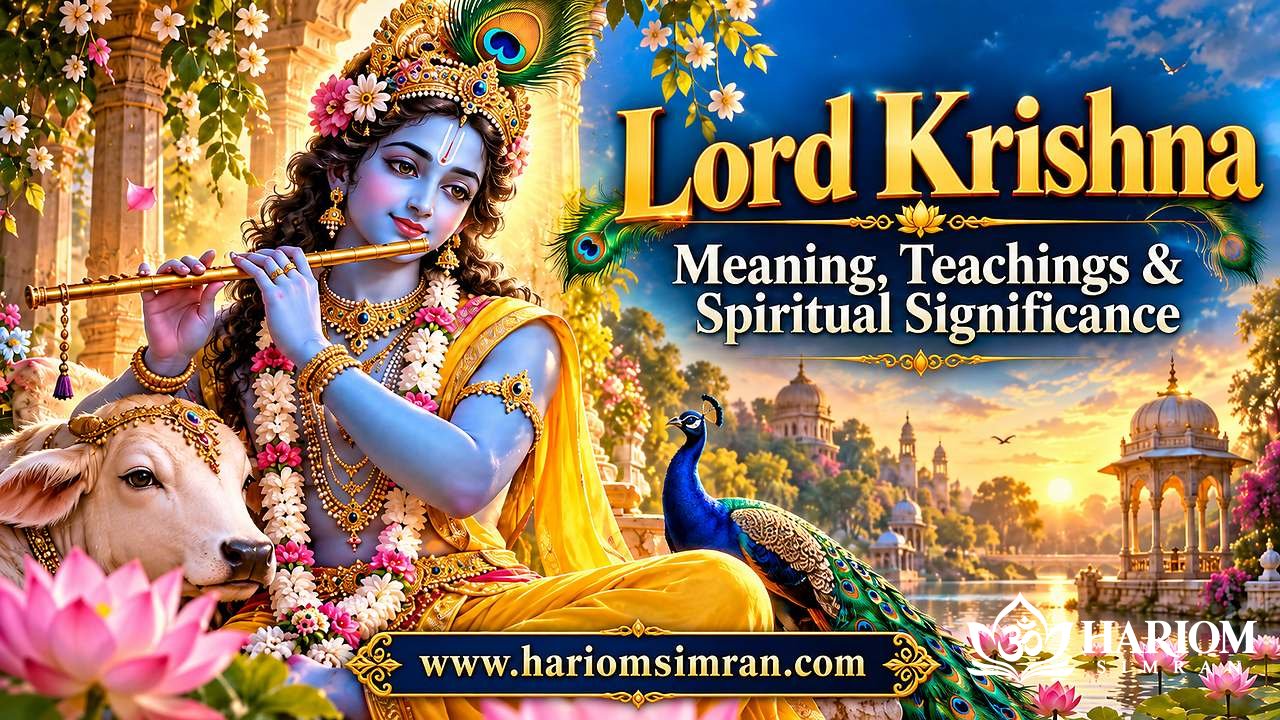
Lord Krishna is one of the most loved and influential Divine figures in Hinduism.
For millions of devotees, Krishna is remembered not through only one form or one story.
He appears as:
- A Divine child
- A playful cowherd
- A loving friend
- A protector of devotees
- A teacher of Dharma
- A statesman and guide
- The charioteer of Arjuna
- The speaker of the Bhagavad Gita
- A manifestation of Lord Vishnu
- The Supreme Divine Reality in several Vaishnava traditions
This remarkable range makes Krishna unique.
The child Krishna inspires love.
The flute-playing Krishna inspires Bhakti.
The Krishna of the Mahabharata represents wisdom, strategy and Dharma.
The Krishna of the Bhagavad Gita teaches humanity how to act, think and live when life becomes morally complicated.
Krishna's teachings address questions that remain relevant today:
How should we perform our responsibilities?
How can we act without becoming controlled by results?
What is true devotion?
How should we respond when Dharma becomes difficult?
What is the relationship between Atman, Karma and the Divine?
How can spiritual wisdom be lived in everyday life?
Lord Krishna therefore represents both Divine love and spiritual wisdom.
To explore the wider Hindu Divine tradition, visit Deities.
Who Is Lord Krishna?
Lord Krishna is a major Divine figure in Hinduism and one of the central deities of Vaishnava traditions.
Many Hindu traditions understand Krishna as an Avatar of Lord Vishnu.
Some Vaishnava traditions, particularly several Krishna-centered traditions, worship Krishna as Svayam Bhagavan, meaning the Supreme Divine Person or the original form of Bhagavan.
These theological perspectives should be respected as part of Hindu diversity.
Krishna is associated with:
- Dharma
- Bhakti
- Divine love
- Wisdom
- Compassion
- Protection
- Joy
- Courage
- Friendship
- Spiritual freedom
- Selfless action
- Divine grace
His life stories are spread across several important Hindu scriptures and devotional traditions.
What Does the Name Krishna Mean?
The Sanskrit name Krishna is commonly connected with meanings such as:
Dark
Dark-blue
or
One who attracts
Traditional theological explanations may interpret the name more deeply.
In devotional traditions, Krishna is often understood as the one who attracts the heart toward the Divine.
This idea fits beautifully with his association with:
- Flute music
- Bhakti
- Radha
- The Gopis
- Vrindavan
- Divine love
Krishna and Lord Vishnu
Krishna is widely worshipped as an Avatar of Lord Vishnu.
Within the famous Dashavatara tradition, Krishna is usually included among Vishnu's principal Avatars.
However, different Vaishnava traditions explain their relationship differently.
Some understand:
Vishnu as the Supreme Lord who appears as Krishna.
Others understand:
Krishna as the original Supreme Bhagavan from whom other Divine forms manifest.
HariOmSimran should preserve this theological diversity rather than presenting only one interpretation as universal.
Explore the broader Vaishnava tradition through Deities.
Krishna's Birth
Krishna's birth is one of Hinduism's most celebrated sacred stories.
He was born to:
Devaki
and
Vasudeva
in Mathura.
The ruler Kansa, Devaki's brother, had heard a prophecy that Devaki's eighth child would bring about his downfall.
Fearful of this prophecy, Kansa imprisoned Devaki and Vasudeva.
When Krishna was born, the sacred narrative describes extraordinary Divine protection.
Vasudeva carried the newborn Krishna across the Yamuna River to Gokul, where Krishna was raised by:
Nanda
and
Yashoda
Krishna's birth is celebrated every year as Krishna Janmashtami.
Explore Hindu celebrations through Festivals.
Krishna Janmashtami
Krishna Janmashtami celebrates the Divine birth of Lord Krishna.
Devotees may observe the festival through:
- Fasting according to personal tradition and health
- Temple worship
- Bhajans and Kirtan
- Bhagavad Gita reading
- Krishna stories
- Midnight worship
- Jhula decoration
- Abhishekam
- Mantra chanting
- Children's Krishna celebrations
- Dahi Handi in some regions
Practices vary by family, temple, region and Sampradaya.
The heart of Janmashtami is devotion and remembrance of Krishna.
Krishna as a Divine Child
Krishna's childhood stories are among the most loved stories in Hindu tradition.
As Bal Krishna, he represents:
- Innocence
- Joy
- Divine play
- Love
- Curiosity
- Sweetness
- Protection
Many devotees develop a deeply personal relationship with Krishna through his child form.
Some worship him as:
Laddu Gopal
or
Bal Gopal
and care for the Divine image with the affection one would show a beloved child.
Yashoda and Krishna
The relationship between Mother Yashoda and Krishna is one of Hindu Bhakti tradition's most beautiful examples of Vatsalya Bhava, devotional love expressed through parental affection.
Yashoda does not simply see Krishna as a distant cosmic Lord.
She loves him as her child.
This becomes a profound spiritual teaching.
The Divine can be approached not only through fear or formal worship, but through intimate love.
Krishna the Butter Thief
Child Krishna is famously called Makhan Chor, the butter thief.
Sacred stories describe Krishna stealing butter from homes in Gokul and Vrindavan.
On the surface, these are joyful childhood stories.
Devotional traditions often give them deeper meanings.
Butter can symbolize the pure essence produced after effort.
Krishna stealing butter can poetically represent the Divine taking possession of the devotee's purified heart.
Different teachers may explain the symbolism differently.
Damodara
One beloved childhood form of Krishna is Damodara.
In the sacred narrative, Mother Yashoda tries to tie young Krishna with a rope after his mischievous behavior.
The story is spiritually powerful because the infinite Divine appears bound by a mother's love.
Devotional interpretation emphasizes:
The Divine who cannot be controlled by worldly power can be reached through sincere Bhakti.
Krishna and Putana
One early Krishna story concerns Putana, who approaches the infant Krishna with harmful intention.
The sacred narrative describes Krishna defeating her.
Different devotional commentators draw different lessons from this episode.
The story commonly emphasizes:
- Divine protection
- Victory over harmful forces
- Krishna's extraordinary nature from childhood
Stories should be understood as sacred narratives rather than forced into modern historical or scientific frameworks.
Krishna and the Serpent Kaliya
One famous Vrindavan story tells of the serpent Kaliya, whose presence polluted the Yamuna.
Krishna subdues Kaliya and dances upon his hoods.
The image has become one of the most famous representations of young Krishna.
The story can symbolize:
- Victory over destructive forces
- Restoration of balance
- Divine protection
- Control over poisonous tendencies
- Courage in the face of danger
Explore sacred narratives through Hindu Stories.
Krishna and Govardhan Hill
Another famous story concerns Govardhan Hill.
According to the sacred narrative, Krishna encouraged the people of Vraja to honor the natural environment and their immediate duties.
When powerful rains threatened the community, Krishna lifted Govardhan Hill and gave shelter to the people and animals.
The story expresses several themes:
- Divine protection
- Community
- Humility
- Nature
- Devotion
- Dependence upon Divine grace
Krishna holding Govardhan with one finger is one of Hindu sacred art's most recognizable images.
Govardhan and Nature
The Govardhan story also encourages reflection on humanity's relationship with nature.
The people of Vraja depended upon:
- Cows
- Land
- Rain
- Grass
- Agriculture
- Community cooperation
The sacred story therefore connects Krishna Bhakti with gratitude toward the environment that sustains life.
Krishna as Gopala
Krishna is frequently called Gopala, meaning protector or caretaker of cows.
He is also called Govinda, a name with several traditional meanings.
His connection with cows and pastoral life is central to Vrindavan devotion.
Krishna as Gopala represents:
- Care
- Gentleness
- Protection
- Simplicity
- Harmony with nature
- Loving responsibility
Why Are Cows Associated With Krishna?
Cows were central to the pastoral economy and daily life of Vraja.
They provided nourishment and represented prosperity and livelihood.
Krishna's care for cows therefore became spiritually meaningful.
In devotional imagery, Krishna surrounded by cows represents peaceful Divine harmony with nature and living beings.
Krishna's Flute
The flute, or Bansuri, is one of Krishna's most famous symbols.
Krishna's flute is associated with:
- Divine attraction
- Love
- Bhakti
- Inner calling
- Spiritual surrender
- Joy
- Harmony
In devotional poetry, the sound of Krishna's flute draws the hearts of devotees toward him.
What Does Krishna's Flute Symbolize?
A flute is hollow.
It produces music when breath flows through it.
Because of this, spiritual teachers sometimes use it as a symbol of surrender.
The lesson can be expressed simply:
When ego becomes quiet, Divine wisdom can flow more freely through life.
This is a devotional interpretation rather than the only meaning of the flute.
Krishna's Peacock Feather
Krishna is frequently shown wearing a peacock feather in his crown.
The feather contributes to his unique and joyful visual identity.
Traditional devotional interpretations may associate it with:
- Beauty
- Nature
- Grace
- Joy
- Simplicity
- Divine play
Peacock imagery is especially common in Krishna art connected with Vrindavan.
Krishna's Blue or Dark Complexion
Krishna is often represented with blue or dark skin.
The Sanskrit name Krishna itself is associated with darkness or dark color.
Blue became especially common in later sacred art.
The color may be interpreted symbolically as representing:
- Vastness
- Infinity
- The sky
- The ocean
- Divine transcendence
Artistic traditions vary, so one exact shade should not be presented as historically universal.
Radha and Krishna
The relationship between Radha and Krishna became one of the most powerful expressions of Divine love in Hindu Bhakti traditions.
Radha represents complete devotion and love for Krishna in many traditions.
Together, Radha Krishna symbolize:
- Divine love
- Bhakti
- Spiritual longing
- Surrender
- Union with the Divine
- The relationship between devotee and Bhagavan
Radha receives particularly strong importance in several Krishna Bhakti traditions.
Is Radha Krishna's Wife?
The answer depends heavily on the tradition and sacred literature being discussed.
Radha Krishna devotion developed through rich poetic, theological and regional traditions.
Different Sampradayas understand their relationship through different spiritual frameworks.
It is therefore better not to reduce Radha Krishna to a simple modern relationship category.
Their Divine relationship is primarily understood through Bhakti Rasa and sacred theology.
Radha as Supreme Devotion
In many Krishna-centered traditions, Radha represents the highest expression of loving devotion.
Her love is not based on:
- Wealth
- Reward
- Social status
- Power
It represents complete spiritual absorption in Krishna.
This makes Radha one of Hindu Bhakti tradition's most profound figures.
Krishna and the Gopis
The Gopis of Vrindavan occupy an important place in Krishna Bhakti.
Their devotion is remembered for its intensity.
In devotional interpretation, they represent souls whose attention has become completely directed toward the Divine.
Their stories should be understood within the theological language of Bhakti, not reduced merely to ordinary social or romantic categories.
Rasa Lila
The Rasa Lila is one of the most famous Krishna traditions.
It describes Krishna dancing with the Gopis.
Devotional traditions interpret the Rasa Lila as a sacred expression of Divine love and the relationship between Bhagavan and devotees.
Its deeper meaning can include:
- Spiritual longing
- Divine presence
- Complete devotion
- Joy of Bhakti
- Loving relationship with the Divine
The narrative requires respectful theological context.
Krishna Leaves Vrindavan
Krishna's life does not remain only in the pastoral world of Vrindavan.
Eventually, he moves toward Mathura and the confrontation with Kansa.
This transition changes the tone of Krishna's story.
The playful child becomes increasingly connected with:
- Responsibility
- Justice
- Leadership
- Protection
- Dharma
Krishna and Kansa
Kansa represents tyranny and fear in Krishna's sacred life narrative.
Krishna eventually confronts and defeats him.
The story can be understood as a victory of:
- Dharma over oppression
- Courage over fear
- Justice over tyranny
- Divine purpose over selfish power
The Krishna who played in Vrindavan is now seen as a protector confronting injustice.
Krishna and Mathura
Mathura is one of the most important sacred places connected with Krishna.
It is traditionally regarded as his birthplace.
Krishna's life story connects Mathura with:
- Birth
- Kansa
- Devaki and Vasudeva
- Liberation from oppression
- Sacred pilgrimage
Mathura remains a major center of Krishna devotion.
Krishna and Vrindavan
Vrindavan is especially associated with Krishna's childhood and youth.
It is remembered for:
- Krishna's flute
- Radha
- Gopis
- Cowherd life
- Sacred forests
- Yamuna
- Govardhan
- Divine play
For many devotees, Vrindavan is not simply a geographical location.
It represents the sacred atmosphere of Krishna Bhakti.
Krishna and Dwarka
Later Krishna traditions are strongly associated with Dwarka.
Krishna is represented there as a royal and political leader.
This reveals a very different dimension of his personality.
The playful Gopala becomes:
- Statesman
- Kingly figure
- Protector
- Strategic thinker
- Counselor
- Leader
Krishna therefore represents both spiritual sweetness and practical wisdom.
Why Does Krishna Have So Many Different Forms?
Krishna's life embraces many human relationships.
He can be approached as:
- Child
- Friend
- Beloved
- Teacher
- Protector
- Lord
- Guide
This allows different devotees to develop different forms of Bhakti.
The Divine relationship does not need to feel identical for every person.
Krishna and Sudama
The story of Krishna and Sudama is widely loved as an example of friendship, humility and devotion.
Sudama is traditionally remembered as Krishna's childhood friend.
When he later visits Krishna in difficult circumstances, Krishna receives him with affection and respect.
The story teaches:
- True friendship is not based on wealth.
- Divine love does not measure social status.
- Humility matters.
- Sincere relationships have lasting value.
Krishna and Draupadi
Krishna is also closely associated with Draupadi in the Mahabharata tradition.
Their relationship represents trust, friendship and Divine protection.
Various episodes show Draupadi turning toward Krishna during moments of crisis.
The details of popular retellings should be carefully distinguished from the exact wording of source texts when developing dedicated story articles.
Krishna and the Pandavas
Krishna plays a central role in the Mahabharata.
He is closely associated with the Pandavas, especially Arjuna.
Krishna does not merely fight their battles for them.
He repeatedly offers:
- Advice
- Strategy
- Guidance
- Diplomacy
- Moral perspective
His role demonstrates that Dharma often requires wisdom rather than simple formulas.
Krishna's Peace Mission
Before the Kurukshetra war, Krishna participates in efforts to avoid catastrophic conflict.
This is important.
Krishna should not be portrayed as someone who simply wanted war.
The Mahabharata presents extensive attempts at negotiation and resolution.
Only when these fail does the conflict become unavoidable within the epic narrative.
This adds depth to Krishna's teaching on Dharma.
Krishna and Arjuna
One of the most important relationships in Hindu sacred literature is the friendship between Krishna and Arjuna.
At Kurukshetra, Krishna becomes Arjuna's charioteer.
This image is spiritually profound.
The Divine does not sit far away from human difficulty.
Krishna stands beside Arjuna in the middle of moral crisis.
Krishna as Parthasarathi
Krishna is known as Parthasarathi, the charioteer of Partha, another name for Arjuna.
The chariot image can inspire spiritual reflection.
Human life has:
- Decisions
- Conflicts
- Duties
- Emotions
- Uncertainty
Krishna as charioteer represents Divine wisdom guiding action.
The Bhagavad Gita
The Bhagavad Gita is one of Hinduism's most influential sacred texts.
It appears within the Mahabharata.
The teaching begins when Arjuna sees teachers, relatives and respected figures on both sides of the battlefield.
He becomes overwhelmed.
He questions whether he should fight.
Krishna responds not with one simple command, but with a profound spiritual dialogue covering:
- Dharma
- Karma
- Atman
- Yoga
- Bhakti
- Knowledge
- Meditation
- Divine nature
- Duty
- Detachment
- Liberation
Explore the wider sacred tradition through Hindu Scriptures.
Why the Bhagavad Gita Begins With a Crisis
The Bhagavad Gita does not begin in a peaceful temple.
It begins during a moral crisis.
That is one reason it remains relevant.
Human beings often seek wisdom when:
- Responsibilities conflict
- Emotions become overwhelming
- Choices are difficult
- Outcomes are uncertain
- Fear blocks action
Krishna's teaching addresses spiritual life in the middle of complexity.
Krishna's Teaching on Dharma
One of the Gita's central themes is Dharma.
Dharma cannot always be reduced to:
Do whatever you want.
Nor is it always:
Follow one rule regardless of context.
The Gita explores responsibility through one's situation, duty, inner discipline and spiritual understanding.
Explore the broader concept through Dharma.
Karma Yoga
One of Krishna's most famous teachings concerns Karma Yoga, the spiritual path of action.
Its central insight is that a person must act, but should not become psychologically enslaved by the fruits of action.
This does not mean:
Results do not matter.
It means:
Do your duty sincerely without allowing attachment to results to control your mind.
Action Without Attachment
People often suffer because they want complete control over outcomes.
But action and outcome are not identical.
A person can control:
- Preparation
- Effort
- Honesty
- Discipline
- Intention
But many external factors remain outside personal control.
Krishna's teaching encourages excellent action with inner balance.
Does Detachment Mean Not Caring?
No.
This is one of the most common misunderstandings of the Bhagavad Gita.
Detachment does not mean laziness or emotional indifference.
A person can care deeply and still avoid destructive attachment.
For example:
Do Your Best
while recognizing:
You Cannot Control Everything.
This can produce both responsibility and inner stability.
Bhakti Yoga
Krishna also teaches Bhakti, devotion to the Divine.
Bhakti can involve:
- Love
- Surrender
- Remembrance
- Worship
- Mantra
- Prayer
- Service
- Trust
Krishna Bhakti later becomes one of Hinduism's most powerful devotional movements.
Jnana and Spiritual Knowledge
The Bhagavad Gita also emphasizes Jnana, spiritual knowledge.
A seeker must understand the difference between:
- Temporary and enduring
- Body and deeper Self
- Ego and spiritual awareness
- Action and attachment
- Individual identity and Divine reality
Different Vedanta traditions interpret these teachings differently.
Krishna and Atman
Krishna teaches that the deepest Self, or Atman, should not be confused simply with the physical body.
The body changes.
The Self belongs to a deeper level of spiritual inquiry.
This teaching connects the Bhagavad Gita with wider Upanishadic philosophy.
Krishna and Rebirth
The Bhagavad Gita discusses repeated birth and death within the framework of Samsara.
Spiritual realization and liberation are associated with freedom from bondage to Karma and repeated becoming.
Different Hindu schools explain the exact relationship among:
- Atman
- Karma
- Rebirth
- Divine grace
- Moksha
through different philosophical frameworks.
Krishna's Vishvarupa
One of the most dramatic moments in the Bhagavad Gita is the revelation of Krishna's Vishvarupa, or Universal Form.
Arjuna is given a vision of Krishna beyond the familiar human form.
The vision includes cosmic vastness, Divine power, creation, destruction and time.
The teaching reveals that Krishna's reality cannot be limited to the ordinary human appearance Arjuna sees beside him.
What Does Vishvarupa Represent?
The Universal Form can represent:
- Divine infinity
- Cosmic unity
- Time
- Creation
- Destruction
- Divine power
- Reality beyond limited perception
The episode is one of Hindu sacred literature's most powerful theological visions.
Krishna and Time
In the Bhagavad Gita's Universal Form teaching, Krishna is associated with the overwhelming power of Time.
Time transforms everything.
Empires.
Bodies.
Relationships.
Civilizations.
Achievements.
Recognizing time's power can reduce arrogance.
It reminds the seeker that human control is limited.
Krishna and Free Will
The Bhagavad Gita presents a sophisticated relationship between:
- Divine teaching
- Human choice
- Karma
- Duty
- Surrender
Krishna teaches Arjuna extensively.
But Arjuna must still make a decision.
This is important.
Spiritual guidance does not necessarily remove human responsibility.
Krishna and Surrender
Krishna Bhakti places great importance on surrender to the Divine.
But surrender should not be confused with passivity.
In the Gita, surrender is connected with:
- Trust
- Wisdom
- Devotion
- Dharma
- Right action
Arjuna does not surrender by abandoning responsibility.
He eventually returns to action with greater spiritual understanding.
Krishna's Sudarshan Chakra
Krishna is frequently associated with the Sudarshan Chakra, the Divine discus also strongly associated with Vishnu.
The Chakra symbolizes:
- Divine protection
- Dharma
- Power
- Cosmic order
- Destruction of harmful forces
Its circular form may also inspire reflections on cosmic cycles and Divine order.
Krishna's Conch
Krishna is also associated with the sacred conch Panchajanya.
The conch has strong ritual and symbolic importance in Hinduism.
It can represent:
- Sacred sound
- Divine announcement
- Courage
- Purity
- Beginning of righteous action
The sound of a conch appears prominently at the beginning of the Kurukshetra battle in the Mahabharata tradition.
Krishna and the Lotus
Like several Hindu Divine figures, Krishna is associated with lotus imagery.
The lotus can symbolize:
- Purity
- Divine beauty
- Spiritual growth
- Detachment
- Sacred consciousness
The Bhagavad Gita also uses imagery connected with remaining inwardly unattached while acting in the world.
Krishna and Dharma in Difficult Situations
Krishna's life repeatedly enters situations where simple rules are not enough.
The Mahabharata world is morally complicated.
Characters face:
- Conflicting duties
- Family loyalty
- Political injustice
- War
- Promises
- Consequences
- Responsibility
Krishna therefore represents not simplistic morality, but the need for wisdom in applying Dharma.
Krishna as a Friend
Krishna's friendship with Arjuna and Sudama shows another important dimension of the Divine.
The Divine can be approached through Sakhya Bhava, friendship.
This allows devotion to include:
- Trust
- Closeness
- Honesty
- Conversation
- Reliance
Spiritual relationship does not always require emotional distance.
Krishna as the Beloved
In Radha Krishna and Gopi traditions, Krishna is approached through the language of Divine love.
This is often called Madhurya Bhava.
The language of love becomes a spiritual vocabulary for complete devotion.
It expresses the soul's longing for the Divine.
Krishna as a Child
Through Bal Krishna devotion, the Divine is loved through parental affection.
This is known as Vatsalya Bhava.
The devotee cares for Krishna.
Feeds him.
Dresses him.
Sings to him.
The relationship reverses the normal idea that humans only ask God for protection.
Here, devotees lovingly care for the Divine child.
Krishna as Bhagavan
Several traditions worship Krishna directly as Bhagavan, the Supreme Lord.
Bhagavan can express Divine reality possessing qualities such as:
- Knowledge
- Power
- Compassion
- Beauty
- Sovereignty
- Grace
Different Vaishnava schools develop this theology in distinctive ways.
Krishna and Vaishnavism
Krishna devotion is central to several Vaishnava traditions.
Important Krishna-centered traditions include different historical Sampradayas and Bhakti lineages.
They may emphasize:
- Bhagavad Gita
- Bhagavata Purana
- Radha Krishna
- Krishna Nama
- Kirtan
- Temple worship
- Seva
- Mantra
- Divine grace
- Bhakti Rasa
Not every Vaishnava tradition interprets Krishna in exactly the same theological way.
Krishna in the Bhagavata Purana
The Bhagavata Purana is one of the most influential scriptures for Krishna Bhakti.
It contains extensive narratives of Krishna's:
- Birth
- Childhood
- Vrindavan life
- Devotees
- Divine play
- Protection of Vraja
- Spiritual teachings
Its Krishna narratives became enormously influential in Hindu devotional culture.
Krishna in the Mahabharata
The Mahabharata presents another important dimension of Krishna.
Here Krishna is:
- Relative
- Friend
- Diplomat
- Counselor
- Strategist
- Charioteer
- Spiritual teacher
The Mahabharata Krishna is deeply engaged with political and ethical complexity.
Krishna in the Harivamsha
The Harivamsha, traditionally connected with the Mahabharata tradition, also contains important Krishna narratives.
It contributes to the development of Krishna's genealogy and sacred life stories.
When HariOmSimran develops advanced scripture articles, these textual relationships can be explained separately.
Krishna and the Bhagavad Gita Are Not the Whole Krishna Tradition
The Bhagavad Gita is extraordinarily important.
But Krishna cannot be understood only through the Gita.
Krishna tradition also includes:
- Childhood stories
- Vrindavan Bhakti
- Radha devotion
- Puranic narratives
- Temple traditions
- Regional poetry
- Kirtan
- Festivals
- Sacred geography
A complete Krishna article therefore needs both wisdom and Bhakti.
Important Names of Lord Krishna
Krishna is worshipped through many names.
Some widely known names include:
- Govinda: A deeply revered name with several traditional interpretations
- Gopala: Protector of cows
- Madhava: A sacred Vaishnava name
- Keshava: An important name used in scripture and worship
- Madhusudana: Destroyer of Madhu
- Vasudeva: Krishna as son of Vasudeva and also a major theological name
- Murari: Associated with the defeat of Mura
- Damodara: Krishna bound by Yashoda's love
- Giridhari: Lifter of Govardhan
- Muralidhara: Holder of the flute
- Shyamasundara: The beautiful dark-complexioned Lord
- Parthasarathi: Arjuna's charioteer
- Jagannatha: Lord of the universe in the famous Jagannath tradition
Each name reveals a different devotional dimension.
Krishna Mantras
Several Mantras and Divine names are associated with Krishna traditions.
Devotees may practice:
- Krishna Nama Japa
- Govinda remembrance
- Gopala Mantras
- Radha Krishna Nama
- Vaishnava Mantras according to lineage
Exact Mantra initiation and practice can vary by Sampradaya.
HariOmSimran should avoid presenting every Mantra as universally practiced in identical form.
Explore sacred sound through Mantras.
The Hare Krishna Mahamantra
One of the most internationally recognized Krishna-centered Mantras is the Hare Krishna Mahamantra.
It uses Divine names associated with:
- Hare
- Krishna
- Rama
The Mantra is especially prominent in certain Gaudiya Vaishnava traditions and global Krishna Bhakti movements.
Different Vaishnava traditions may emphasize different Mantras.
Krishna Festivals
Several Hindu festivals are strongly associated with Krishna.
Important celebrations include:
- Krishna Janmashtami
- Govardhan Puja
- Holi, especially in Braj traditions
- Radhashtami, in Radha Krishna traditions
- Gita Jayanti
- Ratha Yatra, especially associated with Lord Jagannath traditions
Regional traditions can add many more celebrations.
Explore Festivals.
Krishna and Holi
The Braj region has a particularly strong association between Krishna traditions and Holi.
Stories involving Krishna, Radha and the people of Vraja contribute to Holi's devotional culture in places such as:
- Mathura
- Vrindavan
- Barsana
- Nandgaon
Local forms of celebration vary.
Krishna and Govardhan Puja
Govardhan Puja remembers Krishna's connection with Govardhan Hill.
The observance can express:
- Gratitude
- Devotion
- Respect for nature
- Community
- Divine protection
Practices vary by region and tradition.
Krishna and Gita Jayanti
Gita Jayanti commemorates the sacred teaching of the Bhagavad Gita.
Devotees may observe it through:
- Gita reading
- Study
- Spiritual discourse
- Meditation
- Krishna worship
It highlights Krishna not only as a beloved deity but also as a spiritual teacher.
Major Krishna Sacred Places
Krishna is associated with several major sacred locations.
These include:
- Mathura
- Gokul
- Vrindavan
- Govardhan
- Barsana
- Nandgaon
- Dwarka
- Kurukshetra
Each place connects with a different chapter of Krishna tradition.
Mathura
Mathura is traditionally Krishna's birthplace.
It is one of India's most important sacred cities.
Its devotional identity is deeply connected with Janmashtami and Krishna's early life.
Vrindavan
Vrindavan represents Krishna's childhood and Bhakti tradition.
It is especially associated with:
- Radha Krishna
- Gopis
- Flute
- Yamuna
- Sacred groves
- Rasa Lila
- Temple worship
Dwarka
Dwarka represents Krishna's royal and leadership dimension.
The city is associated with later stages of Krishna's life and remains one of Hinduism's major pilgrimage centers.
Kurukshetra
Kurukshetra is associated with the Mahabharata war and the Bhagavad Gita.
It represents Krishna as:
- Teacher
- Charioteer
- Guide
- Voice of spiritual wisdom
Explore Hindu sacred geography through Temples.
Famous Krishna Temples
Many important temples are dedicated to Krishna and related Divine forms.
Examples of major traditions include temples dedicated to:
- Krishna
- Radha Krishna
- Dwarkadhish
- Banke Bihari
- Jagannath
- Guruvayurappan
- Udupi Krishna
- Srinathji
- Vitthala or Vithoba
Each tradition has its own history, theology and ritual practices.
Krishna and Jagannath
Lord Jagannath is especially worshipped in Puri and is closely connected with Krishna and Vaishnava traditions.
The famous Ratha Yatra celebrates Jagannath together with Balabhadra and Subhadra.
Jagannath theology contains its own rich regional and devotional traditions.
Krishna and Vitthala
Vitthala, or Vithoba, is an important Krishna or Vishnu-related Divine form especially revered in Maharashtra.
The Varkari tradition developed a powerful Bhakti culture around Vitthala.
Saints associated with this tradition contributed enormously to Indian devotional literature.
Krishna and Srinathji
Srinathji is a famous Krishna form associated especially with Govardhan and the Pushtimarg tradition.
The image represents Krishna lifting Govardhan.
This tradition emphasizes loving Seva and intimate devotion.
Krishna and Banke Bihari
Banke Bihari is a beloved Krishna form associated with Vrindavan.
The devotional tradition surrounding Banke Bihari emphasizes sweetness, intimate Bhakti and Krishna's charming Divine form.
Krishna and Music
Music is deeply connected with Krishna devotion.
His flute itself is musical.
Krishna Bhakti traditions have produced:
- Bhajans
- Kirtan
- Classical compositions
- Folk songs
- Temple music
- Devotional poetry
Music becomes not merely entertainment but a form of remembrance.
Krishna and Dance
Krishna traditions have deeply influenced Indian dance.
Rasa Lila, Krishna stories and Radha Krishna devotion appear in many classical and regional dance traditions.
Dance can become:
- Storytelling
- Worship
- Meditation
- Cultural preservation
Krishna's Divine play has inspired artists for centuries.
Krishna and Art
Krishna is one of the most frequently depicted Divine figures in Hindu art.
Popular artistic scenes include:
- Bal Krishna
- Krishna with Yashoda
- Butter thief Krishna
- Krishna with cows
- Krishna playing flute
- Radha Krishna
- Govardhan lifting
- Kaliya Mardan
- Krishna and Arjuna
- Vishvarupa
Each visual form communicates different theology and emotion.
Krishna and Bhakti Rasa
Krishna traditions developed sophisticated ways of understanding devotional emotion, often discussed through Rasa.
Devotees may relate to Krishna through different Bhavas such as:
- Shanta: Peaceful reverence
- Dasya: Service
- Sakhya: Friendship
- Vatsalya: Parental love
- Madhurya: Loving devotion
Different traditions emphasize these relationships differently.
Krishna and Seva
Krishna devotion often includes Seva, service offered with love.
Seva may involve:
- Temple service
- Food preparation
- Caring for sacred images
- Helping devotees
- Community service
- Feeding others
- Supporting spiritual learning
Service becomes a way of transforming devotion into action.
Krishna and Food Offerings
Many Krishna traditions place strong emphasis on offering food to the Divine before eating.
Such offerings may later be received as Prasada.
The spiritual idea is gratitude.
Food is not taken for granted.
It is remembered as part of Divine grace and interdependence.
Krishna and Vegetarian Traditions
Many Krishna-centered Vaishnava traditions emphasize vegetarian food as part of devotional practice.
Exact dietary disciplines vary by Sampradaya and individual practice.
HariOmSimran should describe specific rules only when discussing a particular tradition rather than presenting every regional practice as universal Hindu law.
Krishna and Dharma
Krishna is perhaps one of Hinduism's strongest Divine figures for understanding Dharma in complex situations.
His teachings remind us that Dharma may require:
- Courage
- Wisdom
- Context
- Discipline
- Responsibility
- Sacrifice
- Clear thinking
Explore Dharma for the broader concept.
Krishna and Compassion
Although Krishna is involved in difficult conflicts, his life also emphasizes compassion.
He protects:
- Devotees
- Communities
- Friends
- Those facing oppression
Compassion does not always mean avoiding difficult action.
Sometimes protecting others requires courage and responsibility.
Krishna and Joy
Unlike spiritual images that focus only on seriousness, Krishna often represents Ananda, joy.
His childhood.
Flute.
Dance.
Friendship.
Festivals.
Devotional music.
These remind devotees that spirituality can include joy.
Sacred life does not have to mean constant sadness or fear.
Krishna and Playfulness
The Sanskrit concept Lila is often associated with Divine play.
Krishna's childhood and Vrindavan stories are especially connected with Lila.
The idea suggests that Divine reality cannot always be understood only through seriousness, rules or abstract philosophy.
Joy, beauty and relationship also become spiritual.
Krishna and Responsibility
Yet Krishna is not only playful.
The same Krishna later deals with:
- Political conflict
- Diplomacy
- War
- Dharma
- Leadership
- Moral crisis
This balance is important.
A mature spiritual life needs both:
Joy
and
Responsibility
What Can Modern Readers Learn From Lord Krishna?
Krishna's life and teachings offer many practical lessons:
- Perform Your Duty Sincerely: Responsibility matters.
- Do Not Be Controlled by Results: Focus on right effort.
- Develop Inner Balance: Success and failure both change.
- Practice Bhakti: Spiritual life can be rooted in love.
- Value Friendship: Krishna's relationships show loyalty and care.
- Protect Dharma: Silence in front of injustice is not always virtue.
- Use Wisdom Before Action: Difficult situations require discernment.
- Stay Humble: Knowledge without humility can become ego.
- Celebrate Joy: Spiritual life can include music, beauty and happiness.
- Respect Nature: Govardhan and Gopala traditions connect devotion with the natural world.
- Seek the Deeper Self: Physical identity is not the complete Self.
- Turn Knowledge Into Action: Wisdom becomes meaningful when lived.
Krishna's Message for Work and Career
The teaching of Karma Yoga can be especially useful in modern professional life.
A person can focus on:
- Preparation
- Integrity
- Effort
- Skill
- Responsibility
without becoming mentally destroyed by every outcome.
This does not eliminate ambition.
It changes the relationship with ambition.
The goal becomes:
Excellent Action Without Destructive Attachment.
Krishna's Message for Difficult Decisions
When life presents complicated choices, Krishna's dialogue with Arjuna suggests a process:
- Understand the situation.
- Examine your responsibility.
- Separate fear from wisdom.
- Consider Dharma.
- Avoid impulsive action.
- Seek appropriate guidance.
- Act with courage.
- Accept that complete control over results is impossible.
This makes Krishna's teaching highly practical.
Krishna's Message for Relationships
Krishna appears in many kinds of relationships:
- Child with Yashoda
- Friend with Sudama
- Friend and guide to Arjuna
- Beloved of Radha
- Protector of devotees
- Member of a large family and community
This shows that spirituality can be expressed through relationships.
Love, trust, loyalty and responsibility can all become spiritual values.
Krishna's Message for the Digital Age
Modern life creates constant distraction.
Notifications.
Social comparison.
Information overload.
Performance pressure.
Krishna's teachings can inspire:
- Focus on your duty
- Reduce obsession with validation
- Develop inner steadiness
- Remember deeper values
- Use knowledge responsibly
- Avoid letting outcomes define your identity
Ancient spiritual teaching can remain meaningful without pretending to be modern technology advice.
Krishna's Symbols and Their Meaning
Some of Krishna's most recognizable symbols include:
- Flute: Divine attraction, Bhakti and inner surrender
- Peacock Feather: Beauty, nature and Divine joy
- Cow: Care, pastoral life and protection
- Lotus: Purity and spiritual growth
- Sudarshan Chakra: Divine order and protection
- Conch: Sacred sound and righteous action
- Yellow Garments: A common traditional feature in Krishna iconography
- Govardhan Hill: Protection and Divine grace
- Chariot: Spiritual guidance in the middle of responsibility
Together these symbols show Krishna as both the Lord of loving Bhakti and the teacher of spiritual wisdom.
Common Misunderstandings About Lord Krishna
Krishna Is Only a Romantic Deity
No. Radha Krishna Bhakti is extremely important, but Krishna is also a teacher of Dharma, protector, statesman, friend, Divine child and speaker of the Bhagavad Gita.
Bhagavad Gita Teaches People Not to Care About Results
No. The Gita teaches freedom from unhealthy attachment to results. It does not teach careless action or lack of responsibility.
Krishna Is Understood Exactly the Same Way by Every Vaishnava Tradition
No. Some traditions primarily understand Krishna as an Avatar of Vishnu, while others worship Krishna as Svayam Bhagavan. Hindu theological diversity should be respected.
Rasa Lila Is Simply an Ordinary Romantic Story
No. Krishna Bhakti traditions understand Rasa Lila through deep theological ideas about Divine love, devotion and the soul's relationship with Bhagavan.
Krishna's Teachings Encourage War
No. The Mahabharata presents Krishna participating in attempts to avoid war. The Bhagavad Gita addresses Arjuna's duty after the larger conflict has reached a severe moral crisis.
How Should Beginners Learn About Lord Krishna?
A structured learning journey can make Krishna's vast tradition easier to understand:
- Begin with Krishna's birth and Janmashtami.
- Explore Bal Krishna and Yashoda.
- Read the childhood stories of Gokul and Vrindavan.
- Understand Krishna as Gopala and Govinda.
- Study Govardhan and Kaliya narratives.
- Explore Radha Krishna Bhakti carefully.
- Understand the spiritual context of the Gopis and Rasa Lila.
- Study Krishna's movement from Vrindavan to Mathura.
- Learn about Kansa and Krishna's role in restoring justice.
- Explore Dwarka and Krishna as a leader.
- Study Krishna's friendship with Sudama and Arjuna.
- Understand Krishna's role in the Mahabharata.
- Study the Bhagavad Gita separately in depth.
- Explore Karma Yoga, Bhakti Yoga and Jnana.
- Learn the meaning of Vishvarupa.
- Explore major Krishna Mantras, festivals and temples.
- Compare how different Vaishnava traditions understand Krishna.
This approach preserves both Krishna's devotional sweetness and philosophical depth.
Why Lord Krishna Still Matters
Lord Krishna remains relevant because his life brings together dimensions that people often separate.
He combines:
Love and wisdom
Joy and responsibility
Devotion and action
Friendship and leadership
Playfulness and seriousness
Spirituality and practical life
The flute-playing Krishna reminds us that life needs beauty.
Bal Krishna reminds us of innocence and love.
Govardhan Krishna represents protection.
Radha Krishna represents Bhakti.
Krishna with Sudama represents friendship.
Krishna with Arjuna represents guidance.
The Krishna of the Bhagavad Gita represents spiritual wisdom in the middle of crisis.
Vishvarupa reveals the cosmic Divine beyond ordinary perception.
Krishna therefore does not teach escape from life.
His teachings repeatedly invite the seeker to live life with:
- Dharma
- Wisdom
- Devotion
- Courage
- Compassion
- Inner balance
Explore Hindu Divine Wisdom With HariOmSimran
HariOmSimran is developing the Deities section as a structured journey through Hindu Divine traditions.
Continue exploring:
The next strong article in the God category should be:
Lord Rama: Life, Dharma and Spiritual Significance
After Lord Rama, we can continue with:
- Lord Ganesha
- Lord Hanuman
- Lord Kartikeya
- Surya Deva
Then we can systematically expand the Goddess category with Durga, Lakshmi, Saraswati, Parvati, Kali, Sita and Radha.
Learn • Explore • Understand • Preserve
Key Takeaway
Lord Krishna is one of Hinduism's most loved and influential Divine figures.
He is worshipped as:
- Bal Krishna
- Gopala
- Govinda
- Radha's beloved
- Protector of Vrindavan
- Friend of Sudama
- Guide of the Pandavas
- Arjuna's charioteer
- Teacher of the Bhagavad Gita
- Avatar of Vishnu in many traditions
- Svayam Bhagavan in several Krishna-centered Vaishnava traditions
His life teaches that spirituality includes both Bhakti and Dharma.
Krishna's flute represents Divine love and attraction.
Govardhan represents protection.
His friendship represents loyalty.
The Bhagavad Gita teaches disciplined action, devotion, knowledge and inner balance.
The Vishvarupa reveals Divine reality beyond ordinary perception.
Spiritual Significance
This deity holds profound spiritual importance in Hindu tradition. Below are the key aspects of worship and significance.
Worship Practices
Devotees worship this deity through various rituals and practices that deepen their spiritual connection.
- Devotion
- Spiritual Growth
- Sacred Rituals
- Divine Blessings

Worship & Rituals
Explore the various ways devotees connect with this deity through prayer, rituals, and spiritual practices.
🙏 Daily Prayers
Daily prayers and mantras dedicated to this deity help devotees maintain a strong spiritual connection.
🕯️ Festival Celebrations
Special festivals and celebrations honor this deity, bringing communities together in devotion.
📿 Sacred Offerings
Traditional offerings and rituals that express devotion and seek divine blessings.
📖 Sacred Texts
Scriptures and hymns that describe the glory and teachings associated with this deity.
Frequently Asked Questions
Lord Krishna is a major Hindu Divine figure and one of the central deities of Vaishnavism. Many traditions worship him as an Avatar of Lord Vishnu, while several Krishna-centered traditions understand him as Svayam Bhagavan, the Supreme Divine Person.
Krishna is known for his Divine childhood in Gokul and Vrindavan, his relationship with Radha and the Gopis, lifting Govardhan Hill, defeating Kansa, his friendship with Arjuna and his teachings in the Bhagavad Gita.
Krishna's flute is commonly associated with Divine attraction, Bhakti, love, harmony and surrender. Devotional teachers sometimes compare the hollow flute with a heart freed from ego through which Divine wisdom can flow.
Krishna teaches about Dharma, Karma Yoga, Bhakti, spiritual knowledge, Atman, meditation, detachment, Divine reality and liberation. One central teaching is to perform one's responsibility sincerely without becoming enslaved by attachment to results.
Many Hindu traditions understand Krishna as an Avatar of Lord Vishnu. Several Krishna-centered Vaishnava traditions instead worship Krishna as Svayam Bhagavan and understand other Divine forms through Krishna. Both perspectives belong to Hindu theological tradition.
Lord Krishna is important because his life and teachings bring together Divine love, Bhakti, Dharma, friendship, joy, courage, spiritual wisdom and practical action. His Bhagavad Gita teachings remain among the most influential teachings in Hindu philosophy.