

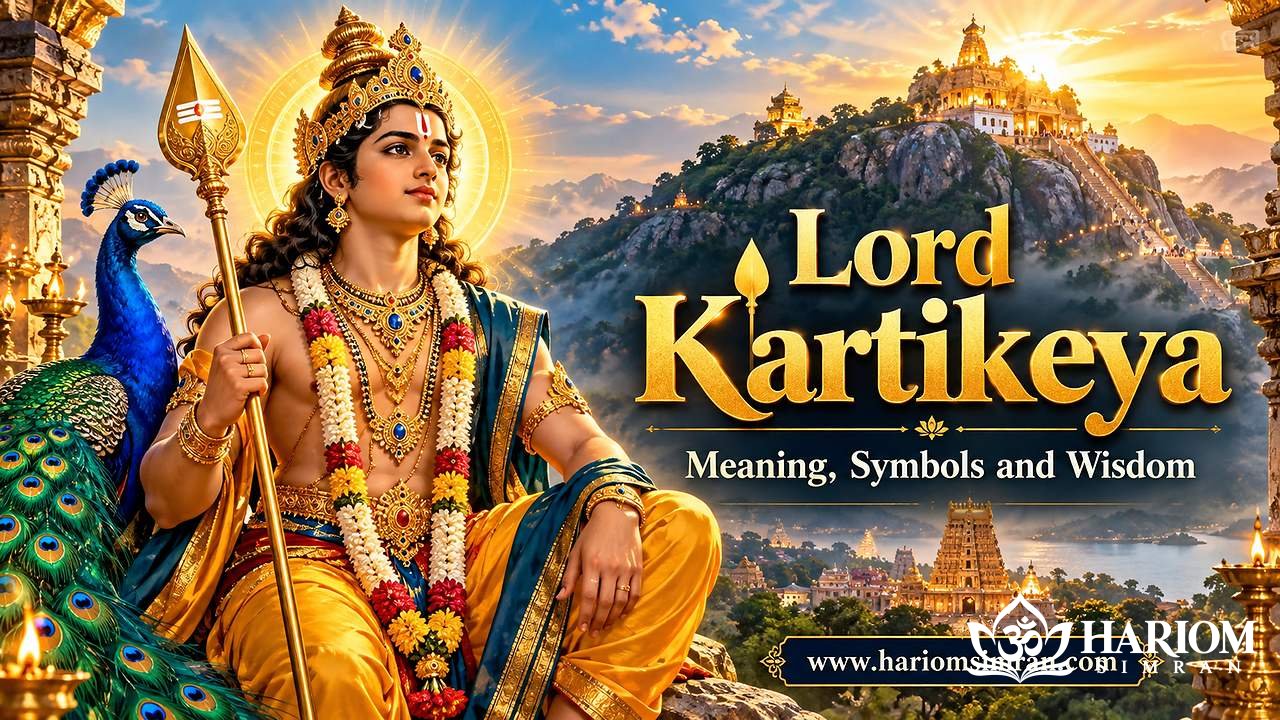
Lord Kartikeya is a major Hindu Divine figure associated with courage, wisdom, spiritual discipline, leadership and the protection of Dharma.
He is known by many sacred names, including:
- Kartikeya
- Murugan
- Skanda
- Subrahmanya
- Shanmukha
- Arumugam
- Kumara
- Saravana
- Guha
- Devasenapati
Kartikeya is traditionally regarded as the son of Lord Shiva and Goddess Parvati and the brother of Lord Ganesha.
In Tamil Hindu traditions, he is especially loved as Murugan and is connected with the sacred Vel, the peacock, hill temples, Skanda Sashti, Thaipusam and the six sacred abodes known as Arupadai Veedu.
But Kartikeya is much more than a warrior deity.
His sacred form teaches an important spiritual message:
Courage needs wisdom. Power needs Dharma. Leadership needs responsibility.
To explore other Divine forms in Hinduism, visit HariOmSimran Deities.
Who Is Lord Kartikeya?
Lord Kartikeya is a Hindu deity associated with:
- Courage
- Wisdom
- Leadership
- Spiritual knowledge
- Protection
- Discipline
- Youthful energy
- Victory over destructive forces
- Dharma
His traditions are especially strong in South India, particularly Tamil Nadu, but Kartikeya is worshipped across India and by Hindu communities around the world.
He is closely connected with the wider Hindu Divine family of Shiva, Parvati and Ganesha.
For a broader understanding of Hindu Divine traditions, explore Hinduism.
Is Kartikeya the Same as Murugan?
Yes, Murugan is the major Tamil devotional identity of Lord Kartikeya.
In different regions, devotees may know him by different names.
The same Divine figure may be called:
- Kartikeya
- Murugan
- Skanda
- Subrahmanya
- Shanmukha
Regional traditions may emphasize different stories, temples and theological meanings.
Murugan devotion is especially important in Tamil Hindu culture.
Is Kartikeya the Same as Skanda?
Skanda is another important name of Kartikeya.
The name appears in Sanskrit sacred literature and later Hindu devotional traditions.
Kartikeya's many names reflect the richness of Hindu tradition rather than separate unrelated deities.
What Does Kartikeya Mean?
The name Kartikeya is traditionally connected with the Krittikas, celestial mothers associated with his birth traditions.
Because he was nurtured by the Krittikas in important sacred narratives, he came to be known as Kartikeya.
Different scriptures describe his birth in different ways, which is common in Hindu sacred literature.
You can explore wider Hindu textual traditions through HariOmSimran Scriptures.
What Does Murugan Mean?
The Tamil name Murugan is traditionally associated with qualities such as:
- Youth
- Beauty
- Divine radiance
- Excellence
- Spiritual brilliance
Murugan is often represented as a youthful Divine warrior.
His youth does not represent immaturity.
Instead, it symbolizes:
Energy guided by purpose.
Lord Kartikeya's Family
Kartikeya belongs to one of Hinduism's most important Divine families.
He is traditionally associated with:
- Lord Shiva as father
- Goddess Parvati as mother
- Lord Ganesha as brother
These Divine figures represent complementary spiritual qualities.
Shiva is associated with meditation and transformation.
Parvati represents Shakti and Divine power.
Ganesha represents wisdom and auspicious beginnings.
Kartikeya represents courageous action, discipline and spiritual knowledge.
Explore the wider family of Hindu Divine forms through Deities.
Birth of Lord Kartikeya
Lord Kartikeya's birth is described through several sacred traditions.
Some narratives connect his birth with:
- Lord Shiva
- Goddess Parvati
- Agni
- Ganga
- The Krittikas
- Saravana
- Divine sparks or energy
Although details vary, one central theme remains consistent:
Kartikeya is born for a Divine purpose connected with restoring cosmic order.
This is important because Hindu sacred stories often contain multiple theological versions.
HariOmSimran treats these differences respectfully rather than presenting one version as the only valid tradition.
Kartikeya and the Krittikas
The Krittikas are closely connected with Kartikeya's sacred birth tradition.
They are traditionally described as nurturing the Divine child.
This relationship explains the name Kartikeya.
In some traditions, the Krittikas are associated with a celestial star group.
The religious meaning, however, should be understood within its sacred context rather than reduced only to astronomy.
Why Does Lord Kartikeya Have Six Faces?
Lord Kartikeya is often represented with six faces.
This form is known as:
Shanmukha
or
Arumugam
A major traditional explanation connects his six faces with the six Krittikas who cared for him.
The six faces also developed several symbolic interpretations.
They may represent:
- Expanded awareness
- Divine knowledge
- Awareness in all directions
- Spiritual completeness
- Mastery of human weaknesses
- Multiple dimensions of Divine power
Different traditions interpret these symbols differently.
Spiritual Meaning of the Six Faces
The six faces can offer a practical spiritual lesson:
Do not look at an important problem from only one direction.
Before making a decision, consider:
- Facts
- Consequences
- Emotions
- Dharma
- Other people's perspectives
- Long-term impact
This is why Kartikeya's six-faced form can also symbolize mature awareness.
For a deeper understanding of righteous action, explore Dharma.
Kartikeya as a Divine Warrior
Kartikeya is often represented as a Divine warrior and commander.
One important title is:
Devasenapati
which broadly means:
Commander of the Divine Forces
His warrior symbolism represents:
- Courage
- Readiness
- Discipline
- Leadership
- Strategy
- Protection of Dharma
The spiritual meaning is not uncontrolled violence.
It is the responsible use of strength.
Strength Must Serve Dharma
Strength itself is not automatically good.
Power can be used to:
- Protect
- Serve
- Build
- Defend
But it can also be misused.
Kartikeya's warrior form teaches:
Power becomes meaningful when it is controlled by wisdom and Dharma.
Lord Kartikeya's Vel
The Vel, or sacred spear, is one of the most important symbols associated with Kartikeya and Murugan.
In many Murugan traditions, Goddess Parvati gives the Vel to Kartikeya.
It becomes central to his Divine mission.
What Does the Vel Symbolize?
The Vel can symbolize:
- Divine knowledge
- Focus
- Courage
- Protection
- Clear purpose
- Spiritual insight
- Removal of ignorance
The pointed form of the spear also makes it a powerful symbol of concentration.
Vel and Spiritual Knowledge
Ignorance can create:
- Fear
- Confusion
- Ego
- Poor judgment
- Wrong assumptions
The Vel symbolically cuts through confusion.
Its spiritual teaching can be expressed simply:
Let wisdom pierce through ignorance.
Focus Like the Vel
Modern life often creates scattered attention.
People may have:
- Too many goals
- Too many distractions
- Endless notifications
- Too many unfinished tasks
Kartikeya's Vel reminds us:
Choose the right direction and give it focused effort.
Explore other Hindu sacred symbols and Divine traditions through Deities.
Kartikeya's Peacock
Lord Kartikeya's Vahana is commonly the peacock.
The peacock is one of Murugan's most recognizable symbols.
It is traditionally associated with:
- Beauty
- Majesty
- Pride
- Alertness
- Transformation
What Does the Peacock Mean Spiritually?
A common spiritual interpretation connects the peacock with mastery over pride.
The peacock is naturally beautiful and striking.
This creates a useful spiritual reminder:
Beauty, talent and achievement should not become ego.
Kartikeya riding the peacock can therefore symbolize wisdom mastering pride.
Kartikeya and Surapadman
One of the most important Murugan traditions concerns the conflict with Surapadman.
This sacred story is especially important in Tamil Hindu tradition.
It is closely connected with Skanda Sashti.
Kartikeya confronts Surapadman using the Vel.
The story can be understood on several levels.
It is a sacred Divine narrative, but devotional traditions also draw spiritual lessons from it.
Spiritual Meaning of Kartikeya's Victory
The victory over Surapadman can inspire reflection on overcoming:
- Ego
- Pride
- Ignorance
- Misuse of power
- Spiritual confusion
The message is not simply about defeating an enemy.
It can also be understood as mastering destructive tendencies within ourselves.
Explore related sacred narratives through Hindu Stories.
Transformation of Surapadman
Some Murugan traditions describe a transformation after Surapadman's defeat.
Elements associated with the defeated force become connected with Kartikeya's:
- Peacock
- Rooster emblem
This introduces an important spiritual concept:
Victory does not always require destroying energy. Sometimes energy can be transformed.
Transforming Negative Energy
Human emotions contain energy.
Anger contains energy.
Ambition contains energy.
Desire contains energy.
Even pride contains energy.
The challenge is not always to destroy these energies completely.
The deeper question is:
Can they be redirected toward something constructive?
Kartikeya's symbolism offers a powerful answer:
Transform energy through Dharma.
Kartikeya's Rooster Emblem
A rooster or cock emblem is also associated with Murugan traditions.
Traditional interpretations can include:
- Awakening
- Courage
- Victory
- Alertness
Just as the rooster announces the beginning of a new day, it can symbolize awakening from spiritual ignorance.
Kartikeya as Guha
Another important name of Kartikeya is:
Guha
The name is associated with hidden or inward spiritual meaning.
This reveals a very different dimension of Kartikeya.
He is not only a warrior.
He is also connected with:
- Inner wisdom
- Spiritual mystery
- Self-knowledge
- Hidden Divine truth
The Inner Battle
Human beings naturally notice external problems first.
But spiritual traditions often ask us to look within.
We may struggle with:
- Anger
- Fear
- Pride
- Jealousy
- Confusion
- Attachment
Kartikeya as Guha reminds us:
The greatest battle may sometimes be inside the mind.
Kartikeya as a Spiritual Teacher
A famous South Indian tradition presents Kartikeya not only as a student or Divine son but also as a Guru.
He is associated with profound knowledge of Om, the sacred Pranava.
In some sacred narratives, Kartikeya teaches even Lord Shiva.
This remarkable tradition gives him the title:
Swaminatha
Swamimalai
The sacred temple center Swamimalai is especially associated with Kartikeya as a spiritual teacher.
The tradition presents the Divine son explaining the deeper meaning of sacred wisdom.
This creates a profound lesson:
Wisdom is not limited by age or status.
What Does Swaminatha Teach Us?
Kartikeya as Guru teaches:
- Remain open to knowledge.
- Do not assume authority means knowing everything.
- Respect wisdom wherever it appears.
- Continue learning throughout life.
- Humility is necessary even for powerful people.
This strongly supports HariOmSimran's own educational purpose:
Learn • Explore • Understand • Preserve
Kartikeya and Lord Ganesha
Kartikeya and Lord Ganesha appear together in several well-known sacred stories.
One famous narrative involves a challenge in which the brothers must circle the world.
Kartikeya begins the physical journey.
Ganesha approaches the challenge differently by circling Shiva and Parvati.
Different versions preserve different details.
What Does the Kartikeya and Ganesha Story Teach?
The story should not be reduced to saying:
Ganesha was clever and Kartikeya was not.
They represent different strengths.
Kartikeya demonstrates:
- Energy
- Action
- Courage
- Effort
- Direct engagement
Ganesha demonstrates:
- Insight
- Interpretation
- Alternative thinking
Together they teach:
Wisdom can take more than one form.
Reflection and Action
Sometimes life requires careful thinking.
Sometimes it requires decisive action.
Too much thinking can become hesitation.
Too much action can become recklessness.
Kartikeya and Ganesha together symbolically remind us that mature wisdom needs:
Reflection and Action
in the right balance.
Kartikeya and Palani
Palani is one of the most famous Murugan pilgrimage centers.
It is deeply connected with Murugan's sacred traditions and the famous Divine fruit narrative.
Murugan's form at Palani emphasizes another important dimension:
Renunciation.
Palani and Detachment
At Palani, Murugan is associated with simplicity and detachment.
This may seem surprising for a Divine warrior.
But that contrast is spiritually meaningful.
Strength is not always the ability to possess more.
Sometimes strength is the ability to let go.
Palani therefore connects Kartikeya with:
- Simplicity
- Detachment
- Self-control
- Inner wisdom
- Renunciation
Kartikeya and Valli
Valli is one of the major Divine consorts associated with Murugan in South Indian tradition.
Valli traditions are especially beloved in Tamil devotional culture.
Her sacred stories involve themes such as:
- Love
- Devotion
- Grace
- Hill culture
- Divine relationship
Different retellings preserve different details.
Kartikeya and Devasena
Devasena, also called Deivayanai in important Tamil traditions, is another major Divine consort associated with Kartikeya.
She is closely connected with celestial and Divine traditions.
Valli and Devasena together are interpreted in several theological ways depending on the tradition.
Kartikeya in Tamil Hinduism
Murugan has an especially profound place in Tamil Hindu spirituality and culture.
His traditions include:
- Ancient Tamil devotional heritage
- Sacred hills
- Temple worship
- Bhakti poetry
- Music
- Pilgrimage
- Vel worship
- Kavadi traditions
- Major festivals
This makes Murugan one of the most important Divine figures in Tamil Hinduism.
Kartikeya in Hindu Scriptures
Kartikeya appears in many Hindu sacred traditions.
References and stories connected with him occur across:
- Puranic literature
- Mahabharata traditions
- Skanda-related literature
- Tamil devotional texts
- Temple traditions
- Regional sacred poetry
Different texts emphasize different dimensions of his identity.
Explore sacred texts through Hindu Scriptures.
Tiruppugazh
Tiruppugazh is one of the great Tamil devotional traditions associated with Murugan.
It is connected with the poet-saint Arunagirinathar.
The hymns praise Murugan through rich devotional language.
Tiruppugazh has strongly influenced:
- Murugan Bhakti
- Temple worship
- Music
- Tamil spiritual culture
Six Sacred Abodes of Murugan
Tamil tradition reveres six major pilgrimage centers known as:
Arupadai Veedu
or
Six Abodes of Murugan
They are:
- Tirupparankundram
- Tiruchendur
- Palani
- Swamimalai
- Tiruttani
- Pazhamudircholai
Each site preserves an important dimension of Murugan tradition.
Explore Hindu sacred places through Temples.
Tirupparankundram
Tirupparankundram is associated with important traditions involving Murugan and Devasena.
It is one of the major Murugan pilgrimage centers of Tamil Nadu.
Tiruchendur
Tiruchendur is especially connected with Murugan's victory over Surapadman.
Its coastal temple setting makes it distinctive among the six sacred abodes.
Skanda Sashti traditions are especially important here.
Palani
Palani represents Murugan's wisdom, simplicity and renunciation.
It is one of the best-known Murugan pilgrimage centers.
Swamimalai
Swamimalai represents Kartikeya as spiritual teacher.
It is associated with the tradition of Murugan explaining profound Pranava knowledge.
Tiruttani
Tiruttani is another important Murugan pilgrimage center.
Traditions associated with the site emphasize peace, Divine presence and Kartikeya's sacred life.
Pazhamudircholai
Pazhamudircholai is associated with Murugan in a lush hill environment.
It completes the famous six-abode tradition.
Skanda Sashti
Skanda Sashti is one of the most important festivals associated with Lord Kartikeya.
It is especially prominent in Tamil Hindu tradition.
The observance remembers Kartikeya's conflict with and victory over Surapadman.
Devotional practices differ by region, temple and family.
Explore Hindu festivals through Festivals.
Spiritual Meaning of Skanda Sashti
The festival can inspire reflection on overcoming:
- Ego
- Fear
- Ignorance
- Harmful habits
- Misuse of strength
Its deeper message is victory through discipline and Divine grace.
Thaipusam
Thaipusam is another major festival associated with Lord Murugan.
It is celebrated by Tamil Hindu communities in many parts of the world.
The festival is especially connected with:
- Murugan
- Vel
- Devotion
- Vows
- Kavadi
- Prayer
- Spiritual discipline
Kavadi and Murugan Devotion
The Kavadi tradition is especially associated with Thaipusam.
Devotees may carry different forms of Kavadi as an expression of:
- Devotion
- Gratitude
- Vows
- Pilgrimage
- Spiritual discipline
Practices differ significantly across communities.
Physical devotional practices should always be approached responsibly and according to health and community guidance.
Kartikeya Mantras
Several Mantras are associated with Kartikeya, Murugan and Subrahmanya.
Exact practices vary according to:
- Family tradition
- Temple
- Region
- Sampradaya
- Initiatory lineage
Explore wider Hindu sacred sound traditions through Mantras.
Om Saravanabhavaya Namah
A widely known devotional Mantra is:
Om Saravanabhavaya Namah
It expresses reverence toward Lord Murugan through the sacred name Saravanabhava.
The purpose of Mantra practice is spiritual remembrance and devotion.
It should not be promoted as a guaranteed formula for wealth, health or supernatural outcomes.
Kartikeya and Courage
Courage is one of Kartikeya's defining qualities.
But courage does not mean acting without thought.
True courage includes:
- Understanding risk
- Controlling fear
- Acting responsibly
- Protecting what is right
- Maintaining discipline
- Standing with Dharma
Courage Is Not Aggression
Aggression often comes from:
- Ego
- Anger
- Insecurity
- Desire to dominate
Courage can come from:
- Duty
- Compassion
- Responsibility
- Dharma
Kartikeya represents disciplined courage, not uncontrolled aggression.
Kartikeya and Leadership
As Devasenapati, Kartikeya represents responsible leadership.
Leadership requires more than authority.
A strong leader needs:
- Clarity
- Courage
- Discipline
- Strategic thinking
- Responsibility
- Ability to inspire
- Self-control
Kartikeya's Leadership Lesson
A leader should ask:
Do I understand the mission?
Am I acting from Dharma or ego?
Can I make difficult decisions responsibly?
Can I control myself before trying to lead others?
This is why Kartikeya's leadership symbolism remains highly relevant.
Kartikeya and Discipline
Youthful energy can create extraordinary achievements.
But energy without direction can become chaos.
Kartikeya represents:
Energy With Direction.
This requires:
- Purpose
- Values
- Focus
- Guidance
- Discipline
What Young People Can Learn From Kartikeya
Kartikeya's symbolism can inspire young people to:
- Build courage.
- Develop discipline.
- Study seriously.
- Control impulsive behavior.
- Use energy productively.
- Respect responsibility.
- Avoid unnecessary ego.
- Seek spiritual knowledge.
- Stand against injustice wisely.
Kartikeya and Knowledge
Kartikeya's warrior identity should not hide his strong connection with knowledge.
As Guha and Swaminatha, he represents profound spiritual understanding.
His life teaches:
Strength without understanding is incomplete.
Knowledge Before Action
A person can act quickly and still act incorrectly.
A person can sound confident and still be wrong.
Kartikeya's wisdom encourages:
Understand first. Then act decisively.
Kartikeya and Ego
The peacock and Surapadman traditions can also inspire reflection on ego.
Ego may say:
- I must always win.
- I cannot admit mistakes.
- I must appear superior.
- My power gives me the right to control others.
Kartikeya's spiritual victory teaches mastery of ego rather than expansion of ego.
Kartikeya and Fear
Fear is natural.
But fear can stop people from:
- Speaking truth
- Accepting responsibility
- Trying something new
- Facing failure
- Leaving harmful situations
Kartikeya does not teach:
Never feel fear.
His message is:
Do not let fear automatically make your decisions.
Kartikeya and Inner Enemies
Some of the most difficult enemies are internal.
These may include:
- Anger
- Pride
- Greed
- Jealousy
- Attachment
- Confusion
Kartikeya's warrior symbolism can therefore become a spiritual metaphor for inner discipline.
The Greatest Battle
It can be easier to defeat an opponent than to admit our own mistake.
It can be easier to criticize someone else than to control our own anger.
Kartikeya's deeper warrior teaching is:
Master the inner disorder before trying to control the outer world.
Kartikeya and Dharma
Kartikeya's strength is always meaningful when connected with Dharma.
His sacred role is not about displaying power.
It is about restoring and protecting righteous order.
For a deeper understanding, explore Dharma.
Kartikeya and Seva
Leadership can itself become Seva.
As Devasenapati, Kartikeya accepts responsibility for others.
This teaches:
Leadership is not only authority. It is responsibility.
Murugan Bhakti
Murugan devotion is deeply personal.
Devotees may approach him through:
- Puja
- Mantra
- Temple worship
- Pilgrimage
- Bhajan
- Tamil hymns
- Kavadi
- Festival observance
- Seva
- Fasting according to personal tradition and health
Practices vary by region and Sampradaya.
Murugan and Sacred Hills
Murugan has a powerful association with hills and mountains.
Many major Murugan temples are located in elevated landscapes.
The mountain can symbolize:
- Spiritual ascent
- Discipline
- Higher perspective
- Effort
- Pilgrimage
Spiritual Growth Is Like Climbing
A mountain is not climbed in one step.
Growth requires:
- Persistence
- Patience
- Direction
- Effort
Spiritual development often works the same way.
There may be no instant shortcut.
Kartikeya's Message for Modern Life
Modern life creates challenges such as:
- Information overload
- Short attention spans
- Online conflict
- Social comparison
- Fear of failure
- Pressure to appear successful
Kartikeya's symbols offer practical wisdom:
- Six Faces: Look at a problem from multiple perspectives.
- Vel: Focus your energy.
- Peacock: Do not let pride control you.
- Warrior Form: Develop disciplined courage.
- Swaminatha: Never stop learning.
- Sacred Hills: Real growth requires effort.
Lord Kartikeya's Main Symbols
Lord Kartikeya's sacred symbols include:
- Vel: Wisdom, focus and Divine power
- Peacock: Pride transformed through spiritual mastery
- Six Faces: Expanded awareness and Divine knowledge
- Rooster Emblem: Awakening, alertness and victory
- Youthful Form: Energy and potential
- Warrior Form: Courage and protection of Dharma
- Sacred Hills: Spiritual ascent and discipline
- Devasenapati: Responsible leadership
- Swaminatha: Guru wisdom and spiritual knowledge
What Can Modern Readers Learn From Kartikeya?
Lord Kartikeya offers timeless practical lessons:
- Develop Courage: Fear should not control every decision.
- Stay Focused: Give energy to what truly matters.
- Use Strength Responsibly: Power should serve Dharma.
- Look From Different Perspectives: Avoid narrow thinking.
- Master Pride: Success should not become ego.
- Transform Negative Energy: Redirect energy toward constructive action.
- Keep Learning: Wisdom is never finished.
- Lead Responsibly: Leadership is service, not status.
- Develop Discipline: Energy needs direction.
- Face Inner Weaknesses: Spiritual battles also happen within.
- Balance Reflection and Action: Think carefully, then act.
- Remain Humble: Knowledge and power need humility.
Common Misunderstandings About Lord Kartikeya
Are Kartikeya and Murugan Different Gods?
Generally, no. Murugan is the especially important Tamil devotional identity of Kartikeya or Skanda. Regional traditions may emphasize different stories and theological meanings.
Is Kartikeya Only a God of War?
No. Kartikeya is also associated with wisdom, spiritual knowledge, discipline, leadership, courage and protection of Dharma.
Do Kartikeya's Six Faces Have Only One Meaning?
No. Several traditional and symbolic interpretations exist. They are associated with the Krittikas, expanded awareness, Divine knowledge and other spiritual ideas.
Is the Vel Only a Weapon?
No. In Murugan tradition, the Vel also symbolizes focus, wisdom, Divine knowledge, courage and the removal of ignorance.
Is Kartikeya Worshipped Only in Tamil Nadu?
No. Murugan devotion is especially strong in Tamil traditions, but Kartikeya, Skanda and Subrahmanya are worshipped in several regions of India and by Hindu communities worldwide.
How Should Beginners Learn About Lord Kartikeya?
A clear learning path is:
- Begin with Kartikeya's major names.
- Understand his relationship with Shiva and Parvati.
- Learn the different birth traditions.
- Explore the Krittikas.
- Understand his six-faced Shanmukha form.
- Study the meaning of the Vel.
- Explore the peacock symbolism.
- Learn the Surapadman story.
- Understand Skanda Sashti.
- Learn about Valli and Devasena.
- Explore Kartikeya as Swaminatha.
- Study the Kartikeya and Ganesha story.
- Learn about Palani.
- Explore the Six Abodes of Murugan.
- Understand Thaipusam and Kavadi.
- Learn about Tiruppugazh.
- Explore Murugan Mantras and temple traditions.
Why Lord Kartikeya Still Matters
Lord Kartikeya remains spiritually relevant because human beings constantly need to balance:
Courage and Wisdom
Strength and Responsibility
Speed and Reflection
Confidence and Humility
Leadership and Seva
Ambition and Dharma
Courage without wisdom can become recklessness.
Strength without Dharma can become oppression.
Ambition without humility can become ego.
Knowledge without action may remain unused.
Kartikeya brings these qualities together.
His six faces remind us to see more widely.
His Vel teaches focus.
His peacock teaches mastery over pride.
His warrior form represents courage.
His title Devasenapati represents responsible leadership.
His Swaminatha tradition represents spiritual knowledge.
His sacred hill traditions remind us:
Growth Requires Effort.
Lord Kartikeya's timeless message is:
Be Courageous, Stay Focused, Master the Ego, Seek Wisdom and Use Your Strength in the Service of Dharma.
Explore More With HariOmSimran
Continue your Hindu learning journey through:
These internal connections help readers move naturally from Kartikeya's Divine identity into related Hindu philosophy, scriptures, sacred stories, festivals, Mantras and pilgrimage traditions.
Learn • Explore • Understand • Preserve
Key Takeaway
Lord Kartikeya, also known as Murugan, Skanda and Subrahmanya, represents courageous action guided by spiritual wisdom.
His major symbols carry clear teachings:
- Six Faces: Expanded awareness
- Vel: Wisdom and focused action
- Peacock: Mastery over pride
- Rooster: Awakening and courage
- Warrior Form: Protection of Dharma
- Sacred Hills: Spiritual effort
- Devasenapati: Responsible leadership
- Swaminatha: Divine knowledge
Kartikeya teaches that courage without wisdom can become recklessness and strength without Dharma can become harmful.
His deeper message is simple:
Use courage with wisdom, power with responsibility and leadership in the service of Dharma.
Spiritual Significance
This deity holds profound spiritual importance in Hindu tradition. Below are the key aspects of worship and significance.
Worship Practices
Devotees worship this deity through various rituals and practices that deepen their spiritual connection.
- Devotion
- Spiritual Growth
- Sacred Rituals
- Divine Blessings

Worship & Rituals
Explore the various ways devotees connect with this deity through prayer, rituals, and spiritual practices.
🙏 Daily Prayers
Daily prayers and mantras dedicated to this deity help devotees maintain a strong spiritual connection.
🕯️ Festival Celebrations
Special festivals and celebrations honor this deity, bringing communities together in devotion.
📿 Sacred Offerings
Traditional offerings and rituals that express devotion and seek divine blessings.
📖 Sacred Texts
Scriptures and hymns that describe the glory and teachings associated with this deity.
Frequently Asked Questions
Lord Kartikeya is a major Hindu Divine figure associated with courage, wisdom, leadership and protection of Dharma. He is traditionally regarded as the son of Lord Shiva and Goddess Parvati and the brother of Lord Ganesha.
One major sacred tradition connects Kartikeya's six faces with the six Krittikas who nurtured him. The faces also carry symbolic meanings connected with expanded awareness and Divine knowledge.
They belong to the same broad Divine tradition. Murugan is especially prominent in Tamil Hinduism, while Kartikeya and Skanda are widely used in Sanskritic traditions. Regional customs and theological emphasis may differ.
The Vel is Kartikeya's sacred spear. It symbolizes Divine knowledge, concentration, courage, protection and the ability to cut through spiritual ignorance.
Lord Kartikeya's Vahana is the peacock. It is commonly interpreted as a symbol of beauty and pride brought under the control of spiritual wisdom.
Lord Kartikeya represents courage guided by wisdom, strength guided by Dharma and leadership guided by responsibility. His traditions also emphasize spiritual knowledge, humility, discipline and transformation.