

Lord Brahma is traditionally associated with creation in many Hindu traditions.
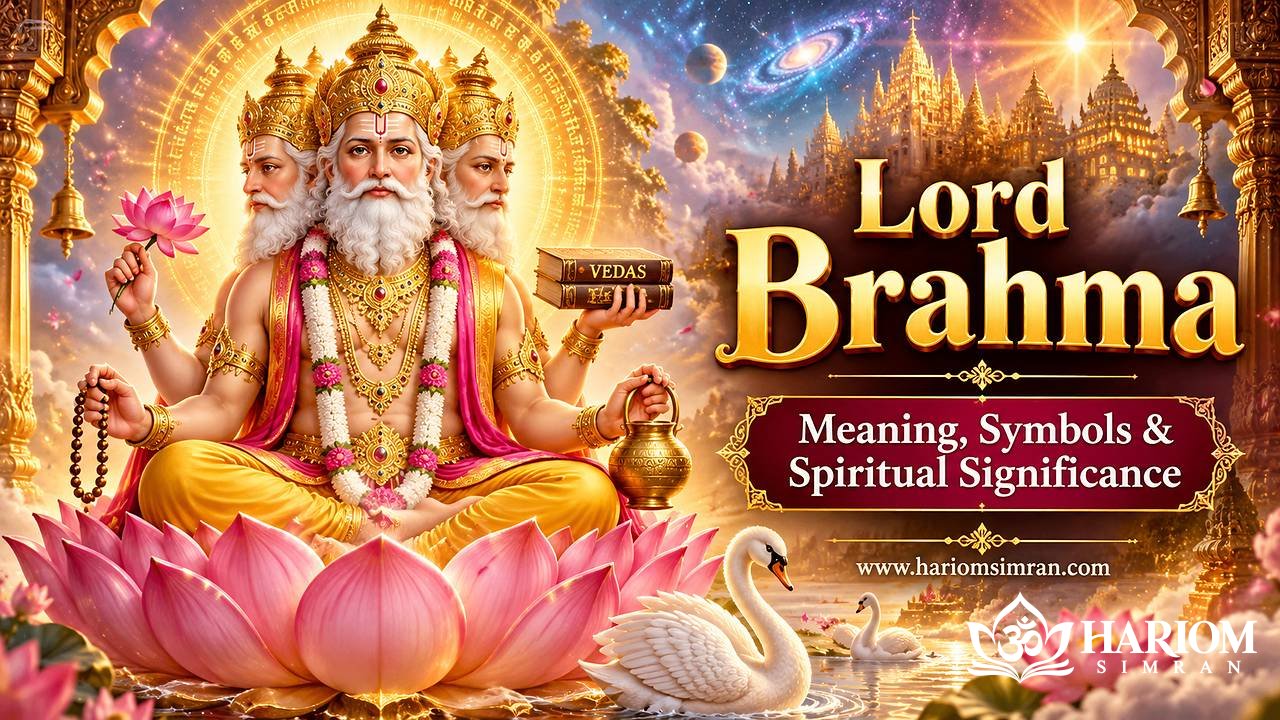
He is commonly represented with:
- Four faces
- Four arms
- Sacred Vedas
- A lotus
- A rosary
- A Kamandalu
- The Hamsa, or swan, as his Vahana
Within the popular Trimurti framework, Brahma is connected with creation, Vishnu with preservation and Shiva with transformation or dissolution.
But Brahma's spiritual meaning goes much deeper than the simple label “Creator God.”
His symbolism touches important themes such as:
- Sacred knowledge
- Creation
- Time
- Cosmic order
- Speech
- Wisdom
- The Vedas
- Conscious planning
- Responsibility
- Beginning of manifestation
Lord Brahma is therefore an important Divine figure for understanding how Hindu traditions reflect on the beginning of the manifested universe.
To explore the wider Hindu Divine tradition, visit Deities.
Who Is Lord Brahma?
Lord Brahma is a major Divine figure in Hindu tradition and is traditionally associated with the process of creation.
In many popular theological explanations, he forms part of the Trimurti:
- Brahma: Creation
- Vishnu: Preservation
- Shiva: Transformation or dissolution
This framework helps explain three major cosmic functions.
However, Hindu traditions are diverse.
Different schools may understand ultimate reality differently.
For example:
- Some Vaishnava traditions understand Brahma as arising through Vishnu or Narayana.
- Some Shaiva traditions understand all cosmic functions as ultimately dependent upon Shiva.
- Shakta traditions may understand creation itself through Devi or Shakti.
- Vedantic traditions may distinguish the personal deity Brahma from the ultimate reality called Brahman.
Because of this diversity, Brahma should not be presented as the universally supreme creator in every Hindu tradition.
Brahma and Brahman Are Not the Same
One of the most important distinctions for beginners is:
Brahma and Brahman are different concepts.
Brahma
Brahma is a Divine figure associated with creation.
He is commonly depicted with four faces and four arms.
Brahman
Brahman is a philosophical term referring to ultimate reality in the Upanishadic and Vedantic traditions.
Brahman is not simply another name for Lord Brahma.
This distinction is essential when studying Hindu philosophy.
For deeper philosophical understanding, explore Hindu Scriptures.
What Does the Name Brahma Mean?
The name Brahma is connected with Sanskrit roots associated with greatness, expansion and sacred expression.
In Hindu religious understanding, Brahma is strongly connected with the expansion of manifested creation.
This fits his traditional role as the Divine creator within the cosmic order.
Lord Brahma and Creation
Brahma is commonly associated with the beginning of manifested creation.
Sacred Hindu texts contain several different creation narratives.
This is important because Hinduism does not depend upon one single creation story accepted identically by every tradition.
Different scriptures may describe creation through:
- Brahma
- Narayana
- Vishnu
- Shiva
- Devi
- Hiranyagarbha
- Purusha
- Brahman
- Prakriti and Purusha
- Other philosophical and theological frameworks
This diversity reflects Hinduism's layered scriptural tradition.
Is Brahma the Creator of Everything?
A simple popular answer is:
Brahma is associated with creation.
A more accurate theological answer is:
His exact role depends on the tradition and scripture being studied.
In some traditions Brahma directly organizes or produces manifested worlds.
In others, he himself arises from a deeper Divine source.
Therefore, HariOmSimran should avoid presenting one theological model as the only Hindu understanding of creation.
Brahma and the Trimurti
The Trimurti is one of the most familiar Hindu theological frameworks.
It associates three major cosmic functions with three Divine figures:
- Brahma: Srishti, or creation
- Vishnu: Sthiti, or preservation
- Shiva: Transformation or dissolution
This can help beginners understand cosmic processes.
But the Trimurti should not be treated as a rigid structure explaining every Hindu tradition.
Many Vaishnava, Shaiva and Shakta traditions organize theology differently.
Creation, Preservation and Transformation
The Trimurti can also be understood symbolically.
Everything in life passes through cycles.
A project begins.
It continues.
Eventually it changes or ends.
A plant grows.
It lives.
It returns to nature.
Human relationships, societies and even stars undergo change.
Creation, preservation and transformation are therefore not only cosmic ideas.
They are patterns visible throughout life.
The Four Faces of Lord Brahma
One of Brahma's most famous features is his four faces.
Traditional images usually show four heads or faces facing different directions.
These faces receive several symbolic interpretations.
They may represent:
- The four Vedas
- The four directions
- The comprehensive nature of knowledge
- Awareness extending in every direction
- Different dimensions of creation
Symbolic interpretations can vary by tradition.
Four Faces and the Four Vedas
A widely known interpretation connects Brahma's four faces with the four Vedas:
- Rigveda
- Yajurveda
- Samaveda
- Atharvaveda
This strengthens Brahma's association with sacred knowledge.
The image suggests that creation and knowledge are deeply connected.
To understand the wider Vedic tradition, explore Hindu Scriptures.
Why Does Knowledge Matter in Creation?
Creation is not only about producing physical forms.
Order requires intelligence.
Structure requires understanding.
Speech requires meaning.
Ritual requires knowledge.
Society requires memory and transmission.
Brahma's association with the Vedas therefore symbolically connects creation with:
Knowledge
Order
Language
Planning
Wisdom
The Four Directions
Brahma's four faces may also be associated with the four directions.
This symbolism suggests awareness extending throughout the cosmos.
It presents Brahma as connected with creation in all directions rather than one limited location.
Was Brahma Originally Shown With Five Heads?
Some sacred narratives describe Brahma as originally having five heads.
Later stories explain how one head was removed.
Versions and interpretations vary across Puranic traditions.
These narratives should be presented carefully because there is no need to force one version as universally accepted.
The better educational approach is to acknowledge that Hindu sacred stories often exist in multiple forms.
Lord Brahma's Four Arms
Brahma is usually depicted with four arms.
Like the four faces, the arms carry symbolic objects.
Common objects include:
- The Vedas or sacred book
- Mala or rosary
- Kamandalu
- Lotus
Each object adds another layer to Brahma's meaning.
The Vedas in Brahma's Hands
The sacred scriptures shown with Brahma symbolize knowledge.
Creation without knowledge could become disorder.
The Vedas therefore represent:
- Sacred wisdom
- Cosmic order
- Knowledge
- Spiritual teaching
- Preservation of sacred tradition
Brahma's imagery reminds us that knowledge plays an essential role in shaping life.
Brahma's Mala
A rosary or Akshamala is often shown in Brahma's hand.
The beads may symbolize:
- Time
- Cycles
- Meditation
- Sacred repetition
- Continuous creation
Each bead can be viewed as part of an ongoing sequence.
This symbolism connects Brahma with both creation and the passage of time.
Brahma's Kamandalu
The Kamandalu is a traditional water vessel associated with sages and ascetics.
Brahma is often shown carrying one.
Water is deeply important in Hindu sacred symbolism.
It can represent:
- Life
- Purity
- Potential
- Creation
- Sacred beginnings
The Kamandalu therefore strengthens Brahma's association with the emergence of life.
The Lotus
Lord Brahma is frequently associated with the lotus.
The lotus is one of Hinduism's most important sacred symbols.
It can represent:
- Purity
- Creation
- Spiritual awakening
- Divine beauty
- Growth
- Emergence from deeper reality
A lotus grows from water and rises above it.
This makes it a powerful symbol of spiritual development.
Brahma Emerging From a Lotus
One of the most famous Vaishnava creation narratives describes Brahma emerging from a lotus connected with Lord Vishnu, often represented as Narayana resting upon the cosmic waters.
In this theological framework:
- Vishnu or Narayana is the deeper Divine source.
- A lotus emerges.
- Brahma appears upon the lotus.
- Brahma then participates in the creation of the manifested universe.
This narrative is especially important in Vaishnava and Puranic traditions.
It should be presented as one major Hindu theological account rather than the only creation story.
Brahma and Lord Vishnu
Brahma and Vishnu are closely connected in several creation narratives.
In some Vaishnava traditions, Brahma receives the responsibility of creation from Vishnu.
This emphasizes an important distinction:
Creating within the universe does not necessarily mean being the ultimate source of all reality.
Different traditions understand this relationship differently.
Explore the wider Divine tradition through Deities.
Brahma and Lord Shiva
Brahma and Shiva also appear together in many Puranic narratives.
Some stories explore questions such as:
- Pride
- Divine supremacy
- Infinite reality
- Truth
- Humility
- Cosmic functions
A famous group of stories concerns a limitless pillar of light associated with Shiva.
Different versions appear in Shaiva literature and later traditions.
These stories often teach that ultimate Divine reality cannot be measured through ego or ordinary perception.
Brahma and Goddess Saraswati
Lord Brahma is traditionally associated with Goddess Saraswati, the Goddess of knowledge, learning, speech, music and wisdom.
Together, Brahma and Saraswati can symbolically connect:
Creation
with
Knowledge
This relationship is spiritually meaningful.
Creation requires expression.
Expression requires language.
Language requires knowledge.
Knowledge allows creation to be organized and understood.
Saraswati and Sacred Knowledge
Goddess Saraswati represents areas such as:
- Learning
- Speech
- Wisdom
- Music
- Arts
- Knowledge
- Education
Her association with Brahma reinforces the idea that creation is connected with intelligence and sacred order.
HariOmSimran can later develop a dedicated Goddess article on Saraswati under the Goddess category.
Brahma's Vahana: Hamsa
Lord Brahma is commonly associated with the Hamsa, often translated as swan.
In Indian sacred symbolism, Hamsa carries important meanings.
It can represent:
- Wisdom
- Discernment
- Purity
- Spiritual understanding
- Freedom
The Hamsa becomes an especially appropriate Vahana for a deity associated with knowledge and creation.
Hamsa and Discernment
Traditional symbolism sometimes associates the Hamsa with the ability to distinguish what is valuable from what is not.
Spiritually, this represents Viveka, or discernment.
A seeker must learn to distinguish:
- Permanent from temporary
- Wisdom from information
- Truth from appearance
- Helpful action from harmful action
Brahma's Vahana therefore adds a philosophical dimension to his symbolism.
Brahma and the Vedas
Brahma is strongly connected with Vedic knowledge in later Hindu tradition.
His four faces are frequently linked with the four Vedas.
This does not mean scholars should simply claim Brahma personally authored every Vedic text in the ordinary human sense.
The Vedas are traditionally understood as sacred Shruti, and Hindu traditions explain their origin through theological frameworks.
Brahma's connection emphasizes their sacred and cosmic status.
Brahma and Sacred Speech
Creation in Hindu thought is frequently associated with:
Sound
Speech
Mantra
Sacred word
This makes Brahma's connection with Vedic knowledge especially meaningful.
The universe is not merely physical matter.
It is understood through patterns, names, forms and sacred order.
Explore Hindu sacred sound through Mantras.
Brahma and Time
Lord Brahma is also associated with immense cosmic cycles.
Hindu cosmology speaks of enormous periods such as:
- Yugas
- Manvantaras
- Kalpas
- Days and nights of Brahma
These concepts express a universe operating over vast cycles.
They should be understood within Hindu cosmological tradition rather than automatically equated with modern scientific measurements.
What Is a Day of Brahma?
Traditional Hindu cosmology describes a day of Brahma as an enormous cosmic period.
Creation unfolds through vast cycles.
At the end of a cosmic period, dissolution takes place.
Later another cycle begins.
The philosophical message is powerful:
Even cosmic structures are not permanent.
Cyclical Time in Hinduism
Many Hindu traditions view cosmic time as cyclical rather than simply one straight line.
Cycles include:
- Creation
- Continuation
- Dissolution
- Re-creation
This gives Brahma's role a recurring character.
Creation is not necessarily imagined as a single event that occurred only once.
Brahma and Hiranyagarbha
The concept of Hiranyagarbha, often translated as the Golden Embryo or Golden Womb, appears in Vedic and later philosophical traditions.
It represents a primordial cosmic principle connected with creation.
Later traditions sometimes connect Hiranyagarbha with Brahma.
However, these concepts should not always be treated as perfectly identical in every text or philosophy.
Context matters.
Brahma and Prajapati
Prajapati is another important Vedic and later Hindu term connected with creation and beings.
It broadly means:
Lord of Creatures
or
Lord of Progeny
In some later traditions, Prajapati becomes closely associated with Brahma.
But Vedic texts can use Prajapati in ways that are broader or different.
Again, historical development matters.
Brahma and the Prajapatis
Puranic traditions describe various Prajapatis participating in the continuation of creation.
These figures are often associated with:
- Procreation
- Lineages
- Sages
- Cosmic order
- Expansion of living beings
Specific lists can vary by scripture.
HariOmSimran should avoid presenting one list as universally fixed across every text.
Brahma and the Saptarishis
Lord Brahma is also associated in many traditions with the Saptarishis, the seven great sages.
The Saptarishis play important roles in:
- Sacred knowledge
- Lineages
- Dharma
- Vedic tradition
- Preservation of wisdom
Lists of the seven sages can vary according to cosmic age and text.
Why Is Lord Brahma Worship Less Commonly?
One of the most frequently asked questions about Brahma is:
Why are there fewer temples dedicated to Brahma compared with Vishnu or Shiva?
Several sacred stories and theological explanations have developed around this question.
Different traditions tell different stories involving:
- Brahma and Saraswati
- Savitri
- Shiva
- Truth and pride
- Ritual events
- Curses
There is no need to select one story and claim it is the sole historical explanation.
Fewer Temples Does Not Mean Brahma Is Unimportant
The relative rarity of major Brahma temples does not mean Brahma is absent from Hindu theology.
He remains important in:
- Puranic narratives
- Temple iconography
- Creation theology
- Vedic symbolism
- Ritual contexts
- Sacred literature
- Trimurti imagery
Religious importance should not be measured only by the number of independent temples.
Pushkar Brahma Temple
One of the best-known temples dedicated to Lord Brahma is located in Pushkar, Rajasthan.
The Pushkar region has strong sacred associations with Brahma.
The temple and surrounding sacred lake attract pilgrims.
Various Puranic and local traditions explain Brahma's connection with Pushkar.
Explore Hindu sacred places through Temples.
Is Pushkar the Only Brahma Temple?
No.
It is incorrect to claim that Pushkar contains the only Brahma temple in the world.
There are other temples and shrines associated with Brahma.
Pushkar is simply one of the most famous and important Brahma pilgrimage centers.
This distinction is important for factual accuracy.
Brahma Temples in Hindu Tradition
Although dedicated Brahma temples are comparatively less common than major Shiva or Vishnu temples, Brahma appears within many temple complexes.
He may appear:
- In sculpture
- In sacred panels
- In Trimurti imagery
- In creation scenes
- With Saraswati
- Within temple iconographic programs
His presence remains important even when he is not the main presiding deity.
Brahma and Yajna
Brahma is closely associated with sacred ritual traditions.
Creation itself can sometimes be imagined through sacrificial or ritual symbolism.
The Vedic world strongly connects:
- Ritual
- Order
- Sacred speech
- Cosmic balance
Brahma's connection with Vedic knowledge therefore naturally places him within a ritual context.
Brahma and the Role of Knowledge
Perhaps one of Brahma's most useful spiritual lessons for modern readers is the relationship between creation and knowledge.
Before creating something valuable, a person needs understanding.
To build a home, planning is needed.
To create software, knowledge is required.
To raise a family, responsibility is required.
To build a society, order is needed.
Creation without wisdom can easily become chaos.
Brahma's symbolism reminds us:
Creation carries responsibility.
Creation Is More Than Making Things
Modern life often celebrates constant production.
More content.
More products.
More projects.
More technology.
More buildings.
But Brahma's symbolism invites a deeper question:
Should everything that can be created actually be created?
True creation requires:
- Knowledge
- Responsibility
- Ethics
- Purpose
- Awareness of consequences
This makes Brahma's symbolism especially relevant in the modern technological age.
Brahma and Human Creativity
Human beings constantly create.
We create:
- Ideas
- Art
- Families
- Organizations
- Technology
- Businesses
- Communities
- Stories
- Systems
Brahma can therefore become a spiritual symbol of responsible creativity.
The question is not only:
What Can I Create?
The deeper question is:
What Should I Create, and Why?
Creation and Ego
Creativity can become a source of pride.
A person may think:
I created this, therefore everything belongs to me.
Hindu sacred narratives often challenge such ego.
Creation itself takes place within a much larger reality.
Every creator depends upon:
- Nature
- Knowledge inherited from others
- Time
- Resources
- Society
- Previous generations
This can encourage humility.
Brahma and Humility
Some Puranic narratives involving Brahma explore themes of pride and humility.
Different stories should be studied in their own textual context.
The broader spiritual lesson is clear:
Knowledge without humility can become ego.
Even great knowledge should lead toward wisdom rather than arrogance.
Brahma and the Beginning of Knowledge
Brahma is sometimes represented as a transmitter of sacred knowledge to sages.
This reflects a traditional understanding of spiritual knowledge moving through:
Divine Source
to
Rishis
to
Teachers
to
Students
This becomes part of the wider Guru Shishya tradition.
Brahma and Dharma
Creation also implies responsibility.
Once life exists, order becomes important.
This naturally connects Brahma's symbolism with Dharma.
Dharma supports:
- Responsibility
- Order
- Ethical action
- Social balance
- Spiritual growth
Explore the wider meaning through Dharma.
Brahma in Hindu Stories
Lord Brahma appears in many sacred narratives.
Common story themes include:
- Creation of beings
- Brahma and Vishnu
- Brahma and Shiva
- Brahma and Saraswati
- Prajapatis
- Sages
- Boons
- Asuras
- Cosmic cycles
- Sacred rituals
Many stories involve Brahma granting boons after intense Tapas.
These narratives often lead to important lessons about power and responsibility.
Brahma and Boons
In many Puranic stories, beings perform severe Tapas and receive boons from Brahma.
These stories frequently reveal an important principle:
Power itself is morally neutral.
What matters is how it is used.
A boon can be used wisely.
It can also be misused through ego, ambition or aggression.
This creates important lessons about responsibility.
Can Brahma Grant Immortality?
Several sacred stories feature beings requesting immortality from Brahma.
Often the request is not granted in absolute form.
Instead, complicated conditions are requested.
These stories become important narrative devices in Puranic literature.
They also reflect the broader Hindu idea that embodied existence remains subject to cosmic law and change.
Brahma and Asura Stories
Several well-known Asura narratives involve Brahma granting boons.
These stories should not be reduced to the idea that Brahma supports evil.
Rather, they often explore:
- Tapas
- Divine impartiality
- Free will
- Misuse of power
- Consequences
- Cosmic balance
Sacred stories use dramatic characters to explore ethical and spiritual questions.
Explore related narratives through Hindu Stories.
Does Brahma Have an Avatar Tradition?
Brahma does not generally have an avatar tradition comparable to the famous Dashavatara tradition associated with Vishnu.
However, different scriptures and regional traditions may associate Brahma with various manifestations, sages or cosmic roles.
These should be studied within their specific textual contexts.
Brahma and Meditation
Brahma is not usually represented as the primary meditation deity in the same way Shiva often is.
However, his symbolism can still support contemplation on:
- Creation
- Sacred knowledge
- Time
- Responsibility
- Cosmic order
- Wisdom
- Impermanence
- Speech and thought
Contemplating Brahma can therefore become a reflection on how we use our own creative capacity.
Brahma and Mantras
Hindu traditions contain Mantras and prayers associated with Brahma.
However, Brahma Mantra practice is not as universally prominent in popular devotional life as Shiva, Vishnu, Ganesha or Devi Mantras.
Exact Mantra practices may vary according to lineage.
HariOmSimran should avoid inventing universal Mantra rules where traditions differ.
Explore broader sacred sound teachings through Mantras.
Brahma and Festivals
Lord Brahma does not have one universally dominant festival comparable to Maha Shivaratri for Shiva or Janmashtami for Krishna.
However, Brahma may be honored within:
- Temple festivals
- Local pilgrimage traditions
- Pushkar celebrations
- Vedic rituals
- Creation-related observances
- Regional traditions
Specific celebrations vary by region.
Explore Hindu sacred celebrations through Festivals.
Lord Brahma's Main Symbols
Lord Brahma's iconography can be summarized through several major symbols:
- Four Faces: Comprehensive knowledge and the four Vedas
- Four Arms: Divine power and sacred functions
- Vedas: Knowledge and sacred order
- Lotus: Creation, purity and spiritual emergence
- Akshamala: Time, meditation and cycles
- Kamandalu: Life, purity and creative potential
- Hamsa: Wisdom and discernment
- White Beard: Maturity and ancient wisdom in many artistic depictions
These symbols collectively present Brahma as a Divine figure of creation guided by knowledge.
Why Does Brahma Often Have a Beard?
Many artistic representations show Brahma with a white beard.
This visual feature commonly communicates:
- Age
- Wisdom
- Maturity
- Ancient knowledge
It helps distinguish Brahma iconographically from several other major Hindu deities.
Not every historical image must depict him identically.
Brahma's Color and Clothing
Traditional representations vary.
Brahma may be depicted with reddish, golden or other skin tones depending on artistic and regional tradition.
He is often shown wearing sacred or royal garments.
There is no need to insist on one exact visual color as universally correct.
Hindu sacred art varies widely across regions and centuries.
What Modern Readers Can Learn From Lord Brahma
Lord Brahma's symbolism offers several useful lessons:
- Create With Purpose: Not everything that can be created is worth creating.
- Value Knowledge: Good creation requires understanding.
- Practice Discernment: Hamsa symbolizes wise discrimination.
- Stay Humble: Knowledge should not become arrogance.
- Respect Time: Creation exists within cycles.
- Think About Consequences: Every creation influences something else.
- Preserve Wisdom: Sacred knowledge must be passed responsibly.
- Use Creativity Ethically: Intelligence without Dharma can become harmful.
- Accept Change: Even created forms are temporary.
- Recognize Interdependence: No creator works completely alone.
Brahma's Lesson for Creators
Whether someone is:
- An artist
- A parent
- A teacher
- A software developer
- A business owner
- A writer
- A designer
- A leader
they are participating in some form of creation.
Brahma's symbolism asks:
What are you creating?
Why are you creating it?
Who will it affect?
Is knowledge guiding the process?
Is Dharma guiding the outcome?
These are timeless questions.
Creation and Responsibility in the Digital Age
Modern technology allows humans to create faster than ever before.
We can create:
- Artificial intelligence
- Digital media
- Software
- Social platforms
- Synthetic images
- Automated systems
- Global businesses
Brahma's symbolism becomes surprisingly relevant.
Creativity alone is not enough.
Modern creation also needs:
- Wisdom
- Ethics
- Responsibility
- Transparency
- Awareness of consequences
This is where ancient symbolism can speak meaningfully to modern life.
Brahma and Preservation of Knowledge
Creation without preservation can disappear quickly.
This connects Brahma naturally with the wider Hindu tradition of sacred knowledge transmission.
Teachers preserve wisdom.
Families transmit traditions.
Temples preserve rituals.
Scriptures preserve teachings.
Digital platforms can now help preserve knowledge for future generations.
This directly connects with HariOmSimran's purpose:
Learn • Explore • Understand • Preserve
Common Misunderstandings About Lord Brahma
Brahma and Brahman Are the Same
No. Brahma is a Divine figure traditionally associated with creation. Brahman is the ultimate reality discussed in the Upanishads and Vedanta.
Pushkar Is the Only Brahma Temple
No. Pushkar is one of the most famous Brahma pilgrimage centers, but other Brahma temples and shrines also exist.
Brahma Is Worshipped Less Because He Is Unimportant
No. The number of dedicated temples does not determine theological importance. Brahma remains important in creation narratives, Puranic traditions, sacred symbolism and Hindu cosmology.
Every Hindu Tradition Says Brahma Is the Supreme Creator
No. Vaishnava, Shaiva, Shakta and Vedantic traditions can explain creation and Brahma's role differently.
Hinduism Has Only One Creation Story
No. Hindu scriptures contain multiple creation narratives and philosophical explanations.
Beginners Lord Brahma Ko Kaise Samjhein?
A useful study sequence is:
- Begin with Brahma's role in the Trimurti.
- Understand the difference between Brahma and Brahman.
- Study the symbolism of his four faces.
- Learn the connection with the four Vedas.
- Explore his four arms and sacred objects.
- Understand the lotus symbolism.
- Study the Hamsa as his Vahana.
- Learn about Saraswati and sacred knowledge.
- Explore Brahma in Vaishnava creation narratives.
- Study his connection with Prajapati and Hiranyagarbha carefully.
- Learn about Pushkar and Brahma temples.
- Explore Puranic stories involving Brahma and boons.
- Compare different Hindu theological understandings of creation.
This gives a balanced foundation without oversimplifying the tradition.
Why Lord Brahma Still Matters
Lord Brahma remains spiritually meaningful because every human being participates in creation.
We create:
Thoughts
Words
Relationships
Families
Ideas
Technology
Institutions
Art
Knowledge
Every creation has consequences.
Brahma therefore represents more than a distant cosmic beginning.
His symbolism asks us to think about the quality of our own creative actions.
Do we create with knowledge?
Do we create with responsibility?
Do we create with humility?
Do we consider what our creation will do to others?
Do we preserve wisdom for the next generation?
These questions make Brahma's symbolism highly relevant today.
HariOmSimran Ke Saath Hindu Divine Wisdom Explore Karein
HariOmSimran Deities section ko structured Hindu Divine knowledge journey ke roop mein develop kar raha hai.
Continue exploring:
For the God category, the next strong article after Lord Brahma should be:
Lord Krishna: Life, Teachings and Spiritual Significance
After that, a strong sequence would be:
- Lord Rama
- Lord Ganesha
- Lord Hanuman
- Lord Kartikeya
- Surya Deva
Then we can expand the Goddess category systematically.
Learn • Explore • Understand • Preserve
Key Takeaway
Lord Brahma is traditionally associated with creation and sacred knowledge in Hinduism.
Within the popular Trimurti framework:
- Brahma represents creation
- Vishnu represents preservation
- Shiva represents transformation
Brahma's major symbols include:
- Four Faces: Knowledge, the four Vedas and awareness in all directions
- Vedas: Sacred wisdom and cosmic order
- Lotus: Creation, purity and spiritual emergence
- Akshamala: Time, meditation and cosmic cycles
- Kamandalu: Life and creative potential
- Hamsa: Wisdom and discernment
One of the most important lessons is to understand that Brahma and Brahman are not the same concept.
Brahma is a Divine figure associated with creation.
Brahman is the ultimate reality discussed in Vedanta.
Spiritual Significance
This deity holds profound spiritual importance in Hindu tradition. Below are the key aspects of worship and significance.
Worship Practices
Devotees worship this deity through various rituals and practices that deepen their spiritual connection.
- Devotion
- Spiritual Growth
- Sacred Rituals
- Divine Blessings

Worship & Rituals
Explore the various ways devotees connect with this deity through prayer, rituals, and spiritual practices.
🙏 Daily Prayers
Daily prayers and mantras dedicated to this deity help devotees maintain a strong spiritual connection.
🕯️ Festival Celebrations
Special festivals and celebrations honor this deity, bringing communities together in devotion.
📿 Sacred Offerings
Traditional offerings and rituals that express devotion and seek divine blessings.
📖 Sacred Texts
Scriptures and hymns that describe the glory and teachings associated with this deity.
Frequently Asked Questions
Lord Brahma is a major Hindu Divine figure traditionally associated with creation. In the popular Trimurti framework, Brahma represents creation, Vishnu preservation and Shiva transformation or dissolution.
No. Brahma is a deity associated with creation, while Brahman is the philosophical concept of ultimate reality found especially in the Upanishads and Vedanta.
Brahma's four faces are commonly associated with the four Vedas, four directions and the comprehensive nature of sacred knowledge. Interpretations can vary by tradition.
Lord Brahma is traditionally associated with Goddess Saraswati, the Goddess of knowledge, learning, speech, music and wisdom. Some sacred narratives also include other names and traditions, so details can vary by text.
Different Hindu traditions provide different sacred stories explaining the relative rarity of independent Brahma temples. There is no need to treat one story as the only explanation. Brahma remains important in Hindu theology even though dedicated temples are comparatively fewer.
Lord Brahma is important because he represents creation, knowledge, sacred order, cosmic cycles and responsible creativity. His symbolism reminds us that creation should be guided by wisdom, humility and Dharma.