

Among the four Vedas, the Yajurveda is especially important for understanding the world of Vedic ritual.
If the Rigveda is closely associated with sacred hymns, and the Samaveda with melodic chanting, the Yajurveda brings us closer to sacred action.
It contains Mantras, ritual formulas and instructions connected with Vedic ceremonies.
Its teachings help us understand questions such as:
How was a Vedic Yajna performed?
Which Mantras accompanied particular ritual actions?
What was the role of sacred fire?
Why were offerings made?
How were ritual actions connected with cosmic order?
The Yajurveda therefore shows us that Vedic spirituality was not only about prayer or philosophy.
It was also about disciplined action performed with sacred intention.
To understand the wider scriptural tradition, explore Hindu Scriptures.
What Is the Yajurveda?
The Yajurveda is one of the four principal Vedas.
The four Vedas are:
- Rigveda
- Samaveda
- Yajurveda
- Atharvaveda
The Yajurveda belongs to the Shruti tradition.
Shruti means:
“That Which Is Heard.”
Traditional Hindu understanding regards the Vedas as sacred knowledge perceived by ancient Rishis.
The Yajurveda is particularly associated with:
- Yajna
- Sacred Ritual
- Ritual Formulas
- Offerings
- Ceremonial Procedure
- Sacred Fire
- Priestly Responsibility
- Cosmic Order
Its purpose is not merely to explain ritual in theory.
It also preserves the sacred formulas used while ritual actions were being performed.
What Does Yajurveda Mean?
The word Yajurveda is connected with the Sanskrit word Yajus.
Yajus broadly refers to a sacrificial or ritual formula.
Veda means knowledge or sacred knowledge.
So Yajurveda can broadly be understood as:
Sacred Knowledge of Ritual Formulas and Yajna
This immediately explains why the Yajurveda has such a practical character.
Many of its passages are connected with specific ritual actions.
A sacred formula may be recited while:
Preparing an offering
Placing material into the sacred fire
Consecrating a ritual space
Performing a ceremonial action
The words and actions work together.
Why Is the Yajurveda Different From the Rigveda?
The Rigveda and Yajurveda are both part of the Vedic tradition, but their emphasis differs.
The Rigveda is especially known for hymns.
The Yajurveda is especially connected with ritual formulas and ceremonial action.
A simple way to understand the difference is:
Rigveda gives prominence to sacred hymns.
Yajurveda gives prominence to sacred action supported by Mantra.
This does not mean the Rigveda has no ritual connection or the Yajurveda has no spiritual depth.
The Vedas overlap and interact.
But each developed a distinctive role within the larger Vedic tradition.
What Is Yajna?
To understand the Yajurveda, we need to understand Yajna.
Yajna is one of the central concepts of Vedic religion.
It refers broadly to sacred offering and ritual.
A Vedic Yajna may involve:
- Sacred Fire
- Offerings
- Mantras
- Priests
- Ritual Implements
- Precise Actions
- Sacred Timing
- Invocations
- Prayers
The ritual was not simply a public performance.
Within the Vedic worldview, Yajna could represent a relationship among:
Human Beings
Divine Powers
Nature
Sacred Order
Community
This is why ritual action was treated with great seriousness.
Why Is Fire Important in Yajna?
Sacred fire plays a major role in many Vedic rituals.
Agni is one of the most important Vedic deities.
Through fire, offerings could be presented within the ritual.
Agni was understood as a sacred mediator connecting worshippers with Divine powers.
This makes fire much more than a physical element.
Within ritual, it can symbolize:
Transformation
Offering
Purification
Communication
Sacred Presence
The importance of Agni connects the Yajurveda closely with the wider Vedic world.
Explore Hindu Divine traditions through Deities.
Who Was the Adhvaryu Priest?
The priest most closely associated with the Yajurveda is known as the Adhvaryu.
The Adhvaryu had practical responsibilities during ritual.
These could include:
Preparing the ritual ground
Measuring the ceremonial space
Handling ritual implements
Preparing offerings
Performing prescribed actions
Reciting Yajurvedic formulas
This role required detailed knowledge.
The Adhvaryu needed to know not only what to recite but also when and how to act.
This makes the Yajurveda especially important for understanding the practical organization of Vedic ritual.
Different Priests in Vedic Ritual
Large Vedic ceremonies could involve several specialized priestly roles.
Broadly, important roles were associated with different Vedic traditions.
The Hotr was connected mainly with Rigvedic recitation.
The Udgatr was associated with Samavedic chanting.
The Adhvaryu was especially connected with Yajurvedic ritual action.
The Brahman priest supervised the larger ritual process and was associated in later classifications with Atharvavedic knowledge.
This shows how the four Vedas could work together in one ceremonial system.
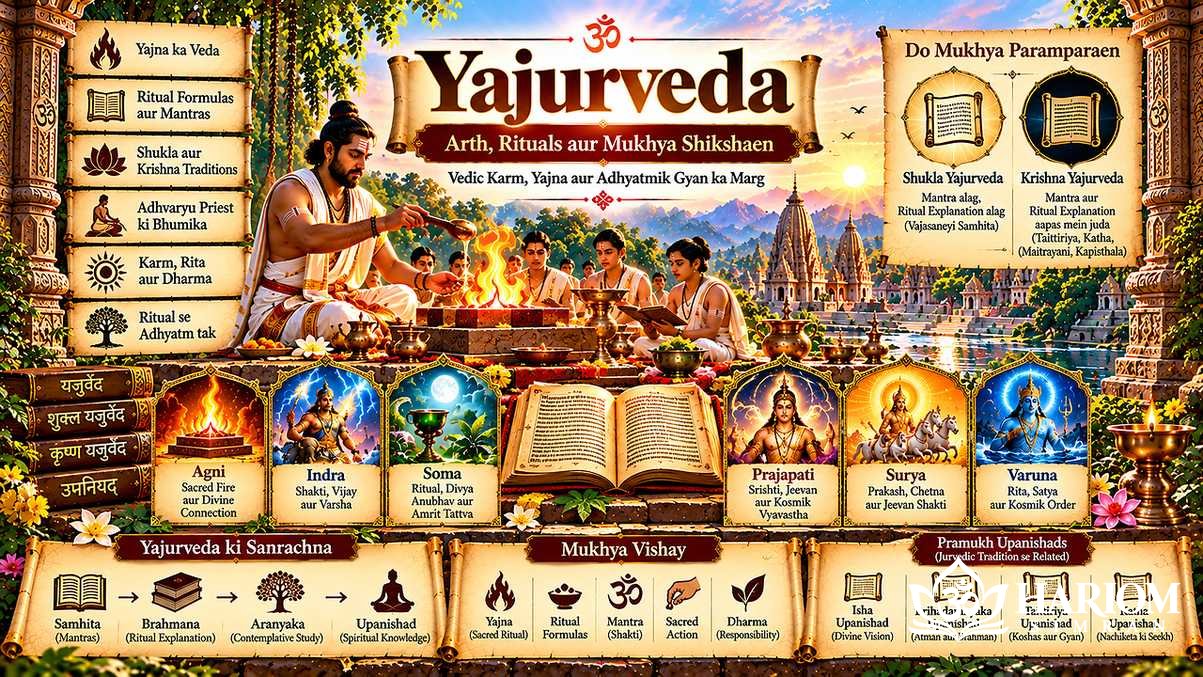
Two Major Yajurveda Traditions
The Yajurveda is traditionally divided into two major branches:
- Shukla Yajurveda
- Krishna Yajurveda
These are commonly translated as:
White Yajurveda
and
Black Yajurveda
The difference does not refer to moral ideas of good and bad.
It concerns the organization of the textual material.
Shukla Yajurveda
The Shukla Yajurveda is also known as the White Yajurveda.
In this tradition, Mantra material is arranged more distinctly from explanatory ritual prose.
Its principal Samhita is commonly known as the Vajasaneyi Samhita.
The Shukla Yajurveda is especially important because several influential Vedic and Upanishadic traditions are associated with it.
Krishna Yajurveda
The Krishna Yajurveda is commonly called the Black Yajurveda.
In this tradition, Mantras and explanatory prose are often more closely mixed together.
Several important textual schools are associated with the Krishna Yajurveda.
These include traditions such as:
Taittiriya
Katha
Maitrayani
and
Kapisthala
The existence of these different traditions shows the diversity of Vedic textual transmission.
Why Are They Called White and Black Yajurveda?
The traditional labels Shukla and Krishna broadly distinguish two ways the material was organized.
In the Shukla tradition, ritual formulas and explanatory material are more clearly separated.
In the Krishna tradition, these elements are often interwoven.
It is important not to interpret the terms as spiritual judgments.
They refer to textual arrangement and traditional classification.
What Is the Vajasaneyi Samhita?
The Vajasaneyi Samhita is the principal Samhita associated with the Shukla Yajurveda.
It contains Mantras used in different Vedic rituals.
Its material is connected with ceremonial traditions involving:
- Offerings
- Sacred Fire
- Consecration
- Ritual Actions
- Prayers
- Sacrificial Formulas
The text is preserved through different traditional recensions.
Its importance also extends into philosophical literature because major Upanishadic traditions are connected with the Shukla Yajurveda.
What Is the Taittiriya Samhita?
The Taittiriya Samhita belongs to the Krishna Yajurveda tradition.
It is one of the most important surviving Yajurvedic collections.
It contains both sacred formulas and explanatory material connected with Vedic ritual.
The wider Taittiriya tradition also includes important texts such as:
Taittiriya Brahmana
Taittiriya Aranyaka
Taittiriya Upanishad
This allows us to see how one Vedic tradition can move from ritual instruction toward deeper philosophical reflection.
What Kind of Rituals Does the Yajurveda Describe?
The Yajurveda is connected with many forms of Vedic ritual.
These can range from relatively regular offerings to complex royal and ceremonial rites.
Yajurvedic traditions discuss rituals connected with:
Fire Offerings
Soma Ceremonies
Seasonal Rituals
Consecrations
Royal Ceremonies
Household and Public Rites
Some rituals were highly complex and required several trained priests.
The importance of the Yajurveda lies partly in showing how detailed and organized Vedic ritual culture became.
Yajurveda and Sacred Action
One of the most important ideas we can learn from the Yajurveda is that action itself can become sacred when performed within a spiritual framework.
A ritual action is not merely movement.
It may involve:
Intention
Mantra
Discipline
Correct Timing
Offering
Responsibility
Awareness
This combination of word and action later becomes important in wider Hindu discussions about Karma, Dharma and spiritual practice.
Yajurveda and Mantra
The Yajurveda preserves many sacred Mantras and ritual formulas.
These Mantras are often connected with specific actions.
For example, a formula might accompany:
An Offering
A Ritual Gesture
Preparation of Sacred Space
Invocation of a Deity
Consecration
The context matters.
A Yajurvedic Mantra should not always be treated as though it were an independent modern affirmation.
Its original ritual setting is often important for understanding its meaning.
Explore the wider Hindu Mantra tradition through Mantras.
Yajurveda and Ritual Precision
Vedic ritual placed strong emphasis on precision.
A ritual could require correct:
- Words
- Pronunciation
- Action
- Sequence
- Timing
- Offering
- Priestly Role
This attention to detail reflects the Vedic belief that sacred action should be disciplined.
The ritual was not meant to be improvised casually.
Traditional knowledge was transmitted carefully from teacher to student.
Yajurveda and Oral Tradition
Like other Vedas, the Yajurveda was preserved through disciplined oral transmission.
Students memorized texts under the guidance of teachers.
They learned:
Correct Pronunciation
Correct Accent
Correct Sequence
Correct Ritual Context
Different schools preserved their own recensions.
This created multiple textual lineages within the Yajurvedic tradition.
Yajurveda and Shruti
The Yajurveda belongs to Shruti.
Traditional Hindu understanding places the Vedas in a special scriptural category because they are not treated as ordinary human compositions.
Ancient Rishis are understood as seers of Vedic knowledge.
This traditional view is often connected with the concept of Apaurusheya, meaning that the Vedas are not regarded as products of ordinary human authorship.
Modern historical scholarship studies these texts through language, chronology and cultural development.
HariOmSimran should continue to distinguish clearly between traditional religious understanding and academic historical approaches.
Important Deities in the Yajurveda
The Yajurveda contains Mantras addressed to many Vedic Divine powers.
Important figures include:
Agni
Indra
Soma
Surya
Savitr
Varuna
Prajapati
and others.
However, the Yajurveda often presents these deities within a strongly ritual context.
The focus is frequently on how sacred formulas and offerings function within ceremony.
Agni in the Yajurveda
Agni has a central place because sacred fire is essential to many Yajurvedic rituals.
Offerings are placed into fire while Mantras are recited.
Agni can therefore represent:
Sacred Fire
Transformation
Offering
Divine Communication
Ritual Presence
This strong connection with fire helps explain why Yajna is so closely associated with the Yajurveda.
Prajapati in Yajurvedic Thought
Prajapati appears in important Vedic traditions as a figure associated with creation and lordship over beings.
In ritual and cosmological texts, Prajapati can become connected with:
Creation
Sacrifice
Cosmic Order
Life
Later Hindu traditions developed many different theological ideas, so Prajapati should be understood carefully within the Vedic context.
Yajurveda and Rita
The concept of Rita, cosmic order, remains important in the wider Vedic worldview.
Ritual was connected with maintaining harmony and proper order.
Correct ritual action could therefore be understood within a larger vision of:
Cosmic Order
Truth
Responsibility
Sacred Relationship
Later Hindu discussions of Dharma developed within a long history that includes these Vedic ideas.
Explore Dharma for a deeper introduction.
Yajurveda and Dharma
The later concept of Dharma is broader than the ritual world of early Vedic literature.
However, the Yajurveda contributes to the background from which later ideas of sacred responsibility developed.
The text repeatedly emphasizes:
Correct Action
Discipline
Responsibility
Sacred Procedure
These themes later find wider expression in Hindu ideas about living according to Dharma.
Is Yajna Only an Ancient Fire Ritual?
No.
Historically, Yajna has a specific Vedic ritual meaning connected with sacred offering.
But later Hindu traditions also developed broader interpretations.
For example, sacred texts can use the language of Yajna symbolically for:
Selfless Action
Study
Knowledge
Discipline
Service
Spiritual Offering
It is important to distinguish later symbolic interpretations from the original ritual contexts rather than treating them as exactly identical.
Yajurveda and the Bhagavad Gita
The Bhagavad Gita belongs to a much later textual setting than the Vedic Samhitas.
However, the Gita uses and develops the concept of Yajna in broader spiritual ways.
There, Yajna can become connected with disciplined action, knowledge and spiritual offering.
This demonstrates how Vedic ideas continued to develop across Hindu intellectual history.
Yajurveda and the Isha Upanishad
The Isha Upanishad is associated with the Shukla Yajurveda.
It is a short but highly influential philosophical text.
It explores themes such as:
- The Divine Presence
- Renunciation
- Action
- Knowledge
- Spiritual Vision
- Life in the World
Its famous opening teaching emphasizes seeing the universe in relation to the Divine.
Different Vedanta traditions interpret the Upanishad in different ways.
This is an important example of how Yajurvedic literature moves from ritual toward philosophy.
Yajurveda and the Brihadaranyaka Upanishad
The Brihadaranyaka Upanishad is one of the largest and most influential Upanishads.
It is associated with the Shukla Yajurveda tradition.
It explores profound questions about:
Atman
Brahman
Consciousness
Reality
Death
Liberation
Knowledge
Some of the most important philosophical dialogues in Hindu tradition appear in this text.
Its presence within the Yajurvedic world shows that the tradition cannot be reduced only to ritual.
Yajurveda and the Taittiriya Upanishad
The Taittiriya Upanishad belongs to the Krishna Yajurveda tradition.
It includes important teachings related to:
Education
Ethical Conduct
Brahman
Joy
The Human Person
It is also well known for teachings later discussed through the idea of the Five Koshas, or layers of human existence.
Different philosophical traditions interpret these teachings in different ways.
Yajurveda and the Katha Upanishad
The Katha Upanishad is associated with the Krishna Yajurveda tradition.
It presents the famous dialogue between Nachiketa and Yama, the Lord of Death.
The dialogue explores:
Death
The Self
Desire
Wisdom
Spiritual Discipline
Immortality
Liberation
The Katha Upanishad became one of the most widely admired philosophical texts in Hindu tradition.
Does the Yajurveda Contain Philosophy?
Yes.
The Yajurveda Samhitas are strongly connected with ritual action.
However, the wider Yajurvedic corpus includes:
Brahmanas
Aranyakas
Upanishads
These layers gradually move from external ritual toward symbolic and philosophical reflection.
Important Yajurvedic Upanishads explore some of Hindu philosophy's deepest questions.
This makes the Yajurveda both a ritual and philosophical tradition.
Yajurveda and the Rigveda
The Rigveda and Yajurveda worked together within Vedic ritual.
Rigvedic priests recited hymns.
Yajurvedic priests performed ritual actions and recited formulas.
This shows that Vedic scripture was not always used as isolated books.
Different Vedas had complementary ritual functions.
Yajurveda and the Samaveda
The Samaveda contributed sacred chants to important ceremonies.
The Yajurveda contributed ritual formulas and procedural knowledge.
Together, they demonstrate how:
Sound
Action
Offering
Prayer
and
Ritual Timing
could form one integrated spiritual practice.
Yajurveda and the Atharvaveda
The Atharvaveda has a different emphasis, including prayers and teachings connected with household, social, protective and spiritual concerns.
The Yajurveda is more strongly associated with formal ritual action.
Their differences show the breadth of Vedic sacred literature.
Yajurveda and Later Puja
Modern Hindu Puja and ancient Vedic Yajna are not exactly the same ritual system.
Later Hindu worship developed through many influences, including:
Vedic Traditions
Agamas
Puranas
Temple Traditions
Bhakti
However, elements such as sacred fire, Mantra, offerings and ritual discipline continued to influence Hindu worship.
This shows both continuity and development within Hindu tradition.
Is Yajurveda Only for Priests?
Traditional specialized ritual performance required detailed training.
However, anyone can study the Yajurveda historically, philosophically and educationally.
There is an important difference between:
Learning About Yajurveda
and
Performing Specialized Vedic Rituals
HariOmSimran can make Yajurvedic knowledge accessible while respecting the complexity of traditional practice.
Can Beginners Read the Yajurveda?
Yes, but context is extremely helpful.
A beginner may find parts of the Yajurveda difficult because many passages assume knowledge of Vedic ritual.
A better learning approach is:
Step 1
Understand what Yajna means.
Step 2
Learn the role of the Adhvaryu priest.
Step 3
Understand Shukla and Krishna Yajurveda.
Step 4
Learn about important Samhitas and ritual traditions.
Step 5
Explore major associated Upanishads.
Step 6
Study specific Yajurvedic Mantras and rituals in their original contexts.
This sequence helps prevent the text from feeling like a collection of disconnected ceremonial instructions.
Common Misunderstandings About the Yajurveda
Misunderstanding 1: Yajurveda Is Only a Ritual Manual
No.
Ritual is central, but the wider Yajurvedic tradition also contains deep philosophical texts.
Misunderstanding 2: Shukla and Krishna Mean Good and Bad
No.
These terms distinguish major textual traditions and their organization.
Misunderstanding 3: Yajna Is Only About Putting Things Into Fire
No.
Vedic Yajna is a structured sacred ceremony involving Mantras, offerings, priestly roles, timing and symbolic meaning.
Misunderstanding 4: Yajurveda and Rigveda Are the Same
No.
They interact closely, but their main ritual functions differ.
Misunderstanding 5: Every Hindu Performs Yajurvedic Rituals
No.
Hindu religious practice is diverse, and specialized Vedic rituals are only one part of the wider Hindu tradition.
What Can Modern Readers Learn From the Yajurveda?
The Yajurveda comes from an ancient ritual culture, but some of its deeper questions remain relevant.
It encourages reflection on:
Can Action Become Sacred?
Why Does Intention Matter?
Why Does Discipline Matter?
How Do Words and Actions Work Together?
What Does It Mean to Offer Something Beyond Oneself?
How Can Human Life Relate to a Larger Cosmic Order?
These questions give the Yajurveda meaning beyond historical ritual study.
Why the Yajurveda Still Matters
The Yajurveda remains important because it preserves one of the most detailed windows into Vedic ritual practice.
It helps us understand:
Yajna
Sacred Fire
Ritual Formulas
Vedic Priests
Offerings
Ceremonial Discipline
Sacred Action
Oral Transmission
Upanishadic Philosophy
It also shows how Hindu sacred thought can move from:
External Action
to
Symbolic Meaning
to
Philosophical Reflection
This development makes the Yajurveda an essential part of the Vedic knowledge tradition.
Explore Vedic Knowledge With HariOmSimran
HariOmSimran is building its Scripture section as a structured and interconnected Hindu knowledge journey.
Continue exploring:
The next detailed Scripture article will be:
Atharvaveda: Meaning, Prayers and Sacred Wisdom
After completing the four individual Vedas, we can move deeper into:
Samhitas
Brahmanas
Aranyakas
Upanishads
and
Important Vedic Suktas
Learn • Explore • Understand • Preserve
Key Takeaway
The Yajurveda is one of the four Vedas and is especially associated with sacred ritual action.
Its tradition preserves:
Yajna
Ritual Formulas
Sacred Fire
Offerings
Ceremonial Procedures
Priestly Responsibilities
Mantras
The Yajurveda developed through two major traditions:
Shukla Yajurveda
and
Krishna Yajurveda
Its wider textual tradition also includes major philosophical works such as the:
Isha Upanishad
Brihadaranyaka Upanishad
Taittiriya Upanishad
Katha Upanishad
The Yajurveda therefore connects sacred action with deeper questions about responsibility, the Self, reality and spiritual liberation.
Key Teachings
This scripture reveals profound wisdom and guidance for our spiritual journey. Below are the key teachings and principles derived from this sacred text.
Core Principles
These teachings provide guidance for living a life of faith, compassion, and spiritual growth.
- Spiritual Growth
- Divine Wisdom
- Sacred Teachings
- Faith Journey

Study Resources
Explore these resources to deepen your understanding of this scripture and apply its teachings to your daily life.
📖 Study Guide
Comprehensive study materials to help you understand the context, meaning, and application of this scripture.
🙏 Reflection Questions
Thought-provoking questions to help you reflect on the teachings and apply them to your personal spiritual journey.
📝 Journal Prompts
Guided journaling prompts to help you document your insights, prayers, and spiritual growth.
👥 Discussion Topics
Engaging discussion topics for group study and fellowship, fostering deeper understanding and community.
Frequently Asked Questions
The Yajurveda is one of the four Vedas and is especially associated with Vedic rituals, sacred formulas, Yajna, offerings and ceremonial action.
The Shukla Yajurveda generally keeps Mantra material more clearly separated from explanatory prose, while the Krishna Yajurveda often combines Mantras and ritual explanations more closely.
Yajna is a Vedic sacred offering or ritual that may involve fire, Mantras, offerings, priests and carefully prescribed ceremonial actions.
The Adhvaryu is the priest especially associated with Yajurvedic ritual. This priest performs practical ritual actions and recites the appropriate Yajurvedic formulas.
Important Upanishads associated with Yajurvedic traditions include the Isha, Brihadaranyaka, Taittiriya and Katha Upanishads.
The Yajurveda is important because it preserves detailed Vedic ritual traditions and connects sacred action, Mantra, Yajna, responsibility and philosophical reflection within one major Vedic tradition.