

Among Hindu scriptures, the Upanishads hold a special place.
They take us into some of the deepest questions explored in Hindu philosophy:
Who Am I?
What Is the True Self?
What Is Ultimate Reality?
What Happens After Death?
Why Do Human Beings Experience Rebirth?
Can We Become Free From Samsara?
What Is the Relationship Between Atman and Brahman?
These are not simply abstract philosophical questions.
The Upanishads explore them as questions about human life, spiritual knowledge and liberation.
Earlier layers of Vedic literature give us sacred hymns, ritual formulas, Yajna and symbolic interpretations.
The Upanishads increasingly turn attention inward.
They ask the seeker to examine:
- Consciousness
- The Self
- Reality
- Knowledge
- Desire
- Death
- Karma
- Meditation
- Liberation
This movement helped shape many later Hindu philosophical traditions, especially Vedanta.
To understand the wider structure of Hindu sacred literature, explore Hindu Scriptures.
What Are the Upanishads?
The Upanishads are sacred philosophical texts connected with the Vedic tradition.
They belong to the wider category of Shruti.
Shruti means:
“That Which Is Heard.”
The Upanishads are traditionally associated with different Vedas and textual schools.
They explore profound spiritual subjects such as:
- Atman
- Brahman
- Karma
- Samsara
- Moksha
- Meditation
- Knowledge
- Consciousness
- Sacred Sound
- Ultimate Reality
The Upanishads are not one single book.
They are a collection of many texts composed and transmitted through different Vedic traditions.
What Does Upanishad Mean?
The Sanskrit word Upanishad has been interpreted in different ways.
It is traditionally associated with the idea of a student sitting close to a teacher in order to receive sacred knowledge.
This gives us a powerful image:
Teacher
Student
Dialogue
Inquiry
Spiritual Knowledge
Many Upanishads are actually structured through conversations.
A student asks.
A teacher responds.
A king questions a sage.
A seeker approaches someone believed to possess deeper knowledge.
Sometimes the text gives a direct teaching.
Sometimes it answers a question with another question.
The goal is not merely to memorize information.
The goal is deeper understanding.
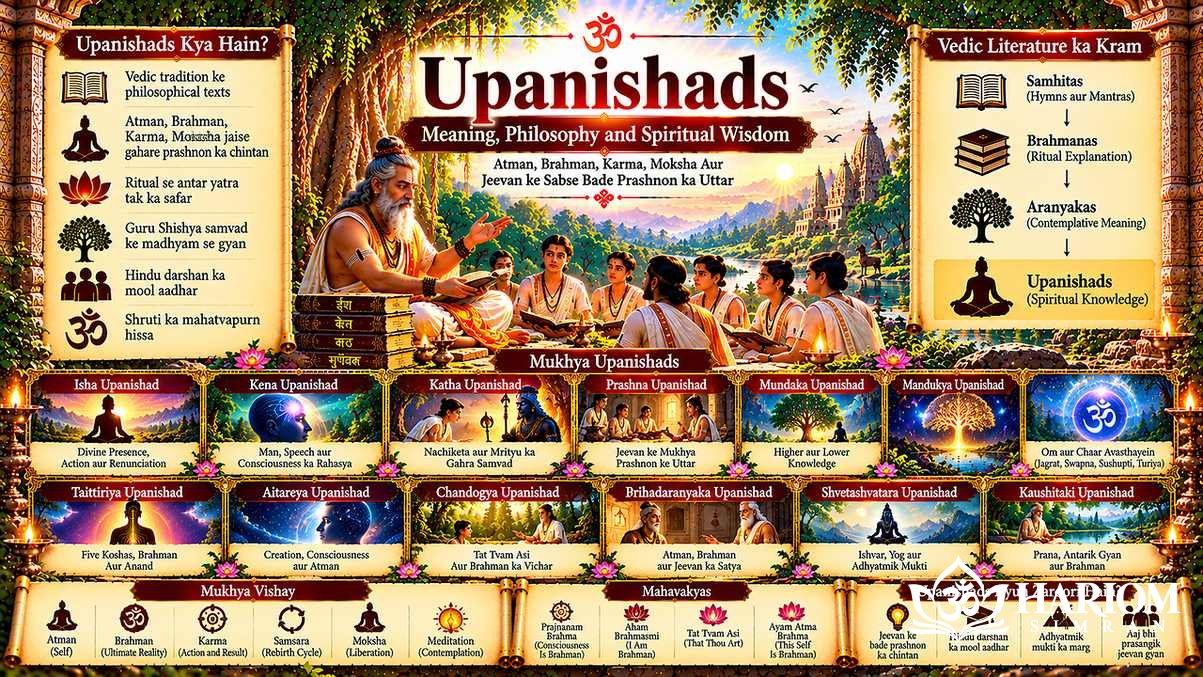
Where Do the Upanishads Fit Within Vedic Literature?
A useful beginner framework is:
- Samhitas
- Brahmanas
- Aranyakas
- Upanishads
Broadly:
Samhitas
Preserve sacred hymns, Mantras, chants and ritual formulas.
Brahmanas
Explain Vedic ritual procedures and symbolic meanings.
Aranyakas
Move increasingly toward contemplation and inward interpretation.
Upanishads
Explore deep philosophical questions about Self, reality, consciousness and liberation.
This structure is extremely helpful for learning.
However, actual Vedic textual traditions are more complex.
Some Upanishads occur within or are closely connected with Brahmana or Aranyaka material.
The transition from one textual layer to another was gradual.
Why Are the Upanishads Called Vedanta?
The word Vedanta can broadly mean:
The End of the Vedas
This has two important senses.
First, many Upanishads appear toward the concluding portions of Vedic textual traditions.
Second, they can represent the philosophical culmination or deeper purpose of Vedic inquiry.
Over time, Vedanta also became the name of major Hindu philosophical traditions that interpret the teachings of the Upanishads, Bhagavad Gita and Brahma Sutras.
Different Vedanta schools interpret the Upanishads differently.
This diversity is essential to understand.
The Upanishads do not belong exclusively to one later philosophical school.
How Many Upanishads Are There?
There is no single simple answer.
Many Upanishads have been preserved across Hindu tradition.
A later traditional collection known as the Muktika Upanishad lists 108 Upanishads.
However, not all Upanishads are equally ancient or equally influential.
A smaller group is commonly called the:
Principal Upanishads
or
Mukhya Upanishads
These texts have received extensive philosophical commentary and have played a major role in Vedanta.
Depending on the traditional or scholarly classification used, lists of principal Upanishads can vary.
A commonly discussed group includes around 10 to 13 major texts.
Major Upanishads
Important principal Upanishads include:
- Isha Upanishad
- Kena Upanishad
- Katha Upanishad
- Prashna Upanishad
- Mundaka Upanishad
- Mandukya Upanishad
- Taittiriya Upanishad
- Aitareya Upanishad
- Chandogya Upanishad
- Brihadaranyaka Upanishad
Other texts often included in wider principal lists include:
Shvetashvatara Upanishad
Kaushitaki Upanishad
Maitri Upanishad
Each has its own style, questions and philosophical emphasis.
Are All Upanishads the Same?
No.
This is extremely important.
The Upanishads were preserved through different Vedic traditions and do not all present philosophical ideas in exactly the same way.
Some emphasize:
- Knowledge
- Meditation
- Atman
- Brahman
- Om
- Prana
- Devotion
- Consciousness
- Renunciation
- The Divine
Different later schools interpret these teachings through different philosophical frameworks.
The Upanishads are therefore better understood as a rich tradition of spiritual inquiry rather than one simple textbook with one uniform formula.
What Is Atman?
One of the central concepts in the Upanishads is Atman.
Atman is often translated as:
Self
However, this can be misleading if we think only of personality, name or social identity.
In many Upanishadic teachings, Atman points toward the deepest reality of the self.
The texts ask:
Am I only the body?
Am I only my thoughts?
Am I only my emotions?
What remains beneath changing experiences?
Different Upanishads and later philosophical schools interpret Atman in different ways.
But the search for the true Self becomes one of the defining themes of Upanishadic philosophy.
What Is Brahman?
Another central concept is Brahman.
In many Upanishadic contexts, Brahman refers to the ultimate or foundational reality.
Brahman can be discussed in relation to:
- Existence
- Consciousness
- Cosmic Reality
- The Source of All
- The Ground of Being
- The Divine
Different Vedanta traditions interpret Brahman differently.
Some emphasize nondual ultimate reality.
Some emphasize a Supreme personal Divine.
Some distinguish between the individual self and the Supreme while affirming their profound relationship.
Therefore, Brahman should not be reduced to one oversimplified definition.
What Is the Relationship Between Atman and Brahman?
This is one of the most influential questions in Hindu philosophy.
Different Upanishadic passages explore the relationship between:
The Individual Self
and
Ultimate Reality
Later Vedanta traditions offer different interpretations.
Advaita Vedanta
Strongly emphasizes the nondual identity of Atman and Brahman at the highest level of realization.
Vishishtadvaita Vedanta
Understands individual souls and the universe as real and inseparably related to the Supreme Brahman.
Dvaita Vedanta
Maintains a real distinction between the individual soul and the Supreme Divine.
These are only brief introductions.
Each tradition has sophisticated arguments and scriptural interpretations.
HariOmSimran should eventually explore the major Vedanta schools through separate detailed articles.
What Is Moksha?
Moksha means spiritual liberation.
Upanishadic traditions ask how a person can become free from ignorance, bondage and the cycle of repeated birth and death.
Moksha may be connected with:
- Self-Knowledge
- Knowledge of Brahman
- Freedom From Ignorance
- Spiritual Realization
- Freedom From Samsara
Different Hindu philosophical traditions explain liberation differently.
But the search for freedom from spiritual bondage becomes one of the most important themes of later Hindu philosophy.
What Is Samsara?
Samsara refers to the cycle of birth, death and rebirth.
Human existence is understood as part of an ongoing cycle shaped by ignorance, desire and Karma.
The Upanishads contribute significantly to the development of this idea.
The spiritual question becomes:
Can this cycle be transcended?
The answer increasingly becomes connected with knowledge, realization and liberation.
Karma in the Upanishads
The idea of Karma becomes increasingly important in later Vedic and Upanishadic thought.
Karma broadly concerns action and its consequences.
Earlier Vedic ritual uses the language of action in strong ceremonial contexts.
Upanishadic teachings increasingly connect action with moral and spiritual consequences.
This helps develop a wider understanding:
Human action matters.
Choices shape experience.
Knowledge and spiritual realization may lead beyond bondage to action.
The full Hindu doctrine of Karma developed through many texts and traditions over time.
Knowledge and Ignorance
A major Upanishadic contrast is between:
Knowledge
and
Ignorance
Ignorance does not simply mean lack of information.
It can refer to misunderstanding the true nature of Self and reality.
A person may have great practical knowledge but still not understand:
Who am I at the deepest level?
What is permanent?
What is ultimate reality?
The Upanishadic search is therefore concerned with transformative knowledge.
Knowledge is not merely something a person possesses.
It can change how reality is understood.
Higher and Lower Knowledge
The Mundaka Upanishad famously distinguishes different forms of knowledge.
This does not mean ordinary learning has no value.
Instead, the distinction points toward the difference between knowledge of things and knowledge of ultimate reality.
This creates a powerful spiritual question:
What kind of knowledge can truly free a human being?
The Upanishads repeatedly return to this concern.
The Role of the Guru
The relationship between Guru and Shishya is deeply important in many Upanishadic narratives.
A seeker approaches a teacher with a serious question.
The teacher may require:
- Patience
- Discipline
- Reflection
- Preparation
- Humility
- Inquiry
The Upanishadic teacher does not always provide an immediate simple answer.
Sometimes the student is guided step by step.
This reflects an important principle:
Spiritual knowledge requires more than curiosity. It requires readiness to understand.
Dialogue in the Upanishads
Many Upanishads use dialogue as a teaching method.
Important dialogues include conversations involving:
Nachiketa and Yama
Yajnavalkya and Maitreyi
Yajnavalkya and King Janaka
Uddalaka and Shvetaketu
These dialogues make philosophical questions deeply human.
Instead of presenting only abstract theories, they show seekers asking about:
Death
The Self
Knowledge
Immortality
Reality
Liberation
This storytelling method makes the Upanishads especially powerful.
Katha Upanishad and Nachiketa
The Katha Upanishad tells the famous story of Nachiketa, a young seeker who encounters Yama, the Lord of Death.
Nachiketa is offered worldly rewards.
But he asks a deeper question:
What happens after death?
His refusal to abandon the spiritual question becomes a powerful symbol of serious inquiry.
The text explores:
- Death
- Atman
- Desire
- Discipline
- Wisdom
- Immortality
- Liberation
This makes the Katha Upanishad one of the most accessible and influential Upanishadic texts.
Chandogya Upanishad
The Chandogya Upanishad is one of the largest and most influential Upanishads.
It is associated with the Samaveda tradition.
Its teachings include discussions of:
- Om
- Meditation
- Brahman
- Atman
- Sacred Sound
- Reality
- Knowledge
One of its most famous teachings is:
Tat Tvam Asi
This statement has been interpreted differently by various Vedanta traditions.
It should therefore be studied within context rather than reduced to a simple slogan.
Brihadaranyaka Upanishad
The Brihadaranyaka Upanishad is one of the oldest and most extensive principal Upanishads.
It belongs to the Shukla Yajurveda tradition.
Important themes include:
- Atman
- Brahman
- Consciousness
- Death
- Knowledge
- Liberation
- Spiritual Inquiry
It contains famous dialogues involving the sage Yajnavalkya.
Its philosophical depth made it highly influential across Vedanta traditions.
Isha Upanishad
The Isha Upanishad is short but highly influential.
It is associated with the Shukla Yajurveda.
Its teachings engage questions concerning:
- Divine Presence
- Action
- Renunciation
- Knowledge
- Life in the World
- Spiritual Vision
One of its important themes is how spiritual wisdom can relate to life rather than simply escaping from life.
Different traditions interpret its teachings differently.
Kena Upanishad
The Kena Upanishad asks profound questions:
What directs the mind?
What gives speech its power?
What enables hearing?
What makes sight possible?
Behind these questions is a search for the ultimate source behind human capacities.
The text invites the seeker to look beyond ordinary experience toward the deeper reality that makes experience possible.
Mundaka Upanishad
The Mundaka Upanishad is associated with the Atharvaveda.
It explores:
- Higher Knowledge
- Lower Knowledge
- Brahman
- The Self
- Spiritual Realization
- Liberation
It also contains memorable imagery used to explain spiritual knowledge and the relationship between individual experience and ultimate reality.
Mandukya Upanishad
The Mandukya Upanishad is one of the shortest principal Upanishads, yet it became extraordinarily influential.
Its central themes include:
Om
and
Four States of Consciousness
These are commonly discussed as:
- Waking
- Dreaming
- Deep Sleep
- Turiya
Turiya points toward a reality that cannot simply be reduced to the ordinary three states of experience.
Later Vedanta traditions, especially Advaita, gave the Mandukya Upanishad major philosophical importance.
Taittiriya Upanishad
The Taittiriya Upanishad belongs to the Krishna Yajurveda tradition.
Its teachings include:
- Education
- Ethical Conduct
- Brahman
- Joy
- Human Existence
- Spiritual Discipline
It is also famous for teachings later discussed through the framework of the Five Koshas.
These layers are commonly understood as aspects of human existence ranging from the physical to increasingly subtle dimensions.
Aitareya Upanishad
The Aitareya Upanishad is associated with the Rigveda.
It explores:
- Creation
- Consciousness
- The Self
- Human Existence
- Ultimate Reality
It is especially important for its reflection on consciousness.
The text contributes to the larger Upanishadic inquiry into what truly defines the human being.
Prashna Upanishad
The Prashna Upanishad is associated with the Atharvaveda.
Its title is connected with the idea of questions.
Six seekers approach a teacher and ask major spiritual questions.
Subjects include:
- Creation
- Prana
- Human Life
- Meditation
- Om
- Spiritual Knowledge
Its question-and-answer structure makes it particularly useful for structured study.
Shvetashvatara Upanishad
The Shvetashvatara Upanishad is especially important because it includes strong theological and devotional dimensions alongside philosophical inquiry.
Its teachings discuss themes such as:
- Brahman
- The Divine
- Meditation
- Yoga
- Creation
- Spiritual Liberation
It has been important to several later Hindu theological traditions.
Its language also helps show that Upanishadic thought is not limited to one philosophical style.
Upanishads and Om
Om holds profound importance in several Upanishads.
It can be contemplated as:
- Sacred Sound
- Symbol of Ultimate Reality
- Support for Meditation
- Expression of the Vedic Tradition
Different texts approach Om differently.
The Mandukya Upanishad is especially famous for connecting Om with states of consciousness.
Wider Hindu Mantra traditions can be explored through Mantras.
What Are the Mahavakyas?
The term Mahavakya means:
Great Saying
Later Vedanta traditions highlight certain Upanishadic statements as especially important.
Four famous Mahavakyas commonly discussed are:
Prajnanam Brahma
Often translated as:
Consciousness Is Brahman
Associated with the Aitareya tradition.
Aham Brahmasmi
I Am Brahman
Associated with the Brihadaranyaka Upanishad.
Tat Tvam Asi
That Thou Art
Associated with the Chandogya Upanishad.
Ayam Atma Brahma
This Self Is Brahman
Associated with the Mandukya tradition.
Different Vedanta schools interpret these statements in different ways.
They should not be explained without acknowledging that diversity.
Upanishads and Meditation
Meditation appears in many different forms across the Upanishadic tradition.
Practices may involve contemplation of:
- Om
- Prana
- The Self
- The Sun
- Sacred Sound
- Cosmic Principles
- Brahman
The goal is not always the same.
Different teachings belong to different textual and philosophical settings.
This is another reason why “Upanishadic meditation” should not be treated as one single technique.
Upanishads and Prana
Prana plays an important role in several Upanishads.
Prana can be connected with:
- Breath
- Life
- Vitality
- The Human Organism
- Cosmic Life
Certain dialogues discuss the relationship between Prana and other human faculties.
The concept later becomes central in Yoga and many Hindu spiritual traditions.
Upanishads and Death
Death is one of the most powerful subjects in the Upanishads.
The question is not simply:
How do we avoid death?
The deeper questions are:
Who actually dies?
What is the Self?
Is consciousness identical to the body?
What continues?
What leads to rebirth?
What is liberation?
The Katha Upanishad is especially famous for exploring these questions.
Upanishads and Renunciation
Some Upanishadic teachings increasingly emphasize detachment from worldly desire.
This contributes to the development of later Hindu traditions of renunciation.
However, the Upanishads do not all present one identical lifestyle.
Some dialogues involve:
- Householders
- Kings
- Students
- Sages
- Renunciants
This reminds us that spiritual inquiry in Hindu tradition developed in diverse social settings.
Upanishads and Bhakti
The Upanishads are commonly associated with philosophy and knowledge.
However, certain Upanishadic texts also contain themes that later devotional traditions find highly significant.
These may include:
- Reverence for the Supreme
- Grace
- Meditation on the Divine
- Devotion
- Personal Divine Language
Later Hindu traditions often interpret Upanishadic teachings through devotional as well as philosophical frameworks.
Do the Upanishads Teach One God?
The answer requires nuance.
The Upanishads contain different ways of speaking about ultimate reality.
Some passages emphasize:
Unity
Some emphasize:
Brahman
Some use personal Divine language.
Some focus on:
Atman
Consciousness
Cosmic Reality
Later Hindu traditions interpret these teachings differently.
It would therefore be inaccurate to force the entire Upanishadic tradition into one simple modern label.
Explore wider Hindu Divine traditions through Deities.
Upanishads and Vedanta
The Upanishads became foundational for later Vedanta philosophy.
Major Vedanta traditions include:
- Advaita Vedanta
- Vishishtadvaita Vedanta
- Dvaita Vedanta
Other Vedanta traditions also developed important interpretations.
Each reads the relationship between:
Atman
Brahman
The World
The Divine
in different ways.
This diversity shows why Upanishadic interpretation has remained a living philosophical tradition rather than a closed historical subject.
Upanishads and the Bhagavad Gita
The Bhagavad Gita belongs to a later textual setting within the Mahabharata.
However, many of its philosophical concerns are deeply connected with Upanishadic thought.
These include:
- Atman
- Brahman
- Karma
- Yoga
- Knowledge
- Devotion
- Liberation
The Bhagavad Gita brings these themes into a distinctive dialogue about action, duty and spiritual life.
Upanishads and Yoga
The relationship between the Upanishads and Yoga is broad and historically layered.
Some Upanishads contain teachings related to:
- Meditation
- Sense Control
- Breath
- Concentration
- Inner Awareness
- Spiritual Discipline
Later Yoga traditions develop these subjects much further.
It is therefore useful to see Upanishadic teachings as part of the wider historical background of Hindu contemplative practice.
Upanishads and Dharma
The Upanishads do not primarily function as detailed Dharma manuals.
Their strongest emphasis is often on spiritual knowledge and ultimate reality.
However, ethical preparation remains important.
Qualities such as:
- Truthfulness
- Self-Control
- Discipline
- Respect for Teachers
- Responsibility
- Serious Inquiry
appear within the wider Upanishadic world.
Explore the broader Hindu concept through Dharma.
Are the Upanishads a Religion or a Philosophy?
The distinction between religion and philosophy does not always map neatly onto ancient Hindu texts.
The Upanishads include:
Philosophical Inquiry
Spiritual Practice
Sacred Teaching
Meditation
Theology
Ritual Background
Questions About Liberation
They are both philosophical and deeply spiritual.
Reducing them only to abstract philosophy would miss their religious context.
Reducing them only to ritual religion would miss their intellectual depth.
Were the Upanishads Written by One Person?
No.
The Upanishads do not have one single author.
They emerged within different Vedic schools and teaching traditions.
Many teachings are presented through named sages, teachers, kings and students.
Examples include:
Yajnavalkya
Uddalaka Aruni
Shvetaketu
Nachiketa
King Janaka
Traditional Hindu understanding places these texts within Shruti.
Modern scholarship studies their language, chronology and historical development.
These approaches should be clearly distinguished rather than confused.
Are the Upanishads Older Than the Bhagavad Gita?
The principal early Upanishads generally represent earlier layers of Hindu sacred literature than the Bhagavad Gita.
However, Upanishadic literature developed over a long period.
Some Upanishads are much later than the oldest principal texts.
Therefore, it is more accurate to distinguish between:
Early Principal Upanishads
and
Later Upanishadic Literature
rather than treating all Upanishads as belonging to one single date.
Can Beginners Read the Upanishads?
Yes.
However, some Upanishads can feel difficult because they contain:
- Symbolic Language
- Ancient Ritual References
- Philosophical Dialogue
- Compressed Teachings
- Multiple Interpretations
Beginners benefit from starting with context before reading passages in isolation.
How Should a Beginner Study the Upanishads?
A practical learning path is:
Step 1
Understand the Vedic structure of Samhitas, Brahmanas and Aranyakas.
Step 2
Learn the basic concepts of Atman, Brahman, Karma, Samsara and Moksha.
Step 3
Start with accessible principal Upanishads such as Katha and Isha.
Step 4
Explore Kena, Mundaka and Prashna.
Step 5
Move into Mandukya and Taittiriya.
Step 6
Study Chandogya and Brihadaranyaka in greater depth.
Step 7
Compare how major Vedanta traditions interpret important passages.
This gradual approach prevents the Upanishads from becoming a collection of disconnected quotations.
Common Misunderstandings About the Upanishads
Misunderstanding 1: The Upanishads Are One Book
No.
They are a large collection of sacred texts connected with different Vedic traditions.
Misunderstanding 2: All Upanishads Teach Exactly the Same Philosophy
No.
They contain diverse teachings that later Hindu schools interpret differently.
Misunderstanding 3: Upanishads Reject the Vedas
No.
They belong to the Vedic Shruti tradition and develop within the wider Vedic world.
Misunderstanding 4: Upanishads Are Only About Advaita Vedanta
No.
Advaita places enormous importance on the Upanishads, but Vishishtadvaita, Dvaita and other Vedanta traditions also interpret them as foundational scripture.
Misunderstanding 5: The Upanishads Are Only for Monks
No.
Their dialogues include students, householders, kings and sages. Their spiritual questions concern human life more broadly.
What Can Modern Readers Learn From the Upanishads?
The Upanishads come from an ancient world, but their questions remain remarkably human.
They ask:
What defines me when everything around me changes?
Is happiness found only in external possessions?
What is consciousness?
How should we understand death?
Can knowledge change the way we experience life?
What is the relationship between the individual and ultimate reality?
What does freedom really mean?
Modern readers may not accept every historical interpretation in the same way.
But the depth of these questions explains why the Upanishads continue to inspire philosophical and spiritual study.
Why the Upanishads Still Matter
The Upanishads remain among the most influential texts in Hindu intellectual and spiritual history.
They helped shape later discussions of:
Atman
Brahman
Karma
Samsara
Moksha
Meditation
Om
Consciousness
Vedanta
They also represent a remarkable movement in Vedic thought.
The journey develops from:
Sacred Hymn
to
Ritual
to
Symbolic Interpretation
to
Inner Contemplation
and finally toward:
Direct Philosophical Inquiry Into Reality and the Self
That journey is one of the reasons the Upanishads remain central to understanding Hindu philosophy.
Explore Upanishadic Wisdom With HariOmSimran
HariOmSimran is developing the Scripture section as a structured and interconnected Hindu knowledge journey.
Continue exploring:
Now that the main Upanishads overview is complete, the best next article in the Scripture series should be:
Isha Upanishad: Meaning, Teachings and Philosophy
Then we can continue systematically with:
Kena Upanishad
Katha Upanishad
Prashna Upanishad
Mundaka Upanishad
Mandukya Upanishad
Taittiriya Upanishad
Aitareya Upanishad
Chandogya Upanishad
Brihadaranyaka Upanishad
and other principal Upanishads.
Learn • Explore • Understand • Preserve
Key Takeaway
The Upanishads are among the deepest philosophical texts of the Vedic tradition.
They explore fundamental questions about:
Atman
Brahman
Karma
Samsara
Moksha
Om
Consciousness
Death
Spiritual Knowledge
The Upanishads are not one book and do not present one single later philosophical system.
Different texts preserve different teachings, and later Hindu traditions interpret them in different ways.
Their lasting importance comes from the questions they ask:
Who Are We?
What Is Real?
What Is the Source of Consciousness?
What Is the Relationship Between the Individual and the Ultimate?
Can Human Beings Become Free From Spiritual Bondage?
These questions helped shape Vedanta and continue to inspire Hindu spiritual and philosophical inquiry today.
Key Teachings
This scripture reveals profound wisdom and guidance for our spiritual journey. Below are the key teachings and principles derived from this sacred text.
Core Principles
These teachings provide guidance for living a life of faith, compassion, and spiritual growth.
- Spiritual Growth
- Divine Wisdom
- Sacred Teachings
- Faith Journey

Study Resources
Explore these resources to deepen your understanding of this scripture and apply its teachings to your daily life.
📖 Study Guide
Comprehensive study materials to help you understand the context, meaning, and application of this scripture.
🙏 Reflection Questions
Thought-provoking questions to help you reflect on the teachings and apply them to your personal spiritual journey.
📝 Journal Prompts
Guided journaling prompts to help you document your insights, prayers, and spiritual growth.
👥 Discussion Topics
Engaging discussion topics for group study and fellowship, fostering deeper understanding and community.
Frequently Asked Questions
The Upanishads are sacred philosophical texts within the Vedic Shruti tradition. They explore Atman, Brahman, Karma, Samsara, Moksha, consciousness, meditation and ultimate reality.
A later traditional collection known as the Muktika lists 108 Upanishads, but a smaller group of around 10 to 13 texts is commonly treated as the principal or Mukhya Upanishads.
There is no single teaching expressed identically in every Upanishad. Major themes include knowledge of the Self, Brahman, liberation from Samsara, consciousness and the search for ultimate reality.
The Upanishads are part of the wider Vedic Shruti tradition. Earlier Vedic layers emphasize hymns, ritual and symbolism, while the Upanishads increasingly focus on philosophical and spiritual inquiry.
The Upanishads are foundational scriptures for Vedanta. Vedanta refers to later philosophical traditions that interpret the Upanishads along with texts such as the Bhagavad Gita and Brahma Sutras.
The Upanishads are important because they shaped Hindu teachings about Atman, Brahman, Karma, Samsara, Moksha and consciousness, while forming the philosophical foundation for major Vedanta traditions.