

Hindu scriptures mein Upanishads ka ek bahut special place hai.
Ye humein Hindu philosophy ke kuch sabse deep questions tak le jati hain:
Main Kaun Hoon?
Mera Asli Self Kya Hai?
Ultimate Reality Kya Hai?
Mrityu Ke Baad Kya Hota Hai?
Rebirth Kyun Hota Hai?
Kya Samsara Se Mukti Possible Hai?
Atman Aur Brahman Ka Relationship Kya Hai?
Ye sirf abstract philosophical questions nahi hain.
Upanishads in questions ko human life, spiritual knowledge aur liberation ke perspective se explore karti hain.
Earlier Vedic literature humein sacred hymns, ritual formulas, Yajna aur symbolic interpretations deta hai.
Upanishads attention ko increasingly inward direction mein le jati hain.
Ye explore karti hain:
- Consciousness
- The Self
- Reality
- Knowledge
- Desire
- Death
- Karma
- Meditation
- Liberation
Isi spiritual aur philosophical movement ne later Hindu traditions, especially Vedanta, ko deeply influence kiya.
Wider sacred literature ko understand karne ke liye Hindu Scriptures explore karein.
Upanishads Kya Hain?
Upanishads Vedic tradition se connected sacred philosophical texts hain.
Ye wider Shruti tradition ka part hain.
Shruti ka meaning hai:
“Jo Suna Gaya.”
Upanishads different Vedas aur textual schools ke saath associated hain.
Inke major subjects include:
- Atman
- Brahman
- Karma
- Samsara
- Moksha
- Meditation
- Knowledge
- Consciousness
- Sacred Sound
- Ultimate Reality
Upanishads ek single book nahi hain.
Ye many sacred texts ka collection hain jo different Vedic traditions ke through preserve hue.
Upanishad Word Ka Meaning Kya Hai?
Sanskrit word Upanishad ko different ways mein explain kiya gaya hai.
Traditional understanding mein ise often teacher ke paas baithkar sacred knowledge receive karne ke idea se connect kiya jata hai.
Ye ek powerful spiritual image create karta hai:
Guru
Shishya
Samvad
Prashna
Adhyatmik Gyan
Many Upanishads dialogues ke form mein likhi gayi hain.
Student question poochta hai.
Teacher answer karta hai.
Kabhi ek Raja kisi Rishi se question karta hai.
Kabhi seeker deeper knowledge ki search mein Guru ke paas jata hai.
Kabhi direct teaching milti hai.
Kabhi ek question ka jawab another question se diya jata hai.
Goal sirf information memorize karna nahi hai.
Goal hai:
Deeper Understanding
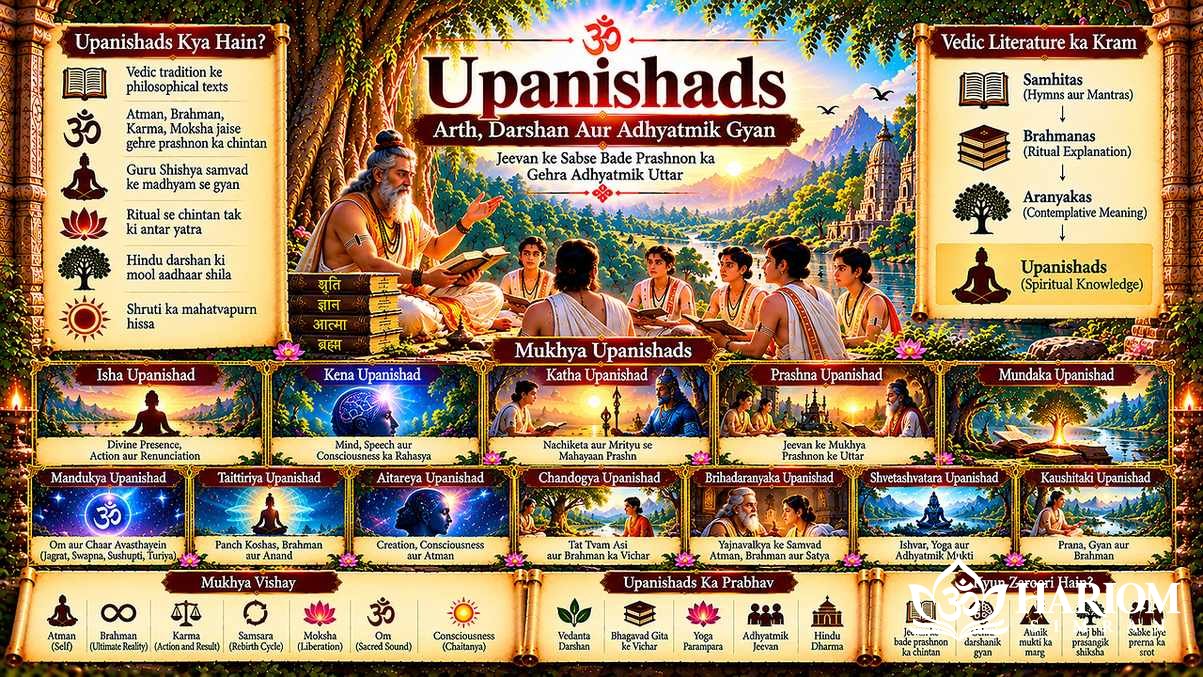
Vedic Literature Mein Upanishads Kahan Fit Hoti Hain?
Beginners ke liye ek useful framework hai:
- Samhitas
- Brahmanas
- Aranyakas
- Upanishads
Broadly:
Samhitas
Sacred hymns, Mantras, chants aur ritual formulas preserve karti hain.
Brahmanas
Vedic rituals, procedures aur symbolic meanings explain karti hain.
Aranyakas
Ritual ko contemplation aur inner interpretation ki taraf le jati hain.
Upanishads
Self, reality, consciousness aur liberation ke deeper philosophical questions explore karti hain.
Ye framework learning ke liye bahut helpful hai.
Lekin actual Vedic textual history more complex hai.
Kuch Upanishads Brahmana ya Aranyaka material ke within ya unke closely connected form mein milti hain.
Isliye transition gradual tha.
Upanishads Ko Vedanta Kyun Kaha Jata Hai?
Word Vedanta broadly mean karta hai:
Vedas Ka Ant
Iske do important meanings hain.
First, many Upanishads Vedic textual traditions ke concluding portions ke near milti hain.
Second, ye Vedic inquiry ke philosophical culmination ya deeper purpose ko represent kar sakti hain.
Later, Vedanta major Hindu philosophical traditions ka naam bhi bana.
Vedanta traditions mainly interpret karti hain:
Upanishads
Bhagavad Gita
Brahma Sutras
Lekin different Vedanta schools Upanishads ko different ways mein understand karti hain.
Ye diversity bahut important hai.
Upanishads sirf ek later philosophical school ki property nahi hain.
Kitni Upanishads Hain?
Iska ek simple universal answer nahi hai.
Hindu tradition mein many Upanishads preserve hui hain.
Later traditional collection Muktika Upanishad mein 108 Upanishads ki list milti hai.
Lekin sab Upanishads same period ki nahi hain aur sabka influence bhi equal nahi hai.
Ek smaller group ko commonly kaha jata hai:
Principal Upanishads
ya
Mukhya Upanishads
In texts par extensive philosophical commentaries hui hain aur Vedanta mein inka special importance hai.
Different traditions aur scholars lists ko slightly differently classify kar sakte hain.
Commonly around 10 se 13 principal Upanishads discuss ki jati hain.
Major Upanishads Kaun Si Hain?
Important principal Upanishads include:
- Isha Upanishad
- Kena Upanishad
- Katha Upanishad
- Prashna Upanishad
- Mundaka Upanishad
- Mandukya Upanishad
- Taittiriya Upanishad
- Aitareya Upanishad
- Chandogya Upanishad
- Brihadaranyaka Upanishad
Wider principal lists mein often include ki jati hain:
Shvetashvatara Upanishad
Kaushitaki Upanishad
Maitri Upanishad
Har Upanishad ka apna style, philosophical emphasis aur teaching method hai.
Kya Sab Upanishads Same Teaching Deti Hain?
Nahi.
Ye point extremely important hai.
Upanishads different Vedic traditions mein preserve hui hain.
Inmein philosophical emphasis vary karta hai.
Different texts stronger focus kar sakti hain on:
- Knowledge
- Meditation
- Atman
- Brahman
- Om
- Prana
- Devotion
- Consciousness
- Renunciation
- The Divine
Later Hindu philosophical schools in teachings ko different frameworks se interpret karti hain.
Isliye Upanishads ko ek single textbook ki tarah samajhna accurate nahi hai.
Better hai unhe sacred spiritual inquiry ki rich tradition ke roop mein understand karna.
Atman Kya Hai?
Upanishads ka central concept hai Atman.
Atman ko commonly translate kiya jata hai:
Self
Lekin sirf personality, name ya social identity ko Atman samajhna incomplete hoga.
Many Upanishadic teachings mein Atman deepest reality of the self ko point karta hai.
Texts questions raise karti hain:
Kya Main Sirf Body Hoon?
Kya Main Sirf Thoughts Hoon?
Kya Main Sirf Emotions Hoon?
Changing Experiences Ke Peeche Kya Remain Karta Hai?
Different Upanishads aur later philosophical schools Atman ko different ways mein interpret karti hain.
Lekin true Self ki search Upanishadic philosophy ka defining theme hai.
Brahman Kya Hai?
Another central concept hai Brahman.
Many Upanishadic contexts mein Brahman ultimate ya foundational reality ko refer karta hai.
Brahman ko discuss kiya ja sakta hai in relation to:
- Existence
- Consciousness
- Cosmic Reality
- Source of All
- Ground of Being
- The Divine
Different Vedanta traditions Brahman ko differently interpret karti hain.
Kuch nondual ultimate reality emphasize karti hain.
Kuch Supreme personal Divine ko emphasize karti hain.
Kuch individual self aur Supreme Divine ke beech real distinction ko maintain karti hain.
Isliye Brahman ko ek overly simple definition mein reduce nahi karna chahiye.
Atman Aur Brahman Ka Relationship Kya Hai?
Ye Hindu philosophy ke most influential questions mein se ek hai.
Different Upanishadic passages explore karte hain relationship between:
Individual Self
and
Ultimate Reality
Later Vedanta traditions ne different interpretations develop ki.
Advaita Vedanta
Advaita highest spiritual realization mein Atman aur Brahman ki nondual unity ko emphasize karta hai.
Vishishtadvaita Vedanta
Vishishtadvaita individual souls aur universe ko real maanti hai aur unhe Supreme Brahman ke saath inseparably related understand karti hai.
Dvaita Vedanta
Dvaita individual soul aur Supreme Divine ke beech real distinction maintain karta hai.
Ye sirf introductory descriptions hain.
Each Vedanta tradition ke arguments aur scriptural interpretations much more detailed hain.
Future HariOmSimran articles mein in philosophical schools ko separately explore karna useful hoga.
Moksha Kya Hai?
Moksha spiritual liberation ko refer karta hai.
Upanishadic traditions ask karti hain:
Human being ignorance aur bondage se free kaise ho sakta hai?
Birth aur death ke cycle se liberation kaise possible hai?
Moksha connected ho sakta hai:
- Self-Knowledge
- Knowledge of Brahman
- Freedom From Ignorance
- Spiritual Realization
- Freedom From Samsara
Different Hindu philosophical traditions Moksha ko different ways mein explain karti hain.
Lekin spiritual bondage se freedom Upanishadic thought ka major theme hai.
Samsara Kya Hai?
Samsara birth, death aur rebirth ke cycle ko refer karta hai.
Human existence ko ongoing cycle ka part samjha jata hai jo ignorance, desire aur Karma se connected hai.
Upanishads is concept ke philosophical development mein important role play karti hain.
Central question ban jata hai:
Kya Samsara Se Mukti Possible Hai?
Answer increasingly knowledge, realization aur Moksha ke saath connect hota hai.
Upanishads Mein Karma
Karma later Vedic aur Upanishadic thought mein increasingly important ho jata hai.
Karma broadly action aur consequences se connected hai.
Earlier Vedic context mein action strong ritual meaning carry karta tha.
Upanishadic teachings increasingly moral aur spiritual consequences ke dimension ko deepen karti hain.
Broader understanding develop hoti hai:
Human Actions Matter.
Choices Experience Ko Shape Karte Hain.
Spiritual Knowledge Bondage Se Freedom Ki Direction De Sakta Hai.
Complete Hindu Karma doctrine many texts aur traditions ke through gradually develop hua.
Knowledge Aur Ignorance
Upanishads mein major contrast hai:
Knowledge
and
Ignorance
Ignorance ka meaning sirf information ki kami nahi hai.
Ye Self aur reality ki true nature ko misunderstand karne se connected ho sakta hai.
Ek person practical world mein bahut knowledgeable ho sakta hai.
Lekin spiritual level par usse questions remain kar sakte hain:
Main Deepest Level Par Kaun Hoon?
Kya Permanent Hai?
Ultimate Reality Kya Hai?
Upanishadic knowledge transformative knowledge hai.
Ye sirf information add nahi karta.
Ye reality ko dekhne ka entire perspective change kar sakta hai.
Higher Aur Lower Knowledge
Mundaka Upanishad different forms of knowledge ke beech famous distinction present karti hai.
Iska ye meaning nahi ki ordinary learning useless hai.
Point ye hai ki knowledge of things aur knowledge of ultimate reality same category ke knowledge nahi hain.
Ye ek powerful question create karta hai:
Kaun Sa Gyan Human Being Ko Truly Free Kar Sakta Hai?
Upanishads repeatedly is deeper concern ki taraf return karti hain.
Guru Ka Role
Many Upanishadic narratives mein Guru Shishya relationship deeply important hai.
Seeker serious question ke saath teacher ke paas jata hai.
Teacher student se expect kar sakta hai:
- Patience
- Discipline
- Reflection
- Preparation
- Humility
- Inquiry
Upanishadic Guru always instant simple answer nahi deta.
Kabhi teaching gradually unfold hoti hai.
Isse important principle samajh aata hai:
Spiritual Knowledge Sirf Curiosity Se Nahi, Serious Preparation Aur Understanding Se Develop Hota Hai.
Upanishads Mein Dialogue
Many Upanishads teaching ke liye dialogue format use karti hain.
Famous examples include conversations between:
Nachiketa Aur Yama
Yajnavalkya Aur Maitreyi
Yajnavalkya Aur King Janaka
Uddalaka Aur Shvetaketu
Ye dialogues philosophical questions ko deeply human bana dete hain.
Subjects include:
Death
The Self
Knowledge
Immortality
Reality
Liberation
Ye teaching style Upanishads ki special strength hai.
Katha Upanishad Aur Nachiketa
Katha Upanishad famous story preserve karti hai of Nachiketa, ek young seeker jo Yama, Lord of Death, se encounter karta hai.
Nachiketa ko worldly rewards offer hote hain.
Lekin wo deeper question ko nahi chhodta:
Mrityu Ke Baad Kya Hota Hai?
Uska serious inquiry ke saath committed rehna spiritual search ka powerful symbol ban jata hai.
Katha Upanishad explore karti hai:
- Death
- Atman
- Desire
- Discipline
- Wisdom
- Immortality
- Liberation
Isi wajah se Katha Upanishad beginners ke liye bhi one of the most engaging Upanishads hai.
Chandogya Upanishad
Chandogya Upanishad one of the largest aur most influential Upanishads hai.
Ye Samaveda tradition se associated hai.
Important teachings include:
- Om
- Meditation
- Brahman
- Atman
- Sacred Sound
- Reality
- Knowledge
Iska famous statement hai:
Tat Tvam Asi
Different Vedanta traditions is teaching ko different ways mein interpret karti hain.
Isliye ise simple slogan bana dena accurate nahi hoga.
Context important hai.
Brihadaranyaka Upanishad
Brihadaranyaka Upanishad principal Upanishads mein one of the oldest aur most extensive texts hai.
Ye Shukla Yajurveda tradition se associated hai.
Major themes include:
- Atman
- Brahman
- Consciousness
- Death
- Knowledge
- Liberation
- Spiritual Inquiry
Ismein Sage Yajnavalkya ke famous philosophical dialogues preserve hain.
Vedanta traditions mein iska enormous influence raha hai.
Isha Upanishad
Isha Upanishad short hai, lekin highly influential hai.
Ye Shukla Yajurveda se associated hai.
Its themes include:
- Divine Presence
- Action
- Renunciation
- Knowledge
- Life in the World
- Spiritual Vision
Ye ek important question raise karti hai:
Spiritual wisdom aur worldly life ka relationship kya hai?
Different philosophical traditions iska different interpretation deti hain.
Kena Upanishad
Kena Upanishad profound questions se start hoti hai:
Mind Ko Kaun Direct Karta Hai?
Speech Ko Power Kaun Deta Hai?
Hearing Possible Kaise Hoti Hai?
Sight Ke Peeche Deeper Source Kya Hai?
Ye questions human faculties ke behind ultimate source ki search represent karte hain.
Text seeker ko ordinary perception ke beyond deeper reality ko explore karne invite karta hai.
Mundaka Upanishad
Mundaka Upanishad Atharvaveda se associated hai.
Important subjects include:
- Higher Knowledge
- Lower Knowledge
- Brahman
- The Self
- Spiritual Realization
- Liberation
Ismein memorable spiritual imagery bhi milti hai.
Mundaka Upanishad repeatedly deeper knowledge aur ultimate reality ki search ko emphasize karti hai.
Mandukya Upanishad
Mandukya Upanishad principal Upanishads mein one of the shortest texts hai.
Lekin iska philosophical influence extremely strong hai.
Main themes hain:
Om
aur
Four States of Consciousness
Commonly ye four states explain ki jati hain:
- Waking
- Dreaming
- Deep Sleep
- Turiya
Turiya ordinary three states se beyond reality ko point karta hai.
Later Advaita tradition ne Mandukya Upanishad ko special philosophical importance di.
Taittiriya Upanishad
Taittiriya Upanishad Krishna Yajurveda tradition se associated hai.
Its teachings include:
- Education
- Ethical Conduct
- Brahman
- Joy
- Human Existence
- Spiritual Discipline
Ye teachings later Five Koshas ke framework ke liye bhi famous hain.
Five Koshas human existence ke different layers ko describe karne ke liye widely discussed concept hai.
Aitareya Upanishad
Aitareya Upanishad Rigveda se associated hai.
Important themes include:
- Creation
- Consciousness
- The Self
- Human Existence
- Ultimate Reality
Text consciousness par special philosophical reflection present karta hai.
Ye question raise karta hai ki human being ko fundamentally define kya karta hai.
Prashna Upanishad
Prashna Upanishad Atharvaveda se associated hai.
Iska title questions ke concept se connected hai.
Six seekers ek teacher ke paas spiritual questions lekar jate hain.
Important subjects include:
- Creation
- Prana
- Human Life
- Meditation
- Om
- Spiritual Knowledge
Question and answer structure is text ko systematic study ke liye useful banata hai.
Shvetashvatara Upanishad
Shvetashvatara Upanishad especially interesting hai kyunki philosophical inquiry ke saath strong theological aur devotional dimensions bhi milte hain.
Themes include:
- Brahman
- The Divine
- Meditation
- Yoga
- Creation
- Spiritual Liberation
Ye several later Hindu theological traditions ke liye important text raha hai.
Ye also show karta hai ki Upanishadic thought sirf ek single philosophical style tak limited nahi hai.
Upanishads Aur Om
Om several Upanishads mein profound importance rakhta hai.
Om ko understand kiya ja sakta hai as:
- Sacred Sound
- Symbol of Ultimate Reality
- Meditation Ka Support
- Vedic Tradition Ka Sacred Expression
Different Upanishads Om ko different contexts mein explore karti hain.
Mandukya Upanishad especially Om aur states of consciousness ke relationship ke liye famous hai.
Wider sacred sound traditions ke liye Mantras explore karein.
Mahavakyas Kya Hain?
Word Mahavakya ka meaning hai:
Great Saying
Later Vedanta traditions kuch Upanishadic statements ko especially important maanti hain.
Four famous Mahavakyas commonly discuss kiye jate hain:
Prajnanam Brahma
Common interpretation:
Consciousness Is Brahman
Aitareya tradition se associated.
Aham Brahmasmi
Common translation:
I Am Brahman
Brihadaranyaka Upanishad se associated.
Tat Tvam Asi
Common translation:
That Thou Art
Chandogya Upanishad se associated.
Ayam Atma Brahma
Common translation:
This Self Is Brahman
Mandukya tradition se associated.
Different Vedanta schools in statements ko differently interpret karti hain.
HariOmSimran articles mein in philosophical differences ko respectfully explain karna important hai.
Upanishads Aur Meditation
Upanishads mein meditation different forms mein appear hoti hai.
Contemplation involve kar sakti hai:
- Om
- Prana
- The Self
- Sun
- Sacred Sound
- Cosmic Principles
- Brahman
Every Upanishad same meditation technique teach nahi karti.
Different practices different textual aur philosophical contexts se belong karti hain.
Isliye “Upanishadic Meditation” ko one universal technique ke roop mein present karna oversimplification hoga.
Upanishads Aur Prana
Prana several Upanishads mein major concept hai.
Prana connected hai:
- Breath
- Life
- Vitality
- Human Organism
- Cosmic Life
Some dialogues Prana aur other human faculties ke relationship ko explore karte hain.
Later Yoga aur Hindu spiritual traditions mein Prana even more central concept ban gaya.
Upanishads Aur Mrityu
Death Upanishads ka one of the most powerful subjects hai.
Question sirf ye nahi hai:
Death Ko Avoid Kaise Karein?
Deeper questions hain:
Actually Kaun Marta Hai?
Self Kya Hai?
Kya Consciousness Body Ke Equal Hai?
Kya Continue Karta Hai?
Rebirth Kis Se Connected Hai?
Moksha Kya Hai?
Katha Upanishad in questions ko especially powerful way mein explore karti hai.
Upanishads Aur Renunciation
Kuch Upanishadic teachings worldly desire se detachment ko emphasize karti hain.
Ye later Hindu renunciation traditions ke development mein contribute karta hai.
Lekin sab Upanishads same lifestyle present nahi karti.
Dialogs mein different social backgrounds ke people appear karte hain:
- Students
- Householders
- Kings
- Sages
- Renunciants
Ye diversity remind karti hai ki Hindu spiritual inquiry different social settings mein develop hui.
Upanishads Aur Bhakti
Upanishads usually philosophy aur knowledge ke saath strongly associated hain.
Lekin some Upanishadic texts devotional dimensions bhi show karti hain.
Themes include kar sakte hain:
- Reverence for Supreme Reality
- Grace
- Meditation on the Divine
- Devotion
- Personal Divine Language
Later Hindu traditions Upanishadic teachings ko devotional as well as philosophical frameworks mein interpret karti hain.
Kya Upanishads One God Sikhati Hain?
Iska answer nuanced hona chahiye.
Upanishads ultimate reality ke bare mein different kinds of language use karti hain.
Kuch passages emphasize karte hain:
Unity
Kuch focus karte hain:
Brahman
Kuch personal Divine language use karte hain.
Kuch focus karte hain:
Atman
Consciousness
Cosmic Reality
Later traditions different interpretations develop karti hain.
Isliye entire Upanishadic tradition ko one simple modern theological category mein fit karna accurate nahi hoga.
Wider Hindu Divine traditions ke liye Deities explore karein.
Upanishads Aur Vedanta
Upanishads later Vedanta philosophy ki foundational scriptures ban gayi.
Major Vedanta traditions include:
- Advaita Vedanta
- Vishishtadvaita Vedanta
- Dvaita Vedanta
Other Vedantic traditions bhi important hain.
Different schools relationship between:
Atman
Brahman
World
The Divine
ko different ways mein explain karti hain.
Ye diversity show karti hai ki Upanishadic interpretation living philosophical tradition hai.
Upanishads Aur Bhagavad Gita
Bhagavad Gita Mahabharata ke andar ek later textual setting se belong karti hai.
Lekin iske many philosophical themes Upanishadic thought ke saath deeply connected hain.
Examples include:
- Atman
- Brahman
- Karma
- Yoga
- Knowledge
- Devotion
- Liberation
Bhagavad Gita in themes ko action, duty aur spiritual life ke distinctive context mein explore karti hai.
Upanishads Aur Yoga
Upanishads aur Yoga ka relationship broad aur historically layered hai.
Some Upanishads contain teachings related to:
- Meditation
- Sense Control
- Breath
- Concentration
- Inner Awareness
- Spiritual Discipline
Later Yoga traditions in subjects ko much more deeply systematize karti hain.
Isliye Upanishadic material ko Hindu contemplative traditions ke historical foundations mein important layer ke roop mein samajhna useful hai.
Upanishads Aur Dharma
Upanishads primarily detailed Dharma manuals nahi hain.
Inka stronger focus ultimate reality aur spiritual knowledge par hai.
Lekin ethical preparation still important hai.
Important values include:
- Truthfulness
- Self-Control
- Discipline
- Respect for Teachers
- Responsibility
- Serious Inquiry
Wider Hindu concept ko explore karne ke liye Dharma dekhein.
Kya Upanishads Religion Hain Ya Philosophy?
Ancient Hindu texts par modern religion versus philosophy distinction always perfectly apply nahi hota.
Upanishads combine karti hain:
Philosophical Inquiry
Spiritual Practice
Sacred Teaching
Meditation
Theology
Ritual Background
Liberation
Inhe sirf abstract philosophy kehna incomplete hoga.
Inhe sirf ritual religion kehna bhi incomplete hoga.
Ye both intellectually deep aur spiritually sacred texts hain.
Kya Upanishads Ek Person Ne Likhi?
Nahi.
Upanishads ka ek single human author nahi hai.
Ye different Vedic schools aur teaching traditions ke through emerge hui.
Many teachings named sages, students aur kings ke through present ki jati hain.
Important names include:
Yajnavalkya
Uddalaka Aruni
Shvetaketu
Nachiketa
King Janaka
Traditional Hindu understanding in texts ko Shruti ke framework mein dekhti hai.
Modern scholarship language, chronology aur historical development ke through study karti hai.
Dono perspectives ko clearly distinguish karna important hai.
Kya Upanishads Bhagavad Gita Se Purani Hain?
Principal early Upanishads generally Bhagavad Gita se earlier layers of Hindu sacred literature represent karti hain.
Lekin Upanishadic literature many centuries ke through develop hua.
Kuch Upanishads much later hain.
Isliye better distinction hai:
Early Principal Upanishads
and
Later Upanishadic Literature
Saari Upanishads ko one single historical date se associate karna correct nahi hai.
Kya Beginners Upanishads Read Kar Sakte Hain?
Haan.
Lekin kuch texts difficult lag sakti hain because inmein hota hai:
- Symbolic Language
- Ancient Ritual References
- Philosophical Dialogue
- Compressed Teachings
- Multiple Interpretations
Beginners ko context ke saath start karna chahiye, isolated quotations se nahi.
Beginner Upanishads Ko Kaise Study Kare?
Practical learning path:
Step 1
Samhitas, Brahmanas Aur Aranyakas Ka Basic Structure Samjhein.
Step 2
Atman, Brahman, Karma, Samsara Aur Moksha Jaise Concepts Samjhein.
Step 3
Katha Aur Isha Jaise Relatively Accessible Upanishads Se Start Karein.
Step 4
Kena, Mundaka Aur Prashna Explore Karein.
Step 5
Mandukya Aur Taittiriya Ki Taraf Move Karein.
Step 6
Chandogya Aur Brihadaranyaka Ko Detail Mein Study Karein.
Step 7
Different Vedanta Traditions Ke Interpretations Compare Karein.
Ye gradual approach Upanishads ko disconnected quotations ka collection banne se bachata hai.
Upanishads Ke Common Misunderstandings
Misunderstanding 1: Upanishads Ek Single Book Hain
Nahi.
Ye many sacred texts ka collection hain jo different Vedic traditions se associated hain.
Misunderstanding 2: Sab Upanishads Exactly Same Philosophy Sikhati Hain
Nahi.
Inmein different teachings aur emphases milte hain.
Later Hindu traditions in teachings ko differently interpret karti hain.
Misunderstanding 3: Upanishads Vedas Ko Reject Karti Hain
Nahi.
Upanishads Vedic Shruti tradition ka hi part hain.
Misunderstanding 4: Upanishads Sirf Advaita Vedanta Ke Bare Mein Hain
Nahi.
Advaita in texts ko foundational maanti hai, lekin Vishishtadvaita, Dvaita aur other Vedanta traditions bhi Upanishads ko authoritative scripture ke roop mein interpret karti hain.
Misunderstanding 5: Upanishads Sirf Monks Ke Liye Hain
Nahi.
Inke dialogues students, householders, kings, sages aur renunciants ke beech hote hain.
Inke spiritual questions broader human life ko address karte hain.
Modern Readers Upanishads Se Kya Seekh Sakte Hain?
Upanishads ancient world se belong karti hain, lekin inke questions aaj bhi remarkably relevant hain.
They ask:
Jab Sab Kuch Change Ho Raha Hai, To Mujhe Fundamentally Define Kya Karta Hai?
Kya Happiness Sirf External Possessions Se Milti Hai?
Consciousness Kya Hai?
Death Ko Kaise Samjhein?
Kya Knowledge Hamare Experience Ko Transform Kar Sakta Hai?
Individual Aur Ultimate Reality Ka Relationship Kya Hai?
True Freedom Ka Meaning Kya Hai?
Modern readers every historical interpretation ko same way mein accept karein ye zaroori nahi.
Lekin questions ki depth explain karti hai ki Upanishads thousands of years baad bhi spiritual aur philosophical study ko inspire karti hain.
Upanishads Aaj Bhi Important Kyun Hain?
Upanishads Hindu intellectual aur spiritual history ke most influential texts mein se hain.
Inhone later discussions ko deeply shape kiya:
Atman
Brahman
Karma
Samsara
Moksha
Meditation
Om
Consciousness
Vedanta
Ye Vedic thought ki remarkable journey ko bhi represent karti hain:
Sacred Hymn
se
Ritual
phir
Symbolic Interpretation
phir
Inner Contemplation
aur finally
Reality Aur Self Par Direct Philosophical Inquiry
Isi wajah se Hindu philosophy ko understand karne ke liye Upanishads central importance rakhti hain.
HariOmSimran Ke Saath Upanishadic Wisdom Explore Karein
HariOmSimran apne Scripture section ko structured aur interconnected Hindu knowledge journey ke roop mein develop kar raha hai.
Continue exploring:
Upanishads ka main overview complete hone ke baad Scripture series ka best next article hoga:
Isha Upanishad: Arth, Shikshaen Aur Darshan
Uske baad systematically cover kiya ja sakta hai:
Kena Upanishad
Katha Upanishad
Prashna Upanishad
Mundaka Upanishad
Mandukya Upanishad
Taittiriya Upanishad
Aitareya Upanishad
Chandogya Upanishad
Brihadaranyaka Upanishad
aur other principal Upanishads.
Learn • Explore • Understand • Preserve
Key Takeaway
Upanishads Vedic tradition ke deepest philosophical texts mein se hain.
Ye fundamental subjects explore karti hain:
Atman
Brahman
Karma
Samsara
Moksha
Om
Consciousness
Death
Spiritual Knowledge
Upanishads ek single book nahi hain aur ek single later philosophical system ko uniformly present nahi karti.
Different texts different teachings preserve karti hain.
Later Hindu traditions bhi in teachings ko different ways mein interpret karti hain.
Inki lasting importance un fundamental questions mein hai jo ye ask karti hain:
Hum Kaun Hain?
Reality Kya Hai?
Consciousness Ka Source Kya Hai?
Individual Aur Ultimate Reality Ka Relationship Kya Hai?
Kya Human Being Spiritual Bondage Se Free Ho Sakta Hai?
In questions ne Vedanta aur wider Hindu spiritual inquiry ko profoundly shape kiya hai.
Key Teachings
This scripture reveals profound wisdom and guidance for our spiritual journey. Below are the key teachings and principles derived from this sacred text.
Core Principles
These teachings provide guidance for living a life of faith, compassion, and spiritual growth.
- Spiritual Growth
- Divine Wisdom
- Sacred Teachings
- Faith Journey

Study Resources
Explore these resources to deepen your understanding of this scripture and apply its teachings to your daily life.
📖 Study Guide
Comprehensive study materials to help you understand the context, meaning, and application of this scripture.
🙏 Reflection Questions
Thought-provoking questions to help you reflect on the teachings and apply them to your personal spiritual journey.
📝 Journal Prompts
Guided journaling prompts to help you document your insights, prayers, and spiritual growth.
👥 Discussion Topics
Engaging discussion topics for group study and fellowship, fostering deeper understanding and community.
Frequently Asked Questions
Upanishads Vedic Shruti tradition ke sacred philosophical texts hain. Ye Atman, Brahman, Karma, Samsara, Moksha, consciousness, meditation aur ultimate reality jaise subjects explore karti hain.
Later traditional Muktika collection 108 Upanishads list karti hai. Lekin around 10 se 13 texts commonly principal ya Mukhya Upanishads ke roop mein especially important maani jati hain.
Har Upanishad exactly same teaching present nahi karti. Major themes mein Self ka knowledge, Brahman, consciousness, liberation from Samsara aur ultimate reality ki search include hain.
Upanishads wider Vedic Shruti tradition ka part hain. Earlier Vedic layers hymns, rituals aur symbolism ko emphasize karti hain, jabki Upanishads increasingly philosophical aur spiritual inquiry par focus karti hain.
Nahi. Upanishads Vedanta ki foundational scriptures hain. Vedanta later philosophical traditions ko refer karta hai jo Upanishads, Bhagavad Gita aur Brahma Sutras ko interpret karti hain.
Upanishads important hain kyunki inhone Atman, Brahman, Karma, Samsara, Moksha aur consciousness par Hindu philosophical thought ko deeply shape kiya aur major Vedanta traditions ke liye foundation provide ki.