

Taittiriya Upanishad ek bahut gehra spiritual question raise karti hai:
Hum actually kaun hain?
Kya hum sirf apna sharir hain?
Kya hum apni saans aur life energy hain?
Kya hum apne thoughts aur emotions hain?
Kya hum apni buddhi aur knowledge hain?
Ya hamari identity in sabhi changing layers se bhi deeper hai?
Taittiriya Upanishad seeker ko human experience ke different levels ke through gradually deeper Self-inquiry ki taraf le jati hai.
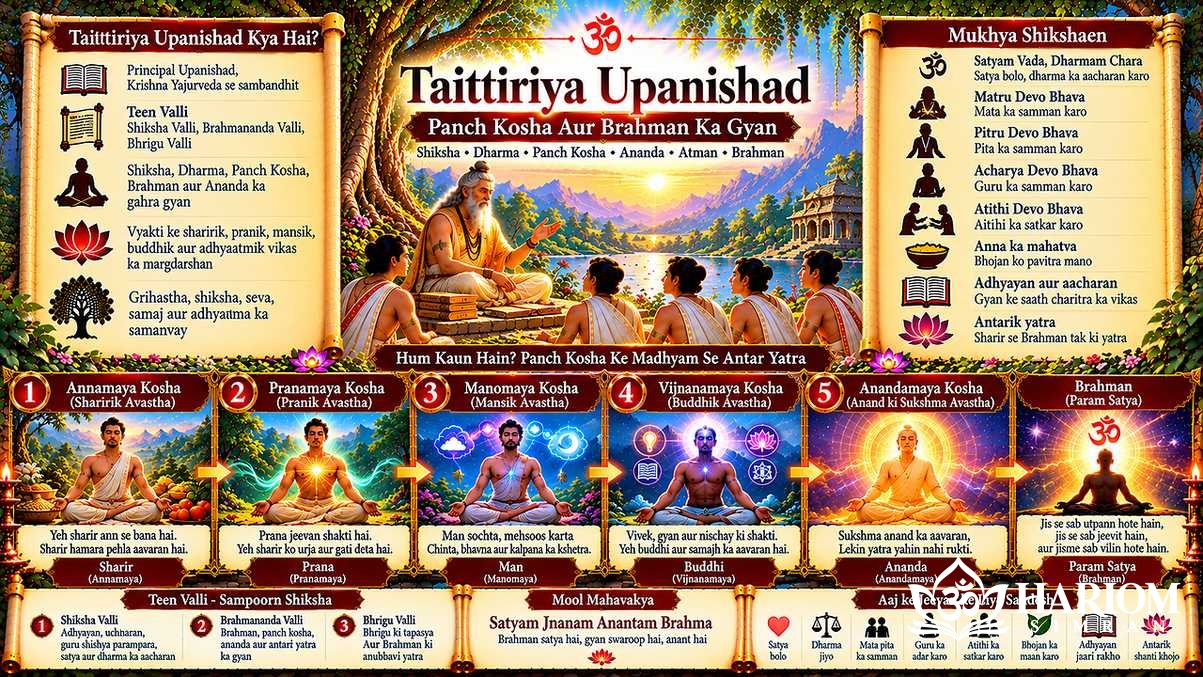
Later Vedantic tradition is teaching ko commonly Panch Kosha, yani Five Koshas, ke framework ke through explain karti hai:
- Annamaya Kosha: Physical body aur food-based existence
- Pranamaya Kosha: Prana aur vital life functions
- Manomaya Kosha: Mind, emotions aur sensory processing
- Vijnanamaya Kosha: Buddhi, understanding aur discernment
- Anandamaya Kosha: Subtle bliss-related experience
Lekin Taittiriya Upanishad sirf Panch Kosha ke bare mein nahi hai.
Ye equally important teachings deti hai on:
- Education aur disciplined learning
- Sacred pronunciation aur Vedic recitation
- Guru Shishya relationship
- Satya aur Dharma
- Parents, teachers aur guests ka respect
- Food ka sacred importance
- Prana aur mind
- Brahman
- Ananda
- Bhrigu ki spiritual inquiry
- Self-knowledge aur inner transformation
Isi combination ki wajah se Taittiriya Upanishad Hindu sacred philosophy ke saath saath ethical aur educational wisdom ka bhi important source hai.
Wider sacred tradition ko samajhne ke liye Hindu Scriptures explore karein.
Taittiriya Upanishad Kya Hai?
Taittiriya Upanishad principal ya Mukhya Upanishads mein se ek hai.
Ye Krishna Yajurveda se associated hai aur Taittiriya Aranyaka tradition ka part hai.
Is text mein Vedic thought ka ek beautiful development dekhne ko milta hai.
Journey gradually move karti hai:
- Sacred recitation se disciplined learning ki taraf
- Learning se ethical conduct ki taraf
- Ethical conduct se Self-inquiry ki taraf
- Self-inquiry se Brahman aur Ananda ki taraf
Taittiriya Upanishad sirf ye nahi poochti:
Brahman Kya Hai?
Ye equally practical questions bhi address karti hai:
- Student ko kaise jeena chahiye?
- Truth ko daily life mein kaise practice karein?
- Dharma ka real meaning conduct mein kaise dikhta hai?
- Parents aur teachers ke prati gratitude kyun important hai?
- Body, Prana, mind aur deeper Self ka relationship kya hai?
- Happiness aur spiritual Ananda mein kya difference hai?
Ye balance is scripture ko especially valuable banata hai.
Isse Taittiriya Upanishad Kyun Kaha Jata Hai?
Naam Taittiriya Krishna Yajurveda ki Taittiriya branch ya school se connected hai.
Isliye iska title kisi ek philosophical teaching, deity ya character se nahi, balki uski Vedic textual lineage se aata hai.
Taittiriya Upanishad Aur Krishna Yajurveda
Krishna Yajurveda ritual, sacred formulas aur philosophical reflection ka rich tradition preserve karta hai.
Taittiriya Upanishad isi background se emerge hoti hai, lekin seeker ko increasingly inward direction mein guide karti hai.
Is movement ko simple way mein samjhein:
- External Sacred Practice
- Disciplined Learning
- Ethical Living
- Inner Reflection
- Self-Inquiry
- Brahman Ki Khoj
Iska meaning earlier Vedic tradition ko reject karna nahi hai.
Instead, Upanishad spiritual life ke meaning ko aur deepen karti hai.
Taittiriya Upanishad Ka Structure
Taittiriya Upanishad traditionally three major sections, ya Vallis, mein divided hai:
- Shiksha Valli: Education, pronunciation, discipline, ethics aur student life
- Brahmananda Valli: Brahman, creation, Panch Kosha aur Ananda
- Bhrigu Valli: Bhrigu ki inquiry aur Brahman ko gradually understand karne ka path
Brahmananda Valli ko commonly Ananda Valli bhi kaha jata hai.
Ye three Vallis milkar ek complete learning journey create karti hain.
Shiksha Valli: Education Bhi Spiritual Practice Hai
First section, Shiksha Valli, education aur sacred learning par strong focus karti hai.
Vedic tradition historically oral transmission par depend karti thi.
Scripture ko:
- Suna jata tha
- Recite kiya jata tha
- Repeat kiya jata tha
- Memorize kiya jata tha
- Teacher se student tak transmit kiya jata tha
Isliye correct pronunciation, sound aur rhythm sacred education ka part the.
Shiksha Valli remind karti hai ki serious spiritual learning discipline ke bina complete nahi hoti.
Wider sacred sound tradition ko samajhne ke liye Mantras explore karein.
Guru Aur Shishya Ka Relationship
Taittiriya Upanishad Acharya aur Shishya ke relationship ko important place deti hai.
Teacher ka role sirf information dena nahi hai.
Traditional learning mein teacher student ko guide karta hai in:
- Knowledge
- Discipline
- Conduct
- Reflection
- Spiritual understanding
Student ki taraf se bhi kuch qualities important hain:
- Respect
- Attention
- Commitment
- Patience
- Practice
- Serious inquiry
Real education therefore relationship, responsibility aur transformation se connected hai.
Education Aur Character
Taittiriya Upanishad knowledge aur character ko separate nahi karti.
Person highly educated ho sakta hai, lekin agar uska conduct irresponsible ho to learning incomplete reh sakti hai.
Upanishadic education ke important dimensions include:
- Satya: Truthfulness
- Dharma: Right conduct aur responsibility
- Shraddha: Sincere commitment
- Daan: Responsible generosity
- Samman: Respect and dignity
- Self-Discipline: Apne actions aur impulses ko responsibly guide karna
Ye idea modern education ke liye bhi relevant hai.
Education sirf career banane ka medium nahi.
Education person ke character ko bhi shape karti hai.
Satyam Vada, Dharmam Chara
Taittiriya Upanishad ki most famous teachings mein se ek hai:
Satyam Vada
Dharmam Chara
Broadly iska meaning hai:
Satya Bolo.
Dharma Ka Aacharan Karo.
Ye important hai because text truth aur Dharma ko sirf philosophical subjects ke roop mein present nahi karti.
Inhe life mein practice karna hai.
Dharma ke wider meaning ko HariOmSimran par detail mein explore kiya ja sakta hai.
Satya Ka Practical Meaning
Satya sirf verbally sach bolne tak limited nahi hai.
Spiritual life mein truthfulness include kar sakti hai:
- Apne motives ke bare mein honesty
- Apni mistakes ko accept karna
- Knowledge ki limits ko recognize karna
- Doosron ko intentionally mislead na karna
- Apne aap ko false image ke through deceive na karna
Ultimate truth ki search ordinary truthfulness se disconnected nahi ho sakti.
Dharmam Chara Ka Meaning
Dharmam Chara ka broad sense hai:
Dharma Ko Jeevan Mein Practice Karo.
Dharma include kar sakta hai:
- Right conduct
- Responsibility
- Ethical living
- Justice
- Proper action
- Duty
- Spiritual principles
- Life ko support karne wala order
Dharma therefore sirf theory nahi hai.
Ye choices aur relationships ke through live hota hai.
Matru Devo Bhava
Another famous instruction hai:
Matru Devo Bhava
Broadly:
Mata Ko Sacred Respect Do.
Teaching mother ke prati gratitude, dignity aur reverence emphasize karti hai.
Iska purpose blind obedience promote karna nahi hai.
Respect ke saath healthy discernment aur appropriate boundaries bhi important reh sakte hain.
Pitru Devo Bhava
Text kehti hai:
Pitru Devo Bhava
Broadly:
Pita Ko Sacred Respect Do.
Teaching family responsibility aur gratitude ko highlight karti hai.
Spiritual learning ka purpose arrogance create karna nahi hona chahiye.
True learning gratitude ko deepen kar sakti hai.
Acharya Devo Bhava
Another famous teaching hai:
Acharya Devo Bhava
Broadly:
Teacher Ko Sacred Respect Do.
Traditional setting mein Acharya:
- Knowledge transmit karta hai
- Student ko discipline sikhata hai
- Understanding develop karne mein help karta hai
- Character formation mein role play karta hai
Lekin respect ka meaning blindly every person claiming spiritual authority ko follow karna nahi hai.
Discernment bhi important hai.
Atithi Devo Bhava
Text also teaches:
Atithi Devo Bhava
Broadly:
Guest Ko Sacred Respect Do.
Ye teaching hospitality ko spiritual conduct ke saath connect karti hai.
Important message hai:
Spirituality Sirf Ritual Ya Temple Tak Limited Nahi Hai.
Doosron ke saath dignity aur respect se behave karna bhi Dharma ka part ho sakta hai.
Respect Ka Meaning Blind Obedience Nahi Hai
Traditional teachings ko modern context mein responsibly samajhna important hai.
Respect ka meaning ye nahi hai:
- Abuse tolerate karna
- Personal safety ignore karna
- Healthy boundaries remove karna
- Questioning completely stop karna
- Judgment abandon karna
Deeper message gratitude, dignity aur responsible conduct ka hai.
Daan Aur Shraddha
Shiksha Valli giving ke attitude ko bhi importance deti hai.
Daan sirf amount ke bare mein nahi hai.
Giving ke saath ideally hona chahiye:
- Shraddha
- Responsibility
- Humility
- Respect
- Receiver ki dignity ka dhyan
Real generosity person ko superior feel karane ka tool nahi banna chahiye.
Food Aur Generosity
Taittiriya Upanishad later food ko deep sacred importance deti hai.
Isliye feeding others, hospitality aur food-sharing traditions ko bhi wider Dharma aur Seva ke context mein understand kiya ja sakta hai.
Food dena sirf material action nahi.
Dignity aur care bhi matter karti hai.
Learning Kabhi Stop Nahi Honi Chahiye
Taittiriya tradition continued learning ko value karti hai.
Formal education complete hone ke baad bhi person ko:
- Study karte rehna chahiye
- Reflect karte rehna chahiye
- Knowledge ko life mein apply karna chahiye
- Useful wisdom responsibly share karni chahiye
Ye HariOmSimran ke Learn • Explore • Understand • Preserve approach ke saath naturally align karta hai.
Brahmananda Valli: Deeper Spiritual Inquiry
Second major section hai Brahmananda Valli, jise Ananda Valli bhi kaha jata hai.
Yahan Upanishad deeper metaphysical questions explore karti hai.
Important themes include:
- Brahman
- Creation
- Human identity
- Panch Kosha
- Ananda
- Self-Knowledge
Ye section later Vedanta mein especially influential bana.
Brahman Kya Hai?
Taittiriya Upanishad Brahman ko ultimate reality ki taraf point karti hai.
Brahman ordinary changing object ki tarah understand nahi kiya jata.
Text Brahman ko existence ke deeper foundation ke roop mein explore karti hai.
A famous teaching hai:
Satyam Jnanam Anantam Brahma
Satyam Jnanam Anantam Brahma
Broadly, ye expression Brahman ko point karta hai through:
- Satyam: Truth or reality
- Jnanam: Knowledge or consciousness
- Anantam: Infinite or limitless
Lekin in words ko ordinary three qualities ki simple list ke roop mein understand karna incomplete hoga.
Different Vedanta traditions is expression ko different philosophical frameworks mein interpret karti hain.
Brahman Aur Creation
Taittiriya Upanishad differentiated existence ko deeper reality se arise hota hua describe karti hai.
Traditional sequence mein include hote hain:
- Akasha
- Vayu
- Agni
- Water
- Earth
- Plants
- Food
- Human life
Ye modern scientific cosmology nahi hai.
Ye ancient Vedic spiritual cosmology ka part hai.
Main teaching hai:
Different Forms of Existence Ek Deeper Reality Par Depend Karte Hain.
Anna Ka Sacred Importance
Taittiriya Upanishad food, yani Anna, ko remarkable importance deti hai.
Food:
- Body ko sustain karta hai
- Growth ko support karta hai
- Embodied life ka foundation hai
- Human beings ko Earth aur nature se connect karta hai
Spiritual life yahan physical life se separate nahi hai.
Panch Kosha Kya Hain?
Later Vedantic tradition Taittiriya teaching ko commonly Panch Kosha framework ke through explain karti hai.
Kosha ka broad meaning hai sheath, covering ya layer.
Panch Kosha hain:
- Annamaya Kosha: Physical body
- Pranamaya Kosha: Vital life energy
- Manomaya Kosha: Mind and emotions
- Vijnanamaya Kosha: Intellect and discernment
- Anandamaya Kosha: Subtle bliss-related dimension
Ye five physical organs nahi hain.
Ye human experience ke increasingly subtle dimensions ko understand karne ka spiritual framework hain.
Kosha Teaching Ka Purpose
Panch Kosha teaching seeker ko repeatedly question karne invite karti hai:
Kya Ye Layer Hi Mera Complete Self Hai?
Journey visible se subtle ki taraf move karti hai.
Isliye Panch Kosha sirf classification system nahi hai.
Ye Self-inquiry ka method bhi ban sakta hai.
Annamaya Kosha
Annamaya Kosha physical body se connected hai.
Body depend karti hai:
- Food
- Water
- Material elements
- Physical nourishment
- Biological processes
Ye human identity ka most visible dimension hai.
Kya Body Hi Complete Self Hai?
Body essential hai.
Without body, ordinary embodied human experience possible nahi hai.
Lekin body continuously change karti hai.
Childhood body adult body jaisi nahi hoti.
Adult body aging ke saath change hoti hai.
Health, strength aur appearance bhi change karte hain.
Upanishadic inquiry therefore poochti hai:
Kya Constantly Changing Body Hamara Complete Self Ho Sakti Hai?
Body Ka Respect Karna
Panch Kosha teaching body hatred promote nahi karti.
Body ko respect karna important hai.
Body ke through hum:
- Work karte hain
- Relationships experience karte hain
- Seva karte hain
- Learning karte hain
- Spiritual practice karte hain
Lesson hai:
Body Ko Care Karo, Lekin Deepest Self Ko Sirf Body Tak Limit Mat Karo.
Pranamaya Kosha
Second sheath hai Pranamaya Kosha.
Ye Prana se connected hai.
Prana ko sirf ordinary breath ke equal samajhna incomplete ho sakta hai.
Hindu philosophical traditions mein ye broadly connect hota hai:
- Vitality
- Life force
- Breath
- Life-sustaining functions
Physical structure se journey ab living activity ki taraf move karti hai.
Body Aur Prana Ka Relationship
Living body aur lifeless body same nahi hote.
Prana therefore physical structure ke beyond life dimension ko represent karta hai.
Lekin inquiry yahan bhi stop nahi karti.
Question remain karta hai:
Kya Life Energy Hi Deepest Self Hai?
Prana Aur Modern Science
Prana ancient Hindu spiritual aur philosophical concept hai.
Isse modern physiology, oxygen circulation ya medical diagnosis ke equal present nahi karna chahiye.
Traditional concepts aur modern medical science ko respectfully distinguish karna important hai.
Manomaya Kosha
Third sheath hai Manomaya Kosha.
Ye mind, ya Manas, se connected hai.
Mind handle karta hai:
- Thoughts
- Emotions
- Memories
- Sensory impressions
- Reactions
- Mental imagination
Hum apne mind ke saath strong identification develop karte hain.
Hum kehte hain:
Main Khush Hoon.
Main Dukhi Hoon.
Main Pareshan Hoon.
Lekin mental states continuously change hote hain.
Kya Mind Hi Self Hai?
Thoughts come and go.
Emotions change hote hain.
Memories evolve karti hain.
Preferences change hoti hain.
Agar mind constantly changing hai, Upanishadic inquiry poochti hai:
Kya Changing Mind Hamari Deepest Identity Ho Sakta Hai?
Ye seeker ko aur subtle level ki taraf guide karta hai.
Vijnanamaya Kosha
Fourth sheath hai Vijnanamaya Kosha.
Ye commonly connect hota hai:
- Buddhi
- Understanding
- Intellect
- Discernment
- Decision-making
- Knowledge
Vijnanamaya level person ko reflect aur discriminate karne ki capacity deta hai.
Buddhi Aur Viveka
Discernment ke through person ask kar sakta hai:
- Kya right hai?
- Kya wrong hai?
- Kya temporary hai?
- Kya lasting hai?
- Kya beneficial hai?
- Kya sirf attractive hai?
- Kya truth ke closer hai?
Ye spiritual learning ke liye very important capacity hai.
Kya Intellectual Knowledge Enough Hai?
Nahi.
Person philosophy ke concepts deeply understand kar sakta hai aur still spiritual realization se far ho sakta hai.
Intellectual knowledge valuable hai, lekin Upanishads often remind karti hain:
Knowing About Truth Aur Realizing Truth Same Nahi Hain.
Anandamaya Kosha
Fifth sheath hai Anandamaya Kosha.
Ananda broadly refer kar sakta hai:
- Bliss
- Deep joy
- Spiritual fullness
- Subtle happiness
Ye ordinary pleasure se deeper concept hai.
Lekin Anandamaya ko carefully understand karna important hai.
Kya Anandamaya Kosha Brahman Hai?
Is question ka one-line universal answer dena correct nahi hoga.
Different Vedanta traditions Anandamaya passage ko differently interpret karti hain.
Isliye HariOmSimran par safe aur accurate approach hai:
Anandamaya Ko Directly Aur Universally Brahman Ke Identical Declare Na Karein.
Philosophical context aur commentary matter karti hai.
Pleasure Aur Ananda Mein Difference
Ordinary pleasure conditions par depend karta hai.
Examples:
- Favorite food
- Entertainment
- Achievement
- Recognition
- Wealth
- Comfort
Ye experiences temporary hain.
Upanishadic Ananda deeper spiritual fullness ki taraf point karta hai.
Panch Kosha Ki Complete Journey
Panch Kosha framework ko simple progression mein samjhein:
- Annamaya: Main body experience karta hoon.
- Pranamaya: Main living vitality experience karta hoon.
- Manomaya: Main thoughts aur emotions experience karta hoon.
- Vijnanamaya: Main samajhta, evaluate aur decide karta hoon.
- Anandamaya: Main subtle happiness aur fullness experience karta hoon.
Har level par question hai:
Jo Main Experience Kar Raha Hoon, Kya Main Sirf Wahi Hoon?
Ye inquiry seeker ko deeper Self ki taraf move karti hai.
Panch Kosha Five Separate Souls Nahi Hain
Panch Kosha ka meaning person ke andar five independent souls hona nahi hai.
Ye human experience ke different levels ko represent karte hain.
Ultimate inquiry Atman aur Brahman ke relationship ki taraf move karti hai.
Panch Kosha Aur Self-Inquiry
Panch Kosha ko contemplative questions ke through bhi samjha ja sakta hai:
- Body: Meri body change hoti hai. Kya Main Sirf Body Hoon?
- Prana: Meri energy change hoti hai. Kya Main Sirf Vitality Hoon?
- Mind: Mere thoughts change hote hain. Kya Main Sirf Thoughts Hoon?
- Intellect: Meri understanding evolve hoti hai. Kya Main Sirf Buddhi Hoon?
- Bliss: Pleasant states bhi come and go karti hain. Inke peeche deeper reality kya hai?
Panch Kosha Aur Modern Wellness
Aaj Panch Kosha framework Yoga aur wellness programs mein commonly use hota hai.
Ye helpful ho sakta hai, lekin original context ko preserve karna important hai.
Taittiriya Upanishad ka purpose sirf:
- Physical wellness
- Energy balance
- Mental wellness
- Relaxation
nahi hai.
Deeper purpose hai:
Self-Inquiry Aur Brahman Ki Khoj.
Ananda Ki Teaching
Taittiriya Upanishad Ananda par one of the most famous philosophical reflections present karti hai.
Text progressively greater forms of happiness ko contemplate karti hai.
Purpose ye prove karna nahi ki bliss ko exact mathematical units mein measure kiya ja sakta hai.
Purpose hai seeker ko ye understand karana:
Ordinary Pleasure Ultimate Spiritual Fullness Ka Measure Nahi Hai.
Brahman Aur Ananda
Brahman ko Ananda ke saath connect karna ye nahi kehta:
Brahman Bas Ek Happy Feeling Hai.
Feelings change hoti hain.
Brahman temporary emotional state nahi hai.
Ananda deeper spiritual fullness aur completeness ki taraf point karta hai.
Fear Aur Brahman Ka Gyan
Taittiriya Upanishad fear ke deeper roots ko bhi touch karti hai.
Fear arise ho sakta hai through:
- Separation
- Attachment
- Uncertainty
- Loss
- Mortality
Deeper spiritual understanding person ke existential fear ke saath relationship ko transform kar sakti hai.
Iska meaning ye nahi ki spiritual person normal human concern kabhi feel nahi karega.
Bhrigu Valli: Inquiry Ka Path
Third major section hai Bhrigu Valli.
Ye Bhrigu aur Varuna ke dialogue ke through ek beautiful spiritual learning model present karti hai.
Bhrigu Brahman ka knowledge seek karta hai.
Varuna usse ready-made final definition dekar stop nahi karte.
Wo usse inquiry ka direction dete hain.
Bhrigu Kaun Hai?
Bhrigu seeker hai jo Varuna ke paas ja kar request karta hai:
Mujhe Brahman Ka Gyan Sikhaiye.
Varuna usse guide karte hain ki wo investigate kare:
- Jisse beings arise hote hain
- Jiske through beings live karte hain
- Jisme beings return karte hain
Ye Bhrigu ko final slogan se zyada useful cheez deta hai:
A Method of Inquiry
Bhrigu Ki Spiritual Journey
Bhrigu gradually deeper levels explore karta hai:
- Anna: Food and material nourishment
- Prana: Life principle
- Manas: Mind
- Vijnana: Knowledge and understanding
- Ananda: Deeper bliss-related reality
Journey increasingly subtle hoti jati hai.
Ye Panch Kosha teaching ke saath strong resonance rakhti hai.
Bhrigu Food Se Kyun Start Karta Hai?
Food embodied life ka obvious foundation hai.
Body food ke through sustain hoti hai.
Living beings material nourishment par depend karte hain.
Isliye Bhrigu visible aur practical reality se start karta hai.
Lekin wo first insight ko final truth nahi maan leta.
Ye uski inquiry ki strength hai.
Food Se Prana Tak
Bhrigu recognize karta hai ki life physical material se more hai.
Prana living dimension ko represent karta hai.
Lekin wo yahan bhi stop nahi karta.
Inquiry phir mind ki taraf move karti hai.
Prana Se Mind Tak
Mind thoughts, emotions aur perception ko process karta hai.
Ye Prana aur body se subtler lagta hai.
Lekin Bhrigu still deeper jata hai.
Mind Se Vijnana Tak
Knowledge aur understanding mind se more refined dimension present karte hain.
Vijnana person ko reflect aur discern karne allow karta hai.
Phir bhi inquiry continue karti hai.
Vijnana Se Ananda Tak
Finally journey Ananda ki taraf move karti hai.
Is gradual progression ka purpose one-word answer memorize karna nahi hai.
Purpose hai:
Experience Ke Through Deeper Reality Ko Investigate Karna.
Varuna Direct Answer Kyun Nahi Dete?
Ye Taittiriya Upanishad ka one of the strongest educational insights hai.
Teacher student ko answer de sakta hai.
Lekin student ko samajh develop karni hoti hai.
Varuna Bhrigu ko encourage karte hain:
- Reflect karo
- Contemplate karo
- Observe karo
- Return karo
- Deeper question poochho
Ye real inquiry-based education hai.
Tapas Ka Role
Bhrigu ki journey mein Tapas important hai.
Tapas ka meaning hamesha extreme physical hardship nahi hai.
Yahan broadly include ho sakta hai:
- Discipline
- Focused reflection
- Inner inquiry
- Persistent contemplation
- Serious spiritual effort
Deep knowledge patience demand karti hai.
Food Ka Respect
Bhrigu Valli aur wider Taittiriya teaching food ko sacred respect deti hai.
Food humein connect karta hai with:
- Earth
- Water
- Plants
- Animals
- Human labor
- Family
- Community
Food ke prati gratitude spiritual attitude ban sakti hai.
Food Aur Seva
Food ke respect ka practical expression feeding others ke through bhi ho sakta hai.
Hindu traditions mein Anna Daan aur Bhandara important Seva forms rahe hain.
Lekin dignity important hai.
Receiver ko respect ke saath treat karna spiritual giving ka essential part hai.
Taittiriya Upanishad Aur Atman
Panch Kosha teaching ultimately deeper Atman inquiry ki taraf le jati hai.
Seeker asks:
Body Ko Kaun Janta Hai?
Prana Ko Kaun Experience Karta Hai?
Mind Ke Thoughts Ko Kaun Observe Karta Hai?
Knowledge Aur Bliss Ko Kaun Experience Karta Hai?
Ye inquiry increasingly deeper Self ki taraf point karti hai.
Taittiriya Upanishad Aur Brahman
Brahman text ka foundational reality hai.
Brahman ko existence ke:
- Source
- Support
- Deeper ground
ke roop mein explore kiya jata hai.
Different Vedanta traditions Atman, Brahman aur individual soul ke relationship ko differently understand karti hain.
Advaita Vedanta Interpretation
Advaita Vedanta Taittiriya Upanishad ko major importance deta hai.
Advaita interpretations often Panch Kosha ko layers of identification ke roop mein explain karti hain.
Seeker gradually recognize karta hai:
Main Sirf Body Nahi.
Main Sirf Prana Nahi.
Main Sirf Mind Nahi.
Main Sirf Intellect Nahi.
Is process ke through deeper Self-realization ki inquiry develop hoti hai.
Vishishtadvaita Interpretation
Vishishtadvaita Vedanta Brahman, soul aur world ko Advaita se differently explain karta hai.
Individual souls aur universe real hain aur Supreme Brahman par dependent hain.
Isliye same Upanishadic passages different metaphysical meanings receive kar sakte hain.
Dvaita Interpretation
Dvaita Vedanta individual soul aur Supreme Brahman ke beech real distinction maintain karta hai.
Is framework mein Self aur Brahman related statements ko complete identity ke roop mein necessarily interpret nahi kiya jata.
Ye Hindu philosophical diversity ka important example hai.
Shared Scripture, Different Interpretations
Ek important principle yaad rakhein:
Same Upanishad Ko Different Vedanta Traditions Different Ways Mein Interpret Kar Sakti Hain.
Is diversity ko weakness nahi, Hindu philosophical history ki richness ke roop mein understand karna chahiye.
Panch Kosha Aur Yoga
Later Yoga traditions Panch Kosha model ko widely use karti hain.
Modern Yoga education mein Koshas often explain kiye jate hain through:
- Body
- Breath or energy
- Mind
- Wisdom
- Inner joy
Ye useful interpretation ho sakti hai, lekin original Upanishadic goal deeper Self-understanding hai.
Taittiriya Upanishad Aur Dharma
Shiksha Valli ek important point clear karti hai:
Spiritual Knowledge Ethical Responsibility Se Separate Nahi Hai.
Person sacred philosophy deeply study kare, lekin daily conduct mein truth aur Dharma ignore kare, to learning incomplete reh sakti hai.
Dharma ka wider explanation is teaching ko aur deepen karta hai.
Taittiriya Upanishad Aur Family Values
Mother, father, teacher aur guest ki teachings remind karti hain ki Hindu spiritual life sirf meditation aur metaphysics tak limited nahi hai.
Relationships bhi matter karti hain.
Text humein poochne invite karti hai:
- Kya knowledge ke saath gratitude badh raha hai?
- Kya education ke saath respect badh raha hai?
- Kya spiritual study character improve kar rahi hai?
- Kya hum doosron ki dignity recognize kar rahe hain?
Taittiriya Upanishad Aur Education
Taittiriya Upanishad ek powerful educational philosophy present karti hai.
True education develop karni chahiye:
- Knowledge
- Character
- Responsibility
- Respect
- Discernment
- Truthfulness
- Humility
Ye education ko sirf examination, degree aur career success se broader banata hai.
Knowledge Aur Humility
Bhrigu repeatedly deeper jata hai.
Wo first answer ke baad announce nahi karta:
Mujhe Sab Pata Chal Gaya.
Ye itself important lesson hai.
Real knowledge often humility increase karti hai.
Jitna deeper seeker jata hai, utna clearly wo recognize karta hai ki reality simple labels se greater hai.
Common Misunderstandings About the Taittiriya Upanishad
Taittiriya Upanishad Sirf Panch Kosha Ka Text Hai
Nahi. Panch Kosha important teaching hai, lekin scripture education, ethics, Dharma, Brahman, Ananda, food aur Bhrigu ki inquiry ko bhi deeply explore karti hai.
Panch Kosha Physical Organs Hain
Nahi. Koshas spiritual aur philosophical dimensions hain. Inhe physical anatomy ke organs ke roop mein present karna accurate nahi hai.
Anandamaya Ka Meaning Sirf Happiness Hai
Nahi. Ananda temporary pleasure se deeper spiritual fullness ki taraf point karta hai.
Parents Aur Teachers Ka Respect Blind Obedience Hai
Nahi. Traditional teaching gratitude aur dignity ko emphasize karti hai. Healthy judgment aur appropriate boundaries important remain karte hain.
Every Vedanta School Same Meaning Deta Hai
Nahi. Advaita, Vishishtadvaita, Dvaita aur other traditions important passages ko different philosophical frameworks mein interpret karti hain.
Beginner Taittiriya Upanishad Ko Kaise Study Kare?
Agar aap first time Taittiriya Upanishad study kar rahe hain, ye learning order useful ho sakta hai:
- Pehle Krishna Yajurveda aur Taittiriya Aranyaka ke saath iska connection samjhein.
- Shiksha Valli se start karein.
- Satyam Vada aur Dharmam Chara ko context mein understand karein.
- Matru Devo Bhava, Pitru Devo Bhava, Acharya Devo Bhava aur Atithi Devo Bhava ko study karein.
- Brahmananda Valli mein Brahman aur Panch Kosha teachings par move karein.
- Har Kosha ko separately samjhein.
- Ananda teaching ko ordinary pleasure se differentiate karein.
- Bhrigu Valli ko carefully study karein.
- Finally major Vedanta interpretations compare karein.
Modern Readers Taittiriya Upanishad Se Kya Seekh Sakte Hain?
Taittiriya Upanishad ke lessons modern life mein bhi powerful hain:
- Education character bhi build kare.
- Truth ko sirf discuss nahi, practice karein.
- Dharma daily decisions mein dikhe.
- Parents aur teachers ke prati gratitude rakhein.
- Guests aur others ko dignity dein.
- Food ko casually waste na karein.
- Body ko respect karein, lekin identity ko sirf body tak limit na karein.
- Thoughts ko observe karein instead of unhe entire Self samajhne ke.
- Intelligence ke saath humility maintain karein.
- Deep questions par first answer ke baad stop na karein.
Education Beyond Career
Modern education often focus karti hai:
- Grades
- Degrees
- Jobs
- Income
- Professional skills
Ye sab important hain.
Lekin Taittiriya Upanishad deeper question poochti hai:
Education Kis Tarah Ka Human Being Create Kar Rahi Hai?
Kya person more truthful hua?
More responsible?
More respectful?
More thoughtful?
Ye question text ko modern educational discussion mein bhi relevant banata hai.
Body, Mind Aur Identity
Modern people often identity ko tie karte hain:
- Appearance
- Fitness
- Career
- Emotions
- Thoughts
- Intelligence
- Social status
Panch Kosha teaching gently poochti hai:
Agar Ye Sab Change Hote Hain, To Deepest Self Kya Hai?
Ye Upanishadic inquiry ka heart hai.
Bhrigu Ka Learning Method
Bhrigu ki journey ek professional learning model ke roop mein bhi samjhi ja sakti hai:
- Question poochho
- Observation karo
- Reflect karo
- First answer ko test karo
- Deeper inquiry karo
- Understanding ko refine karo
Ye method spiritual learning ke beyond bhi useful ho sakta hai.
Taittiriya Upanishad Aaj Bhi Important Kyun Hai?
Taittiriya Upanishad aaj bhi important hai because ye modern life mein often separate ho chuki cheezon ko connect karti hai:
- Education with character
- Knowledge with Dharma
- Spirituality with family responsibility
- Body with Prana
- Mind with discernment
- Food with gratitude
- Happiness with deeper inquiry
- Student with teacher
- Individual life with Brahman
Iska spiritual journey broadly aisa hai:
Seekho.
Satya Ko Jiyo.
Dharma Ka Aacharan Karo.
Relationships Ka Samman Karo.
Apne Experience Ki Layers Ko Samjho.
Body Aur Mind Se Deeper Inquiry Karo.
Brahman Ki Khoj Karo.
Isi richness ki wajah se Taittiriya Upanishad Upanishadic tradition ki most complete educational aur spiritual texts mein se ek hai.
HariOmSimran Ke Saath Upanishadic Wisdom Explore Karein
HariOmSimran Scripture section ko structured aur interconnected Hindu knowledge journey ke roop mein develop kar raha hai.
Continue exploring:
Upanishads series ka next detailed article hoga:
Aitareya Upanishad: Srishti, Consciousness Aur Atman
Uske baad:
- Chandogya Upanishad
- Brihadaranyaka Upanishad
- Other important Upanishadic texts
Learn • Explore • Understand • Preserve
Key Takeaway
Taittiriya Upanishad principal Upanishads mein se ek hai aur Krishna Yajurveda ki Taittiriya Aranyaka tradition se associated hai.
Iske three major sections hain:
- Shiksha Valli: Education, Satya, Dharma aur disciplined conduct
- Brahmananda Valli: Brahman, Panch Kosha aur Ananda
- Bhrigu Valli: Spiritual inquiry aur gradual understanding of Brahman
Its famous ethical teachings include:
- Satyam Vada
- Dharmam Chara
- Matru Devo Bhava
- Pitru Devo Bhava
- Acharya Devo Bhava
- Atithi Devo Bhava
Panch Kosha framework human experience ko five increasingly subtle dimensions ke through explain karta hai:
- Annamaya
- Pranamaya
- Manomaya
- Vijnanamaya
- Anandamaya
Bhrigu ki journey food se Prana, mind, knowledge aur Ananda tak move karti hai.
Key Teachings
This scripture reveals profound wisdom and guidance for our spiritual journey. Below are the key teachings and principles derived from this sacred text.
Core Principles
These teachings provide guidance for living a life of faith, compassion, and spiritual growth.
- Spiritual Growth
- Divine Wisdom
- Sacred Teachings
- Faith Journey

Study Resources
Explore these resources to deepen your understanding of this scripture and apply its teachings to your daily life.
📖 Study Guide
Comprehensive study materials to help you understand the context, meaning, and application of this scripture.
🙏 Reflection Questions
Thought-provoking questions to help you reflect on the teachings and apply them to your personal spiritual journey.
📝 Journal Prompts
Guided journaling prompts to help you document your insights, prayers, and spiritual growth.
👥 Discussion Topics
Engaging discussion topics for group study and fellowship, fostering deeper understanding and community.
Frequently Asked Questions
Taittiriya Upanishad Krishna Yajurveda se associated principal Upanishad hai. Ye education, Dharma, Brahman, Panch Kosha, Ananda aur Bhrigu ki spiritual inquiry ko explore karti hai.
Panch Kosha Annamaya, Pranamaya, Manomaya, Vijnanamaya aur Anandamaya hain. Later Vedantic tradition inhe progressively subtle sheaths ya dimensions of human experience ke roop mein explain karti hai.
Three major sections Shiksha Valli, Brahmananda Valli aur Bhrigu Valli hain. Ye respectively education aur conduct, Brahman aur Panch Kosha, aur Bhrigu ki spiritual inquiry par focus karti hain.
Broadly iska meaning hai, “Satya Bolo Aur Dharma Ka Aacharan Karo.” Teaching emphasize karti hai ki spiritual knowledge daily conduct aur ethical responsibility mein reflect hona chahiye.
Different Vedanta traditions Anandamaya passage ko differently interpret karti hain. Isliye Anandamaya ko universally Brahman ke identical present karna accurate nahi hoga.
Taittiriya Upanishad important hai because ye spiritual philosophy ko practical life ke saath connect karti hai through education, Satya, Dharma, family responsibility, food, Panch Kosha, Brahman, Ananda aur disciplined Self-inquiry.