

The Taittiriya Upanishad asks a question that touches every human being:
Who are we beneath the many layers through which we experience life?
We live through the body.
We breathe.
We think.
We feel.
We understand.
We experience moments of happiness and peace.
But are any of these, by themselves, the complete Self?
The Taittiriya Upanishad guides the seeker through increasingly subtle dimensions of human experience.
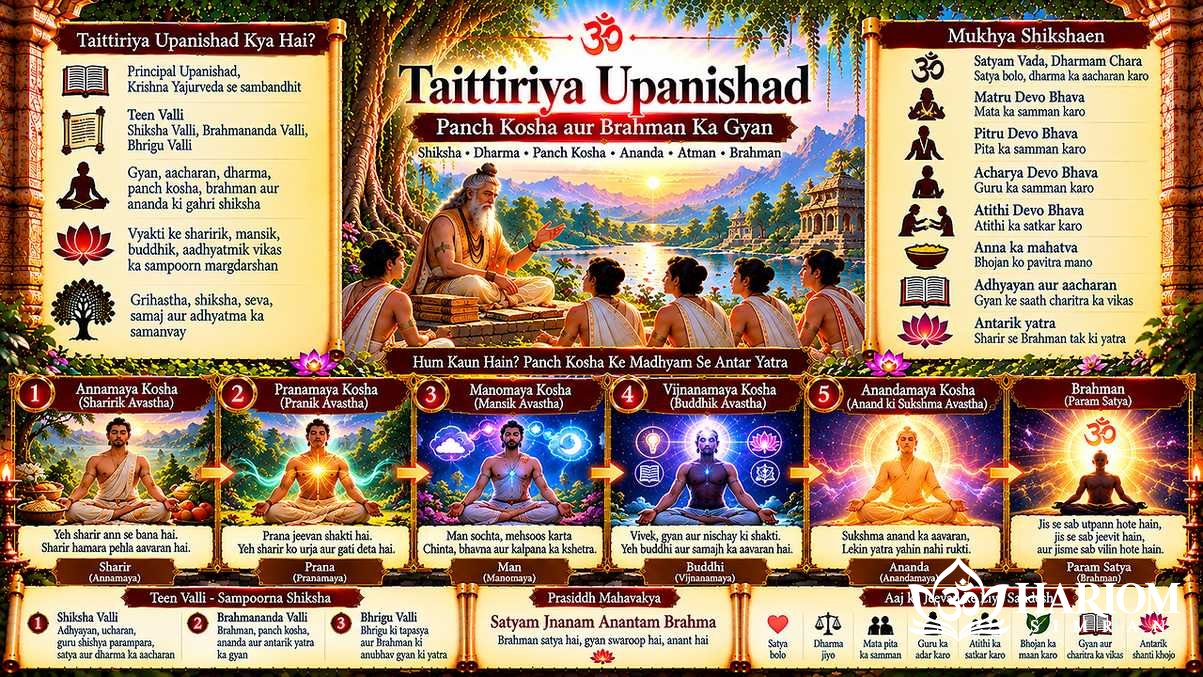
Later Vedantic teaching commonly explains this journey through the framework of the Five Koshas, or five sheaths:
Annamaya
Pranamaya
Manomaya
Vijnanamaya
Anandamaya
The teaching begins with the physical human being and gradually moves inward.
From food and body.
To life energy.
To mind.
To understanding.
To a subtle dimension associated with bliss.
Yet the journey does not simply stop at one layer.
The deeper inquiry concerns Brahman, the ultimate reality from which beings arise, by which they live and into which they ultimately return.
The Taittiriya Upanishad is also much more than the Five Koshas.
It contains profound teachings on:
- Education
- Pronunciation and Sacred Recitation
- Teacher and Student
- Truth
- Dharma
- Parents
- Teachers
- Guests
- Food
- Prana
- Mind
- Knowledge
- Ananda
- Brahman
- Spiritual Inquiry
Its combination of ethics, education and metaphysics makes it one of the richest principal Upanishads.
To understand the wider sacred tradition, explore Hindu Scriptures.
What Is the Taittiriya Upanishad?
The Taittiriya Upanishad is one of the principal or Mukhya Upanishads.
It is associated with the Krishna Yajurveda.
More specifically, it forms part of the Taittiriya Aranyaka tradition.
This connection is important.
The text stands within the wider development of Vedic thought from:
Ritual
to
Symbolic Reflection
to
Inner Contemplation
to
Philosophical Inquiry
The Taittiriya Upanishad explores both practical and spiritual dimensions of life.
It asks not only:
What is Brahman?
But also:
How should a student live?
How should truth be practiced?
How should parents, teachers and guests be respected?
What is the relationship between body, Prana, mind and deeper Self?
This balance makes the text especially valuable for HariOmSimran’s educational approach.
Why Is It Called the Taittiriya Upanishad?
The name Taittiriya comes from the Taittiriya branch or school of the Krishna Yajurveda tradition.
The Upanishad belongs to that textual lineage.
Its name therefore reflects its Vedic school rather than one individual philosophical concept.
Taittiriya Upanishad and the Krishna Yajurveda
The Krishna Yajurveda contains important ritual and philosophical material.
The Taittiriya Upanishad emerges from this world but directs the seeker increasingly inward.
The movement becomes:
External Sacred Practice
toward
Inner Spiritual Understanding
This does not mean the text rejects the earlier Vedic tradition.
Instead, it deepens the meaning of spiritual life.
How Is the Taittiriya Upanishad Structured?
The Taittiriya Upanishad is traditionally divided into three main sections, or Vallis:
- Shiksha Valli
- Brahmananda Valli
- Bhrigu Valli
The Brahmananda Valli is also commonly called the Ananda Valli.
Each section has a distinctive emphasis.
Shiksha Valli
Focuses on education, recitation, discipline, ethical conduct and the relationship between teacher and student.
Brahmananda Valli
Explores Brahman, the nature of reality, the layered human being and the teachings later known as the Five Koshas.
Bhrigu Valli
Presents Bhrigu’s inquiry into Brahman through disciplined contemplation.
Together, these three sections create a complete spiritual journey.
Shiksha Valli: Education as Sacred Practice
The first section is the Shiksha Valli.
The word Shiksha is connected with instruction and traditionally with the proper study of sound and pronunciation.
This is significant because Vedic knowledge was transmitted orally.
Correct pronunciation mattered.
Sound mattered.
Rhythm mattered.
Teacher and student relationship mattered.
The beginning of the Taittiriya Upanishad therefore reminds us that spiritual education begins with discipline.
Sacred Sound and Pronunciation
In Vedic tradition, scripture is not merely something written on a page.
It is recited.
Heard.
Repeated.
Memorized.
Transmitted.
This makes pronunciation and sound part of sacred learning.
The Shiksha Valli reflects this culture of careful transmission.
For wider sacred sound traditions, explore Mantras.
Teacher and Student
The Taittiriya Upanishad places strong importance on the relationship between:
Acharya
and
Shishya
The teacher does not simply provide information.
The teacher guides the student in:
Knowledge
Conduct
Discipline
Reflection
The student must also bring:
Respect
Attention
Commitment
Practice
This shows that learning is relational.
Education and Character
The Taittiriya Upanishad does not separate knowledge from character.
A person can be intellectually educated but ethically weak.
The text refuses to treat this as complete education.
Spiritual education includes:
Truthfulness
Dharma
Responsibility
Respect
Generosity
Self-Discipline
This makes the Upanishad highly relevant to modern education.
Satyam Vada, Dharmam Chara
One of the most famous teachings of the Taittiriya Upanishad is:
Satyam Vada
Dharmam Chara
Broadly:
Speak the Truth.
Practice Dharma.
These teachings appear in the context of instructions given to a student.
Truth is not presented only as an abstract philosophical ideal.
It must become part of life.
Similarly, Dharma is not simply something to study.
It must be lived.
Explore the wider concept through Dharma.
Truth as a Way of Life
Satya, or truth, is essential because spiritual inquiry depends upon honesty.
A seeker who constantly deceives others or themselves cannot easily approach deeper reality.
Truthfulness includes honesty about:
Speech
Actions
Motives
Knowledge
Limitations
The path toward ultimate truth begins with truth in ordinary life.
Practice Dharma
The instruction Dharmam Chara means that Dharma must be practiced.
Dharma can include:
Right Conduct
Responsibility
Duty
Ethical Living
Justice
Proper Action
Spiritual Principles
The Order That Supports Life
Dharma is therefore something lived through choices and relationships.
Matru Devo Bhava
Another famous teaching is:
Matru Devo Bhava
Broadly:
Regard the mother with sacred respect.
The teaching emphasizes gratitude and reverence toward the mother.
It reflects the importance of family responsibility within Hindu ethical life.
This should not be used to justify harmful behavior or remove reasonable personal boundaries.
Its spiritual purpose is gratitude and respect.
Pitru Devo Bhava
The next teaching is:
Pitru Devo Bhava
Broadly:
Regard the father with sacred respect.
Again, the principle is gratitude and responsibility toward parents.
The teaching reminds the student that education should not produce arrogance toward those who supported their life.
Acharya Devo Bhava
The text also teaches:
Acharya Devo Bhava
Broadly:
Regard the teacher with sacred respect.
The teacher represents the transmission of knowledge.
In the traditional educational context, the Acharya helps shape both understanding and character.
This does not mean every person claiming to be a Guru should be followed without judgment.
Hindu traditions also value discernment.
Atithi Devo Bhava
Another famous teaching is:
Atithi Devo Bhava
Broadly:
Treat the guest with sacred respect.
Hospitality becomes part of spiritual life.
This teaching suggests that Dharma is not restricted to temples and rituals.
The way we treat another human being can itself become spiritual practice.
Respect and Discernment
These famous teachings should be understood responsibly.
Respect does not require:
Blind Obedience
Tolerance of Abuse
Abandonment of Judgment
The deeper lesson is about gratitude, dignity and ethical conduct.
This balanced understanding is important for modern readers.
Give With Faith
The Shiksha Valli also discusses giving.
Daan should not become an act of arrogance.
Giving should be approached with:
Shraddha
Responsibility
Respect
Humility
The attitude behind giving matters.
This connects ethics with inner intention.
Give With Dignity
True giving should not humiliate the receiver.
The Taittiriya teaching encourages seriousness and respect around generosity.
This remains a valuable principle for Seva and charitable action.
Learning Should Continue
The text encourages ongoing learning and transmission.
Education does not end when the formal student phase ends.
Knowledge should continue to be:
Studied
Reflected Upon
Practiced
Shared Responsibly
This aligns strongly with HariOmSimran’s goal of preserving Hindu knowledge for future generations.
Brahmananda Valli
The second major section is the Brahmananda Valli, also commonly called the Ananda Valli.
Here, the Upanishad moves into profound philosophical inquiry.
Important themes include:
Brahman
Creation
The Human Being
The Five Koshas
Ananda
Self-Knowledge
This section contains some of the most influential teachings in Vedanta.
What Is Brahman?
The Taittiriya Upanishad presents Brahman as the ultimate reality from which beings arise.
A famous teaching describes Brahman through ideas associated with:
Truth
Knowledge
Infinity
This teaching later becomes central to Vedantic interpretation.
Different philosophical schools explain these terms differently.
Therefore, Brahman should not be reduced to one simplistic definition.
Satyam, Jnanam, Anantam Brahma
A famous expression from the Taittiriya Upanishad is:
Satyam Jnanam Anantam Brahma
Broadly, it points toward Brahman as:
Truth
Knowledge or Consciousness
Infinite
These terms do not simply describe Brahman as an object possessing three qualities.
Different Vedanta traditions interpret the statement in sophisticated ways.
Its importance lies in directing the seeker beyond limited, changing reality.
Brahman as the Source of Creation
The Upanishad presents a sequence in which differentiated existence arises from deeper reality.
The text connects Brahman with the source of:
Space
Air
Fire
Water
Earth
Plants
Food
Human Life
This should not be treated as modern scientific cosmology.
Its purpose is spiritual.
It presents all differentiated existence as dependent on a deeper reality.
Food Has Sacred Importance
One of the distinctive features of the Taittiriya Upanishad is the importance given to Anna, or food.
Food sustains embodied life.
The body itself depends upon nourishment.
The text therefore treats food with reverence.
This is important because spirituality is not presented as disconnected from physical existence.
Anna and the Human Body
The physical body is nourished by food.
It grows through food.
It returns to material nature.
This forms the foundation of the first Kosha teaching:
Annamaya
The seeker begins with the most visible dimension of human existence.
What Are the Five Koshas?
Later Vedantic teaching commonly presents the Taittiriya sequence as the Pancha Kosha, or Five Koshas.
Kosha means:
Sheath
Covering
or broadly
Layer
The five are:
- Annamaya Kosha
- Pranamaya Kosha
- Manomaya Kosha
- Vijnanamaya Kosha
- Anandamaya Kosha
These should not necessarily be imagined as five physical shells stacked inside the body.
They are a spiritual framework for exploring increasingly subtle dimensions of human experience.
Why Are They Called Sheaths?
The word Kosha suggests something that covers or encloses.
Later Vedantic interpretation uses this framework to show how the deepest Self can be confused with different layers of experience.
A person may think:
I Am Only the Body.
Then:
I Am My Vital Energy.
Then:
I Am My Mind.
Then:
I Am My Intellect.
Then perhaps:
I Am Blissful Experience.
The inquiry continues deeper.
First Kosha: Annamaya
Annamaya Kosha is commonly understood as the food-made sheath.
This refers broadly to the physical dimension of the human being.
The body depends upon:
Food
Water
Material Elements
Physical Processes
The Upanishad begins here because the body is our most obvious identity.
Is the Body the Self?
The body is essential.
Without the body, ordinary embodied life cannot continue.
But the Upanishadic inquiry asks:
Is the body the deepest Self?
The body constantly changes.
Childhood body.
Adult body.
Aging body.
Cells change.
Appearance changes.
Yet the sense of personal continuity remains.
This suggests that the spiritual inquiry must continue deeper.
Respecting the Body
The teaching should not be used to devalue the body.
The body is not presented as worthless.
It is the vehicle of embodied life.
Food sustains it.
Health affects our ability to live and practice.
The spiritual lesson is:
Respect the body without reducing the entire Self to the body.
Second Kosha: Pranamaya
The second sheath is Pranamaya Kosha.
This is connected with Prana, the vital life principle.
Prana is broader than ordinary breathing.
It can be connected with:
Vitality
Living Energy
Breath
Life-Sustaining Functions
The seeker now moves from physical form toward the principle that animates life.
Body and Prana
A body without life is not the same as a living person.
Prana therefore represents a dimension deeper than physical structure alone.
But the Upanishadic inquiry does not stop here.
If Prana changes and functions through life, is Prana itself the deepest Self?
The journey continues.
Prana in Hindu Tradition
Prana becomes highly important in later:
Yoga
Ayurveda
Meditation Traditions
However, the Taittiriya Upanishad should be studied within its own philosophical context.
Prana should not be presented as a substitute for modern medical explanations.
Third Kosha: Manomaya
The third sheath is Manomaya Kosha.
This is connected with Manas, the mind.
The mind processes:
Thoughts
Emotions
Sensory Impressions
Memories
Responses
Human beings strongly identify with mental activity.
We say:
I Am Happy.
I Am Sad.
I Am Worried.
I Am Confused.
But the Upanishadic inquiry asks:
If thoughts and emotions constantly change, are they the deepest Self?
Mind Is Powerful but Changeable
The mind shapes our experience.
The same situation can feel completely different depending upon the mental state.
Yet the mind is unstable.
Thoughts arise and disappear.
Emotions rise and fall.
Memories change.
The seeker therefore continues beyond identification with the mind.
Fourth Kosha: Vijnanamaya
The fourth sheath is Vijnanamaya Kosha.
This is often connected with:
Understanding
Intellect
Discernment
Knowledge
Decision-Making
This is subtler than ordinary mental reaction.
Vijnana allows the person to:
Reflect
Judge
Understand
Discriminate
Choose
This dimension is crucial for spiritual inquiry.
Intellect and Discernment
The intellect can ask:
What Is Right?
What Is True?
What Is Temporary?
What Is Permanent?
What Should I Choose?
This discriminating faculty becomes essential in Vedantic inquiry.
But even intellectual knowledge is still examined.
The person who knows philosophy conceptually may still not have realized the Self.
Knowledge Is Not the Final Ego
Vijnanamaya should not become a new identity:
I Am Intelligent, Therefore I Know the Self.
The Upanishads repeatedly warn against intellectual pride.
Discernment is essential.
But spiritual realization may go beyond conceptual thought.
Fifth Kosha: Anandamaya
The fifth sheath is Anandamaya Kosha.
Ananda broadly means:
Bliss
Joy
Deep Happiness
Spiritual Fullness
This is subtler than ordinary pleasure.
The Taittiriya teaching explores a dimension of profound happiness associated with increasingly subtle experience.
But Anandamaya should be understood carefully.
Is Anandamaya the Final Self?
Different Vedanta traditions interpret the Anandamaya teaching differently.
Therefore, it is not responsible to simply say:
Anandamaya Kosha Is Automatically the Absolute Self.
Later commentators carefully examine whether Anandamaya represents Brahman itself or a subtle sheath related to bliss.
Different schools reach different conclusions.
HariOmSimran should preserve this philosophical diversity.
Pleasure and Ananda Are Not the Same
Ordinary pleasure depends on conditions.
Food.
Entertainment.
Success.
Recognition.
Possessions.
These can create happiness.
But they are temporary.
Ananda in Upanishadic philosophy points toward something much deeper than temporary sensory pleasure.
The Journey Through the Five Koshas
The Five Koshas can be understood as a journey:
Annamaya
Body.
Then:
Pranamaya
Life.
Then:
Manomaya
Mind.
Then:
Vijnanamaya
Understanding.
Then:
Anandamaya
Bliss-related subtle experience.
At every stage, the seeker asks:
Is This the Complete Self?
This turns the Five Koshas into a method of spiritual inquiry.
Five Koshas Are Not Five Separate Souls
This is important.
The teaching does not mean there are five independent souls inside one person.
The Koshas are dimensions through which human experience can be understood.
The deeper inquiry concerns Atman and Brahman.
Koshas and Self-Inquiry
A practical contemplative question can be asked at each level.
Body
My body changes. Am I only my body?
Prana
My energy changes. Am I only my vitality?
Mind
My thoughts change. Am I only my thoughts?
Intellect
My understanding changes. Am I only my intellect?
Bliss
Pleasant and subtle states also change. What is deeper than changing experience?
This makes the Kosha teaching spiritually powerful.
Five Koshas and Modern Wellness
The Five Koshas are often used today in Yoga and wellness programs.
This can be useful, but care is needed.
The original Upanishadic context is philosophical and spiritual.
It should not be reduced to a generic wellness model.
The purpose is not merely:
Body Wellness
Energy Wellness
Mental Wellness
The deeper goal is Self-inquiry and understanding of Brahman.
Ananda in the Taittiriya Upanishad
The Taittiriya Upanishad contains one of the most famous reflections on Ananda, or bliss.
It presents a graded contemplation of happiness.
The teaching asks the seeker to imagine increasingly greater forms of joy.
The purpose is to show that ordinary human happiness cannot measure the fullness associated with Brahman.
The Measure of Human Happiness
The Upanishad begins with an imagined ideal human happiness.
Then it multiplies the scale repeatedly.
Greater and greater forms of happiness are contemplated.
The teaching is not a mathematical formula for measuring spiritual bliss.
It is a philosophical device.
It helps the seeker understand that ultimate Ananda cannot be reduced to ordinary pleasure.
Brahman and Ananda
The Upanishadic tradition strongly associates Brahman with fullness and bliss.
But this should not be simplified as:
Brahman Is Just a Happy Feeling.
Feelings change.
Brahman is not presented as a temporary emotional state.
Ananda points toward a much deeper spiritual reality.
Fear and the Knowledge of Brahman
The Taittiriya Upanishad also reflects on freedom from fear.
Fear often arises from:
Separation
Uncertainty
Attachment
Mortality
The knowledge of deeper reality transforms the seeker's relationship with fear.
This does not mean spiritually knowledgeable people never experience ordinary human concern.
The philosophical teaching concerns deeper existential fear.
Bhrigu Valli
The third major section is the Bhrigu Valli.
This section presents an especially beautiful spiritual teaching through the relationship between:
Bhrigu
and
Varuna
Bhrigu approaches Varuna and asks to know Brahman.
Instead of simply giving him a final definition, Varuna guides him toward inquiry.
This makes the Bhrigu Valli one of the most powerful models of experiential learning in the Upanishads.
Who Is Bhrigu?
Bhrigu is the seeker in this section.
He approaches Varuna, traditionally his father and teacher, seeking knowledge of Brahman.
His question is profound:
Teach me Brahman.
Varuna does not merely provide a slogan.
He gives Bhrigu a framework and encourages him to practice Tapas, disciplined contemplation.
What Does Varuna Teach?
Varuna directs Bhrigu to investigate that from which beings are born, by which they live and into which they return.
This gives Bhrigu a method.
He must inquire into the source of life.
The teacher guides.
The student investigates.
This is a remarkable educational model.
Bhrigu Begins With Food
Bhrigu first recognizes Anna, food or material nourishment, as deeply important.
All embodied beings depend on food.
The body arises through nourishment.
Life continues through nourishment.
But Bhrigu does not stop there.
He continues his inquiry.
From Food to Prana
Bhrigu next recognizes the importance of Prana.
Life is more than physical material.
The living principle must be considered.
But again, Prana is not the end of the inquiry.
Bhrigu continues.
From Prana to Mind
Then attention moves toward Manas, mind.
Human life includes:
Thought
Memory
Emotion
Perception
Mind appears more subtle than physical body or vital energy.
But the inquiry continues.
From Mind to Vijnana
Bhrigu moves toward Vijnana, deeper understanding or intelligence.
The capacity to know appears more fundamental.
Yet even this is not the final stopping point.
The seeker continues through contemplation.
From Vijnana to Ananda
Finally, Bhrigu's inquiry moves toward Ananda.
The journey has become increasingly subtle:
Food
to
Prana
to
Mind
to
Knowledge
to
Ananda
This parallels the famous Kosha framework.
Why Does Varuna Not Give the Final Answer Immediately?
This is one of the most important educational lessons in the Taittiriya Upanishad.
A teacher can tell a student:
Brahman Is This.
But memorizing the sentence is not the same as understanding.
Varuna therefore gives Bhrigu something more valuable:
A Method of Inquiry
The student must reflect.
Contemplate.
Return.
Question.
Deepen.
This is real education.
Tapas in the Bhrigu Valli
Tapas is central to Bhrigu’s journey.
Tapas here should not automatically be understood as extreme physical hardship.
It can involve:
Concentrated Reflection
Discipline
Spiritual Effort
Inner Inquiry
Persistent Contemplation
Bhrigu learns because he does not stop at the first answer.
Learning Through Experience
Bhrigu's journey shows that spiritual knowledge develops gradually.
The seeker can begin with something obvious.
Then ask:
Is There Something Deeper?
Then continue.
This approach makes the Taittiriya Upanishad highly relevant for modern learners.
Anna Brahma
The Bhrigu Valli gives profound importance to food.
Food is sometimes contemplated as connected with Brahman.
This does not mean an ordinary meal is simply identical to the totality of Brahman in every philosophical sense.
The deeper teaching is reverence for the sustaining basis of embodied life.
Do Not Disrespect Food
The Taittiriya tradition includes strong teachings around respecting food.
This has practical meaning.
Food should not be treated casually.
It sustains life.
It connects us with:
Earth
Water
Plants
Animals
Human Labor
Community
Gratitude for food can become a spiritual attitude.
Food and Seva
Respect for food naturally connects with feeding others.
Within Hindu traditions, Anna Daan and Bhandara can become important forms of Seva.
The spiritual value lies not simply in distributing food, but in dignity, care and compassion.
Taittiriya Upanishad and Atman
The Five Koshas ultimately lead toward deeper inquiry into Atman.
If body, Prana, mind, intellect and changing blissful experience are examined as layers, then the seeker asks:
Who knows these layers?
What is the deepest Self?
This becomes a central Vedantic question.
Taittiriya Upanishad and Brahman
Brahman is the foundational reality throughout the deeper philosophical sections of the text.
The seeker is guided to understand Brahman as the source, support and ultimate ground of existence.
Different Vedanta traditions interpret the exact relationship between:
Atman
Brahman
World
Individual Soul
differently.
Taittiriya Upanishad and Advaita Vedanta
Advaita Vedanta gives great importance to the Taittiriya Upanishad.
Advaita interpretations often explain the Five Koshas as layers of mistaken identification that must be examined in order to recognize the deeper Self.
The teaching Satyam Jnanam Anantam Brahma also receives extensive Advaitic commentary.
However, Advaita is not the only tradition that interprets the text.
Taittiriya Upanishad and Vishishtadvaita
Vishishtadvaita Vedanta also regards Upanishadic scripture as foundational.
Its interpretations of Brahman, individual soul and world differ from Advaita.
The Supreme Brahman is understood as ultimate reality while souls and universe remain real and dependent upon the Supreme.
The same passages may therefore receive different philosophical explanations.
Taittiriya Upanishad and Dvaita
Dvaita Vedanta maintains a real distinction between individual soul and Supreme Brahman.
Therefore, statements concerning Brahman and Self are interpreted without collapsing the individual soul into complete identity with the Supreme.
This reminds us:
Shared Scripture Does Not Always Mean Identical Interpretation.
Five Koshas and Vedanta
The Kosha teaching became highly influential in later Vedantic study.
Its value lies in systematic Self-inquiry.
The seeker learns not to stop at the first layer of identity.
This creates a progression from the obvious toward the subtle.
Body Is Not Rejected
Vedanta does not require body hatred.
The body is necessary for embodied life.
It must be cared for.
But spiritual inquiry asks us not to assume:
The Body Is the Entire Self.
This distinction is important.
Mind Is Not Rejected
Similarly, the mind is not treated as useless.
The mind is essential for:
Learning
Devotion
Reflection
Meditation
Relationships
But thoughts constantly change.
Therefore, the deepest identity may not be reducible to mental activity.
Intellect Is Not Rejected
Vijnana or intellect is highly valuable.
Without discernment, spiritual study becomes difficult.
But intellectual achievement can still become a source of ego.
The seeker must use intellect without becoming trapped by intellectual identity.
Bliss Is Not Ordinary Pleasure
Anandamaya is sometimes misunderstood as:
Feeling Good All the Time
That is not the teaching.
Spiritual Ananda is not the same as temporary sensory pleasure.
A pleasant experience comes and goes.
The Upanishadic inquiry concerns a much deeper dimension.
Five Koshas Are a Map, Not Anatomy
The Five Koshas should not be presented as organs that could be located through physical surgery.
They belong to a spiritual and philosophical framework.
Modern health claims should not be attached to them without evidence.
This distinction protects the integrity of both spirituality and science.
Taittiriya Upanishad and Yoga
The Five Kosha framework later becomes important in Yoga traditions.
Modern Yoga education often uses the Koshas to discuss:
Body
Breath
Mind
Wisdom
Inner Joy
This can be helpful if the Upanishadic roots are respected.
The original goal is deeper Self-understanding, not only wellness.
Taittiriya Upanishad and Dharma
The Shiksha Valli directly connects spiritual learning with Dharma.
A person should not become spiritually knowledgeable while ignoring ethical responsibility.
Truth and Dharma belong together.
This makes the text particularly valuable for practical Hindu education.
Explore Dharma for the wider concept.
Taittiriya Upanishad and Family Values
The teachings concerning mother, father, teacher and guest show that spiritual life includes relationships.
Hindu philosophy is not only about abstract metaphysics.
It also asks:
How Do We Treat People?
Do We Show Gratitude?
Do We Act Responsibly?
Does Knowledge Make Us More Respectful?
These questions remain relevant.
Taittiriya Upanishad and Seva
The values of generosity, food, hospitality and responsibility naturally connect with Seva.
Spiritual knowledge should influence conduct.
A person who studies sacred texts but treats others without dignity has missed an important part of the teaching.
Taittiriya Upanishad and Education
The text offers an educational philosophy that remains powerful today.
True education should develop:
Knowledge
Character
Responsibility
Respect
Discernment
Truthfulness
This is more comprehensive than education based only on examinations or professional success.
Knowledge and Humility
The deeper a person learns, the more they should recognize the limits of ego.
Bhrigu repeatedly returns to deeper inquiry.
He does not stop after the first insight.
This humility becomes one of the text's hidden lessons.
Does the Taittiriya Upanishad Teach Five Bodies?
The safer answer is:
It presents a layered teaching that later tradition commonly explains as the Five Koshas.
Calling them “five bodies” can sometimes create confusion.
The Sanskrit framework is better understood as five sheaths or dimensions associated with embodied experience.
Is Anandamaya Kosha the Soul?
Not simply.
Different Vedanta traditions interpret Anandamaya differently.
It should therefore not be presented as universally identical with Atman or Brahman.
The deeper Self-inquiry continues beyond simplistic identification.
Are the Five Koshas Scientific?
They are part of an ancient spiritual and philosophical framework.
They are not a modern scientific model of anatomy, neuroscience or physiology.
They can be studied as Hindu philosophical teachings without presenting them as scientifically proven biological structures.
Can the Five Koshas Improve Health?
The framework may help people reflect on body, breath, mind and inner life.
However, it should not be used to promise cures or guaranteed health outcomes.
Medical conditions require appropriate professional healthcare.
Is Taittiriya Upanishad Only About the Five Koshas?
No.
This is one of the most common oversimplifications.
The Taittiriya Upanishad also teaches about:
Education
Sacred Recitation
Truth
Dharma
Parents
Teachers
Guests
Food
Brahman
Ananda
Bhrigu’s Inquiry
The Five Koshas are only one major part of a much richer scripture.
Common Misunderstandings About the Taittiriya Upanishad
Misunderstanding 1: It Is Only a Five Kosha Text
No.
Its three Vallis cover education, ethics, Brahman, Ananda and spiritual inquiry in addition to the layered human being.
Misunderstanding 2: The Five Koshas Are Physical Organs
No.
They belong to a philosophical and spiritual model of human experience.
Misunderstanding 3: Anandamaya Means Ordinary Happiness
No.
Ananda has a much deeper spiritual meaning than temporary pleasure.
Misunderstanding 4: Respect for Parents and Teachers Means Blind Obedience
No.
The teaching emphasizes gratitude and dignity. Discernment and appropriate boundaries remain important.
Misunderstanding 5: The Text Gives One Philosophy Accepted Identically by Every Vedanta School
No.
Advaita, Vishishtadvaita, Dvaita and other traditions interpret important passages differently.
How Should Beginners Study the Taittiriya Upanishad?
A useful learning sequence is:
Step 1
Understand its connection with the Krishna Yajurveda and Taittiriya Aranyaka.
Step 2
Study the Shiksha Valli and its teachings on education, truth and Dharma.
Step 3
Understand the teachings on mother, father, teacher and guest.
Step 4
Study Brahmananda Valli and the Five Koshas.
Step 5
Understand Annamaya, Pranamaya, Manomaya, Vijnanamaya and Anandamaya carefully.
Step 6
Study the teachings on Brahman and Ananda.
Step 7
Explore Bhrigu’s journey through food, Prana, mind, knowledge and bliss.
Step 8
Compare how major Vedanta traditions interpret the deeper teachings.
This approach preserves the natural architecture of the text.
What Can Modern Readers Learn From the Taittiriya Upanishad?
The Taittiriya Upanishad offers powerful lessons for modern life.
Education Should Build Character, Not Only Careers.
Truth Should Be Practiced, Not Merely Discussed.
Dharma Must Be Lived Through Responsibility.
Parents, Teachers and Guests Deserve Dignity and Gratitude.
Food Should Be Respected.
Human Identity Is Deeper Than the Body Alone.
Thoughts Are Important, but They Are Not the Whole Self.
Knowledge Should Lead to Humility.
Deep Questions Require Patient Inquiry.
These teachings remain remarkably relevant.
Education Beyond Employment
Modern education often focuses heavily on:
Grades
Jobs
Income
Professional Skills
These are important.
But the Taittiriya Upanishad asks:
What Kind of Person Is Education Creating?
This question gives the text lasting importance.
Body, Mind and Identity
Modern people often experience identity through the body and mind.
Appearance.
Fitness.
Thoughts.
Emotions.
Intelligence.
The Kosha teaching invites a deeper question:
Is There More to the Self Than These Changing Layers?
That question remains central to spiritual inquiry.
Bhrigu’s Method for Modern Learning
Bhrigu's journey offers a remarkable learning method:
Ask
Reflect
Test Your Understanding
Go Deeper
Do Not Stop at the First Answer
This method can be valuable far beyond religious study.
Why the Taittiriya Upanishad Still Matters
The Taittiriya Upanishad remains important because it brings together areas that are often separated today.
It connects:
Education with Character
Knowledge with Dharma
Spirituality with Family Responsibility
Body with Prana
Mind with Discernment
Happiness with Deeper Inquiry
Student with Teacher
Human Life with Brahman
Its journey can be summarized as:
Learn Carefully
Live Truthfully
Practice Dharma
Respect Relationships
Understand the Layers of Experience
Go Beyond Superficial Identity
Seek Brahman Through Deeper Inquiry
This makes the Taittiriya Upanishad one of the most complete educational and spiritual texts in the Upanishadic tradition.
Explore Upanishadic Wisdom With HariOmSimran
HariOmSimran is developing the Scripture section as a structured and interconnected journey through Hindu sacred knowledge.
Continue exploring:
The next detailed article in our Upanishads series should be:
Aitareya Upanishad: Creation, Consciousness and the Self
After that, we can continue systematically with:
Chandogya Upanishad
Brihadaranyaka Upanishad
and then other important Upanishadic texts.
Learn • Explore • Understand • Preserve
Key Takeaway
The Taittiriya Upanishad is a principal Upanishad associated with the Krishna Yajurveda and the Taittiriya Aranyaka tradition.
It contains three major sections:
Shiksha Valli
Brahmananda Valli
Bhrigu Valli
The text teaches that spiritual education includes both knowledge and character.
Its famous teachings include:
Satyam Vada
Dharmam Chara
Matru Devo Bhava
Pitru Devo Bhava
Acharya Devo Bhava
Atithi Devo Bhava
The Brahmananda Valli presents the layered human experience later widely explained through the Five Koshas:
Annamaya
Pranamaya
Manomaya
Vijnanamaya
Anandamaya
The Bhrigu Valli shows spiritual learning through inquiry rather than memorization.
Bhrigu moves from:
Food
to
Prana
to
Mind
to
Knowledge
to
Ananda
The central lesson is not simply to memorize five layers.
Key Teachings
This scripture reveals profound wisdom and guidance for our spiritual journey. Below are the key teachings and principles derived from this sacred text.
Core Principles
These teachings provide guidance for living a life of faith, compassion, and spiritual growth.
- Spiritual Growth
- Divine Wisdom
- Sacred Teachings
- Faith Journey

Study Resources
Explore these resources to deepen your understanding of this scripture and apply its teachings to your daily life.
📖 Study Guide
Comprehensive study materials to help you understand the context, meaning, and application of this scripture.
🙏 Reflection Questions
Thought-provoking questions to help you reflect on the teachings and apply them to your personal spiritual journey.
📝 Journal Prompts
Guided journaling prompts to help you document your insights, prayers, and spiritual growth.
👥 Discussion Topics
Engaging discussion topics for group study and fellowship, fostering deeper understanding and community.
Frequently Asked Questions
The Taittiriya Upanishad is a principal Upanishad associated with the Krishna Yajurveda. It explores education, Dharma, Brahman, the Five Koshas, Ananda and Bhrigu’s spiritual inquiry.
The Five Koshas are Annamaya, Pranamaya, Manomaya, Vijnanamaya and Anandamaya. Later Vedantic tradition explains them as progressively subtle sheaths or dimensions of human experience.
The three major sections are Shiksha Valli, Brahmananda Valli and Bhrigu Valli. They focus respectively on education and conduct, Brahman and layered human experience, and Bhrigu’s spiritual inquiry.
Broadly, it means “Speak the truth and practice Dharma.” The teaching emphasizes that spiritual education must influence actual conduct.
Different Vedanta traditions interpret the Anandamaya teaching differently. It should not be presented as universally identical with Brahman without acknowledging these philosophical differences.
The Taittiriya Upanishad is important because it combines spiritual philosophy with practical teachings on education, truth, Dharma, family responsibility, food, the Five Koshas, Brahman and disciplined Self-inquiry.