


When people hear the word Veda, they often imagine one ancient book.
The reality is much more complex.
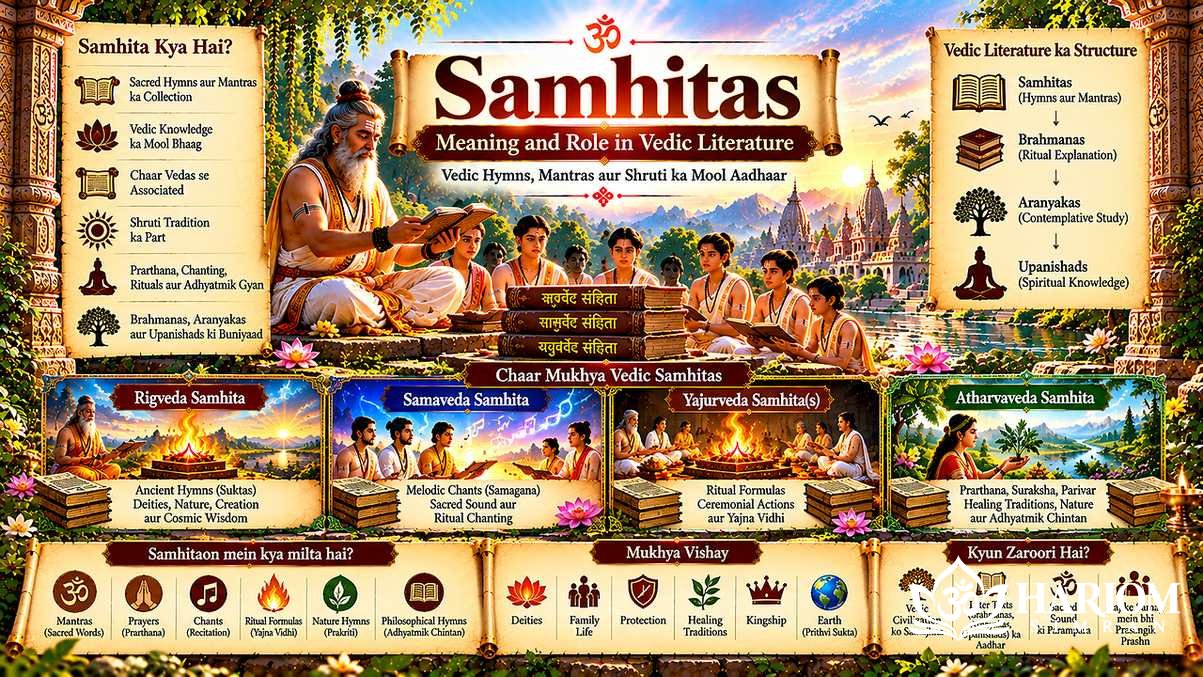
The Vedic tradition developed through several layers of sacred literature, and the Samhitas form the core collections associated with the four Vedas.
These are the collections where we encounter many of the ancient:
- Hymns
- Mantras
- Sacred Chants
- Ritual Formulas
- Prayers
- Invocations
The four principal Vedic Samhita traditions are connected with:
Rigveda
Samaveda
Yajurveda
Atharvaveda
But each Samhita has a different character.
The Rigveda Samhita is especially known for hymns.
The Samaveda Samhita is strongly connected with melodic chanting.
The Yajurvedic Samhitas preserve ritual formulas and ceremonial material.
The Atharvaveda Samhita includes prayers and sacred teachings related to many dimensions of life.
Understanding the Samhitas gives us the foundation we need before moving deeper into the Brahmanas, Aranyakas and Upanishads.
For the wider structure of Hindu sacred literature, explore Hindu Scriptures.
What Does Samhita Mean?
The Sanskrit word Samhita broadly carries the sense of:
Collection
Compilation
or
Something Brought Together
In the Vedic context, Samhita refers to the core collections of sacred verses, Mantras, chants and ritual formulas associated with the Vedas.
This is important because the word Samhita can also appear in other Sanskrit literature.
Not every text called a Samhita is necessarily one of the four Vedic Samhitas.
When we discuss Vedic Samhitas, we are referring specifically to the primary sacred collections connected with the Vedic tradition.
Where Do the Samhitas Fit Within Vedic Literature?
A useful beginner framework for understanding Vedic literature is:
- Samhitas
- Brahmanas
- Aranyakas
- Upanishads
These layers represent different dimensions of the Vedic tradition.
Samhitas
Preserve hymns, Mantras, chants and ritual formulas.
Brahmanas
Explain ritual procedures and their meanings.
Aranyakas
Develop symbolic and contemplative interpretations.
Upanishads
Explore philosophical and spiritual questions about the Self, Brahman, reality and liberation.
This progression should not be understood as four completely separate religions or four perfectly identical stages.
Different Vedic traditions preserve these textual layers in different ways.
Still, this framework is very useful for understanding the structure of Vedic sacred literature.
Are the Samhitas Shruti?
Yes.
The Vedic Samhitas belong to the Shruti tradition.
Shruti means:
“That Which Is Heard.”
Traditional Hindu understanding regards Vedic sacred knowledge as perceived by ancient Rishis.
The Rishis are traditionally understood as seers of Mantras, rather than ordinary authors in the modern literary sense.
This gives the Samhitas a foundational position within Hindu sacred literature.
The Four Main Vedic Samhita Traditions
The four principal Vedas each have an associated Samhita tradition.
They are:
- Rigveda Samhita
- Samaveda Samhita
- Yajurveda Samhitas
- Atharvaveda Samhita
It is important to notice that the Yajurveda developed through multiple major Samhita traditions.
This reflects the diversity of Vedic transmission.
1. Rigveda Samhita
The Rigveda Samhita is one of the most famous Vedic collections.
It contains ancient hymns traditionally called Suktas.
The Rigveda Samhita is organized into 10 Mandalas.
Its hymns address many Vedic deities and sacred powers, including:
- Agni
- Indra
- Soma
- Varuna
- Surya
- Ushas
- Ashvins
- Savitr
Its themes include:
- Prayer
- Sacred Fire
- Nature
- Creation
- Rita
- Yajna
- Divine Powers
- Human Aspiration
- Cosmic Mystery
Some Rigvedic hymns are devotional.
Others are connected with ritual.
Some contain profound philosophical reflection.
This diversity makes the Rigveda Samhita one of the foundational sources for understanding early Vedic thought.
What Is a Sukta?
A Sukta is a Vedic hymn.
A Sukta usually contains a number of individual verses or Mantras.
Different Suktas may be dedicated to:
A Deity
A Cosmic Principle
Prayer
Creation
Ritual
Nature
Spiritual Reflection
Famous Rigvedic examples include:
Nasadiya Sukta
Purusha Sukta
Hiranyagarbha Sukta
These should eventually be explored as dedicated HariOmSimran articles.
2. Samaveda Samhita
The Samaveda Samhita is strongly associated with sacred chanting.
Many of its verses are closely related to material also found in the Rigveda.
However, the purpose is different.
The Samaveda arranges sacred verses for melodic and liturgical recitation.
This means its identity lies not only in the words but also in:
- Melody
- Pitch
- Chanting
- Ritual Performance
- Oral Transmission
The Samaveda demonstrates that sacred sound can be an essential part of scriptural tradition.
Samhita and Samagana
The Samaveda becomes especially important through Samagana, the singing of Sama chants.
A written verse may preserve the words.
Traditional oral performance preserves:
How the Sound Rises
How It Falls
How Long a Syllable Is Held
Where Repetition Occurs
How Melody Functions in Ritual
This is why direct oral teaching became so important in Samavedic traditions.
Explore broader sacred sound traditions through Mantras.
3. Yajurveda Samhitas
The Yajurveda differs from the Rigveda and Samaveda because it is especially associated with ritual formulas and ceremonial action.
The Yajurvedic traditions preserve sacred formulas used during rituals.
These formulas may accompany:
- Offerings
- Sacred Fire Rituals
- Consecrations
- Ritual Gestures
- Ceremonial Procedures
The Yajurveda developed through two major traditions:
Shukla Yajurveda
and
Krishna Yajurveda
Shukla Yajurveda Samhita
The principal Samhita associated with the Shukla Yajurveda is the:
Vajasaneyi Samhita
This tradition generally keeps the Mantra collection more distinctly separated from explanatory ritual material.
The Vajasaneyi Samhita preserves formulas associated with different Vedic ceremonies.
Krishna Yajurveda Samhitas
The Krishna Yajurveda preserves several important textual traditions.
These include:
- Taittiriya Samhita
- Maitrayani Samhita
- Katha Samhita
- Kapisthala Tradition
In these traditions, Mantras and ritual explanations may be more closely interwoven.
This is an important example of textual diversity within the Vedas.
Why Does the Yajurveda Have Multiple Samhitas?
Vedic knowledge was transmitted through different Shakhas, or teaching branches.
Different schools preserved their own textual and ritual traditions.
This means the Vedic corpus was not transmitted through one single centralized manuscript tradition.
Instead, knowledge passed through different lineages.
This diversity helps explain why different recensions and Samhitas exist.
4. Atharvaveda Samhita
The Atharvaveda Samhita has a distinctive character.
It contains sacred material related to:
- Prayer
- Protection
- Family Life
- Marriage
- Peace
- Prosperity
- Ancient Healing Traditions
- Nature
- Kingship
- Life and Death
- Philosophy
- Cosmic Reality
Its range is broad and often closely connected with human life.
This makes the Atharvaveda Samhita different in emphasis from the other Vedic collections.
Atharvaveda Samhita Recensions
Two important Atharvavedic textual traditions are:
Shaunaka
and
Paippalada
The Shaunaka recension is commonly organized into 20 Kandas.
The Paippalada tradition preserves another important version of Atharvavedic textual material.
These differences remind us again that oral and textual transmission occurred through multiple Vedic schools.
What Do the Samhitas Contain?
The Vedic Samhitas collectively preserve many kinds of sacred expression.
These include:
Hymns
Sacred poetry praising deities or reflecting on cosmic realities.
Mantras
Sacred utterances used in prayer, ritual, contemplation or invocation.
Chants
Verses arranged for musical or liturgical recitation.
Ritual Formulas
Sacred words spoken alongside ritual actions.
Prayers
Requests for guidance, protection, strength, prosperity or spiritual insight.
Philosophical Reflection
Certain hymns explore profound questions concerning existence, creation and ultimate reality.
This diversity shows why Vedic Samhitas cannot be reduced to one simple category.
What Is a Vedic Mantra?
A Vedic Mantra is a sacred utterance preserved within Vedic tradition.
Depending on the context, a Mantra may function as:
- Prayer
- Invocation
- Praise
- Ritual Formula
- Sacred Chant
- Contemplative Verse
Not every Mantra serves the same purpose.
Context matters.
A ritual Mantra should not automatically be treated as though it were a general affirmation intended for every modern situation.
Understanding its textual setting gives a more accurate picture.
Why Is Sound So Important in the Samhitas?
Vedic tradition places extraordinary importance on sacred sound.
The Samhitas were preserved orally for generations.
This required careful attention to:
- Pronunciation
- Accent
- Pitch
- Sequence
- Rhythm
- Memory
For some Vedic traditions, the precise sound pattern is part of the sacred transmission.
This means the Samhitas were not simply written documents.
They were living oral traditions.
How Were the Samhitas Preserved?
Students traditionally learned through direct instruction.
A teacher would recite.
The student would listen.
The student would repeat.
This process required intense discipline.
Different recitation techniques developed to protect the text from accidental alteration.
The aim was to preserve:
Exact Words
Exact Order
Correct Pronunciation
Traditional Accent
This oral discipline is one of the most remarkable features of Vedic history.
Samhitas and the Guru Shishya Tradition
The preservation of the Samhitas is closely connected with the Guru Shishya tradition.
The student did not simply read a manuscript independently.
Knowledge was transmitted directly from teacher to student.
This method helped preserve details that writing alone could not easily communicate.
It also strengthened the relationship between:
Learning
Listening
Discipline
Memory
Living Tradition
Samhitas and Vedic Deities
The Samhitas introduce us to many Vedic Divine powers.
These include figures such as:
Agni
Indra
Soma
Varuna
Surya
Savitr
Ushas
Ashvins
Vayu
Prajapati
Different deities become more prominent in different collections and contexts.
Their meanings should be understood within the Vedic worldview rather than assuming that all later Hindu theology already existed in exactly the same form.
Explore wider Hindu Divine traditions through Deities.
Samhitas and Agni
Agni is one of the most important figures across Vedic tradition.
In the Rigveda, Agni is praised in sacred hymns.
In Yajurvedic ritual, sacred fire becomes central to offerings.
Across Vedic practice, Agni can represent:
- Fire
- Transformation
- Offering
- Sacred Communication
- Ritual Presence
Agni therefore connects Mantra, ritual and Divine worship.
Samhitas and Soma
Soma appears prominently in Vedic literature.
The term can refer to:
A Sacred Ritual Substance
and
A Divine Principle Associated With It
Soma plays a major role in both Rigvedic and Samavedic traditions.
Soma rituals help us understand how:
Mantra
Chant
Offering
Ritual
and
Sacred Experience
could function together.
Samhitas and Yajna
Yajna is central to much of Vedic religious life.
The Samhitas provide many of the sacred words used in ritual.
Different Vedic collections contributed different elements.
The Rigveda provided hymns.
The Samaveda provided chants.
The Yajurveda provided ritual formulas.
The Atharvaveda developed other forms of sacred prayer and ritual knowledge.
Together, these traditions contributed to a highly structured sacred culture.
Samhitas and Rita
One of the important concepts visible in Vedic literature is Rita.
Rita is associated with:
- Cosmic Order
- Truth
- Harmony
- Regularity
- Right Functioning
Vedic hymns often connect human life with a larger cosmic order.
Later Hindu ideas of Dharma developed within a much longer history that includes these early Vedic concepts.
Explore the wider concept through Dharma.
Samhitas and Nature
The natural world is deeply present in Vedic Samhitas.
Important imagery includes:
- Fire
- Sun
- Dawn
- Wind
- Rain
- Rivers
- Earth
- Sky
- Plants
- Night
- Storms
Nature is not merely background scenery.
Natural powers frequently carry sacred and cosmic meaning.
This gives Vedic poetry its distinctive relationship between spirituality and the natural world.
Samhitas and Creation
The Samhitas also preserve different reflections on creation.
There is no single Vedic creation account that replaces all others.
Different hymns use different images and questions.
Examples include:
Nasadiya Sukta
Hiranyagarbha Sukta
Purusha Sukta
Some hymns use symbolic imagery.
Some ask philosophical questions.
Some reflect on cosmic unity.
This diversity is one of the most fascinating aspects of Vedic literature.
Are the Samhitas Only About Ritual?
No.
Ritual is important, but the Samhitas contain much more.
They also preserve:
- Sacred Poetry
- Prayer
- Nature Hymns
- Cosmology
- Devotional Expression
- Philosophical Questions
- Social Concerns
- Spiritual Reflection
Reducing the Samhitas to ritual manuals would ignore their literary and philosophical richness.
Samhitas and the Brahmanas
After the core Samhita collections, the Brahmanas become particularly important for understanding Vedic ritual.
The Samhita may preserve a Mantra or sacred formula.
The Brahmana can explain:
How It Is Used
When It Is Used
Why a Ritual Is Performed
What Symbolic Meaning It Carries
This relationship makes the Brahmanas an important next step in our Scripture series.
Samhitas and the Aranyakas
The Aranyakas develop increasingly symbolic and contemplative interpretations.
Where Samhitas preserve sacred words and Brahmanas explain ritual, Aranyakas often move toward deeper reflection.
They form an important bridge between:
External Ritual
and
Internal Contemplation
This transition prepares the way for many Upanishadic teachings.
Samhitas and the Upanishads
The Upanishads represent some of the deepest philosophical developments within Vedic tradition.
Their questions include:
What Is Atman?
What Is Brahman?
What Is Consciousness?
What Is Ultimate Reality?
What Is Moksha?
The movement from Samhita to Upanishadic thought helps us see the extraordinary breadth of Vedic literature.
The tradition includes both:
Sacred Hymn
and
Philosophical Inquiry
Are the Samhitas Older Than the Upanishads?
Broadly, the core Samhita materials represent earlier layers of Vedic literature than the principal philosophical Upanishads.
However, Vedic textual development occurred over long periods.
Different texts contain different chronological layers.
It is therefore better to speak about earlier and later layers of Vedic literature rather than imagining that every text appeared at one exact moment.
Traditional Hindu understanding and modern historical scholarship may approach chronology differently.
HariOmSimran should continue to distinguish those perspectives clearly.
Is Samhita the Same as Veda?
Sometimes people casually use a Veda's name when they specifically mean its Samhita.
For example, someone may say:
“Rigveda”
when referring specifically to:
Rigveda Samhita
However, the broader Vedic tradition also includes associated:
Brahmanas
Aranyakas
Upanishads
Therefore, the word Veda can have a broader meaning than the core Samhita collection alone.
This distinction is very important when studying Hindu scriptures in detail.
Are All Samhitas the Same Type of Text?
No.
The four Vedic Samhita traditions have different emphases.
Rigveda Samhita
Primarily sacred hymns.
Samaveda Samhita
Primarily verses arranged for sacred chanting.
Yajurveda Samhitas
Primarily ritual formulas and ceremonial material.
Atharvaveda Samhita
Prayers, sacred formulas, everyday concerns and philosophical reflection.
They are connected, but they are not identical.
Why Are There Different Vedic Recensions?
Vedic texts were preserved through different traditional schools called Shakhas.
A Shakha can broadly be understood as a branch or school of transmission.
Different Shakhas preserved:
- Texts
- Pronunciation
- Ritual Traditions
- Interpretations
- Recitation Methods
Over time, some Shakhas survived while others were lost or became less prominent.
This explains why we encounter multiple recensions within Vedic literature.
Samhitas and Shakhas
The concept of Shakha is essential for understanding Vedic transmission.
The Vedas were not preserved through a single institution.
Different teacher lineages maintained their own branches.
For example:
The Samaveda has traditions such as:
Kauthuma
Ranayaniya
Jaiminiya
The Atharvaveda includes:
Shaunaka
Paippalada
The Yajurveda preserves several major branches.
This diversity should be seen as part of the richness of Vedic transmission.
Can Beginners Read the Samhitas?
Yes, but context is extremely helpful.
A beginner may find many passages difficult because they assume knowledge of:
Vedic Deities
Ritual
Ancient Language
Sacred Symbolism
Historical Context
A structured introduction makes the material much easier to understand.
How Should a Beginner Study the Samhitas?
A useful learning path is:
Step 1
Understand the four Vedas.
Step 2
Learn what Samhita means.
Step 3
Study each Vedic Samhita's main purpose.
Step 4
Learn about important Vedic deities.
Step 5
Understand Mantra, Yajna and Rita.
Step 6
Explore selected important hymns individually.
Step 7
Move into the Brahmanas, Aranyakas and Upanishads.
This approach gives readers context before they enter more complex passages.
Common Misunderstandings About the Samhitas
Misunderstanding 1: Samhita Means One Specific Book
Not always.
Samhita is a textual term meaning a collection, and several Vedic traditions have their own Samhitas.
Misunderstanding 2: Samhitas and Vedas Are Always Exactly the Same Thing
Not necessarily.
The Samhitas are the core collections, while broader Vedic literature also includes Brahmanas, Aranyakas and Upanishads.
Misunderstanding 3: All Samhitas Contain the Same Kind of Material
No.
Different Vedic Samhitas emphasize hymns, chants, ritual formulas or broader sacred concerns.
Misunderstanding 4: Samhitas Are Only Ritual Texts
No.
They also include prayer, poetry, cosmology, nature, Divine reflection and philosophical inquiry.
Misunderstanding 5: Vedic Texts Were Preserved Only Through Written Manuscripts
No.
Oral preservation was fundamental to the Vedic tradition.
What Can Modern Readers Learn From the Samhitas?
The Samhitas come from an ancient world, but the questions they preserve can still feel deeply human.
They ask us to reflect on:
How Do Human Beings Relate to Nature?
What Makes a Word Sacred?
Why Is Memory Important?
What Is the Relationship Between Prayer and Action?
How Did Ancient People Understand Cosmic Order?
Why Do Human Beings Ask Questions About Creation?
These questions make Vedic literature meaningful not only historically, but philosophically as well.
Why the Samhitas Still Matter
The Samhitas matter because they preserve the foundational sacred voices of Vedic tradition.
They help us understand the development of:
Mantra
Sacred Sound
Yajna
Rita
Vedic Deities
Prayer
Cosmology
Nature
Philosophical Inquiry
Without understanding the Samhitas, it becomes much harder to understand the later layers of Vedic literature.
The Brahmanas, Aranyakas and Upanishads all develop within a world whose sacred vocabulary is already deeply shaped by the Samhitas.
HariOmSimran Ke Saath Vedic Knowledge Explore Karein
HariOmSimran is building its Scripture section as a structured and interconnected Hindu knowledge library.
Continue exploring:
The next detailed Scripture article should be:
Brahmanas: Meaning, Rituals and Vedic Interpretation
After that, we can continue with:
Aranyakas
Upanishads
and then important individual Vedic Suktas.
Learn • Explore • Understand • Preserve
Key Takeaway
The Samhitas are the foundational collections of Vedic sacred literature.
They preserve:
Hymns
Mantras
Sacred Chants
Prayers
Ritual Formulas
The four major Vedic Samhita traditions are associated with:
Rigveda
Samaveda
Yajurveda
Atharvaveda
Each has its own character.
Rigveda emphasizes sacred hymns.
Samaveda emphasizes melodic chanting.
Yajurveda emphasizes ritual formulas and sacred action.
Atharvaveda preserves prayers and teachings related to many practical and spiritual dimensions of life.
Together, the Samhitas form the foundation upon which the Brahmanas, Aranyakas and Upanishadic traditions develop.
Key Teachings
This scripture reveals profound wisdom and guidance for our spiritual journey. Below are the key teachings and principles derived from this sacred text.
Core Principles
These teachings provide guidance for living a life of faith, compassion, and spiritual growth.
- Spiritual Growth
- Divine Wisdom
- Sacred Teachings
- Faith Journey

Study Resources
Explore these resources to deepen your understanding of this scripture and apply its teachings to your daily life.
📖 Study Guide
Comprehensive study materials to help you understand the context, meaning, and application of this scripture.
🙏 Reflection Questions
Thought-provoking questions to help you reflect on the teachings and apply them to your personal spiritual journey.
📝 Journal Prompts
Guided journaling prompts to help you document your insights, prayers, and spiritual growth.
👥 Discussion Topics
Engaging discussion topics for group study and fellowship, fostering deeper understanding and community.
Frequently Asked Questions
In the Vedic context, a Samhita is a core collection of sacred hymns, Mantras, chants or ritual formulas associated with a particular Veda.
The four main traditions are the Rigveda Samhita, Samaveda Samhita, Yajurveda Samhitas and Atharvaveda Samhita.
Yes. The Vedic Samhitas belong to Shruti and hold a foundational place within Hindu sacred literature.
Samhitas preserve the core hymns, Mantras and ritual formulas, while Brahmanas primarily explain ritual procedures, meanings and symbolic interpretations.
The Samhitas form the core collections of the Vedas, but broader Vedic literature also includes Brahmanas, Aranyakas and Upanishads.
The Samhitas are important because they preserve foundational Vedic hymns, Mantras, sacred sound, ritual language, cosmology and spiritual ideas that influenced later Hindu philosophy and practice.