


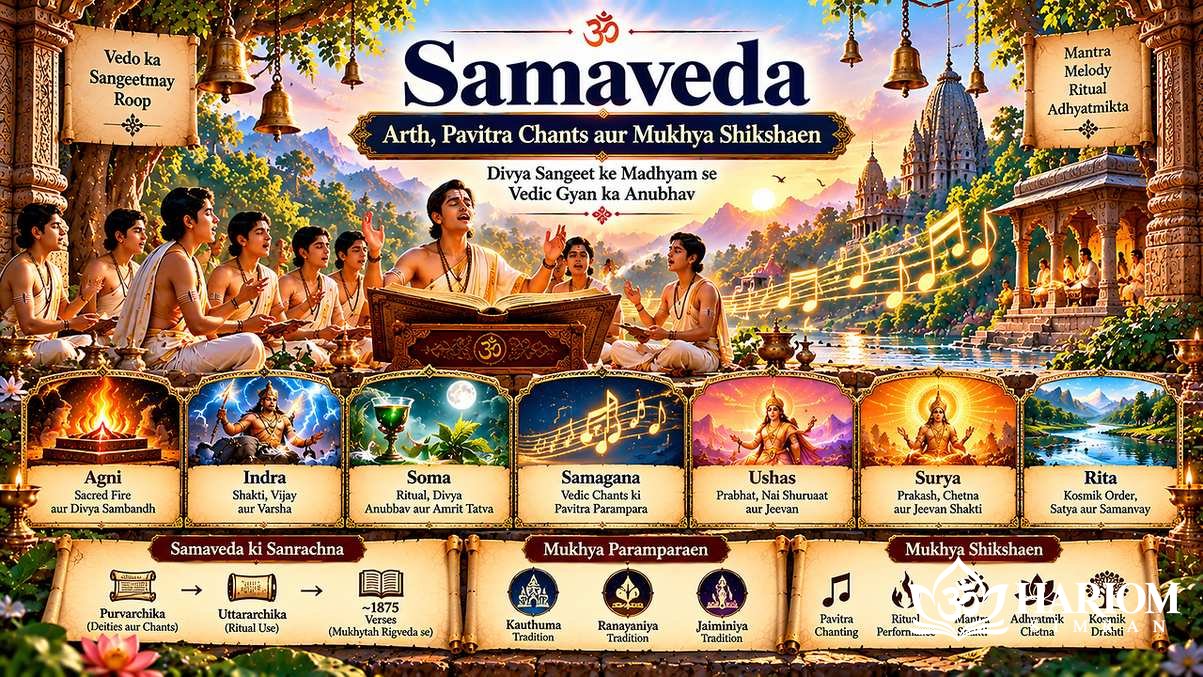
Among the four Vedas, the Samaveda has a distinctive place because it transforms sacred verses into a tradition of melodic Vedic chanting.
If the Rigveda introduces us to sacred hymns, the Samaveda shows us how sacred words can also become sacred sound.
Its importance lies not only in what is recited, but also in:
How It Is Sung
How the Voice Moves
How the Chant Is Preserved
How Sacred Sound Becomes Part of Ritual
The Samaveda is closely connected with Vedic ceremonies, especially rituals where specific priests were responsible for singing sacred verses.
Many of its verses are related to verses also found in the Rigveda, but the Samaveda arranges them for a different purpose.
It gives those verses a liturgical and musical life.
This makes the Samaveda one of the most important scriptures for understanding sacred chanting in the Vedic tradition.
To explore the larger scriptural tradition, visit Hindu Scriptures.
What Is the Samaveda?
The Samaveda is one of the four principal Vedas.
The four Vedas are:
- Rigveda
- Samaveda
- Yajurveda
- Atharvaveda
Samaveda belongs to the Shruti tradition.
Shruti means:
"That Which Is Heard."
Traditional Hindu understanding regards Vedic knowledge as sacred revelation perceived by ancient Rishis.
The Samaveda preserves this knowledge through a highly developed tradition of chanting.
Its identity is therefore strongly connected with:
- Sacred Sound
- Melody
- Chanting
- Ritual Performance
- Oral Transmission
- Vedic Worship
What Does Samaveda Mean?
The word Sama is associated with chant, melody or song.
Veda means knowledge or sacred knowledge.
So Samaveda can broadly be understood as:
The Veda of Sacred Chanting
This does not mean it is simply a collection of songs in the modern sense.
Samavedic chanting developed within a specific sacred and ritual context.
The sound, pitch, sequence and method of singing were part of a disciplined religious tradition.
Why Is Samaveda Different From the Rigveda?
The Rigveda and Samaveda are closely connected.
Many verses found in the Samaveda are based on verses also preserved in the Rigveda.
However, their purpose is different.
The Rigveda primarily preserves hymns as sacred poetic verses.
The Samaveda takes many such verses and arranges them for melodic ritual recitation.
A simple way to understand the difference is:
Rigveda Focuses Strongly on the Hymn
Samaveda Focuses Strongly on the Chant
The words may sometimes be related, but their liturgical function is different.
This shows that in Vedic tradition, sacred knowledge involves more than written meaning.
Sound itself matters.
How Many Verses Are in the Samaveda?
The exact number can vary depending on recension and method of counting.
A commonly studied Samaveda recension contains around 1,875 verses, and a large majority are closely related to Rigvedic material.
Only a relatively small number are not found in the Rigveda in corresponding form.
This sometimes leads people to ask:
If many verses come from the Rigveda, why is Samaveda considered a separate Veda?
The answer lies in its function.
Samaveda preserves a distinctive tradition of:
Arrangement
Melody
Liturgical Use
Chanting Technique
Ritual Performance
The sacred value is not only in the words.
It is also in how those words are sung.
How Is the Samaveda Structured?
The Samaveda Samhita is commonly understood through two major sections:
- Purvarchika
- Uttararchika
These sections organize verses for particular liturgical and chanting purposes.
Purvarchika
The Purvarchika contains verses arranged largely according to deities and ritual use.
It prepares the singer for the melodic application of the verses.
Prominent deities include:
- Agni
- Indra
- Soma
These Divine figures are especially important in Vedic ritual and Samavedic chanting.
Uttararchika
The Uttararchika contains verses arranged in combinations more directly connected with ritual performance.
Here, verses are grouped according to the requirements of particular ceremonies and chant sequences.
This section shows how sacred verses move from textual preservation into living liturgical practice.
What Is Samagana?
Samagana refers to the singing of Sama chants.
This is one of the most distinctive features of the Samaveda tradition.
A Samavedic verse could be transformed through melodic patterns used during ritual.
The chant may involve:
- Extended Syllables
- Pitch Changes
- Repetition
- Musical Patterns
- Special Vocal Sounds
- Carefully Preserved Sequences
This means that simply reading the written words does not fully reproduce the traditional Samavedic experience.
The chant belongs to an oral performance tradition.
Why Is Sacred Sound So Important in the Samaveda?
The Samaveda demonstrates a central feature of Vedic spirituality:
Sacred words are not only understood intellectually. They are also experienced through sound.
In traditional recitation, attention may be given to:
- Pronunciation
- Pitch
- Rhythm
- Vocal Movement
- Sequence
- Breath
- Repetition
A small change in sound could alter the traditional form of the chant.
This is why Samavedic education required disciplined listening and repetition.
The Guru Shishya tradition was especially important in preserving this accuracy.
Explore the wider sacred sound tradition through Mantras.
Samaveda and Vedic Ritual
The Samaveda had an important role in Vedic sacrificial ceremonies.
Different priests performed different responsibilities during major rituals.
The priest especially associated with Samavedic chanting is known as the Udgatr.
The Udgatr and associated priests sang prescribed Sama chants during ritual.
This division of responsibility shows how sophisticated Vedic ceremonial traditions became.
A ritual could involve:
Rigvedic Recitation
Samavedic Chanting
Yajurvedic Formulas
Sacred Actions
Different Vedic traditions worked together within one larger ceremonial system.
Who Is the Udgatr?
The Udgatr was the priest responsible for singing Samavedic chants during important Vedic rituals.
This role required specialized training.
The priest had to know:
- The Correct Verses
- The Correct Melody
- The Correct Sequence
- The Correct Ritual Moment
- The Correct Method of Chanting
This was not casual singing.
It was a disciplined sacred responsibility.
Samaveda and Soma Rituals
The Samaveda has a particularly strong connection with Soma rituals.
Soma was an important element in Vedic ceremonial tradition.
Samavedic chants were performed during specific stages of Soma sacrifices.
This is one reason deities such as:
Indra
Agni
and
Soma
appear prominently within Samavedic material.
The chants were integrated into ritual actions rather than being performed simply for artistic enjoyment.
Major Deities in the Samaveda
The Samaveda contains verses addressed to several important Vedic deities.
Because much of its textual material is related to Rigvedic hymns, many familiar Vedic deities appear here as well.
Three are especially prominent.
Agni
Agni is associated with sacred fire.
Fire plays a central role in Vedic ritual.
Agni is connected with:
- Sacred Offering
- Transformation
- Ritual
- Divine Communication
- Sacred Presence
Samavedic chants associated with Agni form part of the ritual environment where sacred sound and sacred fire come together.
Indra
Indra is one of the most frequently praised Vedic deities.
He is associated with:
- Strength
- Victory
- Power
- Rain
- Heroic Action
Many Samavedic chants are connected with Indra because of his importance in Soma rituals.
Soma
Soma holds a particularly important place in Samavedic ritual.
The term is associated both with a sacred ritual substance and with the Divine power connected with it.
Samavedic chanting around Soma ceremonies demonstrates the close connection between:
Sacred Substance
Ritual Action
Mantra
Melody
and
Divine Worship
Is the Samaveda Connected With Indian Music?
Yes, but the connection should be explained carefully.
The Samaveda preserves one of the oldest surviving traditions of sacred melodic chanting in India.
Because of this, it is often discussed in relation to the ancient roots of Indian musical culture.
However, it would be too simple to say:
"All Indian Music Came Directly From the Samaveda."
Indian music developed over many centuries through different regional, theoretical, devotional and performance traditions.
The Samaveda is an important early sacred musical tradition, but the history of Indian music is much broader.
What Makes Samavedic Chanting Musical?
Samavedic chanting uses structured pitch and melodic movement.
Traditional chants are not simply spoken.
The voice follows prescribed patterns.
Depending on the tradition, chanting may involve:
- Rising Notes
- Falling Notes
- Held Sounds
- Repeated Syllables
- Melodic Expansion
- Special Vocal Insertions
This transforms a sacred verse into a liturgical chant.
The relationship between word and melody is one of the defining features of the Samaveda.
What Are Stobha Syllables?
Samavedic chanting can include special vocal elements known as Stobhas.
These are syllables or sounds inserted into the melodic performance.
Their role is connected with the structure and performance of the chant rather than the ordinary grammatical meaning of the original verse.
This shows that Samagana developed its own sophisticated musical language.
The chant is therefore not simply a Rigvedic verse sung casually.
It is a carefully constructed liturgical form.
Samaveda Recensions
Like other Vedic traditions, the Samaveda developed different recensions or textual schools.
Three important Samavedic traditions commonly discussed are:
- Kauthuma
- Ranayaniya
- Jaiminiya
These traditions preserve differences in:
- Textual Arrangement
- Chanting
- Melodic Tradition
- Ritual Practice
- Transmission
The existence of different recensions shows that Vedic tradition was preserved through multiple teaching lineages.
Kauthuma Tradition
The Kauthuma recension became one of the most widely preserved Samavedic traditions.
Much modern discussion of Samaveda structure is based on this recension.
Its textual and chanting traditions continue to be important for the study of Samavedic literature.
Ranayaniya Tradition
The Ranayaniya tradition is closely related to the Kauthuma tradition but preserves its own transmission and chanting features.
It provides further evidence of how Vedic knowledge developed through distinct oral lineages.
Jaiminiya Tradition
The Jaiminiya tradition preserves important material that differs in some respects from the better known Kauthuma tradition.
It is especially valuable for understanding the diversity of Samavedic ritual, chanting and textual preservation.
How Was the Samaveda Preserved?
The Samaveda was preserved primarily through oral transmission.
This required much more than memorizing words.
Students had to preserve:
- Text
- Pronunciation
- Pitch
- Melody
- Rhythm
- Sequence
- Performance Method
This made Samavedic preservation especially demanding.
Written manuscripts could record the words, but the living musical tradition required direct teaching.
A student needed to hear the chant and reproduce it accurately.
Why Was the Guru Shishya Tradition Important?
Samavedic chanting is difficult to learn only from written text.
A teacher demonstrates:
How the Voice Moves
Where the Sound Rises
Where It Falls
How Long a Syllable Is Held
When a Repetition Occurs
The student listens carefully and repeats.
This teacher and student relationship helped preserve the tradition across generations.
It also explains why Vedic knowledge is deeply connected with listening.
Samaveda and Shruti
Samaveda belongs to Shruti.
Shruti means:
"That Which Is Heard."
This classification becomes especially meaningful with Samaveda because hearing is central to its preservation.
The sacred chant exists not merely as words on a page.
It exists as a sound transmitted through living tradition.
This is one of the clearest examples of why the concept of Shruti matters in Hindu scriptural understanding.
Samaveda and Mantra
The Samaveda is deeply connected with Mantra.
However, its relationship with Mantra is distinctive.
Many verses are transformed into melodic chants.
This means the practitioner encounters:
Sacred Words
Sacred Meaning
Sacred Sound
Sacred Melody
Ritual Context
together.
This integrated approach helps explain why sound holds such importance across many later Hindu traditions.
Explore Mantras for broader introductions to Hindu Mantra traditions.
Samaveda and Om
The sacred syllable Om becomes especially important in later Vedic and Upanishadic reflection.
One of the major Upanishads associated with the Samavedic tradition, the Chandogya Upanishad, gives profound importance to sacred sound and Om.
In these philosophical developments, sound becomes connected not merely with ritual performance but also with:
- Meditation
- Consciousness
- Ultimate Reality
- Spiritual Knowledge
This shows how Vedic chanting gradually opens into deeper philosophical inquiry.
Samaveda and the Chandogya Upanishad
The Chandogya Upanishad is one of the major Upanishads associated with the Samaveda.
It contains important teachings about:
- Om
- Meditation
- Brahman
- Atman
- Sacred Sound
- Reality
- Spiritual Knowledge
One of its most famous teachings is connected with the Mahavakya:
Tat Tvam Asi
commonly translated as:
"That Thou Art."
Different Vedanta traditions interpret this teaching in different ways.
The Chandogya Upanishad demonstrates how the Samavedic tradition extends from ritual chant into profound philosophical reflection.
Samaveda and the Kena Upanishad
The Kena Upanishad is also associated with the Samavedic tradition through an important textual lineage.
It asks powerful philosophical questions.
For example:
What Power Directs the Mind?
What Makes the Ear Hear?
What Gives Speech Its Power?
What Is the Ultimate Source Behind Human Faculties?
These questions move far beyond ceremonial chanting.
They explore the deeper source of consciousness and Divine reality.
Does the Samaveda Teach Philosophy?
Yes.
The Samaveda Samhita itself is strongly connected with liturgical chanting.
However, the larger Samavedic textual tradition includes important philosophical material, especially through its associated Upanishads.
This is an important distinction.
The Vedic tradition contains multiple layers.
A tradition can begin with:
Sacred Chant
and develop toward:
Contemplation
Meditation
Atman
Brahman
Ultimate Reality
This movement is one of the remarkable features of Vedic literature.
Samaveda and Nature
Like the Rigveda, Samavedic verses often draw from the world of Vedic deities and natural forces.
Sacred fire, rain, light, plants and cosmic powers appear within this religious landscape.
However, in the Samaveda these verses often enter a new context through melody and ritual performance.
Nature, Divine power, sacred word and sound become closely connected.
Samaveda and Yajna
The Samaveda plays an important role in Yajna, or Vedic sacrificial ritual.
During major rituals, chants were sung at carefully prescribed moments.
This means Samaveda helped give ritual a sonic dimension.
Yajna could include:
Sacred Fire
Offerings
Mantras
Chants
Priestly Actions
Ritual Timing
Together, these elements created a highly structured sacred ceremony.
Samaveda and the Rigveda
The relationship between Samaveda and Rigveda is one of the most important examples of how Vedic texts interact.
Many Samavedic verses have close parallels in the Rigveda.
But their arrangement and use differ.
In the Rigveda, a verse belongs primarily within a hymn.
In the Samaveda, the same or related verse may become part of a melodic ritual sequence.
This teaches an important lesson about Hindu scriptures:
The same sacred words can have different functions in different contexts.
Samaveda and the Yajurveda
Samaveda and Yajurveda worked together within the larger Vedic ritual system.
Samaveda supplied sacred chants.
Yajurveda supplied many ritual formulas and procedural elements.
During ceremony, different priests performed specialized duties.
This allowed:
Sound
Action
Offering
Prayer
and
Ritual Knowledge
to function together.
Samaveda and the Atharvaveda
The Samaveda and Atharvaveda have different emphases.
Samaveda is particularly associated with liturgical singing.
Atharvaveda contains a wider range of prayers and teachings related to household, protection, social concerns and spiritual reflection.
Together with Rigveda and Yajurveda, they reveal how broad the Vedic tradition really is.
Is Samaveda Only About Music?
No.
This is a common misunderstanding.
Music and melodic chanting are central to the Samaveda, but the tradition is not simply about artistic performance.
Samavedic chanting is connected with:
- Ritual
- Worship
- Mantra
- Sacred Sound
- Priestly Responsibility
- Oral Preservation
- Spiritual Tradition
Its musical dimension exists within a sacred framework.
Is Samaveda a Copy of the Rigveda?
No.
Although many Samavedic verses are related to Rigvedic verses, calling Samaveda a copy misses its purpose.
Its unique contribution lies in:
- Melodic Arrangement
- Liturgical Function
- Chanting Tradition
- Ritual Application
- Oral Performance
The same words can serve a new sacred function when transformed through Samagana.
Did Samaveda Influence Later Bhajan and Kirtan?
It is reasonable to recognize Samaveda as an early and important sacred chanting tradition in India.
However, direct historical claims should be made carefully.
Bhajan, Kirtan and later devotional music developed in different periods, communities and religious traditions.
They share a wider Hindu appreciation of sacred sound and devotional singing, but they should not simply be described as direct extensions of Samaveda without historical nuance.
Samaveda and Sacred Sound in Later Hinduism
Sacred sound remained extremely important throughout later Hindu traditions.
It appears in:
- Mantra
- Japa
- Bhajan
- Kirtan
- Temple Chanting
- Stotra Recitation
- Vedic Ceremonies
- Meditation
These traditions developed in different historical contexts.
Samaveda remains one of the ancient foundations for understanding why sound can carry religious importance in Hindu spirituality.
Can Anyone Read About the Samaveda?
Yes.
Anyone interested in Hindu sacred literature can study its history, structure, teachings and philosophical importance.
Traditional performance of specialized Vedic chants, however, belongs to disciplined lineages with particular rules of pronunciation and transmission.
A beginner should therefore distinguish between:
Learning About the Samaveda
and
Performing Traditional Samavedic Chanting
Studying the tradition respectfully is different from assuming mastery of its specialized ritual recitation.
How Should a Beginner Study the Samaveda?
A practical learning path is:
Step 1
Understand the difference between Rigveda and Samaveda.
Step 2
Learn the meaning of Sama and Samagana.
Step 3
Understand Purvarchika and Uttararchika.
Step 4
Learn about the Udgatr priest and Soma rituals.
Step 5
Explore Agni, Indra and Soma within the Samavedic context.
Step 6
Study the Chandogya and Kena Upanishads.
This sequence helps readers move from chant and ritual toward deeper philosophy.
Common Misunderstandings About the Samaveda
Misunderstanding 1: Samaveda Is Just a Music Book
No.
Its chants belong to a sacred Vedic ritual tradition.
Misunderstanding 2: Samaveda and Rigveda Are the Same Text
No.
They share many related verses, but their organization and liturgical functions differ.
Misunderstanding 3: Anyone Can Learn Traditional Samagana From Written Words Alone
Traditional Samavedic chanting depends heavily on oral teaching, pronunciation and melodic transmission.
Misunderstanding 4: Samaveda Is Important Only for Musicians
No.
It is important for understanding Vedic ritual, Mantra, sacred sound, oral tradition and associated philosophy.
Misunderstanding 5: Every Hindu Uses Samavedic Chants Daily
No.
Hindu religious life is highly diverse, and most Hindus do not personally practice specialized Samavedic chanting.
What Can Modern Readers Learn From the Samaveda?
The Samaveda comes from an ancient ritual world, but it still raises meaningful questions.
For example:
Can Sound Carry Spiritual Meaning?
Why Does the Way We Speak Matter?
How Can Discipline Preserve Knowledge?
What Happens When Sacred Words Become Living Performance?
How Are Ritual, Art and Spirituality Connected?
The Samaveda reminds us that knowledge is not always transmitted only through written explanation.
Sometimes knowledge is preserved through:
Listening
Memory
Voice
Practice
and
Tradition
Why the Samaveda Still Matters
The Samaveda remains important because it preserves one of the world's remarkable traditions of sacred chanting.
It helps us understand:
Vedic Ritual
Sacred Sound
Oral Preservation
Mantra
Melodic Recitation
Priestly Tradition
Soma Rituals
Upanishadic Philosophy
It also shows how a sacred tradition can connect:
Poetry
Music
Ritual
Memory
and
Spiritual Inquiry
into one living form of knowledge.
Explore Vedic Knowledge With HariOmSimran
HariOmSimran is developing its Scripture section as a structured journey through Hindu sacred knowledge.
Continue exploring:
The next detailed Scripture article will be:
Yajurveda: Meaning, Rituals and Sacred Teachings
After that, we will continue with:
Atharvaveda
Then we can move deeper into:
Samhitas
Brahmanas
Aranyakas
Upanishads
and important Vedic Suktas.
Learn • Explore • Understand • Preserve
Key Takeaway
The Samaveda is one of the four Vedas and is especially associated with sacred melodic chanting.
Many of its verses are closely related to Rigvedic material, but the Samaveda gives them a distinctive liturgical and musical function.
Its tradition centers on:
Sacred Chants
Samagana
Vedic Ritual
Soma Ceremonies
Udgatr Priests
Oral Preservation
Sacred Sound
The wider Samavedic tradition also connects with major philosophical texts such as the Chandogya Upanishad and Kena Upanishad.
The Samaveda therefore shows how Hindu sacred knowledge can move from word to sound, from sound to ritual, and from ritual toward spiritual reflection.
Key Teachings
This scripture reveals profound wisdom and guidance for our spiritual journey. Below are the key teachings and principles derived from this sacred text.
Core Principles
These teachings provide guidance for living a life of faith, compassion, and spiritual growth.
- Spiritual Growth
- Divine Wisdom
- Sacred Teachings
- Faith Journey

Study Resources
Explore these resources to deepen your understanding of this scripture and apply its teachings to your daily life.
📖 Study Guide
Comprehensive study materials to help you understand the context, meaning, and application of this scripture.
🙏 Reflection Questions
Thought-provoking questions to help you reflect on the teachings and apply them to your personal spiritual journey.
📝 Journal Prompts
Guided journaling prompts to help you document your insights, prayers, and spiritual growth.
👥 Discussion Topics
Engaging discussion topics for group study and fellowship, fostering deeper understanding and community.
Frequently Asked Questions
The Samaveda is one of the four Vedas and is especially associated with sacred chanting, melodic recitation and Vedic ritual.
Many Samavedic verses are related to Rigvedic verses, but the Samaveda arranges them for melodic and liturgical use. Its emphasis is therefore strongly connected with sacred chanting.
Samagana is the traditional singing of Sama chants. It involves carefully preserved melodic patterns, pronunciation, pitch and ritual performance.
The Udgatr is the Vedic priest responsible for singing Samavedic chants during important rituals, especially ceremonies connected with Soma.
The Samaveda preserves an ancient sacred melodic tradition and is important in discussions of India's musical heritage. However, Indian music developed through many later traditions, so the relationship should not be oversimplified.
The Chandogya Upanishad and Kena Upanishad are important philosophical texts associated with Samavedic traditions.