

Among the four Vedas, the Rigveda holds a particularly important place.
It preserves some of the earliest surviving layers of Vedic sacred poetry and gives us a remarkable window into ancient Hindu religious thought.
The Rigveda contains hymns about:
- Divine Powers
- Sacred Fire
- Nature
- Prayer
- Cosmic Order
- Creation
- Human Aspiration
- Ritual
- Truth
- The Mystery of Existence
Some hymns praise particular Vedic deities.
Others reflect on profound questions about the universe, creation and the nature of reality.
This combination of prayer, poetry, ritual and philosophical reflection makes the Rigveda much more than a collection of ancient hymns.
It is one of the foundational texts for understanding the development of Vedic thought.
To understand the wider scriptural tradition first, explore Hindu Scriptures.
What Is the Rigveda?
The Rigveda, also written as Rig Veda, is one of the four principal Vedas.
The four Vedas are:
- Rigveda
- Samaveda
- Yajurveda
- Atharvaveda
The Rigveda is especially known for its collection of sacred hymns.
These hymns are traditionally called Suktas.
They praise Vedic deities, reflect on cosmic principles and express prayers, hopes, questions and spiritual insight.
The Rigveda belongs to the Shruti tradition.
Shruti means:
"That Which Is Heard."
In traditional Hindu understanding, the Vedic Mantras were perceived by ancient Rishis rather than simply composed as ordinary literature.
What Does Rigveda Mean?
The word Rigveda is associated with sacred verses, praise and knowledge.
The Sanskrit term Rik refers broadly to a verse or hymn of praise.
Veda means knowledge or sacred knowledge.
So Rigveda can be understood broadly as:
Sacred Knowledge Preserved Through Hymns
This description helps explain why poetic expression is so central to the text.
The Rigveda communicates sacred ideas through carefully preserved verses rather than through a single continuous narrative.
How Is the Rigveda Structured?
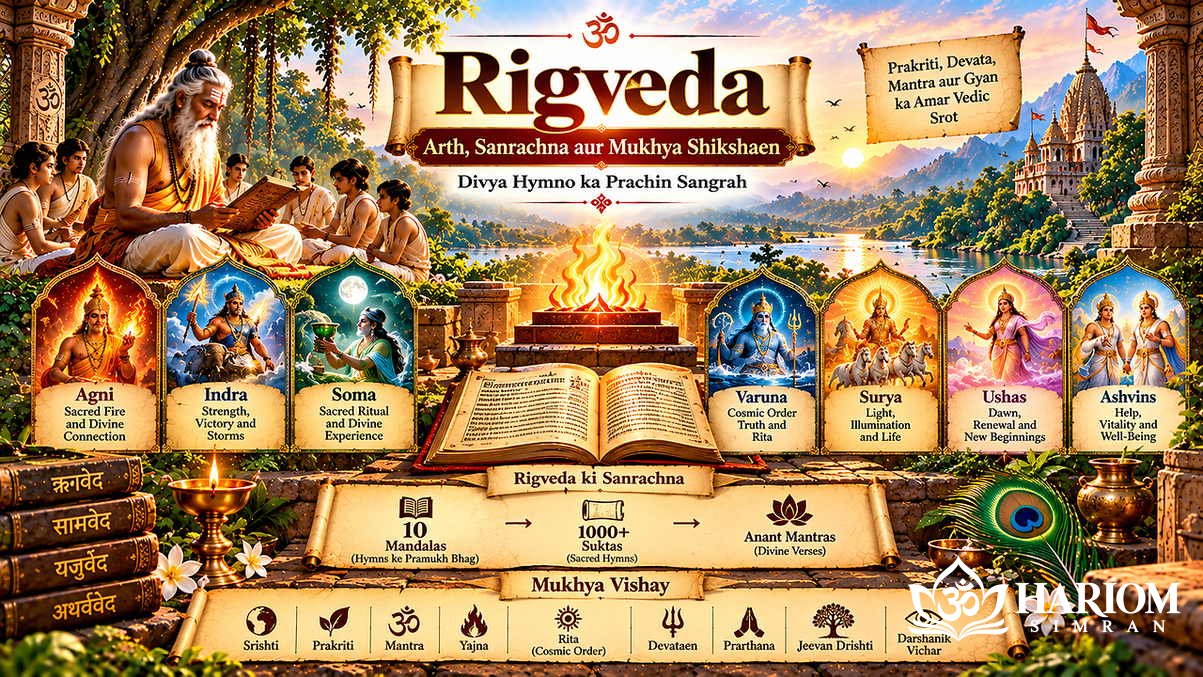
The Rigveda Samhita is traditionally organized into 10 Mandalas.
A Mandala can be understood as a major division or collection.
Within the 10 Mandalas are more than one thousand hymns, traditionally called Suktas.
These hymns contain thousands of individual verses.
The structure is therefore:
Rigveda
then
10 Mandalas
then
Suktas
then
Individual Verses
This structure helps readers understand that the Rigveda is not one continuous story.
It is a collection of sacred hymns preserved within different groupings.
What Are the 10 Mandalas of the Rigveda?
The Rigveda contains ten major Mandalas.
Each Mandala contains a collection of hymns.
The Mandalas differ in size, themes, associated Rishis and deities.
A beginner does not need to memorize every Mandala immediately.
The important point is that the text developed as an organized collection of sacred poetry.
Several middle Mandalas are particularly associated with ancient Rishi families.
These are sometimes called the Family Books because groups of hymns are connected with particular Rishi lineages.
This reminds us that oral lineage played a major role in Vedic preservation.
What Is a Sukta?
A Sukta is a Vedic hymn.
The word is commonly understood in the sense of something well spoken or beautifully expressed.
A Sukta may contain several Mantras or verses.
Different Suktas may focus on:
- A Particular Deity
- Prayer
- Creation
- Ritual
- Cosmic Order
- Nature
- Spiritual Reflection
- Human Aspirations
Some Suktas became especially influential because of their philosophical depth.
HariOmSimran will eventually explore important Rigvedic Suktas individually.
Who Are the Rishis of the Rigveda?
The hymns of the Rigveda are traditionally associated with Rishis.
A Rishi is commonly understood as a seer.
In traditional Hindu thought, Rishis are not simply treated as poets who invented sacred verses from personal imagination.
They are understood as seers who perceived sacred knowledge.
Several important Rishi lineages are associated with Rigvedic hymns.
These include traditions connected with names such as:
- Vishvamitra
- Vasishtha
- Atri
- Bharadvaja
- Gritsamada
- Kanva
Different Mandalas preserve associations with different families and seers.
This demonstrates the importance of lineage in Vedic learning.
Were There Women Rishis in the Rigveda?
Yes.
Vedic tradition also preserves the names of female seers, often referred to as Rishikas.
Women traditionally associated with Vedic hymns include:
- Lopamudra
- Ghosha
- Apala
- Vishvavara
Their presence is an important part of Vedic literary tradition.
It also reminds us that the Rigveda was shaped by more than one kind of spiritual voice.
This topic deserves a separate future article because the role of women seers in Vedic tradition is often overlooked in introductory discussions.
Major Deities in the Rigveda
The Rigveda addresses many Divine powers.
These deities often represent more than simple natural objects.
They may carry ritual, cosmic, ethical and spiritual significance.
Some of the most prominent include:
Agni
Agni is one of the most important deities in the Rigveda.
Agni is associated with sacred fire.
The very opening hymn of the Rigveda is dedicated to Agni.
This immediately shows his importance in Vedic religion.
Fire played a central role in ritual because offerings were placed into sacred fire.
Agni could therefore be understood as a connection between:
Human Worshippers
and
The Divine Realm
Agni is associated with:
- Sacred Fire
- Ritual
- Offering
- Transformation
- Communication With Divine Powers
Indra
Indra is among the most frequently praised deities in the Rigveda.
He is associated with:
- Strength
- Victory
- Storms
- Rain
- Heroic Power
- Cosmic Struggle
One of Indra's most famous Vedic narratives concerns his victory over Vritra.
This story is connected with the release of waters and the restoration of cosmic or natural order.
The symbolism of these hymns has been interpreted in different ways over time.
Soma
Soma has a complex position in the Rigveda.
The word can refer to:
- A Sacred Ritual Substance
- The Deity Associated With Soma
- Sacred Experience
- Ritual Power
An entire Mandala of the Rigveda is especially associated with Soma hymns.
Soma therefore occupies an important place within Vedic ritual and sacred poetry.
Varuna
Varuna is strongly associated with cosmic and moral order.
He appears in important hymns connected with:
Rita
Truth
Cosmic Law
Moral Responsibility
Varuna's association with Rita makes him particularly significant for understanding early Vedic ideas about order and ethical responsibility.
Surya
Surya represents the Sun and Divine illumination.
The Sun plays a powerful symbolic role in Hindu sacred thought.
In Vedic literature, solar imagery may connect with:
- Light
- Vision
- Order
- Life
- Spiritual Illumination
Solar traditions continued to develop throughout later Hindu history.
Savitr
Savitr is another important solar-associated deity.
The famous Gayatri Mantra is addressed to Savitr.
The Mantra asks for illumination of the intellect and has become one of the most widely recognized sacred Mantras in Hindu tradition.
HariOmSimran should eventually have a dedicated article on the Gayatri Mantra, including its Vedic context, meaning and traditional significance.
Explore related sacred sound traditions through Mantras.
Ushas
Ushas is the Vedic Goddess of Dawn.
Her hymns are known for their poetic beauty.
Dawn represents:
- Light
- Renewal
- Awakening
- New Beginning
- Life
The imagery of Ushas shows how closely Rigvedic poetry is connected with observation of nature.
Ashvins
The Ashvins are Divine twins who appear frequently in Rigvedic hymns.
They are associated with:
- Help
- Rescue
- Vitality
- Restoration
- Well-Being
Their hymns contain vivid narratives of assistance and deliverance.
Vayu
Vayu is associated with wind.
Wind is a powerful natural force and also becomes important in later Hindu philosophical and yogic thought through ideas connected with breath and life energy.
The Vedic context, however, should be understood on its own terms rather than automatically equating every later concept with the earliest hymns.
Prithvi and Dyaus
The Earth and Sky appear as important cosmic principles in Vedic thought.
They are sometimes addressed together as:
Dyaus and Prithvi
or
Heaven and Earth
They represent the cosmic environment within which life and sacred order unfold.
What Is Rita in the Rigveda?
One of the most important concepts in the Rigveda is Rita.
Rita is connected with:
- Cosmic Order
- Truth
- Regularity
- Harmony
- Right Functioning
- Moral Order
The movement of the Sun, the cycles of nature, ritual correctness and truthfulness can all be understood within a larger vision of order.
Rita helps us see that Vedic thought did not separate nature, morality and spirituality as completely unrelated subjects.
Later Hindu concepts of Dharma developed within a long intellectual history that includes Vedic ideas of order.
Explore the broader concept through Dharma.
What Is Yajna in the Rigveda?
Yajna refers to sacred offering and ritual.
Vedic ritual often involved offerings made through sacred fire while Mantras were recited.
Yajna can involve relationships among:
Humans
Divine Powers
Nature
Sacred Order
Ritual was not merely a symbolic performance.
Within the Vedic worldview, it could participate in maintaining harmony between human life and the larger cosmic order.
Later Hindu traditions developed wider interpretations of Yajna as well.
Mantra in the Rigveda
The Rigveda is one of the foundational sources of Vedic Mantras.
A Mantra can be:
- A Prayer
- A Sacred Verse
- An Invocation
- A Hymn of Praise
- A Ritual Formula
- A Contemplative Expression
Not every Rigvedic Mantra has the same purpose.
Context matters.
A verse used within a particular ritual should not automatically be removed from its traditional setting and presented as though it had one universal modern use.
This is why understanding scripture alongside practice is important.
The Gayatri Mantra in the Rigveda
The Gayatri Mantra is one of the best known Mantras associated with the Rigvedic tradition.
It is linked with Savitr and spiritual illumination.
Its importance grew enormously across later Hindu traditions.
Today, it is widely known as a sacred prayer associated with clarity, wisdom and spiritual reflection.
However, its meaning should be explained carefully within its Vedic context rather than through exaggerated promises.
Creation in the Rigveda
The Rigveda contains several different reflections on creation.
This is important because Vedic literature does not provide one single creation narrative that replaces every other interpretation.
Instead, different hymns approach cosmic origin through different images and questions.
Among the most famous are:
Nasadiya Sukta
Hiranyagarbha Sukta
Purusha Sukta
Each approaches creation and cosmic reality differently.
Nasadiya Sukta
The Nasadiya Sukta is one of the most famous philosophical hymns of the Rigveda.
It asks profound questions about the beginning of existence.
Rather than simply declaring a straightforward creation story, it reflects on mystery.
Questions include ideas such as:
What existed before creation?
Was there being or non-being?
How did creation begin?
Can anyone fully know the ultimate origin?
This questioning style makes the hymn remarkable.
It shows that intellectual and philosophical inquiry was already an important part of Vedic sacred thought.
Hiranyagarbha Sukta
The Hiranyagarbha Sukta is associated with the idea of Hiranyagarbha, often translated as the Golden Embryo or Golden Germ.
It presents a powerful image of cosmic origin.
Hiranyagarbha becomes associated with the source from which existence develops.
This hymn contributed to later Hindu reflections on creation and cosmic unity.
Purusha Sukta
The Purusha Sukta describes a cosmic being called Purusha.
Its imagery presents the universe in relation to a vast cosmic person.
Different Hindu traditions have interpreted the hymn in theological, ritual, symbolic and philosophical ways.
Because its later interpretations are complex, this Sukta deserves a separate detailed article rather than a short explanation.
Does the Rigveda Teach One God or Many Gods?
The Rigveda contains hymns addressed to many deities.
This has led to many discussions about how Vedic theology should be understood.
Some hymns praise one deity with extremely elevated language.
Other passages suggest deeper unity behind different Divine names or powers.
Later Hindu philosophers interpreted these verses in different ways.
Some emphasized ultimate unity.
Some developed devotional theology centered on a Supreme personal Divine.
Others offered different philosophical readings.
The safest approach is to respect the complexity of the text rather than force the whole Rigveda into one simple modern category.
Explore wider Hindu Divine traditions through Deities.
The Rigveda and Nature
Nature appears throughout the Rigveda.
Important imagery includes:
- Fire
- Sun
- Dawn
- Wind
- Rain
- Rivers
- Sky
- Earth
- Night
- Storms
Nature is not merely decorative background.
Natural forces are often experienced as sacred realities and connected with Divine powers.
This gives Rigvedic poetry a deeply cosmic character.
Rivers in the Rigveda
Rivers play an important role in Vedic life and poetry.
They were sources of:
- Water
- Agriculture
- Travel
- Settlement
- Sacred Symbolism
Some Rigvedic hymns praise rivers directly.
The relationship between geography and sacred tradition later became a major feature of Hindu religious life.
Sacred rivers continue to hold great importance in Hindu traditions today.
Prayer in the Rigveda
Rigvedic hymns reveal many forms of prayer.
People pray for:
- Protection
- Strength
- Prosperity
- Health
- Victory
- Wisdom
- Long Life
- Family Welfare
- Divine Support
But some hymns move beyond practical requests and enter philosophical reflection.
This combination makes the Rigveda both deeply human and spiritually profound.
Is the Rigveda Only About Ritual?
No.
Ritual is certainly important.
But the Rigveda also contains:
- Poetry
- Prayer
- Nature
- Philosophy
- Cosmology
- Theology
- Questions About Creation
- Ethical Ideas
- Spiritual Reflection
Reducing the Rigveda to a ritual manual would ignore much of its richness.
Is the Rigveda the Oldest Veda?
The Rigveda is generally regarded as preserving the earliest surviving layers of Vedic sacred literature.
However, the Vedic corpus developed over a long period.
Different portions belong to different phases of Vedic tradition.
It is therefore more accurate to say that the Rigveda contains some of the oldest surviving Vedic material rather than imagining that the entire text appeared at one single moment.
Traditional religious understanding and modern historical research may approach questions of chronology differently.
Both contexts should be clearly distinguished.
Who Wrote the Rigveda?
Traditional Hindu understanding does not describe the Rigveda as the work of one human author.
Its hymns are associated with different Rishis and lineages.
The Vedas are traditionally described as Apaurusheya in important Hindu philosophical traditions.
Apaurusheya broadly means:
Not of Ordinary Human Authorship
The Rishis are understood as seers of the Mantras.
Modern historical scholarship studies the Rigveda through language, culture, chronology and textual development.
Traditional Hindu thought approaches its sacred authority through a different framework.
These perspectives should not be confused.
How Was the Rigveda Preserved?
The Rigveda was preserved through a highly disciplined oral tradition.
Students learned the text directly from teachers.
Attention was given to:
- Exact Words
- Pronunciation
- Accent
- Pitch
- Sequence
- Rhythm
Different recitation techniques were developed to protect the text from alteration.
This oral preservation is one of the most remarkable achievements associated with Vedic learning.
Why Does Pronunciation Matter?
Vedic recitation treats sound as important.
Pronunciation and accent are part of the traditional form of the text.
This means the Rigveda was not preserved merely as a collection of written ideas.
It was preserved as a living sound tradition.
The student had to listen carefully and reproduce what was taught.
This relationship between hearing, memory and recitation explains the traditional importance of the Guru Shishya learning system.
Is the Rigveda Still Used Today?
Yes, elements of the Rigvedic tradition continue in Hindu religious life.
Rigvedic verses may appear in:
- Vedic Ceremonies
- Yajna
- Wedding Rituals
- Sacred Recitation
- Mantra Practice
- Traditional Study
However, most Hindus do not personally study the entire Rigveda.
Modern Hindu religious life also draws heavily from:
Bhagavad Gita
Ramayana
Mahabharata
Puranas
Agamas
Bhakti Traditions
and
Regional Sacred Literature
Vedic influence therefore continues within a much broader Hindu religious world.
Rigveda and the Samaveda
The Rigveda and Samaveda are closely connected.
Many verses used in the Samaveda are derived from Rigvedic material.
However, Samaveda arranges verses for sacred singing and liturgical use.
This illustrates an important point:
A sacred verse can have one textual context and a different ritual function in another Vedic collection.
Rigveda and the Yajurveda
The Rigveda emphasizes hymns.
The Yajurveda is more closely connected with ritual formulas and ceremonial procedures.
During Vedic ritual, different priests had different responsibilities.
The larger ritual system therefore brought together:
Hymns
Chants
Ritual Formulas
Sacred Actions
The four Vedas should therefore be understood as interconnected traditions.
Rigveda and the Atharvaveda
The Atharvaveda contains material related to many household, social, protective and spiritual concerns.
The Rigveda, by comparison, is especially known for its ancient hymn tradition.
Both contain philosophical and sacred material, but their emphasis differs.
Together, they reveal the diversity of Vedic religious life.
Rigveda and the Upanishads
The Rigveda belongs to a larger Vedic tradition that eventually develops toward increasingly philosophical inquiry.
The Upanishads explore questions such as:
What Is Atman?
What Is Brahman?
What Is Consciousness?
What Is Ultimate Reality?
What Is Moksha?
The philosophical curiosity visible in certain Rigvedic hymns helps us see that this later development did not appear without earlier roots.
Rigveda and Dharma
The fully developed later Hindu concept of Dharma should not simply be projected backward unchanged into every Rigvedic hymn.
However, early Vedic concepts such as Rita contribute to the intellectual background from which later discussions of Dharma developed.
Rita emphasizes order, truth and harmony.
Later Dharma expands into questions involving:
- Ethics
- Duty
- Responsibility
- Right Conduct
- Social Life
- Spiritual Living
Explore the concept further through Dharma.
What Can Modern Readers Learn From the Rigveda?
The Rigveda comes from an ancient cultural world.
Modern readers should therefore avoid forcing every hymn into modern assumptions.
At the same time, many questions raised by the text remain deeply human.
For example:
Where Did the Universe Come From?
What Is the Meaning of Sacred Order?
How Should Humans Relate to Nature?
How Do Prayer and Gratitude Shape Life?
Can the Ultimate Origin of Existence Be Fully Known?
These questions continue to inspire spiritual, philosophical and historical study.
Common Misunderstandings About the Rigveda
Misunderstanding 1: The Rigveda Is One Continuous Story
No.
It is a collection of many hymns organized into Mandalas.
Misunderstanding 2: The Rigveda Is Only About Ritual
No.
It contains prayer, sacred poetry, cosmology, theology, philosophy and reflection on creation.
Misunderstanding 3: All Rigvedic Hymns Teach the Same Theology
No.
Different hymns use different images, deities and theological perspectives.
Misunderstanding 4: The Rigveda and Bhagavad Gita Are the Same Kind of Scripture
No.
The Rigveda belongs to Shruti and the Bhagavad Gita belongs broadly to Smriti.
They come from different textual settings.
Misunderstanding 5: Every Modern Hindu Studies the Rigveda Directly
No.
Hindu spiritual life includes many scriptures, practices, traditions and devotional paths.
The Rigveda remains foundational without being the only scripture used in daily religious life.
How Should a Beginner Study the Rigveda?
A beginner should not feel pressured to understand the entire Rigveda immediately.
A practical learning path is:
Step 1
Understand the role of the Rigveda among the four Vedas.
Step 2
Learn about the 10 Mandalas and the meaning of Sukta.
Step 3
Understand major Vedic deities such as Agni, Indra, Soma, Varuna, Surya and Ushas.
Step 4
Study important concepts such as Rita, Yajna and Mantra.
Step 5
Explore important hymns individually.
Recommended examples include:
Nasadiya Sukta
Purusha Sukta
Hiranyagarbha Sukta
and
Gayatri Mantra
This gradual approach makes the text much easier to understand.
Why the Rigveda Still Matters
The Rigveda remains important because it preserves some of the deepest roots of Vedic and Hindu sacred thought.
It helps us understand the early development of:
Mantra
Yajna
Sacred Sound
Rita
Prayer
Cosmology
Divine Symbolism
Philosophical Inquiry
Hindu Scriptural Tradition
Its hymns also preserve something timeless:
Human beings looking at fire, sunrise, storms, rivers and the vast universe, then asking what all of this means.
That combination of reverence and questioning is one of the reasons the Rigveda continues to fascinate readers today.
Explore Vedic Knowledge With HariOmSimran
HariOmSimran is building its Scripture section as an interconnected learning journey.
Continue exploring:
The next detailed Scripture article should be:
Samaveda: Meaning, Sacred Chants and Teachings
After that, we can continue with:
Yajurveda
Atharvaveda
and then move deeper into important Vedic Suktas and the Upanishads.
Learn • Explore • Understand • Preserve
Key Takeaway
The Rigveda is one of the four Vedas and preserves some of the earliest surviving sacred poetry of the Vedic tradition.
It contains hymns connected with deities such as:
Agni
Indra
Soma
Varuna
Surya
Ushas
and others.
Its teachings and themes include:
Prayer
Rita
Yajna
Sacred Sound
Nature
Creation
Truth
Cosmic Order
Spiritual Inquiry
The Rigveda is not simply a ritual book or a collection of ancient mythology.
It is a diverse sacred text that combines poetry, prayer, ritual, theology and philosophical questioning.
Its influence forms an important part of the foundation from which later Hindu thought developed.
Key Teachings
This scripture reveals profound wisdom and guidance for our spiritual journey. Below are the key teachings and principles derived from this sacred text.
Core Principles
These teachings provide guidance for living a life of faith, compassion, and spiritual growth.
- Spiritual Growth
- Divine Wisdom
- Sacred Teachings
- Faith Journey

Study Resources
Explore these resources to deepen your understanding of this scripture and apply its teachings to your daily life.
📖 Study Guide
Comprehensive study materials to help you understand the context, meaning, and application of this scripture.
🙏 Reflection Questions
Thought-provoking questions to help you reflect on the teachings and apply them to your personal spiritual journey.
📝 Journal Prompts
Guided journaling prompts to help you document your insights, prayers, and spiritual growth.
👥 Discussion Topics
Engaging discussion topics for group study and fellowship, fostering deeper understanding and community.
Frequently Asked Questions
The Rigveda is one of the four principal Vedas and contains ancient sacred hymns, prayers and reflections on deities, nature, creation, cosmic order and spiritual life.
The Rigveda Samhita is traditionally organized into 10 Mandalas containing more than one thousand hymns known as Suktas.
Important Rigvedic deities include Agni, Indra, Soma, Varuna, Surya, Ushas and the Ashvins, along with many other Divine powers.
Yes. The Gayatri Mantra is associated with the Rigvedic tradition and is addressed to Savitr. It later became one of the most widely recognized Hindu Mantras.
The Nasadiya Sukta is a famous Rigvedic hymn that reflects philosophically on the origin of creation and whether the ultimate beginning of existence can be fully known.
The Rigveda is important because it preserves some of the oldest surviving layers of Vedic sacred thought and provides foundational material for understanding Vedic deities, Mantra, Yajna, Rita, cosmology and later Hindu philosophy.