

Some scriptures teach through stories.
Some teach through hymns.
Some teach through philosophical statements.
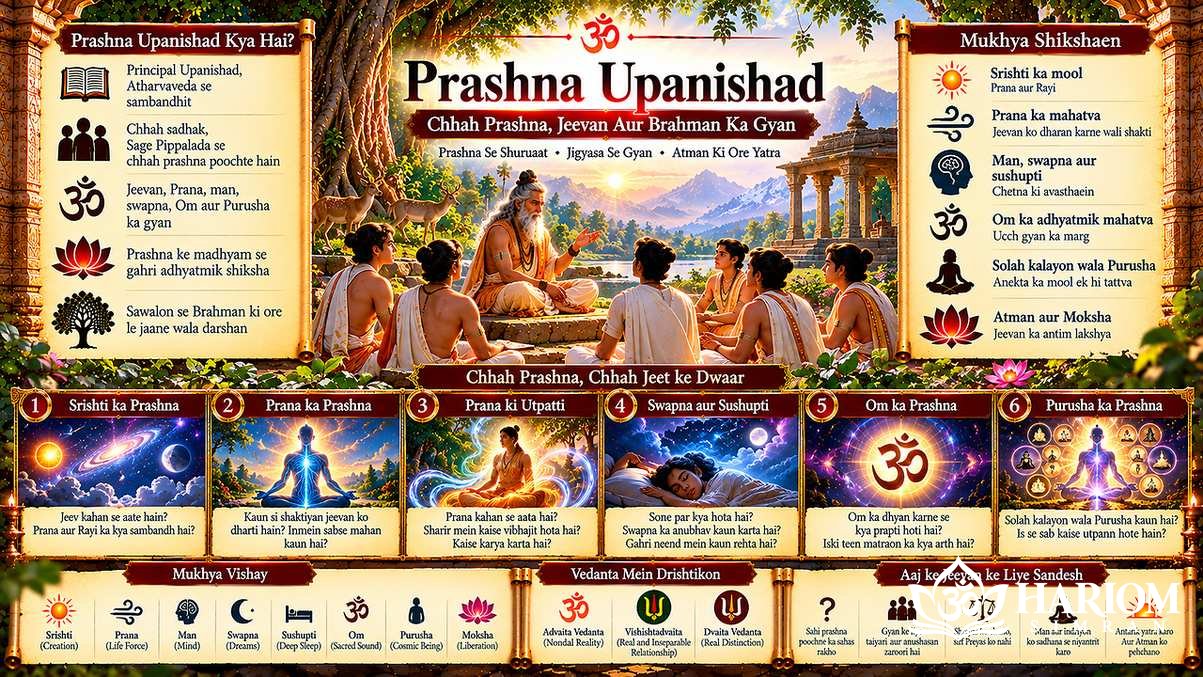
The Prashna Upanishad teaches through questions.
Six serious seekers approach the sage Pippalada.
They do not arrive casually.
They come because they want to understand some of the deepest mysteries of existence:
Where does life come from?
What power keeps the human body alive?
Where does Prana come from?
What happens when we sleep and dream?
What is the spiritual importance of Om?
What is the Purusha with sixteen parts?
These six questions give the Prashna Upanishad its structure.
The text is deeply philosophical, but its style is remarkably practical.
Each seeker asks one focused question.
Pippalada responds step by step.
The result is a spiritual journey from the origins of life toward the deepest source of existence.
The Prashna Upanishad explores:
- Creation
- Prana
- The Human Body
- The Senses
- Mind
- Dreams
- Deep Sleep
- Om
- Purusha
- Spiritual Knowledge
- Liberation
Its teaching reminds us that spiritual wisdom often begins when we learn how to ask the right question.
To understand the wider sacred tradition, explore Hindu Scriptures.
What Is the Prashna Upanishad?
The Prashna Upanishad is one of the principal or Mukhya Upanishads.
It is associated with the Atharvaveda.
The word Prashna means:
Question
The text is structured around six major questions presented to the sage Pippalada by six seekers.
Each question explores a different dimension of life and spiritual reality.
The six discussions move through:
Creation
Prana
Human Life
Consciousness
Dream and Sleep
Om
and finally
Purusha
This makes the Prashna Upanishad especially useful for structured learning.
Why Is It Called the Prashna Upanishad?
Its name comes from its distinctive question-based format.
Each section centers on a Prashna, meaning a question.
Instead of presenting philosophy as a long continuous lecture, the Upanishad develops through dialogue.
A seeker asks.
Pippalada answers.
Then another seeker asks a deeper question.
This creates a progressive learning journey.
The text shows that spiritual knowledge is not simply about collecting answers.
It begins with serious inquiry.
Prashna Upanishad and the Atharvaveda
The Prashna Upanishad is associated with the Atharvaveda.
This is significant because the Atharvaveda contains sacred material related to many dimensions of human life, including prayer, protection, household concerns, healing traditions, kingship and spiritual reflection.
The Prashna Upanishad takes the inquiry into a more philosophical direction.
It asks about:
The Origin of Life
The Nature of Prana
The Human Person
Consciousness
Om
Ultimate Reality
The text therefore represents an important philosophical development within the Atharvavedic tradition.
Who Is Sage Pippalada?
Pippalada is the teacher at the center of the Prashna Upanishad.
Six seekers approach him because they believe he possesses knowledge of Brahman.
However, Pippalada does not immediately answer their questions.
He first asks them to live with him for a period of disciplined preparation.
They are instructed to practice qualities traditionally associated with serious spiritual study, including:
Tapas
Brahmacharya
Shraddha
These can broadly involve discipline, self-restraint and sincere commitment.
Only after this period are they invited to ask their questions.
This gives the text an important message:
Deep Questions Require Preparation.
Why Does Pippalada Make Them Wait?
Modern life encourages instant answers.
Search.
Click.
Read.
Move on.
The Prashna Upanishad presents a very different approach.
Before the seekers receive answers, they must prepare themselves.
This suggests that spiritual knowledge is not only about whether information is available.
It also depends on:
The Readiness of the Student
The Seriousness of the Question
The Ability to Reflect
The Discipline to Understand
Pippalada's method shows that spiritual learning is a process, not simply information transfer.
The Six Seekers
Traditional accounts identify the six seekers as:
- Kabandhi Katyayana
- Bhargava Vaidarbhi
- Kausalya Ashvalayana
- Sauryayani Gargya
- Satyakama Shaibya
- Sukesha Bharadvaja
Each seeker asks one major question.
Together, their questions form the six sections of the Upanishad.
The Six Questions at a Glance
The Prashna Upanishad can be understood through six central questions:
First Question
Where do living beings come from?
Second Question
What powers support and maintain the human being, and which is greatest?
Third Question
Where does Prana come from, and how does it function in the body?
Fourth Question
What happens during sleep, dream and deep rest?
Fifth Question
What is the spiritual significance of meditation on Om?
Sixth Question
Who is the Purusha with sixteen parts?
These questions move from the cosmos toward the human being and finally toward ultimate reality.
First Question: Where Does Life Come From?
The first seeker, Kabandhi Katyayana, asks about the origin of living beings.
The question is fundamental:
From where are creatures born?
Pippalada's answer uses Vedic cosmological language.
He speaks about Prajapati, associated with creation and generative power.
The teaching also introduces the relationship between:
Prana
and
Rayi
These concepts become important for understanding the Upanishad's view of life.
Prana and Rayi
In this teaching, Prana and Rayi represent complementary dimensions of creation.
Prana can be connected with:
Life
Vital Energy
Activity
The Living Principle
Rayi is often associated with:
Matter
Form
Material Existence
The relationship between these two helps explain how life and form are understood together.
Rather than describing creation only as physical matter, the text sees living existence through a combination of life principle and material manifestation.
The Sun and Prana
The Prashna Upanishad gives the Sun an important symbolic role.
The Sun is associated with Prana.
Why?
Because the Sun sustains life.
Light supports activity.
Its rising awakens movement in the world.
In the Upanishadic framework, the solar principle becomes connected with life and vitality.
The text uses cosmic imagery to show that human life exists within a larger order.
The Moon and Rayi
The Moon is associated in the teaching with Rayi.
This creates a symbolic cosmic pairing:
Sun and Moon
Prana and Rayi
Life and Form
The aim is not to present modern astronomy or biology.
The Upanishad is expressing an ancient spiritual cosmology.
Modern readers should understand the teaching within its Vedic philosophical context rather than treating it as scientific theory.
Creation as Relationship
One important insight from the first question is that creation is not presented as isolated objects appearing independently.
Life develops through relationships.
Energy and form.
Life and matter.
Sun and Moon.
Time and beings.
This relational view prepares the reader for later sections, where the human body is also understood as a system of interdependent powers.
Time and Creation
The first question also connects creation with cycles of time.
The Upanishad reflects on:
Year
Months
Days
Night
Solar Movement
Time is not simply an empty background.
It is part of the rhythm through which living existence unfolds.
This reflects a wider Vedic awareness of cosmic cycles.
Second Question: What Powers Support Human Life?
The second seeker, Bhargava Vaidarbhi, asks:
How many powers support the human being?
Which faculties maintain life?
Which of them is greatest?
The question turns from cosmic creation toward the human person.
Different faculties can claim importance:
Speech
Sight
Hearing
Mind
The Elements
But one principle ultimately becomes central:
Prana
The Faculties Claim Importance
The Upanishad presents a memorable teaching in which different faculties appear to claim:
We Support This Body.
Speech is important.
Sight is important.
Hearing is important.
Mind is important.
Each has an essential role.
But the text asks:
What happens if Prana departs?
The answer reveals the special importance of Prana.
Prana as the Chief Life Force
Prana is presented as the chief sustaining principle.
When Prana prepares to leave, the other faculties are disturbed.
This demonstrates that their functioning depends upon life itself.
The teaching can be summarized:
Eyes May See, But Only in a Living Being.
Speech May Speak, But Only in a Living Being.
Mind May Think, But Life Must Be Present.
Prana therefore becomes the organizing life principle.
The Queen Bee Analogy
A famous analogy compares the relationship to bees following their queen.
When the chief bee moves, the others follow.
When it settles, the others settle.
Similarly, when Prana functions, the faculties remain active within the living organism.
This vivid analogy makes a complex philosophical idea easy to remember.
Is Prana Just Breath?
Not exactly.
Prana is often associated with breath because breathing is one of the clearest signs of life.
However, in Hindu philosophical and Yogic traditions, Prana can carry a broader meaning.
It can refer to:
Vitality
Life Force
Living Energy
The Principle Supporting Bodily Functions
Therefore, translating Prana simply as “breath” can sometimes be too narrow.
Prana and the Divine Powers
The Prashna Upanishad speaks about Prana with great reverence.
It associates Prana symbolically with important cosmic and Divine powers.
This creates a strong connection between:
Human Life
and
Cosmic Life
The life within an individual is not viewed as isolated from the larger order of existence.
Explore wider Hindu Divine traditions through Deities.
Third Question: Where Does Prana Come From?
The third seeker, Kausalya Ashvalayana, asks a deeper question.
If Prana is so important:
Where does Prana itself come from?
How does it enter the body?
How does it divide its functions?
How does it leave?
The inquiry moves from recognizing Prana's importance to understanding its origin.
Prana Comes From the Self
Pippalada teaches that Prana arises from the Atman or deeper Self.
This is philosophically significant.
Prana is powerful.
But it is not the highest reality.
It depends upon something deeper.
This creates an important hierarchy:
Body Depends on Prana
and
Prana Depends on the Self
The seeker is gradually being guided beyond physical life toward the deeper spiritual source.
How Prana Enters the Body
The Upanishad connects Prana's entry into embodied life with the mind and subtle processes of existence.
The language is spiritual and philosophical rather than anatomical.
The purpose is not to explain biological development in modern scientific terms.
The teaching explores how the life principle becomes associated with an individual embodied being.
The Fivefold Functions of Prana
Later Hindu traditions commonly speak about five major expressions of vital energy.
The Prashna Upanishad contributes importantly to this understanding.
These are commonly described as:
Prana
Associated especially with breathing and the upper region.
Apana
Associated with downward-moving functions and elimination.
Samana
Associated with digestion and balancing processes.
Vyana
Associated with circulation and distribution throughout the body.
Udana
Associated with upward movement and, in some teachings, the transition at death.
These terms became highly influential in later Yoga and Ayurveda traditions.
Prana and the Human Body
The human body is presented as an organized living system.
Different functions do not operate randomly.
Prana works through differentiated expressions.
This allows the Upanishad to explain life as both:
One
and
Many
One life principle operates through multiple bodily functions.
This becomes another example of unity expressed through diversity.
Prana and the Mind
The Upanishad also connects Prana with the mental and spiritual condition of the person.
Human life is not reduced to isolated physical systems.
Body, mind and life are interconnected.
This holistic perspective becomes increasingly important across Hindu contemplative traditions.
Prana at Death
The third question also connects Prana with what happens at death.
The Upanishadic worldview links the person's inner condition, thought and Karma with the transition beyond physical life.
Later Hindu traditions develop these teachings much more extensively.
The Prashna Upanishad provides an important early framework connecting:
Life
Mind
Action
Death
Future Experience
Fourth Question: What Happens During Sleep?
The fourth seeker, Sauryayani Gargya, asks questions about sleep and consciousness.
He asks, in essence:
Which powers sleep when a person sleeps?
Which remain awake?
Who sees dreams?
Who experiences the happiness of deep sleep?
In what are all these faculties finally established?
This is one of the most fascinating sections for modern readers.
What Sleeps?
During sleep, the outward sensory faculties become inactive.
The eyes are no longer actively seeing the external world.
The ears no longer attend to ordinary external sound in the same way.
The senses withdraw from their outward activity.
The Upanishad uses this to explore the difference between:
External Perception
and
Inner Consciousness
What Remains Awake?
Although the senses become quiet, life continues.
Breathing continues.
The organism remains alive.
Pranic functions continue.
This again emphasizes the sustaining role of Prana.
Sleep therefore becomes a philosophical window into the structure of the human being.
What Happens in Dreams?
The Prashna Upanishad gives the mind an important role in dreams.
During dreaming, the mind can revisit:
What Has Been Seen
What Has Been Heard
What Has Been Experienced
It can also combine impressions in new ways.
The external senses may be quiet, yet the inner world remains active.
This shows that consciousness cannot be understood only through external sensory activity.
Dream as an Inner World
In waking life, the mind responds heavily to external experience.
In dreams, the mind can create an internal world.
Places appear.
People appear.
Fear appears.
Joy appears.
Movement appears.
Yet the physical body may remain still.
The Upanishad uses this everyday human experience to invite deeper reflection on the relationship between:
Mind
Perception
Experience
Self
Deep Sleep
The discussion then moves beyond dreams toward deep sleep.
In deep sleep, ordinary mental activity becomes quiet.
The person does not experience the same stream of external perception or dream imagery.
The Upanishadic tradition finds this state philosophically important.
Why?
Because it raises the question:
What remains when ordinary mental activity becomes silent?
Happiness in Deep Sleep
The text associates deep sleep with a form of rest or happiness.
However, this does not mean that deep sleep itself is identical with final liberation.
The deeper teaching is that ordinary sensory and mental activity can become quiet while existence continues.
Later Upanishads, especially the Mandukya Upanishad, develop states of consciousness in even greater philosophical depth.
Where Do the Faculties Rest?
The fourth question ultimately asks where the different human faculties are established.
The answer directs attention toward a deeper Self.
Body, senses, mind and Prana do not constitute independent ultimate realities.
They exist within a deeper spiritual foundation.
The inquiry is gradually approaching Atman and Purusha.
Consciousness Beyond Waking
The Prashna Upanishad is important because it refuses to identify human existence only with waking activity.
It explores:
Waking
Dream
Deep Sleep
These states raise a profound question:
Is the Self identical with only one state of experience?
Later Upanishadic philosophy develops this question further.
Fifth Question: What Is the Power of Om?
The fifth seeker, Satyakama Shaibya, asks about meditation on Om.
Om is one of the most sacred sounds in Hindu tradition.
The question concerns the spiritual result of contemplating Om.
Pippalada explains that the depth and completeness of contemplation matter.
This teaching presents Om as much more than a religious symbol.
It becomes a spiritual support connecting the seeker with higher reality.
Om and the Vedic Tradition
Om is deeply connected with:
Sacred Recitation
Meditation
Brahman
Vedic Learning
Spiritual Contemplation
Different Upanishads explore Om from different perspectives.
The Prashna Upanishad places Om within a graded teaching about spiritual contemplation.
Explore wider sacred sound traditions through Mantras.
The Three Matras of Om
Om is traditionally analyzed through the sound elements:
A
U
M
These are sometimes referred to as Matras.
The Prashna Upanishad discusses different levels of meditation associated with Om.
The teaching suggests that incomplete and complete contemplation can lead toward different spiritual results.
The exact interpretations receive different explanations in traditional commentary.
Partial and Complete Contemplation
One important message is that spiritual practice should not be treated superficially.
Depth matters.
Understanding matters.
Completeness matters.
The Upanishad gradually points toward the fullest contemplation of Om as a means connected with a higher spiritual realization.
This teaching later becomes especially important in the Mandukya Upanishad, where Om and states of consciousness receive detailed philosophical interpretation.
Om as a Bridge
Om functions as a bridge between:
Sound
and
Silence
Prayer
and
Meditation
Individual Awareness
and
Ultimate Reality
The sound can become a focus through which scattered attention is gathered.
Its importance comes from the sacred tradition and philosophical meanings associated with it.
Sixth Question: Who Is the Purusha With Sixteen Parts?
The sixth seeker, Sukesha Bharadvaja, asks about a mysterious Purusha with sixteen parts.
This is the final question.
By this point, the Upanishad has already explored:
Creation.
Prana.
The body.
Dream.
Sleep.
Om.
Now it asks about the deeper source from which the many dimensions of existence arise.
What Is Purusha?
The Sanskrit word Purusha has different meanings in different Hindu texts and philosophical traditions.
In the Prashna Upanishad, the Purusha is presented as the deeper source associated with the sixteen parts or Kalas.
It should therefore be understood within the context of this specific teaching.
The text directs the seeker toward a reality from which differentiated existence emerges and into which it ultimately returns.
The Sixteen Parts
The text presents a sequence of sixteen aspects commonly identified as:
- Prana
- Shraddha
- Akasha
- Vayu
- Agni or Light
- Water
- Earth
- Senses
- Mind
- Food
- Vital Strength
- Tapas
- Mantras
- Karma
- Worlds
- Name
Translations and explanatory wording may differ slightly across traditions.
The central teaching is more important than treating the list as isolated vocabulary.
From One to Many
The sixteen parts illustrate how the many can arise from the deeper One.
Prana.
Elements.
Mind.
Food.
Actions.
Worlds.
Names.
All appear as differentiated aspects of existence.
Yet they are not independent of their deeper source.
This becomes a powerful Upanishadic pattern:
Multiplicity Emerges From Unity.
The Rivers and the Ocean Analogy
One of the most beautiful images associated with this teaching compares the process with rivers entering the ocean.
Before reaching the ocean, rivers have distinct names.
One river.
Another river.
Another river.
But when they enter the ocean, their separate names and forms are no longer maintained in the same way.
Similarly, the sixteen parts return to the Purusha.
The analogy points toward spiritual unity beyond separate forms.
What Does the River Analogy Teach?
The analogy invites the seeker to think about identity.
Human beings strongly identify with:
Name
Body
Role
Possessions
Social Identity
Personal History
These are meaningful within ordinary life.
But the Upanishad asks whether they represent the deepest level of reality.
The river has a name.
The ocean is deeper than the individual river-name.
Purusha and Immortality
The teaching of the sixteen parts moves the text toward freedom from mortality.
The differentiated aspects of embodied existence arise and dissolve.
But the deeper source is presented as beyond ordinary fragmentation.
Knowing that deeper reality is connected with the Upanishadic search for freedom from death.
From Creation to the Self
The structure of the Prashna Upanishad is remarkably elegant.
It begins with:
Where Does Life Come From?
Then asks:
What Sustains Life?
Then:
Where Does Prana Come From?
Then:
What Happens to Consciousness During Sleep?
Then:
How Can Om Support Spiritual Realization?
Finally:
What Is the Source of the Sixteen Parts?
The questions gradually move from the outer universe toward deeper spiritual reality.
Prashna Upanishad and Brahman
Although the six questions focus on different subjects, they ultimately point toward the search for Brahman, the deeper reality behind existence.
Creation has a source.
Prana has a source.
The senses depend upon life.
Mind is not the final reality.
Om points beyond ordinary speech.
The sixteen parts arise from a deeper Purusha.
The Upanishad's different teachings are therefore interconnected.
Prashna Upanishad and Atman
The text also contributes to the wider Upanishadic inquiry into Atman.
The body alone does not explain the person.
The senses alone do not explain the person.
Mind alone does not explain the person.
Prana itself arises from something deeper.
The seeker is gradually directed toward the spiritual Self.
Prashna Upanishad and Prana
Among all the principal Upanishads, the Prashna Upanishad is especially important for understanding Prana.
It discusses:
Prana's Importance
Prana's Origin
Prana's Functions
Prana's Relationship With the Body
Prana at Death
Later Hindu Yoga and contemplative traditions develop these teachings much further.
Prana Is Not a Medical Diagnosis
Modern readers should be careful not to confuse philosophical Prana teachings with modern medical science.
The Upanishad belongs to an ancient spiritual framework.
Its teachings can be studied for religious, philosophical and historical understanding.
They should not replace modern medical knowledge or professional healthcare.
Prashna Upanishad and Yoga
The text contributes to the wider historical development of Yogic ideas through its teachings on:
Prana
Mental Discipline
Om
Inner Awareness
However, it is not a complete Yoga manual.
Later Yoga traditions systematize practices such as breath regulation and meditation much more extensively.
The Prashna Upanishad provides important philosophical foundations.
Prashna Upanishad and Vedanta
The Prashna Upanishad became important within later Vedanta traditions.
Its teachings concerning:
Brahman
Atman
Prana
Om
Purusha
Liberation
became subjects of philosophical interpretation.
Different Vedanta schools may explain these concepts differently.
HariOmSimran should continue to distinguish the original text from later philosophical commentary.
Knowledge Requires Discipline
One of the most practical lessons appears before the questions even begin.
The seekers do not simply demand answers.
They prepare.
They wait.
They discipline themselves.
This teaches an important spiritual principle:
The Quality of the Student Matters as Much as the Quality of the Question.
A deep answer can be misunderstood if the listener is not prepared to engage with it.
Asking Better Questions
The title itself encourages a useful habit.
Instead of asking only:
What Should I Believe?
The Prashna Upanishad encourages questions such as:
Where Does Life Come From?
What Keeps Me Alive?
What Is the Relationship Between Mind and Consciousness?
What Happens When the Senses Become Quiet?
What Is the Purpose of Sacred Sound?
What Is the Deeper Source Behind Individual Identity?
These questions transform spiritual study into inquiry.
Information and Realization
Knowing the six questions is not the same as understanding their spiritual meaning.
A person may memorize:
The seekers.
The answers.
The terminology.
The sixteen parts.
But Upanishadic study aims at something deeper.
It asks whether knowledge changes the way a person understands:
Life
Self
Mortality
Consciousness
Reality
This distinction between information and realization appears repeatedly across the Upanishads.
What Can Modern Readers Learn From the Prashna Upanishad?
The text offers several powerful lessons.
Ask Serious Questions.
Prepare Yourself Before Expecting Deep Answers.
Recognize That Life Is Interconnected.
Do Not Reduce Human Existence to One Faculty.
Understand That Mind and Senses Are Not the Whole Self.
Use Spiritual Practice With Depth Rather Than Superficially.
Look Beyond Name and Form Toward Deeper Reality.
These insights help explain why the Prashna Upanishad remains meaningful today.
Common Misunderstandings About the Prashna Upanishad
Misunderstanding 1: Prana Simply Means Oxygen
No.
Prana is a broader spiritual and philosophical concept of vital life within Hindu traditions.
Misunderstanding 2: The Upanishad Is a Scientific Biology Text
No.
It presents ancient Vedic cosmology and spiritual philosophy, not modern scientific physiology.
Misunderstanding 3: Sleep Is the Same as Moksha
No.
Deep sleep is spiritually interesting because ordinary mental activity becomes quiet, but it should not simply be identified with liberation.
Misunderstanding 4: Chanting Om Automatically Guarantees Liberation
No.
The text emphasizes meditation and spiritual depth. Sacred practice should not be reduced to a guaranteed mechanical outcome.
Misunderstanding 5: The Sixteen Parts Are Sixteen Separate Ultimate Realities
No.
The teaching directs attention toward the deeper Purusha from which differentiated aspects arise and into which they return.
Is the Prashna Upanishad Difficult?
It is easier to follow structurally than some other Upanishads because the text is organized into six clear questions.
However, some teachings require careful context.
These include:
Prana and Rayi
The Five Functions of Prana
Dream and Deep Sleep
Meditation on Om
The Sixteen Kalas
A question-by-question learning method works best.
How Should a Beginner Study the Prashna Upanishad?
Step 1
Understand why the six seekers approach Pippalada.
Step 2
Study the first question about creation, Prana and Rayi.
Step 3
Understand why Prana is presented as the chief sustaining life force.
Step 4
Study the origin and fivefold functioning of Prana.
Step 5
Explore the teachings about sleep, dreams and consciousness.
Step 6
Study the role of Om in spiritual contemplation.
Step 7
Understand the Purusha and sixteen parts.
Step 8
Observe how all six questions point toward deeper spiritual reality.
This sequence follows the natural architecture of the text.
Why the Prashna Upanishad Still Matters
The Prashna Upanishad remains important because it teaches us how spiritual inquiry can be structured.
It begins with the cosmos.
Then life.
Then Prana.
Then consciousness.
Then meditation.
Then the deeper Purusha.
Its six questions gradually move from:
Where Does Life Come From?
toward
What Is the Ultimate Source Behind Life?
That progression is the spiritual heart of the text.
HariOmSimran Ke Saath Upanishadic Wisdom Explore Karein
HariOmSimran apne Scripture section ko structured aur interconnected Hindu knowledge journey ke roop mein develop kar raha hai.
Continue exploring:
The next detailed article in our Upanishads series should be:
Mundaka Upanishad: Higher Knowledge and the Path to Brahman
After that, we can continue with:
Mandukya Upanishad
Taittiriya Upanishad
Aitareya Upanishad
Chandogya Upanishad
Brihadaranyaka Upanishad
and later other important Upanishadic texts.
Learn • Explore • Understand • Preserve
Key Takeaway
The Prashna Upanishad is a principal Upanishad associated with the Atharvaveda.
Its teaching is organized around six seekers and six questions.
The questions explore:
The Origin of Life
Prana
The Powers Supporting the Human Being
Sleep and Dreams
Om
Purusha and the Sixteen Parts
Sage Pippalada does not immediately answer the seekers.
He first requires discipline and preparation.
This itself becomes an important teaching.
The Upanishad gradually guides the reader from the visible world toward deeper spiritual reality.
Its message can be summarized simply:
Ask Deep Questions.
Prepare Yourself to Understand the Answers.
Look Beyond the Many Forms of Life Toward Their Deeper Source.
Key Teachings
This scripture reveals profound wisdom and guidance for our spiritual journey. Below are the key teachings and principles derived from this sacred text.
Core Principles
These teachings provide guidance for living a life of faith, compassion, and spiritual growth.
- Spiritual Growth
- Divine Wisdom
- Sacred Teachings
- Faith Journey

Study Resources
Explore these resources to deepen your understanding of this scripture and apply its teachings to your daily life.
📖 Study Guide
Comprehensive study materials to help you understand the context, meaning, and application of this scripture.
🙏 Reflection Questions
Thought-provoking questions to help you reflect on the teachings and apply them to your personal spiritual journey.
📝 Journal Prompts
Guided journaling prompts to help you document your insights, prayers, and spiritual growth.
👥 Discussion Topics
Engaging discussion topics for group study and fellowship, fostering deeper understanding and community.
Frequently Asked Questions
The Prashna Upanishad is a principal Upanishad associated with the Atharvaveda. It is structured around six seekers asking Sage Pippalada six questions about creation, Prana, consciousness, Om and Purusha.
Prashna means “question.” The text receives its name because its teachings are organized around six major spiritual questions.
Pippalada is the sage who teaches the six seekers. He first asks them to undergo disciplined preparation before answering their questions.
Prana is presented as the chief sustaining life principle supporting bodily and sensory functions. The text also explains its origin and different functions within embodied life.
The text presents Om as a sacred support for spiritual contemplation and discusses different depths of meditation associated with it. It should not be treated as a mechanical guarantee of spiritual results.
The final question describes sixteen aspects arising from the Purusha, including Prana, elements, senses, mind, food, Karma, worlds and name. The teaching emphasizes that differentiated existence ultimately depends on a deeper spiritual source.