

Kuch scriptures kahaniyon ke through sikhati hain.
Kuch hymns ke through.
Kuch philosophical statements ke through.
Lekin Prashna Upanishad apni teachings questions ke through explain karti hai.
Chhah serious seekers Sage Pippalada ke paas aate hain.
Wo casually nahi aate.
Wo deeply samajhna chahte hain:
Jeevan kahan se aata hai?
Human body ko alive rakhne wali shakti kya hai?
Prana ka source kya hai?
Hum sote aur sapne dekhte waqt kya hota hai?
Om ka spiritual importance kya hai?
Sixteen parts wala Purusha kaun hai?
Ye chhah questions hi Prashna Upanishad ka structure form karte hain.
Text deeply philosophical hai, lekin iska learning style bahut clear aur practical hai.
Har seeker ek focused question poochta hai.
Pippalada step by step answer dete hain.
Is tarah Upanishad humein life ke origin se lekar deeper spiritual reality tak le jati hai.
Prashna Upanishad explore karti hai:
- Srishti
- Prana
- Human Body
- Senses
- Mind
- Dreams
- Deep Sleep
- Om
- Purusha
- Spiritual Knowledge
- Liberation
Is text ka ek simple lekin powerful lesson hai:
Spiritual Wisdom Aksar Sahi Question Poochne Se Start Hoti Hai.
Wider sacred tradition ko samajhne ke liye Hindu Scriptures explore karein.
Prashna Upanishad Kya Hai?
Prashna Upanishad principal ya Mukhya Upanishads mein se ek hai.
Ye Atharvaveda se associated hai.
Word Prashna ka meaning hai:
Question
Text chhah major questions ke around structured hai jo six seekers Sage Pippalada se poochte hain.
Har question life aur spiritual reality ke ek different dimension ko explore karta hai.
Ye chhah discussions gradually move karti hain through:
Srishti
Prana
Human Life
Consciousness
Dream Aur Sleep
Om
and finally
Purusha
Isi structured format ki wajah se Prashna Upanishad beginners ke liye especially useful hai.
Isse Prashna Upanishad Kyun Kaha Jata Hai?
Iska naam iske question-based structure se aata hai.
Har section ek Prashna, yani question, ke around develop hota hai.
Instead of ek long lecture dene ke, text dialogue format use karti hai.
Seeker poochta hai.
Pippalada answer dete hain.
Phir next seeker deeper question poochta hai.
Is tarah learning progressively deepen hoti hai.
Text ye bhi sikhati hai:
Spiritual Knowledge Sirf Answers Collect Karna Nahi Hai.
Real learning serious inquiry se start hoti hai.
Prashna Upanishad Aur Atharvaveda
Prashna Upanishad Atharvaveda se associated hai.
Atharvaveda life ke many dimensions cover karta hai, including:
Prayer
Protection
Household Life
Healing Traditions
Kingship
Spiritual Reflection
Prashna Upanishad isi tradition ko deeper philosophical direction mein le jati hai.
Ye explore karti hai:
Life Ka Origin
Prana Ki Nature
Human Being
Consciousness
Om
Ultimate Reality
Isliye ye Atharvavedic tradition ke important philosophical developments mein se ek hai.
Sage Pippalada Kaun Hain?
Pippalada Prashna Upanishad ke central teacher hain.
Six seekers unke paas aate hain because they believe ki unke paas Brahman related deeper knowledge hai.
Lekin Pippalada immediately answers nahi dete.
Wo pehle students ko preparation ke liye discipline practice karne ko kehte hain.
Traditional description mein important qualities include:
Tapas
Brahmacharya
Shraddha
Broadly, ye represent karte hain:
Discipline
Self-Control
Sincerity
Spiritual Commitment
Preparation ke baad hi seekers apne questions poochte hain.
Ye itself important teaching hai:
Deep Questions Ke Liye Deep Preparation Chahiye.
Pippalada Unhe Wait Kyun Karate Hain?
Modern life instant answers ki aadat create karti hai.
Search karo.
Answer dekho.
Next topic par move ho jao.
Prashna Upanishad very different approach present karti hai.
Pehle student prepare hota hai.
Phir answer receive karta hai.
Ye suggest karta hai ki spiritual knowledge sirf information availability par depend nahi karti.
Ye depend karti hai:
Student Ki Readiness
Question Ki Seriousness
Reflection Ki Ability
Understanding Ki Discipline
Pippalada ka approach show karta hai:
Spiritual Learning Ek Process Hai, Sirf Information Transfer Nahi.
Chhah Seekers Kaun Hain?
Traditional text mein six seekers ke naam diye jate hain:
- Kabandhi Katyayana
- Bhargava Vaidarbhi
- Kausalya Ashvalayana
- Sauryayani Gargya
- Satyakama Shaibya
- Sukesha Bharadvaja
Har seeker ek major question poochta hai.
Together, ye six questions entire Upanishad ka structure create karte hain.
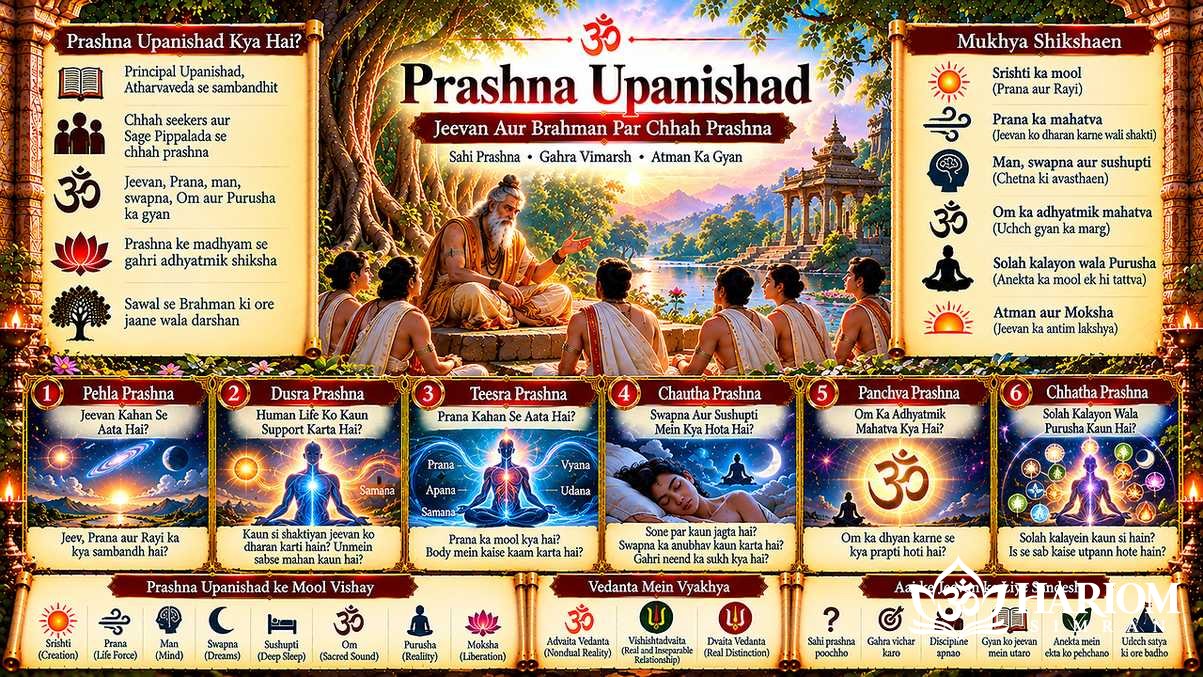
Chhah Prashna Ek Nazar Mein
Pehla Prashna
Living beings kahan se aate hain?
Dusra Prashna
Human being ko kaun si powers support karti hain, aur unmein sabse important kaun hai?
Teesra Prashna
Prana kahan se aata hai aur body mein kaise function karta hai?
Chautha Prashna
Sleep, dream aur deep sleep mein kya hota hai?
Panchva Prashna
Om meditation ka spiritual meaning kya hai?
Chhatha Prashna
Sixteen parts wala Purusha kaun hai?
Ye questions outer universe se inner Self aur deeper reality ki taraf movement create karte hain.
Pehla Prashna: Jeevan Kahan Se Aata Hai?
First seeker Kabandhi Katyayana poochta hai:
Living beings ka origin kya hai?
Simple words mein:
Creatures kahan se aati hain?
Pippalada ancient Vedic cosmological language mein answer dete hain.
Wo Prajapati ka reference dete hain, jo creation aur generative power se associated hai.
Teaching mein do important concepts introduce hote hain:
Prana
and
Rayi
Prana Aur Rayi
Is teaching mein Prana aur Rayi creation ke complementary dimensions ko represent karte hain.
Prana connected ho sakta hai:
- Life
- Vital Energy
- Activity
- Living Principle
Rayi associated ho sakti hai:
- Matter
- Form
- Material Existence
Ye combination explain karta hai ki life aur form together kaise samjhe ja sakte hain.
Upanishad creation ko sirf matter ke roop mein nahi dekhti.
Wo life aur form dono ke relationship ko emphasize karti hai.
Surya Aur Prana
Prashna Upanishad Surya, yani Sun, ko important symbolic role deti hai.
Sun ko Prana ke saath connect kiya jata hai.
Kyun?
Because Sun life ko sustain karta hai.
Light activity ko support karti hai.
Sunrise world ko awaken karta hai.
Upanishadic symbolism mein solar principle vitality aur life se connected ho jata hai.
Ye teaching human life ko larger cosmic order ke andar place karti hai.
Chandra Aur Rayi
Moon ko teaching mein Rayi ke saath associate kiya jata hai.
Isse symbolic pairing develop hoti hai:
Sun Aur Moon
Prana Aur Rayi
Life Aur Form
Important point ye hai ki text modern astronomy ya biology explain nahi kar rahi.
Ye ancient spiritual cosmology present kar rahi hai.
Modern reader ko isse Vedic philosophical framework ke andar samajhna chahiye.
Creation as Relationship
First question ka important insight hai:
Creation Isolated Objects Ka Collection Nahi Hai.
Existence relationships se develop hoti hai.
Life Aur Matter
Energy Aur Form
Sun Aur Moon
Time Aur Living Beings
Ye relational thinking later questions ke liye foundation create karti hai, jahan body bhi interconnected system ke roop mein explain hoti hai.
Time Aur Creation
First question time ke cycles ko bhi important place deta hai.
Text reflect karti hai:
Year
Months
Days
Night
Solar Movement
Time empty background nahi hai.
Ye existence ke rhythm ka part hai.
Ye wider Vedic worldview ko reflect karta hai jahan cosmic cycles spiritual understanding ke saath connected hain.
Dusra Prashna: Human Life Ko Kaun Support Karta Hai?
Second seeker Bhargava Vaidarbhi poochta hai:
Human being ko kitni powers support karti hain?
Kaun si faculties life ko maintain karti hain?
Sabse important kaun hai?
Ab inquiry cosmos se human being ki taraf move karti hai.
Important faculties include:
Speech
Sight
Hearing
Mind
Elements
Lekin eventually one principle central ban jata hai:
Prana
Faculties Apni Importance Claim Karti Hain
Upanishad ek memorable teaching present karti hai jahan different faculties apni importance express karti hain.
Speech important hai.
Sight important hai.
Hearing important hai.
Mind important hai.
Lekin question hai:
Agar Prana chale jaye to kya hoga?
Answer Prana ke special importance ko show karta hai.
Prana as the Chief Life Force
Prana chief sustaining principle ke roop mein present hota hai.
Jab Prana depart karne lagta hai, other faculties disturbed ho jati hain.
Iska simple meaning hai:
Eyes Tabhi Dekhti Hain Jab Being Alive Hai.
Speech Tabhi Bolti Hai Jab Life Present Hai.
Mind Tabhi Function Karta Hai Jab Living System Active Hai.
Isliye Prana organizing life principle ke roop mein explain hota hai.
Queen Bee Analogy
Prashna Upanishad ek famous analogy use karti hai.
Bees apni queen ko follow karti hain.
Jab chief bee move karti hai, others follow karti hain.
Jab wo settle karti hai, others bhi settle hoti hain.
Similarly, Prana ke saath faculties ki dependence explain ki jati hai.
Ye analogy complex concept ko very easy aur memorable bana deti hai.
Kya Prana Sirf Breath Hai?
Nahi.
Prana breath se strongly associated hai because breathing life ka obvious sign hai.
Lekin Hindu philosophical aur Yogic traditions mein Prana ka meaning broader hai.
Ye refer kar sakta hai:
- Vitality
- Life Force
- Living Energy
- Life-Supporting Principle
Isliye Prana ko sirf “breath” translate karna sometimes incomplete ho sakta hai.
Prana Aur Divine Powers
Prashna Upanishad Prana ko great reverence ke saath describe karti hai.
Prana ko cosmic aur Divine powers se symbolically connect kiya jata hai.
Isse strong connection create hota hai between:
Individual Life
and
Cosmic Life
Human life isolated nahi hai.
Wo larger order ka part hai.
Wider Hindu Divine traditions ke liye Deities explore karein.
Teesra Prashna: Prana Kahan Se Aata Hai?
Third seeker Kausalya Ashvalayana deeper question poochta hai:
Agar Prana itna important hai, to Prana khud kahan se aata hai?
Body mein kaise enter karta hai?
Different functions mein kaise divide hota hai?
Death ke time iska kya role hai?
Inquiry ab Prana ki importance se Prana ke source ki taraf move karti hai.
Prana Self Se Aata Hai
Pippalada teach karte hain ki Prana Atman, yani deeper Self, se arise hota hai.
Ye extremely important philosophical teaching hai.
Prana powerful hai.
Lekin highest reality nahi hai.
Uska bhi deeper source hai.
Hierarchy kuch is tarah samjhi ja sakti hai:
Body Prana Par Depend Karti Hai
and
Prana Self Par Depend Karta Hai
Isse seeker gradually physical life se deeper spiritual reality ki taraf move karta hai.
Prana Body Mein Kaise Aata Hai?
Upanishad Prana ke embodied existence se connection ko spiritual language mein explain karti hai.
Ye anatomical biology ka description nahi hai.
Purpose ye understand karna hai ki life principle individual embodied being se kaise associated hota hai.
Text mind aur subtle spiritual processes ko bhi role deti hai.
Prana Ke Panch Main Functions
Later Hindu traditions commonly Prana ke five major functions describe karti hain.
Prashna Upanishad is understanding ke development mein important hai.
Prana
Upper region, breathing aur life functions se associated.
Apana
Downward-moving bodily functions aur elimination se associated.
Samana
Digestion aur balancing processes se associated.
Vyana
Body-wide distribution aur circulation type functions se associated.
Udana
Upward movement aur some teachings mein death-transition se connected.
Ye concepts later Yoga aur Ayurveda traditions mein highly influential bane.
Prana Aur Human Body
Human body ek organized living system ke roop mein present hoti hai.
Different functions random nahi hain.
One life principle multiple expressions ke through operate karta hai.
Ye Upanishadic pattern show karta hai:
Unity Can Express Itself Through Diversity.
Prana Aur Mind
Prashna Upanishad body, mind aur life ko completely separate systems ke roop mein treat nahi karti.
Prana mental aur spiritual condition ke saath bhi connected hai.
Ye holistic view later Hindu contemplative traditions mein increasingly important ban jata hai.
Prana Aur Mrityu
Third question death ke time Prana ke role ko bhi discuss karta hai.
Upanishadic worldview inner condition, thought aur Karma ko death ke transition se connect karti hai.
Later Hindu traditions in teachings ko much more detail mein develop karti hain.
Prashna Upanishad important early framework provide karti hai connecting:
Life
Mind
Action
Death
Future Experience
Chautha Prashna: Sleep Mein Kya Hota Hai?
Fourth seeker Sauryayani Gargya sleep aur consciousness ke bare mein questions poochta hai.
Broadly:
Sleep mein kaun si powers rest karti hain?
Kaun si active rehti hain?
Dream kaun dekhta hai?
Deep sleep ka happiness kaun experience karta hai?
Finally ye sab faculties kis deeper reality mein rest karti hain?
Ye modern readers ke liye Prashna Upanishad ka one of the most fascinating sections hai.
Sleep Mein Kya Rest Karta Hai?
Sleep ke time outward senses quiet ho jati hain.
Eyes external world ko actively see nahi karti.
Ears ordinary sound par same level se attend nahi karti.
External sensory engagement reduce hoti hai.
Ye distinction create karta hai between:
External Perception
and
Inner Experience
Kya Awake Rehta Hai?
Even during sleep, life continue karti hai.
Breathing continue hoti hai.
Body alive rehti hai.
Pranic functions operate karte rehte hain.
Isse again Prana ka sustaining role emphasize hota hai.
Sleep spiritual inquiry ka useful window ban jati hai.
Dreams Mein Kya Hota Hai?
Prashna Upanishad dreams mein mind ko important role deti hai.
Dreaming state mein mind revisit kar sakta hai:
Jo Dekha Gaya
Jo Suna Gaya
Jo Experience Kiya Gaya
Mind old impressions ko new forms mein combine bhi kar sakta hai.
External senses quiet ho sakti hain, lekin inner world active rehta hai.
Dream as an Inner World
Dream ke andar:
Places appear karti hain.
People appear karte hain.
Fear arise hota hai.
Joy arise hota hai.
Movement experience hoti hai.
Lekin body bed par still ho sakti hai.
Ye Upanishad ko reflect karne ka opportunity deta hai on:
Mind
Perception
Experience
Self
Deep Sleep
Discussion dreams se move karke deep sleep ki taraf jati hai.
Deep sleep mein ordinary mental activity quiet ho jati hai.
No normal stream of external perception.
No active dream imagery in the same way.
Upanishadic tradition ke liye ye state philosophical importance rakhti hai.
Question hai:
Jab ordinary mental activity quiet ho jaye, tab kya remain karta hai?
Deep Sleep Ka Sukha
Text deep sleep ko rest aur happiness se associate karti hai.
Lekin ye important distinction hai:
Deep Sleep Moksha Ke Equal Nahi Hai.
Teaching ye show karti hai ki sensory aur mental activity quiet ho sakti hai, lekin existence continue karti hai.
Later Mandukya Upanishad consciousness states ko aur deeper way mein explore karti hai.
Faculties Finally Kahan Rest Karti Hain?
Fourth question gradually deeper spiritual foundation ki taraf move karta hai.
Body.
Senses.
Mind.
Prana.
Ye sab independent ultimate realities nahi hain.
Inke peeche deeper Self ka question arise hota hai.
Inquiry gradually Atman aur Purusha ki direction leti hai.
Waking Se Beyond Consciousness
Prashna Upanishad ka important contribution ye hai ki human existence ko sirf waking state ke through define nahi kiya jata.
Text explore karti hai:
Waking
Dream
Deep Sleep
Ye powerful question raise karta hai:
Kya Self Sirf Ek State of Experience Ke Equal Hai?
Later Upanishads is question ko aur deepen karti hain.
Panchva Prashna: Om Ki Shakti Kya Hai?
Fifth seeker Satyakama Shaibya Om ke meditation ke bare mein poochta hai.
Om Hindu tradition ka one of the most sacred sounds hai.
Question hai:
Om par meditation ka spiritual result kya ho sakta hai?
Pippalada explain karte hain ki practice ki depth aur completeness matter karti hai.
Om sirf decorative religious symbol nahi hai.
Ye higher spiritual contemplation ka support hai.
Om Aur Vedic Tradition
Om deeply connected hai:
Sacred Recitation
Meditation
Brahman
Vedic Learning
Spiritual Contemplation
Different Upanishads Om ko different perspectives se explore karti hain.
Prashna Upanishad Om ko graded spiritual contemplation ke framework mein explain karti hai.
Wider sacred sound tradition ke liye Mantras explore karein.
Om Ki Teen Matras
Om ko traditionally sound components ke through analyze kiya jata hai:
A
U
M
Inhe often Matras kaha jata hai.
Prashna Upanishad different levels of Om contemplation discuss karti hai.
Teaching suggest karti hai ki incomplete aur complete contemplation different spiritual outcomes se connected ho sakti hai.
Different traditional commentaries details ko differently explain karti hain.
Partial Aur Complete Contemplation
Important lesson hai:
Spiritual Practice Superficial Nahi Honi Chahiye.
Depth matters.
Understanding matters.
Completeness matters.
Upanishad Om ki fuller contemplation ko higher spiritual realization ke saath connect karti hai.
Later Mandukya Upanishad Om aur consciousness states par even deeper philosophical teaching deti hai.
Om as a Bridge
Om symbolically bridge ka role play kar sakta hai between:
Sound Aur Silence
Prayer Aur Meditation
Individual Awareness Aur Ultimate Reality
Sacred sound scattered attention ko gather karne ka support ban sakta hai.
Chhatha Prashna: Sixteen Parts Wala Purusha Kaun Hai?
Sixth seeker Sukesha Bharadvaja poochta hai:
Sixteen parts wala Purusha kaun hai?
Ye final question hai.
Ab tak Upanishad discuss kar chuki hai:
Srishti.
Prana.
Body.
Dream.
Sleep.
Om.
Ab inquiry deeper source ki taraf jati hai jahan se differentiated existence arise hoti hai.
Purusha Kya Hai?
Word Purusha different Hindu texts aur philosophies mein different meanings carry karta hai.
Prashna Upanishad ke context mein Purusha deeper source hai jo sixteen parts ya Kalas se connected hai.
Text seeker ko us reality ki taraf direct karti hai jahan se many aspects emerge hote hain aur finally return karte hain.
Sixteen Parts Kaun Se Hain?
Text sixteen aspects ka sequence present karti hai, commonly listed as:
- Prana
- Shraddha
- Akasha
- Vayu
- Agni Ya Light
- Water
- Earth
- Senses
- Mind
- Food
- Vital Strength
- Tapas
- Mantras
- Karma
- Worlds
- Name
Different translations wording mein slight variations use kar sakti hain.
Important point list memorize karna nahi hai.
Important point hai:
Many Aspects Ek Deeper Source Par Depend Karte Hain.
One Se Many
Sixteen parts show karti hain ki differentiated existence deeper unity se arise ho sakti hai.
Prana.
Elements.
Mind.
Food.
Actions.
Worlds.
Names.
Ye sab appear karte hain as many forms.
Lekin deeper source independent reality remain karta hai.
Upanishadic pattern hai:
Anekta Ka Mool Ek Deeper Unity Mein Hai.
Rivers Aur Ocean Ki Upama
Is teaching ki one of the most beautiful images hai:
Rivers entering the ocean.
Ocean reach karne se pehle rivers ke separate names hote hain.
Ek river.
Another river.
Different forms.
Lekin ocean mein enter karne ke baad individuality same way mein maintain nahi rehti.
Similarly, sixteen parts Purusha mein return karti hain.
Ye analogy deeper spiritual unity ki taraf point karti hai.
River Analogy Kya Sikhati Hai?
Human beings strongly identify karte hain with:
Name
Body
Role
Possessions
Social Identity
Personal History
Ordinary life mein ye sab meaningful hain.
Lekin Upanishad poochti hai:
Kya Ye Hamari Deepest Reality Hain?
River ka naam hota hai.
Lekin ocean river ke name se greater hai.
Purusha Aur Immortality
Sixteen parts ka teaching freedom from mortality ke question ko deepen karta hai.
Differentiated aspects arise aur dissolve hote hain.
Lekin deeper source ordinary fragmentation se beyond present hota hai.
Us deeper reality ka knowledge death ke fear se spiritual freedom ki taraf point karta hai.
Srishti Se Self Tak
Prashna Upanishad ka structure remarkably systematic hai.
First question:
Life Kahan Se Aati Hai?
Second:
Life Ko Sustain Kaun Karta Hai?
Third:
Prana Ka Source Kya Hai?
Fourth:
Sleep Aur Consciousness Mein Kya Hota Hai?
Fifth:
Om Spiritual Realization Ko Kaise Support Karta Hai?
Sixth:
Sixteen Parts Ka Deeper Source Kya Hai?
Questions gradually outer cosmos se inner spiritual source ki taraf move karte hain.
Prashna Upanishad Aur Brahman
Although six questions different subjects par hain, ultimately wo Brahman, deeper reality, ki search ke saath connected hain.
Creation ka source hai.
Prana ka source hai.
Senses life par depend karti hain.
Mind final reality nahi hai.
Om ordinary speech se beyond point karta hai.
Sixteen parts deeper Purusha se emerge hote hain.
Isliye entire text interconnected hai.
Prashna Upanishad Aur Atman
Text wider Upanishadic inquiry into Atman ko deepen karti hai.
Body alone person ko explain nahi karti.
Senses alone person ko explain nahi karti.
Mind alone enough nahi hai.
Prana bhi deeper source se arise hota hai.
Seeker ko gradually deeper spiritual Self ki taraf guide kiya jata hai.
Prashna Upanishad Aur Prana
Principal Upanishads mein Prashna Upanishad specially important hai for understanding Prana.
Text explain karti hai:
Prana Ka Importance
Prana Ka Origin
Prana Ke Functions
Body Ke Saath Relationship
Death Ke Time Role
Later Yoga aur spiritual traditions in concepts ko much more deeply develop karti hain.
Prana Medical Diagnosis Nahi Hai
Modern readers ko important distinction samajhna chahiye.
Prana ancient spiritual aur philosophical framework ka concept hai.
Isse modern medical science ke replacement ke roop mein use nahi karna chahiye.
Prana teachings religious, philosophical aur historical understanding ke liye important hain.
Medical health ke liye modern healthcare aur qualified professionals important rehte hain.
Prashna Upanishad Aur Yoga
Text Yogic thought ke historical development mein contribute karti hai through:
Prana
Mental Discipline
Om
Inner Awareness
Lekin Prashna Upanishad complete Yoga manual nahi hai.
Later Yoga traditions meditation aur breath practices ko more systematically develop karti hain.
Prashna Upanishad Aur Vedanta
Prashna Upanishad later Vedanta traditions ke liye important scripture ban gayi.
Its teachings on:
Brahman
Atman
Prana
Om
Purusha
Liberation
different philosophical interpretations ka subject bani.
Different Vedanta schools same concepts ko differently explain kar sakti hain.
Is diversity ko respectfully preserve karna important hai.
Knowledge Ke Liye Discipline Zaroori Hai
Text ka most practical lesson questions start hone se pehle hi mil jata hai.
Seekers answers demand nahi karte.
Wo prepare karte hain.
Wait karte hain.
Discipline practice karte hain.
Ye sikhata hai:
Question Ki Quality Ke Saath Student Ki Quality Bhi Matter Karti Hai.
Deep answer unprepared mind mein easily misunderstand ho sakta hai.
Better Questions Poochna
Prashna Upanishad khud humein better questions poochna sikhati hai.
Instead of sirf asking:
Mujhe Kya Believe Karna Chahiye?
Text questions encourage karti hai:
Life Kahan Se Aati Hai?
Mujhe Alive Kya Rakhta Hai?
Mind Aur Consciousness Ka Relationship Kya Hai?
Sleep Mein Senses Quiet Hone Par Kya Hota Hai?
Sacred Sound Ka Purpose Kya Hai?
Individual Identity Ke Peeche Deeper Source Kya Hai?
Ye inquiry spiritual education ko deeper banati hai.
Information Aur Realization
Six questions memorize kar lena spiritual realization nahi hai.
Names learn kar lena enough nahi hai.
Definitions ya sixteen parts remember kar lena bhi final goal nahi hai.
Upanishadic study ask karti hai:
Kya Knowledge Hamari Understanding Ko Transform Kar Raha Hai?
Specifically understanding of:
Life
Self
Mortality
Consciousness
Reality
Ye difference between information and realization entire Upanishadic tradition mein repeatedly appear hota hai.
Modern Readers Prashna Upanishad Se Kya Seekh Sakte Hain?
Prashna Upanishad many useful lessons offer karti hai:
Serious Questions Poochhein.
Deep Answers Ke Liye Khud Ko Prepare Karein.
Life Ko Interconnected System Ke Roop Mein Dekhein.
Human Being Ko Sirf One Faculty Tak Reduce Na Karein.
Mind Aur Senses Ko Whole Self Na Samjhein.
Spiritual Practice Ko Superficially Na Karein.
Name Aur Form Se Beyond Deeper Reality Ko Explore Karein.
Prashna Upanishad Ke Common Misunderstandings
Misunderstanding 1: Prana Sirf Oxygen Hai
Nahi.
Prana Hindu spiritual aur philosophical traditions mein broader vital-life concept hai.
Misunderstanding 2: Ye Upanishad Scientific Biology Book Hai
Nahi.
Ye ancient Vedic spiritual philosophy aur cosmology present karti hai, modern physiology nahi.
Misunderstanding 3: Deep Sleep Moksha Hai
Nahi.
Deep sleep philosophical reflection ke liye important hai, lekin liberation ke identical nahi hai.
Misunderstanding 4: Om Chant Karne Se Automatically Moksha Milta Hai
Nahi.
Text depth of contemplation aur spiritual understanding ko emphasize karti hai. Koi guaranteed mechanical result present nahi kiya jata.
Misunderstanding 5: Sixteen Parts Sixteen Separate Ultimate Realities Hain
Nahi.
Teaching deeper Purusha ki taraf point karti hai jisse differentiated aspects arise hote hain aur jisme return karte hain.
Kya Prashna Upanishad Difficult Hai?
Structure ke level par ye many Upanishads se easier hai because six clear questions hain.
Lekin kuch concepts careful study demand karte hain:
Prana Aur Rayi
Five Functions of Prana
Dream Aur Deep Sleep
Om Meditation
Sixteen Kalas
Question-by-question learning approach is text ke liye best hai.
Beginner Prashna Upanishad Ko Kaise Study Kare?
Step 1
Samjhein Ki Six Seekers Pippalada Ke Paas Kyun Aate Hain.
Step 2
Creation, Prana Aur Rayi Wala First Question Study Karein.
Step 3
Prana Ko Chief Life Force Kyun Kaha Gaya, Ye Samjhein.
Step 4
Prana Ka Origin Aur Five Functions Explore Karein.
Step 5
Sleep, Dreams Aur Consciousness Ki Teaching Study Karein.
Step 6
Om Meditation Ka Role Samjhein.
Step 7
Purusha Aur Sixteen Parts Ki Teaching Explore Karein.
Step 8
Observe Karein Ki Chhah Questions Deeper Reality Ki Taraf Kaise Point Karte Hain.
Ye order text ki natural architecture ko follow karta hai.
Prashna Upanishad Aaj Bhi Important Kyun Hai?
Prashna Upanishad spiritual inquiry ko systematic banati hai.
Ye start karti hai cosmos se.
Then life.
Then Prana.
Then consciousness.
Then meditation.
Then Purusha.
Chhah questions gradually move karte hain from:
Life Kahan Se Aati Hai?
toward
Life Ka Ultimate Source Kya Hai?
Isi progression mein text ka spiritual heart present hai.
HariOmSimran Ke Saath Upanishadic Wisdom Explore Karein
HariOmSimran apne Scripture section ko structured aur interconnected Hindu knowledge journey ke roop mein develop kar raha hai.
Continue exploring:
Upanishads series ka next detailed article hoga:
Mundaka Upanishad: Para Vidya Aur Brahman Ka Gyan
Uske baad hum continue karenge:
Mandukya Upanishad
Taittiriya Upanishad
Aitareya Upanishad
Chandogya Upanishad
Brihadaranyaka Upanishad
aur later other important Upanishadic texts.
Learn • Explore • Understand • Preserve
Key Takeaway
Prashna Upanishad principal Upanishads mein se ek hai aur Atharvaveda se associated hai.
Iski teaching six seekers aur six questions ke around structured hai.
Questions explore karte hain:
Life Ka Origin
Prana
Human Being Ko Support Karne Wali Powers
Sleep Aur Dreams
Om
Purusha Aur Sixteen Parts
Sage Pippalada seekers ko immediately answer nahi dete.
Wo pehle discipline aur preparation demand karte hain.
Ye khud ek important teaching hai.
Prashna Upanishad gradually visible life se deeper spiritual reality ki taraf guide karti hai.
Iska message simple words mein samjhein:
Deep Questions Poochho.
Answers Samajhne Ke Liye Khud Ko Prepare Karo.
Life Ke Many Forms Ke Peeche Deeper Source Ko Explore Karo.
Key Teachings
This scripture reveals profound wisdom and guidance for our spiritual journey. Below are the key teachings and principles derived from this sacred text.
Core Principles
These teachings provide guidance for living a life of faith, compassion, and spiritual growth.
- Spiritual Growth
- Divine Wisdom
- Sacred Teachings
- Faith Journey

Study Resources
Explore these resources to deepen your understanding of this scripture and apply its teachings to your daily life.
📖 Study Guide
Comprehensive study materials to help you understand the context, meaning, and application of this scripture.
🙏 Reflection Questions
Thought-provoking questions to help you reflect on the teachings and apply them to your personal spiritual journey.
📝 Journal Prompts
Guided journaling prompts to help you document your insights, prayers, and spiritual growth.
👥 Discussion Topics
Engaging discussion topics for group study and fellowship, fostering deeper understanding and community.
Frequently Asked Questions
Prashna Upanishad Atharvaveda se associated principal Upanishad hai. Ismein six seekers Sage Pippalada se creation, Prana, consciousness, Om aur Purusha par six spiritual questions poochte hain.
Prashna ka meaning hai “question.” Text ka structure six major questions ke around organized hai.
Pippalada wo sage hain jo six seekers ko teach karte hain. Wo answers dene se pehle seekers ko discipline aur preparation practice karne ko kehte hain.
Prana chief sustaining life principle ke roop mein present hota hai. Text Prana ka origin, bodily functions aur human life ke saath relationship explain karti hai.
Text Om ko spiritual contemplation ke sacred support ke roop mein present karti hai aur different levels of meditation ko discuss karti hai. Isse guaranteed mechanical spiritual result ke roop mein present nahi kiya jana chahiye.
Final teaching sixteen aspects ko Purusha se arising batati hai, including Prana, elements, senses, mind, food, Karma, worlds aur name. Central idea ye hai ki differentiated existence ek deeper spiritual source par depend karti hai.