

The Mundaka Upanishad begins with one of the most important questions in Hindu philosophy:
What should a person know in order to understand everything that truly matters?
This question is not about collecting more information.
It is about discovering the difference between:
Knowledge that helps us understand the world
and
Knowledge that helps us understand ultimate reality.
The Mundaka Upanishad calls these two broad forms of knowledge:
Apara Vidya
and
Para Vidya
This distinction becomes the foundation of the entire text.
The Upanishad does not reject learning.
It does not say that scriptures, language, ritual, astronomy or intellectual knowledge are useless.
Instead, it asks a deeper question:
Can knowledge about many things give us knowledge of the Imperishable?
From this starting point, the text explores:
- Para Vidya
- Apara Vidya
- Brahman
- Atman
- Om
- Creation
- Karma
- Ritual
- Renunciation
- The Two Birds
- Truth
- Spiritual Realization
- Moksha
The Mundaka Upanishad guides the seeker from external knowledge toward direct understanding of the deeper reality behind life.
To understand the wider scriptural tradition, explore Hindu Scriptures.
What Is the Mundaka Upanishad?
The Mundaka Upanishad is one of the principal or Mukhya Upanishads.
It is associated with the Atharvaveda.
The text is especially important for its teachings on:
Higher and Lower Knowledge
Brahman
Atman
Om
Spiritual Discipline
The Limits of Ritual
Liberation
It also contains several famous images that became deeply influential in later Hindu philosophy.
These include:
Two Birds Sitting on One Tree
and
Om as a Bow, the Self as an Arrow and Brahman as the Target
The famous expression Satyameva Jayate, meaning broadly “Truth Alone Triumphs,” also comes from the Mundaka Upanishad.
Why Is It Called the Mundaka Upanishad?
The exact interpretation of the word Mundaka has been discussed in different ways.
It is sometimes connected with the idea of shaving or cutting away, which later interpreters have associated symbolically with removing ignorance.
However, the safest way to understand the title is as the traditional name of this Upanishadic text.
Its spiritual purpose is certainly connected with cutting through false understanding and discovering deeper truth.
Mundaka Upanishad and the Atharvaveda
The Mundaka Upanishad belongs to the Atharvaveda tradition.
Like the Prashna Upanishad, it takes Atharvavedic thought into a strongly philosophical direction.
Its questions concern:
What Is Real Knowledge?
What Is Brahman?
How Does the Universe Arise?
Can Ritual Alone Give Final Liberation?
What Is the Relationship Between the Individual Self and Ultimate Reality?
This makes the Mundaka Upanishad one of the most important texts for understanding the development of Vedanta.
How Is the Mundaka Upanishad Structured?
The text is traditionally divided into:
Three Mundakas
Each Mundaka contains:
Two Khandas
This gives a total of:
Six Sections
The structure gradually moves from:
Types of Knowledge
to
The Nature of Brahman
then
Meditation and Self-Knowledge
and finally
Liberation
The three-part structure makes the text relatively systematic compared with some other Upanishads.
The Opening Teacher Lineage
The Mundaka Upanishad begins by presenting a lineage of sacred knowledge.
Brahmavidya, the knowledge of Brahman, is transmitted through teachers.
This reflects an important Upanishadic principle:
Spiritual Knowledge Is Preserved Through a Living Tradition of Teaching.
Knowledge is not treated as something invented casually by an individual.
It is received, understood and transmitted with discipline.
This connects the text with the wider Guru Shishya tradition.
Shaunaka Approaches Angiras
A major dialogue begins when Shaunaka, described as a respected householder, approaches the sage Angiras.
Shaunaka asks a profound question:
What is that knowledge by knowing which everything becomes known?
This question drives the entire Upanishad.
He is not asking:
How can I know every individual fact?
He is asking:
Is there a deeper principle that helps us understand the foundation of everything?
This is a very different kind of inquiry.
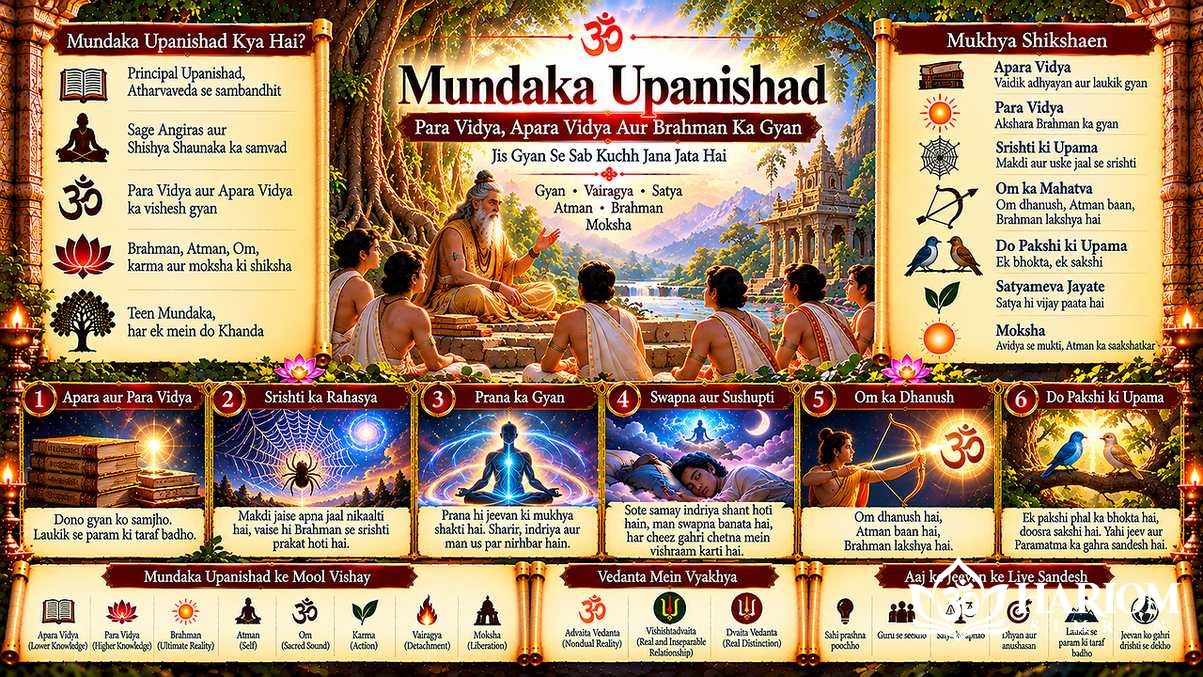
Two Kinds of Knowledge
Angiras responds by distinguishing two forms of knowledge:
Apara Vidya
and
Para Vidya
This is one of the most famous teachings of the Mundaka Upanishad.
Broadly:
Apara Vidya
Lower or conventional knowledge.
Para Vidya
Higher knowledge through which the Imperishable is known.
The words “higher” and “lower” should be understood carefully.
The Upanishad does not say that ordinary knowledge has no value.
It distinguishes knowledge of forms and systems from knowledge of ultimate reality.
What Is Apara Vidya?
Apara Vidya includes traditional areas of learning.
The text names the four Vedas:
Rigveda
Yajurveda
Samaveda
Atharvaveda
It also refers to supporting disciplines traditionally associated with Vedic study.
These include areas such as:
- Phonetics
- Ritual
- Grammar
- Etymology
- Meter
- Astronomy or Calendrical Knowledge
These disciplines are important.
They preserve language, ritual and sacred learning.
But the Mundaka Upanishad asks:
Do they directly reveal the Imperishable?
Does the Mundaka Upanishad Reject the Vedas?
No.
This would be a serious misunderstanding.
The text itself belongs to the Vedic Shruti tradition.
Its purpose is not to insult the Vedas.
Instead, it distinguishes between:
Knowledge of sacred texts
and
Direct knowledge of the ultimate reality toward which those teachings point.
A person can study scripture deeply and still need spiritual realization.
This distinction is one of the most important educational lessons in the text.
What Is Para Vidya?
Para Vidya is the higher knowledge.
It is described as the knowledge through which the Akshara, the Imperishable, is known.
The word Akshara can carry meanings connected with:
Imperishable
Unchanging
That Which Does Not Decay
The seeker moves from studying many changing things toward understanding the deeper reality that does not depend on change.
Information Versus Realization
The distinction between Apara and Para Vidya can be understood through a simple example.
A person may know:
The names of hundreds of scriptures.
The history of many traditions.
The meaning of Sanskrit terms.
The details of ritual.
The arguments of philosophers.
This is valuable learning.
But the Upanishad asks:
Has that knowledge transformed the person's understanding of Self and reality?
That is the difference between information and realization.
Why Both Forms of Knowledge Matter
It would be wrong to conclude that only Para Vidya matters and all other education is useless.
Apara Vidya can prepare the mind.
It preserves tradition.
It gives language and conceptual tools.
It provides context.
But the Mundaka Upanishad refuses to let the seeker confuse scholarship with final realization.
This distinction remains highly relevant for modern spiritual education.
What Is Brahman?
The Mundaka Upanishad describes Brahman as the deeper reality from which existence arises.
Brahman is not simply one object among other objects.
The text points toward Brahman as the source behind:
Life
Mind
World
Elements
Living Beings
Cosmic Order
Different Vedanta traditions later interpret Brahman in different ways.
The Mundaka Upanishad became an important scriptural foundation for these discussions.
Brahman as the Imperishable
The text repeatedly emphasizes the Imperishable.
Everything in ordinary experience changes.
Bodies change.
Objects change.
Relationships change.
Thoughts change.
Civilizations change.
The Upanishadic inquiry asks:
Is there a reality that does not depend upon this cycle of change?
This becomes the search for Brahman.
How Does Creation Arise?
The Mundaka Upanishad uses several powerful analogies to explain how the universe arises from Brahman.
One analogy is:
A Spider Producing and Withdrawing Its Web
Another is:
Plants Growing From the Earth
Another is:
Hair Growing From a Living Person
These images help explain how multiplicity emerges from a deeper source.
The Spider and the Web
The spider analogy is especially famous.
A spider produces a web from itself.
The web depends upon the spider.
The spider can also withdraw the web.
The analogy suggests that the universe is not completely separate from its deeper source.
Existence emerges from Brahman and remains dependent upon Brahman.
Later philosophical traditions interpret this relationship differently.
Creation Without a Separate Material Source
The analogy also raises a deeper question.
If Brahman is the source of reality, is creation produced from something completely outside Brahman?
The text's imagery suggests a much more intimate relationship between source and manifestation.
This becomes important in later Vedantic debates about:
Brahman
World
Individual Self
Brahman and the Elements
The text describes the emergence of cosmic principles and elements.
These may include:
Prana
Mind
Senses
Space
Air
Fire
Water
Earth
The point is not to present modern physics.
The teaching belongs to an ancient spiritual cosmology.
Its purpose is to show that differentiated existence comes from a deeper source.
Brahman Is Both Beyond and Present
A powerful tension runs through the Mundaka Upanishad.
Brahman is beyond ordinary sensory description.
Yet Brahman is also the source of everything we experience.
This means ultimate reality is not merely distant.
The spiritual search becomes one of recognizing the deeper foundation already present behind life.
The Limits of Ritual
The Mundaka Upanishad contains a strong critique of relying on ritual alone for ultimate liberation.
This is important.
The text does not say that every ritual is meaningless.
Instead, it questions the belief that ritual action by itself can provide permanent freedom from Samsara.
Ritual may lead to particular results.
But those results are still limited.
Ritual and Temporary Results
The Upanishad emphasizes that actions produce results.
But results based on action are themselves conditioned.
If a ritual is performed to obtain a particular heavenly reward, that reward remains within the realm of cause and effect.
Therefore, it cannot automatically equal final liberation.
This is a major Upanishadic development.
The seeker begins moving from:
External Results
toward
Knowledge of the Self and Brahman
Does the Mundaka Upanishad Oppose Yajna?
No.
It should not be read as a simplistic attack on Vedic ritual.
The text belongs to the same sacred tradition.
Its concern is spiritual limitation.
The teaching asks:
Can a finite action produce an infinite result?
This becomes a philosophical question about Karma and liberation.
Karma and Spiritual Limitation
Actions matter.
Good actions matter.
Ethical conduct matters.
Religious actions matter.
But the Upanishad asks whether action alone can remove the deeper ignorance about the Self.
This distinction helps explain why knowledge becomes so important in later Vedanta.
When the Seeker Becomes Dissatisfied With Limited Results
The Mundaka Upanishad describes a person who examines the results of action and recognizes their limitations.
This is not necessarily pessimism.
It is discernment.
The seeker realizes:
Temporary Results Cannot Provide Permanent Freedom.
At that point, the spiritual search deepens.
Approaching the Guru
The Upanishad teaches that a serious seeker should approach a teacher who is:
Well Grounded in Scripture
and
Established in Brahman
This is a powerful standard.
A Guru is not simply someone who knows religious terminology.
True guidance combines:
Knowledge
and
Realization
This reinforces the importance of the Guru Shishya tradition.
The Role of Humility
The seeker approaches with humility.
Why?
Because spiritual learning requires openness.
If a person already believes:
I Know Everything
then deeper learning becomes difficult.
Humility does not mean lack of intelligence.
It means recognizing that ultimate reality may be greater than our current understanding.
The Fire Imagery
Fire remains important within the Vedic world.
The Mundaka Upanishad uses fire imagery both in ritual and philosophical contexts.
Fire can symbolize:
Transformation
Energy
Light
Sacred Action
But the text gradually directs the seeker beyond external fire toward inner knowledge.
Brahman as Light
The Upanishad uses powerful imagery of light.
Brahman is associated with a reality beyond ordinary physical illumination.
A famous teaching describes a realm where the Sun, Moon, stars and lightning do not illuminate by their own power.
Instead, everything shines through the deeper light of the ultimate reality.
The philosophical point is not about physical brightness.
It is about the source of awareness and existence.
Inner Light and Consciousness
Light becomes a metaphor for:
Knowledge
Awareness
Truth
Spiritual Illumination
The seeker moves from external light toward the deeper light through which reality becomes known.
This symbolism became highly influential in later Hindu spirituality.
Om as the Bow
One of the most famous images in the Mundaka Upanishad is:
Om as the Bow
Atman as the Arrow
Brahman as the Target
This is a powerful meditation metaphor.
The seeker is asked to become focused.
The arrow must be prepared.
The bow must be used properly.
The target must be clear.
What Does the Bow and Arrow Analogy Mean?
The analogy teaches concentration.
A distracted archer misses the target.
Similarly, a distracted seeker may know spiritual ideas without developing deeper realization.
Om becomes a support for focused contemplation.
Atman becomes the arrow directed toward Brahman.
The teaching emphasizes:
Attention
Discipline
Meditation
Single-Pointed Inquiry
Explore the wider sacred sound tradition through Mantras.
Om in the Mundaka Upanishad
Om is not treated as a magical sound that automatically guarantees liberation.
Its value lies in sacred contemplation.
The sound becomes a spiritual support.
The seeker's mind must be disciplined.
The teaching must be understood.
The practice must be approached with seriousness.
This avoids reducing Om to a mechanical formula.
The Two Birds on One Tree
Another famous teaching describes:
Two Birds Sitting on the Same Tree
They are closely connected.
One bird eats the fruits of the tree.
The other bird watches without eating.
This metaphor became one of the most influential images in Upanishadic philosophy.
The Bird That Eats the Fruit
The first bird experiences the fruits.
Some are pleasant.
Some are unpleasant.
This bird can symbolize the individual being involved in experience.
It tastes the results of:
Action
Desire
Pleasure
Pain
Karma
This represents ordinary embodied existence.
The Bird That Watches
The second bird does not consume the fruits.
It remains a witness.
It is calm.
It observes.
This bird points toward a deeper spiritual reality.
Different Vedanta traditions interpret the two birds differently.
Some emphasize the relationship between the individual self and the Supreme Self.
Others interpret the metaphor through nondual philosophical frameworks.
Why the Two Birds Matter
The analogy raises a profound question:
Are we only the experiencer of pleasure and pain, or is there a deeper dimension of Self?
Human beings usually identify completely with experience.
I am happy.
I am sad.
I succeeded.
I failed.
The two-bird teaching invites the seeker to discover the deeper witness behind changing experience.
Experience and the Witness
The witness concept does not mean that human life should become emotionally detached in an unhealthy sense.
Its spiritual purpose is to reduce absolute identification with changing experiences.
If every emotion becomes the whole of our identity, we remain unstable.
The Upanishad points toward a deeper center.
The Tree as Life
The tree can be understood symbolically as the field of embodied existence.
Its fruits represent experiences shaped by Karma.
The individual bird moves through pleasure and pain.
The witnessing bird remains connected with deeper reality.
This metaphor prepares the ground for important later Vedantic discussions.
Atman in the Mundaka Upanishad
The Mundaka Upanishad directs attention from the changing personality toward Atman.
The deeper Self is not simply:
Body
Thought
Emotion
Possession
Social Identity
The search for Atman is the search for what remains deeper than changing experience.
Atman and Brahman
The relationship between Atman and Brahman becomes central.
Different Vedanta schools interpret this relationship differently.
Advaita Vedanta
Emphasizes the highest nondual realization of Atman and Brahman.
Vishishtadvaita Vedanta
Understands the individual soul as real and inseparably dependent upon Supreme Brahman.
Dvaita Vedanta
Maintains a real distinction between the individual soul and Supreme Brahman.
The Mundaka Upanishad became important to all major Vedantic discussions.
What Is Brahmavidya?
Brahmavidya means knowledge of Brahman.
This is not simply theoretical knowledge.
It points toward transformative understanding of ultimate reality.
The text presents Brahmavidya as the highest spiritual knowledge.
This is closely connected with Para Vidya.
Knowledge That Removes Ignorance
Why is knowledge so important?
Because the fundamental problem is not simply lack of possessions.
It is misunderstanding reality.
If bondage is connected with ignorance about the Self and Brahman, then knowledge becomes liberating.
This is one of the foundations of Vedantic philosophy.
Satyameva Jayate
One of the most famous lines from the Mundaka Upanishad is:
Satyameva Jayate
Broadly translated:
Truth Alone Triumphs
This expression later became widely known as the national motto of India.
But within the Upanishadic context, its spiritual meaning is much deeper than a patriotic slogan.
The teaching connects truth with the path toward ultimate reality.
What Does Satyameva Jayate Mean Spiritually?
The statement emphasizes that truth is not merely one useful social value among many.
Truth is connected with spiritual progress.
Falsehood creates distortion.
Self-deception creates bondage.
Truthfulness supports clarity.
The path to Brahman therefore requires alignment with truth.
Satya and Spiritual Life
Satya, truth, becomes an essential spiritual value.
Truthfulness applies not only to speech.
It also involves honesty about:
Our Motives
Our Attachments
Our Fears
Our Knowledge
Our Limitations
A person cannot seek ultimate truth while continuously deceiving themselves.
Tapas in the Mundaka Upanishad
The text also values Tapas, disciplined spiritual effort.
Tapas should not automatically be understood as extreme physical hardship.
Broadly, it can involve:
Discipline
Focus
Self-Control
Dedicated Practice
Inner Refinement
Spiritual understanding requires sustained effort.
Brahmacharya and Spiritual Discipline
The Upanishadic path also values forms of disciplined living associated with Brahmacharya.
Different traditions explain Brahmacharya in different contexts.
At a broad educational level, it can be connected with:
Self-Control
Responsible Conduct
Conservation of Attention
Dedication to Spiritual Learning
The goal is to reduce distraction and support deeper inquiry.
The Knots of the Heart
The Mundaka Upanishad uses another powerful image:
The Knots of the Heart Are Cut
when the highest reality is seen.
These knots can be understood symbolically as:
Ignorance
Attachment
Confusion
Deep Spiritual Bondage
The image suggests liberation as release from what binds the inner life.
Doubts Are Dissolved
The text also speaks about doubts being resolved through realization.
This does not mean a realized person knows every factual answer in the universe.
The teaching concerns the deepest existential doubts:
Who Am I?
What Is Real?
What Is the Source of Life?
What Is Freedom?
Spiritual realization transforms these foundational questions.
Karma and Liberation
The Mundaka Upanishad also presents a deeper relationship between Karma and knowledge.
Actions continue to have consequences.
But liberation is not simply another temporary result created by action.
The text points toward realization beyond ordinary cause and effect.
This is why Para Vidya becomes central.
Moksha in the Mundaka Upanishad
Moksha is freedom from spiritual bondage.
The text connects liberation with:
Knowledge of Brahman
Self-Realization
Truth
Purity
Disciplined Inquiry
Freedom From Ignorance
The exact nature of Moksha is interpreted differently by later Hindu traditions.
Is Liberation After Death or During Life?
The Upanishadic tradition contains discussions that later Vedanta schools develop in different ways.
Some emphasize realization while living.
Others emphasize the soul's final relation with the Supreme.
The Mundaka Upanishad should therefore be studied with awareness that later traditions interpret liberation differently.
The Sage Who Knows Brahman
The Upanishad presents the knower of Brahman as transformed.
Knowledge is not merely an academic achievement.
The person becomes free from narrow identity and spiritual confusion.
This reinforces the difference between:
Learning About Brahman
and
Realizing Brahman
Mundaka Upanishad and Renunciation
The Mundaka Upanishad has a strong contemplative and renunciant tone.
It values turning away from exclusive dependence on temporary rewards.
However, this should not be simplified into hatred of family, work or society.
Its deeper concern is:
Attachment to Limited Results
The seeker must recognize that temporary achievement cannot satisfy the deepest spiritual longing.
Householders and Spiritual Knowledge
It is important that Shaunaka, who asks the opening question, is presented as a respected householder.
This reminds us that deep philosophical inquiry is not limited only to one social lifestyle.
The spiritual search can begin within household life.
Different Hindu traditions later develop different paths for householders and renunciants.
Does Mundaka Upanishad Reject Material Life?
No.
It questions the belief that material and ritual achievements provide ultimate security.
Human beings need food, shelter, relationships and responsibilities.
The Upanishad's concern is not ordinary practical life.
It asks whether temporary things can provide permanent spiritual freedom.
The Danger of Spiritual Pride
Apara Vidya can sometimes create spiritual pride.
A person may know many scriptures and begin to think:
I Have Reached the Highest Knowledge.
The Mundaka Upanishad challenges this assumption.
Scholarship is valuable.
But spiritual knowledge must go deeper than intellectual accumulation.
Knowledge and Character
True spiritual learning should transform character.
If a person studies Brahman but becomes more arrogant, something important has been missed.
The text connects higher knowledge with:
Truth
Discipline
Clarity
Freedom From Attachment
The purpose of knowledge is transformation.
Mundaka Upanishad and Yoga
The Mundaka Upanishad is not a systematic Yoga manual.
However, it contains important contemplative ideas related to:
Om
Concentration
Inner Awareness
Purification
Self-Knowledge
These teachings contribute to the wider history of Hindu meditation.
Meditation on the Self
The bow-and-arrow metaphor gives a clear contemplative direction.
The seeker's awareness must become focused.
The target is not external possession.
The target is deeper reality.
Meditation becomes a disciplined movement away from distraction and toward spiritual understanding.
Mundaka Upanishad and Sacred Sound
Om is one of the strongest connections between the Mundaka Upanishad and the wider Hindu sacred sound tradition.
Sacred sound is not merely decorative.
It can become a support for contemplation.
Explore Mantras for the wider role of sacred sound in Hindu tradition.
Mundaka Upanishad and Deities
The text speaks primarily in philosophical language about Brahman, Atman and cosmic reality.
However, it remains part of the larger Vedic world.
Hindu traditions later connect Upanishadic philosophy with different theological understandings of the Divine.
Explore wider Hindu Divine traditions through Deities.
Mundaka Upanishad and Vedanta
The Mundaka Upanishad became a major source for later Vedanta.
Its teachings about:
Para Vidya
Brahman
Atman
The Two Birds
Om
Liberation
received extensive philosophical interpretation.
Different Vedanta schools agree that the Upanishad is authoritative but do not always interpret its metaphysical teachings in exactly the same way.
Mundaka Upanishad and Advaita Vedanta
Advaita Vedanta gives strong importance to the Mundaka Upanishad.
Advaita interpreters often emphasize:
Brahman as Ultimate Reality
The Higher Knowledge of the Self
The Limitations of Karma
Freedom Through Knowledge
The two-bird and bow-and-arrow teachings are especially important in Advaitic interpretation.
But Advaita is not the only tradition that values the text.
Mundaka Upanishad and Other Vedanta Traditions
Vishishtadvaita, Dvaita and other Vedantic traditions also interpret the Upanishads.
These traditions may emphasize:
Supreme Brahman
The Reality of the Individual Soul
Divine Dependence
Devotion
Difference and Relationship
This diversity should be acknowledged whenever major Upanishadic teachings are explained.
Is Mundaka Upanishad Against Religion?
No.
The text is itself sacred scripture.
Its criticism is directed toward misunderstanding the purpose and limits of religious action.
It asks whether ritual without deeper knowledge can provide final liberation.
This is not rejection of religion.
It is spiritual self-examination within the Vedic tradition.
Is Apara Vidya Bad?
No.
Apara Vidya includes highly valuable forms of learning.
The problem arises only when limited knowledge is mistaken for final realization.
Language, scripture, ritual and intellectual study can all prepare the seeker.
The Upanishad simply points beyond them toward Para Vidya.
Can Para Vidya Be Learned From Books?
Books can guide.
Teachers can explain.
Scriptures can point toward truth.
But Para Vidya is not presented as mere memorization.
Its deepest meaning involves realization of the Imperishable.
This is why both study and spiritual transformation matter.
Is Om a Guaranteed Method to Moksha?
No.
The Mundaka Upanishad uses Om as a profound support for contemplation.
It should not be presented as a mechanical guarantee of liberation.
Spiritual traditions emphasize preparation, discipline, understanding and realization.
Is the Two Birds Teaching Literal?
It is a philosophical metaphor.
Its purpose is to illuminate the relationship between:
Experience
The Individual Self
The Witness
Ultimate Reality
Different Vedanta traditions interpret the metaphor differently.
Common Misunderstandings About the Mundaka Upanishad
Misunderstanding 1: Apara Vidya Is Useless
No.
It is valuable knowledge, but it does not by itself equal direct realization of the Imperishable.
Misunderstanding 2: The Upanishad Rejects the Vedas
No.
The Mundaka Upanishad itself belongs to the Vedic Shruti tradition.
Misunderstanding 3: Ritual Has No Value
No.
The text questions whether ritual alone can provide final liberation.
Misunderstanding 4: Om Automatically Gives Moksha
No.
Om is presented as a sacred support for focused spiritual contemplation, not a guaranteed mechanical result.
Misunderstanding 5: The Two Birds Have Only One Accepted Interpretation
No.
Different Vedanta traditions interpret the metaphor through different philosophical frameworks.
What Can Modern Readers Learn From the Mundaka Upanishad?
The Mundaka Upanishad asks questions that remain highly relevant today.
How much information is enough?
Does education automatically create wisdom?
Can achievement remove existential insecurity?
Are temporary rewards enough to satisfy the deepest human questions?
What is the difference between knowing about truth and realizing truth?
Can we observe our experiences without being completely controlled by them?
These questions make the text especially meaningful in an age of endless information.
Education Versus Wisdom
Modern people can access enormous amounts of information instantly.
But the Mundaka Upanishad makes a crucial distinction:
Information Is Not the Same as Wisdom.
A person can know many facts and still not know themselves.
The Upanishad therefore remains a powerful text for spiritual education.
Success Versus Fulfillment
The text also challenges our understanding of success.
A person may achieve:
Wealth.
Status.
Recognition.
Academic knowledge.
Professional success.
Religious merit.
But the deeper question remains:
Does this remove fear, ignorance and inner bondage?
The Mundaka Upanishad asks the seeker to distinguish achievement from liberation.
Why the Mundaka Upanishad Still Matters
The Mundaka Upanishad remains important because it asks one of the most fundamental questions in spiritual life:
What Kind of Knowledge Can Truly Set a Person Free?
Its answer is not anti-education.
It is a call for deeper education.
The seeker moves from:
Apara Vidya
toward
Para Vidya
From:
Information
toward
Realization
From:
Temporary Results
toward
The Imperishable
From:
Experiencing the Fruits of Life
toward
Recognizing the Deeper Witness
This journey makes the Mundaka Upanishad one of the most powerful texts in the Upanishadic tradition.
Explore Upanishadic Wisdom With HariOmSimran
HariOmSimran is developing the Scripture section as a structured and interconnected journey through Hindu sacred knowledge.
Continue exploring:
The next detailed article in our Upanishads series should be:
Mandukya Upanishad: Om and the Four States of Consciousness
After that, we can continue with:
Taittiriya Upanishad
Aitareya Upanishad
Chandogya Upanishad
Brihadaranyaka Upanishad
and later other important Upanishadic texts.
Learn • Explore • Understand • Preserve
Key Takeaway
The Mundaka Upanishad is a principal Upanishad associated with the Atharvaveda.
Its most famous teaching distinguishes:
Apara Vidya, knowledge of scriptures and traditional disciplines,
from
Para Vidya, the higher knowledge through which the Imperishable is realized.
The Upanishad also teaches through powerful images:
The Spider and Its Web
Om as the Bow
Atman as the Arrow
Brahman as the Target
Two Birds Sitting on One Tree
It teaches that ritual, scholarship and external achievement have value, but they should not be mistaken for final spiritual realization.
The seeker must move from knowing many things toward understanding the deeper reality behind existence.
Key Teachings
This scripture reveals profound wisdom and guidance for our spiritual journey. Below are the key teachings and principles derived from this sacred text.
Core Principles
These teachings provide guidance for living a life of faith, compassion, and spiritual growth.
- Spiritual Growth
- Divine Wisdom
- Sacred Teachings
- Faith Journey

Study Resources
Explore these resources to deepen your understanding of this scripture and apply its teachings to your daily life.
📖 Study Guide
Comprehensive study materials to help you understand the context, meaning, and application of this scripture.
🙏 Reflection Questions
Thought-provoking questions to help you reflect on the teachings and apply them to your personal spiritual journey.
📝 Journal Prompts
Guided journaling prompts to help you document your insights, prayers, and spiritual growth.
👥 Discussion Topics
Engaging discussion topics for group study and fellowship, fostering deeper understanding and community.
Frequently Asked Questions
The Mundaka Upanishad is a principal Upanishad associated with the Atharvaveda. It explores higher and lower knowledge, Brahman, Atman, Om, Karma, spiritual realization and liberation.
Apara Vidya refers to conventional and scriptural learning, while Para Vidya is the higher knowledge through which the Imperishable reality is known.
No. It belongs to the Vedic Shruti tradition itself. It distinguishes knowledge of scripture from direct realization of the ultimate reality toward which scripture points.
The two birds on one tree represent different dimensions of spiritual experience. One bird experiences the fruits of life, while the other remains as a witness. Different Vedanta traditions interpret this metaphor differently.
The Upanishad compares Om to a bow, Atman to an arrow and Brahman to the target. The metaphor emphasizes focused meditation, discipline and single-pointed spiritual inquiry.
The Mundaka Upanishad is important because it distinguishes information from realization and teaches that final liberation depends on deeper knowledge of Brahman rather than temporary achievements or ritual results alone.