

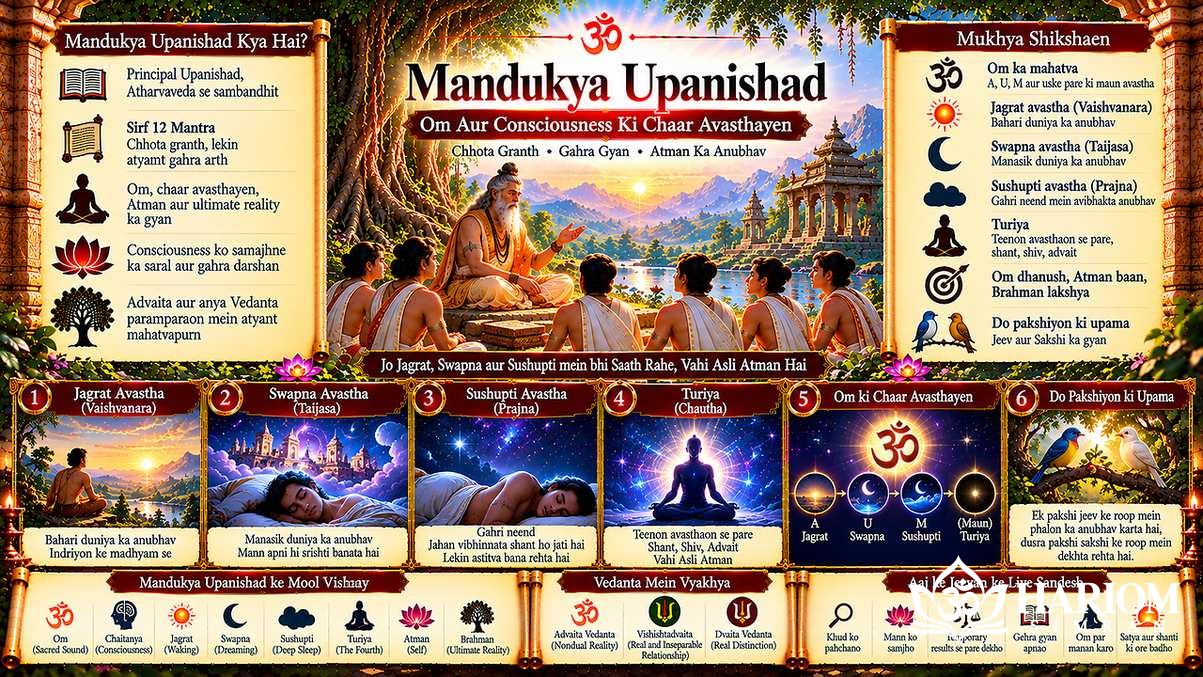
The Mandukya Upanishad is one of the shortest principal Upanishads.
Yet its philosophical influence is extraordinary.
In only 12 Mantras, the text explores some of the deepest questions about:
Om
Atman
Consciousness
Waking
Dreaming
Deep Sleep
Turiya
Ultimate Reality
Its central insight is simple to state, but profound to explore:
Human experience changes from one state to another, but what is the deeper reality behind all these states?
When we are awake, we experience an external world.
When we dream, another world appears within the mind.
When we enter deep sleep, ordinary mental activity becomes quiet.
Yet we later say:
I Was Awake.
I Dreamed.
I Slept Deeply.
Who is the “I” connected with all these changing states?
The Mandukya Upanishad asks the seeker to investigate this question deeply.
It connects the four dimensions of consciousness with the sacred sound Om, making the text one of the most important philosophical explorations of sacred sound in Hindu tradition.
To understand the wider scriptural tradition, explore Hindu Scriptures.
What Is the Mandukya Upanishad?
The Mandukya Upanishad is one of the principal or Mukhya Upanishads.
It is associated with the Atharvaveda.
The text contains only 12 Mantras.
Despite its short length, it presents a highly concentrated philosophical teaching about:
- Atman
- Om
- Consciousness
- Waking State
- Dream State
- Deep Sleep
- Turiya
- Ultimate Reality
The Mandukya Upanishad became especially influential in Advaita Vedanta, particularly through the later Mandukya Karika associated with Gaudapada.
However, the Upanishad itself belongs to the wider Vedic Shruti tradition and should not be reduced only to one later school of philosophy.
Why Is the Mandukya Upanishad Important?
The Mandukya Upanishad is important because it takes an ordinary human experience and turns it into spiritual inquiry.
Every person experiences:
Waking
Dreaming
Sleep
But usually we do not ask what these states reveal about the Self.
The Upanishad asks:
Am I only the waking personality?
What happens to my identity in dreams?
What remains in deep sleep?
Is there a deeper reality present through all three states?
The text calls this deeper dimension Turiya, commonly understood as the “fourth.”
This does not simply mean a fourth ordinary state that appears after the other three.
Turiya points toward the deeper reality underlying experience itself.
Mandukya Upanishad and the Atharvaveda
The Mandukya Upanishad belongs to the Atharvaveda tradition.
This places it alongside other important Atharvavedic Upanishads such as:
Prashna Upanishad
and
Mundaka Upanishad
Each has a distinctive emphasis.
Prashna Upanishad explores six major spiritual questions.
Mundaka Upanishad distinguishes Para Vidya from Apara Vidya.
Mandukya Upanishad turns inward toward:
Consciousness
Atman
and
Om
Together, these texts show the philosophical richness of the Atharvavedic tradition.
How Is the Mandukya Upanishad Structured?
The Mandukya Upanishad contains only 12 Mantras.
Broadly, the text develops through three major ideas.
First
It presents Om as deeply connected with all experience and reality.
Second
It describes Atman through four dimensions or quarters.
These are:
- Vaishvanara
- Taijasa
- Prajna
- Turiya
Third
It connects the sound components of Om:
A
U
M
and the silence or transcendence associated beyond the sounded syllable with these dimensions of consciousness.
This compact structure gives the Upanishad remarkable philosophical depth.
Om in the Mandukya Upanishad
The Mandukya Upanishad begins by giving Om extraordinary significance.
Om is not treated only as a sound used before prayer.
The text connects Om with:
Past
Present
Future
and even that which lies beyond ordinary time.
This makes Om a symbol of total reality.
The teaching is not simply:
Om Represents One Religious Idea.
Instead, Om becomes a sacred symbol through which the seeker contemplates:
Time
Experience
Consciousness
Atman
Brahman
For wider sacred sound traditions, explore Mantras.
Why Is Om So Important?
Om is one of the most sacred sounds in Hindu tradition.
Different scriptures explain its significance differently.
In the Mandukya Upanishad, Om becomes especially important because it mirrors the structure of consciousness.
The sound is analyzed through:
A
U
M
These sound elements are connected with:
Waking
Dreaming
Deep Sleep
Then the teaching points beyond these sounded components toward Turiya.
The sound becomes a map for spiritual contemplation.
Atman and the Four Quarters
The Mandukya Upanishad describes Atman as having four Padas, often translated as quarters or aspects.
These are:
First Pada
Vaishvanara, associated with waking consciousness.
Second Pada
Taijasa, associated with dreaming consciousness.
Third Pada
Prajna, associated with deep sleep.
Fourth
Turiya, beyond the ordinary three states.
The word “quarter” should not be misunderstood as though Atman were physically divided into four pieces.
The teaching uses these categories to help us examine different dimensions of experience.
The First State: Waking
The waking state is called Jagrat.
The experiencer associated with waking consciousness is called Vaishvanara.
In waking life, awareness is mainly directed toward the external world.
We experience:
People
Objects
Places
Work
Relationships
Sound
Form
Taste
Touch
This is the state most people identify with as normal reality.
But the Mandukya Upanishad asks:
Is waking experience the whole of consciousness?
The answer is clearly no.
What Is Vaishvanara?
Vaishvanara refers to the consciousness associated with the waking state in the Mandukya teaching.
Here, awareness engages with external objects.
The waking person experiences the world through the senses and mind.
This is ordinary outward-facing consciousness.
The text begins here because this is the state most familiar to us.
Why Waking Is Not the Whole Self
Most people define themselves using waking identity.
For example:
My Name
My Job
My Family Role
My Possessions
My Memories
But during dreaming, the waking world temporarily disappears from immediate experience.
During deep sleep, even the dream world disappears.
Yet existence continues.
This creates a profound question:
Can the waking identity really be the complete Self?
The Second State: Dreaming
The dream state is commonly called Svapna.
The experiencer associated with dreaming consciousness is called Taijasa.
During dreams, the external senses are not engaging with the world in the same way.
Yet experiences still appear.
We may see places.
Talk to people.
Feel fear.
Experience happiness.
Move through imaginary environments.
The dream world can feel completely real while the dream lasts.
This makes dreaming philosophically significant.
What Is Taijasa?
Taijasa refers to the experiencer of the dream state.
In dreaming, awareness turns inward toward subtle impressions, memories and mental forms.
The mind creates an internal world.
External objects are no longer necessary for the experience to appear.
This teaches an important lesson:
Experience does not always depend on the external world in the way we normally assume.
Dreams and the Nature of Reality
Dreaming raises a powerful philosophical question.
While dreaming, a person may believe the dream world is real.
Only after waking do they recognize:
That Was a Dream.
The Mandukya Upanishad uses this ordinary experience to challenge unquestioned assumptions about reality.
This does not necessarily mean the waking world is simply identical to a dream.
Rather, the text encourages deeper discrimination between:
Experience
and
Ultimate Reality
The Dreaming Mind
The dream state demonstrates the creative power of the mind.
The mind can generate:
People
Places
Sounds
Emotions
Danger
Pleasure
without those things being physically present in the waking environment.
This helps the seeker understand why mind itself cannot automatically be treated as the final measure of reality.
Waking and Dreaming Compared
Waking and dreaming appear very different.
In waking:
External objects dominate experience.
In dreaming:
Internal mental impressions dominate experience.
Yet both involve:
An Experiencer
Objects of Experience
Awareness
The Mandukya Upanishad asks the seeker to look deeper than either state.
The Third State: Deep Sleep
The third state is Sushupti, deep sleep.
The experiencer associated with deep sleep is called Prajna.
In deep sleep:
External perception is absent.
Dream imagery is absent.
Ordinary thought becomes quiet.
Yet the person does not cease to exist.
After waking, a person may say:
I Slept Well.
or
I Knew Nothing While Sleeping.
This statement becomes philosophically important.
What Is Prajna?
In the Mandukya Upanishad, Prajna is associated with deep sleep.
This state is characterized by a kind of undifferentiated experience.
The multiplicity of waking life disappears.
The dream world also disappears.
There is no ordinary division into:
Seer and Seen
Dreamer and Dream
in the same active sense.
But deep sleep is still not the final realization of the Self.
Why Deep Sleep Matters
Deep sleep matters because it shows that consciousness cannot simply be identified with active thought.
During deep sleep:
Thought quiets.
Sense experience quiets.
Dream imagery quiets.
Yet afterward, continuity is recognized.
This raises an important question:
What connects waking, dreaming and deep sleep?
The Upanishad points toward Atman.
Is Deep Sleep the Same as Moksha?
No.
This is an important misunderstanding to avoid.
Deep sleep may involve temporary freedom from ordinary mental activity.
But ignorance has not necessarily been destroyed.
When the person wakes, ordinary identity, desire and confusion return.
Moksha is not simply unconscious rest.
Spiritual liberation requires deeper realization.
Deep Sleep and Potentiality
The deep sleep state can be understood as a condition where differentiated experiences become unmanifest.
Waking and dream experiences are absent.
But the potential for them remains.
When the person wakes, the familiar world of perception and thought returns.
This helps explain why deep sleep is not final liberation.
The Fourth: Turiya
The most profound teaching of the Mandukya Upanishad concerns Turiya.
Turiya literally means:
The Fourth
But it should not be understood simply as another ordinary state beside waking, dreaming and deep sleep.
Turiya points toward the deeper reality that underlies and transcends all three.
The text uses careful negative language because Turiya cannot be easily reduced to ordinary categories.
What Is Turiya?
Turiya is not described as:
Waking Consciousness
Dream Consciousness
or
Deep Sleep Consciousness
It is not merely an object that can be seen or mentally imagined.
It is connected with:
Atman
Peace
Non-Dual Spiritual Reality
The Cessation of Ordinary Multiplicity
Ultimate Awareness
Different Vedanta traditions interpret its metaphysical significance differently.
Why Is Turiya Called the Fourth?
The word “fourth” is a teaching device.
It comes after the first three states in explanation.
But Turiya is not necessarily a temporary experience that simply occurs after deep sleep every night.
Rather, it points toward the reality present through all experience.
The seeker is encouraged to recognize what is constant beneath changing states.
Turiya Is Not a Trance
Turiya should not automatically be reduced to a trance, blackout or unusual altered state.
The Upanishad's teaching is more subtle.
It points toward the deepest reality of the Self.
Modern readers sometimes imagine Turiya as a mysterious spiritual experience produced by technique.
That can oversimplify the text.
Turiya is primarily a philosophical and spiritual teaching concerning ultimate reality.
The Witness of the Three States
A useful way to approach the Mandukya teaching is to ask:
What knows waking?
What knows dreaming?
What recognizes deep sleep afterward?
The states change.
Yet some form of continuity remains.
This insight leads toward the concept of the Self as deeper than any single state.
Later Vedanta traditions develop this idea extensively.
Atman Beyond Waking Identity
The waking person may say:
I Am This Body.
I Am This Profession.
I Am This Personality.
But in dreams, the waking identity may be forgotten.
In deep sleep, both waking and dreaming identities become quiet.
The Upanishad therefore asks whether our deepest Self can be reduced to any temporary identity.
Consciousness and Changing Experience
Every state has different content.
Waking
External world.
Dreaming
Internal mental world.
Deep Sleep
Absence of ordinary differentiated experience.
Yet all are known as part of one life.
The Mandukya Upanishad turns this observation into spiritual inquiry.
The Sound A and Waking
The first sound component of Om is:
A
The Mandukya Upanishad connects A with the waking state and Vaishvanara.
One reason is that A is considered foundational among sounds.
The association helps the seeker use Om as a contemplative map.
The goal is not merely pronunciation analysis.
The deeper purpose is understanding consciousness.
The Sound U and Dreaming
The second component is:
U
This is associated with the dream state and Taijasa.
The Upanishad connects the middle sound with the intermediate dimension of experience.
Dreaming stands between external waking consciousness and deep sleep.
Again, the sound-symbol relationship supports contemplation.
The Sound M and Deep Sleep
The third sound component is:
M
This is connected with deep sleep and Prajna.
The closing of the sound can symbolize a kind of gathering or resolution.
Just as waking and dream distinctions become quiet in deep sleep, the sound of Om moves toward completion.
What Comes After A, U and M?
After the sounded Om becomes quiet, there is silence.
Later philosophical interpretation often connects this silence with Turiya.
The silence is not simply empty absence.
It can symbolize the reality beyond ordinary sound distinctions.
This gives Om an extraordinary contemplative depth:
Sound Leads Toward Silence.
Distinct States Lead Toward the Deeper Self.
Is the Silence Part of Om?
Different teachers may explain the relationship in different ways.
The Mandukya teaching emphasizes that the Self and Om correspond through the sound elements and the fourth dimension.
It is therefore better to understand the silence as a contemplative pointer toward what cannot be reduced to the sounded components.
Om as a Map of Consciousness
The Mandukya Upanishad turns Om into a spiritual map.
A
Waking.
U
Dreaming.
M
Deep Sleep.
Turiya
The reality beyond and underlying the three states.
This makes Om both:
Sound
and
Philosophy
Practice
and
Symbol
Does Chanting Om Automatically Reveal Turiya?
No.
This would oversimplify the Upanishad.
Om can be a profound support for spiritual contemplation.
But mechanical repetition alone should not be presented as a guaranteed path to realization.
Traditional Hindu spiritual paths emphasize:
Understanding
Discipline
Meditation
Guidance
Self-Inquiry
Ethical Preparation
Mandukya Upanishad and Atman
The entire text is ultimately about Atman.
The first three states show different forms of experience.
Turiya points toward the deeper Self.
The text challenges identification with:
Body
Dream Mind
Temporary Thoughts
Sensory Experience
The Self must be understood more deeply.
Mandukya Upanishad and Brahman
The Mandukya Upanishad also connects Atman and ultimate reality.
The famous Upanishadic teaching:
Ayam Atma Brahma
is associated with the Mandukya tradition.
Broadly translated:
This Self Is Brahman
This statement became one of the famous Mahavakyas highlighted in later Vedanta.
However, different philosophical traditions interpret such statements differently.
Ayam Atma Brahma
Ayam Atma Brahma is traditionally considered one of the four major Mahavakyas emphasized in Vedantic teaching.
Its philosophical meaning should not be reduced to:
My Ordinary Ego Is God.
That would miss the Upanishadic context.
The statement points toward the deepest Self, not the personality, ego or social identity.
Different Vedanta traditions interpret the exact relationship between Atman and Brahman according to their own philosophical frameworks.
Mandukya Upanishad and Advaita Vedanta
The Mandukya Upanishad is extremely important in Advaita Vedanta.
Advaita emphasizes the nondual nature of ultimate reality.
The teaching of Turiya becomes central for understanding the Self beyond waking, dream and deep sleep.
Later philosopher Gaudapada wrote the famous Mandukya Karika, which became highly influential in Advaita tradition.
However, the Upanishad itself should be distinguished from later commentary.
Who Was Gaudapada?
Gaudapada was an important early Vedantic philosopher associated with the Mandukya Karika.
The Karika is not the same text as the Mandukya Upanishad.
It is a later philosophical work organized around the Upanishad's teachings.
This distinction is important for educational accuracy.
HariOmSimran should clearly separate:
The 12-Mantra Mandukya Upanishad
from
Gaudapada's Mandukya Karika
Mandukya Karika and Non-Dual Philosophy
The Mandukya Karika develops sophisticated philosophical arguments concerning:
Non-Duality
Consciousness
Dream
Reality
Causation
These teachings became important for later Advaita philosophy.
But when presenting the Mandukya Upanishad itself, the article should avoid automatically attributing every later Gaudapadian argument directly to the original 12 Mantras.
Other Vedanta Interpretations
Although Mandukya Upanishad is especially famous in Advaita circles, it belongs to the shared Upanishadic scriptural tradition.
Other Vedanta traditions also engage with Upanishadic teachings while interpreting Atman, Brahman and the Supreme differently.
This diversity should be acknowledged.
Is the World Just a Dream?
The Mandukya Upanishad's discussion of waking and dreaming often leads people to ask:
Does Hindu philosophy say the world is literally a dream?
The answer requires nuance.
The Upanishad compares states of consciousness and encourages inquiry into their reality.
Later Advaita thinkers use dream analogies more extensively.
But the simple statement:
The World Is Just a Dream
can be misleading if removed from philosophical context.
Dream Analogy and Spiritual Inquiry
The useful insight is not necessarily that waking life is identical to an ordinary dream.
The insight is that experiences can feel real within a state.
Therefore, the seeker should not accept every appearance as ultimate reality without inquiry.
This encourages Viveka, or discrimination.
Consciousness in Modern Discussion
Modern readers are often attracted to the Mandukya Upanishad because it discusses states of consciousness.
However, the text is not a modern neuroscience manual.
It does not provide brain scans, neurological mechanisms or scientific sleep stages.
Its framework is:
Spiritual
Philosophical
Contemplative
Modern science and Upanishadic philosophy can ask different kinds of questions.
They should not be confused.
Waking Consciousness and Daily Life
The waking state is where most responsibilities occur.
Family.
Work.
Education.
Society.
Ethics.
Dharma.
The Upanishad does not tell us that waking life is meaningless.
Instead, it asks us not to mistake one state of experience for the complete truth of the Self.
Dreaming and Inner Psychology
Dreams show that the mind can construct entire worlds.
This reminds us that perception is not always a simple mirror of external reality.
Memory, imagination and mental impressions influence experience.
The Upanishadic lesson encourages self-awareness.
Deep Sleep and Rest
Deep sleep shows that mental activity can become quiet.
But the person still exists.
This challenges the idea:
I Think, Therefore I Exist
as a complete description of Self.
The Upanishadic inquiry goes deeper than active thought.
Turiya and Spiritual Freedom
Turiya becomes connected with freedom because it points beyond complete identification with changing states.
If the Self is not limited to:
Waking Success
Dream Images
Deep Sleep Unconsciousness
then spiritual identity becomes deeper than temporary experience.
This insight is central to the Mandukya Upanishad.
Is Turiya Always Present?
Many Vedantic interpretations emphasize that Turiya is not something completely absent that must later be manufactured.
Rather, it is the deeper reality already underlying experience.
Spiritual realization involves recognition rather than creation of the Self.
Different traditions may articulate this differently.
Turiya and Non-Duality
The Mandukya Upanishad uses language associated with peace and non-dual spiritual reality.
Later Advaita interpreters see this as a powerful affirmation of nonduality.
Other traditions may understand the ultimate reality through different theological frameworks.
HariOmSimran should present the text without claiming that every Hindu school interprets it identically.
The Meaning of Prapanchopashama
An important expression associated with Turiya is often discussed as Prapanchopashama.
Broadly, it can indicate:
The Cessation or Quieting of Multiplicity
This does not necessarily mean physical destruction of the world.
The spiritual emphasis concerns transcending ordinary fragmented perception.
This term receives sophisticated explanation in later Vedantic commentary.
Shantam, Shivam, Advaitam
Turiya is famously described using profound terms such as:
Shantam
Shivam
Advaitam
Broadly:
Peaceful
Auspicious
Non-Dual
These terms point toward a spiritual reality beyond ordinary conflict and division.
They should be studied carefully in context rather than treated as simple slogans.
Does Shivam Here Mean Lord Shiva?
The word Shivam can mean auspicious, gracious or peaceful.
In the Mandukya context, it should not automatically be interpreted only as a direct reference to Lord Shiva as a specific deity.
Later Hindu traditions may connect philosophical language with theological understandings in different ways.
Context matters.
Explore wider Hindu Divine traditions through Deities.
Mandukya Upanishad and Meditation
The text naturally supports contemplative practice because it asks the seeker to examine experience directly.
A person may reflect:
What Changes Between Waking and Dreaming?
What Disappears in Deep Sleep?
What Is Constant Through All Three?
What Does Om Reveal About These States?
Such inquiry can deepen spiritual awareness.
Mandukya Upanishad and Self-Inquiry
Self-inquiry is not simply repeating:
Who Am I?
It means carefully examining assumptions about identity.
Am I only:
My Body?
My Thoughts?
My Dreams?
My Memories?
My Waking Personality?
The Mandukya Upanishad pushes inquiry beyond these limited identifications.
Om Meditation
Om meditation can involve:
Recitation
Listening
Contemplating A, U and M
Reflecting on the Three States
Contemplating Turiya
The exact practice varies by lineage.
HariOmSimran should avoid presenting one modern technique as though it is the only traditional Mandukya method.
Importance of a Teacher
Because the text is extremely short, misunderstanding is easy.
A single word may carry extensive philosophical meaning.
Traditional commentary and qualified guidance can therefore help readers understand:
Turiya
Atman
Brahman
The Four Padas
Om
The Guru Shishya tradition remains relevant.
Short Text, Deep Meaning
One of the great lessons of the Mandukya Upanishad is that length does not equal depth.
The text has only 12 Mantras.
Yet centuries of philosophy have emerged around them.
This should encourage readers to study slowly rather than assume:
Short Means Simple.
Is Mandukya Upanishad Only for Advanced Students?
Beginners can study it.
However, proper context helps.
Before studying Mandukya deeply, it is useful to understand:
Atman
Brahman
Om
Basic Upanishadic Philosophy
Waking, Dream and Deep Sleep
The main overview of Hindu Scriptures can help build this foundation.
Mandukya Upanishad and Moksha
The text does not present Moksha as another external reward.
Its teaching points toward realization of the deeper Self.
Liberation becomes connected with freedom from mistaken identification.
When the seeker understands Atman beyond the changing states, spiritual bondage can be understood differently.
Later Vedanta traditions explain the exact nature of Moksha in different ways.
Is Moksha a Fourth Experience?
Not exactly.
If Turiya is treated merely as another experience that begins and ends, it becomes another changing state.
The Upanishad points toward something deeper.
Turiya is connected with the underlying reality of the Self.
This distinction is crucial.
Experience Versus Reality
A spiritual experience can arise and disappear.
Peace may come and go.
Meditative absorption may come and go.
Visions may come and go.
The Mandukya inquiry asks:
What Is Present Even When Experiences Change?
This makes the text much deeper than a search for extraordinary states.
Mandukya Upanishad and Sacred Sound
The Mandukya Upanishad is one of the most important scriptures for understanding the philosophical depth of Om.
Om becomes a bridge between:
Sound
Consciousness
Atman
Ultimate Reality
Explore wider sacred sound teachings through Mantras.
Mandukya Upanishad and Vedanta
The text became foundational for later Vedantic inquiry.
Its major subjects include:
Atman
Brahman
Non-Duality
Consciousness
Om
Turiya
Different philosophical traditions may not agree on every interpretation.
This diversity is part of Hindu intellectual history.
Mandukya Upanishad and Advaita
Advaita gives the Mandukya Upanishad an especially prominent place.
The distinction between changing states and the deeper Self fits strongly with Advaita's nondual interpretation.
Gaudapada's Karika later develops these themes extensively.
However, when writing educational content, it is important to distinguish:
What the Upanishad says
from
How later Advaita commentators explain it.
Turiya Is Not the Ego
One major misunderstanding is identifying the ordinary ego with Turiya.
The ego says:
I Am This Person.
I Own This.
I Want This.
Turiya is not simply the ego enlarged into cosmic proportions.
The Upanishadic Self is deeper than ordinary personality.
Om Is Not Just a Symbol
Om is certainly a sacred symbol visually.
But in the Mandukya Upanishad, it is much more.
It is:
A Sound
A Teaching Tool
A Symbol of Reality
A Map of Consciousness
A Support for Contemplation
This gives Om extraordinary philosophical significance.
Is Turiya Conscious or Unconscious?
Ordinary categories become difficult here.
Turiya is not deep sleep unconsciousness.
Nor is it ordinary waking cognition.
The Upanishad points toward a reality beyond the standard division between ordinary knowing and not knowing.
This is why commentary is important.
Does Mandukya Upanishad Teach Mindfulness?
The text encourages deep awareness of consciousness and experience.
However, it should not simply be renamed as modern mindfulness.
Modern mindfulness practices have their own contexts and methods.
The Mandukya Upanishad belongs to a Vedic philosophical tradition focused on Atman and ultimate reality.
Does It Teach Lucid Dreaming?
No.
Dreaming is discussed philosophically.
The Upanishad does not function as a manual for controlling dreams.
Its concern is the relationship between dream experience, waking experience and the deeper Self.
Does It Teach Sleep Therapy?
No.
Deep sleep is used as a philosophical state of consciousness.
The text should not be treated as medical advice for sleep disorders.
Health-related sleep concerns require appropriate medical guidance.
Common Misunderstandings About the Mandukya Upanishad
Misunderstanding 1: Turiya Is Simply the Fourth Sleep Stage
No.
Turiya is a spiritual and philosophical concept, not a modern physiological sleep stage.
Misunderstanding 2: Deep Sleep Is Moksha
No.
Deep sleep temporarily quiets ordinary mental activity, but ignorance returns when waking resumes.
Misunderstanding 3: Om Chanting Automatically Gives Enlightenment
No.
Om is a profound contemplative support, but spiritual realization should not be presented as a guaranteed mechanical result.
Misunderstanding 4: The World Is Literally Just a Dream
This is an oversimplification.
Dream comparisons are used for philosophical inquiry into experience and reality.
Misunderstanding 5: Mandukya Upanishad and Mandukya Karika Are the Same Text
No.
The Upanishad contains 12 Mantras. The Mandukya Karika is a later philosophical work associated with Gaudapada.
What Can Modern Readers Learn From the Mandukya Upanishad?
The Mandukya Upanishad offers powerful reflections for modern life.
Do Not Define Yourself Only Through Your Waking Role.
Your job, possessions and social identity are meaningful, but they may not be your deepest Self.
Observe the Mind Carefully.
Dreaming shows how powerfully the mind creates experience.
Recognize the Limits of Thought.
Deep sleep reminds us that existence is not identical with continuous thinking.
Seek What Remains Constant.
Life changes constantly, but spiritual inquiry asks what deeper reality underlies those changes.
Use Sacred Practice With Understanding.
Om should be approached with reverence and contemplation, not as a mechanical formula.
Identity Beyond Roles
Modern people often define themselves through:
Career.
Income.
Status.
Relationships.
Nationality.
Achievements.
Failures.
The Mandukya Upanishad asks a deeper question:
Who Are You When These Roles Become Quiet?
This makes its teaching highly relevant in a world where identity is often tied to external performance.
Thoughts Are Not the Whole Self
Thoughts constantly change.
One moment confident.
Next moment anxious.
One moment happy.
Next moment uncertain.
If identity is completely tied to thought, the sense of Self becomes unstable.
Mandukya inquiry encourages the seeker to discover a deeper foundation.
Why the Mandukya Upanishad Still Matters
The Mandukya Upanishad remains important because it turns everyday experience into one of Hindu philosophy's deepest investigations.
Everyone wakes.
Everyone dreams.
Everyone sleeps.
But the Upanishad asks:
Who Experiences These States?
What Changes?
What Remains?
What Is Atman?
What Does Om Reveal About Consciousness?
What Lies Beyond Ordinary Waking, Dream and Sleep?
Its journey can be summarized as:
Jagrat
to
Svapna
to
Sushupti
to
Turiya
and through Om:
A
to
U
to
M
toward the reality beyond ordinary sound.
This makes the Mandukya Upanishad one of the most concentrated and profound texts in Hindu sacred philosophy.
Explore Upanishadic Wisdom With HariOmSimran
HariOmSimran is developing the Scripture section as a structured and interconnected journey through Hindu sacred knowledge.
Continue exploring:
The next detailed article in our Upanishads series should be:
Taittiriya Upanishad: Five Koshas and Brahman
After that, we can continue systematically with:
Aitareya Upanishad
Chandogya Upanishad
Brihadaranyaka Upanishad
and later other important Upanishadic texts.
Learn • Explore • Understand • Preserve
Key Takeaway
The Mandukya Upanishad is one of the shortest principal Upanishads, containing only 12 Mantras.
Yet it presents one of the deepest Hindu philosophical teachings on consciousness.
It explores four dimensions:
Vaishvanara, the waking experiencer.
Taijasa, the dream experiencer.
Prajna, the deep sleep experiencer.
Turiya, the deeper reality beyond the ordinary three states.
The Upanishad connects these teachings with Om:
A with waking.
U with dreaming.
M with deep sleep.
And the reality beyond ordinary sound with Turiya.
Key Teachings
This scripture reveals profound wisdom and guidance for our spiritual journey. Below are the key teachings and principles derived from this sacred text.
Core Principles
These teachings provide guidance for living a life of faith, compassion, and spiritual growth.
- Spiritual Growth
- Divine Wisdom
- Sacred Teachings
- Faith Journey

Study Resources
Explore these resources to deepen your understanding of this scripture and apply its teachings to your daily life.
📖 Study Guide
Comprehensive study materials to help you understand the context, meaning, and application of this scripture.
🙏 Reflection Questions
Thought-provoking questions to help you reflect on the teachings and apply them to your personal spiritual journey.
📝 Journal Prompts
Guided journaling prompts to help you document your insights, prayers, and spiritual growth.
👥 Discussion Topics
Engaging discussion topics for group study and fellowship, fostering deeper understanding and community.
Frequently Asked Questions
The Mandukya Upanishad is a principal Upanishad associated with the Atharvaveda. It contains 12 Mantras and explores Om, Atman, waking, dreaming, deep sleep and Turiya.
The teaching discusses waking consciousness associated with Vaishvanara, dream consciousness associated with Taijasa, deep sleep associated with Prajna and Turiya as the deeper reality beyond the ordinary three states.
Turiya means “the fourth,” but it is not simply another ordinary state like waking or dreaming. It points toward the deeper reality of Atman that underlies and transcends the three changing states.
The Mandukya Upanishad connects A with waking, U with dreaming and M with deep sleep. The reality beyond these sounded components points toward Turiya.
No. Deep sleep temporarily quiets ordinary sensory and mental activity, but spiritual ignorance can return upon waking. Moksha involves deeper realization of the Self.
The Mandukya Upanishad is important because in only 12 Mantras it connects Om, Atman and the states of consciousness into a profound inquiry about the deepest reality behind human experience.