


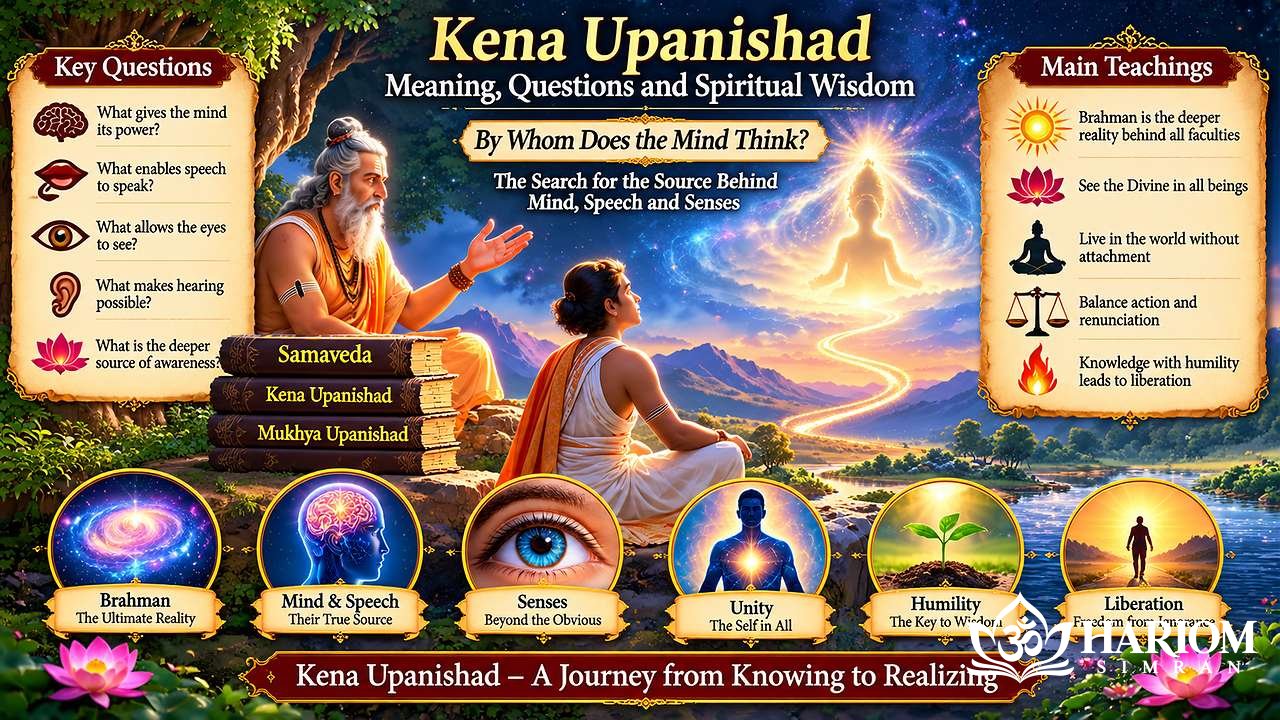
The Kena Upanishad begins not with a story, ritual or command, but with a question.
A profound question.
By whose power does the mind think?
What enables speech to speak?
What gives the eyes the power to see?
What allows the ears to hear?
What is the deeper source behind human awareness?
These questions immediately take the reader beyond ordinary experience.
We usually think about what the mind is thinking.
The Kena Upanishad asks something deeper:
What makes thinking possible in the first place?
We normally pay attention to what we hear.
The Upanishad asks:
What makes hearing possible?
This shift from the object of experience to the source of experience is the heart of the Kena Upanishad.
Its teachings explore Brahman, consciousness, sensory perception, knowledge, humility and the limits of ordinary understanding.
The text also contains one of the most memorable symbolic narratives in the Upanishadic tradition, where the gods become proud of a victory and are reminded that their power does not belong to them independently.
To understand the wider scriptural tradition, explore Hindu Scriptures.
What Is the Kena Upanishad?
The Kena Upanishad is one of the principal or Mukhya Upanishads.
It is associated with the Samaveda tradition.
It is also traditionally connected with the Talavakara or Jaiminiya textual tradition.
The Kena Upanishad explores questions about the source behind:
Mind
Speech
Hearing
Sight
Breath
Knowledge
Consciousness
Its central concern is Brahman, the deeper reality that makes human experience possible but cannot simply be reduced to one ordinary object of experience.
Why Is It Called the Kena Upanishad?
The name Kena comes from the Sanskrit word used at the beginning of the text.
Kena broadly means:
By Whom?
or
Through Whose Power?
The Upanishad begins by asking who or what directs the mind, speech and sensory faculties.
Its title therefore reflects its entire philosophical method.
The Kena Upanishad does not begin by telling the seeker what to believe.
It begins by asking:
What is behind everything we ordinarily take for granted?
Kena Upanishad and the Samaveda
The Kena Upanishad belongs to the Samaveda tradition.
This connection is meaningful because the Samaveda places great importance on sacred sound, chanting and oral transmission.
The Kena Upanishad moves from sacred sound toward a deeper philosophical question:
What gives speech itself its power?
This is a remarkable development.
The seeker no longer asks only how sacred words should be recited.
The seeker asks what deeper reality makes speech possible at all.
For wider sacred sound traditions, explore Mantras.
How Is the Kena Upanishad Structured?
The Kena Upanishad is commonly divided into four sections, traditionally called Khandas.
The earlier sections are primarily philosophical and poetic.
They ask questions about Brahman, consciousness and the sensory faculties.
The later sections shift into a symbolic narrative involving the Devas, a mysterious Yaksha and Uma Haimavati.
This combination of philosophy and story makes the Kena Upanishad especially powerful.
The first half asks:
What is Brahman?
The second half shows:
Why spiritual knowledge requires humility.
The Opening Question
The Kena Upanishad opens by asking what directs the human mind.
This immediately challenges our ordinary assumptions.
We usually say:
I Think.
I Speak.
I See.
I Hear.
But the Upanishad asks:
What makes all of these powers possible?
The question is not primarily biological.
It is philosophical and spiritual.
The text searches for the ultimate foundation behind human faculties.
What Gives the Mind Its Power?
The mind is normally treated as the center of thought.
But the Kena Upanishad asks the seeker to look deeper.
If the mind itself is an instrument of knowing, then:
What makes the mind capable of knowing?
This question changes the direction of spiritual inquiry.
Instead of studying only thoughts, the seeker begins to investigate the basis of awareness itself.
This is one reason the Kena Upanishad remains important in Hindu philosophy.
What Gives Speech Its Power?
Speech is essential to Vedic tradition.
Mantras, teachings and sacred knowledge are transmitted through words.
Yet the Kena Upanishad asks:
What enables speech to function?
The teaching suggests that Brahman cannot simply be captured by ordinary speech.
Words can point toward truth.
They can guide inquiry.
They can transmit teachings.
But ultimate reality cannot be completely contained within language.
This does not make sacred words useless.
It shows the limits of words.
What Gives Hearing Its Power?
The Kena Upanishad also turns attention toward hearing.
Normally we focus on sounds.
But the text asks about the deeper principle that makes hearing possible.
This movement from:
Sound
to
Hearing
and then toward:
The Source Behind Hearing
illustrates the Upanishadic method.
The seeker is repeatedly encouraged to move beyond surface experience toward its deeper foundation.
What Gives Sight Its Power?
The same method applies to vision.
We see forms, colors, people and the natural world.
But the Upanishad asks:
What is the deeper source through which seeing becomes possible?
The teaching points beyond the physical object and beyond even the sensory organ.
It turns attention toward consciousness and the reality underlying perception.
Brahman Beyond the Senses
A central teaching of the Kena Upanishad is that Brahman cannot simply be treated as an ordinary object.
An ordinary object can be:
Seen.
Heard.
Touched.
Described.
Measured.
Compared.
But Brahman is not merely one more thing inside the universe.
The Upanishad points toward Brahman as the deeper ground through which experience itself becomes possible.
This is why the language of the text can initially feel difficult.
The seeker is looking for the source of experience using the very faculties that depend upon that source.
The Ear Behind Hearing
One of the Kena Upanishad's most famous teaching patterns describes Brahman in relation to human faculties.
Brahman is presented as the deeper reality behind hearing, thinking, speech and seeing.
The teaching can be understood as asking us not to stop at the instrument.
The ear hears.
But what makes hearing meaningful?
The eye sees.
But what makes seeing part of conscious experience?
The mind thinks.
But what illuminates thought?
These questions move the inquiry toward consciousness itself.
Can Brahman Be Described?
The Kena Upanishad places strong limits on simple descriptions of Brahman.
If we imagine Brahman as an ordinary object that the mind can completely possess, we have already misunderstood the teaching.
The text repeatedly pushes beyond easy definitions.
Brahman is not merely:
Something We Know Like an Ordinary Object
But neither is Brahman simply:
Something Completely Unknown
The relationship between Brahman, knowledge and the knower is more subtle.
Known and Unknown
One of the most profound teachings in the Kena Upanishad concerns what is known and what is unknown.
The text suggests that Brahman is different from both ordinary known objects and ordinary unknown objects.
This is difficult because we normally divide everything into two categories:
Things I Know
and
Things I Do Not Know
The Kena Upanishad challenges this entire framework.
Brahman is not merely another item waiting to be added to our collection of knowledge.
Brahman is connected with the very possibility of knowing.
The Limits of Intellectual Knowledge
This is why intellectual understanding alone is not enough.
A person may memorize definitions such as:
Brahman Is Ultimate Reality.
But simply repeating the definition is not the same as realization.
Upanishadic inquiry distinguishes between:
Knowing About Something
and
Direct Spiritual Understanding
This difference becomes crucial.
A person can become very knowledgeable about philosophy while still missing the transformation the teaching seeks.
The Paradox of Knowing Brahman
The Kena Upanishad uses deliberately paradoxical teaching.
The person who confidently believes that Brahman has been fully understood may not yet understand.
The person who recognizes that ultimate reality cannot be completely reduced to ordinary conceptual knowledge may be closer to wisdom.
This does not mean:
Knowledge Is Impossible.
Instead, the text distinguishes between ordinary object based knowledge and deeper realization.
Spiritual humility becomes part of true knowledge.
Why Humility Matters
The theme of humility becomes even clearer in the narrative portion of the Upanishad.
Knowledge can create pride.
Power can create pride.
Victory can create pride.
A person begins to think:
I Did This.
This Power Belongs to Me.
I Understand Everything.
The Kena Upanishad challenges this attitude.
True wisdom begins when we recognize that the deeper source of life and power is greater than the individual ego.
The Story of the Devas and the Yaksha
The later portion of the Kena Upanishad tells a famous story.
The Devas achieve a victory.
They become proud.
They begin to believe that the victory belongs to their own power.
Then a mysterious presence appears.
The text presents this presence as a Yaksha, connected with Brahman.
The Devas do not recognize who or what stands before them.
This story transforms an abstract philosophical lesson into a dramatic spiritual teaching about pride, power and Divine reality.
Agni Approaches the Yaksha
The Devas first send Agni to discover the identity of the mysterious presence.
Agni represents tremendous power.
Fire can burn.
Transform.
Consume.
Illuminate.
Agni approaches confidently.
The Yaksha asks about his power.
Agni explains that he can burn what exists upon Earth.
Then the Yaksha places a small piece of matter before him.
Agni cannot burn it.
This moment is deeply symbolic.
Power that appears enormous becomes powerless before the source from which power itself arises.
What Does Agni's Failure Mean?
The story is not meant to disrespect Agni.
Agni is one of the most important Vedic Divine powers.
The spiritual point is different.
Even great cosmic powers do not possess ultimate power independently.
Their ability exists within a deeper reality.
The story therefore challenges the idea of absolute self sufficiency.
It teaches:
Power Without Knowledge of Its Source Can Lead to Pride.
Vayu Approaches the Yaksha
Next, Vayu approaches.
Vayu is associated with wind and movement.
He too expresses confidence in his power.
The Yaksha places the same challenge before him.
Vayu cannot move the object.
Again, the teaching becomes clear.
Even extraordinary power is limited when separated from recognition of its deeper source.
What Does Vayu's Failure Teach?
Vayu's inability is another lesson about humility.
Human beings often identify strongly with ability.
We think:
My Intelligence
My Strength
My Wealth
My Position
My Talent
The Upanishadic story asks us to consider:
Where did the ability itself come from?
The teaching shifts attention from possession of power toward the source of power.
Indra Approaches
Finally, Indra approaches the mysterious presence.
But before he can question the Yaksha, it disappears.
Indra is then confronted not with a simple answer but with another sacred encounter.
He sees Uma Haimavati.
She becomes the one who reveals the truth.
The victory of the Devas was made possible through Brahman.
Their pride was based on misunderstanding.
Who Is Uma Haimavati?
Uma Haimavati appears in the Kena Upanishad as a radiant feminine figure who reveals knowledge to Indra.
Haimavati is traditionally understood in connection with the Himalayas.
Later Hindu tradition strongly associates Uma with Parvati, the Goddess.
In the Kena Upanishad narrative, her most immediate role is that of a revealer of spiritual knowledge.
She tells Indra that the mysterious presence was Brahman.
This makes her role extremely significant.
Knowledge arrives through the Divine Feminine.
Uma as the Revealer of Knowledge
The appearance of Uma adds another dimension to the story.
Agni has power.
Vayu has power.
Indra has authority.
But power and authority are not enough.
Knowledge must be revealed.
Uma becomes associated with this moment of understanding.
The narrative therefore moves through:
Power
then
Failure
then
Humility
then
Knowledge
This sequence is one of the most memorable spiritual lessons in the Upanishad.
Indra and Spiritual Understanding
Indra receives special significance because he approaches most closely to the truth.
He does not fully discover Brahman through his own power.
Instead, understanding comes through revelation and inquiry.
The story suggests that spiritual knowledge is not simply conquered.
It is approached through humility, openness and recognition.
The Meaning of the Yaksha
The Yaksha can be understood as the mysterious appearance through which Brahman challenges the pride of the gods.
The form is significant because Brahman is not immediately recognized.
The Divine does not always appear in the form we expect.
This challenges spiritual assumptions.
A person may know many doctrines and still fail to recognize truth when it appears outside familiar expectations.
Pride and Spiritual Blindness
The narrative teaches that pride can prevent recognition.
The gods have experienced victory.
Instead of asking:
What Made This Possible?
they think:
We Are the Source of This Victory.
The error is not only moral pride.
It is metaphysical misunderstanding.
They mistake dependent power for independent power.
This is why spiritual humility becomes a form of wisdom.
Knowledge as Recognition
In the Kena Upanishad, knowledge is not merely accumulating information.
It is recognition.
Recognizing the source behind:
Mind.
Speech.
Hearing.
Sight.
Breath.
Power.
Victory.
When this recognition occurs, the ego can no longer claim complete independence.
Spiritual knowledge therefore transforms identity.
Kena Upanishad and Atman
The Kena Upanishad primarily speaks in terms of Brahman and the source behind human faculties.
However, its teachings naturally connect with the wider Upanishadic inquiry into Atman.
If awareness cannot be reduced simply to the body, senses or ordinary mind, then deeper questions about the Self become unavoidable.
Other principal Upanishads develop this relationship more explicitly.
Kena Upanishad and Brahman
Brahman is the central philosophical reality of the Kena Upanishad.
The text teaches us to look beyond:
Speech to the source of speech
Mind to the source of thought
Sight to the source of seeing
Hearing to the source of hearing
This does not turn Brahman into another hidden object.
Instead, Brahman becomes the deeper basis through which these faculties function.
Kena Upanishad and Consciousness
Modern readers often find the Kena Upanishad especially interesting because its questions resemble philosophical questions about consciousness.
What makes awareness possible?
Can consciousness be reduced to what appears within consciousness?
Who or what is the knower?
The Upanishad belongs to an ancient spiritual context, not modern neuroscience.
Therefore, it should not be presented as a scientific theory of the brain.
Its value lies in philosophical and contemplative inquiry into experience and awareness.
Mind Is Not the Final Reality
Human beings often identify strongly with thought.
We may assume:
My Thoughts Are My Deepest Self.
But the Kena Upanishad encourages us to ask:
What knows the movement of thought?
If thoughts can be observed, then the philosophical inquiry continues deeper.
The text does not provide a simplistic psychological formula.
It redirects attention from thought toward the underlying condition of awareness.
Speech Cannot Capture Everything
Human language is powerful.
It can preserve scriptures.
Teach philosophy.
Express devotion.
Build relationships.
But language has limits.
The Kena Upanishad reminds us that ultimate reality cannot simply be contained inside a definition.
This protects spiritual teaching from becoming mere terminology.
Words matter.
But realization must go deeper than words.
Silence and Spiritual Understanding
The Kena Upanishad does not simply teach that silence is always better than speech.
Its deeper message is that sacred truth exceeds ordinary verbal description.
Sometimes wisdom requires speaking.
Sometimes questioning.
Sometimes listening.
And sometimes recognizing where concepts reach their limit.
This balance becomes important in later Hindu contemplative traditions.
Kena Upanishad and Guru Shishya Tradition
The structure of the text reflects the wider Guru Shishya tradition.
Spiritual inquiry develops through questions and responses.
A seeker does not simply receive information passively.
The seeker must think.
Question.
Reflect.
Recognize limits.
And gradually understand.
This makes the Kena Upanishad particularly valuable for educational platforms such as HariOmSimran because the text itself models inquiry based learning.
Asking the Right Question
One of the deepest lessons of the Kena Upanishad is that spiritual progress often begins not with an answer but with the right question.
The opening question is not:
Which Deity Should I Worship?
or
Which Ritual Should I Perform?
It asks:
What is the source behind the faculties through which I experience everything?
The quality of the question changes the quality of inquiry.
Kena Upanishad and Meditation
The Kena Upanishad is philosophical rather than a manual of meditation techniques.
However, its teachings naturally support contemplation.
A seeker may reflect on questions such as:
What is behind thought?
What makes awareness possible?
Can the observer itself be observed as an ordinary object?
Such reflection can deepen spiritual awareness.
However, traditional meditation practices should be understood within their specific lineages and contexts.
Kena Upanishad and Sacred Sound
Because the Kena Upanishad belongs to the Samaveda tradition, its connection with sacred sound is particularly meaningful.
Yet it asks us to look beyond sound to the reality that allows hearing and speech.
This creates a beautiful progression:
Sacred Sound
to
Awareness of Sound
to
The Source of Awareness
Explore the wider Hindu tradition of sacred sound through Mantras.
Kena Upanishad and the Divine
The Kena Upanishad speaks of Brahman in ways that resist easy categorization.
Brahman is not simply one visible deity among other beings.
Yet the narrative also includes Agni, Vayu, Indra and Uma.
This demonstrates an important feature of Hindu sacred thought.
Philosophical inquiry into ultimate reality and devotional or Divine imagery can exist within the same scriptural world.
Explore wider Hindu Divine traditions through Deities.
Does the Kena Upanishad Say the Gods Are Powerless?
No.
That would misunderstand the story.
Agni, Vayu and Indra remain important Vedic Divine figures.
The lesson is that their powers are not ultimately independent of Brahman.
The narrative uses their encounter to teach humility and the deeper source of power.
Kena Upanishad and Vedanta
The Kena Upanishad became important within Vedanta because it deals directly with the relationship between Brahman, knowledge and consciousness.
Major Vedanta traditions interpret these themes through different philosophical frameworks.
Advaita, Vishishtadvaita, Dvaita and other traditions do not explain Brahman and the individual self in exactly the same way.
HariOmSimran should preserve this diversity rather than presenting one interpretation as universally accepted.
Kena Upanishad and Advaita Vedanta
Advaita Vedanta gives great importance to the teaching that Brahman is not an ordinary object of knowledge.
Advaita interpreters emphasize the deeper identity of consciousness and ultimate reality.
The Kena Upanishad's questions about the knower and the faculties become highly significant in this context.
However, this is one major interpretive tradition, not the only possible reading.
Other Vedanta Interpretations
Other Vedanta schools affirm the authority of the Upanishads while interpreting Brahman and the individual soul differently.
Some emphasize the Supreme Lord as the ultimate source behind all faculties and powers.
Some maintain real distinctions between the soul, universe and Supreme Divine.
The important educational principle is:
Same Scripture, Different Philosophical Interpretations.
This diversity is central to the history of Vedanta.
Kena Upanishad and Humility
If one teaching connects both halves of the Kena Upanishad, it is humility.
The philosophical section teaches humility before the limits of conceptual knowledge.
The narrative section teaches humility before the source of power.
The seeker learns:
Do Not Assume You Fully Possess Ultimate Truth.
Do Not Assume Your Power Exists Independently.
These two forms of humility support spiritual wisdom.
Power Without Wisdom
The story of the Devas remains highly relevant.
Human beings can possess:
Knowledge.
Technology.
Authority.
Wealth.
Influence.
Physical power.
But power does not automatically produce wisdom.
The Kena Upanishad asks:
Do We Understand the Source, Purpose and Limits of Our Power?
This question gives the ancient text continuing philosophical relevance.
Knowledge Without Humility
The same is true of knowledge.
A person may become educated and still become arrogant.
The Kena Upanishad challenges the idea that intellectual confidence automatically equals realization.
True spiritual knowledge includes recognition of the limits of ego centered understanding.
Can Brahman Be Seen?
Not in the ordinary sense of seeing an object.
If Brahman is the deeper basis through which seeing itself becomes possible, then Brahman cannot simply be placed in front of the eye like an ordinary visible thing.
This does not mean Brahman is meaningless or unreal.
It means the category of ordinary sensory object is insufficient.
Can Brahman Be Thought About?
Yes, the Upanishad itself clearly encourages inquiry.
But it also reminds us that conceptual thought cannot completely capture Brahman.
Thought can guide.
Question.
Clarify.
Remove misunderstandings.
But ultimate reality is not exhausted by a mental definition.
Is the Kena Upanishad About Consciousness?
Consciousness is certainly one of the major philosophical themes that modern readers can identify within the text.
However, the Kena Upanishad should not be reduced to a modern theory of consciousness.
Its actual concern is spiritual and metaphysical.
It asks about Brahman as the source behind human faculties and experience.
Is Uma Haimavati Goddess Parvati?
Later Hindu tradition commonly identifies Uma with Parvati.
The Kena Upanishad uses the name Uma Haimavati in the narrative.
Within the text, her immediate role is to reveal Brahman to Indra.
When explaining the passage, it is helpful to distinguish the Upanishadic narrative itself from later developed theological traditions.
Is the Kena Upanishad Difficult?
The text is relatively short but philosophically demanding.
Its main challenges include:
The distinction between ordinary knowledge and realization.
The idea that Brahman is beyond simple known versus unknown categories.
The relationship between senses and consciousness.
The symbolic story of the Devas and the Yaksha.
Different Vedanta interpretations.
This is why slow reading is more valuable than simply reading it quickly.
How Should Beginners Study the Kena Upanishad?
A good learning sequence is to first understand its Samaveda connection, then study the opening questions about mind, speech, sight and hearing. After that, explore the teaching that Brahman cannot be reduced to an ordinary object of knowledge, then study the paradox of knowing and not knowing, followed by the story of Agni, Vayu, Indra, the Yaksha and Uma Haimavati. Finally, compare how major Vedanta traditions interpret the text.
This sequence preserves the natural development of the Upanishad.
Common Misunderstandings About the Kena Upanishad
The Kena Upanishad does not teach that the mind or senses are useless. It asks what deeper reality gives them their power.
It does not teach that Brahman can never be known in any meaningful sense. It distinguishes deeper realization from treating Brahman as an ordinary object.
The story of Agni and Vayu does not insult Vedic deities. It teaches that power has a deeper source.
The Upanishad is not exclusively an Advaita text, even though Advaita gives it great importance.
Uma Haimavati's appearance is not a minor decorative episode. She plays the decisive role of revealing Brahman to Indra.
What Can Modern Readers Learn From the Kena Upanishad?
The Kena Upanishad asks questions that remain remarkably relevant:
What Is the Source Behind My Abilities?
Does Intelligence Automatically Mean Wisdom?
Can Power Exist Without Responsibility?
Do Words Capture Everything That Is Real?
What Is the Difference Between Information and Realization?
Can Pride Prevent Us From Recognizing Truth?
These questions make the Kena Upanishad valuable even for readers living far outside its ancient Vedic world.
Why the Kena Upanishad Still Matters
The Kena Upanishad matters because it directs spiritual inquiry toward the source behind ordinary experience.
It does not ask only:
What Do You See?
It asks:
What Makes Seeing Possible?
It does not ask only:
What Are You Thinking?
It asks:
What Gives the Mind Its Power?
It does not ask only:
What Power Do You Possess?
It asks:
What Is the Source of That Power?
Through these questions, the Kena Upanishad transforms spiritual inquiry from surface knowledge into deeper awareness.
Explore Upanishadic Wisdom With HariOmSimran
HariOmSimran is developing the Scripture section as a structured journey through Hindu sacred knowledge.
Continue exploring Hindu Scriptures, Hinduism, Mantras, Deities, Dharma, Hindu Stories, Temples and Festivals.
The next detailed article in our Upanishads series should be:
Katha Upanishad: Nachiketa, Death and the Wisdom of the Self
After that, we can continue systematically with Prashna Upanishad, Mundaka Upanishad, Mandukya Upanishad, Taittiriya Upanishad, Aitareya Upanishad, Chandogya Upanishad and Brihadaranyaka Upanishad.
Learn • Explore • Understand • Preserve
Key Takeaway
The Kena Upanishad is a principal Upanishad associated with the Samaveda.
Its name comes from the question:
By Whom?
The text asks what gives the mind, speech, hearing, sight and other faculties their power.
Its central teaching directs the seeker beyond ordinary objects toward Brahman, the deeper reality behind experience and awareness.
The second half presents the memorable story of the Devas, the mysterious Yaksha and Uma Haimavati.
Agni and Vayu discover the limits of their power.
Indra approaches more closely to the mystery.
Uma reveals that the Devas' victory ultimately came through Brahman.
The Upanishad therefore joins two profound teachings:
True Knowledge Requires Humility.
True Power Must Recognize Its Source.
Key Teachings
This scripture reveals profound wisdom and guidance for our spiritual journey. Below are the key teachings and principles derived from this sacred text.
Core Principles
These teachings provide guidance for living a life of faith, compassion, and spiritual growth.
- Spiritual Growth
- Divine Wisdom
- Sacred Teachings
- Faith Journey

Study Resources
Explore these resources to deepen your understanding of this scripture and apply its teachings to your daily life.
📖 Study Guide
Comprehensive study materials to help you understand the context, meaning, and application of this scripture.
🙏 Reflection Questions
Thought-provoking questions to help you reflect on the teachings and apply them to your personal spiritual journey.
📝 Journal Prompts
Guided journaling prompts to help you document your insights, prayers, and spiritual growth.
👥 Discussion Topics
Engaging discussion topics for group study and fellowship, fostering deeper understanding and community.
Frequently Asked Questions
The Kena Upanishad is one of the principal Upanishads associated with the Samaveda. It explores Brahman, consciousness, mind, speech, sensory perception, knowledge and spiritual humility.
Its name comes from the Sanskrit word Kena, meaning “By whom?” The text begins by asking by whose power the mind, speech and senses function.
A central teaching is that Brahman is the deeper source behind mind, speech, hearing, sight and other faculties, yet cannot simply be treated as an ordinary object of knowledge.
After the Devas become proud of a victory, Brahman appears mysteriously as a Yaksha. Agni and Vayu fail to demonstrate their powers before it, while Indra later learns from Uma Haimavati that the mysterious presence was Brahman.
Uma Haimavati is the radiant feminine figure who reveals to Indra that the mysterious Yaksha was Brahman. Later Hindu tradition commonly connects Uma with Goddess Parvati.
The Kena Upanishad is important because it asks what lies behind thought, speech and perception while teaching that genuine spiritual knowledge requires humility, deeper inquiry and recognition of the ultimate source of power.