

Few Upanishadic stories are as memorable as the story of Nachiketa.
A young seeker stands before Yama, the Lord of Death.
He is offered wealth.
Long life.
Pleasure.
Power.
Beautiful possessions.
Every attraction that could turn his attention away from the deepest question.
But Nachiketa refuses.
He wants to know something more important:
What happens after death?
Does the Self continue?
What is the truth behind human mortality?
How can a person become free from fear and spiritual bondage?
This is the heart of the Katha Upanishad.
The text turns the mystery of death into a journey toward the knowledge of Atman, the deeper Self.
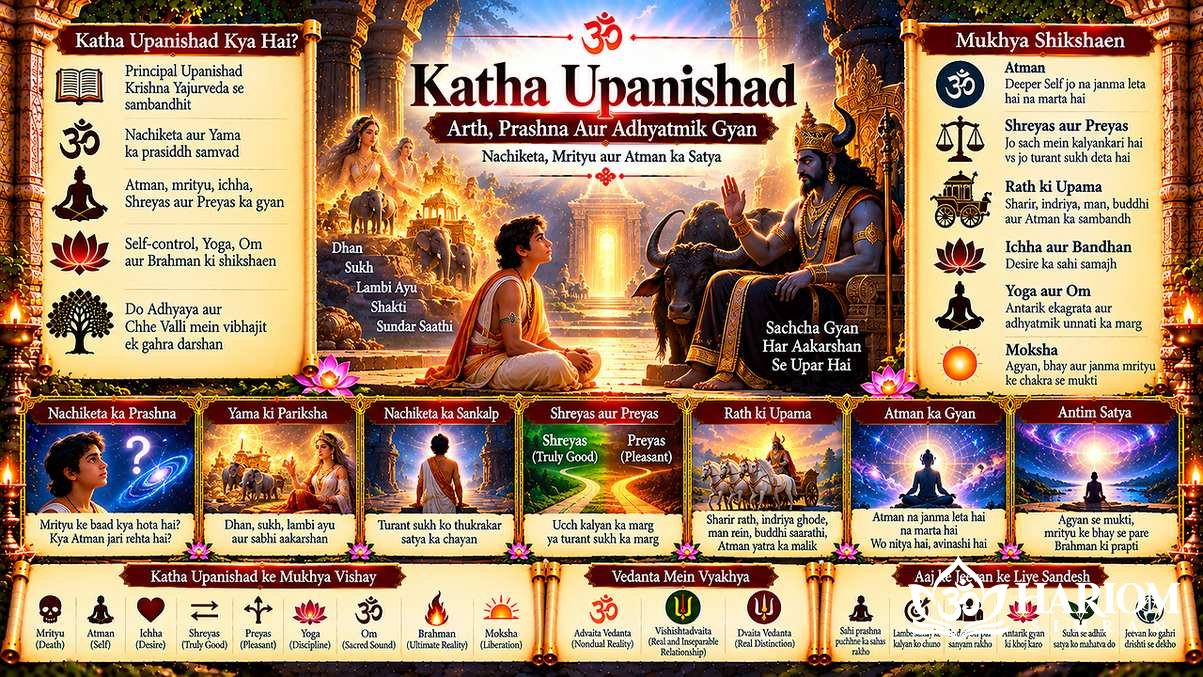
Through the dialogue between Nachiketa and Yama, the Upanishad explores:
- Life And Death
- Atman
- Desire
- Shreyas And Preyas
- Self-Control
- The Chariot Analogy
- Yoga
- Om
- Brahman
- Spiritual Liberation
The story is ancient, but its central challenge remains deeply relevant:
Will we choose what is merely pleasant, or what leads toward deeper wisdom?
To understand the wider scriptural tradition, explore Hindu Scriptures.
What Is the Katha Upanishad?
The Katha Upanishad is one of the principal or Mukhya Upanishads.
It is associated with the Krishna Yajurveda.
The text is also connected with the Katha school of the Yajurvedic tradition.
It is especially famous for the dialogue between:
Nachiketa
and
Yama
The conversation begins with questions about death but gradually develops into a profound teaching about:
Atman
Brahman
Desire
Self-Discipline
Consciousness
Meditation
Liberation
The Katha Upanishad is one of the most accessible principal Upanishads because its philosophy unfolds through a powerful human story.
Why Is It Called the Katha Upanishad?
The name Katha is connected with the Katha school or branch of the Krishna Yajurveda tradition.
The text should therefore not be understood as simply meaning “story Upanishad,” even though it contains one of the most famous stories in Hindu philosophy.
Its name reflects its Vedic textual lineage.
Katha Upanishad and the Krishna Yajurveda
The Katha Upanishad belongs to the Krishna Yajurveda tradition.
This connection is important because the Yajurveda is strongly associated with ritual action and sacred formulas.
The Katha Upanishad moves into a deeper philosophical world.
Instead of asking only:
How should a ritual be performed?
The text asks:
What is the meaning of death?
What is the true Self?
What remains when the body dies?
This demonstrates the broader movement of Vedic thought from ritual toward philosophical inquiry.
How Is the Katha Upanishad Structured?
The Katha Upanishad is traditionally divided into:
Two Adhyayas
Each Adhyaya contains:
Three Vallis
This gives the text a total of six Vallis.
The structure unfolds gradually.
The early sections introduce Nachiketa, his father's sacrifice and his encounter with Yama.
The later sections move deeper into teachings about:
The Self
The Chariot Analogy
Desire
Yoga
Om
Brahman
Liberation
The narrative becomes increasingly philosophical as the text progresses.
Who Is Nachiketa?
Nachiketa is the young seeker at the center of the Katha Upanishad.
He is remembered not because he possesses worldly power, but because he possesses something spiritually more important:
The Courage to Ask the Right Question
He is young, but serious.
Respectful, but fearless.
Curious, but not distracted by pleasure.
His character represents the ideal spiritual student.
Nachiketa wants truth more than comfort.
That makes him one of the most powerful seeker figures in the Upanishadic tradition.
Nachiketa and His Father
The story begins with Nachiketa's father, traditionally called Vajashravasa.
He is performing a religious offering in which possessions are being given away.
Nachiketa observes that some of the cows being donated are old and no longer useful.
This troubles him.
The problem is not simply that the gift is imperfect.
The deeper issue is:
Can an outwardly religious act have real spiritual value if it is performed without genuine sincerity?
This question introduces a major theme of the Upanishad:
Inner Integrity Matters More Than External Appearance.
Nachiketa's Question to His Father
Nachiketa repeatedly asks his father:
To whom will you give me?
His questioning becomes uncomfortable.
Eventually, in anger, his father tells him:
I give you to Death.
The statement sets the entire spiritual journey in motion.
Rather than treating the words casually, Nachiketa goes toward the abode of Yama.
This moment shows his seriousness.
He is willing to follow truth even when the path becomes frightening.
Nachiketa Arrives at the House of Yama
When Nachiketa reaches Yama's abode, Yama is not present.
Nachiketa waits.
Traditionally, he remains there for three nights without receiving proper hospitality.
When Yama returns, he recognizes that an honored guest has waited in his house.
To make amends, Yama grants Nachiketa three boons.
These three boons shape the early structure of the teaching.
The First Boon
For his first boon, Nachiketa does not ask for wealth or personal advantage.
He asks that his relationship with his father be restored.
He wants his father to be free from anger and to welcome him peacefully when he returns.
This is significant.
Before asking about the mystery of existence, Nachiketa seeks reconciliation within his family.
Spiritual knowledge does not begin by ignoring human relationships.
It begins with harmony and responsibility.
The Second Boon
For his second boon, Nachiketa asks Yama to teach him about a sacred fire connected with attaining a heavenly state.
Yama explains the ritual.
Nachiketa learns it carefully.
Yama is pleased with his understanding and associates the teaching with Nachiketa.
This becomes known as the Nachiketa Fire.
The episode is important because it preserves the connection between:
Vedic Ritual
and
Upanishadic Knowledge
The text does not begin by rejecting ritual.
Instead, it gradually moves beyond ritual toward deeper knowledge of the Self.
The Third Boon
Nachiketa's third boon is the most important.
He asks:
When a person dies, some say that the person continues to exist, while others say that nothing remains. What is the truth?
This is not a superficial question.
It goes directly to the mystery of human existence.
Yama initially hesitates.
He tells Nachiketa that even the gods have found this question difficult.
But Nachiketa does not withdraw his request.
He wants the truth.
Why Does Yama Test Nachiketa?
Yama does not immediately answer.
Instead, he tests Nachiketa.
He offers him:
- Long Life
- Children And Grandchildren
- Wealth
- Horses
- Elephants
- Gold
- Land
- Power
- Pleasures
- Beautiful Companions
In simple terms, Yama offers almost everything a person might normally desire.
But there is one condition:
Do Not Ask About Death.
Nachiketa refuses.
Why Nachiketa Rejects Wealth and Pleasure
Nachiketa understands something fundamental.
Pleasure is temporary.
Wealth is temporary.
Physical beauty is temporary.
Even a long life eventually ends.
He tells Yama that these things cannot answer his deepest question.
This is one of the most important moments in the Katha Upanishad.
Nachiketa does not say that every worldly pleasure is automatically evil.
His point is deeper:
Temporary Things Cannot Solve the Problem of Mortality.
Shreyas and Preyas
Yama begins his teaching by distinguishing between two paths:
Shreyas
and
Preyas
These are among the most famous concepts in the Katha Upanishad.
Shreyas
Shreyas can broadly refer to:
What Is Truly Good
What Leads Toward Higher Well-Being
What Supports Spiritual Growth
Preyas
Preyas refers more closely to:
What Is Pleasant
What Immediately Attracts Us
What We Desire Because It Feels Good
The wise person learns to distinguish between them.
Pleasant Is Not Always Beneficial
This teaching remains remarkably practical.
Something can feel pleasant now but create suffering later.
Something can feel difficult now but lead to growth.
Examples can include:
Comfort Versus Discipline
Immediate Pleasure Versus Long-Term Responsibility
Flattery Versus Truth
Impulse Versus Wisdom
Entertainment Versus Serious Study
The Katha Upanishad teaches that spiritual maturity requires learning to distinguish:
What I Want
from
What Is Truly Good
Nachiketa Chooses Shreyas
Yama recognizes that Nachiketa has chosen Shreyas.
He has rejected temporary attractions for the sake of deeper truth.
This qualifies him for higher teaching.
The lesson is important.
Spiritual knowledge is not simply given because someone is curious.
The seeker must also demonstrate:
Discernment
Patience
Self-Control
Seriousness
Commitment to Truth
Nachiketa possesses these qualities.
Vidya and Avidya
The Katha Upanishad distinguishes the path of spiritual knowledge from the path of ignorance.
A person may be intellectually confident and still remain spiritually confused.
The text warns against people who imagine themselves wise while remaining trapped in ignorance.
This teaching is especially relevant today.
Access to information does not automatically produce wisdom.
The question is:
Does Knowledge Transform the Way We Understand Life?
Atman in the Katha Upanishad
The central philosophical teaching of the Katha Upanishad concerns Atman, the Self.
The text challenges the idea that our deepest identity is simply:
The Body
The Senses
Thoughts
Emotions
Social Identity
The Self is presented as deeper than these changing aspects of experience.
The body changes.
Thoughts change.
Emotions change.
Circumstances change.
The Upanishad asks:
What is the deeper reality of the person?
The Self Is Not Born and Does Not Die
One of the most famous teachings of the Katha Upanishad describes the Self as not being born and not dying in the ordinary sense.
The teaching presents Atman as fundamentally different from the changing physical body.
The body enters existence and eventually dies.
But the deeper Self is not treated as merely another temporary object.
This teaching becomes extremely influential in later Hindu philosophy.
Death and the Self
The central question of the Katha Upanishad is therefore transformed.
Initially, Nachiketa asks:
What happens after death?
Yama's teaching gradually shifts the question toward:
What is it that truly dies?
If a human being identifies only with the body, death appears as total destruction.
But if the deeper Self is not identical with the body, the understanding of mortality changes.
This becomes a foundation for deeper teachings about Samsara and liberation.
Atman Is Difficult to Understand
Yama does not present Self-knowledge as something easy.
Atman cannot be fully understood simply through:
Casual Listening
Argument
Intellectual Pride
The seeker needs preparation.
Understanding requires:
Discernment
Self-Control
Guidance
Meditation
Serious Inquiry
This does not mean intellectual study is useless.
It means intellectual study alone may not be enough.
The Chariot Analogy
One of the most famous teachings of the Katha Upanishad is the Chariot Analogy.
The human being is compared to a chariot system.
Broadly, the analogy presents:
The Body as the Chariot
The Senses as the Horses
The Mind as the Reins
The Intellect as the Charioteer
The Self as the Master of the Chariot
This analogy is one of the clearest explanations of self-discipline in Hindu philosophy.
The Body as the Chariot
The body is compared with the chariot.
A chariot is necessary for travel.
Likewise, the body is the vehicle through which human life is experienced.
The Katha Upanishad does not teach hatred of the body.
The problem arises when the vehicle is mistaken for the deepest Self.
The body is important.
But it is not the whole of who we are.
The Senses as Horses
The senses are compared with horses.
Horses possess great energy.
But if they run without guidance, the chariot may lose direction.
Similarly, human senses constantly move toward:
Objects
Pleasure
Sound
Taste
Sight
Desire
The teaching is not that senses are evil.
The issue is whether they are guided.
The Mind as the Reins
The mind is compared with the reins.
Reins connect the charioteer with the horses.
Similarly, the mind manages sensory impulses.
A restless mind creates instability.
A disciplined mind allows better direction.
This analogy shows why mental discipline becomes important in spiritual life.
The Intellect as the Charioteer
The intellect, or discriminating faculty, is compared with the charioteer.
The charioteer must know:
The Destination
The Road
How to Guide the Horses
Without discernment, the chariot may move quickly in the wrong direction.
This becomes a powerful teaching about wisdom.
Speed is not enough.
Energy is not enough.
Desire is not enough.
Direction Matters.
The Self as the Master of the Chariot
The Self is the true master or passenger of the chariot.
The analogy reminds the seeker:
You are not simply the senses.
You are not simply the mind.
You are not simply the body.
The deeper spiritual inquiry asks who is the real experiencer behind these faculties.
This teaching becomes closely connected with the Upanishadic search for Atman.
What Happens When the Senses Are Uncontrolled?
If the senses are uncontrolled and the mind lacks discipline, the chariot becomes difficult to guide.
The person may be pulled constantly from one desire to another.
This produces a life dominated by:
Impulse
Attachment
Restlessness
Confusion
The Katha Upanishad therefore connects spiritual progress with mastery rather than suppression.
The goal is not to destroy human faculties.
The goal is to bring them into harmony.
Self-Control in the Katha Upanishad
Self-control here does not mean becoming emotionally lifeless.
It means not becoming a slave to every impulse.
The disciplined seeker can experience desire without automatically obeying it.
This creates freedom.
Without self-control, we may believe we are choosing freely while actually being controlled by:
Habit
Fear
Pleasure
Anger
Social Pressure
Craving
The Upanishadic path aims at deeper freedom.
Katha Upanishad and Yoga
The Katha Upanishad contains important early teachings related to Yoga.
The text describes a state in which the senses become steady, the mind becomes calm and higher understanding is established.
This is sometimes connected with the development of later Yoga philosophy.
However, the Katha Upanishad should not simply be treated as identical to Patanjali's Yoga Sutras.
It belongs to an earlier Upanishadic context.
What Does Yoga Mean Here?
In the Katha Upanishad, Yoga is closely connected with:
Control of the Senses
Stability of the Mind
Inner Concentration
Spiritual Awareness
The emphasis is on gathering the scattered faculties and directing awareness toward deeper reality.
This makes the text important in the history of Hindu contemplative thought.
The Inner Journey
The Katha Upanishad repeatedly directs attention inward.
Human beings naturally search outward:
For possessions.
Recognition.
Pleasure.
Information.
Security.
But the Upanishad asks whether the deepest truth can be found only by looking outward.
The search for Atman becomes an inner journey.
This does not require rejecting the external world.
It requires understanding that the deepest question cannot be solved through external acquisition alone.
The Path Is Subtle
The Katha Upanishad describes the spiritual path as subtle and difficult.
A famous image compares it to a path as sharp as a razor.
The idea is not meant to create fear.
It emphasizes:
Attention
Discernment
Care
Discipline
Spiritual understanding requires more than casual interest.
The seeker must learn to distinguish reality from appearance.
Arise, Awake and Learn
One of the most famous teachings associated with the Katha Upanishad urges the seeker to:
Arise
Awaken
and
Learn from the wise
This became one of the most inspiring calls in Hindu spiritual literature.
The message is active.
Spiritual life is not passive waiting.
The seeker must awaken from ignorance and seek understanding with seriousness.
The Role of the Guru
The Katha Upanishad places great importance on genuine guidance.
Self-knowledge is subtle.
Therefore, guidance from someone who understands the path is valuable.
Nachiketa has courage and intelligence.
But he still learns from Yama.
This reflects the wider Guru Shishya tradition.
Spiritual inquiry involves both:
Personal Effort
and
Guided Learning
Katha Upanishad and Om
The Katha Upanishad also discusses Om.
Om is presented as a profound support for spiritual contemplation.
It is connected with the search for Brahman and the highest spiritual goal.
The text does not treat Om merely as a decorative religious symbol.
It belongs to a sacred contemplative tradition.
Explore the wider Hindu tradition of sacred sound through Mantras.
Om as a Spiritual Support
Om can function as a focus through which the seeker turns the mind toward ultimate reality.
Different Upanishads emphasize Om in different ways.
The Mandukya Upanishad later develops an especially detailed philosophical teaching around Om.
In the Katha Upanishad, Om appears within the broader path toward Brahman and liberation.
Brahman in the Katha Upanishad
The text also points toward Brahman, ultimate reality.
The Self and Brahman become central to the spiritual inquiry.
Different Vedanta traditions later interpret the relationship between individual Atman and Brahman differently.
The Katha Upanishad therefore became an important scriptural source for:
Advaita
Vishishtadvaita
Dvaita
and other Vedantic traditions.
The Smallest and the Greatest
The Katha Upanishad uses paradoxical language to describe the deeper Self or ultimate reality.
It can be described as:
Smaller Than the Small
and
Greater Than the Great
This language pushes beyond ordinary physical measurement.
Atman cannot be understood as simply another object with physical size.
The paradox encourages contemplation of a reality not limited by ordinary categories.
Atman in the Heart
The Upanishadic tradition sometimes speaks of the Self as present within the heart.
This should not automatically be reduced to the physical organ.
In sacred philosophical language, the heart can represent the inner center of being.
The seeker is invited to discover the deeper Self within.
Desire and Bondage
Desire plays an important role in the Katha Upanishad.
The problem is not simply that humans experience preferences.
The deeper issue is attachment.
When identity becomes tied to endless desire, a person remains restless.
One desire is fulfilled.
Another appears.
Then another.
The cycle continues.
Spiritual freedom requires understanding desire rather than simply being driven by it.
When Desires Fall Away
One of the Upanishad's important teachings connects liberation with freedom from desires that dominate the heart.
This does not necessarily mean becoming unable to care about anything.
The concern is bondage.
When compulsive craving no longer controls the person, a deeper freedom becomes possible.
Katha Upanishad and Samsara
The teaching about death naturally connects with Samsara, the cycle of birth and death.
Human beings continue within bondage when they remain trapped in ignorance and desire.
The deeper knowledge of Self becomes connected with liberation from this cycle.
Later Hindu philosophical traditions develop detailed explanations of Karma, rebirth and Moksha.
Katha Upanishad and Moksha
Moksha is spiritual liberation.
In the Katha Upanishad, liberation is deeply connected with realization of the Self and freedom from ignorance.
The seeker moves beyond fear of death because the deeper Self is understood differently from the mortal body.
Different Hindu traditions explain the exact nature of Moksha differently.
HariOmSimran should respect these distinctions.
Fear of Death
The Katha Upanishad is particularly powerful because it does not avoid death.
It begins with death.
The teacher is Death.
The central question concerns death.
But the text does not remain trapped in fear.
Instead, death becomes a doorway to deeper inquiry.
The spiritual question becomes:
If death is unavoidable, how should we understand life?
Why Yama Is the Teacher
Yama is an extraordinary choice of teacher.
Who could be more appropriate to answer questions about mortality than the Lord of Death?
Yet Yama does not simply describe what happens after death.
He teaches Nachiketa about:
Discipline
Atman
Wisdom
Desire
Yoga
Liberation
The answer to death is therefore not merely information about the afterlife.
It is knowledge of the Self.
Yama as a Wise Teacher
Yama is not portrayed only as frightening.
In the Katha Upanishad, he becomes a teacher of profound spiritual wisdom.
He tests the student.
Explains difficult truths.
Uses analogy.
Distinguishes higher from lower choices.
This portrayal demonstrates the rich symbolic role of Yama within Hindu tradition.
Explore wider Hindu Divine traditions through Deities.
Katha Upanishad and the Bhagavad Gita
The Katha Upanishad and Bhagavad Gita share several philosophical themes.
Both discuss:
The Self
Sense Control
Desire
Discipline
Spiritual Knowledge
Yoga
Liberation
Some teachings and images strongly resonate across the two texts.
However, the Bhagavad Gita belongs to a later Mahabharata setting and develops these themes through Krishna's dialogue with Arjuna.
The texts should be connected thoughtfully, not treated as identical.
Katha Upanishad and Vedanta
The Katha Upanishad became an important text for later Vedanta traditions.
Its teachings on Atman, Brahman and liberation became central to philosophical interpretation.
Different schools agree that the text is authoritative but disagree about certain metaphysical conclusions.
This is normal within Hindu philosophical history.
A responsible article should distinguish:
The Scripture
from
Later Interpretation
Katha Upanishad and Advaita Vedanta
Advaita Vedanta gives strong importance to teachings about the deathless Self and ultimate spiritual realization.
Advaita interpreters read many passages in light of the nondual relationship between Atman and Brahman.
This makes the Katha Upanishad an important text within Advaita study.
But Advaita is not the only Vedanta tradition that values it.
Katha Upanishad and Other Vedanta Traditions
Vishishtadvaita, Dvaita and other Vedantic traditions also interpret the Katha Upanishad.
They may emphasize:
The Supreme Divine
The Reality of the Individual Soul
Dependence on Brahman
Difference and Relationship
The same scripture can therefore support different philosophical discussions.
This diversity is part of the living Hindu intellectual tradition.
Is Nachiketa a Historical Person?
The Katha Upanishad presents Nachiketa as the central figure in a sacred philosophical narrative.
The text's main importance lies in the spiritual teaching conveyed through his dialogue with Yama.
Modern historical questions about whether every narrative detail can be independently verified are separate from the traditional scriptural meaning.
HariOmSimran should distinguish these perspectives without unnecessarily dismissing either.
Is the Katha Upanishad About the Afterlife?
Partly, but reducing it to an afterlife text would miss its deeper purpose.
Nachiketa asks what happens after death.
But Yama's answer becomes a teaching about:
The Self
Desire
Wisdom
Discipline
Yoga
Liberation
The text transforms curiosity about death into inquiry about the nature of life itself.
Does the Katha Upanishad Teach Reincarnation?
The Katha Upanishad belongs to the Upanishadic world in which Karma, rebirth and liberation become increasingly important concepts.
Its teachings describe different spiritual outcomes according to understanding and conduct.
However, later Hindu traditions develop much more detailed theories of reincarnation.
The Katha Upanishad should be read as an important early philosophical source within that larger development.
Does the Katha Upanishad Reject Pleasure?
No.
The text distinguishes Preyas, the pleasant, from Shreyas, the truly beneficial or spiritually higher.
The point is not that everything enjoyable is evil.
The problem arises when immediate pleasure becomes the only basis for decision-making.
The wise person learns when pleasure conflicts with what is genuinely good.
Is the Body Considered Bad?
No.
The chariot analogy actually shows that the body has an important role.
A chariot is necessary for the journey.
But the traveler should not confuse the vehicle with the destination or the deepest Self.
The teaching encourages proper relationship with the body rather than hatred of it.
Katha Upanishad and Self-Discipline
The chariot analogy makes self-discipline practical.
If senses are horses and mind is reins, then spiritual growth requires coordination.
The seeker does not achieve freedom by allowing every faculty to move in a different direction.
Freedom grows through integration.
This makes discipline a positive spiritual capacity rather than mere restriction.
Knowledge Versus Information
The modern world gives us access to enormous amounts of information.
The Katha Upanishad asks a more difficult question:
What Knowledge Changes the Way We Live?
Nachiketa does not ask Yama for more information about wealth.
He asks for knowledge that can address mortality itself.
This distinction makes the text highly relevant to modern education.
Courage to Ask Difficult Questions
Nachiketa represents spiritual courage.
He asks the question many people avoid.
Death.
Instead of distracting himself from mortality, he investigates it.
This courage teaches an important lesson:
Difficult Questions Do Not Become Less Important Because They Are Uncomfortable.
Patience in Spiritual Learning
Nachiketa waits for Yama.
He refuses distractions.
He listens carefully.
He demonstrates memory and understanding.
His journey shows that genuine spiritual learning requires patience.
Modern culture often expects instant answers.
The Katha Upanishad presents a different model:
Deep Questions Require Deep Attention.
Why the Katha Upanishad Still Matters
The Katha Upanishad remains relevant because it addresses questions every human being eventually encounters.
What Is Worth Choosing?
What Is Temporary?
What Is the Self?
Why Are We Afraid of Death?
Can Desire Control Our Lives?
What Is Real Freedom?
How Should We Train the Mind and Senses?
What Kind of Knowledge Can Transform Us?
These are not ancient questions only.
They remain human questions.
What Can Modern Readers Learn From the Katha Upanishad?
Modern readers can draw several important reflections from the text.
Choose long-term good over immediate attraction.
Do not confuse wealth with ultimate security.
Train attention rather than living through constant impulse.
Ask difficult questions instead of avoiding them.
Recognize that the body, mind and senses are important but may not define the deepest Self.
Seek knowledge that transforms character, not only information that increases intellectual confidence.
Common Misunderstandings About the Katha Upanishad
Misunderstanding 1: The Text Says All Pleasure Is Bad
No.
It distinguishes the pleasant from the truly beneficial and asks the seeker to develop discernment.
Misunderstanding 2: The Body Is Considered Evil
No.
The body is compared to a chariot, an important vehicle that must be properly guided.
Misunderstanding 3: Yama Only Teaches About Death
No.
Yama teaches about Atman, desire, self-control, Yoga, Om, wisdom and liberation.
Misunderstanding 4: Self-Control Means Suppressing Every Emotion
No.
The teaching emphasizes mastery and direction rather than becoming emotionally lifeless.
Misunderstanding 5: The Katha Upanishad Belongs Only to Advaita
No.
Several Vedanta traditions regard the Upanishads as authoritative and interpret their teachings differently.
How Should a Beginner Study the Katha Upanishad?
A useful learning sequence is:
Step 1
Understand Nachiketa's relationship with his father and the three boons.
Step 2
Study why Yama tests Nachiketa with wealth and pleasure.
Step 3
Understand Shreyas and Preyas.
Step 4
Study the teachings about Atman and death.
Step 5
Explore the Chariot Analogy carefully.
Step 6
Understand the teachings on sense control, Yoga and Om.
Step 7
Study Samsara, liberation and the final spiritual teachings.
Step 8
Compare major Vedanta interpretations.
This sequence preserves the natural progression from story to philosophy.
HariOmSimran Ke Saath Upanishadic Wisdom Explore Karein
HariOmSimran is developing the Scripture section as a structured and interconnected Hindu knowledge journey.
Continue exploring:
The next detailed article in our Upanishads series should be:
Prashna Upanishad: Six Questions About Life and Brahman
After that, we can continue systematically with:
Mundaka Upanishad
Mandukya Upanishad
Taittiriya Upanishad
Aitareya Upanishad
Chandogya Upanishad
Brihadaranyaka Upanishad
and then other important Upanishadic texts.
Learn • Explore • Understand • Preserve
Key Takeaway
The Katha Upanishad is one of the most memorable principal Upanishads because it presents profound philosophy through the story of Nachiketa and Yama.
Nachiketa asks what happens after death.
Yama tests him with wealth, pleasure and long life.
Nachiketa refuses temporary distractions and chooses deeper knowledge.
Through their dialogue, the Upanishad teaches about:
Shreyas and Preyas
Atman
Death
Desire
Self-Control
The Chariot Analogy
Yoga
Om
Brahman
Moksha
Its central spiritual challenge is powerful:
Will we choose what is immediately pleasant, or what leads toward deeper truth?
Nachiketa chooses truth.
That choice transforms his encounter with death into a journey toward knowledge of the Self.
Key Teachings
This scripture reveals profound wisdom and guidance for our spiritual journey. Below are the key teachings and principles derived from this sacred text.
Core Principles
These teachings provide guidance for living a life of faith, compassion, and spiritual growth.
- Spiritual Growth
- Divine Wisdom
- Sacred Teachings
- Faith Journey

Study Resources
Explore these resources to deepen your understanding of this scripture and apply its teachings to your daily life.
📖 Study Guide
Comprehensive study materials to help you understand the context, meaning, and application of this scripture.
🙏 Reflection Questions
Thought-provoking questions to help you reflect on the teachings and apply them to your personal spiritual journey.
📝 Journal Prompts
Guided journaling prompts to help you document your insights, prayers, and spiritual growth.
👥 Discussion Topics
Engaging discussion topics for group study and fellowship, fostering deeper understanding and community.
Frequently Asked Questions
The Katha Upanishad is a principal Upanishad associated with the Krishna Yajurveda. It presents the dialogue between Nachiketa and Yama and explores Atman, death, desire, self-control, Yoga and liberation.
Nachiketa is the young seeker who approaches Yama with a profound question about what happens after death. He becomes an ideal example of courage, discipline and commitment to spiritual truth.
Shreyas refers broadly to what is truly good and spiritually beneficial, while Preyas refers to what is immediately pleasant or attractive. The wise seeker learns to distinguish between them.
The Katha Upanishad compares the body to a chariot, the senses to horses, the mind to reins, the intellect to the charioteer and the Self to the master of the chariot. The analogy teaches disciplined control of human faculties.
The text teaches that the deepest Self is not simply identical with the mortal body. Nachiketa's question about death becomes a deeper inquiry into Atman, Samsara and spiritual liberation.
The Katha Upanishad is important because it combines an engaging story with deep teachings on death, Atman, desire, self-discipline, Yoga and Moksha, while showing why the search for lasting truth is more valuable than temporary pleasure.