


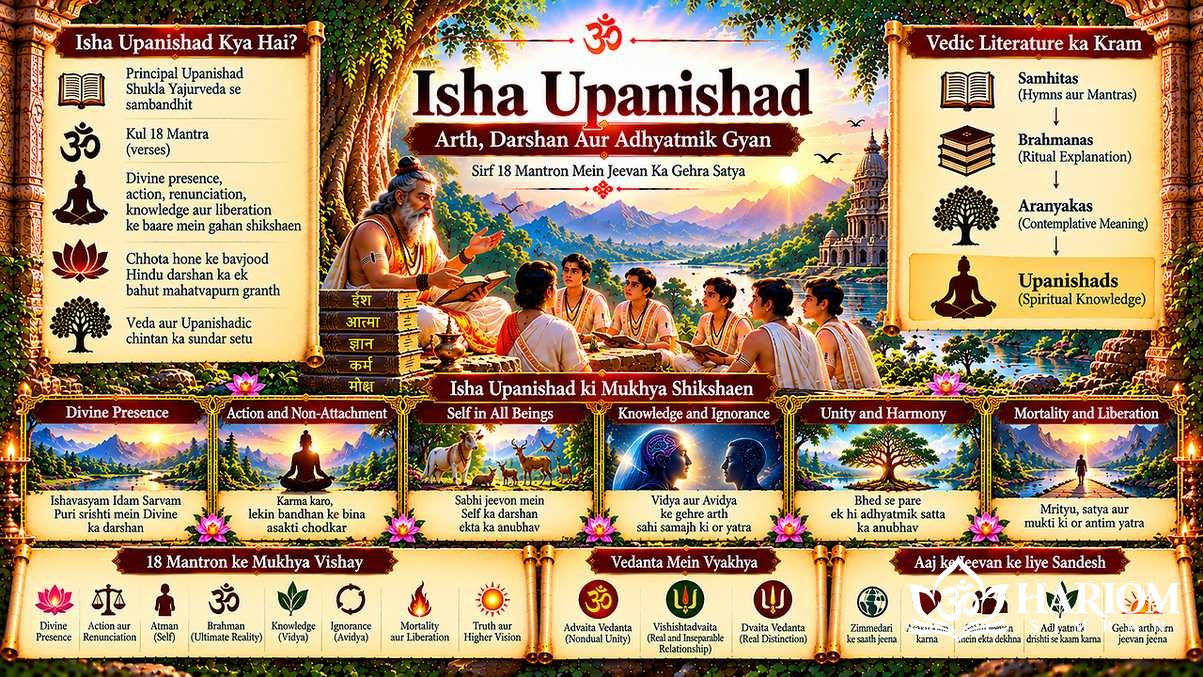
The Isha Upanishad, also called the Ishavasya Upanishad, is one of the shortest principal Upanishads.
Yet within only 18 verses, it raises some of the deepest questions of Hindu philosophy.
How should a person live in the world?
Should spiritual life require leaving worldly action behind?
What does it mean to see the Divine everywhere?
What is the relationship between knowledge and action?
What happens when we recognize the same deeper reality within all beings?
How can human life move toward freedom rather than attachment?
The Isha Upanishad approaches these questions with remarkable intensity.
Its opening verse begins with a powerful spiritual vision:
Everything in this changing universe is to be seen in relation to the Divine.
From there, the text explores action, renunciation, knowledge, unity, ignorance, mortality and liberation.
Because the Isha Upanishad is extremely concise, almost every verse has generated centuries of interpretation.
Different Vedanta traditions do not explain every passage in exactly the same way.
That diversity should be respected.
To understand the larger scriptural setting, explore Hindu Scriptures.
What Is the Isha Upanishad?
The Isha Upanishad is one of the principal or Mukhya Upanishads.
It belongs to the Shukla Yajurveda, also known as the White Yajurveda.
Unlike several Upanishads that appear within Brahmana or Aranyaka traditions, the Isha Upanishad forms the concluding portion of the Vajasaneyi Samhita.
This gives it a particularly close textual connection with the Vedic Samhita tradition.
It contains only 18 Mantras or verses, making it one of the shortest major Upanishads.
Despite its brevity, its themes include Isha, Atman, Divine presence, action, renunciation, knowledge, unity, mortality and liberation.
Why Is It Called the Isha Upanishad?
The name comes from the opening word:
Isha
The Sanskrit expression at the beginning is commonly known as:
Ishavasyam Idam Sarvam
Because of this opening, the text is also called the:
Ishavasya Upanishad
The term Isha can be understood in relation to the Lord, ruler or Supreme Divine.
Different philosophical traditions interpret the theological significance of this word differently.
Some emphasize the all-pervading Supreme Lord.
Others read the verse through a strongly nondual understanding of ultimate reality.
The text therefore became important across several Vedanta traditions.
Isha Upanishad and the Shukla Yajurveda
The Isha Upanishad is associated with the Shukla Yajurveda, specifically the Vajasaneyi Samhita tradition.
This is important because it reminds us that Upanishadic philosophy did not develop separately from the Vedas.
The Upanishads emerged within the larger Vedic world.
Earlier Yajurvedic literature strongly emphasizes sacred action and ritual.
The Isha Upanishad takes this inherited concern with action and asks a deeper question:
How should a person act without becoming spiritually bound by action?
This question becomes one of the central themes of the text.
Why Is the Isha Upanishad Important?
The Isha Upanishad is important because it refuses to present spiritual life as a simple choice between:
Worldly Life
and
Spiritual Life
Instead, it explores how spiritual understanding can transform the way a person lives and acts.
Its teachings engage several apparent tensions:
Action and Renunciation
Knowledge and Ignorance
Unity and Diversity
Life and Death
The Individual and the Universal
Rather than giving simplistic answers, the text encourages deeper reflection on how these dimensions relate.
The Opening Teaching
The first verse is the most famous part of the Isha Upanishad.
It begins with the idea expressed through:
Ishavasyam Idam Sarvam
The verse presents a vision in which the entire moving world is understood in relation to Isha, the Divine.
This teaching can transform how a person sees:
Possessions, relationships, nature, other beings and even personal identity.
If everything belongs within a larger sacred reality, possessiveness becomes harder to justify.
The verse therefore connects spiritual vision with how one lives.
Divine Presence in the World
One of the most powerful themes of the Isha Upanishad is that spiritual reality should not be imagined only as something distant from the world.
The Divine is not presented merely as an object hidden somewhere outside existence.
The opening vision asks the seeker to perceive the world itself differently.
Nature, living beings and human life are no longer spiritually empty.
They exist within a sacred reality.
This teaching later becomes important in several Hindu philosophical traditions, though each tradition explains the exact relationship between God, world and soul differently.
Explore wider Hindu understandings of the Divine through Deities.
Renunciation and Enjoyment
The first verse contains language that has inspired different interpretations concerning renunciation, enjoyment and non-possessiveness.
The teaching should not be simplified into:
“Own nothing and leave everything.”
Nor should it be reduced to:
“Enjoy everything freely.”
The deeper concern is attachment.
A person can live in the world while recognizing that nothing is ultimately an isolated possession of the ego.
This creates a different relationship with life.
The spiritual question becomes:
Can we participate in the world without allowing possession, greed or attachment to control us?
Isha Upanishad and Action
The second verse directly addresses action.
This is extremely important.
The text does not simply say that spiritual seekers must stop acting.
Instead, it discusses living a full human life while performing action in a way that does not bind the person spiritually.
This teaching later resonates strongly with Hindu reflections on Karma Yoga, although the Isha Upanishad belongs to an earlier Vedic context.
The important principle is that action itself is not necessarily the problem.
Attachment, ignorance and the way action is understood are spiritually significant.
Does the Isha Upanishad Reject Worldly Life?
No.
This is one of the most important misunderstandings to avoid.
The Isha Upanishad contains strong language related to renunciation and spiritual knowledge, but it also directly discusses living through action.
This creates a sophisticated balance.
Spiritual life does not necessarily require hatred of the world.
Instead, the seeker must understand how to live without becoming trapped by possessiveness, ignorance and attachment.
Later Hindu traditions develop different approaches to this balance.
Atman in the Isha Upanishad
The Self, or Atman, is central to the Upanishadic tradition.
The Isha Upanishad encourages a transformation in how we understand ourselves and others.
Ordinary perception divides reality into:
Me
and
Others
But deeper spiritual knowledge begins to challenge this separation.
The seeker learns to recognize the Self in all beings and all beings in the Self.
This insight has profound consequences.
If other beings are not completely disconnected from us, hatred and alienation begin to lose their foundation.
Seeing the Self in All Beings
One of the most celebrated teachings of the Isha Upanishad concerns seeing:
All beings in the Self
and
The Self in all beings
This is not merely an intellectual statement.
It describes a transformed spiritual vision.
Normally, human beings experience the world through separation.
We divide:
My interests from yours.
My happiness from yours.
My identity from everyone else's.
The Upanishadic vision asks whether a deeper level of reality connects life in ways ordinary perception fails to recognize.
Unity and Compassion
The Isha Upanishad does not present compassion through a modern ethical theory.
However, its teaching about seeing the Self in all beings has significant ethical implications.
When separation dominates our thinking, fear, hatred and selfishness become easier.
When deeper unity is perceived, the basis of hostility changes.
The text connects spiritual knowledge with freedom from:
Hatred
Delusion
Grief
Its vision suggests that how we understand reality affects how we relate to others.
Grief and Delusion
The Isha Upanishad asks a powerful question.
For the one who perceives unity, where can delusion or grief arise?
This does not mean an enlightened person simply becomes emotionally incapable of feeling ordinary human sadness.
The philosophical point is deeper.
Much suffering arises from mistaken identification, separation and attachment.
When reality is understood differently, the foundations of spiritual confusion begin to change.
The Nature of the Self
Some verses describe the Self in paradoxical language.
The Self is spoken of as:
Moving and unmoving.
Far and near.
Within everything and beyond everything.
These descriptions are intentionally challenging.
They push the mind beyond ordinary categories.
Ultimate reality cannot always be captured using simple physical concepts such as:
Near versus far.
Movement versus stillness.
Inside versus outside.
The paradox encourages contemplation rather than superficial reading.
Why Does the Upanishad Use Paradox?
Upanishadic language sometimes sounds contradictory because it attempts to speak about reality that cannot be reduced to ordinary categories.
If the deepest reality supports all experience, then ordinary language may become inadequate.
Statements such as:
It Moves and It Moves Not
force the reader to think beyond literal physical descriptions.
The purpose is not confusion for its own sake.
The paradox invites deeper inquiry.
Knowledge and Ignorance
One of the most difficult sections of the Isha Upanishad discusses Vidya and Avidya.
These words are often translated as:
Knowledge
and
Ignorance
However, the exact meaning of these terms in these verses has been interpreted differently by commentators.
Therefore, it would be misleading to reduce the teaching to:
Knowledge is good and ignorance is bad.
The verses suggest that different forms of knowledge and activity must be properly understood together.
Traditional commentators explain this passage in different ways.
What Is Vidya?
Vidya broadly means knowledge.
In Hindu philosophical traditions, it can refer to spiritual knowledge or correct understanding.
But within the specific verses of the Isha Upanishad, commentators debate the precise reference.
Depending on interpretation, the discussion may involve knowledge of deities, contemplative knowledge or higher spiritual insight.
Context matters.
HariOmSimran should therefore avoid presenting one disputed interpretation as though every Hindu tradition agrees with it.
What Is Avidya?
Avidya often means ignorance.
In later Vedanta philosophy, it becomes extremely important for explaining spiritual bondage.
However, in the relevant Isha Upanishad verses, the word has received more specialized interpretations.
Some commentators connect it with action or ritual knowledge in contrast with another form of knowledge.
The main lesson for beginners is:
The text presents a sophisticated relationship between different forms of knowledge and practice, not a simple slogan.
Sambhuti and Asambhuti
Another difficult section discusses terms commonly rendered as:
Sambhuti
and
Asambhuti
These verses have also received multiple interpretations.
They may be discussed in relation to manifestation, creation, becoming or particular forms of contemplation.
Different textual recensions and philosophical commentaries complicate the issue further.
For a beginner, the important point is that the Isha Upanishad is not simplistic.
Its later verses engage with subtle distinctions about reality and spiritual practice.
Why Different Commentaries Matter
Because the Isha Upanishad is very short, a single Sanskrit word can carry enormous philosophical weight.
Later teachers interpreted the text through different Vedanta frameworks.
This produced major commentarial traditions.
A responsible educational article should distinguish between:
The Upanishadic text itself
and
Later philosophical interpretation
This helps readers understand Hindu philosophical diversity rather than assuming every commentator says exactly the same thing.
Isha Upanishad and Advaita Vedanta
Advaita Vedanta gives the Isha Upanishad major importance.
Advaita interpreters emphasize the realization of nondual reality and knowledge of the Self.
From this perspective, the Upanishad's teachings about seeing the Self in all beings strongly support the realization of underlying unity.
However, Advaita is not the only Vedantic tradition that values the Isha Upanishad.
Isha Upanishad and Vishishtadvaita
Vishishtadvaita Vedanta also draws on Upanishadic scripture but understands the relationship between individual souls, the world and Brahman differently.
Rather than treating individuality and world as ultimately unreal, Vishishtadvaita emphasizes their real and inseparable dependence upon the Supreme.
From such perspectives, the opening teaching can be understood through the Divine's pervasive presence and sovereignty.
Isha Upanishad and Dvaita
Dvaita Vedanta maintains a real distinction between the individual soul and Supreme Divine reality.
Dvaita commentators therefore interpret passages about unity without erasing the distinction between God and the individual soul.
This demonstrates why the same Upanishadic verse can receive different interpretations within Hindu philosophy.
The diversity is part of the living Vedanta tradition.
Isha Upanishad and Vedanta
The Isha Upanishad became foundational for Vedanta because it addresses central questions such as:
What is ultimate reality?
What is the Self?
How should action be understood?
What is spiritual knowledge?
How is the world related to the Divine?
How can liberation be approached?
Different Vedanta schools answer these questions differently, but they return repeatedly to Upanishadic scripture.
Isha Upanishad and Karma
The text's discussion of action is particularly important for understanding the development of Hindu thought about Karma.
Karma does not simply mean fate.
Its basic sense is connected with action.
The spiritual problem is how action becomes associated with bondage.
The Isha Upanishad suggests that a person can live and act without necessarily becoming trapped by action.
Later Hindu texts develop this question in much greater detail.
Isha Upanishad and the Bhagavad Gita
The Bhagavad Gita belongs to a later textual world, but some of its central concerns resonate strongly with the Isha Upanishad.
Both explore questions involving:
Action
Attachment
Knowledge
Renunciation
Spiritual Freedom
The Bhagavad Gita develops these issues through the dialogue between Krishna and Arjuna and through teachings on Karma Yoga, Jnana, Bhakti and Dharma.
The texts should not be treated as identical, but the philosophical connection is important.
Renunciation Without Escaping Life
One of the lasting insights readers often find in the Isha Upanishad is the possibility of inner renunciation.
A person may outwardly participate in life while gradually letting go of the idea:
Everything exists for me to possess.
Renunciation in this sense becomes a transformation in relationship rather than merely physical abandonment.
The person acts, lives and relates, but tries not to make ego-centered possession the foundation of life.
Isha Upanishad and Desire
Attachment and desire play an important role in Hindu discussions of spiritual bondage.
The Isha Upanishad's opening teaching challenges possessiveness.
The seeker is encouraged to view reality through a sacred perspective rather than through constant acquisition.
This does not require pretending that normal human needs do not exist.
Instead, it raises the question:
When does a need become attachment, and when does attachment begin to control life?
Isha Upanishad and Death
The closing verses turn toward mortality and the final spiritual journey.
The seeker prays while facing the reality of death.
The physical body returns to its elements.
The spiritual concern becomes focused on remembrance, truth and the path beyond ordinary mortality.
This gives the final verses an intensely personal quality.
Philosophy becomes prayer.
Prayer to Surya
One of the closing passages addresses the radiant solar reality.
The seeker asks that the dazzling covering be removed so that truth may be perceived.
The Sun in this context is more than an ordinary astronomical object.
Vedic solar symbolism can relate to:
Light
Vision
Truth
Divine Illumination
The imagery expresses the desire to see beyond appearances.
The Golden Covering
A famous image in the Isha Upanishad speaks of truth being hidden by a brilliant or golden covering.
The seeker asks for this covering to be removed.
Spiritually, the image can represent the difficulty of perceiving deeper reality.
Something can be beautiful, powerful or radiant and still prevent us from seeing beyond it.
The prayer therefore becomes a request for true vision.
Prayer to Agni
The final verse addresses Agni, the sacred fire.
The seeker asks Agni for guidance along the good path.
This creates a beautiful connection with the wider Vedic tradition.
The text that explores some of the deepest philosophical questions of the Self ends with a Vedic prayer.
Philosophy and sacred tradition remain connected.
Explore broader Hindu Divine traditions through Deities.
Isha Upanishad and Sacred Sound
Like other Vedic texts, the Isha Upanishad belongs to a tradition where recitation matters.
Its verses are not merely philosophical sentences printed on a page.
They belong to Shruti.
Traditionally, pronunciation, oral transmission and recitation are important.
This reminds us that Hindu sacred philosophy developed through both:
Sound
and
Meaning
Explore the wider sacred sound tradition through Mantras.
Is Om Central to the Isha Upanishad?
Unlike the Mandukya Upanishad, the Isha Upanishad is not primarily structured as an exposition of Om.
Its main emphasis lies elsewhere, especially in Divine presence, action, Self, unity and spiritual knowledge.
However, the text belongs to the wider Vedic sacred sound tradition where Om later becomes deeply important.
Each Upanishad should therefore be studied according to its own emphasis rather than forcing every Upanishad into the same themes.
Does the Isha Upanishad Teach Nonviolence?
The Isha Upanishad does not function as a systematic text on Ahimsa.
However, its vision of seeing the Self in all beings can have profound ethical implications.
If spiritual insight reduces the sense of radical separation between oneself and others, cruelty and hatred become harder to justify.
Later Hindu traditions develop Ahimsa through broader scriptural and philosophical discussions.
Does the Isha Upanishad Teach Environmentalism?
The Upanishad should not be converted directly into a modern environmental document.
Its opening vision does, however, challenge the idea that the world exists only as an object for human possession.
Seeing the entire world as related to the Divine can encourage reverence rather than exploitation.
This can inspire modern environmental reflection, but the ancient text should first be understood within its own spiritual context.
Does the Isha Upanishad Reject Wealth?
The text is better understood as challenging possessiveness and attachment rather than simply declaring that material resources are evil.
Hindu tradition includes householders as well as renunciants.
The deeper question is:
How does a person relate to what they possess?
Wealth can become a source of attachment, pride or harm.
It can also be used responsibly.
The spiritual problem lies deeper than the existence of material objects themselves.
Action and Spiritual Freedom
The Isha Upanishad presents an important insight:
Freedom does not necessarily mean becoming physically inactive.
Human beings must act.
The question is whether action strengthens bondage or becomes integrated with spiritual understanding.
This concern later becomes central in Hindu discussions of Karma Yoga.
The Upanishad therefore remains relevant for people living ordinary family, professional and social lives.
Knowledge Without Ego
Spiritual knowledge can itself become a source of ego.
A person may think:
I know more than everyone else.
But true Upanishadic knowledge aims at transformation rather than intellectual pride.
If knowledge of unity increases arrogance, something has been misunderstood.
The Isha Upanishad directs knowledge toward freedom from delusion and separation.
Spirituality in Everyday Life
One reason the Isha Upanishad remains meaningful is that it does not treat spirituality only as withdrawal from existence.
Its teachings can prompt modern readers to reflect on:
Work.
Relationships.
Possessions.
Ambition.
Responsibility.
Nature.
Mortality.
Spirituality then becomes a question of how we see and participate in life, not merely which religious activities we perform.
Is the Isha Upanishad Difficult?
Yes, despite its short length.
The text contains only 18 verses, but some are philosophically dense.
Particular challenges include discussions of:
Vidya and Avidya
Sambhuti and Asambhuti
Action and Knowledge
Unity and Difference
This makes commentarial context extremely valuable.
Short scripture does not necessarily mean simple scripture.
How Should Beginners Study the Isha Upanishad?
A practical learning order is to first understand its connection with the Shukla Yajurveda, then study the opening vision of Divine presence, followed by action and non-attachment, the teaching of seeing the Self in all beings, the difficult sections on knowledge and ignorance, and finally the closing prayers concerning truth, Surya and Agni.
After that, readers can compare how different Vedanta traditions interpret major passages.
This approach is more useful than collecting isolated quotations.
Common Misunderstandings About the Isha Upanishad
Several misunderstandings are especially common. The Isha Upanishad is not simply a text telling everyone to abandon worldly life. It does not say that action is automatically opposed to spirituality. Its discussion of Vidya and Avidya cannot be accurately reduced to a simple contrast between good knowledge and bad ignorance. It is also not exclusively an Advaita text, because several Vedanta traditions regard Upanishadic scripture as authoritative and interpret its teachings differently.
Understanding these points protects the text from oversimplification.
What Can Modern Readers Learn From the Isha Upanishad?
The Isha Upanishad asks questions that remain relevant even in modern life.
Can we use things without becoming possessed by them?
Can we work without allowing ambition to become our identity?
Can we recognize dignity in other beings?
Can knowledge make us less divided rather than more arrogant?
Can spiritual insight exist alongside responsibility?
Can awareness of death change how we live?
These questions explain why a text of only 18 verses has remained philosophically influential for centuries.
Why the Isha Upanishad Still Matters
The Isha Upanishad matters because it brings together ideas that are often treated as opposites.
It speaks about:
Divine Presence and the World
Renunciation and Participation
Knowledge and Action
Individual Experience and Deeper Unity
Life and Mortality
Its spiritual vision does not simply tell the seeker to escape the world.
It asks the seeker to see the world differently.
That shift in vision is one of its most enduring teachings.
Explore Upanishadic Wisdom With HariOmSimran
HariOmSimran is developing the Scripture section as a structured journey through Hindu sacred knowledge.
Continue exploring Hindu Scriptures, Hinduism, Mantras, Deities, Dharma, Hindu Stories, Temples and Festivals.
The next detailed article in our Upanishads series should be:
Kena Upanishad: Meaning, Questions and Spiritual Wisdom
After that we can continue with Katha Upanishad, Prashna Upanishad, Mundaka Upanishad, Mandukya Upanishad, Taittiriya Upanishad, Aitareya Upanishad, Chandogya Upanishad and Brihadaranyaka Upanishad.
Learn • Explore • Understand • Preserve
Key Takeaway
The Isha Upanishad is one of the shortest principal Upanishads, containing only 18 verses, yet it explores some of Hindu philosophy's deepest questions.
Its central themes include Divine presence, non-attachment, action, Atman, unity, knowledge, mortality and liberation.
Its opening vision teaches the seeker to view the entire world in relation to the Divine.
Its later teachings ask how action can be performed without spiritual bondage and how deeper knowledge transforms our perception of ourselves and others.
The Isha Upanishad does not offer a simplistic rejection of worldly life.
Instead, it asks whether human beings can live, act and participate in the world while seeing reality through a deeper spiritual vision.
Key Teachings
This scripture reveals profound wisdom and guidance for our spiritual journey. Below are the key teachings and principles derived from this sacred text.
Core Principles
These teachings provide guidance for living a life of faith, compassion, and spiritual growth.
- Spiritual Growth
- Divine Wisdom
- Sacred Teachings
- Faith Journey

Study Resources
Explore these resources to deepen your understanding of this scripture and apply its teachings to your daily life.
📖 Study Guide
Comprehensive study materials to help you understand the context, meaning, and application of this scripture.
🙏 Reflection Questions
Thought-provoking questions to help you reflect on the teachings and apply them to your personal spiritual journey.
📝 Journal Prompts
Guided journaling prompts to help you document your insights, prayers, and spiritual growth.
👥 Discussion Topics
Engaging discussion topics for group study and fellowship, fostering deeper understanding and community.
Frequently Asked Questions
The Isha Upanishad is one of the principal Upanishads associated with the Shukla Yajurveda. It contains 18 verses exploring Divine presence, Self, action, renunciation, knowledge and liberation.
It is also called Ishavasya because its opening begins with the expression Ishavasyam Idam Sarvam, which presents the world in relation to Isha, the Divine.
There is no single statement that captures the whole text, but major themes include seeing the Divine throughout existence, living without possessive attachment, acting without spiritual bondage and recognizing deeper unity.
Yes, renunciation is important, but the text also discusses action. Its teaching should therefore not be reduced to abandoning worldly life. It explores how non-attachment and spiritual understanding can transform action.
Advaita Vedanta gives the Isha Upanishad major importance, but it is also interpreted by other Vedanta traditions. Its teachings should not be presented as belonging exclusively to one later philosophical school.
The Isha Upanishad is important because in only 18 verses it brings together Divine presence, action, renunciation, knowledge, unity, mortality and liberation, making it one of the most concentrated philosophical texts in the Upanishadic tradition.