


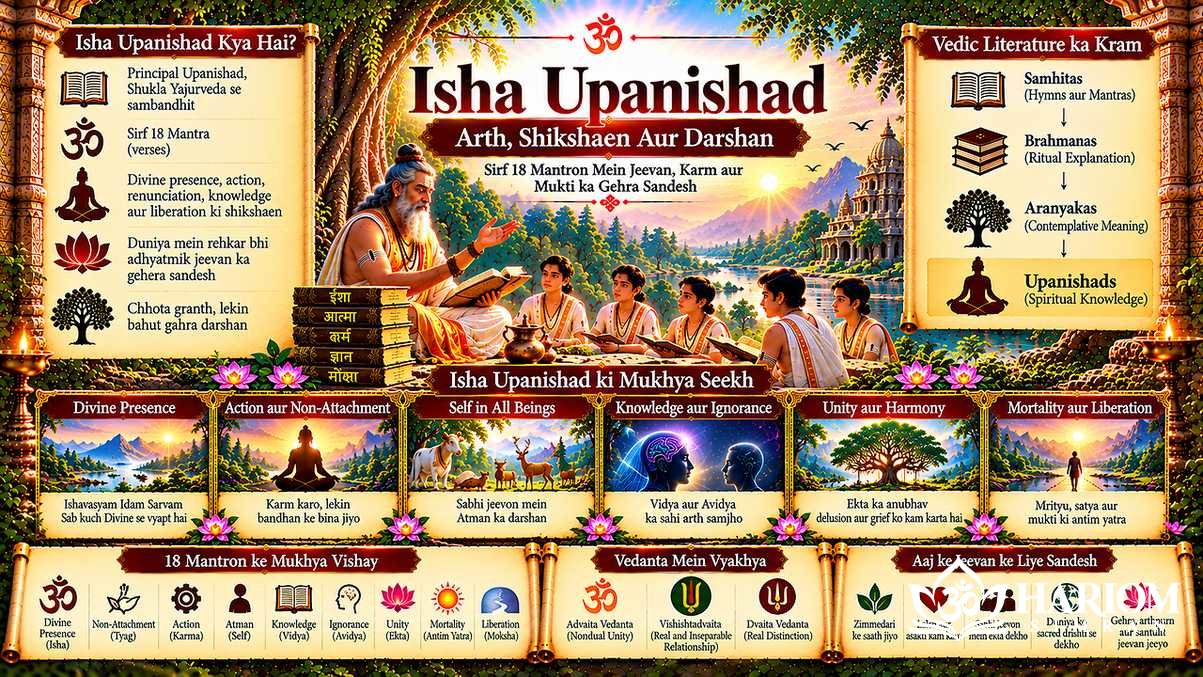
Isha Upanishad, jise Ishavasya Upanishad bhi kaha jata hai, principal Upanishads mein se one of the shortest texts hai.
Lekin sirf 18 verses ya Mantras ke andar ye Hindu philosophy ke kuch most profound questions explore karti hai.
Human being duniya mein kaise jiye?
Kya spiritual life ke liye worldly action chhodna zaroori hai?
Divine presence ko har jagah dekhne ka meaning kya hai?
Knowledge aur action ka relationship kya hai?
Agar hum sabhi beings mein deeper unity dekhein to hamari life kaise change hoti hai?
Attachment se freedom kaise mil sakti hai?
Isha Upanishad in questions ko deeply explore karti hai.
Iska opening verse ek powerful spiritual vision present karta hai:
Poore changing universe ko Divine reality ke sambandh mein dekha jana chahiye.
Uske baad text action, renunciation, knowledge, unity, ignorance, mortality aur liberation jaise themes ko explore karta hai.
Isha Upanishad bahut concise hai, isliye almost har verse par centuries se different interpretations develop hui hain.
Different Vedanta traditions har passage ko exactly same way mein explain nahi karti.
Is diversity ko respectfully understand karna important hai.
Wider scriptural context ke liye Hindu Scriptures explore karein.
Isha Upanishad Kya Hai?
Isha Upanishad principal ya Mukhya Upanishads mein se ek hai.
Ye Shukla Yajurveda, yani White Yajurveda, se associated hai.
Many Upanishads Brahmana ya Aranyaka traditions ke andar appear hoti hain, lekin Isha Upanishad Vajasaneyi Samhita ke concluding portion se connected hai.
Isliye iska Vedic Samhita tradition ke saath direct textual connection bahut strong hai.
Isha Upanishad mein sirf 18 Mantras hain.
Lekin themes bahut deep hain:
- Isha
- Atman
- Divine Presence
- Action
- Renunciation
- Knowledge
- Unity
- Mortality
- Liberation
Isha Upanishad Naam Kyun Hai?
Naam opening word Isha se aata hai.
Opening expression hai:
Ishavasyam Idam Sarvam
Isi wajah se text ko Ishavasya Upanishad bhi kaha jata hai.
Word Isha Lord, ruler ya Supreme Divine reality se connected hai.
Different philosophical traditions is word ko different ways mein understand karti hain.
Kuch traditions all-pervading Supreme Lord ko emphasize karti hain.
Kuch traditions ultimate reality ki nondual understanding par focus karti hain.
Isi wajah se Isha Upanishad different Vedanta schools ke liye important scripture ban gayi.
Isha Upanishad Aur Shukla Yajurveda
Isha Upanishad Shukla Yajurveda ki Vajasaneyi Samhita tradition se associated hai.
Ye connection important hai because Upanishadic philosophy Vedas se separate tradition nahi hai.
Ye Vedic world ke andar hi develop hoti hai.
Earlier Yajurvedic literature ritual action aur sacred formulas ko strongly emphasize karta hai.
Isha Upanishad is inherited concern ko deeper question mein transform karti hai:
Human being action kaise kare bina spiritually bound hue?
Ye Isha Upanishad ka central philosophical concern ban jata hai.
Isha Upanishad Important Kyun Hai?
Isha Upanishad spiritual life ko simple choice mein reduce nahi karti:
Worldly Life
ya
Spiritual Life
Instead, ye explore karti hai ki spiritual understanding ordinary life aur action ko kaise transform kar sakti hai.
Text several important relationships explore karti hai:
Action Aur Renunciation
Knowledge Aur Ignorance
Unity Aur Diversity
Life Aur Death
Individual Aur Universal Reality
Isha Upanishad simple answers dene ke bajaye seeker ko deeper reflection ki taraf le jati hai.
Opening Teaching
Isha Upanishad ka first verse sabse famous teachings mein se ek hai.
Ye begin hota hai:
Ishavasyam Idam Sarvam
Broad spiritual vision ye hai ki poore moving universe ko Isha, Divine reality, ke sambandh mein dekha jaye.
Ye teaching hamare relationship ko change kar sakti hai with:
Possessions
Relationships
Nature
Other Beings
Personal Identity
Agar reality ko sacred perspective se dekha jaye, possessiveness naturally question ke under aa jati hai.
Opening verse spiritual vision ko practical living ke saath connect karta hai.
Divine Presence in the World
Isha Upanishad ka powerful idea hai ki Divine reality ko sirf duniya se bahar ya bahut door imagine nahi karna chahiye.
Spiritual reality existence se completely separate nahi hai.
Opening teaching seeker ko duniya ko differently dekhne invite karti hai.
Nature, living beings aur human life spiritually empty nahi hain.
Sab larger sacred reality ke andar exist karte hain.
Later Hindu philosophical schools God, soul aur world ke exact relationship ko differently explain karti hain.
Wider Hindu Divine traditions ke liye Deities explore karein.
Tyag Aur Jeevan Ka Anand
First verse mein aisi language milti hai jise renunciation, non-attachment aur enjoyment ke context mein differently interpret kiya gaya hai.
Teaching ko simple slogan mein reduce karna correct nahi hoga:
“Sab Kuch Chhod Do.”
Ya:
“Jo Chaho Enjoy Karo.”
Deeper concern hai attachment aur possessiveness.
Human being duniya mein live kar sakta hai, lekin ego-centered ownership ko life ka ultimate truth na samjhe.
Spiritual question ye ban jata hai:
Kya Hum Duniya Mein Participate Kar Sakte Hain Bina Greed Aur Attachment Ke Control Mein Aaye?
Isha Upanishad Aur Karma
Second verse directly action ko address karta hai.
Ye bahut significant hai.
Text ye nahi kehta ki spiritual seeker ko action completely stop kar dena chahiye.
Instead, ye human life ko action ke through live karne aur spiritual bondage se bachne ke relationship ko explore karta hai.
Later Hindu thought mein ye concern Karma Yoga ke saath strongly resonate karta hai.
Important principle hai:
Action Khud Problem Nahi Hai.
Attachment, ignorance aur action ko understand karne ka tarika spiritually important hai.
Kya Isha Upanishad Worldly Life Ko Reject Karti Hai?
Nahi.
Ye common misunderstanding hai.
Isha Upanishad renunciation aur spiritual knowledge ko importance deti hai, lekin saath hi action ko bhi directly discuss karti hai.
Isliye iska message world ko hate karna ya ordinary life ko automatically reject karna nahi hai.
Challenge hai:
World Mein Kaise Jiyein Bina Possessiveness Aur Attachment Ke Slave Bane?
Different Hindu traditions ne is balance ko different ways mein develop kiya.
Atman in the Isha Upanishad
Upanishadic tradition ka central concept hai Atman, yani deeper Self.
Isha Upanishad hamari identity aur other beings ke relationship ko rethink karne invite karti hai.
Ordinary perception reality ko divide karti hai:
Main
aur
Dusre
Lekin deeper spiritual knowledge is separation ko challenge karti hai.
Seeker ko sabhi beings mein Self aur Self mein sabhi beings ko recognize karne ki teaching milti hai.
Ye insight spiritual aur ethical dono levels par profound hai.
Sabhi Jeevon Mein Self Ka Darshan
Isha Upanishad ki celebrated teachings mein se ek hai:
All beings in the Self
aur
The Self in all beings
Ye sirf intellectual statement nahi hai.
Ye transformed spiritual vision describe karta hai.
Normally hum world ko separation ke through experience karte hain:
Mera Interest
Tumhara Interest
Meri Khushi
Tumhari Khushi
Meri Identity
Baaki Sab
Upanishadic inquiry poochti hai ki kya deeper reality ordinary separation se zyada interconnected hai.
Ekta Aur Karuna
Isha Upanishad modern ethical theory ke form mein compassion explain nahi karti.
Lekin sabhi beings mein Self ko dekhne ki teaching ke strong ethical implications hain.
Jab separation dominant hota hai, selfishness, fear aur hatred easier ho jate hain.
Jab deeper unity perceive hoti hai, hostility ka foundation weak ho sakta hai.
Text spiritual insight ko freedom se connect karti hai from:
- Hatred
- Delusion
- Grief
Reality ko hum kaise understand karte hain, ye hamare relationships ko bhi influence karta hai.
Grief Aur Delusion
Isha Upanishad ek profound question raise karti hai:
Jahan unity ka realization ho, wahan delusion aur grief kaise arise karein?
Iska ye meaning nahi ki spiritually realized person ordinary human sadness feel hi nahi kar sakta.
Point deeper hai.
Bahut suffering mistaken identification, separation aur attachment se linked hoti hai.
Reality ki understanding change hone par spiritual confusion ka foundation bhi change ho sakta hai.
Self Ki Nature
Kuch verses Self ko paradoxical language mein describe karti hain.
Self ko kaha jata hai:
Moving Yet Unmoving
Far Yet Near
Within All Yet Beyond All
Ye descriptions intentionally challenging hain.
Ultimate reality ko ordinary physical categories se fully capture karna difficult hai.
Near aur far.
Movement aur stillness.
Inside aur outside.
Upanishadic language seeker ko in categories ke beyond contemplate karne invite karti hai.
Paradox Kyun Use Hota Hai?
Upanishads kabhi contradictory lagne wali language use karti hain because ordinary words ultimate reality ko fully express nahi kar pate.
Agar deepest reality all experience ka basis hai, to normal categories insufficient ho sakti hain.
Statement jaise:
It Moves and It Moves Not
mind ko literal physical thinking ke beyond push karta hai.
Purpose confusion create karna nahi.
Purpose deeper inquiry generate karna hai.
Vidya Aur Avidya
Isha Upanishad ka one of the most difficult sections Vidya aur Avidya discuss karta hai.
Common translations hain:
Knowledge
and
Ignorance
Lekin relevant verses mein in terms ka exact philosophical meaning commentators differently explain karte hain.
Isliye teaching ko simple formula mein reduce karna inaccurate hoga:
Knowledge Good Hai, Ignorance Bad Hai.
Text different forms of knowledge aur practice ke relationship ko more carefully explore karta hai.
Vidya Kya Hai?
Vidya broadly knowledge ko refer karti hai.
Hindu philosophy mein ye spiritual knowledge ya correct understanding se connected ho sakti hai.
Lekin Isha Upanishad ke specific verses mein exact reference debated hai.
Different commentators Vidya ko differently interpret karte hain, including:
- Knowledge Related to Deities
- Contemplative Knowledge
- Spiritual Insight
Context important hai.
HariOmSimran par one interpretation ko universal Hindu agreement ke roop mein present nahi karna chahiye.
Avidya Kya Hai?
Avidya generally ignorance ko refer karti hai.
Later Vedanta mein Avidya spiritual bondage ko explain karne mein central concept ban jati hai.
Lekin Isha Upanishad ke relevant verses mein term ko specialized ways mein bhi interpret kiya gaya hai.
Some commentators ise action ya ritual knowledge ke context mein explain karte hain.
Beginner ke liye important understanding hai:
Text Different Forms of Knowledge Aur Practice Ke Complex Relationship Ko Explore Karti Hai.
Sambhuti Aur Asambhuti
Isha Upanishad ke later difficult verses Sambhuti aur Asambhuti jaise terms discuss karte hain.
Different commentators inhe manifestation, creation, becoming, non-manifestation ya specific contemplative practices ke context mein explain karte hain.
Textual recensions aur philosophical commentaries bhi interpretations ko influence karte hain.
Beginner ke liye key point hai:
Isha Upanishad Simple Philosophy Nahi Hai.
Its later verses subtle metaphysical distinctions explore karte hain.
Commentaries Important Kyun Hain?
Isha Upanishad sirf 18 verses ki hai.
Isliye ek single Sanskrit word bhi enormous philosophical importance carry kar sakta hai.
Later teachers ne text ko different Vedanta frameworks se interpret kiya.
Responsible learning ke liye distinguish karna important hai:
Original Upanishadic Text
aur
Later Philosophical Commentary
Ye distinction Hindu philosophical diversity ko better understand karne mein help karta hai.
Isha Upanishad Aur Advaita Vedanta
Advaita Vedanta Isha Upanishad ko major importance deta hai.
Advaita interpretations Self aur ultimate reality ki nondual realization ko strongly emphasize karti hain.
Sabhi beings mein Self ko dekhne ki teaching Advaita ke liye underlying unity ke realization ke context mein significant hai.
Lekin Isha Upanishad sirf Advaita tradition tak limited nahi hai.
Isha Upanishad Aur Vishishtadvaita
Vishishtadvaita Vedanta Upanishadic scripture ko equally important maanta hai, lekin individual souls, world aur Brahman ke relationship ko Advaita se differently understand karta hai.
Vishishtadvaita individual souls aur universe ko real maanta hai aur unhe Supreme Brahman par inseparably dependent samajhta hai.
Is perspective se Divine presence ko Supreme reality ki pervasive sovereignty ke context mein explain kiya ja sakta hai.
Isha Upanishad Aur Dvaita
Dvaita Vedanta individual soul aur Supreme Divine reality ke beech real distinction maintain karta hai.
Dvaita interpretations unity related passages ko aise explain karti hain jahan God aur individual soul ki distinction erase nahi hoti.
Ye demonstrate karta hai ki same Upanishadic verse Hindu philosophy mein multiple respected interpretations receive kar sakta hai.
Isha Upanishad Aur Vedanta
Isha Upanishad Vedanta ke liye foundational text hai because ye questions explore karti hai:
Ultimate Reality Kya Hai?
Self Kya Hai?
Action Ka Meaning Kya Hai?
Spiritual Knowledge Kya Hai?
World Aur Divine Ka Relationship Kya Hai?
Liberation Kaise Approach Ki Jaye?
Different Vedanta traditions answers differently deti hain, lekin scriptural foundation Upanishads hi hain.
Isha Upanishad Aur Karma
Text ka action par focus Hindu Karma concept ke development ko understand karne mein important hai.
Karma ka simple meaning fate nahi hai.
Its basic sense action se connected hai.
Spiritual question hai:
Action Bandhan Kaise Create Karta Hai?
Isha Upanishad suggest karti hai ki human being action karte hue bhi spiritual bondage se free reh sakta hai, depending on understanding aur attachment.
Later texts is theme ko much more detail mein develop karte hain.
Isha Upanishad Aur Bhagavad Gita
Bhagavad Gita later textual setting mein belong karti hai, lekin Isha Upanishad ke several concerns ke saath strong philosophical resonance hai.
Dono texts explore karte hain:
- Action
- Attachment
- Knowledge
- Renunciation
- Spiritual Freedom
Bhagavad Gita in themes ko Krishna aur Arjuna ke dialogue ke through expand karti hai.
Texts identical nahi hain, lekin philosophical connection important hai.
Life Se Bhaage Bina Tyag
Isha Upanishad ka one of the most meaningful insights hai possibility of inner renunciation.
Person outwardly life mein participate kar sakta hai, lekin gradually ye idea let go karta hai:
Everything Exists For Me To Possess.
Renunciation phir sirf physical abandonment nahi rehta.
Ye relationship ka transformation ban jata hai.
Person live karta hai, work karta hai, relationships maintain karta hai, lekin ego-centered possession ko life ka foundation nahi banata.
Isha Upanishad Aur Desire
Attachment aur desire Hindu spirituality mein bondage ke important subjects hain.
Opening teaching possessiveness ko challenge karti hai.
Seeker ko reality ko constant acquisition ke perspective se nahi, sacred perspective se dekhne invite kiya jata hai.
Iska ye meaning nahi ki normal human needs wrong hain.
Question hai:
Need Kab Attachment Ban Jati Hai?
Attachment Kab Life Ko Control Karne Lagti Hai?
Isha Upanishad Aur Mrityu
Closing verses mortality aur final spiritual journey ki taraf move karti hain.
Seeker death ki reality ko face karte hue prayer karta hai.
Physical body elements mein return karti hai.
Attention truth, remembrance aur spiritual journey par shift hota hai.
Ye closing verses philosophy ko deeply personal bana dete hain.
Philosophy prayer mein transform ho jati hai.
Surya Se Prarthana
Closing section mein radiant solar reality ko address kiya jata hai.
Seeker pray karta hai ki dazzling covering remove ho jaye taaki truth ka darshan ho sake.
Vedic tradition mein Sun sirf physical astronomical object nahi hai.
Solar imagery connect ho sakti hai:
- Light
- Vision
- Truth
- Divine Illumination
Prayer deeper reality ko clearly perceive karne ki desire express karti hai.
Golden Covering Ka Symbol
Isha Upanishad ka famous image hai truth ka brilliant ya golden covering se hidden hona.
Seeker request karta hai ki covering remove ho.
Spiritual meaning mein ye represent kar sakta hai ki appearances deeper truth ko hide kar sakti hain.
Koi cheez beautiful aur powerful ho sakti hai, lekin phir bhi ultimate reality ko obscure kar sakti hai.
Prayer true spiritual vision ki request ban jati hai.
Agni Se Prarthana
Final verse Agni, sacred fire, ko address karta hai.
Seeker Agni se good path par guide karne ki prarthana karta hai.
Ye Vedic continuity ka beautiful example hai.
Text Self aur ultimate reality ke profound philosophical questions explore karti hai, lekin end Vedic prayer ke saath hota hai.
Philosophy aur sacred ritual tradition disconnected nahi hain.
Wider Divine traditions ke liye Deities explore karein.
Isha Upanishad Aur Sacred Sound
Other Vedic texts ki tarah Isha Upanishad bhi Shruti tradition ka part hai.
Its verses sirf printed philosophical sentences nahi hain.
Traditional transmission mein pronunciation, oral recitation aur sound ka importance hai.
Ye remind karta hai ki Hindu sacred philosophy develop hui through:
Sound
and
Meaning
Wider sacred sound traditions ke liye Mantras explore karein.
Kya Om Isha Upanishad Ka Main Subject Hai?
Mandukya Upanishad ki tarah Isha Upanishad primarily Om ke detailed exposition par based nahi hai.
Its central focus zyada strongly hai:
Divine Presence
Action
Atman
Unity
Knowledge
Liberation
Om wider Vedic tradition mein important hai, lekin har Upanishad ko same themes ke through explain nahi karna chahiye.
Har text ka apna distinctive emphasis hai.
Kya Isha Upanishad Ahimsa Sikhati Hai?
Isha Upanishad Ahimsa par systematic treatise nahi hai.
Lekin sabhi beings mein Self ko dekhne ki teaching strong ethical implications carry kar sakti hai.
Agar deeper spiritual insight radical separation ko reduce karti hai, to hatred aur cruelty ko justify karna harder ho jata hai.
Later Hindu traditions Ahimsa ko broader scriptural aur philosophical frameworks mein develop karti hain.
Kya Isha Upanishad Environmentalism Sikhati Hai?
Ancient Upanishad ko directly modern environmental manifesto mein convert karna accurate nahi hoga.
Lekin opening vision clearly challenge karti hai ye idea ki world sirf human possession ke liye exist karta hai.
Agar poori existence Divine reality se connected hai, to nature ke prati reverence ka perspective naturally emerge ho sakta hai.
Modern environmental reflection inspire ho sakti hai, lekin ancient context ko respect karna important hai.
Kya Isha Upanishad Wealth Ko Reject Karti Hai?
Text ko simple wealth rejection ke roop mein understand karna incomplete hai.
Deeper concern hai:
Possessiveness
Attachment
Greed
Hindu tradition mein householders aur renunciants dono spiritual paths ka part rahe hain.
Important question hai:
Person Apni Possessions Ke Saath Kaise Relate Karta Hai?
Wealth pride aur attachment ka source ban sakti hai.
Lekin responsibly use bhi ki ja sakti hai.
Problem material objects se deeper hai.
Action Aur Spiritual Freedom
Isha Upanishad ka important insight hai:
Freedom Ka Meaning Physical Inactivity Nahi Hai.
Human beings act karte hain.
Real question hai:
Kya Action Bondage Create Karta Hai Ya Spiritual Understanding Ke Saath Integrated Hai?
Later Karma Yoga discussions isi concern ko deeply develop karti hain.
Ye teaching ordinary family, professional aur social life living people ke liye bhi relevant hai.
Knowledge Without Ego
Spiritual knowledge bhi ego ka source ban sakta hai.
Person soch sakta hai:
Mujhe Sabse Zyada Pata Hai.
Lekin Upanishadic knowledge ka aim intellectual pride nahi, transformation hai.
Agar knowledge arrogance aur separation badhata hai, to deeper spiritual meaning miss ho gaya.
Isha Upanishad knowledge ko delusion aur division se freedom ki direction mein orient karti hai.
Everyday Life Mein Spirituality
Isha Upanishad aaj bhi meaningful isliye lagti hai because spirituality ko sirf withdrawal se connect nahi karti.
Its teachings modern readers ko reflect karne invite karti hain on:
Work
Relationships
Possessions
Ambition
Responsibility
Nature
Mortality
Spirituality phir sirf religious activity ka question nahi rehti.
Ye question ban jati hai:
Hum Life Ko Kaise Dekhte Aur Kaise Jeete Hain?
Kya Isha Upanishad Difficult Hai?
Haan.
Short hone ke bawajood text philosophically dense hai.
Specially challenging sections include:
- Vidya and Avidya
- Sambhuti and Asambhuti
- Action and Knowledge
- Unity and Difference
Isliye proper commentary aur context valuable hai.
Short scripture ka meaning automatically simple scripture nahi hota.
Beginner Isha Upanishad Ko Kaise Study Kare?
Practical learning path:
Step 1
Shukla Yajurveda Ke Saath Iska Connection Samjhein.
Step 2
Opening Teaching Ishavasyam Idam Sarvam Ko Context Mein Samjhein.
Step 3
Action Aur Non-Attachment Ki Teaching Study Karein.
Step 4
Sabhi Beings Mein Self Ko Dekhne Ki Teaching Explore Karein.
Step 5
Vidya, Avidya Aur Later Difficult Verses Ko Commentary Ke Saath Study Karein.
Step 6
Surya Aur Agni Se Connected Closing Prayers Samjhein.
Step 7
Different Vedanta Interpretations Compare Karein.
Ye approach isolated quotes collect karne se much more useful hai.
Isha Upanishad Ke Common Misunderstandings
Misunderstanding 1: Isha Upanishad Sabko Worldly Life Chhodne Ko Kehti Hai
Nahi.
Text renunciation ko discuss karti hai, lekin action ko bhi important place deti hai.
Misunderstanding 2: Action Spirituality Ke Opposite Hai
Nahi.
Main concern hai action ka spiritual bondage ke saath relationship.
Misunderstanding 3: Vidya Aur Avidya Sirf Good Knowledge Aur Bad Ignorance Hain
Ye oversimplification hai.
Relevant verses multiple interpretations receive karti hain.
Misunderstanding 4: Isha Upanishad Sirf Advaita Ki Scripture Hai
Nahi.
Advaita ke saath saath other Vedanta traditions bhi Upanishadic scripture ko authoritative maanti hain.
Misunderstanding 5: Renunciation Ka Meaning Sab Material Things Ko Hate Karna Hai
Nahi.
Text ko better way mein non-attachment, possessiveness aur ego ke deeper questions ke through samajhna chahiye.
Modern Readers Isha Upanishad Se Kya Seekh Sakte Hain?
Isha Upanishad ke questions aaj bhi extremely relevant hain:
Kya Hum Cheezon Ko Use Kar Sakte Hain Bina Unke Slave Bane?
Kya Hum Work Kar Sakte Hain Bina Ambition Ko Apni Identity Banaye?
Kya Hum Other Beings Mein Dignity Aur Deeper Connection Dekh Sakte Hain?
Kya Knowledge Humein Less Divided Bana Sakta Hai?
Kya Spiritual Insight Responsibility Ke Saath Coexist Kar Sakta Hai?
Kya Death Ki Awareness Hamare Jeevan Ko Change Kar Sakti Hai?
Sirf 18 verses ka text centuries se influential isliye raha hai because ye deeply human questions address karta hai.
Isha Upanishad Aaj Bhi Important Kyun Hai?
Isha Upanishad aise concepts ko together bring karti hai jinhe hum often opposites samajhte hain:
Divine Presence Aur World
Renunciation Aur Participation
Knowledge Aur Action
Individual Experience Aur Deeper Unity
Life Aur Mortality
Text seeker ko world se simply escape karne ke liye nahi kehti.
Wo seeker ko challenge karti hai:
World Ko Deeper Spiritual Vision Se Dekho.
Ye shift in vision Isha Upanishad ki most enduring teachings mein se ek hai.
HariOmSimran Ke Saath Upanishadic Wisdom Explore Karein
HariOmSimran apne Scripture section ko structured aur interconnected Hindu knowledge journey ke roop mein develop kar raha hai.
Continue exploring:
Upanishads series ka next detailed article hoga:
Kena Upanishad: Arth, Prashna Aur Adhyatmik Gyan
Uske baad hum systematically continue kar sakte hain:
Katha Upanishad
Prashna Upanishad
Mundaka Upanishad
Mandukya Upanishad
Taittiriya Upanishad
Aitareya Upanishad
Chandogya Upanishad
Brihadaranyaka Upanishad
Learn • Explore • Understand • Preserve
Key Takeaway
Isha Upanishad principal Upanishads mein se one of the shortest texts hai.
Ismein sirf 18 Mantras hain, lekin philosophical depth bahut high hai.
Its major themes include:
Divine Presence
Non-Attachment
Action
Atman
Unity
Knowledge
Mortality
Liberation
Opening teaching seeker ko entire world ko Divine reality ke sambandh mein dekhne invite karti hai.
Later teachings action aur spiritual bondage ke relationship ko explore karti hain.
Sabhi beings mein deeper Self ko recognize karne ki teaching separation, delusion aur hatred ko challenge karti hai.
Isha Upanishad worldly life ka simplistic rejection nahi karti.
Instead, wo poochti hai:
Kya Hum Duniya Mein Jee Sakte Hain, Action Kar Sakte Hain Aur Responsibility Nibha Sakte Hain Bina Attachment Aur Ego Ke Bandhan Mein Phase?
Isi question ki depth Isha Upanishad ko aaj bhi powerful banati hai.
Key Teachings
This scripture reveals profound wisdom and guidance for our spiritual journey. Below are the key teachings and principles derived from this sacred text.
Core Principles
These teachings provide guidance for living a life of faith, compassion, and spiritual growth.
- Spiritual Growth
- Divine Wisdom
- Sacred Teachings
- Faith Journey

Study Resources
Explore these resources to deepen your understanding of this scripture and apply its teachings to your daily life.
📖 Study Guide
Comprehensive study materials to help you understand the context, meaning, and application of this scripture.
🙏 Reflection Questions
Thought-provoking questions to help you reflect on the teachings and apply them to your personal spiritual journey.
📝 Journal Prompts
Guided journaling prompts to help you document your insights, prayers, and spiritual growth.
👥 Discussion Topics
Engaging discussion topics for group study and fellowship, fostering deeper understanding and community.
Frequently Asked Questions
Isha Upanishad principal Upanishads mein se ek hai jo Shukla Yajurveda se associated hai. Ismein 18 Mantras hain jo Divine presence, Atman, action, renunciation, knowledge aur liberation ko explore karte hain.
Iska opening expression Ishavasyam Idam Sarvam hai. Isi opening ke karan text ko Ishavasya Upanishad bhi kaha jata hai.
Text ka koi single simple message nahi hai. Major themes mein entire existence ko Divine reality se connected dekhna, possessive attachment ko reduce karna, spiritual bondage ke bina action karna aur deeper unity ko recognize karna shamil hai.
Haan, lekin wo action ko bhi important place deti hai. Isliye teaching ko worldly life completely abandon karne ke message mein reduce nahi karna chahiye.
Nahi. Advaita is text ko major importance deta hai, lekin Vishishtadvaita, Dvaita aur other Vedanta traditions bhi Upanishadic scripture ko interpret karti hain.
Isha Upanishad important hai kyunki sirf 18 verses mein Divine presence, action, renunciation, knowledge, unity, mortality aur spiritual liberation jaise deep themes ko explore karti hai.