

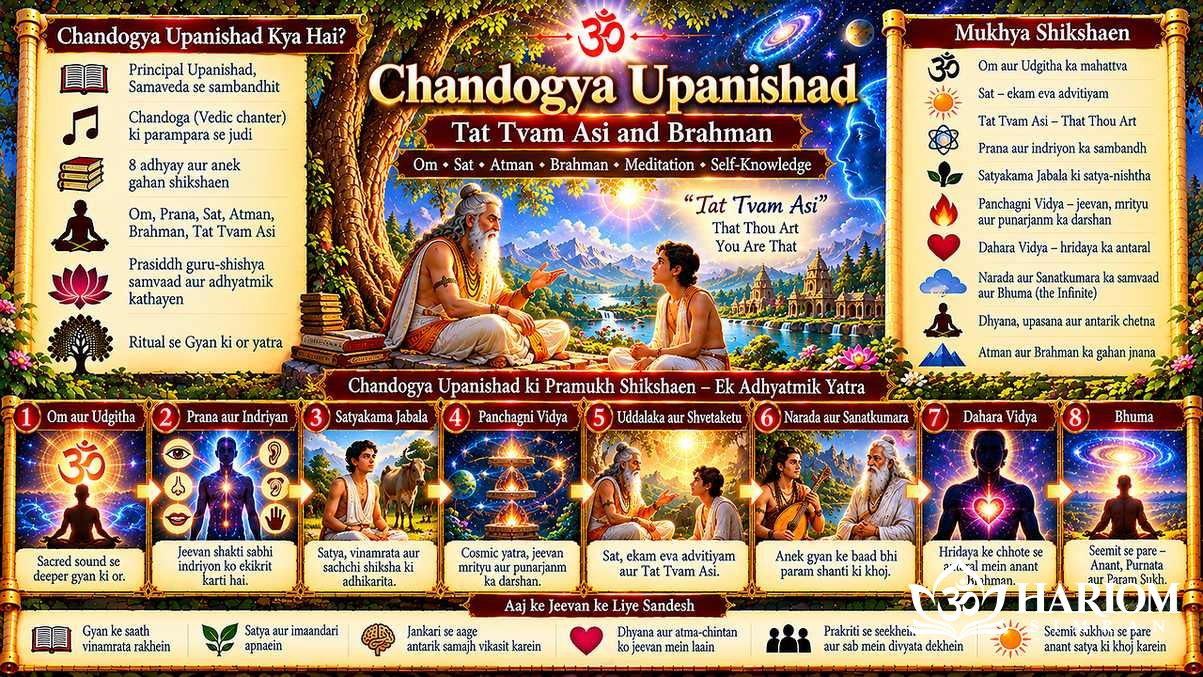
The Chandogya Upanishad is one of the largest and most influential principal Upanishads.
It contains philosophical teachings, symbolic meditations, teacher-student dialogues, spiritual stories and some of the most famous statements in all of Vedanta.
Among them is:
Tat Tvam Asi
Commonly translated as:
That Thou Art
or
You Are That
This teaching appears repeatedly in the dialogue between Uddalaka Aruni and his son Shvetaketu.
But the Chandogya Upanishad is much more than one Mahavakya.
It asks profound questions:
What is the source behind the universe?
What is Sat, or Being?
What is the relationship between Atman and Brahman?
Why is Om sacred?
What makes knowledge transformative rather than merely intellectual?
How can ordinary things such as food, water, breath, speech and space become gateways to spiritual understanding?
What lies within the inner space of the heart?
The Chandogya Upanishad explores these questions through teachings on:
- Sat, or Being
- Brahman
- Atman
- Tat Tvam Asi
- Om
- Udgitha
- Meditation
- Prana
- Speech
- Mind
- Food
- Water
- Space
- Satyakama Jabala
- Uddalaka and Shvetaketu
- Narada and Sanatkumara
- The Five Fires teaching
- Dahara Vidya
- Ethical preparation
- Self-knowledge
- Liberation
The text repeatedly turns ordinary human experience into spiritual inquiry.
To understand the wider sacred tradition, explore Hindu Scriptures.
What Is the Chandogya Upanishad?
The Chandogya Upanishad is one of the principal or Mukhya Upanishads.
It belongs to the Samaveda tradition and is associated with the Chandogya Brahmana.
The Samaveda is especially connected with sacred chanting and musical recitation.
This background helps explain why the Chandogya Upanishad gives important attention to:
- Sacred sound
- Om
- Udgitha
- Chanting
- Symbolic meditation
- Speech
- Breath
- Spiritual meaning behind Vedic recitation
Yet the text gradually moves beyond sound itself.
It asks:
What is the source that gives meaning to sacred sound, mind, life and existence?
This leads toward Brahman and Atman.
Why Is It Called the Chandogya Upanishad?
The name Chandogya is connected with the Chandoga, traditionally a singer or chanter associated with Samavedic recitation.
This reflects the text's strong relationship with the Samaveda and sacred chanting tradition.
The Upanishad begins from the world of sacred sound and gradually opens into a vast philosophical exploration of reality.
Chandogya Upanishad and the Samaveda
The Samaveda is especially known for the melodic chanting of Vedic verses.
The Chandogya Upanishad emerges from this ritual and musical tradition.
Its early teachings often explore symbolic meanings behind chanting.
This creates a progression:
- Sacred sound
- Sacred recitation
- Symbolic meditation
- Prana
- Mind
- Atman
- Brahman
The text therefore shows how Vedic ritual and sound can become pathways toward philosophical inquiry.
For wider Hindu sacred sound teachings, explore Mantras.
How Is the Chandogya Upanishad Structured?
The Chandogya Upanishad is traditionally divided into eight chapters, commonly called Prapathakas.
These chapters contain many individual sections and teachings.
The text is large, so it does not follow only one continuous story.
Instead, it contains several major teaching clusters.
Some of the most important themes include:
- Om and Udgitha meditation
- Prana as a central life principle
- Symbolic meditation on cosmic realities
- Satyakama Jabala's spiritual journey
- Upakosala's teaching
- The Five Fires teaching
- Uddalaka and Shvetaketu
- Tat Tvam Asi
- Narada and Sanatkumara
- Bhuma, or the Infinite
- Dahara Vidya
- The inner space of the heart
- Atman and liberation
This makes Chandogya Upanishad one of the richest texts for detailed study.
Om in the Chandogya Upanishad
The Chandogya Upanishad begins with strong emphasis on Om.
Om is connected with Udgitha, an important element of Samavedic chanting.
The text does not treat Om as a decorative symbol.
Om becomes an object of deep contemplation.
It is connected with:
- Sacred sound
- Breath
- Speech
- Life
- Meditation
- Spiritual meaning
- The search for deeper reality
The Upanishad repeatedly shows that sacred sound can become a doorway to spiritual inquiry.
What Is Udgitha?
Udgitha is connected with Samavedic chant.
In the Chandogya Upanishad, Udgitha is often contemplated symbolically.
Different aspects of existence may be related to the chant.
The goal is not simply musical performance.
The seeker is invited to understand the deeper spiritual meaning behind the sacred act.
Om and Meditation
Meditation on Om in the Chandogya Upanishad belongs to the wider Vedic contemplative tradition.
The text connects sacred sound with deeper realities.
However, it should not be presented as a guaranteed mechanical formula.
Traditional spiritual understanding emphasizes:
- Proper knowledge
- Concentration
- Discipline
- Context
- Guidance
- Sincerity
Om can become a focus for contemplation, but spiritual realization should not be reduced to sound repetition alone.
Sacred Sound and Meaning
The Chandogya Upanishad teaches an important principle:
Sacred practice becomes deeper when its meaning is understood.
A person may perform a chant correctly.
But the text repeatedly asks:
What does the chant point toward?
This distinction between external performance and inner understanding becomes important throughout the Upanishad.
Prana in the Chandogya Upanishad
Prana receives great importance.
Prana can broadly be understood as the life principle or vital force.
The Upanishad explores relationships between:
- Prana
- Speech
- Sight
- Hearing
- Mind
- Life
Different faculties may appear powerful.
But Prana often receives special status because embodied life depends upon it.
The Faculties and Prana
Several Upanishadic texts contain teachings where bodily faculties compare their importance.
Speech is important.
Sight is important.
Hearing is important.
Mind is important.
Yet when life itself becomes threatened, the dependence of these faculties on Prana becomes clearer.
The lesson is not that speech or sight are unimportant.
The lesson is:
Human faculties function within a larger living unity.
Is Prana Just Breath?
Not exactly.
Prana is often closely associated with breath, but the traditional concept is broader.
It can refer to:
- Vitality
- Life energy
- Living principle
- Breath
- Life-sustaining functions
Prana belongs to an ancient spiritual and philosophical framework.
It should not be treated as a replacement for modern medical physiology.
The Story of Satyakama Jabala
One of the most memorable stories in the Chandogya Upanishad is the story of Satyakama Jabala.
Satyakama wishes to become a student of sacred knowledge.
His teacher asks about his lineage.
Satyakama honestly explains that his mother, Jabala, does not know with certainty which lineage his father belonged to.
Instead of inventing an answer, Satyakama tells the truth.
His honesty becomes spiritually significant.
Why Satyakama's Honesty Matters
Satyakama could have created a respectable story.
He could have hidden uncertainty.
Instead, he speaks truthfully.
His teacher recognizes this truthfulness as an important sign of character.
The story becomes a powerful lesson about:
- Satya
- Integrity
- Eligibility for learning
- Character
- Spiritual sincerity
Knowledge without truthfulness is incomplete.
Satyakama and Spiritual Education
Satyakama's story shows that spiritual education involves more than intellectual capacity.
Important qualities include:
- Honesty
- Patience
- Service
- Discipline
- Humility
- Openness to learning
The teacher-student relationship becomes a journey of character and understanding.
Learning From Nature
Satyakama's spiritual education unfolds in an unusual way.
Different aspects of nature become associated with his learning.
Traditional narrative includes symbolic instruction connected with:
- A bull
- Fire
- A swan
- A water bird
These teachings should be understood within the sacred narrative context.
The story suggests that the whole world can become a field of spiritual learning when the seeker is prepared.
Spiritual Knowledge Is Not Limited to Books
Satyakama's journey illustrates a broader Hindu educational principle.
Scriptures are essential.
Teachers are essential.
But learning can also deepen through:
- Nature
- Reflection
- Experience
- Silence
- Responsibility
- Observation
The seeker gradually develops understanding rather than simply memorizing information.
The Story of Upakosala
Another important student in the Chandogya Upanishad is Upakosala.
His story also explores the relationship between student, teacher, sacred fires and spiritual knowledge.
Upakosala serves in his teacher's household and remains dedicated to learning.
The narrative emphasizes patience and preparation.
The Sacred Fires Teach Upakosala
In the sacred narrative, the fires themselves become teachers.
This should not necessarily be read as ordinary physical fire verbally teaching in a modern literal sense.
The story operates within Vedic sacred symbolism.
Fire represents:
- Sacred presence
- Transformation
- Ritual
- Knowledge
- Divine order
The teaching again shows that spiritual truth can be revealed through symbolic forms.
Guru Guidance Still Matters
Even after Upakosala receives important teachings, the role of the human teacher remains important.
This is a subtle lesson.
Spiritual insight and Guru guidance are not necessarily opposites.
Traditional learning integrates:
- Revelation
- Experience
- Reflection
- Teacher guidance
- Discernment
The Five Fires Teaching
The Chandogya Upanishad contains an important teaching known as Panchagni Vidya, or the knowledge of the Five Fires.
This teaching uses symbolic fire imagery to explain cosmic processes, life, death and rebirth.
The five fires are part of a sophisticated Vedic symbolic system.
The teaching connects:
- Heaven
- Rain
- Earth
- Human life
- Birth
It presents existence as an interconnected cosmic process.
Panchagni Vidya and Rebirth
The Five Fires teaching became important in later discussions of:
- Karma
- Rebirth
- Post-death journey
- Cosmic order
- Human birth
However, later Hindu traditions develop these ideas in different ways.
HariOmSimran should present the Chandogya teaching within its own context rather than combining every later doctrine into the original text.
King Pravahana Jaivali
The Five Fires teaching is associated with King Pravahana Jaivali.
His role is significant because spiritual knowledge in the Upanishads is not always shown as flowing through only one social direction.
A king can possess knowledge that even respected Brahmins may seek.
This reminds us that Upanishadic learning can challenge simplistic assumptions about where wisdom must appear.
Uddalaka Aruni and Shvetaketu
One of the most famous sections of the Chandogya Upanishad is the dialogue between Uddalaka Aruni and his son Shvetaketu.
Shvetaketu returns home after many years of study.
He is educated.
He knows many teachings.
But his father notices something.
Knowledge has made him confident.
Perhaps too confident.
Uddalaka therefore asks a deeper question.
Shvetaketu's Education
Shvetaketu has studied extensively.
Yet Uddalaka asks whether he has learned:
That knowledge through which what is unheard becomes understood, what is unthought becomes understood and what is unknown becomes known.
The question resembles other Upanishadic searches for foundational knowledge.
It asks:
Can we know the deeper principle behind many forms?
Knowledge Without Humility
Shvetaketu's story teaches an important lesson.
Education can increase knowledge.
But education can also increase pride.
If learning produces arrogance, deeper wisdom may still be missing.
Uddalaka therefore guides Shvetaketu from:
Information
toward
Insight
From:
Confidence
toward
Inquiry
From:
Many Facts
toward
Underlying Reality
Clay and Many Objects
Uddalaka gives an important analogy.
If someone understands clay, then many clay objects can be understood in terms of their material basis.
A pot may have one name.
A cup another.
A vessel another.
But all are clay.
The names and forms differ.
The underlying material basis remains.
What Does the Clay Analogy Teach?
The analogy helps explain the relationship between:
One
and
Many
Different objects appear.
Different names are used.
Different forms exist.
Yet a deeper basis connects them.
This prepares Shvetaketu for the teaching of Sat, or Being.
Gold and Other Analogies
Similar analogies may use materials and their various forms.
The general insight is:
Understanding the underlying reality changes how we understand the many forms produced from it.
This is not saying that every difference becomes meaningless.
It is asking what deeper reality supports apparent diversity.
Sat: Being or Existence
One of the central teachings of the Chandogya Upanishad concerns Sat.
Sat can broadly mean:
- Being
- Existence
- Reality
- That which truly is
Uddalaka teaches that in the beginning there was Sat, one without a second, according to the famous passage.
This becomes one of the most influential statements in Vedantic philosophy.
Sat Ekam Eva Advitiyam
A famous teaching is commonly expressed as:
Ekam Eva Advitiyam
Broadly:
One Alone, Without a Second
This statement became enormously important in later Vedanta.
However, different schools interpret its implications differently.
Advaita, Vishishtadvaita and Dvaita do not all draw exactly the same metaphysical conclusions.
Creation From Sat
Uddalaka's teaching presents differentiated existence as emerging from Sat.
The text discusses elements such as:
- Fire
- Water
- Food
The purpose is not modern physical science.
The teaching is philosophical.
It explains how the many forms of life depend upon deeper Being.
Food, Water and Mind
The Chandogya Upanishad contains fascinating teachings connecting:
- Food with mind
- Water with Prana
- Subtle essences with human functioning
These passages belong to ancient Vedic physiology and philosophy.
They should not be presented as modern biomedical science.
Their educational importance lies in the Upanishadic understanding of interdependence between nourishment, life and mental functioning.
Shvetaketu's Fasting Experiment
Uddalaka asks Shvetaketu to undergo a period of fasting as part of a teaching.
The purpose is to demonstrate the relationship between nourishment and mental capacity within the text's ancient framework.
Modern readers should not imitate prolonged fasting based solely on this narrative.
Fasting can have health risks for some people.
The spiritual lesson can be studied without turning the passage into medical advice.
The Salt in Water Analogy
One of the most beautiful teachings uses salt dissolved in water.
Once salt dissolves, it may no longer be visibly located in one place.
Yet the water tastes salty throughout.
The analogy helps explain a subtle reality that may not be visible to the senses but can still be present.
What Does the Salt Analogy Teach?
The teaching encourages Shvetaketu to understand that the deepest reality may not always be directly visible.
We often assume:
If I Cannot See It, It Is Not There.
The Upanishad challenges this assumption.
Reality can be subtler than direct visual appearance.
The Banyan Seed Analogy
Another famous teaching involves the seed of a banyan tree.
Uddalaka asks Shvetaketu to break open the tiny seed.
Inside, Shvetaketu cannot identify any visible tree.
Yet from that subtle seed grows an enormous banyan.
The lesson again points toward hidden potential and subtle causation.
The Invisible Source and Visible Tree
The huge tree emerges from something incredibly subtle.
The Upanishad uses this observation to teach:
Visible Form Can Arise From a Source Too Subtle for Ordinary Perception.
Again, this is philosophical symbolism rather than a botanical science lesson.
Tat Tvam Asi
After these teachings, Uddalaka repeatedly tells Shvetaketu:
Tat Tvam Asi
Broadly:
That Thou Art
or
You Are That
This statement is repeated multiple times in the teaching sequence.
Its importance in Vedanta is enormous.
What Does Tat Tvam Asi Mean?
The statement connects the individual Self with the deeper reality being discussed.
However, its precise interpretation differs across Vedanta traditions.
A simplistic translation can miss the philosophical depth.
The statement does not mean:
Your Ordinary Ego Is the Entire Universe.
It concerns the deeper Self, not personality or pride.
Tat Tvam Asi and Advaita Vedanta
Advaita Vedanta interprets Tat Tvam Asi as one of the clearest declarations of the essential nondual identity of Atman and Brahman.
From this perspective:
- The deepest Self is not separate from Brahman.
- Differences belong to changing name and form.
- Self-knowledge reveals nondual reality.
This interpretation became extremely influential.
Tat Tvam Asi and Vishishtadvaita
Vishishtadvaita Vedanta interprets the relationship differently.
The individual soul is real.
Brahman is Supreme Reality.
The soul exists inseparably dependent upon Brahman.
Tat Tvam Asi is therefore understood without eliminating all distinction between individual soul and Supreme Reality.
Tat Tvam Asi and Dvaita
Dvaita Vedanta maintains a real distinction between the individual soul and Supreme Brahman.
The famous statement is therefore interpreted through a framework that preserves difference and dependence.
This is why HariOmSimran should never write:
All Hindu traditions agree Tat Tvam Asi means exactly the same thing.
They do not.
Tat Tvam Asi Is a Mahavakya
Later Vedanta traditionally identifies Tat Tvam Asi as one of the great Mahavakyas.
It is associated with the Samaveda through the Chandogya Upanishad.
Its importance comes from its profound teaching on:
- Self
- Brahman
- Identity
- Reality
- Liberation
Tat Does Not Mean an Ordinary Object
In Tat Tvam Asi, Tat, or “That,” points toward the deeper reality being discussed.
It is not simply referring to one visible thing.
It points toward Sat and ultimate reality.
Tvam Does Not Mean the Ego
Tvam, or “you,” should not be reduced to:
- Name
- Profession
- Personality
- Social identity
- Ego
- Body alone
The philosophical discussion concerns the deeper Self.
Asi Means “Are”
Asi broadly means “are.”
The relationship expressed by the full statement became a major subject of Vedantic interpretation.
Different schools analyze precisely what kind of relationship is being taught.
Why Tat Tvam Asi Is So Famous
The teaching is famous because it transforms spiritual inquiry.
The seeker is not merely searching for a distant ultimate reality somewhere outside.
The teaching turns attention inward.
It asks:
What if the deepest truth we seek is connected with the deepest Self?
Narada and Sanatkumara
Another profound section features Narada and Sanatkumara.
Narada approaches Sanatkumara seeking deeper knowledge.
He already knows many subjects.
He is highly educated.
Yet he admits something important.
Despite all that knowledge, he still experiences sorrow.
Narada's Learning
Narada lists many fields of knowledge that he has studied.
The exact traditional list reflects ancient Vedic education.
The important point is:
Narada Is Not Ignorant.
He is extremely learned.
Yet learning alone has not given complete freedom from sorrow.
Knowledge and Sorrow
This raises a powerful question:
Can information remove existential suffering?
Narada demonstrates intellectual learning.
But he seeks something deeper.
This makes the dialogue highly relevant in the modern information age.
Sanatkumara's Teaching
Sanatkumara guides Narada gradually through increasingly deeper levels of understanding.
The teaching moves through concepts related to:
- Name
- Speech
- Mind
- Intention
- Thought
- Meditation
- Understanding
- Strength
- Food
- Water
- Heat
- Space
- Memory
- Hope
- Prana
Eventually the inquiry moves toward Bhuma.
What Is Bhuma?
Bhuma can broadly be associated with:
- Vastness
- Fullness
- The Infinite
- The Unlimited
Sanatkumara's teaching contrasts the limited with the unlimited.
The limited cannot provide complete fulfillment.
Bhuma points toward spiritual fullness beyond limitation.
Bhuma and Happiness
A famous idea in this teaching connects true happiness with the unlimited rather than the limited.
Temporary objects can provide temporary satisfaction.
But what is limited cannot provide unlimited fulfillment.
This does not mean ordinary joys are meaningless.
The teaching asks whether they can satisfy the deepest spiritual longing.
Information Is Not the Same as Freedom
Narada's story becomes one of the clearest Upanishadic lessons for modern education.
A person may possess:
- Degrees
- Technical knowledge
- Scriptural knowledge
- Language skills
- Professional expertise
Yet still ask:
Why Am I Not at Peace?
The Chandogya Upanishad distinguishes learning from realization.
Dahara Vidya
Another important teaching is Dahara Vidya, associated with the small space within the heart.
The text describes an inner space, often called Dahara Akasha.
Despite being described as small, this inner space is associated with immense spiritual significance.
The Inner Space of the Heart
The teaching uses a powerful paradox.
Something described as small contains a reality connected with vastness.
The spiritual heart is not simply the physical anatomical heart.
The teaching belongs to contemplative symbolism.
The seeker is invited to turn inward toward deeper reality.
Is Brahman Physically Located in the Heart?
It would be misleading to treat the teaching as anatomical localization.
Dahara Vidya belongs to sacred contemplative language.
The heart can represent:
- Inner being
- Spiritual center
- Deep Self
- Interior consciousness
Different traditions explain the symbolism differently.
Inner and Outer Reality
Dahara Vidya challenges our assumption that:
Large Reality Must Occupy Large Physical Space.
Spiritual reality is not measured through ordinary physical dimensions.
The teaching connects inner inquiry with cosmic vastness.
Chandogya Upanishad and Atman
Atman appears repeatedly across Chandogya teachings.
The seeker is encouraged to look beyond:
- Body alone
- Speech alone
- Mind alone
- Social identity
- Intellectual knowledge
- External ritual
The inquiry moves toward the deeper Self.
Chandogya Upanishad and Brahman
Brahman is not always introduced through one single definition.
Instead, the text approaches ultimate reality from many directions.
These include:
- Sat
- Om
- Prana
- Space
- Bhuma
- Inner heart
- Self
- Sacred meditation
This richness is one reason the text became so influential.
Different Teachings, One Larger Search
The Chandogya Upanishad may initially feel like a collection of unrelated sections.
Om.
Prana.
Satyakama.
Five Fires.
Shvetaketu.
Narada.
Dahara Vidya.
But beneath these different teachings runs one larger inquiry:
What is the deepest reality behind life, experience and identity?
Chandogya Upanishad and Vedanta
The Chandogya Upanishad became foundational for later Vedanta.
Its teachings on:
- Tat Tvam Asi
- Sat
- Atman
- Brahman
- Bhuma
- Dahara Vidya
- Meditation
received extensive commentary.
Major Vedanta traditions accept the Upanishad as authoritative while interpreting important passages differently.
Chandogya Upanishad and Advaita
Advaita gives Chandogya Upanishad especially high importance.
Tat Tvam Asi becomes one of the central scriptural statements supporting nondual realization.
Advaita interpretation emphasizes:
- Brahman as ultimate reality
- Atman as the deepest Self
- Nondual realization
- Name and form as dependent manifestations
- Knowledge as liberating
But the Upanishad should not be presented as belonging only to Advaita.
Chandogya Upanishad and Other Vedanta Schools
Vishishtadvaita, Dvaita and other Vedantic traditions also study and interpret Chandogya.
They may emphasize:
- Supreme Brahman
- Dependence of the individual soul
- Real distinctions
- Divine relationship
- Devotion
- Theological meaning
This diversity is part of Hindu philosophical history.
Does Tat Tvam Asi Mean Everyone Is Literally God?
This phrase can easily be misunderstood.
Tat Tvam Asi concerns deep metaphysical teaching.
It does not simply mean:
My Ego, Personality and Desires Are God.
The ordinary ego is not the subject of the Mahavakya.
The teaching concerns the deeper Self and its relationship with ultimate reality.
Does Chandogya Reject Ritual?
No.
The text emerges from a Vedic ritual and chanting tradition.
However, it frequently deepens external ritual through:
- Symbolic understanding
- Meditation
- Knowledge
- Inner contemplation
The movement is not necessarily ritual versus spirituality.
It is often:
Ritual With Deeper Understanding.
Does Chandogya Teach Reincarnation?
The text contains teachings relevant to:
- Death
- Karma
- Rebirth
- Different paths after death
- Human birth
The Five Fires teaching is especially important.
Later Hindu traditions develop these teachings much further.
Does Chandogya Teach Meditation?
Yes, but not as one single standardized meditation system.
The text contains many Upasanas, or contemplative meditations.
Objects of contemplation include:
- Om
- Udgitha
- Prana
- Sun
- Space
- Sacred functions
- Inner heart
- Brahman
Different practices belong to different textual contexts.
Upasana in the Chandogya Upanishad
Upasana can broadly refer to contemplative worship or meditation.
In Chandogya, Upasana often involves understanding the deeper symbolic meaning of a sacred object, chant or cosmic principle.
This creates a bridge between:
Ritual
and
Knowledge
Meditation Requires Understanding
The Upanishad repeatedly suggests that understanding changes spiritual practice.
Doing something mechanically and doing it with knowledge are not always considered equal.
This gives Chandogya a powerful educational message:
Meaning Matters.
Is the Chandogya Upanishad a Science Book?
No.
It contains ancient teachings about:
- Food
- Elements
- Body
- Mind
- Cosmology
- Reproduction
- Life
These belong to Vedic philosophical and sacred frameworks.
They should not be presented as modern scientific discoveries.
The text's value does not depend upon forcing scientific equivalence.
Common Misunderstandings About the Chandogya Upanishad
Chandogya Upanishad Is Only About Tat Tvam Asi
No. Tat Tvam Asi is one of its most famous teachings, but the text also explores Om, Prana, Satyakama, Upakosala, Panchagni Vidya, Bhuma, Dahara Vidya, meditation and many other subjects.
Tat Tvam Asi Means the Ordinary Ego Is Brahman
No. The Mahavakya concerns the deeper Self and ultimate reality. It should not be reduced to ego-based self-glorification.
Every Vedanta Tradition Interprets Tat Tvam Asi the Same Way
No. Advaita, Vishishtadvaita, Dvaita and other traditions provide different philosophical interpretations.
Chandogya Upanishad Rejects Ritual
No. It emerges from the Samavedic ritual tradition but repeatedly seeks deeper symbolic and spiritual meaning within sacred practice.
Chandogya Upanishad Is Modern Science
No. Its cosmological and physiological teachings belong to ancient Vedic spiritual philosophy, not modern scientific methodology.
How Should Beginners Study the Chandogya Upanishad?
Because Chandogya is large, beginners should study it systematically.
A useful order is:
- Understand its relationship with the Samaveda.
- Learn the meaning of Om and Udgitha.
- Study the role of Prana.
- Read the story of Satyakama Jabala.
- Study Upakosala's teaching.
- Understand Panchagni Vidya in its Vedic context.
- Study Uddalaka and Shvetaketu carefully.
- Explore the clay, salt and banyan seed analogies.
- Study Sat and Tat Tvam Asi.
- Read the Narada and Sanatkumara dialogue.
- Understand Bhuma.
- Explore Dahara Vidya.
- Compare major Vedanta interpretations.
This approach makes the large text much easier to understand.
What Can Modern Readers Learn From the Chandogya Upanishad?
The Chandogya Upanishad offers many practical reflections:
- Knowledge Should Produce Humility
- Truthfulness Is Essential for Spiritual Learning
- Information Is Not the Same as Realization
- Sacred Practice Becomes Deeper With Understanding
- Human Identity Is Deeper Than Social Roles
- Visible Forms May Depend on Subtle Causes
- Temporary Satisfaction Is Not the Same as Spiritual Fullness
- Different Traditions Can Interpret the Same Scripture Differently
- Deep Learning Requires Patience
- Self-Inquiry Begins When We Question Surface Identity
Satyakama's Lesson for Modern Education
Satyakama teaches:
Truthfulness Matters More Than Pretending to Know.
In modern life, people often feel pressure to appear:
- Successful
- Knowledgeable
- Perfect
- Certain
But genuine education begins with honesty.
Sometimes the most intelligent statement is:
I Do Not Know Yet.
Shvetaketu's Lesson for Modern Education
Shvetaketu teaches another lesson:
Learning Should Not Create Arrogance.
A person may collect qualifications and information.
But deeper wisdom asks:
Has My Understanding Changed Me?
This question remains important for schools, universities and spiritual education.
Narada's Lesson for the Information Age
Narada knows many subjects.
Yet he still seeks freedom from sorrow.
This is especially relevant today.
We have access to:
- Search engines
- Videos
- Books
- Courses
- Artificial intelligence
- Social media
- Endless information
But information itself does not guarantee:
- Peace
- Wisdom
- Meaning
- Self-understanding
The Chandogya Upanishad recognized this distinction long before the digital age.
Tat Tvam Asi and Identity
Modern people often define themselves through:
- Career
- Income
- Nationality
- Education
- Appearance
- Social status
- Achievements
- Failures
Tat Tvam Asi invites a deeper inquiry:
Is the deepest Self greater than all these changing labels?
Different Vedanta traditions answer the metaphysical question differently, but the invitation to deeper Self-inquiry remains powerful.
Why the Chandogya Upanishad Still Matters
The Chandogya Upanishad remains important because it brings together many dimensions of Hindu spiritual life.
It connects:
- Sacred sound with meditation
- Ritual with meaning
- Prana with embodied life
- Truth with spiritual eligibility
- Education with humility
- Nature with learning
- Creation with Sat
- Individual identity with deeper Self
- Knowledge with liberation
- Inner space with cosmic reality
Its journey repeatedly moves from:
Outer Form
toward
Inner Meaning
From:
Information
toward
Wisdom
From:
Many Names and Forms
toward
Deeper Reality
From:
Who I Think I Am
toward
Who Am I Really?
This makes the Chandogya Upanishad one of the most important texts for understanding the spiritual and philosophical depth of Hinduism.
Explore Upanishadic Wisdom With HariOmSimran
HariOmSimran is developing the Scripture section as a structured and interconnected journey through Hindu sacred knowledge.
Continue exploring:
The next detailed article in our Upanishads series should be:
Brihadaranyaka Upanishad: Atman, Neti Neti and Brahman
After that, we can continue with other important Upanishadic texts and then move systematically into the next Scripture category.
Learn • Explore • Understand • Preserve
Key Takeaway
The Chandogya Upanishad is a principal Upanishad associated with the Samaveda.
It contains eight major chapters and a vast range of teachings.
Some of its most important subjects include:
- Om and Udgitha
- Prana
- Satyakama Jabala
- Upakosala
- Panchagni Vidya
- Uddalaka and Shvetaketu
- Sat
- Tat Tvam Asi
- Narada and Sanatkumara
- Bhuma
- Dahara Vidya
- Atman
- Brahman
Its most famous teaching, Tat Tvam Asi, connects the seeker with a profound inquiry into the relationship between the deepest Self and ultimate reality.
The text also teaches that:
Education without humility is incomplete.
Sacred practice without understanding can remain superficial.
Truthfulness is essential for genuine spiritual learning.
Information alone cannot remove existential sorrow.
Visible names and forms may depend upon a deeper reality.
Key Teachings
This scripture reveals profound wisdom and guidance for our spiritual journey. Below are the key teachings and principles derived from this sacred text.
Core Principles
These teachings provide guidance for living a life of faith, compassion, and spiritual growth.
- Spiritual Growth
- Divine Wisdom
- Sacred Teachings
- Faith Journey

Study Resources
Explore these resources to deepen your understanding of this scripture and apply its teachings to your daily life.
📖 Study Guide
Comprehensive study materials to help you understand the context, meaning, and application of this scripture.
🙏 Reflection Questions
Thought-provoking questions to help you reflect on the teachings and apply them to your personal spiritual journey.
📝 Journal Prompts
Guided journaling prompts to help you document your insights, prayers, and spiritual growth.
👥 Discussion Topics
Engaging discussion topics for group study and fellowship, fostering deeper understanding and community.
Frequently Asked Questions
The Chandogya Upanishad is a principal Upanishad associated with the Samaveda. It contains teachings on Om, Prana, Sat, Atman, Brahman, Tat Tvam Asi, meditation and spiritual knowledge.
Tat Tvam Asi is commonly translated as “That Thou Art” or “You Are That.” It appears in Uddalaka's teaching to Shvetaketu and concerns the relationship between the deeper Self and ultimate reality. Different Vedanta traditions interpret its precise meaning differently.
Uddalaka Aruni is the teacher and father of Shvetaketu. Their dialogue contains famous teachings on Sat, the clay analogy, the banyan seed, salt dissolved in water and Tat Tvam Asi.
Satyakama Jabala is remembered for his honesty and sincere desire for sacred knowledge. His story emphasizes truthfulness, character, patience and spiritual eligibility.
Bhuma broadly refers to vastness, fullness or the unlimited. In the teaching of Sanatkumara to Narada, it is connected with a deeper form of spiritual fulfillment beyond limited objects and experiences.
The Chandogya Upanishad is important because it combines sacred sound, meditation, spiritual stories and profound Vedantic philosophy, including major teachings on Sat, Atman, Brahman and Tat Tvam Asi.