


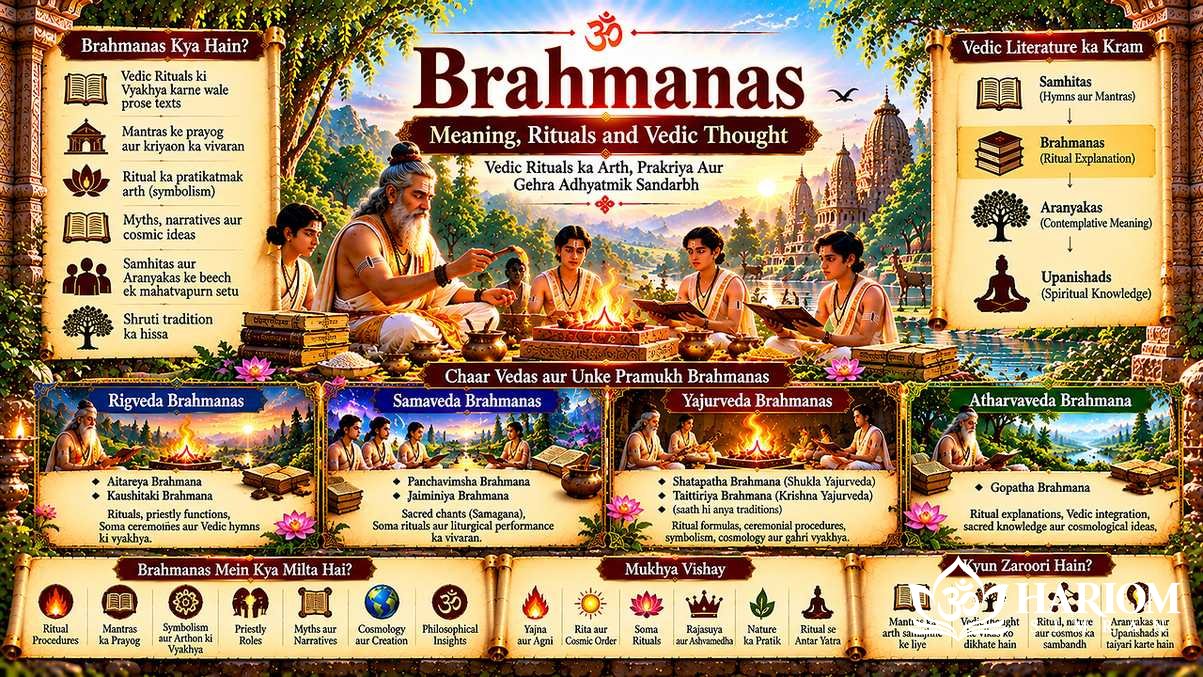
The Vedic tradition is much more than a collection of ancient hymns.
After encountering the Samhitas, with their Mantras, sacred hymns, chants and ritual formulas, an important question naturally appears:
How were these sacred words actually used?
Why were particular rituals performed?
What did different offerings symbolize?
Why did a ceremony require a particular sequence?
How were ritual actions connected with the cosmos?
The Brahmanas help answer these questions.
They are an important layer of Vedic literature concerned especially with the explanation, performance and interpretation of ritual.
But the Brahmanas are not simply instruction manuals.
They also contain:
- Ritual Interpretation
- Sacred Symbolism
- Myths and Narratives
- Cosmological Ideas
- Theological Reflection
- Connections Between Ritual and Nature
- Early Philosophical Speculation
Through these texts, we can see how Vedic thinkers tried to understand not only what should be done during a ritual, but also why the ritual mattered.
The Brahmanas therefore form an important bridge between the sacred formulas of the Samhitas and the more contemplative world of the Aranyakas and Upanishads.
To understand the wider structure first, explore Hindu Scriptures.
What Are the Brahmanas?
The Brahmanas are a major category of Vedic prose texts associated with the different Vedas.
They primarily explain:
- Yajna
- Ritual Procedures
- Sacred Formulas
- Priestly Functions
- Offerings
- Ceremonial Sequences
- Symbolic Meanings
- Ritual Theology
A Samhita may preserve the sacred Mantra.
A Brahmana may explain:
When the Mantra should be recited
Which ritual action accompanies it
Why that action is performed
What symbolic connection the ritual represents
This makes the Brahmanas essential for understanding the practical and intellectual world of Vedic ritual.
What Does the Word Brahmana Mean?
The word Brahmana has more than one meaning in Sanskrit and Hindu tradition.
In this article, Brahmana refers specifically to a category of Vedic sacred texts.
This should not be confused with every other use of the related word.
When we speak about:
Aitareya Brahmana
Shatapatha Brahmana
Taittiriya Brahmana
we are talking about Vedic texts.
The plural form is:
Brahmanas
These texts belong to the wider Vedic scriptural tradition.
Where Do the Brahmanas Fit in Vedic Literature?
A useful introductory framework is:
- Samhitas
- Brahmanas
- Aranyakas
- Upanishads
Broadly:
Samhitas
Preserve Mantras, hymns, chants and sacred formulas.
Brahmanas
Explain ritual use, ceremonial procedures and symbolic meaning.
Aranyakas
Move increasingly toward contemplative and symbolic interpretations.
Upanishads
Explore deeper philosophical questions about Atman, Brahman, consciousness and liberation.
This sequence is useful for learning, but Vedic textual development was complex.
The boundaries between these categories are not always perfectly rigid.
Some texts contain material that moves naturally from ritual explanation toward contemplation and philosophy.
Are the Brahmanas Part of Shruti?
Yes.
The Brahmanas belong to the wider Shruti tradition.
Shruti means:
“That Which Is Heard.”
The Samhitas, Brahmanas, Aranyakas and principal Vedic Upanishads are traditionally included within the broader Vedic sacred corpus.
This gives the Brahmanas an important scriptural position within Hindu tradition.
Why Were the Brahmanas Created?
The Vedic ritual system became highly sophisticated.
A major ceremony could involve:
- Different Priests
- Different Mantras
- Specific Offerings
- Precise Ritual Actions
- Sacred Fires
- Defined Sequences
- Particular Times
- Symbolic Correspondences
The Samhitas preserved the sacred words.
But practitioners also needed knowledge about how those sacred words functioned within ceremony.
The Brahmanas preserve this interpretive and ritual knowledge.
They help explain the relationship between:
Word
Action
Offering
Priest
Fire
Deity
Time
and
Cosmic Order
What Is Yajna?
One of the most important concepts in the Brahmanas is Yajna.
Yajna broadly refers to sacred offering and ritual.
Depending on the ceremony, Yajna could involve:
- Sacred Fire
- Mantra
- Offerings
- Priests
- Ritual Implements
- Consecration
- Chanting
- Precise Actions
Within the Vedic worldview, Yajna could be understood as more than an isolated religious ceremony.
It could symbolize relationships among:
Human Life
Divine Powers
Nature
Time
Sacred Order
The Cosmos
This wider symbolic understanding becomes especially important in the Brahmanas.
Why Is Ritual So Important in the Brahmanas?
The Brahmanas come from a religious world where ritual was understood as a disciplined sacred activity.
Correct ritual involved much more than performing visible actions.
It required:
Correct Mantra
Correct Pronunciation
Correct Sequence
Correct Offering
Correct Priest
Correct Timing
The underlying idea was that sacred action should be performed with knowledge and precision.
The ritual could reflect or participate in a larger cosmic order.
This helps explain why Brahmana texts devote so much attention to details that may initially seem unusual to modern readers.
Ritual and Cosmic Order
Vedic thought often connects ritual with the larger structure of reality.
One important earlier Vedic concept is Rita, associated with cosmic order, truth and harmonious functioning.
Brahmana texts develop intricate connections between ritual actions and the cosmic world.
A ritual element might be associated symbolically with:
- The Sun
- The Seasons
- Speech
- Breath
- Earth
- Sky
- Time
- The Human Body
- Divine Powers
The purpose is not simply to create decorative symbolism.
These connections express a worldview in which human ritual, nature and cosmic order can reflect one another.
Explore the wider idea of Dharma, which later develops within a much broader history of Hindu thought.
Brahmanas and Sacred Fire
Sacred fire plays a central role in many Vedic rituals.
Agni is therefore extremely important.
Agni can represent:
- Sacred Fire
- Transformation
- Offering
- Ritual Presence
- Communication With Divine Powers
Offerings placed into sacred fire become part of the ritual relationship between worshippers and Divine powers.
The Brahmanas provide detailed discussions about fires, offerings and the meaning of different ritual procedures.
Explore wider Divine traditions through Deities.
Different Vedic Priests
Complex Vedic ceremonies could involve several priestly roles.
Four major classifications are commonly associated with the four Vedas.
Hotr
The Hotr was especially associated with Rigvedic recitation.
Udgatr
The Udgatr was associated with Samavedic chanting.
Adhvaryu
The Adhvaryu performed many practical ritual actions and used Yajurvedic formulas.
Brahman Priest
The Brahman priest had an important supervisory role in the larger ritual.
These specialized roles demonstrate how carefully organized major Vedic ceremonies could become.
Brahmanas and the Rigveda
Important Brahmanas associated with the Rigvedic tradition include:
Aitareya Brahmana
and
Kaushitaki Brahmana, also associated with the Shankhayana tradition.
These texts discuss ritual performance, priestly roles and interpretations connected with Rigvedic traditions.
Aitareya Brahmana
The Aitareya Brahmana is an important text associated with the Rigveda.
It contains discussions related to:
- Soma Rituals
- Priestly Functions
- Ritual Sequences
- Sacred Interpretation
- Royal Ceremonies
The wider Aitareya textual tradition also eventually leads into the Aitareya Aranyaka and Aitareya Upanishad.
This gives us an excellent example of progression within Vedic literature.
We can observe movement from:
Ritual
to
Contemplation
to
Philosophy
Kaushitaki Brahmana
The Kaushitaki Brahmana belongs to another important Rigvedic tradition.
It also discusses Vedic ritual and its organization.
Like other Brahmana texts, it gives valuable insight into how sacred hymns were understood within ceremonial life.
Its associated tradition later includes philosophical material connected with the Kaushitaki Upanishad.
Brahmanas and the Samaveda
Samavedic tradition includes several important Brahmana texts.
Among them are:
Panchavimsha Brahmana
Jaiminiya Brahmana
and other Samavedic ritual texts.
Because the Samaveda is strongly connected with chanting, its Brahmanas often help explain ritual settings in which particular chants were performed.
Panchavimsha Brahmana
The Panchavimsha Brahmana, also known as the Tandya Mahabrahmana, is an important Samavedic text.
It is especially associated with:
- Soma Rituals
- Samavedic Chanting
- Ceremonial Sequences
- Priestly Roles
- Liturgical Performance
This text demonstrates that Samavedic music belonged to a highly organized sacred ritual tradition.
It was not simply artistic singing.
Jaiminiya Brahmana
The Jaiminiya Brahmana belongs to another important Samavedic tradition.
It preserves ritual explanations, narratives and interpretive material.
It is particularly valuable because it shows that different Vedic schools could preserve distinctive ritual and textual traditions.
Brahmanas and the Yajurveda
The Yajurveda has particularly important Brahmana literature because of its close relationship with ritual action.
Two traditions deserve special attention:
Shukla Yajurveda
and
Krishna Yajurveda
Shatapatha Brahmana
The Shatapatha Brahmana is one of the most important and extensive Brahmana texts.
It is associated with the Shukla Yajurveda.
Its name is commonly understood in connection with its traditional arrangement into one hundred lessons or sections.
The Shatapatha Brahmana discusses many subjects, including:
- Fire Rituals
- Yajna
- Ritual Construction
- Sacred Symbolism
- Royal Ritual
- Cosmology
- Creation
- Mythic Narratives
- Philosophical Reflection
It is one of the most important sources for understanding Vedic ritual thought.
Why Is the Shatapatha Brahmana Important?
The Shatapatha Brahmana is important not only because of its ritual detail.
It also contains narratives and ideas that became influential in later Hindu thought.
Its discussions sometimes move beyond external ceremony toward questions about:
Creation
The Self
Reality
Sacred Speech
Cosmic Structure
The Brihadaranyaka Upanishad, one of the most influential Hindu philosophical texts, is closely connected with this wider Shukla Yajurvedic tradition.
Taittiriya Brahmana
The Taittiriya Brahmana belongs to the Krishna Yajurveda tradition.
It discusses Vedic ritual, sacred formulas and ceremonial knowledge.
The wider Taittiriya tradition includes:
Taittiriya Samhita
Taittiriya Brahmana
Taittiriya Aranyaka
Taittiriya Upanishad
This sequence clearly demonstrates the layered nature of Vedic sacred literature.
Brahmanas and the Atharvaveda
The primary Brahmana associated with the Atharvaveda is the:
Gopatha Brahmana
The Gopatha Brahmana helps integrate Atharvavedic tradition within the wider ritual and theological world of the Vedas.
It contains ritual explanations and discussions concerning Vedic knowledge.
Gopatha Brahmana
The Gopatha Brahmana is distinctive because it is the principal surviving Brahmana associated with Atharvavedic tradition.
Its material includes discussions connected with:
- Ritual
- Priestly Functions
- Vedic Tradition
- Cosmological Ideas
- Sacred Knowledge
It is important for understanding how the Atharvaveda became positioned within the wider fourfold Vedic framework.
Major Brahmanas at a Glance
| Vedic Tradition | Important Brahmana Texts | Main Association |
|---|---|---|
| Rigveda | Aitareya, Kaushitaki | Ritual, Priestly Functions, Soma |
| Samaveda | Panchavimsha, Jaiminiya | Chants, Soma Rituals, Liturgical Performance |
| Shukla Yajurveda | Shatapatha | Ritual, Symbolism, Cosmology |
| Krishna Yajurveda | Taittiriya | Ritual Formulas, Ceremonies, Interpretation |
| Atharvaveda | Gopatha | Ritual, Vedic Integration, Sacred Knowledge |
This is a beginner-friendly overview.
Each Brahmana tradition contains much more than a short summary can capture.
Brahmanas and Soma Rituals
Soma has a major role in Vedic ritual.
Several Brahmana texts discuss Soma ceremonies in detail.
A Soma ritual could involve:
- Preparation
- Offerings
- Chanting
- Mantras
- Priestly Coordination
- Sacred Timing
Soma is both a ritual substance in the Vedic context and a Divine figure associated with it.
The Brahmanas help explain how these elements functioned within ritual.
Brahmanas and Agnihotra
The Agnihotra is an important Vedic fire offering discussed in ritual traditions.
It is associated with regular offerings made into sacred fire.
Brahmana texts discuss ritual procedures and symbolic meanings connected with such practices.
The point for modern readers is not simply to reproduce ancient rites without training or context.
The deeper value is understanding how Vedic religion connected:
Daily Discipline
Fire
Offering
Time
and
Sacred Responsibility
Brahmanas and Major Royal Rituals
Some Brahmanas also discuss large royal ceremonies.
These include rituals associated with kingship, authority and sovereignty.
Historical examples include traditions connected with:
Rajasuya
and
Ashvamedha
These were complex ritual institutions belonging to specific historical and political contexts.
They should be studied as part of ancient religious history, not treated as everyday modern Hindu practices.
Brahmanas and Mythology
The Brahmanas contain many narratives.
These stories often serve ritual or symbolic purposes.
They may explain:
- Why a ritual exists
- Why a deity is associated with a ritual
- Why a particular sequence is followed
- How a cosmic event relates to ritual action
These narratives are different from later Puranic storytelling in style and purpose.
However, they form an important part of the development of Hindu sacred narrative.
Explore later sacred narratives through Hindu Stories.
Brahmanas and Creation
Creation is an important subject in several Brahmana traditions.
Ritual can be interpreted as reflecting or recreating cosmic processes.
A ritual altar, offering or sequence might symbolically correspond with elements of the universe.
This creates a powerful idea:
The ritual space becomes a symbolic representation of the cosmos.
Such ideas prepare the way for deeper philosophical reflection.
Prajapati in the Brahmanas
Prajapati becomes particularly important in later Vedic ritual and cosmological thought.
Prajapati is associated with:
- Creation
- Living Beings
- Sacrifice
- Cosmic Order
- Generative Power
In some Brahmana narratives, creation and sacrifice are closely linked.
These ideas later develop in different ways across Hindu traditions.
Prajapati should therefore be understood within the specific Vedic context before comparing him with later theology.
Ritual as Symbol
One of the most fascinating features of Brahmana literature is its symbolic interpretation.
A ritual action may represent something beyond itself.
For example, elements might be connected symbolically with:
Speech
Breath
Day
Night
Sun
Moon
Seasons
The Human Body
The Universe
This reveals a worldview where ritual, body, nature and cosmos are deeply interconnected.
Brahmanas and Speech
Vac, or sacred speech, has an important place in Vedic thought.
Mantras are not merely informational sentences.
Speech itself can carry sacred power.
Brahmana texts therefore pay attention to:
- Correct Recitation
- Words
- Sound
- Ritual Speech
- Symbolic Meaning
This reinforces the wider Vedic emphasis on sacred sound.
Explore the wider Mantra tradition through Mantras.
Brahmanas and Prana
Brahmana and later Vedic literature increasingly develop connections between ritual and aspects of human life such as Prana, the vital breath.
This reflects an important shift.
External ritual begins to be interpreted through internal human experience.
Breath, speech, mind and life can become connected with cosmic principles.
This development becomes even more important in the Aranyakas and Upanishads.
From External Ritual to Inner Meaning
One of the most important developments within Vedic literature is the movement from:
External Ritual
toward
Symbolic Understanding
and eventually toward
Inner Contemplation
The Brahmanas play a major role in this transformation.
They begin with ritual actions but frequently ask:
What does this action represent?
What cosmic reality corresponds to it?
What deeper principle does it reveal?
These questions open the door toward the contemplative world of the Aranyakas.
Brahmanas and Aranyakas
The Aranyakas are closely connected with the Brahmana tradition.
In some cases, the textual boundary between a Brahmana and an Aranyaka is not simple.
Broadly, Aranyakas move away from detailed public ritual toward:
- Contemplation
- Symbolism
- Meditative Interpretation
- Inner Meaning
This does not mean ritual suddenly disappears.
Instead, ritual is increasingly reinterpreted.
A physical ceremony can become a subject of inner reflection.
The Aranyakas will therefore be the natural next article in our Scripture series.
Brahmanas and Upanishads
The transition from Brahmana literature toward the Upanishads is one of the most important developments in Hindu intellectual history.
The Brahmanas ask about the meaning behind sacred action.
The Upanishads increasingly ask questions such as:
Who Is the Knower?
What Is Atman?
What Is Brahman?
What Is Consciousness?
What Is Ultimate Reality?
What Is Liberation?
Some major Upanishads are deeply connected with Brahmana and Aranyaka textual traditions.
For example, the Brihadaranyaka Upanishad belongs to the wider Shatapatha tradition.
Are Brahmanas Philosophical Texts?
They are primarily ritual and interpretive texts, but many contain material with philosophical significance.
They explore questions about:
- Creation
- Sacred Speech
- Life
- Cosmic Order
- Ritual Meaning
- Reality
- Human and Cosmic Correspondence
So it would be inaccurate to describe them as only ritual manuals.
At the same time, their style and focus are different from the later Upanishadic philosophical texts.
Are Brahmanas the Same as Brahmins?
No.
This distinction is important.
Brahmanas, in the context of this article, are Vedic texts.
The term Brahmin commonly refers to a traditional social and priestly category within Hindu society.
The words are historically and linguistically related, but they do not mean the same thing.
Someone reading about the Shatapatha Brahmana is reading about a sacred text, not a social group.
Are Brahmanas the Same as the Vedas?
The Brahmanas are part of the broader Vedic textual tradition.
They are not identical to the Samhitas.
A useful distinction is:
Samhita
Core collection of Mantras, hymns, chants or formulas.
Brahmana
Ritual explanation and interpretation connected with those sacred materials.
Aranyaka
Contemplative and symbolic interpretation.
Upanishad
Philosophical inquiry into reality, Self and liberation.
Together, these layers contribute to the larger Vedic corpus.
Are Brahmanas Still Used Today?
Some Brahmana material remains important in traditional Vedic scholarship and ritual lineages.
However, most Hindus today do not directly read Brahmana texts in daily religious life.
Many people are more familiar with:
Bhagavad Gita
Ramayana
Mahabharata
Puranas
Bhakti Literature
Temple Traditions
The Brahmanas remain extremely important for understanding the historical and intellectual development of Vedic religion.
Do Modern Hindu Rituals Come Directly From the Brahmanas?
Not all of them.
Modern Hindu ritual developed through many sources and historical periods.
These include:
- Vedic Traditions
- Agamas
- Puranas
- Tantric Traditions
- Temple Traditions
- Regional Customs
- Bhakti Traditions
Some Vedic elements continued.
Others changed or were incorporated into newer ritual systems.
Ancient Vedic Yajna and modern Hindu Puja should therefore not automatically be treated as identical.
Can Beginners Read the Brahmanas?
Yes, but they can be challenging without background knowledge.
Readers may encounter discussions about:
- Complex Rituals
- Priestly Roles
- Ancient Symbolism
- Specialized Vocabulary
- Vedic Deities
- Ceremonial Sequences
A structured learning approach makes the material much easier to understand.
How Should a Beginner Study the Brahmanas?
A practical sequence is:
Step 1
Understand the four Vedas and their Samhitas.
Step 2
Understand what Yajna means.
Step 3
Learn the major Vedic priestly roles.
Step 4
Understand why ritual symbolism matters.
Step 5
Study the major Brahmanas associated with each Veda.
Step 6
Explore selected narratives and ritual interpretations.
Step 7
Move into the Aranyakas and Upanishads.
This helps readers see the Brahmanas as part of a larger intellectual journey.
Common Misunderstandings About the Brahmanas
Misunderstanding 1: Brahmanas Are Only Ritual Manuals
No.
Ritual is central, but the Brahmanas also contain mythology, cosmology, symbolism and early philosophical reflection.
Misunderstanding 2: Brahmanas and Brahmins Mean the Same Thing
No.
In this context, Brahmanas are Vedic texts.
Misunderstanding 3: Every Veda Has One Identical Brahmana
No.
Different Vedic schools preserved different Brahmana texts and recensions.
Misunderstanding 4: Brahmanas Have Nothing to Do With Philosophy
Incorrect.
Their ritual symbolism and cosmological speculation contribute to the development of later Vedic philosophy.
Misunderstanding 5: Every Modern Hindu Ritual Comes Directly From the Brahmanas
No.
Modern Hindu ritual traditions developed through many textual and regional sources.
What Can Modern Readers Learn From the Brahmanas?
The Brahmanas belong to an ancient ritual world, but they raise questions that remain intellectually interesting.
For example:
Can an action carry symbolic meaning?
Why do human beings create ritual?
How do communities connect sacred stories with religious practice?
Can the human body symbolize the cosmos?
How are time, nature and spiritual life connected?
How does external practice lead toward inner reflection?
These questions help modern readers understand why the Brahmanas became such an important stage in the development of Hindu thought.
Why the Brahmanas Still Matter
The Brahmanas matter because they preserve the interpretive world behind Vedic ritual.
They help us understand:
Yajna
Sacred Fire
Priestly Roles
Ritual Formulas
Symbolism
Cosmology
Sacred Speech
Vedic Mythology
The Development of Philosophical Thought
Without the Brahmanas, many Vedic Mantras and ceremonies would be much harder to understand in their original context.
They also help explain how Vedic thought gradually moved from:
Sacred Action
to
Symbolic Interpretation
to
Inner Contemplation
and eventually toward the philosophical inquiry of the Upanishads.
Explore Vedic Knowledge With HariOmSimran
HariOmSimran is developing the Scripture section as a structured and interconnected Hindu knowledge journey.
Continue exploring:
The next detailed Scripture article will be:
Aranyakas: Meaning and the Journey From Ritual to Contemplation
After Aranyakas, we can move into the major Upanishads and then begin detailed individual Vedic Suktas.
Learn • Explore • Understand • Preserve
Key Takeaway
The Brahmanas are an important layer of Vedic sacred literature.
They help explain:
How Vedic Rituals Were Performed
How Mantras Were Used
Why Particular Actions Were Important
How Ritual Was Connected With the Cosmos
How Sacred Symbolism Developed
Important Brahmana texts include:
Aitareya Brahmana
Kaushitaki Brahmana
Panchavimsha Brahmana
Jaiminiya Brahmana
Shatapatha Brahmana
Taittiriya Brahmana
Gopatha Brahmana
The Brahmanas are especially important because they show Vedic thought moving beyond ritual procedure toward symbolic, cosmological and philosophical reflection.
They therefore form a vital bridge between the Samhitas and the increasingly contemplative worlds of the Aranyakas and Upanishads.
Key Teachings
This scripture reveals profound wisdom and guidance for our spiritual journey. Below are the key teachings and principles derived from this sacred text.
Core Principles
These teachings provide guidance for living a life of faith, compassion, and spiritual growth.
- Spiritual Growth
- Divine Wisdom
- Sacred Teachings
- Faith Journey

Study Resources
Explore these resources to deepen your understanding of this scripture and apply its teachings to your daily life.
📖 Study Guide
Comprehensive study materials to help you understand the context, meaning, and application of this scripture.
🙏 Reflection Questions
Thought-provoking questions to help you reflect on the teachings and apply them to your personal spiritual journey.
📝 Journal Prompts
Guided journaling prompts to help you document your insights, prayers, and spiritual growth.
👥 Discussion Topics
Engaging discussion topics for group study and fellowship, fostering deeper understanding and community.
Frequently Asked Questions
The Brahmanas are Vedic prose texts that primarily explain rituals, Mantras, priestly duties, ceremonial procedures and the symbolic meanings behind Vedic Yajna.
Yes. The Brahmanas belong to the wider Shruti tradition and form an important layer of Vedic sacred literature.
Samhitas preserve core hymns, Mantras, chants and ritual formulas. Brahmanas explain how those sacred materials are used in ritual and what their ceremonial or symbolic meanings are.
Important examples include the Aitareya, Kaushitaki, Panchavimsha, Jaiminiya, Shatapatha, Taittiriya and Gopatha Brahmanas.
No. Brahmanas in this context are Vedic sacred texts. Brahmin refers to a traditional social and priestly category. The terms should not be confused.
The Brahmanas are important because they preserve the ritual, symbolic and cosmological interpretations that help explain how Vedic Mantras and ceremonies were understood, while also preparing the way for the contemplative thought of the Aranyakas and Upanishads.