

The Vedic tradition does not move from ritual to philosophy in one sudden step.
There is an important stage in between.
That stage is represented by the Aranyakas.
After the Samhitas preserve sacred hymns, Mantras and ritual formulas, and the Brahmanas explain ceremonies and their meanings, the Aranyakas begin to ask a different kind of question:
What does the ritual mean within us?
Can an external ceremony have an inner spiritual meaning?
Can fire, breath, speech and consciousness be understood symbolically?
Is sacred knowledge only about action, or also about contemplation?
These questions give the Aranyakas a distinctive place in Vedic literature.
They do not completely abandon ritual.
Instead, they increasingly reinterpret ritual through:
- Symbolism
- Contemplation
- Meditation
- Inner Correspondence
- Sacred Knowledge
- Spiritual Reflection
This makes the Aranyakas an important bridge between the ritual world of the Brahmanas and the philosophical inquiry of the Upanishads.
To understand the wider scriptural structure, explore Hindu Scriptures.
What Are the Aranyakas?
The Aranyakas are a category of Vedic texts traditionally associated with the later and more contemplative layers of Vedic literature.
They often explore:
- Ritual Symbolism
- Meditative Interpretation
- Sacred Sound
- Prana
- Speech
- Mind
- Cosmic Correspondence
- Inner Sacrifice
- Spiritual Knowledge
Where Brahmana texts frequently focus on how a ritual is performed, Aranyaka material increasingly asks:
What deeper reality does this ritual represent?
This change in emphasis is extremely important.
The ritual may still be present, but its meaning begins to move inward.
What Does Aranyaka Mean?
The word Aranyaka is connected with the Sanskrit word Aranya, meaning:
Forest
This is why Aranyakas are often called:
Forest Texts
or
Forest Treatises
Traditionally, they are associated with study in quieter or more secluded settings, away from ordinary public ritual life.
However, the phrase “forest texts” should not be taken too literally.
It does not necessarily mean every Aranyaka was simply written by someone sitting alone in a forest.
The name reflects the traditional association of these teachings with a more withdrawn, contemplative stage of sacred study.
Why Are Aranyakas Called Forest Texts?
The forest has important symbolic significance.
A forest can represent movement away from:
Public Activity
toward
Reflection
and from:
External Ritual
toward
Inner Understanding
In traditional Hindu life, withdrawal from household responsibilities later became associated with the Vanaprastha stage.
The Aranyakas are sometimes linked with this atmosphere of greater contemplation.
Still, Aranyaka literature should primarily be understood by its content and role within Vedic tradition rather than by imagining one fixed historical setting.
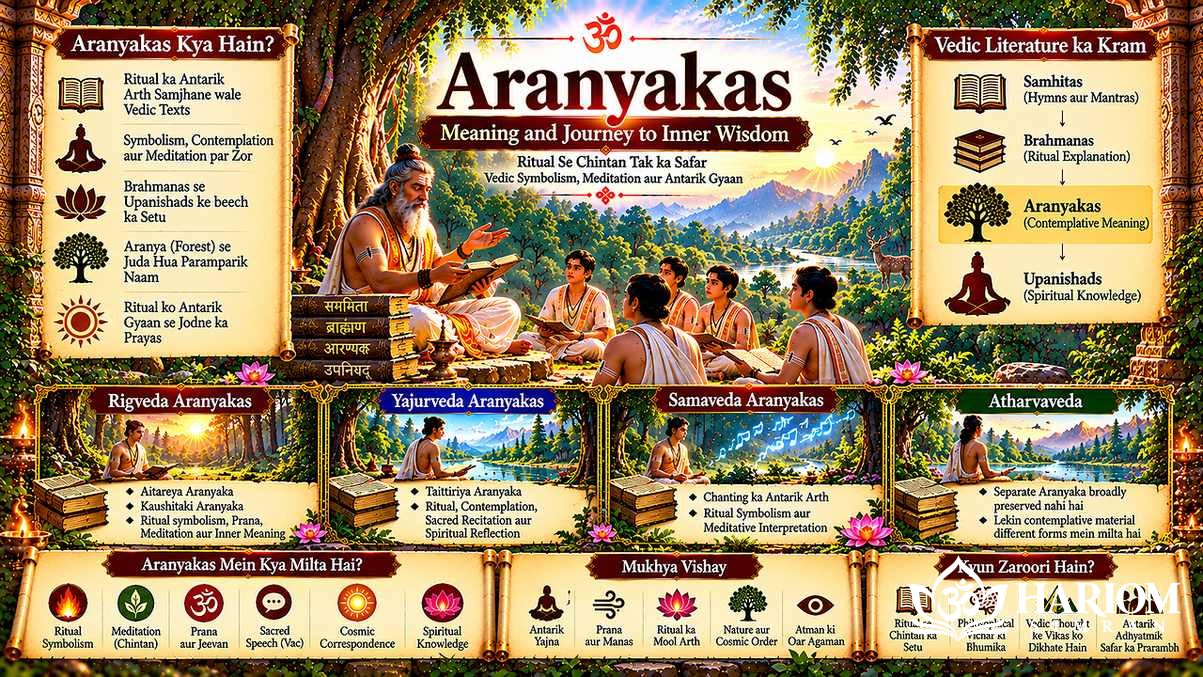
Where Do Aranyakas Fit in Vedic Literature?
A useful introductory structure is:
- Samhitas
- Brahmanas
- Aranyakas
- Upanishads
Broadly:
Samhitas
Preserve sacred hymns, Mantras, chants and ritual formulas.
Brahmanas
Explain rituals, procedures and symbolic meanings.
Aranyakas
Develop contemplative and internal interpretations of ritual.
Upanishads
Explore philosophical questions concerning Atman, Brahman, consciousness and liberation.
This is a useful learning model.
However, actual Vedic texts do not always fall into perfectly separate boxes.
In some traditions, Aranyaka and Upanishadic material are closely connected.
Are Aranyakas Part of Shruti?
Yes.
Aranyakas belong to the wider Shruti tradition.
Shruti means:
“That Which Is Heard.”
Traditional Hindu understanding places the Aranyakas within the sacred Vedic corpus along with:
Samhitas
Brahmanas
and
Principal Vedic Upanishads
This gives them an important place in Hindu scriptural history.
Why Did Aranyaka Literature Develop?
Vedic ritual developed into a sophisticated system of sacred actions, Mantras and symbolic correspondences.
Over time, deeper questions naturally emerged.
For example:
Does the ritual fire represent something within human life?
Can breath itself become sacred?
Can speech be understood as a spiritual power?
Can ritual be contemplated rather than physically performed?
What is the relationship between the individual and the cosmos?
Aranyaka texts begin to explore these questions.
They show a gradual movement from:
Action
to
Meaning
to
Contemplation
From Outer Ritual to Inner Contemplation
This movement is one of the most important developments in Vedic thought.
A Brahmana may explain a ritual offering.
An Aranyaka may reinterpret that offering symbolically.
For example, ritual elements can become connected with:
Breath
Speech
Mind
Sun
Time
Human Body
Cosmic Order
The ritual is no longer understood only as an external ceremony.
It becomes a way of thinking about the structure of human life and reality.
Aranyakas and Yajna
Yajna, sacred offering and ritual, remains important in the Aranyakas.
But the interpretation often becomes more inward.
The question changes from:
How is the Yajna performed?
to:
What does the Yajna represent?
A physical ritual may become connected with:
- Breathing
- Meditation
- Knowledge
- Speech
- Human Life
- Cosmic Processes
This transition prepares the way for later Hindu traditions that interpret sacrifice in ethical, spiritual and philosophical ways.
Aranyakas and Prana
One of the important concepts that gains increasing significance in later Vedic thought is Prana.
Prana is often connected with:
- Breath
- Life
- Vitality
- Living Beings
- Inner Energy
- Human Existence
Aranyaka literature frequently moves attention from external objects toward internal life.
Breath can therefore become more than a physical process.
It can become a subject of spiritual contemplation.
Later Upanishadic and Yogic traditions develop the concept of Prana much further.
Aranyakas and Sacred Speech
Speech is another major subject in Vedic thought.
Sacred speech is often connected with Vac.
In ritual tradition, precise speech is necessary because Mantras must be recited correctly.
In contemplative traditions, speech can also become a deeper spiritual symbol.
Questions begin to emerge such as:
Where does speech come from?
What gives words their power?
What is the relationship between sound, thought and reality?
These questions later become especially important in Upanishadic philosophy.
Explore wider sacred sound traditions through Mantras.
Aranyakas and Meditation
The Aranyakas are important because they begin to emphasize forms of contemplation more strongly.
This does not always mean meditation exactly as it is understood in modern Yoga.
Instead, Aranyaka contemplation can involve sustained reflection on symbolic correspondences.
A practitioner may contemplate relationships such as:
Fire and Speech
Sun and Vision
Breath and Life
Ritual and Cosmos
Human Body and Universe
This type of reflection moves spiritual practice toward inward awareness.
Aranyakas and Symbolic Ritual
A central feature of Aranyaka literature is the idea that ritual can be understood symbolically.
Instead of viewing a ceremony only through its physical components, the reader is encouraged to ask:
What does the fire symbolize?
What does the offering represent?
What does the altar correspond to?
What does the chant reveal?
This approach gradually transforms the meaning of ritual.
Sacred action becomes sacred insight.
Aranyakas and the Human Body
One of the major developments in later Vedic thought is the idea that the human being can reflect the larger cosmos.
Different parts of the body may be symbolically connected with:
- Sun
- Fire
- Wind
- Speech
- Breath
- Space
- Cosmic Forces
This relationship between the microcosm and macrocosm becomes increasingly important in later Hindu philosophy.
The human being is not viewed as completely separate from the universe.
The individual participates in a larger sacred reality.
Aranyakas and Nature
The natural world remains deeply important in Aranyaka literature.
The forest itself becomes a powerful setting for contemplation.
Important natural symbols include:
- Fire
- Sun
- Wind
- Earth
- Sky
- Water
- Plants
- Breath
Nature is not merely scenery.
It becomes a way of thinking about sacred reality.
This continues a theme already present in the Vedic Samhitas.
Aranyakas and the Rigveda
Two important Aranyakas are associated with Rigvedic traditions:
Aitareya Aranyaka
and
Kaushitaki Aranyaka, also associated with the Shankhayana tradition.
These texts preserve ritual interpretation, contemplation and philosophical material.
Aitareya Aranyaka
The Aitareya Aranyaka belongs to the Rigvedic tradition.
It contains material related to:
- Ritual Interpretation
- Prana
- Meditation
- Sacred Recitation
- Inner Meaning
- Philosophical Reflection
Part of the wider Aitareya tradition also contains the Aitareya Upanishad.
This clearly shows how Aranyaka literature can lead directly into Upanishadic philosophy.
Aitareya Tradition
The wider Aitareya sequence helps us see the layered structure of Vedic literature.
We encounter:
Aitareya Brahmana
then
Aitareya Aranyaka
and within the wider tradition:
Aitareya Upanishad
This movement illustrates a gradual shift from:
Ritual Explanation
to
Contemplation
to
Philosophical Inquiry
Kaushitaki Aranyaka
The Kaushitaki Aranyaka belongs to another Rigvedic tradition.
It includes ritual and contemplative material and is connected with the wider Kaushitaki or Shankhayana textual tradition.
The Kaushitaki Upanishad also belongs to this larger scriptural lineage.
Again, we see the close connection between Aranyaka and Upanishadic thought.
Aranyakas and the Yajurveda
The Yajurvedic tradition preserves one of the most important Aranyakas:
Taittiriya Aranyaka
This text belongs to the Krishna Yajurveda tradition.
It is especially valuable because it contains ritual, contemplative and philosophical material.
Taittiriya Aranyaka
The Taittiriya Aranyaka is one of the major surviving Aranyaka texts.
Its material includes themes related to:
- Ritual
- Meditation
- Sacred Recitation
- Prana
- Symbolism
- Contemplation
- Spiritual Knowledge
Parts of the wider Taittiriya tradition are closely connected with important Upanishadic teachings.
Taittiriya Tradition
The wider Taittiriya textual sequence includes:
Taittiriya Samhita
Taittiriya Brahmana
Taittiriya Aranyaka
Taittiriya Upanishad
This is one of the clearest examples of the layered nature of Vedic literature.
It shows a remarkable progression from sacred formula to ritual interpretation, then contemplation and philosophy.
Aranyakas and the Samaveda
Samavedic traditions also preserve texts and sections that perform functions similar to Aranyaka literature.
However, the surviving textual organization is not identical across all Vedas.
This is important.
We should not imagine that each Veda has one perfectly parallel:
Samhita
Brahmana
Aranyaka
Upanishad
arranged in exactly the same way.
Vedic transmission developed through many different Shakhas and lineages.
Does the Atharvaveda Have an Aranyaka?
The Atharvaveda does not preserve a widely recognized separate Aranyaka in the same way that Rigvedic and Yajurvedic traditions do.
This is another example of why Vedic textual history should not be forced into a perfectly uniform model.
The four Vedas share a larger sacred tradition, but their surviving textual structures differ.
Major Aranyakas at a Glance
| Vedic Tradition | Important Aranyaka | Main Themes |
|---|---|---|
| Rigveda | Aitareya Aranyaka | Ritual Symbolism, Prana, Contemplation |
| Rigveda | Kaushitaki Aranyaka | Ritual, Meditation, Inner Meaning |
| Krishna Yajurveda | Taittiriya Aranyaka | Ritual, Recitation, Prana, Spiritual Reflection |
| Other Vedic Traditions | Aranyaka-like Material | Survives in different textual forms |
This table is a simplified learning guide.
The history and classification of Vedic texts are more complex than a single chart can show.
Aranyakas and the Upanishads
The connection between Aranyakas and Upanishads is extremely important.
In some textual traditions, Upanishads occur within or at the end of Aranyaka material.
This reflects the gradual movement from:
Ritual Interpretation
to
Meditation
to
Philosophical Inquiry
The Upanishads increasingly ask:
Who am I?
What is Atman?
What is Brahman?
What is consciousness?
What is the ultimate reality behind existence?
How can liberation be understood?
The Aranyakas help prepare the intellectual and spiritual ground for these questions.
Is Every Upanishad an Aranyaka?
No.
The terms are related historically, but they are not interchangeable.
Some principal Upanishads emerge within Aranyaka or Brahmana textual settings.
Others belong to different Vedic traditions and textual contexts.
It is better to understand Aranyakas as an important transitional layer rather than treating them as another name for the Upanishads.
Aranyakas and Atman
The fully developed philosophical discussion of Atman becomes especially prominent in the Upanishads.
However, Aranyaka literature helps move attention inward.
Instead of focusing only on:
External Fire
External Offering
External Ritual Space
the text begins asking about:
Breath
Speech
Mind
Life
Inner Awareness
This inward movement creates important foundations for later Atman-centered philosophy.
Aranyakas and Brahman
The concept of Brahman develops through Vedic literature in complex ways.
In earlier contexts, the term can be connected with sacred utterance, ritual power or sacred formulation.
In later philosophical thought, Brahman increasingly becomes associated with ultimate reality.
Aranyaka literature occupies an important stage in this development.
It helps move sacred understanding from ritual power toward deeper metaphysical reflection.
Aranyakas and Om
Sacred sound becomes increasingly important in later Vedic contemplation.
Om eventually receives profound philosophical significance in the Upanishads.
Aranyaka traditions help prepare this transition by emphasizing:
- Sacred Recitation
- Sound
- Symbolic Meditation
- Inner Meaning
This development contributes to later Hindu meditation traditions.
Aranyakas and Inner Yajna
One of the most important ideas in the transition from ritual to philosophy is the possibility of understanding Yajna inwardly.
Instead of only offering material into an external fire, spiritual reflection begins asking whether:
Breath can become an offering
Knowledge can become an offering
Speech can become sacred action
Life itself can be understood symbolically
This does not mean the Aranyakas simply reject traditional ritual.
They reinterpret it.
Did the Aranyakas Reject Vedic Ritual?
No.
This is an important misunderstanding.
Aranyakas do not simply say that ritual is useless.
Instead, they often seek a deeper understanding of ritual.
Their approach can be summarized as:
Do not only perform the ritual. Understand what it represents.
This shift is very different from rejecting ritual altogether.
It is a movement from external performance toward deeper insight.
Aranyakas and Renunciation
Later Hindu spiritual traditions place great importance on renunciation.
However, the Aranyakas should not automatically be described as full expressions of later renunciant traditions.
They represent an important movement toward:
- Withdrawal
- Contemplation
- Inner Knowledge
- Reduced Emphasis on Public Ritual
Later traditions develop these themes much more fully.
The Aranyakas are part of that longer spiritual history.
Aranyakas and Vanaprastha
The idea of Vanaprastha, or the forest-dwelling stage of life, is often associated with the atmosphere of Aranyaka study.
Later Hindu thought describes four Ashramas:
- Brahmacharya
- Grihastha
- Vanaprastha
- Sannyasa
However, the full Ashrama system developed historically over time.
It is better to say that the Aranyakas resonate strongly with the contemplative ideal later associated with Vanaprastha, rather than assuming the complete later system was already fixed in exactly the same form.
Aranyakas and Knowledge
The Aranyakas show an increasing concern with knowledge as spiritual practice.
External ritual requires correct action.
Contemplative practice requires understanding.
The question becomes:
What do I know about the meaning behind the action?
This increasing emphasis on knowledge prepares the way for the Upanishadic idea that spiritual realization can depend on deep insight into the nature of Self and reality.
Aranyakas and the Guru Shishya Tradition
Like other Vedic texts, Aranyakas were transmitted within disciplined learning traditions.
The relationship between teacher and student remained important.
But the subject matter increasingly required not only memorization but also reflection.
The student had to understand:
Symbol
Meaning
Correspondence
Contemplative Teaching
The Guru Shishya relationship therefore became a vehicle for both preservation and interpretation.
Aranyakas and Sacred Secrecy
Some Vedic teachings were traditionally understood as appropriate for particular students or settings.
The more contemplative material of the Aranyakas was sometimes treated as knowledge requiring maturity and preparation.
This does not necessarily mean secrecy in the modern sense.
Rather, it reflects the idea that certain teachings should be approached with:
Discipline
Context
Guidance
Serious Study
This attitude continues in many later Hindu philosophical traditions.
Are Aranyakas Ritual Texts or Philosophical Texts?
They are best understood as transitional texts.
They contain both.
Aranyakas may include:
- Ritual Discussion
- Symbolic Interpretation
- Meditative Practice
- Cosmic Correspondence
- Spiritual Reflection
- Early Philosophical Inquiry
This mixed character is exactly what makes them important.
They stand between ritual-centered Brahmana literature and increasingly philosophical Upanishadic thought.
Are Aranyakas the Same as Brahmanas?
No.
They are closely related but have different emphasis.
Brahmanas
Focus strongly on ritual procedure, explanation and symbolism.
Aranyakas
Move increasingly toward contemplation, internalization and meditative interpretation.
The boundary is sometimes fluid, but the change in emphasis is significant.
Are Aranyakas the Same as Upanishads?
No.
Aranyakas and Upanishads are closely connected, but they are not identical.
Aranyakas
Often reinterpret ritual symbolically and contemplatively.
Upanishads
Increasingly focus directly on questions about Atman, Brahman, consciousness and liberation.
Some Upanishads occur within Aranyaka traditions, which explains their close historical relationship.
Are Aranyakas Still Read Today?
Aranyakas are not among the most commonly read Hindu scriptures in everyday devotional life.
Most modern Hindus are more familiar with texts such as:
Bhagavad Gita
Ramayana
Mahabharata
Puranas
Bhakti Literature
However, Aranyakas remain extremely important for understanding the development of Vedic spirituality and Hindu philosophy.
They show us how the movement from ritual toward contemplation occurred.
Why Are Aranyakas Important for Understanding Hindu Philosophy?
Without the Aranyakas, the transition from Vedic ritual to Upanishadic philosophy can seem sudden.
The Aranyakas show that it was gradual.
They help us see the development:
Mantra
then
Ritual
then
Symbolic Interpretation
then
Contemplation
then
Philosophical Inquiry
This progression is one of the most important intellectual developments in Hindu sacred literature.
What Can Modern Readers Learn From the Aranyakas?
Aranyakas come from an ancient world, but they raise questions that remain meaningful.
For example:
Is spiritual practice only external?
Can everyday actions have deeper meaning?
What is the relationship between breath and consciousness?
How does nature support contemplation?
Can ritual symbolism lead to self-understanding?
When should a person move from action toward reflection?
These questions make Aranyaka literature relevant beyond historical study.
Common Misunderstandings About the Aranyakas
Misunderstanding 1: Aranyakas Are Simply Books Written in Forests
Not necessarily.
The name is associated with the forest and contemplative study, but the texts should primarily be understood by their spiritual and literary role.
Misunderstanding 2: Aranyakas Reject Ritual
No.
They often reinterpret ritual symbolically rather than rejecting it.
Misunderstanding 3: Aranyakas and Upanishads Are the Same
No.
They are closely connected but represent different emphases within Vedic literature.
Misunderstanding 4: Every Veda Has One Identical Aranyaka
No.
The surviving textual traditions differ considerably.
Misunderstanding 5: Aranyakas Contain Only Meditation
No.
They can include ritual interpretation, symbolism, recitation, cosmology and early philosophical reflection.
How Should a Beginner Study the Aranyakas?
A practical learning path is:
Step 1
Understand the four Vedas and Samhitas.
Step 2
Understand the role of the Brahmanas.
Step 3
Learn why ritual symbolism became important.
Step 4
Study the Aitareya, Kaushitaki and Taittiriya Aranyakas.
Step 5
Explore concepts such as Prana, speech and inner sacrifice.
Step 6
Observe how ritual becomes contemplation.
Step 7
Move into the principal Upanishads.
This sequence makes the development of Vedic thought much easier to understand.
Why the Aranyakas Still Matter
The Aranyakas matter because they preserve one of the most important transitions in Hindu spiritual history.
They show how Vedic thought began moving from:
External Ritual
toward
Symbolic Meaning
then
Meditative Reflection
and finally
Philosophical Inquiry
They help us understand the growing importance of:
Prana
Speech
Mind
Inner Sacrifice
Meditation
Human and Cosmic Correspondence
Spiritual Knowledge
Without the Aranyakas, it is difficult to fully understand how the philosophical world of the Upanishads emerged from the older Vedic ritual tradition.
Explore Vedic Knowledge With HariOmSimran
HariOmSimran is developing the Scripture section as a structured and interconnected Hindu knowledge journey.
Continue exploring:
The next detailed Scripture article should be:
Upanishads: Meaning, Philosophy and Spiritual Wisdom
After the main Upanishads overview, we can begin a structured series on individual Upanishads such as:
Isha Upanishad
Kena Upanishad
Katha Upanishad
Mundaka Upanishad
Mandukya Upanishad
Taittiriya Upanishad
Aitareya Upanishad
Chandogya Upanishad
Brihadaranyaka Upanishad
and other principal Upanishads.
Learn • Explore • Understand • Preserve
Key Takeaway
The Aranyakas are an important transitional layer of Vedic sacred literature.
They connect the ritual-centered world of the Brahmanas with the philosophical world of the Upanishads.
Their teachings increasingly focus on:
Ritual Symbolism
Prana
Sacred Speech
Contemplation
Meditation
Inner Meaning
Human and Cosmic Correspondence
Important Aranyaka traditions include:
Aitareya Aranyaka
Kaushitaki Aranyaka
Taittiriya Aranyaka
The Aranyakas do not simply reject external ritual.
They ask a deeper question:
What does the ritual reveal about life, consciousness and sacred reality?
That question helps open the way toward the great philosophical teachings of the Upanishads.
Key Teachings
This scripture reveals profound wisdom and guidance for our spiritual journey. Below are the key teachings and principles derived from this sacred text.
Core Principles
These teachings provide guidance for living a life of faith, compassion, and spiritual growth.
- Spiritual Growth
- Divine Wisdom
- Sacred Teachings
- Faith Journey

Study Resources
Explore these resources to deepen your understanding of this scripture and apply its teachings to your daily life.
📖 Study Guide
Comprehensive study materials to help you understand the context, meaning, and application of this scripture.
🙏 Reflection Questions
Thought-provoking questions to help you reflect on the teachings and apply them to your personal spiritual journey.
📝 Journal Prompts
Guided journaling prompts to help you document your insights, prayers, and spiritual growth.
👥 Discussion Topics
Engaging discussion topics for group study and fellowship, fostering deeper understanding and community.
Frequently Asked Questions
Aranyakas are Vedic texts that increasingly interpret ritual through symbolism, contemplation and inner spiritual meaning. They form an important bridge between the Brahmanas and Upanishads.
The word Aranyaka is connected with Aranya, meaning forest. The texts are traditionally associated with more secluded and contemplative sacred study, although the term should not always be interpreted literally.
Yes. Aranyakas belong to the wider Shruti tradition and form part of the Vedic sacred corpus.
Brahmanas primarily explain ritual procedures and meanings. Aranyakas increasingly focus on symbolic, contemplative and internal interpretations of those rituals.
Important examples include the Aitareya Aranyaka, Kaushitaki Aranyaka and Taittiriya Aranyaka.
The Aranyakas are important because they show how Vedic spirituality gradually moved from external ritual toward inner contemplation, helping prepare the philosophical foundation for the Upanishads.