

Vedic tradition ritual se philosophy tak ek hi step mein move nahi karti.
In dono ke beech ek important stage aata hai.
Ye stage Aranyakas represent karte hain.
Jab Samhitas sacred hymns, Mantras aur ritual formulas preserve karti hain, aur Brahmanas rituals aur unke meanings explain karte hain, tab Aranyakas ek different type ke questions raise karna start karte hain:
Ritual ka antarik meaning kya hai?
Kya external ceremony ka inner spiritual meaning bhi ho sakta hai?
Kya fire, breath, speech aur consciousness ko symbolic way mein samjha ja sakta hai?
Kya sacred knowledge sirf action ke bare mein hai, ya contemplation ke bare mein bhi?
Ye questions Aranyakas ko Vedic literature mein ek distinctive place dete hain.
Aranyakas ritual ko completely reject nahi karte.
Instead, wo ritual ko increasingly reinterpret karte hain through:
- Symbolism
- Contemplation
- Meditation
- Inner Correspondence
- Sacred Knowledge
- Spiritual Reflection
Isi wajah se Aranyakas ritual-centered Brahmanas aur philosophical Upanishads ke beech ek important bridge hain.
Wider Hindu scriptural structure ko samajhne ke liye Hindu Scriptures explore karein.
Aranyakas Kya Hain?
Aranyakas Vedic texts ka ek category hain jo Vedic literature ke more contemplative layers se associated hain.
Ye often explore karte hain:
- Ritual Symbolism
- Meditative Interpretation
- Sacred Sound
- Prana
- Speech
- Mind
- Cosmic Correspondence
- Inner Sacrifice
- Spiritual Knowledge
Jahan Brahmana texts ka focus often hota hai:
Ritual kaise perform kiya jaye?
Wahin Aranyaka material increasingly poochta hai:
Ye ritual deeper reality ke bare mein kya batata hai?
Ye change in emphasis extremely important hai.
Ritual present rehta hai, lekin uska meaning gradually inward direction leta hai.
Aranyaka Word Ka Meaning Kya Hai?
Word Aranyaka Sanskrit word Aranya se connected hai.
Aranya ka meaning hai:
Forest
Isi wajah se Aranyakas ko often kaha jata hai:
Forest Texts
ya
Forest Treatises
Traditionally, ye texts quieter aur more secluded sacred study ke atmosphere se associated hain.
Lekin “forest texts” phrase ko too literally interpret nahi karna chahiye.
Ye zaroori nahi ki har Aranyaka literally kisi forest mein sitting author ne compose kiya ho.
Naam zyada strongly contemplative aur withdrawn sacred learning ko reflect karta hai.
Aranyakas Ko Forest Texts Kyun Kaha Jata Hai?
Forest ka symbolic significance bhi important hai.
Forest represent kar sakta hai movement from:
Public Activity
toward
Reflection
aur from:
External Ritual
toward
Inner Understanding
Later Hindu traditions mein household responsibilities se gradual withdrawal ko Vanaprastha ke saath associate kiya gaya.
Aranyakas is contemplative atmosphere ke saath resonate karte hain.
Lekin inhe samajhne ka best way unka actual content aur Vedic literature mein unka role hai.
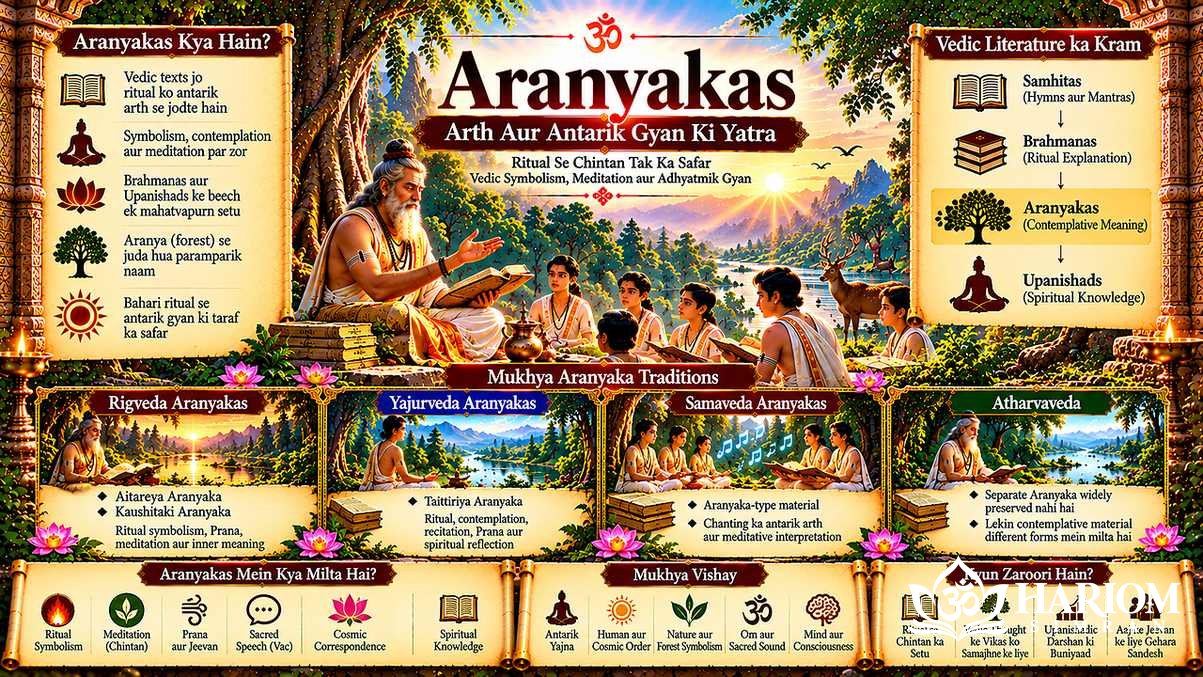
Vedic Literature Mein Aranyakas Kahan Fit Hote Hain?
Beginners ke liye ek useful structure hai:
- Samhitas
- Brahmanas
- Aranyakas
- Upanishads
Broadly:
Samhitas
Sacred hymns, Mantras, chants aur ritual formulas preserve karti hain.
Brahmanas
Rituals, procedures aur symbolic meanings explain karti hain.
Aranyakas
Ritual ko contemplative aur internal meaning ki taraf le jati hain.
Upanishads
Atman, Brahman, consciousness, reality aur Moksha jaise philosophical questions explore karti hain.
Ye learning framework helpful hai.
Lekin actual Vedic texts always perfectly separate categories mein fit nahi hote.
Kuch traditions mein Aranyaka aur Upanishadic material closely connected milta hai.
Kya Aranyakas Shruti Ka Part Hain?
Haan.
Aranyakas wider Shruti tradition ka part hain.
Shruti ka meaning hai:
“Jo Suna Gaya.”
Traditional Hindu understanding ke according Aranyakas wider Vedic sacred corpus ka part hain, along with:
Samhitas
Brahmanas
Principal Vedic Upanishads
Isliye Hindu scriptural history mein Aranyakas ka important place hai.
Aranyaka Literature Develop Kyun Hua?
Vedic ritual time ke saath sophisticated sacred system ban gaya.
Is system mein Mantras, offerings, priests aur symbolic correspondences ka detailed use hota tha.
Naturally, deeper questions develop hone lage.
For example:
Kya ritual fire human life ke andar kisi cheez ko represent karta hai?
Kya breath khud sacred ban sakti hai?
Kya speech spiritual power hai?
Kya ritual ko physically perform karne ke bajaye contemplate bhi kiya ja sakta hai?
Individual aur cosmos ka relationship kya hai?
Aranyakas inhi deeper questions ko explore karte hain.
Ye movement show karte hain:
Action
se
Meaning
aur phir
Contemplation
ki taraf.
Bahari Ritual Se Antarik Chintan Tak
Ye Vedic thought ke most important developments mein se ek hai.
Ek Brahmana ritual offering ko explain kar sakta hai.
Ek Aranyaka usi offering ko symbolically reinterpret kar sakta hai.
Ritual elements connect ho sakte hain:
Breath
Speech
Mind
Sun
Time
Human Body
Cosmic Order
Is point par ritual sirf external ceremony nahi rehta.
Wo human life aur reality ko samajhne ka spiritual framework banne lagta hai.
Aranyakas Aur Yajna
Yajna, yani sacred offering aur ritual, Aranyakas mein bhi important rehta hai.
Lekin interpretation more inward ho jati hai.
Question shift hota hai from:
Yajna kaise perform hota hai?
to:
Yajna kya represent karta hai?
Physical ritual symbolically connect ho sakta hai:
- Breathing
- Meditation
- Knowledge
- Speech
- Human Life
- Cosmic Processes
Ye development later Hindu traditions ke liye important foundation create karta hai, jahan sacrifice ko spiritual aur philosophical meanings mein bhi interpret kiya gaya.
Aranyakas Aur Prana
Later Vedic thought mein Prana ka importance increasingly grow karta hai.
Prana connected hai:
- Breath
- Life
- Vitality
- Living Beings
- Inner Energy
- Human Existence
Aranyakas external ritual se attention ko increasingly inner life ki taraf move karte hain.
Breath sirf physical biological process nahi rehta.
Ye spiritual contemplation ka subject ban sakta hai.
Later Upanishadic aur Yogic traditions Prana ke concept ko aur deeply develop karti hain.
Aranyakas Aur Sacred Speech
Speech Vedic tradition ka another major subject hai.
Sacred speech often Vac ke concept se connected hai.
Ritual mein correct speech important hai because Mantras precise pronunciation ke saath recite hone chahiye.
Contemplative tradition mein speech deeper spiritual symbol bhi ban sakti hai.
Questions emerge hote hain:
Speech ka source kya hai?
Words ko power kaun deta hai?
Sound, thought aur reality ka relationship kya hai?
Ye questions later Upanishadic philosophy mein aur important ho jate hain.
Wider sacred sound tradition ke liye Mantras explore karein.
Aranyakas Aur Meditation
Aranyakas ka importance isliye bhi hai because wo contemplation ko more strongly emphasize karte hain.
Lekin is contemplation ko modern Yoga meditation ke exactly same meaning mein samajhna zaroori nahi.
Aranyaka contemplation often symbolic correspondences par sustained reflection involve kar sakta hai.
For example:
Fire Aur Speech
Sun Aur Vision
Breath Aur Life
Ritual Aur Cosmos
Human Body Aur Universe
Is type ka reflection spiritual practice ko inward awareness ki direction mein le jata hai.
Aranyakas Aur Symbolic Ritual
Aranyaka literature ki central features mein se ek hai ritual ko symbolic way mein samajhna.
Ceremony ke physical elements se beyond questions pooche jate hain:
Fire kya symbolize karti hai?
Offering kya represent karti hai?
Altar ka deeper meaning kya hai?
Chant kya reveal karta hai?
Ye approach ritual ko transform karti hai.
Sacred action gradually sacred insight mein change hone lagta hai.
Aranyakas Aur Human Body
Later Vedic thought ka important development hai idea that human being larger cosmos ko reflect kar sakta hai.
Human body ke different aspects symbolically connected ho sakte hain:
- Sun
- Fire
- Wind
- Speech
- Breath
- Space
- Cosmic Forces
Microcosm aur macrocosm ka ye relationship later Hindu philosophy mein increasingly important ho jata hai.
Individual ko universe se completely separate nahi dekha jata.
Human life larger sacred reality ka part hai.
Aranyakas Aur Nature
Natural world Aranyaka literature mein deeply present hai.
Forest itself contemplation ka powerful symbol ban jata hai.
Important natural symbols include:
- Fire
- Sun
- Wind
- Earth
- Sky
- Water
- Plants
- Breath
Nature yahan sirf scenery nahi hai.
Nature sacred reality ko understand karne ka medium ban sakti hai.
Ye theme already Vedic Samhitas mein present thi aur Aranyakas mein more contemplative form leti hai.
Aranyakas Aur Rigveda
Rigvedic tradition se associated do important Aranyakas hain:
Aitareya Aranyaka
aur
Kaushitaki Aranyaka
Kaushitaki tradition ko Shankhayana tradition ke saath bhi associate kiya jata hai.
Ye texts ritual interpretation, contemplation aur philosophical reflection preserve karte hain.
Aitareya Aranyaka
Aitareya Aranyaka Rigvedic tradition ka important text hai.
Ismein material milta hai related to:
- Ritual Interpretation
- Prana
- Meditation
- Sacred Recitation
- Inner Meaning
- Philosophical Reflection
Wider Aitareya tradition mein Aitareya Upanishad bhi included hai.
Ye clearly show karta hai ki Aranyaka literature kaise directly Upanishadic philosophy ki taraf move kar sakta hai.
Aitareya Tradition
Aitareya textual sequence Vedic literature ki layered nature ko samajhne ke liye very useful hai.
Hum encounter karte hain:
Aitareya Brahmana
phir
Aitareya Aranyaka
aur wider tradition mein:
Aitareya Upanishad
Ye movement represent karta hai:
Ritual Explanation
se
Contemplation
aur phir
Philosophical Inquiry
ki taraf.
Kaushitaki Aranyaka
Kaushitaki Aranyaka another Rigvedic tradition ka part hai.
Ismein ritual aur contemplative material milta hai.
Ye wider Kaushitaki ya Shankhayana textual lineage ke saath connected hai.
Kaushitaki Upanishad bhi isi broader tradition ka part hai.
Again, Aranyaka aur Upanishadic thought ka close relationship visible hota hai.
Aranyakas Aur Yajurveda
Yajurvedic tradition ek particularly important Aranyaka preserve karti hai:
Taittiriya Aranyaka
Ye Krishna Yajurveda tradition se belong karta hai.
Ismein ritual, contemplative aur philosophical material ka rich combination milta hai.
Taittiriya Aranyaka
Taittiriya Aranyaka major surviving Aranyaka texts mein se ek hai.
Important themes include:
- Ritual
- Meditation
- Sacred Recitation
- Prana
- Symbolism
- Contemplation
- Spiritual Knowledge
Wider Taittiriya tradition later important Upanishadic teachings se connected hai.
Taittiriya Tradition
Taittiriya textual sequence include karti hai:
Taittiriya Samhita
Taittiriya Brahmana
Taittiriya Aranyaka
Taittiriya Upanishad
Ye Vedic literature ki layered development ka one of the clearest examples hai.
Hum movement dekhte hain:
Sacred Formula
se
Ritual Interpretation
phir
Contemplation
aur finally
Philosophy
ki taraf.
Aranyakas Aur Samaveda
Samavedic traditions bhi aise texts aur sections preserve karti hain jo Aranyaka-type functions perform karte hain.
Lekin har Veda ki surviving textual organization identical nahi hai.
Ye point important hai.
Humein imagine nahi karna chahiye ki har Veda mein perfectly parallel:
Samhita
Brahmana
Aranyaka
Upanishad
same exact form mein arranged hain.
Vedic transmission many different Shakhas aur lineages ke through develop hua.
Kya Atharvaveda Ka Aranyaka Hai?
Atharvaveda mein widely recognized separate Aranyaka same form mein preserve nahi hua jaise Rigvedic aur Yajurvedic traditions mein milta hai.
Ye ek important example hai ki Vedic textual history perfectly uniform nahi hai.
Four Vedas larger sacred tradition share karte hain, lekin unke surviving textual structures different hain.
Important Aranyakas Ek Nazar Mein
| Vedic Tradition | Important Aranyaka | Main Themes |
|---|---|---|
| Rigveda | Aitareya Aranyaka | Ritual Symbolism, Prana, Contemplation |
| Rigveda | Kaushitaki Aranyaka | Ritual, Meditation, Inner Meaning |
| Krishna Yajurveda | Taittiriya Aranyaka | Ritual, Recitation, Prana, Spiritual Reflection |
| Other Traditions | Aranyaka-Type Material | Different Textual Forms Mein Preserved |
Ye table beginner-friendly learning guide hai.
Actual Vedic textual history isse more complex hai.
Aranyakas Aur Upanishads
Aranyakas aur Upanishads ka relationship extremely important hai.
Kuch textual traditions mein Upanishads Aranyaka material ke within ya end ke paas milte hain.
Ye reflect karta hai gradual movement:
Ritual Interpretation
se
Meditation
aur phir
Philosophical Inquiry
ki taraf.
Upanishads increasingly poochti hain:
Main kaun hoon?
Atman kya hai?
Brahman kya hai?
Consciousness kya hai?
Ultimate reality kya hai?
Liberation ko kaise samjha jaye?
Aranyakas in questions ke liye intellectual aur spiritual ground prepare karte hain.
Kya Har Upanishad Aranyaka Hai?
Nahi.
Terms historically related hain, lekin interchangeable nahi.
Kuch principal Upanishads Aranyaka ya Brahmana textual settings ke andar emerge hote hain.
Others different Vedic traditions aur textual contexts se belong karte hain.
Aranyakas ko transitional layer ke roop mein samajhna better hai.
Aranyakas Aur Atman
Atman ka fully developed philosophical discussion specially Upanishads mein prominent hota hai.
Lekin Aranyakas attention ko increasingly inward move karte hain.
External focus jaise:
Fire
Offering
Ritual Space
gradually move karta hai toward:
Breath
Speech
Mind
Life
Inner Awareness
Ye inward movement later Atman-centered philosophy ki important foundation ban jata hai.
Aranyakas Aur Brahman
Brahman concept Vedic literature mein complex historical development se guzarta hai.
Earlier contexts mein term sacred utterance, ritual power ya sacred formulation se connected ho sakta hai.
Later philosophy mein Brahman increasingly ultimate reality se associated ho jata hai.
Aranyaka literature is development ke beech ka important stage represent karta hai.
Ye sacred understanding ko ritual power se deeper metaphysical reflection ki direction mein move karta hai.
Aranyakas Aur Om
Sacred sound later Vedic contemplation mein increasingly important hota hai.
Om eventually Upanishads mein profound philosophical significance receive karta hai.
Aranyaka traditions is transition ke liye ground prepare karti hain through:
- Sacred Recitation
- Sound
- Symbolic Meditation
- Inner Meaning
Ye development later Hindu meditation traditions ke liye important foundation ban jata hai.
Aranyakas Aur Inner Yajna
Ritual se philosophy ki journey mein important ideas mein se ek hai Yajna ko inwardly samajhna.
Focus sirf external fire mein physical offering tak limited nahi rehta.
Questions develop hote hain:
Kya breath offering ban sakti hai?
Kya knowledge offering ban sakta hai?
Kya speech sacred action ban sakti hai?
Kya life itself symbolic Yajna ke roop mein samjhi ja sakti hai?
Ye traditional ritual ka rejection nahi hai.
Ye uska deeper reinterpretation hai.
Kya Aranyakas Vedic Ritual Ko Reject Karte Hain?
Nahi.
Ye important misunderstanding hai.
Aranyakas ritual ko useless declare nahi karte.
Instead, wo ritual ka deeper meaning understand karne ki koshish karte hain.
Simple words mein approach hai:
Sirf ritual perform mat karo. Uska deeper meaning bhi samjho.
Ye ritual rejection se very different hai.
Ye external performance se inner insight ki taraf movement hai.
Aranyakas Aur Renunciation
Later Hindu traditions mein renunciation ka major importance develop hua.
Lekin Aranyakas ko directly later full renunciant traditions ke equal samajhna correct nahi hoga.
Ye important movement represent karte hain toward:
- Withdrawal
- Contemplation
- Inner Knowledge
- Reduced Focus on Public Ritual
Later spiritual traditions in themes ko much more fully develop karti hain.
Aranyakas is longer history ka important stage hain.
Aranyakas Aur Vanaprastha
Vanaprastha, yani forest-oriented stage of life, ko often Aranyaka atmosphere ke saath connect kiya jata hai.
Later Hindu thought four Ashramas describe karta hai:
- Brahmacharya
- Grihastha
- Vanaprastha
- Sannyasa
Lekin complete Ashrama system historically time ke saath develop hua.
Isliye better hai ye kehna ki Aranyakas contemplative ideal ke saath strongly resonate karte hain jo later Vanaprastha se associate hua.
Aranyakas Aur Knowledge
Aranyakas spiritual practice mein knowledge ke importance ko increasingly highlight karte hain.
External ritual correct action demand karta hai.
Contemplative practice understanding demand karti hai.
Question gradually become karta hai:
Action ke peeche meaning kya hai?
Ye increasing emphasis on knowledge later Upanishadic teaching ke liye foundation create karta hai, jahan spiritual realization deep insight into Self aur reality ke saath connect hoti hai.
Aranyakas Aur Guru Shishya Tradition
Other Vedic texts ki tarah Aranyakas bhi disciplined learning traditions ke through transmit hue.
Guru aur Shishya ka relationship important raha.
Lekin Aranyaka teachings mein memorization ke saath reflection bhi important ho jata hai.
Student ko samajhna hota tha:
Symbol
Meaning
Correspondence
Contemplative Teaching
Guru Shishya relationship preservation aur interpretation dono ka medium ban jata hai.
Aranyakas Aur Sacred Secrecy
Kuch Vedic teachings traditionally particular students aur appropriate settings ke liye suitable samjhi jati thi.
Aranyakas ka more contemplative material maturity aur preparation ke saath approach kiya jata tha.
Isse modern secrecy ke sense mein interpret karna zaroori nahi.
Ye zyada strongly importance reflect karta hai of:
Discipline
Context
Guidance
Serious Study
Ye attitude later Hindu philosophical traditions mein bhi continue hota hai.
Kya Aranyakas Ritual Texts Hain Ya Philosophical Texts?
Best answer hai:
Dono ke beech ka transitional layer.
Aranyakas include kar sakte hain:
- Ritual Discussion
- Symbolic Interpretation
- Meditative Practice
- Cosmic Correspondence
- Spiritual Reflection
- Early Philosophical Inquiry
Exactly ye mixed character unhe so important banata hai.
Wo ritual-centered Brahmanas aur philosophical Upanishads ke beech stand karte hain.
Kya Aranyakas Aur Brahmanas Same Hain?
Nahi.
Dono closely related hain, lekin emphasis different hai.
Brahmanas
Ritual procedure, explanation aur symbolism par strong focus.
Aranyakas
Contemplation, internalization aur meditative interpretation ki direction mein movement.
Boundary sometimes fluid ho sakti hai, lekin difference in emphasis important hai.
Kya Aranyakas Aur Upanishads Same Hain?
Nahi.
Aranyakas aur Upanishads closely connected hain, lekin identical nahi.
Aranyakas
Ritual ko symbolic aur contemplative way mein reinterpret karte hain.
Upanishads
Atman, Brahman, consciousness aur liberation ke direct philosophical questions par more strongly focus karti hain.
Kuch Upanishads Aranyaka traditions ke within occur karti hain, isi wajah se close relationship visible hai.
Kya Aranyakas Aaj Bhi Padhe Jate Hain?
Aranyakas everyday Hindu devotional life mein most commonly read texts nahi hain.
Modern Hindus often more familiar hote hain:
Bhagavad Gita
Ramayana
Mahabharata
Puranas
Bhakti Literature
Lekin Aranyakas Vedic spirituality aur Hindu philosophy ke development ko understand karne ke liye extremely important hain.
Ye show karte hain ki ritual se contemplation ki movement kaise hui.
Hindu Philosophy Samajhne Ke Liye Aranyakas Important Kyun Hain?
Aranyakas ke bina Vedic ritual se Upanishadic philosophy ki movement suddenly appear kar sakti hai.
Aranyakas show karte hain ki ye transition gradual tha.
Development ko is tarah samjha ja sakta hai:
Mantra
phir
Ritual
phir
Symbolic Interpretation
phir
Contemplation
phir
Philosophical Inquiry
Ye Hindu sacred literature ke most important intellectual developments mein se ek hai.
Modern Readers Aranyakas Se Kya Seekh Sakte Hain?
Aranyakas ancient Vedic world se belong karte hain.
Lekin inke questions aaj bhi meaningful hain.
For example:
Kya spiritual practice sirf external hoti hai?
Kya everyday actions ka deeper spiritual meaning ho sakta hai?
Breath aur consciousness ka relationship kya hai?
Nature contemplation ko kaise support karti hai?
Kya ritual symbolism self-understanding ki taraf lead kar sakta hai?
Action se reflection ki taraf move karna kab important hota hai?
Ye questions Aranyaka literature ko historical study se beyond relevant banate hain.
Aranyakas Ke Common Misunderstandings
Misunderstanding 1: Aranyakas Sirf Forest Mein Likhi Gayi Books Hain
Not necessarily.
Name forest aur contemplative study se associated hai, lekin texts ko mainly unke spiritual aur literary role ke through samajhna chahiye.
Misunderstanding 2: Aranyakas Ritual Ko Reject Karte Hain
Nahi.
Wo often ritual ko symbolically reinterpret karte hain.
Misunderstanding 3: Aranyakas Aur Upanishads Same Hain
Nahi.
Dono closely connected hain, lekin Vedic literature mein different emphasis represent karte hain.
Misunderstanding 4: Har Veda Ka Ek Identical Aranyaka Hai
Nahi.
Surviving Vedic textual traditions considerably differ karti hain.
Misunderstanding 5: Aranyakas Sirf Meditation Ke Bare Mein Hain
Nahi.
Inmein ritual interpretation, symbolism, recitation, cosmology aur early philosophical reflection bhi milti hai.
Beginner Aranyakas Ko Kaise Study Kare?
Practical learning path:
Step 1
Four Vedas Aur Samhitas Ko Samjhein.
Step 2
Brahmanas Ka Role Samjhein.
Step 3
Ritual Symbolism Ki Importance Samjhein.
Step 4
Aitareya, Kaushitaki Aur Taittiriya Aranyakas Explore Karein.
Step 5
Prana, Speech Aur Inner Sacrifice Jaise Concepts Study Karein.
Step 6
Observe Karein Ki Ritual Contemplation Mein Kaise Transform Hota Hai.
Step 7
Principal Upanishads Ki Taraf Move Karein.
Ye sequence Vedic thought ke development ko much easier banata hai.
Aranyakas Aaj Bhi Important Kyun Hain?
Aranyakas Hindu spiritual history ke one of the most important transitions ko preserve karte hain.
Ye show karte hain movement from:
External Ritual
toward
Symbolic Meaning
then
Meditative Reflection
and finally
Philosophical Inquiry
Aranyakas growing importance explain karte hain of:
Prana
Sacred Speech
Mind
Inner Sacrifice
Meditation
Human And Cosmic Correspondence
Spiritual Knowledge
Aranyakas ke bina Upanishadic philosophy ka development fully understand karna difficult hota.
HariOmSimran Ke Saath Vedic Knowledge Explore Karein
HariOmSimran apne Scripture section ko structured aur interconnected Hindu knowledge journey ke roop mein develop kar raha hai.
Continue exploring:
Scripture series ka next detailed article hoga:
Upanishads: Arth, Darshan Aur Adhyatmik Gyan
Main Upanishads overview ke baad hum individual Upanishads ka structured series start kar sakte hain, including:
Isha Upanishad
Kena Upanishad
Katha Upanishad
Mundaka Upanishad
Mandukya Upanishad
Taittiriya Upanishad
Aitareya Upanishad
Chandogya Upanishad
Brihadaranyaka Upanishad
aur other principal Upanishads.
Learn • Explore • Understand • Preserve
Key Takeaway
Aranyakas Vedic sacred literature ka important transitional layer hain.
Ye ritual-centered Brahmanas aur philosophical Upanishads ke beech bridge ka kaam karte hain.
Inke teachings increasingly focus karte hain:
Ritual Symbolism
Prana
Sacred Speech
Contemplation
Meditation
Inner Meaning
Human Aur Cosmic Correspondence
Important Aranyaka traditions include:
Aitareya Aranyaka
Kaushitaki Aranyaka
Taittiriya Aranyaka
Aranyakas external ritual ko simply reject nahi karte.
Wo ek deeper question poochte hain:
Ritual life, consciousness aur sacred reality ke bare mein kya reveal karta hai?
Ye question later Upanishadic philosophy ke liye important doorway open karta hai.
Key Teachings
This scripture reveals profound wisdom and guidance for our spiritual journey. Below are the key teachings and principles derived from this sacred text.
Core Principles
These teachings provide guidance for living a life of faith, compassion, and spiritual growth.
- Spiritual Growth
- Divine Wisdom
- Sacred Teachings
- Faith Journey

Study Resources
Explore these resources to deepen your understanding of this scripture and apply its teachings to your daily life.
📖 Study Guide
Comprehensive study materials to help you understand the context, meaning, and application of this scripture.
🙏 Reflection Questions
Thought-provoking questions to help you reflect on the teachings and apply them to your personal spiritual journey.
📝 Journal Prompts
Guided journaling prompts to help you document your insights, prayers, and spiritual growth.
👥 Discussion Topics
Engaging discussion topics for group study and fellowship, fostering deeper understanding and community.
Frequently Asked Questions
Aranyakas Vedic texts hain jo rituals ko symbolism, contemplation aur inner spiritual meaning ke through interpret karte hain. Ye Brahmanas aur Upanishads ke beech important bridge hain.
Word Aranyaka Sanskrit word Aranya se connected hai, jiska meaning forest hai. Ye texts traditionally more secluded aur contemplative sacred study se associated hain.
Haan. Aranyakas wider Shruti tradition ka part hain aur Vedic sacred corpus mein important place rakhte hain.
Brahmanas mainly ritual procedures aur meanings explain karte hain. Aranyakas increasingly symbolic, contemplative aur internal interpretations par focus karte hain.
Important examples include Aitareya Aranyaka, Kaushitaki Aranyaka Aur Taittiriya Aranyaka.
Aranyakas important hain because ye Vedic spirituality ki gradual movement ko show karte hain from external ritual toward inner contemplation, aur Upanishadic philosophy ke liye foundation prepare karte hain.