

Aitareya Upanishad ek remarkable spiritual vision ke saath start hoti hai.
Body, senses, society ya visible universe ko discuss karne se pehle text attention ko Atman, yani Self, ki taraf le jati hai.
Ye fundamental questions raise karti hai:
Experience ka source kya hai?
Ek deeper reality se many forms kaise emerge hote hain?
Body ko conscious aur meaningful experience ka field kya banata hai?
Senses aur consciousness ka relationship kya hai?
Human birth spiritually important kyun mana jata hai?
Seeing, hearing, speaking, thinking aur knowing ke peeche deeper Self kya hai?
Ye questions gradually humein Vedanta ke one of the most famous declarations tak le jate hain:
Prajnanam Brahma
Broadly:
Consciousness Is Brahman
ya
Brahman Is Consciousness
Is statement ka exact philosophical interpretation different Vedanta traditions mein different ho sakta hai, lekin iska importance enormous hai.
Aitareya Upanishad major themes explore karti hai:
- Srishti aur manifestation
- Atman as the deeper source
- Worlds aur cosmic powers
- Human embodiment
- Senses aur unke functions
- Food aur life
- Human birth
- Consciousness
- Self-knowledge
- Brahman
- Prajnanam Brahma
- Spiritual realization
Text relatively short hai, lekin iske questions Hindu philosophy ke most fundamental questions mein se hain.
Wider sacred tradition ko samajhne ke liye Hindu Scriptures explore karein.
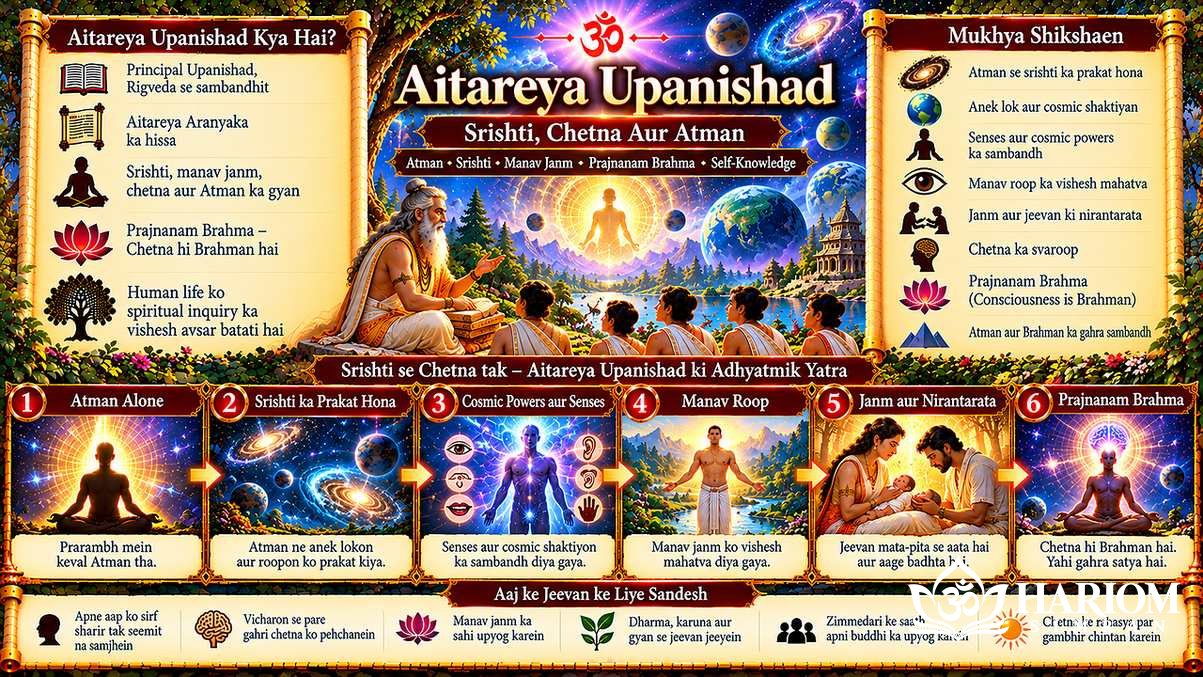
Aitareya Upanishad Kya Hai?
Aitareya Upanishad principal ya Mukhya Upanishads mein se ek hai.
Ye Rigveda se associated hai aur Aitareya Aranyaka tradition ka part hai.
Ye connection important hai because Rigveda Vedic sacred literature ke oldest layers mein se hai.
Aitareya Upanishad hymns aur ritual ke Vedic world se philosophical inquiry ki taraf movement represent karti hai.
Iska central question sirf ye nahi hai:
Physical universe kaise begin hua?
Deeper question hai:
Existence aur conscious life ke peeche spiritual source kya hai?
Aitareya Upanishad Aur Rigveda
Aitareya Upanishad Rigvedic tradition se belong karti hai.
Rigveda mein ancient hymns Divine powers aur cosmic realities ko address karte hain.
Later Vedic development mein Aranyakas aur Upanishads increasingly deeper questions ask karte hain.
Broadly journey ko is tarah samjha ja sakta hai:
- Sacred hymns
- Ritual interpretation
- Symbolic reflection
- Inner contemplation
- Atman aur Brahman ki inquiry
Aitareya Upanishad isi deeper contemplative phase ka important text hai.
Aitareya Upanishad Ka Structure
Aitareya Upanishad traditionally three chapters mein arranged hai.
Broadly, three chapters ka focus hai:
- Chapter One: Srishti, worlds, senses, Divine powers aur embodiment
- Chapter Two: Human birth aur embodied life ki continuity
- Chapter Three: Consciousness, Atman aur Prajnanam Brahma
Ye progression important hai.
Text move karti hai:
Cosmos
se
Human Life
phir
Consciousness
aur finally
Deeper Self
ki taraf.
Beginning Mein Atman
Aitareya Upanishad ka opening teaching profound hai.
Text Atman ko primary position deti hai.
Differentiated creation se pehle attention Self ki taraf direct hoti hai.
Ye philosophical perspective ordinary material explanation se different hai.
Instead of matter se start karke consciousness ko later development samajhne ke, Upanishad spiritual principle se start karti hai.
Ye sacred aur metaphysical teaching hai.
Isse modern scientific cosmology ke replacement ke roop mein present nahi karna chahiye.
Srishti Atman Se Begin Hoti Hai
Creation account Atman ko worlds ke manifestation ke context mein present karta hai.
Text ek spiritual sequence describe karti hai involving:
- Worlds
- Cosmic powers
- Human form
- Sensory faculties
- Divine functions
- Food
- Self ka embodied existence ke saath connection
Teaching symbolic, philosophical aur theological hai.
Purpose scientific timeline provide karna nahi hai.
Purpose hai relationship ko explore karna between:
Source
and
Manifestation
Worlds Ka Prakat Hona
Aitareya Upanishad different worlds ke emergence ka description deti hai.
Ancient Vedic cosmology reality ko multiple levels ya regions ke through samajh sakti thi.
Modern reader ko in passages ko sacred context mein samajhna chahiye.
Main philosophical point hai:
Many Worlds Apne Deeper Source Se Independent Nahi Hain.
Text unity se multiplicity ki movement describe karti hai.
Ek Source, Anek Roop
Upanishadic philosophy ka recurring idea hai:
Multiplicity Complete Separation Ke Equal Nahi Hoti.
Human experience mein hum dekhte hain:
- Different people
- Different animals
- Different natural forms
- Different senses
- Different experiences
Lekin Aitareya Upanishad poochti hai:
In sab experiences ko possible banane wala deeper principle kya hai?
Ye question eventually consciousness tak le jata hai.
Cosmic Powers Aur Human Faculties
Aitareya Upanishad human faculties ko wider cosmic aur Divine powers ke saath connect karti hai.
Ye Vedic worldview ka important feature hai.
Human being cosmos se completely isolated nahi hai.
Text correspondence show karti hai between:
Human Faculties
and
Cosmic Powers
Important functions include:
- Speech
- Sight
- Hearing
- Breath
- Mind
Ye sab wider sacred order ke context mein understand kiye jate hain.
Wider Hindu Divine traditions ke liye Deities explore karein.
Human Being as a Sacred Microcosm
Text ko understand karne ka ek useful way hai human being ko larger cosmic order ka reflection samajhna.
Body sirf mechanical structure nahi hai.
Ye field hai jahan:
- Speech operate karti hai
- Vision operate karta hai
- Hearing operate karta hai
- Breath operate karta hai
- Thought arise hota hai
- Conscious experience possible hota hai
Iska meaning ye nahi ki text anatomy textbook hai.
Ye human being ko sacred philosophical symbolism ke through understand karti hai.
Human Form Important Kyun Hai?
Creation narrative mein human form ko special significance milti hai.
Different powers embodied human existence mein suitable place find karti hain.
Ye human birth ke spiritual potential ki taraf point kar sakta hai.
Human beings possess capacity to:
- Reflect
- Question
- Remember
- Choose
- Study Dharma
- Seek Self-knowledge
- Contemplate Brahman
Human birth ka importance therefore physical superiority ke claim par based nahi hona chahiye.
Deeper point hai:
Conscious Spiritual Inquiry Human Life Mein Possible Hoti Hai.
Senses Independent Nahi Hain
Aitareya Upanishad ka important insight hai ki senses completely independent realities nahi hain.
Eyes present ho sakti hain.
Ears present ho sakte hain.
Speech organs present ho sakte hain.
Lekin deeper question remain karta hai:
Experience meaningful kaise banta hai?
Eye alone conscious seeing explain nahi karti.
Ear alone conscious hearing explain nahi karta.
Tongue alone meaningful speech explain nahi karti.
Inquiry therefore move karti hai:
Organ
se
Function
aur phir
Consciousness
ki taraf.
Speech Aur Consciousness
Speech Vedic tradition mein extremely important hai.
Sacred hymns aur Mantras sound ke through transmit hote hain.
Lekin speech alone deepest reality nahi hai.
Words:
- Spoken hote hain
- Heard hote hain
- Understood hote hain
- Remembered hote hain
Aitareya Upanishad attention ko deeper consciousness ki taraf guide karti hai jiske through speech meaningful ban sakti hai.
Wider sacred sound tradition ke liye Mantras explore karein.
Sight Aur Seer
Seeing simple lag sakta hai.
Eye object ko dekhti hai.
Lekin philosophical inquiry poochti hai:
Seeing ko know kaun karta hai?
Ye physical eye se deeper question hai.
Upanishadic inquiry gradually move karti hai:
Eye
se
Seeing
phir
Awareness of Seeing
aur finally
The Self
ki taraf.
Hearing Aur Knower
Same principle hearing par apply hota hai.
Ear sound receive karta hai.
Lekin conscious being sound ko know karta hai.
Ye distinction important hai between:
Faculty
and
Knower
Senses important hain, lekin necessarily deepest Self nahi hain.
Breath Aur Life
Breathing embodied life ka basic sign hai.
Vedic aur Upanishadic traditions breath ko often Prana ke saath connect karti hain.
Lekin Aitareya Upanishad ki deeper inquiry life-functions par stop nahi hoti.
Question continue hota hai:
Body alive hai ye know kaun karta hai?
Mind Aur Thought
Thought identity ke very close feel hota hai.
Hum kehte hain:
Main Soch Raha Hoon.
Lekin thoughts constantly change hote hain.
One thought appears.
Another disappears.
Opinions change.
Memories change.
Emotions change.
Upanishadic inquiry therefore asks:
Kya Deepest Self Changing Thoughts Ke Equal Hai?
Suitable Body Ki Search
Creation narrative mein symbolic movement appear hoti hai jahan embodied form different powers ke liye suitable field ban jati hai.
Human form ko special role milta hai.
Is section ko biological evolution ke account ke roop mein read karna correct nahi hoga.
Text ka concern deeper hai:
Consciousness Embodied Existence Ke Saath Kaise Related Hai?
Food Ka Prakat Hona
Food Upanishadic literature mein frequently important role play karta hai.
Aitareya Upanishad bhi embodied life ke context mein food ko address karti hai.
Physical body nourishment par depend karti hai.
Lekin food alone conscious existence ko explain nahi karta.
Isse layered understanding develop hoti hai:
- Body nourishment par depend karti hai
- Life bodily functions par depend karti hai
- Experience senses aur mind ke through unfold hota hai
- Meaningful awareness consciousness ke saath connected hai
Food Aur Embodied Person
Spiritual philosophy physical reality ko deny nahi karti.
Human beings ko practical life ke liye chahiye:
- Food
- Water
- Shelter
- Health
- Material support
Spiritual life embodied existence ke through lived hoti hai.
Lekin Upanishad deeper question poochti hai:
Kya Physical Nourishment Complete Self Ko Explain Karta Hai?
Answer seeker ko deeper level ki taraf guide karta hai.
Self Ka Entry Teaching
Creation narrative ke most important moments mein se ek hai Self ka embodied existence ke saath connection.
Text philosophical question raise karti hai:
Agar Self ka principle na ho, to faculties conscious experience ka part kaise banengi?
Ye turning point hai.
Human being organs aur functions ka collection bhar nahi rehta.
Consciousness central ban jati hai.
Entry Teaching Important Kyun Hai?
Imagine kariye ek body jisme ho:
- Eyes
- Ears
- Speech organs
- Breath
- Mind
- Physical structure
Phir bhi question remain karta hai:
Kya Ye Sab Conscious Life Ko Fully Explain Karte Hain?
Aitareya Upanishad deeper principle ki taraf point karti hai.
Ye deeper principle Atman se connected hai.
Atman Koi Physical Organ Nahi Hai
Atman ko heart, brain, eye ya kisi aur organ ki tarah locate karne ki koshish karna text ke philosophical level ko miss kar sakta hai.
Atman ordinary anatomical object nahi hai.
Ye deeper experiencer aur Self ki inquiry se connected hai.
Conscious Experience Central Ban Jata Hai
Aitareya Upanishad progress karte karte consciousness ko increasingly central banati hai.
Human experience include karti hai:
- Seeing
- Hearing
- Smelling
- Speaking
- Thinking
- Understanding
- Remembering
- Knowing
Question hai:
In different activities ko unify karne wala deeper principle kya hai?
Third chapter directly isi inquiry par focus karti hai.
Second Chapter: Human Birth
Second chapter human birth aur life ki continuity par focus karti hai.
Text generations ke through embodied life ke continuation ko reflect karti hai.
Is section ko sometimes three births ke teaching ke through explain kiya jata hai.
Ye ancient Vedic family, embodiment aur continuity ke worldview ka part hai.
Three Births Ki Teaching
Traditional explanation human continuity ko stages ke through understand karti hai.
Broadly ye connect karti hai:
- Parent ke through life ka continuation
- Child ka birth
- Next generation ke through continuity
Different commentarial traditions details ko somewhat differently explain kar sakti hain.
Main philosophical point hai:
Embodied Life Generational Continuity Ke Through Move Karti Hai.
Human Life Isolated Nahi Hai
Individual life completely disconnected event nahi hai.
Hum inherit karte hain:
- Body
- Family history
- Language
- Culture
- Responsibilities
- Knowledge
- Social relationships
Embodied existence relational hai.
Ye Atman ko fully define nahi karta, lekin human life ke context ko explain karta hai.
Parents Aur Continuity
Aitareya Upanishad ka world recognize karta hai ki human embodied life earlier generations par depend karti hai.
Ye naturally values se connect ho sakta hai:
- Gratitude
- Family responsibility
- Knowledge preservation
- Future generations ki care
Taittiriya Upanishad in ethical themes ko aur explicitly develop karti hai.
Kya Second Chapter Biology Lesson Hai?
Nahi.
Human birth ka teaching ancient Vedic philosophical reflection ka part hai.
Ye modern reproductive biology ka substitute nahi hai.
Scientific explanations of conception, genetics aur pregnancy separate field se belong karte hain.
Human Birth as Spiritual Opportunity
Human birth important hai because human consciousness higher inquiry ko possible banati hai.
Human being pooch sakta hai:
- Main Kaun Hoon?
- Dharma Kya Hai?
- Death Kya Hai?
- Brahman Kya Hai?
- Consciousness Kya Hai?
- Moksha Kya Hai?
Ye human life ko spiritual opportunity banata hai.
Human Birth Aur Responsibility
Higher reflective ability responsibility bhi laati hai.
Human intelligence use ki ja sakti hai for:
- Compassion
- Knowledge
- Seva
- Ethical living
- Spiritual growth
- Community welfare
Lekin intelligence selfishness ke liye bhi use ho sakti hai.
Isliye consciousness automatically wisdom guarantee nahi karti.
Wisdom ke liye reflection aur Dharma required hain.
Third Chapter: Self Kaun Hai?
Third chapter especially direct hai.
Inquiry poochti hai:
Wo Self Kaun Hai Jise Hum Samajhna Chahte Hain?
Text human faculties ko examine karti hai.
Kya Self hai:
Seeing?
Hearing?
Thinking?
Knowing?
Inquiry deeper insight ki taraf move karti hai.
Consciousness Central Ho Jati Hai
Aitareya Upanishad consciousness ko human experience ka foundational principle ke roop mein highlight karti hai.
Hum know karte hain because awareness present hai.
Hum recognize karte hain because awareness present hai.
Hum experience karte hain because consciousness present hai.
Ye famous Mahavakya tak lead karta hai:
Prajnanam Brahma
Prajnanam Ka Meaning Kya Hai?
Sanskrit word Prajnanam rich meaning carry karta hai.
Context ke according ye connect ho sakta hai:
- Consciousness
- Awareness
- Knowing
- Intelligence
- Understanding
- Cognitive presence
One-word translation incomplete ho sakti hai.
Vedantic context mein Consciousness commonly use kiya jata hai because ye teaching ki deeper philosophical direction ko capture karta hai.
Prajnanam Brahma
Famous statement hai:
Prajnanam Brahma
Common translation:
Consciousness Is Brahman
ya
Brahman Is Consciousness
Later Vedanta mein ye important Mahavakya ke roop mein highlight kiya gaya.
Ye traditionally Rigvedic Upanishadic tradition se associated hai.
Mahavakya Kya Hai?
Mahavakya ka broad meaning hai:
Great Saying
ya
Great Statement
Later Vedantic tradition kuch Upanishadic statements ko especially profound declarations ke roop mein highlight karti hai.
Prajnanam Brahma in famous Mahavakyas mein se ek hai.
Lekin har Mahavakya ko uske original scriptural context mein samajhna important hai.
Prajnanam Brahma Ka Meaning Ordinary Thoughts Nahi Hai
Important clarification:
Prajnanam Brahma ka meaning ye nahi hai:
Mere Har Thought Ko Brahman Kaha Gaya Hai.
Thoughts change hote hain.
Opinions change hote hain.
Memory change hoti hai.
Emotions change hote hain.
Prajnanam deeper principle of consciousness ki taraf point karta hai, not every temporary mental content.
Consciousness Aur Mind Same Nahi Hain
Mind include karta hai:
- Thoughts
- Memories
- Emotions
- Imagination
- Decisions
Consciousness wo deeper condition hai jiske through ye mental contents known hote hain.
Later Vedanta traditions mind aur consciousness ke relationship ko different ways mein explain karti hain.
Knowing Aur Knower
Aitareya Upanishad deep philosophical problem raise karti hai.
Hum objects ko know kar sakte hain.
Sensations ko know kar sakte hain.
Thoughts ko know kar sakte hain.
Lekin:
Knower Ki Nature Kya Hai?
Agar knower ko bhi simple object bana diya jaye, to us object ko know kaun karega?
Ye inquiry Self ki taraf move karti hai.
Atman Aur Consciousness
Aitareya Upanishad Self ko conscious awareness ke saath deeply connect karti hai.
Atman simply ye nahi hai:
- Body
- Sense organ
- Breath
- Thought
- Memory
- Social identity
Ye sab embodied experience ka part hain.
Deeper Self ko consciousness ke through approach kiya jata hai.
Atman Aur Brahman
Aitareya Upanishad ultimately Atman aur Brahman ke profound relationship ki taraf lead karti hai.
Later Vedanta traditions is relationship ko differently interpret karti hain.
Prajnanam Brahma in philosophical discussions ka central statement ban jata hai.
Aitareya Upanishad Aur Advaita Vedanta
Advaita Vedanta Prajnanam Brahma ko great importance deta hai.
Advaita interpretation Brahman ko pure consciousness ke roop mein understand karne par strong emphasis deta hai.
Deepest Self ko Brahman ke nondual relation mein explain kiya jata hai.
Is view mein consciousness merely body ka property nahi hai.
Ye fundamental reality ki taraf point karti hai.
Lekin Advaita one major interpretation hai, only Hindu interpretation nahi.
Aitareya Upanishad Aur Vishishtadvaita
Vishishtadvaita Vedanta bhi Upanishadic authority accept karta hai.
Lekin individual soul aur Supreme Brahman ke relationship ko Advaita se differently explain karta hai.
Soul real hai.
Brahman Supreme Reality hai.
Souls aur universe Brahman par dependent hain.
Prajnanam related teachings ko isi framework mein understand kiya jata hai.
Aitareya Upanishad Aur Dvaita
Dvaita Vedanta individual soul aur Supreme Brahman ke beech real distinction maintain karta hai.
Isliye Mahavakyas ko complete identity ke framework mein necessarily interpret nahi kiya jata.
Ye important HariOmSimran principle reinforce karta hai:
Shared Scripture Different Respected Interpretations Receive Kar Sakti Hai.
Consciousness Aur Modern Science
Modern readers naturally Aitareya Upanishad ko contemporary consciousness discussions ke saath connect kar sakte hain.
Modern questions include:
- Consciousness kya hai?
- Subjective experience kaise arise hota hai?
- Brain aur mind ka relationship kya hai?
- Awareness ka nature kya hai?
Lekin Aitareya Upanishad neuroscience textbook nahi hai.
Its framework hai:
Spiritual
Philosophical
Metaphysical
Modern science aur Upanishadic philosophy kuch overlapping questions pooch sakti hain, lekin methods different hain.
Kya Aitareya Upanishad Prove Karti Hai Ki Consciousness Brain Se Independent Hai?
Scientifically aisa claim karna too strong hoga.
Upanishad philosophically consciousness ko foundational importance deti hai.
Modern neuroscience brain activity aur conscious experience ke relationships ko study karti hai.
Dono different forms of inquiry hain.
HariOmSimran ko Upanishadic view accurately explain karna chahiye without false scientific proof claims.
Self Social Identity Se Deeper Hai
Modern identity often define hoti hai through:
- Name
- Profession
- Nationality
- Wealth
- Education
- Family role
- Social status
- Online identity
Ye ordinary life mein meaningful hain.
Lekin Aitareya Upanishad deeper question poochti hai:
In Sab Identities Ko Experience Kaun Karta Hai?
Roles change karte hain.
Experiences change karte hain.
Inquiry deeper knower ki taraf move karti hai.
Consciousness Aur Daily Life
Teaching sirf abstract philosophy nahi hai.
Daily life mein hum experience karte hain:
- Success
- Failure
- Praise
- Criticism
- Happiness
- Stress
- Gain
- Loss
Ye sab consciousness mein known hote hain.
Upanishadic inquiry humein remind karti hai:
Har Changing Experience Ko Complete Identity Mat Banao.
Self-Inquiry Ka Importance
Self-inquiry begin ho sakti hai questions ke through:
- Kya Main Sirf Body Hoon?
- Kya Main Sirf Thoughts Hoon?
- Kya Main Sirf Memories Hoon?
- Kya Main Sirf Emotions Hoon?
- In Experiences Ko Know Kaun Karta Hai?
- Changing States Ke Peeche Deeper Self Kya Hai?
Ye questions Aitareya Upanishad ko wider Vedantic search for Atman se connect karte hain.
Creation Aur Consciousness Connected Hain
Aitareya Upanishad ki unique strength hai ki cosmology aur consciousness ko completely separate subjects nahi banaya jata.
Text journey karti hai:
- Manifestation
- Worlds
- Human body
- Senses
- Birth
- Consciousness
Outer universe ka question eventually turn hota hai toward:
Universe Ko Know Karne Wala Conscious Knower Kaun Hai?
Universe Se Self Tak
Text ki spiritual movement ko simple sequence mein samjhein:
- Atman se manifestation
- Manifestation se worlds
- Worlds se embodied life
- Body se senses
- Senses se conscious experience
- Human life se Self-inquiry
- Self-inquiry se Prajnanam Brahma
Short text hone ke bawajood architecture remarkably deep hai.
Kya Creation Story Literal Hai?
Different Hindu traditions sacred cosmological passages ko differently understand kar sakti hain.
Some readers literal dimensions emphasize kar sakte hain.
Others symbolic aur philosophical meaning ko highlight karte hain.
HariOmSimran ko one modern interpretation force nahi karna chahiye.
Best educational approach hai:
Text Kya Sikhati Hai Ye Explain Karein, Aur Modern Science Se Difference Clear Rakhein.
Creation Modern Cosmology Nahi Hai
Aitareya Upanishad ko secretly describing modern science ke claims ke saath connect karna avoid karna chahiye.
For example, text ko directly equate nahi karna chahiye with:
- Big Bang physics
- Evolutionary biology
- Neuroscience
- Modern astronomy
Upanishad ko valuable banne ke liye modern science ke saath forced equivalence ki zaroorat nahi hai.
Its value spiritual philosophy mein hai.
Human Form Aur Spiritual Potential
Human life important hai because conscious inquiry possible hai.
Person:
- Questions pooch sakta hai
- Dharma practice kar sakta hai
- Compassion develop kar sakta hai
- Scripture study kar sakta hai
- Meditation kar sakta hai
- Mortality ko reflect kar sakta hai
- Brahman seek kar sakta hai
- Moksha pursue kar sakta hai
Ye human birth ko spiritual responsibility deta hai.
Consciousness Wisdom Automatically Nahi Banati
Human beings reflective intelligence possess karte hain.
Lekin intelligence alone wisdom guarantee nahi karti.
Wisdom require kar sakti hai:
- Dharma
- Discernment
- Truthfulness
- Humility
- Self-control
- Compassion
Wider understanding ke liye Dharma explore karein.
Aitareya Upanishad Aur Dharma
Aitareya Upanishad primarily philosophical text hai, ethical manual nahi.
Lekin conscious human life ka emphasis naturally responsibility ka question raise karta hai.
Agar human life higher awareness ki capacity provide karti hai, to us awareness ka use bhi matter karta hai.
Aitareya Upanishad Aur Meditation
Text step-by-step meditation manual nahi hai.
Lekin its teachings contemplation support karti hain.
Seeker reflect kar sakta hai:
- Eye se dekhne ko know kaun karta hai?
- Sound ko know kaun karta hai?
- Thoughts ko observe kaun karta hai?
- Thought disappear hone ke baad awareness ka kya nature hai?
- Awareness itself kya hai?
- Kya consciousness sirf one changing mental event hai?
Ye questions deeper Self-inquiry support kar sakte hain.
Sacred Study Aur Commentary
Aitareya Upanishad compact hai.
Lekin key terms very deep hain:
- Atman
- Prajnanam
- Brahman
- Srishti
- Consciousness
- Self
Traditional commentary aur comparative Vedanta study oversimplification avoid karne mein help kar sakti hai.
Short Scripture, Deep Philosophy
Aitareya Upanishad important lesson deti hai:
Short Text Ka Meaning Shallow Teaching Nahi Hai.
A few concentrated passages centuries of philosophical reflection inspire kar sakti hain.
Kya Consciousness Intelligence Ke Same Hai?
Not exactly.
Everyday language mein intelligence refer kar sakti hai problem-solving ya intellectual ability ko.
Prajnanam deeper knowing aur awareness ki taraf point karta hai.
Person highly intelligent ho sakta hai.
Lekin Upanishad ka question intellect se deeper hai:
Knowing Itself Ka Foundation Kya Hai?
Kya Atman Mind Hai?
Nahi.
Mind human experience ka important part hai.
Ismein include hain:
- Thoughts
- Memories
- Emotions
- Decisions
- Imagination
Atman ko changing mental contents se deeper Self ke roop mein explore kiya jata hai.
Kya Atman Ka Meaning Soul Hai?
English mein “soul” often approximate translation ke roop mein use hota hai.
Lekin “soul” different religious traditions mein different meanings carry kar sakta hai.
Educational accuracy ke liye Sanskrit term Atman retain karna often better hai, phir Hindu philosophical context mein explain karna chahiye.
Kya Prajnanam Brahma Ka Meaning “Main God Hoon” Hai?
Ye serious oversimplification hogi.
Prajnanam Brahma ordinary ego ke divine claim ke bare mein nahi hai.
Ye Brahman aur deeper consciousness ke relationship par profound Mahavakya hai.
Ordinary personality, pride aur social identity ko Brahman ke equal simply declare nahi kiya jata.
Common Misunderstandings About the Aitareya Upanishad
Aitareya Upanishad Sirf Creation Story Hai
Nahi. Creation first chapter ka major part hai, lekin text human birth, consciousness, Atman aur Prajnanam Brahma tak move karti hai.
Aitareya Upanishad Modern Scientific Cosmology Explain Karti Hai
Nahi. Its creation teaching ancient Vedic spiritual cosmology ka part hai, modern science ka textbook nahi.
Prajnanam Ka Meaning Ordinary Intelligence Hai
Not exactly. Prajnanam deeper consciousness, knowing aur awareness ki taraf point karta hai.
Prajnanam Brahma Ka Meaning Ordinary Ego Brahman Hai
Nahi. Teaching everyday ego ya personality ke bare mein nahi, deeper reality of consciousness ke bare mein hai.
Every Vedanta Tradition Same Interpretation Deti Hai
Nahi. Advaita, Vishishtadvaita, Dvaita aur other traditions Atman, Brahman aur Mahavakyas ko different philosophical frameworks mein interpret karti hain.
Beginner Aitareya Upanishad Ko Kaise Study Kare?
Aitareya Upanishad ko structured way mein study karna useful rahega:
- Pehle Rigveda aur Aitareya Aranyaka ke saath iska connection samjhein.
- Opening teaching mein Atman ki primary position ko study karein.
- Worlds aur cosmic powers ke emergence ko context ke saath samjhein.
- Human senses aur Divine functions ke relationship ko explore karein.
- Human form ko spiritual importance kyun milti hai, ye samjhein.
- Food aur embodied life ke role ko study karein.
- Self ke body mein entry teaching ko carefully understand karein.
- Second chapter mein human birth aur continuity explore karein.
- Third chapter ko especially slowly study karein.
- Finally Prajnanam Brahma ko different Vedanta interpretations ke saath compare karein.
Modern Readers Aitareya Upanishad Se Kya Seekh Sakte Hain?
Aitareya Upanishad modern life ke liye several powerful reflections offer karti hai:
- Apne Aap Ko Sirf Body Tak Limit Na Karein
- Thoughts Ko Complete Self Na Samjhein
- Conscious Experience Ke Mystery Ko Seriously Explore Karein
- Human Intelligence Ko Responsibly Use Karein
- Spiritual Philosophy Aur Scientific Claims Ko Confuse Na Karein
- Sacred Texts Ko Context Ke Saath Study Karein
- Changing Experiences Ke Peeche Knower Ko Explore Karein
- Mahavakyas Ko Humility Ke Saath Approach Karein
- Different Hindu Interpretations Ka Respect Karein
Technology Ke Yug Mein Consciousness
Modern technology enormous information process kar sakti hai.
Machines calculate kar sakti hain.
Software patterns identify kar sakta hai.
Artificial intelligence language generate kar sakti hai.
Lekin philosophical question remain karta hai:
Conscious Awareness Kya Hai?
Aitareya Upanishad remind karti hai ki:
Information Processing
aur
Conscious Awareness
necessarily same philosophical question nahi hain.
Ye teaching ko modern technological world mein especially interesting banata hai.
Information Aur Awareness Mein Difference
System information store kar sakta hai.
Human person knowledge memorize kar sakta hai.
Lekin Upanishadic inquiry poochti hai:
Knower Ki Nature Kya Hai?
Ye distinction Aitareya Upanishad ko lasting philosophical relevance deta hai.
Human Birth Aur Responsibility Aaj Ke Samay Mein
Agar human beings deeper reflection ki capacity possess karte hain, to ye responsibility bhi create karta hai.
Knowledge use ki ja sakti hai:
- Others ki help ke liye
- Hindu wisdom preserve karne ke liye
- Communities build karne ke liye
- Nature protect karne ke liye
- Dharma practice karne ke liye
- Compassion develop karne ke liye
Consciousness ka spiritual value responsible action ke saath deepen hota hai.
Aitareya Upanishad Aaj Bhi Important Kyun Hai?
Aitareya Upanishad important hai because ye three enormous questions ko connect karti hai:
Manifested Life Kahan Se Aati Hai?
Human Being Ko Conscious Kya Banata Hai?
Deepest Self Kya Hai?
Its journey powerful hai:
Atman
se
Srishti
phir
Embodied Life
phir
Human Birth
phir
Consciousness
aur finally
Brahman
tak.
Text humara attention question se move karti hai:
Kya Exist Karta Hai?
toward the deeper question:
Existence Ko Know Kaun Karta Hai?
Ye question Vedantic philosophy ke heart mein hai.
HariOmSimran Ke Saath Upanishadic Wisdom Explore Karein
HariOmSimran Scripture section ko structured aur interconnected Hindu knowledge journey ke roop mein develop kar raha hai.
Continue exploring:
Upanishads series ka next detailed article hoga:
Chandogya Upanishad: Tat Tvam Asi Aur Brahman Ki Khoj
Uske baad:
- Brihadaranyaka Upanishad
- Other important Upanishadic texts
Learn • Explore • Understand • Preserve
Key Takeaway
Aitareya Upanishad principal Upanishads mein se ek hai aur Rigveda ki Aitareya Aranyaka tradition se associated hai.
Its three chapters seeker ko journey par le jate hain through:
- Srishti aur manifestation
- Human embodiment aur senses
- Birth aur life continuity
- Consciousness
- Atman
- Brahman
Its most famous teaching hai:
Prajnanam Brahma
Broadly:
Consciousness Is Brahman
Ye statement ordinary thoughts ya everyday ego ko refer nahi karti.
Ye deeper reality of consciousness ki taraf point karti hai.
Key Teachings
This scripture reveals profound wisdom and guidance for our spiritual journey. Below are the key teachings and principles derived from this sacred text.
Core Principles
These teachings provide guidance for living a life of faith, compassion, and spiritual growth.
- Spiritual Growth
- Divine Wisdom
- Sacred Teachings
- Faith Journey

Study Resources
Explore these resources to deepen your understanding of this scripture and apply its teachings to your daily life.
📖 Study Guide
Comprehensive study materials to help you understand the context, meaning, and application of this scripture.
🙏 Reflection Questions
Thought-provoking questions to help you reflect on the teachings and apply them to your personal spiritual journey.
📝 Journal Prompts
Guided journaling prompts to help you document your insights, prayers, and spiritual growth.
👥 Discussion Topics
Engaging discussion topics for group study and fellowship, fostering deeper understanding and community.
Frequently Asked Questions
Aitareya Upanishad Rigveda aur Aitareya Aranyaka se associated principal Upanishad hai. Ye Srishti, human embodiment, birth, consciousness, Atman aur Brahman ko explore karti hai.
Text creation aur embodied life se journey start karke consciousness aur deeper Self ki taraf move karti hai. Iska one of the most famous declarations Prajnanam Brahma hai.
Prajnanam Brahma ko commonly “Consciousness Is Brahman” translate kiya jata hai. Ye ultimate reality aur consciousness ke profound relationship ki taraf point karta hai, though different Vedanta traditions iske philosophical meaning ko differently interpret karti hain.
Nahi. Ye ancient Vedic spiritual cosmology ka part hai. Isse modern scientific account of the universe, evolution ya human biology ke equivalent present nahi karna chahiye.
Nahi. Mind changing thoughts, emotions, memories aur decisions ka field hai. Upanishadic inquiry Atman ko in changing mental contents se deeper Self ke roop mein explore karti hai.
Aitareya Upanishad important hai because ye creation, human life aur consciousness ko connect karti hai aur seeker ko Atman, Brahman aur profound Mahavakya Prajnanam Brahma ki taraf guide karti hai.