What Is Sanatana Dharma?
Sanatana Dharma is a profound spiritual, ethical and philosophical concept that many Hindus use to describe the timeless principles at the heart of Hindu tradition.
The Sanskrit expression Sanatana Dharma — सनातन धर्म — is commonly understood as eternal Dharma, timeless Dharma or enduring Dharma.
But Sanatana Dharma is much more than a translation.
It invites us to think about questions that human beings have asked for generations:
How should we live?
Why do our actions matter?
What is our responsibility toward other people?
What is the true Self?
What is the purpose of spiritual life?
What happens beyond one lifetime?
How can a person move toward spiritual freedom?
These questions appear throughout Hindu philosophy, sacred literature, devotional traditions and spiritual practices.
If you are beginning your journey into Hindu thought, first explore What Is Hinduism? Meaning, Beliefs, Origins & Core Teachings.
Understanding Hinduism provides the wider background needed to understand Sanatana Dharma properly.
What Does Sanatana Dharma Mean?
The expression contains two Sanskrit words:
Sanatana
and
Dharma
Understanding each word helps reveal the deeper meaning of the phrase.
Meaning of Sanatana
Sanatana can mean eternal, timeless, enduring, perpetual or continuing beyond a particular period.
In a spiritual context, it points toward principles that are not limited to one historical moment, one generation or one individual.
Meaning of Dharma
Dharma is one of the most important and complex ideas in Hindu philosophy.
It cannot always be translated accurately with a single English word.
Depending on context, Dharma may refer to:
- righteous conduct
- ethical responsibility
- duty
- justice
- proper action
- spiritual principles
- responsibility toward others
- the order that sustains life and society
Dharma therefore means much more than simply “religion.”
At its heart, Dharma asks:
How should we live responsibly, ethically and meaningfully?
You can explore this concept in greater depth in the HariOmSimran guide to Dharma.
Is Sanatana Dharma the Same as Hinduism?
Many Hindus today use Sanatana Dharma when referring to Hinduism.
The two expressions are closely connected, but they do not necessarily mean exactly the same thing in every historical or philosophical context.
Hinduism is the internationally recognized term for the broad family of religious, spiritual, cultural and philosophical traditions that developed primarily on the Indian subcontinent.
Sanatana Dharma emphasizes the idea of an enduring Dharma — timeless principles connected with responsible living, spiritual understanding and the pursuit of truth.
For many practitioners, Hinduism is therefore understood as Sanatana Dharma.
However, Sanatana Dharma should not be reduced to just another label.
It carries a deeper philosophical question:
What principles remain meaningful in guiding human life across generations?
That question is central to understanding Sanatana Dharma.
Does Sanatana Dharma Have a Founder?
Sanatana Dharma has no single historical founder.
It was not created by one person at one moment in history.
Hindu spiritual knowledge developed gradually through generations of:
- Rishis
- Gurus
- philosophers
- saints
- spiritual teachers
- poets
- devotees
- communities
Ancient Hindu traditions give special importance to the Rishis, who are associated with receiving, preserving and transmitting sacred wisdom.
Over time, different philosophical schools and devotional traditions developed their own interpretations and practices.
This is one reason Hinduism contains such enormous diversity today.
Rather than following one founder, Sanatana Dharma represents a continuing spiritual tradition of learning, inquiry, practice and realization.
What Are the Core Principles of Sanatana Dharma?
There is no single checklist followed identically by every Hindu tradition.
Different philosophical and devotional traditions may emphasize different teachings.
However, several concepts appear repeatedly throughout Hindu spiritual thought.
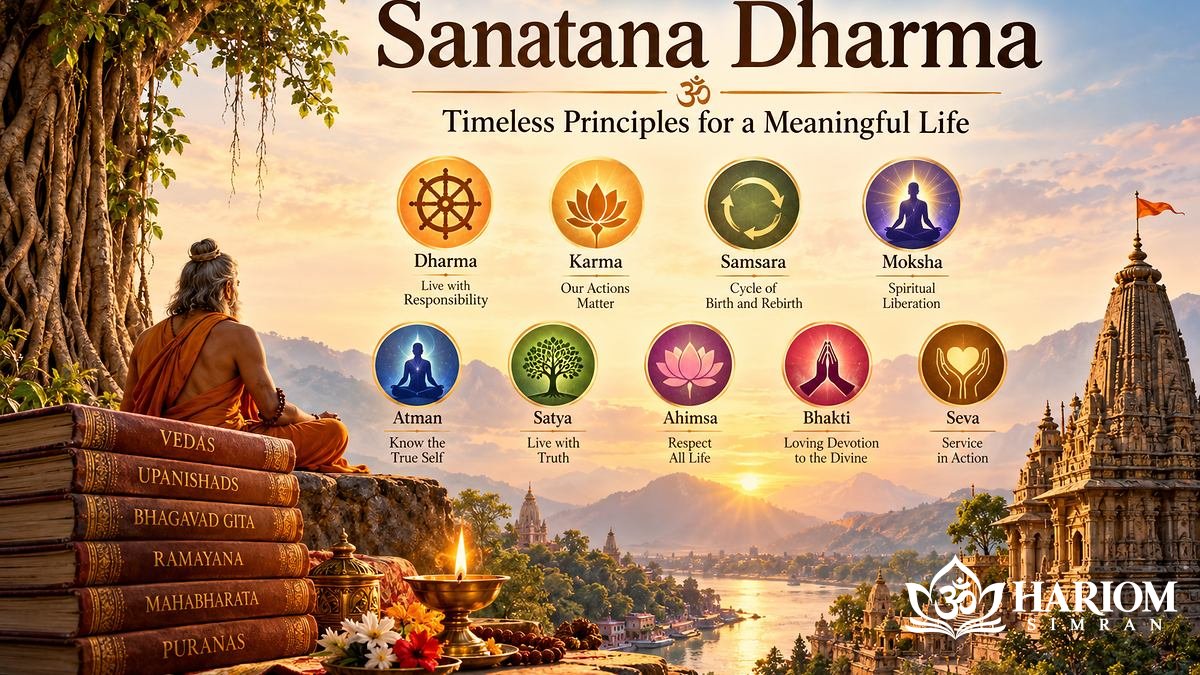
These include:
Dharma
Karma
Samsara
Moksha
Atman
Satya
Ahimsa
Bhakti
Seva
Spiritual knowledge
Self-discipline
Understanding these ideas gives us a strong foundation for understanding Sanatana Dharma.
Dharma — Living With Responsibility
Dharma is one of the foundations of Sanatana Dharma.
It encourages us to think carefully about how our actions affect:
- ourselves
- our families
- society
- other living beings
- nature
- our spiritual growth
Dharma does not always give us an easy answer.
Human life can involve situations where different responsibilities appear to conflict.
A responsibility toward family may conflict with another obligation.
Personal desire may conflict with ethical conduct.
Short-term benefit may conflict with long-term responsibility.
This is why Dharma requires not only rules but also wisdom, context and discernment.
Hindu texts repeatedly explore these difficult questions.
The Ramayana, Mahabharata and Bhagavad Gita all contain situations in which characters must understand what Dharma requires under challenging circumstances.
Explore the wider world of these sacred texts through the Hindu Scriptures section.
Karma — Why Our Actions Matter
Another essential principle of Sanatana Dharma is Karma.
Karma is commonly associated with action.
Within Hindu philosophical traditions, Karma teaches that our actions, intentions and choices have consequences.
What we think matters.
What we say matters.
What we do matters.
However, Karma should not be reduced to the popular idea that every good event is a reward and every difficult event is a punishment.
The Hindu understanding of Karma is much deeper.
It emphasizes responsibility.
Our actions may influence:
- our character
- our relationships
- our circumstances
- our habits
- our spiritual development
Many Hindu traditions also connect Karma with the continuing cycle of birth and rebirth known as Samsara.
Karma therefore encourages us to become more conscious of how we live.
Samsara — The Cycle of Birth and Rebirth
Samsara refers to the continuing cycle of birth, death and rebirth described in many Hindu traditions.
Within this worldview, physical life is not necessarily understood as the complete beginning or end of the spiritual journey.
A being continues through repeated existence while experiencing the consequences of Karma.
Different Hindu philosophical schools explain this process differently.
There is no need to pretend that every school gives exactly the same explanation.
What connects many traditions is the understanding that ordinary existence involves repeated experience, attachment and limitation.
Freedom from this cycle becomes one of the major goals of spiritual life.
That freedom is called Moksha.
Moksha — Spiritual Liberation
Moksha means liberation or spiritual freedom.
It is one of the highest spiritual goals recognized in many Hindu traditions.
Moksha generally refers to freedom from:
- Samsara
- ignorance
- attachment
- spiritual bondage
- misunderstanding of our true nature
Different traditions explain Moksha differently.
Some emphasize knowledge and realization.
Some emphasize Bhakti and Divine grace.
Others emphasize meditation, disciplined spiritual practice or surrender to the Supreme.
Different Vedantic schools also describe the relationship between the individual soul and ultimate reality differently.
This diversity is not something that needs to be hidden.
It is part of the philosophical richness of Hinduism.
Atman — Understanding the True Self
One of the deepest questions in Sanatana Dharma is:
Who am I?
Hindu philosophy does not limit this question to a person's name, profession, nationality or physical body.
The concept of Atman invites deeper inquiry into the nature of the Self.
Atman is commonly translated as the Self or inner Self.
This leads to questions such as:
Am I only this body?
What is consciousness?
What remains while thoughts and experiences constantly change?
What is the relationship between the individual Self and the Divine?
The Upanishads and later Vedantic traditions explore these questions extensively.
Different philosophical schools provide different answers, and understanding those differences is an important part of serious Hindu study.
The Hindu Scriptures section of HariOmSimran is designed to help readers explore these traditions step by step.
Brahman and Ultimate Reality
Another important concept within Hindu philosophy is Brahman.
Brahman is particularly important in the Upanishads and Vedantic traditions.
It refers to ultimate reality.
Different philosophical schools understand the relationship between Brahman, the individual soul and the universe in different ways.
Advaita Vedanta, for example, emphasizes non-duality.
Other Vedantic traditions maintain meaningful distinctions between the individual soul and the Supreme.
These different interpretations remind us that Sanatana Dharma does not depend on only one philosophical explanation.
It contains a long tradition of spiritual discussion, debate and inquiry.
Satya — The Importance of Truth
Satya means truth.
Truth is an important ethical and spiritual value within Sanatana Dharma.
Satya involves more than simply avoiding factual lies.
It can include:
- honesty
- sincerity
- integrity
- faithfulness to what is right
- truthful conduct
At the same time, Hindu ethical thought encourages wisdom.
Truth should not become an excuse for cruelty.
A statement may technically be true but still be spoken with the intention of causing unnecessary harm.
This is why Hindu ethics often requires different values to be considered together.
Truth, compassion and Dharma support one another.
Ahimsa — Respect for Life
Ahimsa is commonly translated as non-harming or non-violence.
It encourages human beings to avoid unnecessary harm and to cultivate compassion.
Ahimsa may influence how a person thinks about:
- physical violence
- speech
- anger
- compassion
- treatment of animals
- treatment of other people
- personal conduct
Different Hindu traditions interpret the practical application of Ahimsa differently.
It should therefore not be presented as one identical rule followed in exactly the same way by every Hindu.
Its underlying message remains powerful:
Spiritual growth requires greater awareness of how our actions affect other living beings.
Bhakti — Loving Devotion to the Divine
For many Hindus, spirituality is experienced most deeply through Bhakti.
Bhakti means devotion or loving relationship with the Divine.
Bhakti may include:
- Puja
- prayer
- mantra
- Bhajan
- Kirtan
- temple worship
- sacred stories
- remembrance of God
- surrender
Devotees may direct their Bhakti toward different Divine forms.
These include Lord Vishnu, Shri Krishna, Shri Rama, Lord Shiva, Devi, Ganesha, Hanuman and many others.
HariOmSimran's Deities section explores the meaning and traditions connected with Hindu Gods and Goddesses.
Bhakti demonstrates an important principle of Sanatana Dharma:
Different people may approach the Divine through different devotional relationships.
Mantra and Spiritual Practice
Mantras also hold an important place within many Hindu traditions.
A mantra may be a sacred sound, word, phrase or verse used in prayer, Japa, meditation or Puja.
Some mantras come from ancient scriptures.
Others are connected with particular deities or devotional traditions.
One of the best-known Shiva mantras is Om Namah Shivaya.
Readers interested in sacred sound and spiritual practice can explore the Mantras section of HariOmSimran.
Mantra practice reminds us that Hindu spirituality is not limited to intellectual philosophy.
It can also involve sound, devotion, meditation and disciplined practice.
Seva — Spiritual Values in Action
Sanatana Dharma is not concerned only with personal spiritual experience.
It also asks how spiritual values influence our treatment of other people.
Seva means service.
Seva may include:
- feeding people
- supporting education
- helping families
- serving in a temple
- caring for elders
- volunteering
- helping one's community
- using personal skills to help others
The deeper idea is that service should not always be motivated by recognition or reward.
Helping another person can itself become part of spiritual practice.
Seva turns Dharma from an abstract idea into something practical.
Different Paths to Spiritual Growth
Not everyone has the same personality or spiritual temperament.
Sanatana Dharma recognizes this reality.
Some people connect with spirituality through devotion.
Others through philosophy.
Some prefer meditation.
Others discover spiritual meaning through responsible work and service.
Several important paths are traditionally discussed.
Bhakti Yoga
Bhakti Yoga is the path of devotion.
It emphasizes love, prayer, worship and remembrance of the Divine.
Karma Yoga
Karma Yoga emphasizes responsible action without selfish attachment to the results.
Work itself can become spiritual practice when performed with the right understanding.
Jnana Yoga
Jnana Yoga emphasizes spiritual knowledge and inquiry.
It asks deep questions about the Self, reality and consciousness.
Raja Yoga and Meditation
Meditative traditions emphasize concentration, discipline, awareness and transformation of the mind.
These paths do not always need to remain separate.
A person may study scripture, perform Puja, repeat a mantra, practice meditation and perform Seva as part of the same spiritual life.
How Does Sanatana Dharma Understand God?
One of the most misunderstood questions about Hinduism is:
Does Hinduism believe in one God or many Gods?
The reality is more nuanced.
Different Hindu traditions understand the Divine differently.
Some worship one Supreme personal God.
Others understand multiple Divine forms as manifestations or expressions of one Supreme Reality.
Some philosophical traditions describe ultimate reality in ways that go beyond ordinary ideas of personality and form.
Major forms of the Divine worshipped within Hindu traditions include:
- Vishnu
- Krishna
- Rama
- Shiva
- Devi
- Ganesha
- Hanuman
- Surya
Different devotional traditions may place one particular form at the center of spiritual life.
This is why Hindu theology cannot be accurately explained using only the categories “one God” or “many gods.”
The relationship between the One and the many is one of the great themes of Hindu thought.
Learn more through HariOmSimran's growing Deities knowledge library.
The Role of Hindu Scriptures
Sanatana Dharma does not depend on one single sacred book.
Hindu sacred literature is vast.
It includes:
The Vedas
The Upanishads
The Ramayana
The Mahabharata
The Bhagavad Gita
The Puranas
Agamas
Tantras
Sutras
and numerous devotional and philosophical texts.
Different traditions give different levels of importance to different scriptures.
The Upanishads deeply explore Atman, Brahman and liberation.
The Bhagavad Gita discusses Dharma, Karma Yoga, Bhakti, knowledge and spiritual responsibility.
The Ramayana teaches through sacred narrative.
The Mahabharata explores the complexity of Dharma in human life.
The Puranas preserve extensive traditions about deities, cosmology, pilgrimage, sacred stories and devotion.
Explore these traditions through Hindu Scriptures: Sacred Texts and Their Teachings.
The Four Goals of Human Life
Hindu philosophy also recognizes that human beings have spiritual, ethical, emotional and material needs.
Classical Hindu thought describes four major aims of life known as the Purusharthas.
They are:
Dharma
Responsible and righteous living.
Artha
Livelihood, prosperity and material well-being.
Kama
Legitimate desire, love, enjoyment and fulfillment.
Moksha
Spiritual liberation.
This framework is important because Sanatana Dharma does not necessarily teach that ordinary human life must be rejected.
Family, livelihood, relationships and prosperity can all have a legitimate place in life.
The key is balance.
Artha and Kama should ideally be pursued within the guidance of Dharma.
Moksha represents the deeper spiritual dimension of human existence.
Puja and Daily Spiritual Life
For many Hindu families, Puja is one of the most familiar ways of expressing devotion.
Puja may be performed:
- at home
- in a temple
- at a sacred place
- during festivals
- during important family occasions
Depending on the tradition, Puja may involve lamps, flowers, water, incense, mantra, prayer and sacred food.
But Puja is more than an outward ritual.
For devotees, it can express:
Love
Gratitude
Remembrance
Surrender
Devotion
Connection with the Divine
Hindu worship varies considerably from one region and family tradition to another.
This diversity should be understood as part of Sanatana Dharma rather than as a contradiction.
Temples and Sacred Places
Hindu temples have played an important role in preserving Sanatana Dharma for generations.
They can serve as places of:
- worship
- pilgrimage
- learning
- community
- festivals
- sacred art
- spiritual transmission
Some temples are connected with particular deities.
Others may contain several shrines.
Hindu sacred geography also extends beyond temples to rivers, mountains, pilgrimage towns and other spiritually significant locations.
The HariOmSimran Temples section explores the history and sacred meaning of important Hindu places.
Festivals and Sanatana Dharma
Hindu festivals are another way spiritual teachings become part of everyday community life.
Festivals may combine:
- worship
- fasting
- stories
- Puja
- family gatherings
- temple visits
- Bhajan
- charity
- Seva
Festivals such as Diwali, Holi, Janmashtami, Rama Navami, Navaratri, Maha Shivaratri and Ganesh Chaturthi connect spiritual teachings with family and community traditions.
They also demonstrate the diversity of Hindu culture.
Different regions may celebrate the same festival differently.
Explore Hindu celebrations through the Festivals section of HariOmSimran.
Sanatana Dharma and Respect for Diversity
Sanatana Dharma developed across thousands of years, many regions and many communities.
As a result, Hindu religious life can look very different from one family to another.
One family may primarily worship Krishna.
Another may follow Shiva traditions.
Another may center spiritual life around Devi.
Some may emphasize meditation.
Some may focus on temple worship.
Others may be strongly influenced by a particular Guru or spiritual lineage.
This diversity does not mean Hinduism has no shared foundation.
Rather, Hindu traditions are connected through overlapping ideas, scriptures, spiritual practices and cultural heritage.
Understanding Sanatana Dharma therefore requires two things:
Recognizing what connects Hindu traditions
and
Respecting the differences between them
Both are important.
Sanatana Dharma in Everyday Life
Sanatana Dharma is not limited to ancient scriptures or temple rituals.
Its principles can influence everyday life.
A person may practice Dharma through:
- honesty
- responsibility
- compassion
- care for family
- respect for elders
- responsible work
- self-discipline
- helping others
- learning
- prayer
- Seva
- spiritual reflection
An ordinary day can therefore contain spiritual meaning.
Going to work responsibly can be part of Dharma.
Caring for parents can be part of Dharma.
Teaching children can be part of Dharma.
Serving people in need can be part of Dharma.
Controlling anger can be spiritual practice.
Learning from mistakes can also become part of spiritual growth.
This is one reason many Hindus describe Sanatana Dharma as a way of life.
Spirituality is not limited to one hour of worship.
It can influence how a person thinks, speaks, works, serves and relates to others.
Common Misunderstandings About Sanatana Dharma
Sanatana Dharma Is Not Just a Rulebook
Dharma requires wisdom and context.
Human situations are often complex, and responsible action may require thoughtful judgment.
Every Hindu Does Not Believe Exactly the Same Thing
Hindu traditions contain many philosophical and devotional schools.
Different communities may understand God, the soul, liberation and spiritual practice differently.
Hinduism Does Not Have Only One Spiritual Path
Bhakti, meditation, knowledge, Karma Yoga, Puja and Seva can all become spiritual paths.
Material Life Is Not Automatically Rejected
Classical Hindu philosophy recognizes Artha and Kama alongside Dharma and Moksha.
The goal is responsible balance rather than uncontrolled desire.
Sanatana Dharma Is More Than Ritual
Ritual is important, but Hindu spiritual life also includes ethics, philosophy, meditation, devotion, knowledge and service.
Why Is Sanatana Dharma Relevant Today?
Modern technology, lifestyles and societies are very different from the ancient world.
But many human questions remain unchanged.
People still ask:
What makes life meaningful?
How should I respond to success and failure?
How can I manage anger and ego?
What responsibilities do I have toward my family?
How should wealth be used responsibly?
How should I treat people who disagree with me?
How can material success and spiritual growth exist together?
Sanatana Dharma does not necessarily provide one simple answer to every situation.
Instead, concepts such as Dharma, Karma, self-discipline, compassion, Bhakti and Seva provide frameworks for deeper reflection.
That is one reason these teachings continue to matter.
Sanatana Dharma remains a living tradition, not simply a subject from ancient history.
Learn Sanatana Dharma With HariOmSimran
HariOmSimran is building a structured Hindu educational and knowledge platform to help readers learn about Hinduism step by step.
You can continue exploring:
Each topic helps explain another part of the wider Hindu spiritual tradition.
The purpose is not to reduce Sanatana Dharma to a few simple definitions.
It is to help readers understand its philosophy, scriptures, spiritual practices, traditions and diversity in a clear and respectful way.
Learn • Explore • Understand • Preserve
Key Takeaway
Sanatana Dharma represents timeless spiritual and ethical principles associated with Hindu tradition.
It cannot be reduced to one founder, one book, one ritual or one philosophy.
Its wider spiritual framework includes:
Dharma
Karma
Samsara
Moksha
Atman
Truth
Compassion
Bhakti
Seva
Self-discipline
and the search for spiritual understanding.
Many Hindus use Sanatana Dharma when referring to Hinduism, but the phrase carries a deeper message.
It asks every generation an enduring question:
How can we live with responsibility, wisdom, compassion and spiritual awareness?
That question is at the heart of Sanatana Dharma.