Dharma is the principle of right, responsible and meaningful living.
It is one of the most important concepts in Hinduism.
The Sanskrit word Dharma does not have one perfect English translation.
Depending on the context, it may refer to:
- righteous conduct
- duty
- responsibility
- ethical behavior
- justice
- spiritual principles
- proper action
- social responsibility
- the order that sustains life
A useful question behind Dharma is:
What is the right thing to do in this situation?
But Dharma is not always easy.
Real life is complicated.
Sometimes responsibilities conflict.
A person may have responsibilities toward:
Family
Society
Work
Spiritual life
Other living beings
Oneself
Understanding Dharma often requires wisdom, context and discernment rather than blindly following one rule.
For a deeper explanation, explore the dedicated HariOmSimran guide to Dharma.
Dharma Is More Than Duty
Dharma is often translated simply as “duty.”
That can be useful, but it is incomplete.
Imagine someone performs a responsibility only because they are forced to do it.
That may technically be a duty, but Dharma asks deeper questions.
Was the action just?
Was it responsible?
Was it honest?
Did it unnecessarily harm someone?
Was it appropriate to the situation?
This is why Dharma involves more than obedience.
It includes ethical understanding and responsible judgment.
Dharma in Everyday Life
Dharma is not limited to temples or religious rituals.
It can influence ordinary life.
Examples may include:
Caring for parents
Raising children responsibly
Doing honest work
Treating people fairly
Keeping promises
Helping people in need
Using wealth responsibly
Respecting other living beings
Learning from mistakes
Practicing spiritual discipline
An ordinary responsibility can become meaningful when it is approached with sincerity and awareness.
This is one reason Hinduism is often described by practitioners as a way of life.
What Is Karma?
Karma means action and is closely connected with the consequences of our choices.
Popular culture often reduces Karma to:
“Do something bad and something bad happens to you.”
That is much too simple.
In Hindu philosophy, Karma is a deeper principle.
It emphasizes that:
Actions matter.
Intentions matter.
Choices matter.
What we repeatedly do can shape who we become.
Karma Is Not Just Punishment and Reward
Karma should not be treated as a cosmic system of instant prizes and punishments.
Life is far more complex.
Hindu traditions have developed sophisticated explanations of Karma across centuries.
Our actions can influence:
- habits
- character
- relationships
- future choices
- spiritual development
- circumstances
Many Hindu traditions also understand Karma as operating across more than one lifetime.
This is where Karma becomes closely connected with Samsara.
Intention and Karma
The intention behind an action can also matter.
Consider two people performing the same outward action.
One acts with compassion.
The other acts only for personal recognition.
The physical action may look similar, but the inner motivation is different.
Hindu spiritual traditions often encourage awareness not only of:
What we do
but also:
Why we do it
This makes Karma a principle of inner responsibility as well as outward action.
Can Karma Be Changed?
Karma should not be understood as fatalism.
The idea of Karma does not necessarily mean:
“Everything is already decided, so nothing can be changed.”
Human beings continue making choices.
Present actions matter.
A person can learn.
A person can change habits.
A person can practice Dharma.
A person can seek spiritual understanding.
This means Hindu teachings on Karma can encourage responsibility rather than helplessness.
What Is Samsara?
Samsara is the cycle of birth, death and rebirth described in many Hindu traditions.
According to this worldview, physical birth is not necessarily the absolute beginning of the spiritual journey, and physical death is not necessarily its final end.
The individual continues through repeated existence.
Karma and Samsara are therefore closely related.
Actions create consequences, and those consequences may influence continued experience within Samsara.
Why Does Samsara Continue?
Different Hindu philosophical schools provide different explanations.
However, Samsara is commonly associated with:
- Karma
- attachment
- desire
- ignorance
- mistaken identification
- spiritual bondage
Human beings become attached to temporary things.
We may identify ourselves only with:
Body
Possessions
Status
Desires
Success
Failure
Ego
Hindu spiritual teachings encourage deeper inquiry into whether these temporary identities represent the whole Self.
This question leads naturally toward the concepts of Atman and Moksha.
To explore Hindu philosophy through its sacred texts, visit the Hindu Scriptures section.
Does Every Hindu Explain Rebirth the Same Way?
No.
Hindu traditions are diverse.
Different schools may explain:
Who or what is reborn
How Karma operates
What continues between lives
and
How liberation occurs
in different ways.
It is therefore better to say that Samsara is a major shared concept across many Hindu traditions, while philosophical explanations of it may differ.
What Is Moksha?
Moksha means spiritual liberation or freedom.
In many Hindu traditions, Moksha is one of the highest spiritual goals of human life.
It generally refers to liberation from:
- Samsara
- ignorance
- attachment
- spiritual bondage
- false identification
- limitations that prevent spiritual realization
Moksha represents something deeper than temporary happiness.
Material success can come and go.
Relationships change.
The body changes.
Circumstances change.
Moksha asks whether there is a deeper form of freedom that is not dependent on temporary conditions.
How Is Moksha Achieved?
There is no single answer accepted identically by every Hindu tradition.
Different spiritual paths emphasize different approaches.
Some emphasize:
Bhakti — devotion to the Divine
Some emphasize:
Jnana — spiritual knowledge
Some emphasize:
Karma Yoga — responsible action without selfish attachment
Others emphasize:
Meditation and disciplined spiritual practice
Many Hindu practitioners combine several approaches.
A person may study scripture, pray, perform Puja, repeat Mantras, meditate and serve others as parts of one spiritual journey.
Explore Hindu devotional and spiritual practices through Mantras.
How Are Dharma and Karma Connected?
Dharma and Karma are closely related but they are not the same thing.
Dharma asks:
What is the responsible action?
Karma asks:
What consequences arise from action?
A person who tries to live according to Dharma becomes more conscious of their choices.
Those choices create Karma.
This creates a practical relationship:
Dharma guides action → action creates Karma.
However, Hindu philosophy does not reduce every situation to a simple formula.
Sometimes the Dharmic choice can be difficult.
Doing what is right may involve sacrifice.
The Mahabharata and Bhagavad Gita repeatedly explore situations in which Dharma is complex rather than obvious.
You can discover these traditions through Hindu Scriptures.
How Are Karma and Samsara Connected?
Karma helps explain why Samsara continues in many Hindu traditions.
Actions, desires and attachments create continuing consequences.
These consequences contribute to repeated spiritual experience.
The relationship can be understood simply as:
Action → Karma → Continued experience → Samsara
This does not mean every event in someone's life should be casually blamed on their past Karma.
That kind of thinking can become insensitive and oversimplified.
Hindu philosophical discussions of Karma are much more nuanced.
The important teaching is personal responsibility:
Our choices matter, even when we cannot fully understand every cause behind life's circumstances.
How Are Samsara and Moksha Connected?
Samsara and Moksha represent two very different spiritual conditions.
Samsara is continued bondage within the cycle of birth and rebirth.
Moksha is liberation from that bondage.
In this sense:
Samsara is the cycle.
Moksha is freedom from the cycle.
Many Hindu spiritual practices therefore aim to transform:
Ignorance into understanding
Attachment into freedom
Ego into humility
Selfishness into service
Restlessness into spiritual awareness
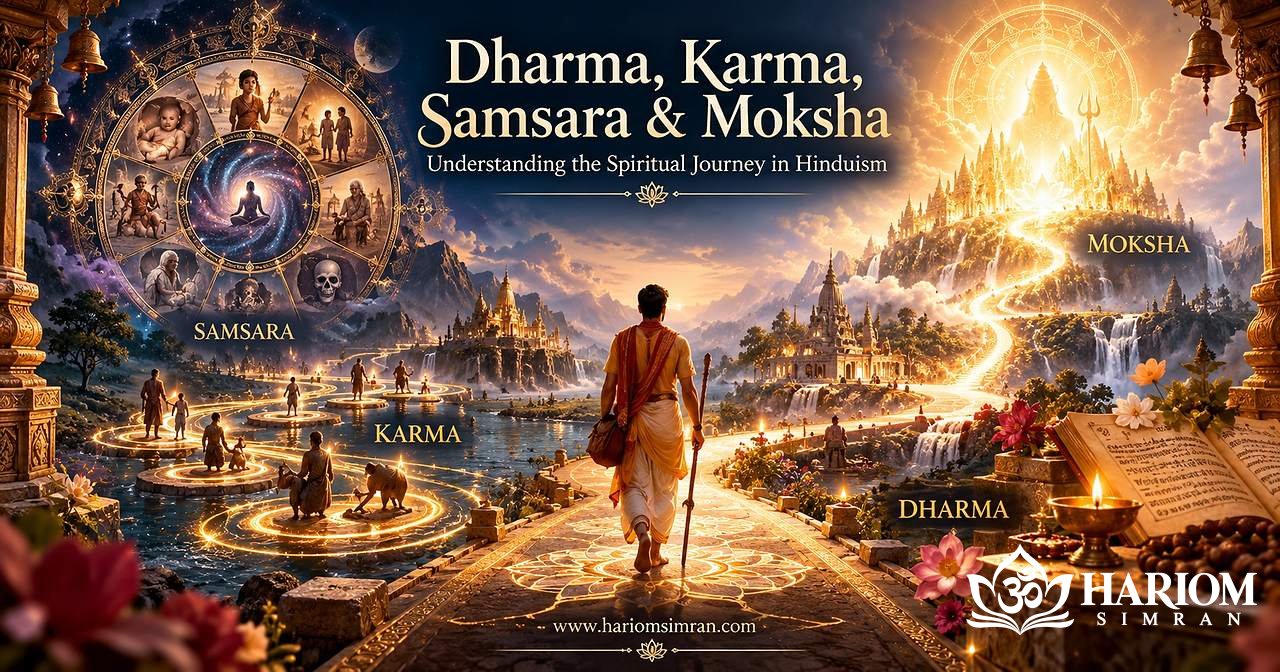
The Four Concepts as One Spiritual Journey
One simple way to understand the relationship is:
Dharma
How should I live?
Karma
What consequences arise from my actions?
Samsara
Why does the cycle of repeated existence continue?
Moksha
How can spiritual freedom be attained?
Together they form a powerful spiritual sequence:
Live responsibly through Dharma.
Become aware of Karma.
Understand the nature of Samsara.
Move toward Moksha.
This is not a mechanical formula.
Hindu philosophy contains many interpretations.
But it provides a helpful foundation for beginners.
Where Does Atman Fit Into This?
The concept of Atman makes these teachings even deeper.
Atman is commonly translated as the Self or inner Self.
Hindu philosophical traditions ask:
Who experiences Karma?
Who passes through Samsara?
Who seeks Moksha?
What is our true identity?
The answer depends on the philosophical school.
The Upanishads and Vedantic traditions devote enormous attention to Atman and ultimate reality.
Different schools disagree about the exact relationship between:
Atman
Brahman
The individual soul
and
The Supreme
These differences have shaped Hindu philosophy for centuries.
Dharma, Karma and the Bhagavad Gita
The Bhagavad Gita is one of the most influential Hindu texts for understanding the relationship between action, responsibility and spiritual freedom.
Its setting is deeply challenging.
Arjuna faces a moral and emotional crisis.
He is not simply asking:
“What action gives me the easiest result?”
He is struggling with questions of:
Dharma
Responsibility
Action
Attachment
Duty
Spiritual understanding
The teachings given by Shri Krishna explore how action can be performed without selfish attachment to outcomes.
This becomes one of the foundations for the teaching of Karma Yoga.
The Bhagavad Gita therefore helps demonstrate why Dharma and Karma are more complex than simple rules about right and wrong.
Can Good Karma Alone Lead to Moksha?
This question is understood differently across Hindu traditions.
Good actions are spiritually important.
Living ethically matters.
Helping others matters.
Following Dharma matters.
But many Hindu philosophical traditions distinguish between:
Better conditions within Samsara
and
Freedom from Samsara itself
Good Karma may be associated with beneficial consequences, but Moksha often requires something deeper.
Depending on the tradition, this may involve:
Self-realization
Divine grace
Bhakti
Spiritual knowledge
Meditation
Detachment
Surrender
This distinction is important.
Hindu spirituality is not simply about collecting “good points.”
It is ultimately concerned with transformation and spiritual freedom.
Bhakti and Moksha
For many Hindu traditions, Bhakti is a powerful path toward spiritual liberation.
Bhakti means loving devotion to the Divine.
A devotee may worship:
Vishnu
Krishna
Rama
Shiva
Devi
or another Divine form.
Devotional traditions may emphasize:
Love
Surrender
Grace
Remembrance of God
Prayer
Puja
Mantra
Different Hindu traditions understand the relationship between Bhakti and Moksha differently.
You can explore Hindu Divine traditions through the Deities section.
Seva and Karma Yoga
Seva, or service, is another practical way spiritual teachings enter everyday life.
Helping others can become more than social activity.
When service is performed without constant desire for recognition or personal reward, it can become spiritual practice.
This connects closely with Karma Yoga.
A person can serve through:
- feeding others
- caring for family
- supporting education
- helping a community
- volunteering
- serving in a temple
- sharing useful knowledge
- using professional skills for others
This shows that Hindu spirituality does not always require withdrawal from ordinary life.
Responsible action itself can become part of the spiritual path.
Do Dharma and Karma Mean Everything Is Predetermined?
No.
This is a common misunderstanding.
Karma is not necessarily the same as fate.
If everything were completely predetermined, moral responsibility would lose much of its meaning.
Hindu traditions generally place importance on present action.
A person can:
Choose differently
Learn
Practice discipline
Develop Bhakti
Study spiritual teachings
Perform Seva
Cultivate wisdom
The past may influence present circumstances, but present choices still matter.
This is one reason Karma encourages responsibility rather than passivity.
Dharma, Karma and Everyday Decisions
These concepts can also help people reflect on modern life.
Consider questions such as:
Is my work honest?
How do I treat employees or colleagues?
How do I use money?
How do I treat my family?
Do my words harm others unnecessarily?
Am I controlled by anger or ego?
Do I help people when I can?
Do I accept responsibility for my choices?
These are not ancient questions only.
They remain relevant today.
Dharma asks us to consider the quality of our conduct.
Karma reminds us that our conduct has consequences.
Dharma, Karma, Samsara and Hindu Stories
Hindu stories often communicate philosophical teachings through memorable narratives.
Instead of giving only abstract definitions, sacred stories show characters making choices and experiencing consequences.
Stories may explore:
Dharma
Karma
Bhakti
Pride
Compassion
Sacrifice
Devotion
Spiritual transformation
For example, the story of Prahlada and Lord Narasimha explores faith, courage, Bhakti and the limits of ego.
Explore traditional narratives through the Hindu Stories section.
Hindu Festivals and These Four Concepts
Hindu festivals also bring philosophical ideas into everyday life.
For example:
Diwali can encourage reflection on light, Dharma and spiritual renewal.
Holi can symbolize the victory of devotion and Dharma over destructive pride.
Janmashtami celebrates Shri Krishna, whose teachings in the Bhagavad Gita deeply explore Dharma and Karma.
Maha Shivaratri inspires devotion, discipline and spiritual reflection.
Festivals therefore connect philosophy with:
Family
Community
Ritual
Devotion
and
Spiritual memory
Explore them through the Festivals section.
Are These Concepts the Same in Every Hindu Tradition?
No.
This point is essential.
Hinduism includes:
Vedanta traditions
Vaishnava traditions
Shaiva traditions
Shakta traditions
Yoga traditions
and many other philosophical and devotional lineages.
These traditions may agree that Dharma, Karma, Samsara and Moksha are important while interpreting them differently.
For example:
What exactly is the Self?
How does Karma operate?
What is Moksha?
What is the relationship between the soul and God?
Different schools provide different answers.
HariOmSimran aims to explain these traditions respectfully rather than presenting one interpretation as the only Hindu view.
Why These Teachings Still Matter Today
Modern life may look very different from the ancient world, but human beings still struggle with:
Responsibility
Consequences
Desire
Fear
Attachment
Ego
Meaning
Suffering
The language may change, but the questions remain.
Dharma asks:
How should I live?
Karma asks:
What are my actions creating?
Samsara asks:
Why do attachment and ignorance keep us spiritually bound?
Moksha asks:
What would true freedom mean?
These questions help explain why Hindu philosophy continues to inspire spiritual inquiry today.
Explore Hindu Philosophy With HariOmSimran
HariOmSimran is building an interconnected Hindu knowledge library to help readers move naturally from basic concepts to deeper spiritual teachings.
Continue exploring:
As the HariOmSimran Hinduism library grows, these concepts will be connected with dedicated articles on Karma, Moksha, Atman, Brahman, Purusharthas and the different paths of Yoga.
Learn • Explore • Understand • Preserve
Key Takeaway
Dharma, Karma, Samsara and Moksha are deeply connected concepts that help explain Hindu understandings of responsible living, action, rebirth and spiritual freedom.
In simple terms:
Dharma guides responsible action.
Karma explains that actions and intentions have consequences.
Samsara describes the cycle of birth, death and rebirth.
Moksha represents liberation from spiritual bondage and Samsara.