Core Beliefs of Hinduism Explained
Hinduism does not have one single creed that every Hindu must accept in exactly the same way.
That is one of the first things to understand when asking, “What do Hindus believe?”
Hinduism is a vast family of religious, spiritual and philosophical traditions. Different communities may follow different deities, scriptures, Gurus, rituals and philosophical schools.
Yet several ideas appear again and again across Hindu thought.
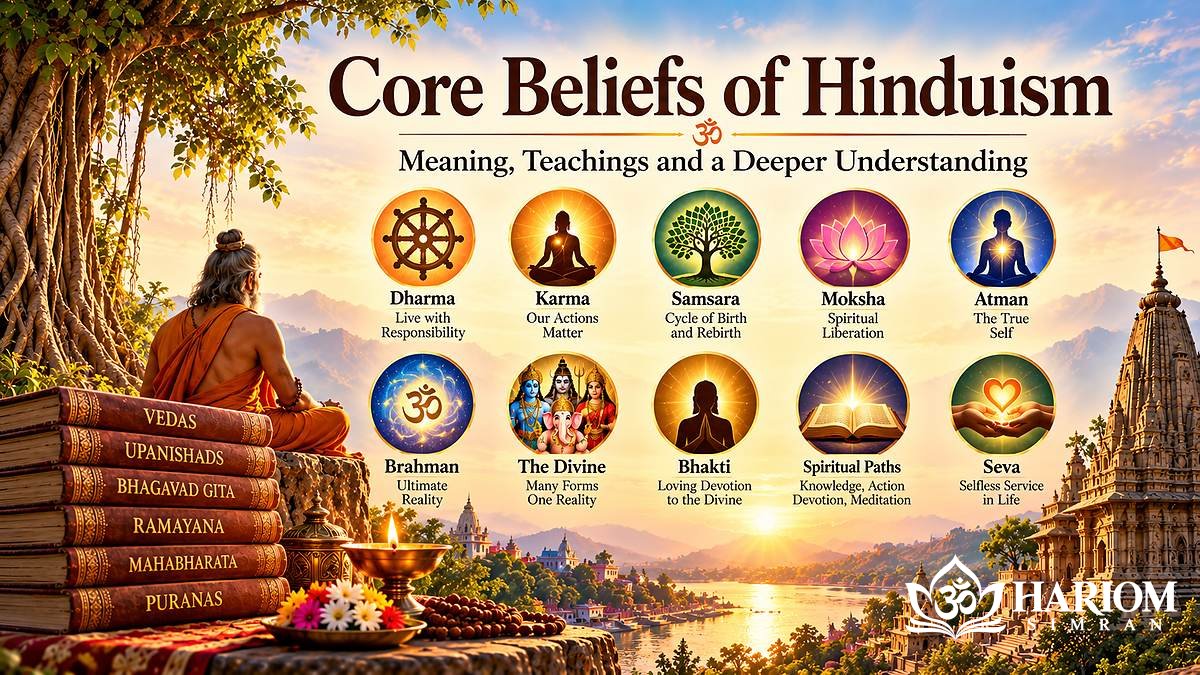
These include:
Dharma
Karma
Samsara
Moksha
Atman
Brahman or the Supreme Reality
Bhakti
Spiritual discipline
Puja
Seva
Respect for different paths
These beliefs help answer some of the deepest questions of human life:
Who are we?
Why do our actions matter?
What happens after death?
What is our relationship with the Divine?
What is the purpose of life?
How can a person grow spiritually?
If you are completely new to the subject, begin with What Is Hinduism? Meaning, Beliefs, Origins & Core Teachings.
Does Hinduism Have One Set of Beliefs?
Not in the same way that some religions are organized around one required creed.
Hinduism developed over thousands of years through many:
- regions
- philosophical schools
- spiritual teachers
- devotional traditions
- scriptures
- communities
- family traditions
Because of this, not every Hindu explains God, the soul, liberation or spiritual practice in exactly the same way.
For example, one Hindu may primarily worship Shri Krishna.
Another may place Lord Shiva at the center of spiritual life.
Another may worship Devi or Shakti.
Some may emphasize meditation and philosophical inquiry.
Others may focus on Puja, Bhakti, temple worship or Seva.
These differences do not mean Hinduism has no shared foundation.
Instead, Hinduism contains overlapping beliefs and principles that connect many different traditions.
1. Dharma — Living Responsibly
One of the most important Hindu beliefs is Dharma.
Dharma is often translated as duty, but that translation is too narrow.
Depending on the context, Dharma can refer to:
- righteous conduct
- responsibility
- ethical living
- justice
- proper action
- spiritual principles
- social responsibility
- the order that supports life
At a practical level, Dharma asks:
What is the right and responsible way to live?
A person's responsibilities may involve:
Family
Work
Community
Society
Nature
Spiritual life
Dharma is not always simple.
Sometimes two responsibilities can conflict with each other.
A person may need wisdom and discernment to decide what is right in a difficult situation.
This complexity is one reason Dharma is explored so deeply in Hindu sacred literature.
You can study the concept in greater depth in HariOmSimran's guide to Dharma.
2. Karma — Actions Have Consequences
Karma is another central idea in Hindu thought.
Karma is closely connected with action.
At its simplest level, the teaching of Karma reminds us that:
Our actions matter.
Our intentions matter.
Our choices have consequences.
But Karma should not be understood as a simple system of instant punishment and reward.
It is much deeper than the popular expression, “What goes around comes around.”
Hindu philosophical traditions examine how actions can shape:
- character
- habits
- relationships
- future choices
- spiritual development
- future experiences
Many Hindu traditions also connect Karma with rebirth.
In this understanding, actions may have consequences that are not limited to one physical lifetime.
This relationship between action and repeated existence leads us to another major Hindu belief: Samsara.
3. Samsara — Birth, Death and Rebirth
Samsara refers to the continuing cycle of birth, death and rebirth.
Many Hindu traditions teach that human existence is not limited to one physical lifetime.
Birth and death are understood as part of a much larger spiritual journey.
The individual continues through repeated experiences while remaining connected with Karma.
Different Hindu schools explain the exact nature of rebirth differently.
However, the general concept of Samsara has had enormous importance in Hindu philosophy.
It changes the way life is understood.
If existence continues beyond one lifetime, then spiritual development is not simply about achieving temporary success.
It becomes part of a longer journey toward understanding, freedom and liberation.
That liberation is known as Moksha.
4. Moksha — Freedom From Spiritual Bondage
Moksha means liberation or spiritual freedom.
It is one of the highest goals recognized in many Hindu traditions.
Moksha is commonly associated with freedom from:
- Samsara
- ignorance
- attachment
- spiritual bondage
- misunderstanding of the true Self
Different Hindu philosophical schools explain Moksha differently.
Some traditions emphasize spiritual knowledge.
Others emphasize loving devotion and Divine grace.
Some focus on meditation and realization.
Others combine devotion, knowledge, right action and spiritual discipline.
This variety is important.
There is no need to force every Hindu tradition into one explanation of liberation.
What connects many of them is the belief that human life has a spiritual possibility beyond ordinary attachment and repeated suffering.
5. Atman — The True Self
One of the most important questions in Hindu philosophy is:
Who am I?
Hindu teachings often encourage people to look beyond temporary identities.
A person has:
- a body
- a name
- relationships
- memories
- thoughts
- emotions
- social roles
But is that the whole person?
The concept of Atman explores the deeper nature of the Self.
Atman is commonly translated as:
Self
or
inner Self
This leads to deeper spiritual questions:
What is consciousness?
What remains while our body changes?
Are we only our thoughts?
What is the relationship between the individual Self and ultimate reality?
The Upanishads and Vedantic traditions explore these questions extensively.
Different schools provide different answers, which is why understanding Hindu philosophy requires respect for philosophical diversity.
Explore Hindu sacred literature through the Hindu Scriptures section.
6. Brahman — Ultimate Reality
Brahman is an important concept particularly within the Upanishads and Vedanta.
Brahman refers to ultimate reality.
This should not automatically be understood as exactly the same thing as the everyday use of the English word “God.”
Hindu philosophical schools interpret Brahman differently.
For example, some traditions emphasize non-duality.
Others understand a meaningful relationship between the individual soul and a Supreme personal Divine reality.
These differences led to the development of major Vedantic traditions.
Questions about Brahman include:
What is ultimate reality?
What is the source of existence?
What is the relationship between the universe and the Divine?
What is the relationship between Atman and Brahman?
These are among the deepest questions explored in Hindu philosophy.
7. Belief in the Divine
One of the most common questions about Hinduism is:
Do Hindus believe in one God or many Gods?
The most accurate answer is that Hindu traditions understand the Divine in several ways.
Some traditions worship one Supreme personal God.
Some see different Divine forms as manifestations or expressions of one Supreme Reality.
Others approach ultimate reality through philosophical ideas that go beyond ordinary concepts of personality and form.
Important Divine forms worshipped within Hindu traditions include:
Vishnu
Krishna
Rama
Shiva
Devi or Shakti
Ganesha
Hanuman
Surya
and many others.
This is why Hinduism cannot be accurately understood simply by choosing between “one God” and “many gods.”
The relationship between the One and the many is much more sophisticated.
Explore different Hindu Divine traditions through the Deities section.
Ishta Devata — A Personal Form of the Divine
An important Hindu idea is Ishta Devata, which may be understood as a chosen or personally cherished form of the Divine.
A devotee may feel especially connected to:
Krishna
Shiva
Rama
Durga
Ganesha
or another Divine form.
This does not always mean rejecting other forms of the Divine.
For many Hindus, having a personal devotional focus exists comfortably within a wider respect for other Hindu traditions.
This provides one explanation for how Hindu families can have strong devotion to one deity while still honoring others.
8. Bhakti — Loving Devotion
Bhakti is devotion toward the Divine.
For millions of Hindus, Bhakti is not merely one belief among many.
It is the heart of spiritual life.
Bhakti may include:
- prayer
- Puja
- Bhajan
- Kirtan
- mantra
- temple worship
- remembering God
- listening to sacred stories
- surrender
- gratitude
Bhakti emphasizes relationship.
A devotee may relate to the Divine as:
Lord
Mother
Father
Friend
Beloved
or another sacred relationship.
Different Bhakti traditions developed around Vishnu, Krishna, Rama, Shiva, Devi and other Divine forms.
Bhakti shows that Hindu spirituality is not only philosophical.
It can also be deeply emotional, personal and devotional.
9. Different Paths Can Lead to Spiritual Growth
Another important Hindu idea is that different people may be suited to different spiritual paths.
Human beings do not all have the same personality.
One person may naturally connect through devotion.
Another through knowledge.
Another through meditation.
Another through service.
This is reflected in several important spiritual paths.
Bhakti Yoga
The path of devotion.
It emphasizes love and surrender toward the Divine.
Karma Yoga
The path of responsible action.
It emphasizes performing one's responsibilities without selfish attachment to the results.
Jnana Yoga
The path of spiritual knowledge.
It involves inquiry into the Self, consciousness and ultimate reality.
Raja Yoga and Meditation
Meditative traditions emphasize discipline, concentration and transformation of the mind.
These paths are not always completely separate.
A person may combine them.
Someone may:
Study scripture
Perform Puja
Repeat Mantras
Meditate
Serve others
and
Fulfil family responsibilities
as part of the same spiritual journey.
10. Hindu Scriptures Are Sources of Spiritual Knowledge
Hinduism does not have one single book that represents every Hindu tradition.
Instead, it has a vast sacred literature.
Important texts include:
Vedas
Upanishads
Ramayana
Mahabharata
Bhagavad Gita
Puranas
Agamas
Tantras
and many other philosophical and devotional works.
Different texts serve different purposes.
The Vedas preserve ancient sacred traditions.
The Upanishads explore profound philosophical questions.
The Bhagavad Gita examines Dharma, action, devotion, knowledge and liberation.
The Ramayana explores Dharma, devotion, relationships and leadership through sacred narrative.
The Mahabharata explores some of the most difficult moral questions of human life.
The Puranas preserve extensive devotional stories and traditions related to Hindu deities, cosmology and sacred places.
You can explore these traditions through Hindu Scriptures.
11. Puja — Worship and Connection With the Divine
Puja is one of the most familiar forms of Hindu worship.
It may be performed:
- at home
- in a temple
- during festivals
- at sacred places
- on important family occasions
Depending on the tradition, Puja may involve:
Diya
Flowers
Incense
Water
Mantra
Prayer
Sacred food
Offerings
The physical ritual is only one part of Puja.
For devotees, Puja can express:
Love
Respect
Gratitude
Surrender
Remembrance
Connection with the Divine
Different Hindu traditions perform Puja in different ways.
There is no single Puja format that every Hindu family must follow.
12. Mantra — The Spiritual Importance of Sacred Sound
Mantras are another important part of Hindu spiritual practice.
A mantra may be a sacred:
Sound
Word
Phrase
or
Verse
Mantras can be used during:
- Puja
- meditation
- Japa
- temple worship
- personal prayer
- spiritual discipline
Some mantras come directly from sacred scriptures.
Others are associated with particular Divine forms or traditions.
Om — ॐ is perhaps the most widely recognized sacred sound associated with Hinduism.
To explore sacred sounds and their meanings, visit HariOmSimran's Mantras section.
13. Satya — Truth
Satya means truth.
It is an important Hindu ethical principle.
Truth can involve:
Honesty
Integrity
Sincerity
Truthful speech
Living according to what is right
But Hindu ethics also recognizes that truth should be practiced with wisdom.
Speaking something true with the deliberate intention of hurting someone unnecessarily does not automatically make the action Dharmic.
This demonstrates an important feature of Hindu ethics.
Principles should not always be separated from each other.
Truth, compassion and Dharma often need to work together.
14. Ahimsa — Avoiding Unnecessary Harm
Ahimsa is commonly translated as non-violence or non-harming.
It encourages respect toward life and the avoidance of unnecessary harm.
Ahimsa can influence:
- physical actions
- speech
- anger
- treatment of animals
- relationships
- compassion
- personal discipline
Different Hindu traditions may interpret the practical application of Ahimsa differently.
However, its wider spiritual message remains important:
Our treatment of other living beings matters.
Spiritual development should ideally make a person more conscious of the suffering caused by their actions.
15. Seva — Selfless Service
Hindu spirituality is not only about personal liberation.
It also involves responsibility toward others.
Seva means service.
Examples may include:
- helping someone in need
- supporting education
- feeding people
- serving at temples
- volunteering
- caring for elderly people
- helping one's community
- sharing knowledge
- using professional skills to help others
Seva becomes spiritually meaningful when it is performed without constant desire for praise or recognition.
It turns spiritual values into practical action.
A person does not have to leave everyday life to practice spirituality.
Helping another person sincerely can itself become spiritual practice.
16. The Four Goals of Human Life
Classical Hindu thought describes four major goals of human life called the Purusharthas.
They are:
Dharma
Responsible and righteous living.
Artha
Livelihood, prosperity and material well-being.
Kama
Legitimate desire, relationships, enjoyment and fulfillment.
Moksha
Spiritual liberation.
This framework reveals an important point about Hindu beliefs.
Hindu spirituality does not necessarily demand rejection of ordinary life.
Work, relationships, prosperity and enjoyment can all have legitimate places.
The challenge is balance.
Artha and Kama should ideally operate within Dharma.
Moksha introduces the deeper spiritual dimension.
We will explore the Purusharthas in a dedicated HariOmSimran article.
17. Life Is Both Spiritual and Practical
One of the most interesting aspects of Hindu thought is that spiritual life does not always require separation from ordinary responsibilities.
A person can pursue spiritual growth while:
Raising children
Working
Supporting family
Serving community
Studying
Managing responsibilities
Hindu philosophy often asks not simply:
“Should I leave ordinary life?”
but also:
“How should I live ordinary life responsibly?”
This is why Dharma becomes so important.
Spirituality can influence how a person:
Works
Speaks
Earns
Spends
Treats family
Responds to difficulty
Uses power
Helps others
In this sense, Hindu belief is connected with everyday conduct.
18. Temples and Sacred Places
Temples have played a major role in Hindu religious life for generations.
A temple may be a place of:
- worship
- Darshan
- Puja
- festivals
- community
- learning
- pilgrimage
- sacred art
- spiritual tradition
Different temples may be dedicated primarily to different Divine forms.
Sacred geography in Hinduism also includes:
Rivers
Mountains
Pilgrimage towns
Forests
and other places connected with spiritual traditions.
Explore the history and spiritual significance of sacred places through HariOmSimran's Temples section.
19. Hindu Festivals Express Beliefs Through Life
Hindu beliefs are not found only in philosophical books.
They also come alive through festivals.
Festivals can combine:
- worship
- Puja
- fasting
- family
- stories
- Bhajan
- temple visits
- Seva
- community gatherings
For example:
Diwali can carry themes of light, Dharma and spiritual renewal.
Holi can express joy, Bhakti and the victory of Dharma over harmful intention.
Janmashtami celebrates Shri Krishna.
Rama Navami celebrates Shri Rama.
Maha Shivaratri centers devotion toward Lord Shiva.
Navaratri celebrates Divine Feminine traditions in different regional forms.
You can learn more through the Hindu Festivals section.
20. Hindu Stories Teach Through Narrative
Stories have always been a powerful way of communicating Hindu spiritual values.
Sacred narratives may explore:
Dharma
Devotion
Courage
Humility
Sacrifice
Ego
Compassion
Faith
A story may communicate spiritual wisdom in a way that philosophical definitions cannot.
For example, the story of Prahlada and Lord Narasimha explores themes of Bhakti, courage, Dharma and ego.
HariOmSimran's Hindu Stories section helps readers explore these teachings through traditional narratives.
Are All Hindu Beliefs the Same Everywhere?
No.
Hindu traditions developed across many:
Regions
Languages
Communities
Guru lineages
Philosophical schools
Different families may have different:
- deities
- rituals
- festivals
- customs
- prayers
- sacred texts
- spiritual practices
One community may emphasize Vishnu.
Another may emphasize Shiva.
Another may emphasize Devi.
Some may follow Vedantic philosophy.
Others may strongly emphasize Bhakti or temple tradition.
These differences are part of Hinduism's historical development.
Understanding Hinduism requires recognizing both:
What connects Hindu traditions
and
What makes individual traditions different.
Why Hindu Beliefs Still Matter Today
The modern world is very different from ancient India.
Yet many questions explored by Hindu philosophy remain deeply relevant:
What makes a good life?
How should we use wealth?
Why should we act responsibly?
How can we manage desire?
What is the purpose of spiritual life?
How should we respond to suffering?
What is the true Self?
How should we treat other people?
Concepts such as Dharma, Karma, compassion, self-discipline and Seva continue to provide frameworks for thinking about these questions.
Hindu beliefs therefore belong not only to history.
For millions of people, they continue to shape everyday spiritual and ethical life.
Understanding Hindu Beliefs With HariOmSimran
HariOmSimran is designed to help readers understand Hinduism as an interconnected knowledge tradition rather than as isolated articles.
Continue your journey through:
Together, these topics help build a clearer picture of Hindu philosophy, spirituality, worship, sacred literature and cultural traditions.
Learn • Explore • Understand • Preserve
Key Takeaway
Hinduism does not have one single creed followed identically by every Hindu, but several core ideas connect many Hindu traditions.
Among the most important are:
Dharma — responsible living
Karma — actions and consequences
Samsara — birth and rebirth
Moksha — spiritual liberation
Atman — the deeper Self
Brahman — ultimate reality
Bhakti — loving devotion
Puja — worship
Seva — service
Satya — truth
Ahimsa — respect for life
At the same time, Hinduism recognizes different spiritual paths, different understandings of the Divine and different ways of practicing spiritual life.
This combination of shared principles and spiritual diversity is one of Hinduism's defining characteristics.