


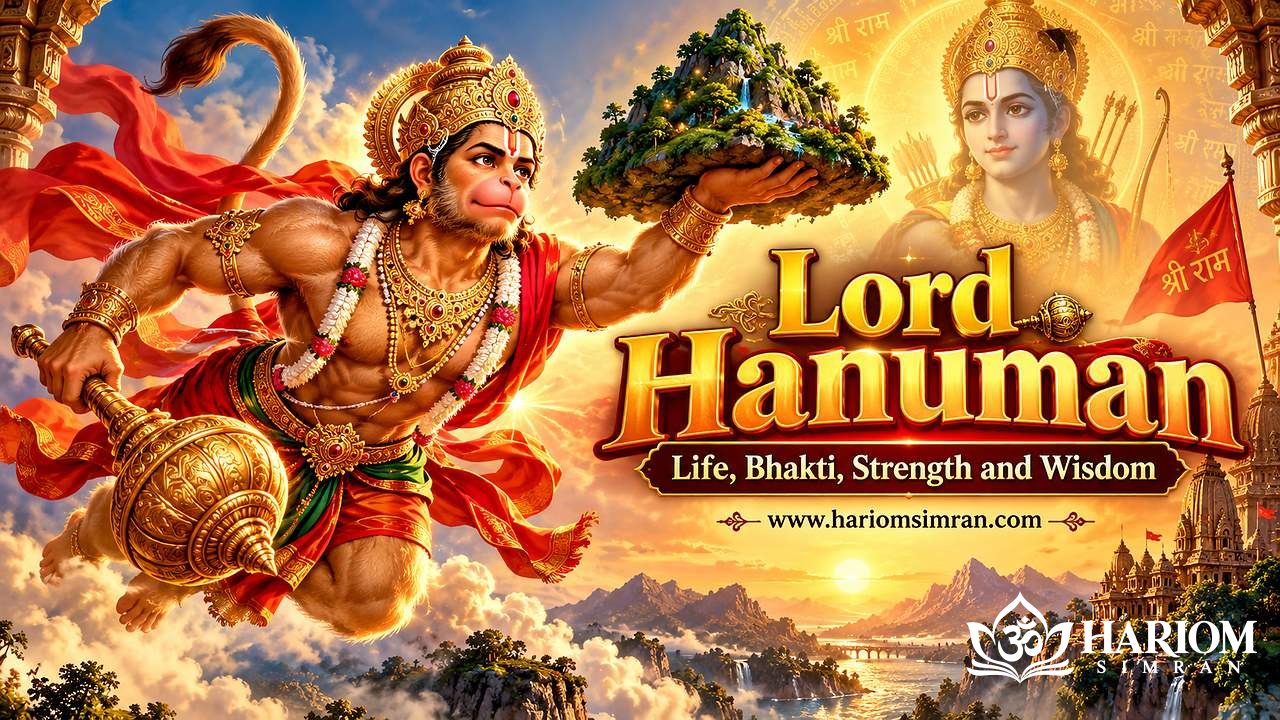
Lord Hanuman is one of the most loved and inspiring Divine figures in Hinduism.
He is remembered for extraordinary physical strength, courage and intelligence.
But Hanuman's greatest quality is not his power.
It is his Bhakti.
Hanuman's entire sacred life is centered on devotion and Seva to Lord Rama.
He represents:
- Unwavering Bhakti
- Extraordinary strength
- Courage
- Humility
- Seva
- Loyalty
- Wisdom
- Self-discipline
- Fearlessness
- Devotion to Dharma
- Control over ego
- Complete dedication to the Divine
Hanuman could cross an ocean.
He could enter Lanka.
He could confront powerful enemies.
He could carry a mountain.
Yet he never allowed these abilities to become a reason for arrogance.
His strength remained in the service of Dharma.
That is what makes Hanuman spiritually extraordinary.
His life teaches a timeless principle:
Real power becomes sacred when it is guided by humility, Bhakti and Seva.
To explore other Hindu Divine traditions, visit Deities.
Who Is Lord Hanuman?
Lord Hanuman is a central figure in the Ramayana and one of Lord Rama's greatest devotees.
He is associated with:
- Rama Bhakti
- Strength
- Courage
- Wisdom
- Devotional service
- Loyalty
- Protection
- Discipline
- Fearlessness
- Humility
Hanuman plays an essential role in the search for Sita and the events leading to Rama's victory over Ravana.
He is not simply a powerful warrior.
He is also:
- A skilled communicator
- A wise advisor
- A disciplined servant
- A strategic thinker
- A diplomat
- A scholar in many devotional traditions
- A symbol of complete surrender to the Divine
Important Names of Lord Hanuman
Hanuman is worshipped through many sacred names.
Some widely known names include:
- Hanuman: His most familiar name
- Anjaneya: Son of Anjana
- Anjaniputra: Son of Anjani or Anjana
- Kesari Nandana: Son of Kesari
- Pavanputra: Son associated with Vayu, the wind deity
- Maruti: A widely used name in several regions
- Bajrangbali: The powerful one with a body compared to Vajra
- Mahavira: Great hero
- Sankat Mochan: Remover of difficulties in devotional tradition
- Ramdoot: Messenger of Lord Rama
- Ram Bhakta: Devotee of Rama
- Kapeesh: Lord or chief among Vanaras in devotional usage
Different regions and scriptures preserve different names and interpretations.
What Does the Name Hanuman Mean?
The exact linguistic and traditional explanations of the name Hanuman vary.
A popular sacred explanation connects the name with an incident involving Hanuman's jaw.
The Sanskrit word Hanu can refer to the jaw.
Traditional narratives describe young Hanuman being struck and injured during one of his childhood adventures.
Over time, the name Hanuman became inseparable from his identity as the great devotee of Rama.
Birth of Lord Hanuman
Hanuman's birth is described through several sacred traditions.
He is traditionally associated with:
Mother Anjana
and
Kesari
He is also deeply connected with Vayu, the deity of wind.
Because of this connection, Hanuman is commonly called:
Pavanputra
or
Vayuputra
meaning the son associated with Vayu.
Different scriptures and regional traditions explain the circumstances of his birth differently.
Who Are Hanuman's Parents?
Hanuman is commonly described as the son of:
Anjana
and
Kesari
Vayu also plays an important Divine role in his birth traditions.
Because sacred narratives vary, it is best to understand these relationships within their traditional theological context rather than force every account into one identical version.
Hanuman and Vayu
The association between Hanuman and Vayu, the Divine principle of wind, is especially meaningful.
Wind is:
- Powerful
- Invisible
- Fast
- Life-sustaining
- Difficult to contain
Hanuman's extraordinary speed and strength reflect many of these qualities.
His title Pavanputra remains one of the most beloved names used by devotees.
Is Hanuman an Avatar of Shiva?
Some Hindu traditions understand Hanuman as an aspect, manifestation or Rudra-related form of Lord Shiva.
This understanding is especially important in certain devotional traditions.
However, not every Hindu text or Sampradaya defines Hanuman in exactly the same way.
HariOmSimran should therefore present this as an important traditional interpretation, not as the only Hindu theological explanation.
Hanuman as a Divine Child
Stories of young Hanuman describe a child filled with extraordinary energy, curiosity and courage.
One of the most famous childhood narratives tells of Hanuman seeing the rising Sun and mistaking it for a fruit.
He leaps toward it.
The story expresses his:
- Fearlessness
- Curiosity
- Extraordinary power
- Innocence
- Divine potential
Hanuman and the Sun
The famous story of Hanuman attempting to reach or swallow the Sun appears in devotional tradition with different details.
The Sun looked like a bright fruit to the young Hanuman.
He leapt toward it with tremendous energy.
This childhood episode became one of the earliest demonstrations of his extraordinary abilities.
The Injury to Hanuman's Jaw
Traditional narratives describe Divine intervention during Hanuman's attempt to reach the Sun.
In some accounts, Indra strikes Hanuman with the Vajra.
Hanuman falls and his jaw is injured.
This incident is sometimes connected with the traditional explanation of the name Hanuman.
Details vary across sacred retellings.
Vayu's Response
In popular sacred narratives, Vayu becomes deeply distressed when Hanuman is injured.
The withdrawal of wind or life-sustaining air creates a cosmic crisis.
The gods then bless Hanuman with extraordinary protections and abilities.
These stories emphasize Hanuman's special Divine destiny.
Hanuman's Divine Blessings
Different traditions describe Hanuman receiving blessings from various Divine beings.
These blessings may include:
- Extraordinary strength
- Speed
- Protection
- Intelligence
- Courage
- Resistance to weapons
- Ability to change form
- Long life
Specific lists vary across texts.
The important spiritual lesson is not simply that Hanuman possesses supernatural abilities.
It is how he uses them.
Hanuman Forgets His Powers
A popular traditional story explains that young Hanuman sometimes used his extraordinary abilities mischievously.
As a result, certain sages caused him to forget his own powers until someone reminded him of them.
Later, before his great leap to Lanka, Jambavan reminds Hanuman of his strength.
This story carries a powerful spiritual message.
What Does Hanuman Forgetting His Strength Teach?
Sometimes a person already has abilities but has forgotten them.
Fear.
Failure.
Criticism.
Doubt.
Habit.
These can hide our confidence.
Hanuman's story reminds us:
Sometimes strength does not need to be created. It needs to be remembered.
This should not be used to promise unlimited abilities.
Its value is as a spiritual reflection on courage and self-belief.
Hanuman and Education
Hanuman is not only associated with physical strength.
Traditional accounts also portray him as highly learned and intelligent.
One famous tradition describes Hanuman learning from Surya, the Sun deity.
He receives knowledge while maintaining extraordinary dedication to learning.
Surya as Hanuman's Guru
In popular sacred tradition, Hanuman approaches Surya and requests education.
Because the Sun is continuously moving across the sky, Hanuman adapts himself in order to learn while Surya continues his journey.
This story highlights:
- Dedication
- Adaptability
- Respect for the Guru
- Intellectual discipline
- Determination
Hanuman therefore represents both:
Bala
and
Buddhi
strength and intelligence.
Strength Without Wisdom
Physical power alone can become dangerous.
The Ramayana repeatedly contrasts different uses of strength.
Ravana is powerful.
Vali is powerful.
Many Rakshasas are powerful.
But Hanuman's strength is different because it is guided by:
- Dharma
- Wisdom
- Bhakti
- Seva
- Self-control
This makes Hanuman's power spiritually meaningful.
Hanuman Meets Lord Rama
The meeting between Hanuman and Lord Rama is one of the most important moments in the Ramayana.
Rama and Lakshmana are searching for Sita.
Hanuman approaches them in connection with Sugriva.
His communication, intelligence and humility immediately reveal his extraordinary character.
This meeting becomes the beginning of one of Hinduism's greatest devotional relationships.
Explore Lord Rama through Deities.
Rama Recognizes Hanuman's Wisdom
In the Ramayana tradition, Hanuman's speech makes a strong impression.
He communicates thoughtfully and skillfully.
This is important because Hanuman is often remembered primarily for physical strength.
But his first great impression on Rama comes through:
Intelligence and Communication.
The lesson is powerful:
True strength includes knowing how to speak wisely.
Hanuman as Ramdoot
One of Hanuman's most important names is:
Ramdoot
meaning:
Messenger of Rama
This title captures his central spiritual role.
Hanuman does not seek attention for himself.
He carries Rama's message.
His mission is greater than his ego.
Hanuman and Sugriva
Hanuman serves as an important connection between Rama and Sugriva.
The alliance becomes crucial in the search for Sita.
Hanuman's role demonstrates:
- Diplomacy
- Trust-building
- Communication
- Loyalty
- Strategic thinking
He helps different people come together for a larger purpose.
Searching for Sita
After Sita is abducted by Ravana, search groups are sent in different directions.
Hanuman becomes part of the southern search party.
Eventually, the group learns that Sita is in Lanka, across the ocean.
Now an enormous obstacle appears.
Someone must cross the sea.
Jambavan Reminds Hanuman of His Power
At this moment, Jambavan reminds Hanuman of his extraordinary abilities.
Hanuman's confidence awakens.
He expands his form and prepares for the leap toward Lanka.
This scene is one of the most inspiring moments in the Ramayana.
It combines:
- Encouragement
- Self-knowledge
- Courage
- Duty
- Faith
The Great Leap to Lanka
Hanuman's leap across the ocean represents one of his greatest achievements.
But the journey is not simply a display of strength.
He faces several tests and obstacles along the way.
He must use:
- Power
- Intelligence
- Adaptability
- Patience
- Judgment
The journey shows that major challenges are rarely solved by only one skill.
Hanuman and Mainaka
A traditional episode describes Mainaka Mountain rising from the sea and offering Hanuman rest.
Hanuman respectfully acknowledges the gesture but continues his mission.
This offers a subtle lesson:
Rest is valuable, but timing matters.
When urgent duty remains unfinished, unnecessary delay can become a distraction.
Hanuman and Surasa
Another sacred episode involves Surasa, who tests Hanuman.
Hanuman does not solve the challenge merely through force.
He uses intelligence and adaptability.
The episode reinforces a central Hanuman teaching:
Not Every Obstacle Requires a Fight.
Sometimes the best solution is wisdom.
Hanuman and Simhika
Another obstacle on the journey is associated with Simhika, who attempts to stop Hanuman.
Different challenges require different responses.
Hanuman's Lanka journey therefore demonstrates flexibility:
- Respect in one situation
- Intelligence in another
- Strength when necessary
This is practical spiritual wisdom.
Hanuman Enters Lanka
Hanuman reaches Lanka and reduces his form in order to move carefully.
This is another important lesson.
He does not remain enormous simply because he can.
He adapts his strength to the mission.
True ability includes knowing:
When to become powerful
and
when to become subtle.
Hanuman Searches for Sita
Inside Lanka, Hanuman searches carefully for Sita.
He observes the city.
He evaluates situations.
He avoids unnecessary confrontation.
Eventually, he finds Sita in Ashoka Vatika.
This part of his mission demonstrates:
- Patience
- Intelligence
- Discipline
- Focus
Hanuman Meets Sita
The meeting between Hanuman and Sita is one of the most emotional moments in the Ramayana.
Sita has been held captive in Lanka.
Hanuman must prove that he genuinely comes as Rama's messenger.
He gives her Rama's message and a sign associated with Rama.
This brings hope.
Hanuman Gives Hope
Hanuman's greatest contribution at this moment is not physical rescue.
It is hope.
Sita learns:
- Rama is searching for her
- She has not been forgotten
- Help is coming
- Hanuman is Rama's genuine messenger
This teaches:
Sometimes Seva means giving someone hope before you can solve the entire problem.
Why Doesn't Hanuman Simply Take Sita Away?
Different Ramayana traditions and commentaries explore this question in different ways.
In the narrative, Sita does not simply return with Hanuman.
The larger conflict must unfold through Rama's mission and the restoration of Dharma.
Dedicated study should distinguish the reasoning given in specific textual versions.
Hanuman in Ashoka Vatika
After meeting Sita, Hanuman takes actions that bring him into direct confrontation with Ravana's forces.
He demonstrates extraordinary strength.
Ashoka Vatika becomes the setting for Hanuman's fearless challenge to Lanka's power.
Hanuman Before Ravana
Hanuman eventually appears before Ravana.
This is a remarkable scene.
Hanuman stands in the court of a powerful king, yet he is not intimidated.
He communicates Rama's message and warns Ravana about the consequences of his actions.
This demonstrates:
- Fearlessness
- Diplomacy
- Loyalty
- Moral courage
Hanuman's Tail Is Set on Fire
A famous episode describes Ravana's forces wrapping Hanuman's tail and setting it on fire.
Hanuman then uses the situation against Lanka.
His burning tail becomes part of the famous Lanka Dahan episode.
Lanka Dahan
Hanuman uses his burning tail to set parts of Lanka on fire.
The episode is remembered as a dramatic demonstration of:
- Courage
- Strategic response
- Fearlessness
- Divine protection
Different retellings contain variations in detail.
The deeper lesson is not destruction for its own sake.
It occurs within the larger Ramayana conflict involving Sita's captivity and Ravana's refusal to restore Dharma.
Hanuman Returns to Rama
After completing his mission, Hanuman returns to Rama with the crucial news:
Sita has been found.
This is one of the most successful intelligence and reconnaissance missions in the epic.
Hanuman has:
- Crossed the ocean
- Found Sita
- Delivered Rama's message
- Assessed Lanka
- Confronted Ravana
- Returned with vital information
His success results from both strength and intelligence.
Hanuman's Humility After Success
One of Hanuman's greatest qualities is what happens after extraordinary achievement.
He does not become arrogant.
He does not say:
Look what I achieved.
His identity remains centered on Rama's Seva.
This gives a major spiritual lesson:
Success Reveals Character.
Achievement can produce ego.
Hanuman allows achievement to deepen devotion.
Building Rama Setu
After Hanuman returns, Rama's forces eventually prepare to cross the sea toward Lanka.
The construction of Rama Setu becomes a collective effort.
Hanuman is one of the great contributors within the larger mission.
This reminds us that even extraordinary individuals still work within teams.
Hanuman in the Lanka War
Hanuman plays a major role during the conflict in Lanka.
He serves through:
- Combat
- Protection
- Communication
- Carrying warriors
- Delivering important support
- Continuing Rama's mission
His Seva takes whatever form the situation requires.
Lakshmana Is Injured
One of Hanuman's most famous episodes occurs when Lakshmana is seriously injured during the battle.
A healing herb is required from a distant mountain region.
Hanuman is sent on the mission.
Hanuman and the Sanjeevani Tradition
The story of Hanuman bringing the Sanjeevani herb is one of the most famous episodes associated with him.
Unable in the popular narrative to confidently identify the required herb, Hanuman carries the mountain or a large portion of it back.
This image has become iconic.
What Does the Sanjeevani Story Teach?
Spiritually, the episode can represent:
- Urgency
- Problem-solving
- Determination
- Seva
- Refusal to give up
Hanuman does not allow uncertainty to stop the mission.
His response is practical:
If the exact solution cannot be separated, bring what is necessary to make the solution possible.
The sacred story should not be presented as modern medical evidence or as a guarantee of miraculous healing.
Hanuman and Seva
Hanuman is one of Hinduism's strongest symbols of Seva.
He repeatedly asks, in effect:
What Does Rama's Work Require Now?
Sometimes the answer is:
- Speak
- Search
- Fight
- Carry
- Encourage
- Travel
- Protect
- Wait
Real Seva is not doing only the work we personally enjoy.
It is serving according to genuine need.
Hanuman's Bhakti to Rama
Hanuman's devotion to Rama is legendary.
His Bhakti is not based on:
- Reward
- Wealth
- Status
- Recognition
- Personal fame
It is based on loving dedication.
This makes Hanuman an ideal of Nishkama Seva, service without selfish attachment.
Rama in Hanuman's Heart
One of the most famous devotional images shows Hanuman opening his chest to reveal:
Rama and Sita within his heart.
This image expresses complete Bhakti.
Its message is clear:
What You Truly Love Lives at the Center of Your Consciousness.
The image is devotional symbolism and should be understood respectfully within Bhakti tradition.
Hanuman's Relationship With Sita
Hanuman's devotion is not limited to Rama alone.
He also shows profound reverence for Sita.
The expression Sita Rama is central to his devotional identity.
Hanuman's Seva therefore honors the Divine couple.
Hanuman as Dasya Bhakta
Hanuman is often understood as the supreme example of Dasya Bhava, devotion through service.
Dasya does not mean humiliation.
It means:
I Offer My Ability in the Service of the Divine.
This transforms strength into Seva.
Hanuman's Humility
Hanuman possesses extraordinary abilities.
Yet humility remains central to his character.
This combination is rare.
People sometimes become arrogant with:
- Knowledge
- Money
- Position
- Strength
- Followers
- Success
Hanuman teaches:
The More Power You Have, the More Humility You Need.
Hanuman and Ego
Hanuman's greatness is not self-centered.
He does not constantly seek credit.
His identity is rooted in Rama.
This is why Hanuman becomes an important spiritual symbol for overcoming ego.
The question becomes:
Am I using my abilities to serve something meaningful, or only to prove my importance?
Hanuman and Strength
Hanuman is strongly associated with Bala, strength.
But his strength has several dimensions.
Physical Strength
He performs extraordinary feats in the Ramayana.
Mental Strength
He remains focused during difficult missions.
Moral Strength
He stands against Ravana.
Emotional Strength
He continues serving through danger and uncertainty.
Spiritual Strength
His Bhakti remains unwavering.
True strength therefore goes far beyond muscles.
Hanuman and Courage
Courage does not mean absence of danger.
Hanuman repeatedly enters dangerous situations.
His courage comes from:
- Purpose
- Dharma
- Bhakti
- Self-control
- Confidence in Rama
This produces a powerful lesson:
Fear becomes easier to face when purpose is greater than ego.
Hanuman and Intelligence
Hanuman's intelligence is sometimes overshadowed by stories about his strength.
But his Lanka mission demonstrates remarkable judgment.
He knows when to:
- Speak
- Hide
- Expand
- Reduce his form
- Negotiate
- Observe
- Fight
- Leave
This is strategic intelligence.
Hanuman and Communication
Hanuman is also a master communicator in the Ramayana tradition.
He must communicate with:
- Rama
- Lakshmana
- Sugriva
- Sita
- Ravana
- Allies
Each situation requires a different tone.
This teaches:
Wisdom Is Not Only Knowing What to Say. It Is Knowing How, When and to Whom to Say It.
Hanuman and Discipline
Great ability without discipline can become destructive.
Hanuman's power remains disciplined by devotion.
He does not act simply because he can.
He acts because the mission requires it.
This is a major spiritual distinction.
Hanuman and Brahmacharya
Hanuman is widely associated in many traditions with Brahmacharya, self-discipline and celibate devotion.
This contributes to his image as a master of:
- Desire
- Focus
- Discipline
- Energy
However, regional traditions about Hanuman can vary, so one model should not automatically be imposed upon every devotional tradition.
Hanuman and the Mind
Hanuman can become a powerful symbol for mental discipline.
The mind can be:
- Restless
- Fearful
- Distracted
- Ego-driven
- Impulsive
Hanuman represents the transformation of energy into focused service.
Hanuman and Prana
Because of his association with Vayu, Hanuman is also symbolically connected in some Yogic and devotional interpretations with:
Prana
or life force.
Such connections should be presented carefully within their traditional contexts.
Hanuman devotion should not be used to make unsupported medical claims.
Hanuman and Rama Nama
Hanuman's identity is inseparable from the Divine Name:
Rama
Rama Nama becomes central to Hanuman Bhakti.
Devotees often associate Hanuman with constant remembrance of Shri Rama.
Explore wider sacred sound traditions through Mantras.
Om Hanumate Namah
One widely known Hanuman Mantra is:
Om Hanumate Namah
Broadly, it expresses reverence to Lord Hanuman.
The Mantra may be used in devotional Japa according to personal or lineage practice.
It should not be presented as a guaranteed formula for supernatural protection, physical strength or success.
Hanuman Chalisa
The Hanuman Chalisa is one of the most widely recited devotional compositions dedicated to Hanuman.
It is traditionally associated with Goswami Tulsidas.
The word Chalisa refers to its forty principal verses.
The composition praises Hanuman's:
- Strength
- Wisdom
- Bhakti
- Courage
- Service to Rama
- Divine qualities
Why Is Hanuman Chalisa So Popular?
Hanuman Chalisa is popular because it combines:
- Devotion
- Sacred remembrance
- Hanuman's life
- Praise
- Prayer
- Spiritual encouragement
Many devotees recite it regularly.
Practices differ by family and tradition.
Does Hanuman Chalisa Guarantee Miracles?
It should not be presented as a guaranteed supernatural formula.
For devotees, recitation can be a meaningful spiritual practice that supports:
- Prayer
- Focus
- Courage
- Bhakti
- Remembrance
- Inner discipline
Medical, financial or supernatural guarantees should not be made.
Sundara Kanda
Sundara Kanda is an important section of the Valmiki Ramayana centered heavily on Hanuman's journey to Lanka.
It includes major events such as:
- Hanuman's leap across the ocean
- His entry into Lanka
- Search for Sita
- Meeting with Sita
- His actions in Lanka
- Return to Rama's side
It is especially revered in many Rama and Hanuman devotional traditions.
Explore Hindu Scriptures.
Why Is It Called Sundara Kanda?
Different traditional explanations exist for the name Sundara Kanda.
The Sanskrit word Sundara broadly means beautiful.
Devotional explanations connect this beauty with:
- Hanuman's qualities
- Rama's mission
- Sita
- Bhakti
- Sacred events in the section
Specific interpretations vary.
Hanuman in the Mahabharata
Hanuman also appears in the Mahabharata tradition.
A famous story connects him with Bhima, who is also associated with Vayu.
Hanuman encounters Bhima and teaches him an important lesson in humility.
Hanuman and Bhima
In the famous narrative, Hanuman appears as an elderly monkey blocking Bhima's path with his tail.
Bhima confidently tries to move the tail but cannot.
Eventually, he realizes he is in the presence of an extraordinary Divine being.
The story teaches:
- Humility
- Limits of physical pride
- Respect
- Recognition of greater wisdom
Hanuman on Arjuna's Flag
Hanuman is also associated with the flag on Arjuna's chariot during the Mahabharata war.
Because of this, Arjuna's banner is associated with the Kapi Dhvaja, the monkey emblem.
This creates a sacred connection between the Rama and Mahabharata traditions.
Hanuman as Chiranjeevi
Hanuman is traditionally counted among the Chiranjeevis, beings understood in Hindu sacred tradition as having extraordinarily long or continuing existence.
Different traditional lists exist.
The devotional belief emphasizes Hanuman's continuing connection with Rama Nama and devotees.
It should be presented as a sacred religious belief rather than a scientifically verified biological claim.
Hanuman Jayanti
The main festival associated with Hanuman is commonly called Hanuman Jayanti.
However, observance dates can vary significantly across regions and traditions.
Different communities may celebrate Hanuman's birth on different lunar dates.
This diversity should be acknowledged.
Explore Hindu observances through Festivals.
How Is Hanuman Jayanti Celebrated?
Devotees may observe Hanuman Jayanti through:
- Hanuman Puja
- Hanuman Chalisa recitation
- Ramayana reading
- Sundara Kanda recitation
- Rama Nama
- Bhajan and Kirtan
- Temple visits
- Seva
- Prasada
- Fasting according to individual tradition and health
Practices vary regionally.
Hanuman and Tuesday
In many Hindu communities, Tuesday is especially associated with Hanuman worship.
Saturday is also associated with Hanuman devotion in many regions.
Devotional practices may include:
- Temple visits
- Hanuman Chalisa
- Mantra
- Offering prayers
- Rama Nama
Such customs vary across families and regions.
Sindoor and Hanuman
Hanuman Murtis are often associated with Sindoor, especially in certain North Indian traditions.
Popular devotional stories explain this association in different ways, often connecting it with Hanuman's devotion to Rama.
Exact ritual practices vary.
Hanuman and the Gada
The Gada, or mace, is one of Hanuman's most recognizable symbols.
It represents:
- Strength
- Courage
- Protection
- Readiness
- Discipline
- Warrior power
But the Gada's deeper meaning depends on how strength is used.
What Does Hanuman's Gada Teach?
Power should not exist merely for domination.
Hanuman uses strength in the service of:
- Rama
- Dharma
- Sita
- Protection
- Justice
The spiritual lesson is:
Strength Should Protect, Not Oppress.
Hanuman's Tail
Hanuman's tail becomes especially important in the Lanka narrative.
It is associated with:
- Identity
- Power
- Lanka Dahan
- Divine protection
Sacred art frequently emphasizes Hanuman's long, powerful tail as part of his Vanara form.
Hanuman's Mountain Image
One of the most iconic images of Hanuman shows him carrying a mountain.
This refers to the Sanjeevani episode.
The image represents:
- Determination
- Urgency
- Seva
- Problem-solving
- Strength used for another person's welfare
Hanuman's Open Chest
Another famous image shows Hanuman opening his chest and revealing Sita and Rama in his heart.
This represents:
- Complete devotion
- Divine remembrance
- Love
- Inner surrender
- Bhakti beyond external display
It is one of the most powerful visual expressions of Rama Bhakti.
Panchamukhi Hanuman
Panchamukhi Hanuman, the five-faced Hanuman, is an important form in several later devotional and Tantric traditions.
Common representations include multiple Divine faces associated with different directions or powers.
Exact theological explanations vary.
Because this is a specialized form, HariOmSimran can later create a dedicated article rather than compress every detail into this foundational page.
Hanuman Temples
Hanuman temples are found across India and throughout Hindu communities worldwide.
Hanuman may be worshipped:
- Alone
- With Rama
- With Sita Rama
- In Ram temples
- In regional forms
- As Sankat Mochan
- As Veera Hanuman
Explore Hindu sacred places through Temples.
Sankat Mochan
The devotional title Sankat Mochan broadly means:
One Who Helps Remove Difficulties or Distress
This title is deeply popular in Hanuman Bhakti.
It reflects devotees' trust in Hanuman's courage, protection and devotion.
However, spiritual devotion should not be turned into guaranteed promises that every worldly problem will disappear.
Hanuman and Protection
Many devotees turn toward Hanuman during moments of:
- Fear
- Difficulty
- Uncertainty
- Weakness
- Crisis
His sacred image inspires courage.
The spiritual benefit can be understood through:
- Prayer
- Bhakti
- Inner strength
- Remembrance of Dharma
- Confidence
Hanuman and Fearlessness
Hanuman is famous for fearlessness.
Yet his fearlessness is not reckless.
He evaluates situations carefully.
True courage is not:
Ignore Every Risk.
It is:
Understand the Risk and Act When Dharma Requires It.
Hanuman and Leadership
Although Hanuman is known as a servant of Rama, he also demonstrates remarkable leadership.
He:
- Takes initiative
- Solves problems
- Communicates clearly
- Inspires others
- Completes difficult missions
- Remains accountable
This shows:
Leadership and Seva are not opposites.
The best leadership can itself be service.
Hanuman's Lesson for Work
Hanuman's qualities can inspire professional life.
A Hanuman-inspired approach includes:
- Understand the mission.
- Stay focused.
- Communicate clearly.
- Adapt quickly.
- Do not chase credit.
- Help the team.
- Remain calm during difficulty.
- Complete the responsibility.
Hanuman's Lesson for Students
Students can learn from Hanuman's combination of Buddhi and Bala.
Practical lessons include:
- Respect teachers.
- Stay disciplined.
- Build confidence.
- Do not underestimate yourself.
- Focus on understanding.
- Use knowledge responsibly.
- Stay humble after success.
Hanuman's Lesson for Difficult Times
When facing difficulty, Hanuman's life suggests:
- Remember your purpose.
- Do not panic immediately.
- Understand the problem.
- Ask for guidance when needed.
- Use intelligence before force.
- Remain adaptable.
- Keep moving toward the goal.
Hanuman's Lesson for Relationships
Hanuman's loyalty demonstrates the importance of:
- Trust
- Reliability
- Presence
- Service
- Respect
Real loyalty does not consist only of words.
It becomes visible through action.
Hanuman's Lesson on Confidence
The Jambavan episode is especially relevant.
Hanuman temporarily does not recognize the full extent of his capabilities.
Someone wise reminds him.
This teaches two lessons:
Do Not Underestimate Yourself.
and
Help Others Remember Their Strength.
Hanuman's Lesson on Humility
Hanuman has countless reasons to become proud.
Yet his identity remains:
Rama's Devotee.
This produces perhaps his greatest lesson:
Capability Does Not Require Arrogance.
Hanuman and Selfless Service
Many people ask:
What Will I Get?
Hanuman represents another question:
How Can I Serve?
This does not mean ignoring one's own legitimate needs.
It means recognizing that a meaningful life includes contribution beyond the self.
Hanuman and Dharma
Hanuman's entire Ramayana role is connected with Dharma.
His strength is used to:
- Find Sita
- Support Rama
- Oppose injustice
- Protect allies
- Restore righteous order
This connects Hanuman naturally with the wider Hindu concept of Dharma.
Hanuman and Bhakti
Hanuman demonstrates that Bhakti is not passive.
His devotion produces action.
He travels.
Searches.
Speaks.
Fights.
Carries.
Protects.
Returns.
Bhakti therefore becomes:
Love Expressed Through Responsible Action.
Hanuman and Seva
Seva is one of the strongest themes in Hanuman's life.
His example shows that Seva should ideally be:
- Sincere
- Humble
- Responsible
- Competent
- Focused
- Free from excessive ego
Good intentions alone are not always enough.
Hanuman's Seva is effective because he combines devotion with ability.
Bhakti and Competence
Hanuman teaches an important principle:
Spiritual Devotion Should Not Become an Excuse for Poor Preparation.
He develops knowledge.
Communication.
Strength.
Strategy.
Discipline.
Then he offers these abilities in Seva.
Hanuman in Modern Life
Modern people may not need to cross an ocean physically.
But everyone faces personal oceans.
These can include:
- Fear
- Career uncertainty
- Family difficulty
- Loss
- Self-doubt
- Academic pressure
- Relationship conflict
- Failure
Hanuman's symbolism asks:
What combination of courage, wisdom and Seva is needed now?
Hanuman and the Digital Age
Hanuman's spiritual qualities are surprisingly relevant in a distracted world.
His focus: Do not lose the mission.
His intelligence: Verify before acting.
His communication: Speak according to the situation.
His humility: Do not chase attention.
His courage: Do difficult work.
His Seva: Use ability for meaningful purpose.
Ancient tradition remains relevant because human challenges continue.
Lord Hanuman's Major Symbols
Hanuman's sacred symbolism includes:
- Gada: Strength and protection
- Mountain: Determined Seva and problem-solving
- Open Chest With Sita Rama: Complete Bhakti
- Long Tail: Power and the Lanka narrative
- Rama Nama: Constant Divine remembrance
- Folded Hands: Humility and devotion
- Flying Form: Courage and purposeful action
- Red or saffron imagery: Common devotional iconography in several traditions
What Modern Readers Can Learn From Hanuman
Lord Hanuman's life offers practical spiritual lessons:
- Use Strength Responsibly: Power should protect, not dominate.
- Stay Humble: Great ability does not require arrogance.
- Develop Bhakti: Love of the Divine can guide action.
- Serve With Competence: Good intentions should be supported by skill.
- Remember Your Strength: Self-doubt can hide real ability.
- Listen to Wise Guidance: Jambavan's encouragement changes the mission.
- Adapt: Different obstacles require different solutions.
- Communicate Wisely: Strength alone cannot solve everything.
- Stay Focused: Hanuman never forgets why he went to Lanka.
- Do Not Chase Credit: Let meaningful work speak.
- Practice Courage: Fear should not control Dharma.
- Make Seva Practical: Help should actually help.
Common Misunderstandings About Lord Hanuman
Hanuman Is Only a Symbol of Physical Strength
No. Hanuman also represents Bhakti, wisdom, communication, humility, strategy, learning, courage and Seva.
Hanuman Has No Connection With Knowledge
Incorrect. Sacred traditions portray Hanuman as intelligent, educated and an exceptional communicator. His association with Surya as Guru further reinforces the importance of learning.
Hanuman Chalisa Guarantees Miracles
No. Hanuman Chalisa is a sacred devotional composition. It should not be marketed as a guaranteed solution for health, money, examinations or supernatural outcomes.
Every Hindu Tradition Defines Hanuman as Shiva's Avatar
No. Some traditions strongly associate Hanuman with Shiva or Rudra, but theological interpretations vary.
Hanuman's Strength Means Violence Is Sacred
No. Hanuman's strength is valuable because it serves Dharma, protection and Rama's mission. Power without ethical direction is not his teaching.
How Should Beginners Learn About Lord Hanuman?
A useful learning journey is:
- Begin with Hanuman's birth traditions.
- Understand his relationship with Anjana, Kesari and Vayu.
- Explore his childhood stories.
- Study his association with Surya as Guru.
- Learn how Hanuman meets Rama.
- Understand his relationship with Sugriva.
- Study Jambavan reminding Hanuman of his power.
- Follow his journey across the ocean.
- Learn about Surasa and other challenges.
- Study his meeting with Sita.
- Understand Hanuman as Ramdoot.
- Explore Lanka Dahan.
- Study his return to Rama.
- Learn the Sanjeevani episode.
- Explore Hanuman's role in the Lanka war.
- Study Hanuman's Bhakti and Seva.
- Read Sundara Kanda.
- Learn about Hanuman Chalisa.
- Explore Hanuman Mantras and festivals.
- Study his Mahabharata connections.
This creates a balanced understanding of Hanuman as both powerful and profoundly wise.
Why Lord Hanuman Still Matters
Lord Hanuman remains relevant because his life addresses one of the biggest human questions:
What Should We Do With Our Strength?
Everyone has some kind of strength.
Physical strength.
Intelligence.
Money.
Position.
Skill.
Technology.
Communication.
Influence.
Hanuman teaches:
Offer Ability to a Worthy Purpose.
His strength serves Dharma.
His intelligence serves Rama.
His courage serves Sita's rescue.
His speech serves communication.
His speed serves the mission.
His humility protects him from ego.
His devotion gives all these abilities direction.
That is why Hanuman is far more than a symbol of physical power.
He represents:
Strength Guided by Wisdom
Wisdom Guided by Dharma
Dharma Guided by Bhakti
and
Bhakti Expressed Through Seva
Explore Hindu Divine Wisdom With HariOmSimran
HariOmSimran is developing the Deities section as a structured educational journey through Hindu Divine traditions.
Continue exploring:
The next strong article in the God category should be:
Lord Kartikeya: Meaning, Courage and Spiritual Wisdom
After Lord Kartikeya, we can create:
Surya Deva: Meaning, Symbols and Spiritual Significance
Then we can systematically expand the Goddess category.
Learn • Explore • Understand • Preserve
Key Takeaway
Lord Hanuman is one of Hinduism's greatest symbols of Bhakti, strength, courage and Seva.
He is remembered as:
- Pavanputra
- Anjaneya
- Bajrangbali
- Ramdoot
- Sankat Mochan
- Mahavira
- Ram Bhakta
Hanuman's extraordinary abilities include strength, speed, intelligence and courage.
But his greatest teaching is how these abilities are used.
He uses strength for protection.
Intelligence for Dharma.
Speech for Rama's mission.
Courage for Sita's search.
Speed for Seva.
And success without arrogance.
The Sanjeevani episode represents determined service.
His journey to Lanka represents courage and intelligence.
His meeting with Sita represents hope.
His open-heart image represents complete Rama Bhakti.
His Gada represents disciplined strength.
His relationship with Rama represents loving Seva.
Spiritual Significance
This deity holds profound spiritual importance in Hindu tradition. Below are the key aspects of worship and significance.
Worship Practices
Devotees worship this deity through various rituals and practices that deepen their spiritual connection.
- Devotion
- Spiritual Growth
- Sacred Rituals
- Divine Blessings

Worship & Rituals
Explore the various ways devotees connect with this deity through prayer, rituals, and spiritual practices.
🙏 Daily Prayers
Daily prayers and mantras dedicated to this deity help devotees maintain a strong spiritual connection.
🕯️ Festival Celebrations
Special festivals and celebrations honor this deity, bringing communities together in devotion.
📿 Sacred Offerings
Traditional offerings and rituals that express devotion and seek divine blessings.
📖 Sacred Texts
Scriptures and hymns that describe the glory and teachings associated with this deity.
Frequently Asked Questions
Lord Hanuman is one of Hinduism's most revered Divine figures and one of Lord Rama's greatest devotees. He plays a central role in the Ramayana and represents Bhakti, courage, strength, wisdom, humility and Seva.
Hanuman is traditionally associated with Mother Anjana and Kesari. He also has a profound Divine connection with Vayu, the wind deity, which is why he is widely called Pavanputra or Vayuputra.
Hanuman's relationship with Rama represents complete Bhakti and selfless Seva. After meeting Rama, Hanuman dedicates his abilities to Rama's mission and becomes one of the strongest models of devotional service in Hindu tradition.
The mountain image is associated with the Sanjeevani episode during the Lanka war. Spiritually, it represents determination, problem-solving and the willingness to do whatever responsible Seva requires when another person's welfare is at stake.
Hanuman Chalisa is a famous devotional composition traditionally associated with Goswami Tulsidas. Its forty principal verses praise Hanuman's strength, wisdom, Bhakti, courage and service to Lord Rama.
Hanuman teaches that true strength should be guided by wisdom, Dharma, humility and Bhakti. His life shows that the greatest abilities become meaningful when they are used in selfless Seva rather than for ego.