


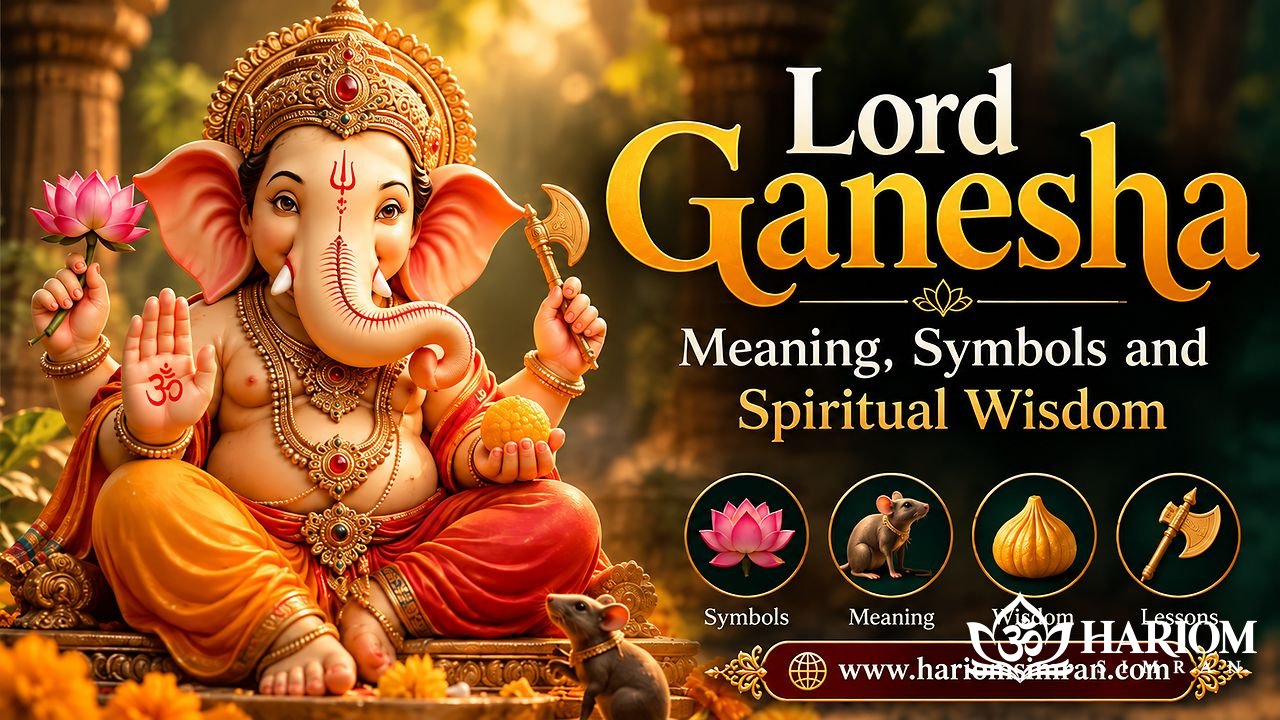
Lord Ganesha is one of the most widely loved and worshipped Divine figures in Hinduism.
He is instantly recognizable through his elephant head, large ears, curved trunk, rounded form, broken tusk, Modak and small mouse or Mushaka as his Vahana.
But every part of Ganesha's sacred imagery carries deeper meaning.
He is worshipped as:
- Remover of obstacles
- Lord of beginnings
- Patron of wisdom
- Guardian of learning
- Lord of intellect and discernment
- Protector of sacred undertakings
- Bestower of Siddhi in devotional traditions
- Son of Lord Shiva and Goddess Parvati
- Divine guide before important beginnings
Before beginning a Puja, journey, business, educational activity, wedding, ceremony or new project, many Hindus first remember Lord Ganesha.
Why?
Because Ganesha represents something essential:
A good beginning requires wisdom.
Removing an obstacle does not always mean making the path easy.
Sometimes the obstacle is external.
Sometimes it is confusion.
Sometimes ego.
Sometimes fear.
Sometimes impatience.
Sometimes we ourselves are the obstacle.
This is why Ganesha's spiritual wisdom goes far beyond the popular phrase:
Remover of Obstacles.
His symbolism teaches us how to think clearly, listen deeply, control desire, act wisely and begin important work with the right intention.
Explore the wider Hindu Divine tradition through Deities.
Who Is Lord Ganesha?
Lord Ganesha is a major Hindu deity worshipped across many traditions and regions.
He is traditionally regarded as the son of:
Lord Shiva
and
Goddess Parvati
He is also closely associated with his brother Lord Kartikeya, known by names such as Skanda, Murugan and Subrahmanya.
Ganesha is worshipped by devotees across different Hindu Sampradayas.
He is important in:
- Shaiva traditions
- Shakta traditions
- Smarta traditions
- Ganapatya traditions
- Many Vaishnava households and temples
- Regional Hindu devotional traditions
This wide reverence makes Ganesha one of Hinduism's most universally recognized Divine figures.
What Does the Name Ganesha Mean?
The name Ganesha can broadly be understood through two Sanskrit elements:
Gana
and
Isha
Gana can refer to a group, multitude, attendants or categories of beings.
Isha means Lord or master.
Therefore, Ganesha can broadly mean:
Lord of the Ganas
or
Lord of Groups or Multitudes
Another very common name is:
Ganapati
which similarly means:
Lord of the Ganas
These names connect Ganesha with Divine authority, leadership and order.
Important Names of Lord Ganesha
Ganesha is worshipped through many sacred names.
Some widely known names include:
- Ganapati: Lord of the Ganas
- Vighneshvara: Lord associated with obstacles
- Vighnaharta: Remover of obstacles
- Vinayaka: A major traditional name of Ganesha
- Ekadanta: One-tusked Lord
- Gajanana: Elephant-faced Lord
- Lambodara: One with the large or rounded belly
- Vakratunda: One with the curved trunk
- Sumukha: Auspicious or beautiful-faced
- Siddhivinayaka: Vinayaka associated with accomplishment and success
- Heramba: An important traditional form of Ganesha
- Dhoomraketu: A name found in traditional lists
- Bhalachandra: One associated with the Moon on the forehead in certain traditions
Different texts and traditions preserve different lists of Ganesha's names.
Why Is Ganesha Worshipped First?
In many Hindu rituals, Lord Ganesha is remembered before other major activities begin.
This is associated with his role as:
Vighnaharta
the remover of obstacles.
But spiritually the teaching is deeper.
Before starting anything important, a person should develop:
- Clarity
- Discipline
- Humility
- Right intention
- Wisdom
- Patience
- Awareness
Ganesha worship reminds the devotee:
Do not rush into an important beginning without preparing the mind.
Ganesha as Vighnaharta
The devotional title Vighnaharta means remover of obstacles.
The Sanskrit word Vighna refers to an obstacle, interruption or difficulty.
But obstacles can appear in different forms.
External Obstacles
These may include:
- Difficult circumstances
- Lack of resources
- Delays
- Unexpected events
- Opposition
- Confusion
Internal Obstacles
These can be even more challenging:
- Ego
- Fear
- Anger
- Laziness
- Impatience
- Attachment
- Poor judgment
- Lack of discipline
Ganesha therefore represents both practical and inner preparation.
Does Ganesha Remove Every Difficulty?
Not necessarily in the simplistic sense that every devotee will immediately get whatever they want.
Hindu devotion should not be reduced to:
Pray and every problem disappears.
Sometimes wisdom removes the obstacle.
Sometimes patience helps us cross it.
Sometimes the correct path is completely different from the one we originally wanted.
Sometimes an obstacle protects us from making a bad decision.
Therefore, Ganesha's blessing can also be understood as:
The wisdom to recognize the right path.
Birth of Lord Ganesha
The birth of Lord Ganesha is one of Hinduism's most famous sacred narratives.
Several versions appear in Puranic and regional traditions.
A widely known version tells that Goddess Parvati created a boy and appointed him to guard her privacy.
When Lord Shiva later arrived, Ganesha did not allow him to enter because he was following Parvati's instruction.
A confrontation followed.
In the sacred narrative, Ganesha lost his original head.
When Parvati expressed profound grief and anger, Shiva restored the child to life with an elephant head.
Ganesha was then given an honored Divine position.
Do All Texts Tell Ganesha's Birth Story the Same Way?
No.
Different Puranas and regional traditions preserve variations.
Details may differ regarding:
- How Ganesha was created
- Who confronted him
- How his head was lost
- How the elephant head was obtained
- Which blessings he received afterward
HariOmSimran should therefore present the birth story as a sacred narrative with multiple traditional versions, rather than claiming one retelling is universally identical.
Explore Hindu sacred narratives through Hindu Stories.
What Does Ganesha's Birth Story Teach?
Beyond the sacred narrative itself, many spiritual reflections have developed around Ganesha's birth.
The story can inspire reflection on:
- Duty
- Obedience
- Identity
- Transformation
- Family relationships
- Protection
- Divine reconciliation
- New beginnings
Ganesha's transformation into the elephant-headed Divine child also makes him a profound symbol of:
Transformation after crisis.
Why Does Lord Ganesha Have an Elephant Head?
The elephant head is Ganesha's most recognizable symbol.
Elephants carry many important qualities.
They are associated with:
- Strength
- Intelligence
- Memory
- Calmness
- Leadership
- Loyalty
- Awareness
- Ability to clear a path
These qualities align naturally with Ganesha's spiritual role.
Elephant Head and Wisdom
The large elephant head can symbolize:
Think Big.
Do not react only from immediate emotion.
Look at the wider situation.
Wise decisions require perspective.
Ganesha's elephant head therefore represents a mind capable of:
- Understanding complexity
- Remembering lessons
- Seeing the larger picture
- Acting patiently
Ganesha's Large Ears
Ganesha is often depicted with large elephant ears.
A popular spiritual interpretation is:
Listen More.
Wise people do not only speak.
They listen.
Deep listening helps us understand:
- Other people
- Different viewpoints
- Teachers
- Experience
- Sacred knowledge
- Our own inner condition
Ganesha's ears therefore symbolize receptivity to wisdom.
Listen Before You Respond
Many modern problems arise because people react before understanding.
Messages are answered immediately.
Opinions are formed instantly.
Arguments begin before listening is complete.
Ganesha's large ears can remind us:
Listen First. Respond Wisely.
That simple principle can improve:
- Family relationships
- Work
- Leadership
- Learning
- Spiritual life
Ganesha's Small Eyes
Ganesha is often represented with relatively small, focused eyes.
These are commonly interpreted as symbols of:
- Concentration
- Attention
- Focus
- Inner vision
The lesson is:
Do Not Let Every Distraction Control Your Attention.
Modern life makes this especially relevant.
Focus in the Digital Age
Today human attention is constantly pulled by:
- Notifications
- Social media
- Messages
- Videos
- News
- Advertisements
- Endless scrolling
Ganesha's focused eyes can become a modern spiritual reminder:
Attention Is Valuable. Use It Carefully.
Ganesha's Trunk
Ganesha's elephant trunk is another profound symbol.
An elephant trunk is powerful enough to move heavy objects.
Yet it is sensitive enough to handle something small.
This combination makes it a beautiful symbol of:
Strength With Sensitivity.
What Does Ganesha's Trunk Teach?
The trunk suggests adaptability.
Sometimes life requires strength.
Sometimes gentleness.
Sometimes immediate action.
Sometimes patience.
Wisdom is knowing which response is appropriate.
A person who uses strength everywhere becomes harsh.
A person who uses gentleness everywhere may fail to act when firmness is necessary.
Ganesha represents balance.
The Curved Trunk
One famous name of Ganesha is:
Vakratunda
meaning one with a curved trunk.
The curved trunk may also symbolize that life does not always follow a perfectly straight path.
Progress can involve:
- Detours
- Delays
- Unexpected changes
- New directions
The important thing is not that the path remains straight.
The important thing is that wisdom continues guiding the journey.
Ganesha's Broken Tusk
One of Ganesha's most recognizable features is his single tusk.
This gives him the name:
Ekadanta
meaning:
One-Tusked
Several sacred narratives explain how Ganesha's tusk became broken.
Different stories appear in Hindu tradition.
Ganesha and the Mahabharata
One famous tradition connects Ganesha with the writing of the Mahabharata.
In this narrative, Sage Vyasa seeks a scribe capable of recording the great epic.
Ganesha agrees.
Conditions are established regarding the flow and understanding of the composition.
According to a famous later traditional explanation, when the writing instrument failed, Ganesha broke his own tusk and continued writing.
This story became one of Ganesha's most powerful educational symbols.
What Does the Broken Tusk Symbolize?
The broken tusk can represent:
- Sacrifice for knowledge
- Determination
- Commitment
- Prioritizing purpose over comfort
- Intellectual discipline
It gives a powerful lesson:
When the purpose is worthy, inconvenience should not always stop the work.
Sacrifice and Wisdom
The broken tusk also reminds us that valuable achievements often require sacrifice.
A student sacrifices free time.
A parent sacrifices comfort.
A teacher sacrifices energy.
A creator sacrifices convenience.
But sacrifice should have purpose.
Ganesha's symbolism teaches:
Sacrifice should serve wisdom, Dharma and meaningful goals.
Ganesha's Large Belly
Ganesha is commonly shown with a large rounded belly.
This has inspired many traditional and devotional interpretations.
It may symbolize the ability to:
- Contain experience
- Accept life's opposites
- Remain steady
- Digest knowledge
- Hold the universe symbolically
The popular name Lambodara is associated with Ganesha's rounded belly.
Digesting Life's Experiences
Physical digestion transforms food.
Similarly, spiritual maturity requires us to process experiences.
Life gives:
- Success
- Failure
- Praise
- Criticism
- Happiness
- Disappointment
An immature mind reacts to everything.
A mature mind learns from everything.
Ganesha's belly can therefore represent:
The capacity to digest life's experiences without being destroyed by them.
Lord Ganesha and Modak
The Modak is one of the most famous offerings associated with Ganesha.
Ganesha is often shown holding or enjoying Modak.
In many traditions, Modak is considered especially dear to him.
Its spiritual symbolism can include:
- Sweetness of wisdom
- Reward of disciplined effort
- Inner joy
- Spiritual fulfillment
Why Does the Modak Symbolize Wisdom?
The outer layer hides the sweet filling within.
This can become a spiritual metaphor.
True wisdom may not always appear immediately.
Learning requires:
- Effort
- Patience
- Practice
- Curiosity
Eventually understanding brings its own sweetness.
Ganesha's Vahana: Mushaka
Lord Ganesha's Vahana is commonly represented as Mushaka, a mouse or rat.
At first, the pairing looks surprising.
A large elephant-headed deity.
A tiny mouse.
Yet this contrast carries powerful symbolism.
What Does the Mouse Represent?
Different interpretations associate Mushaka with:
- Desire
- Restlessness
- Ego
- Curiosity
- Wandering mind
- Ability to enter hidden spaces
A mouse can move almost anywhere.
Similarly, desire can enter every area of the mind.
Ganesha Riding the Mouse
Ganesha's relationship with Mushaka can symbolize:
Wisdom Must Guide Desire.
Desire itself is not always harmful.
People need motivation.
But uncontrolled desire becomes destructive.
The small mouse carrying or accompanying the great Lord suggests:
Do Not Let Desire Become Your Master.
Large Ganesha, Small Vahana
The visual contrast between Ganesha and Mushaka also teaches humility.
Great wisdom does not require a grand vehicle.
The Divine can work through what appears small.
Never assume that value is determined only by physical size or social importance.
Ganesha's Four Arms
Lord Ganesha is frequently represented with four arms, although some forms may have more.
Different objects may appear in his hands depending on iconographic tradition.
Commonly represented objects include:
- Pasha
- Ankusha
- Modak
- Broken tusk
- Mala
- Lotus
- Other sacred objects
Each carries symbolic meaning.
Pasha
The Pasha, or noose, can symbolize Divine power over attachment and bondage.
It may also represent bringing the seeker closer to spiritual truth.
Attachment can bind the mind.
Wisdom helps us recognize what controls us.
Ankusha
The Ankusha, traditionally an elephant goad, can symbolize spiritual guidance and disciplined direction.
The mind often wanders.
The Ankusha reminds the seeker:
Redirect Yourself Toward the Right Path.
Ganesha's Hand of Blessing
Ganesha is frequently depicted with a hand raised in a blessing or protective gesture.
This can communicate:
- Divine protection
- Reassurance
- Grace
- Fearlessness
The devotee is reminded:
Act with wisdom, but do not live entirely through fear.
Ganesha and Om
Lord Ganesha is frequently associated symbolically with the sacred syllable:
Om
Some devotional and visual traditions see similarities between the shape of Ganesha's body and the written form of Om.
Both Ganesha and Om are connected with auspicious beginnings.
Om has deep significance across Hindu sacred traditions as a primordial sacred sound.
Explore wider teachings through Mantras.
Ganesha and Sacred Sound
Ganesha's relationship with learning and sacred beginnings naturally connects him with Mantra practice.
One widely known Ganesha Mantra is:
Om Gan Ganapataye Namah
Broadly, it expresses reverence to Lord Ganapati.
Different traditions may use different Ganesha Mantras for worship, Japa and ritual.
Om Gan Ganapataye Namah
The Mantra:
Om Gan Ganapataye Namah
is widely used in Ganesha devotion.
Its purpose is spiritual remembrance and reverence toward Ganapati.
It should not be presented as a guaranteed formula for instant wealth, exam success, business success or removal of every difficulty.
Mantra practice belongs to a sacred devotional context.
Vakratunda Mahakaya
Another widely recited prayer begins:
Vakratunda Mahakaya
It invokes Ganesha before important activities and seeks freedom from obstacles.
This prayer is commonly recited by students, families and devotees before beginning significant work.
Its popularity reflects Ganesha's role as guardian of auspicious beginnings.
Ganesha and the Ganapati Atharvashirsha
An important sacred text associated with Ganesha is the Ganapati Atharvashirsha, often called the Ganesha Atharvashirsha.
It is an Upanishadic-style text centered on Ganapati.
The text presents Ganesha through profound philosophical language and connects him with ultimate spiritual reality.
This demonstrates that Ganesha tradition includes not only popular stories but also deep theological and philosophical teachings.
Explore Hindu sacred texts through Hindu Scriptures.
Ganesha and Wisdom
Lord Ganesha is strongly associated with Buddhi, or intellect.
But wisdom in Hindu spirituality is not merely intelligence.
A person can be highly intelligent and still make destructive decisions.
Wisdom includes:
- Knowledge
- Discernment
- Self-control
- Ethical judgment
- Patience
- Awareness of consequences
Ganesha therefore represents intelligence guided by Dharma.
Intelligence Versus Wisdom
Modern society often rewards intelligence.
But intelligence alone can create:
- Manipulation
- Harmful technology
- Ego
- Unethical decisions
The deeper spiritual question is:
How Are We Using Intelligence?
Ganesha's symbolism encourages:
Use intelligence with wisdom.
Ganesha and Learning
Lord Ganesha is deeply associated with students and education.
Many students remember Ganesha before:
- Studying
- Exams
- Writing
- Starting a new academic year
- Learning a skill
- Beginning a creative project
The spiritual purpose should not be misunderstood.
Prayer is not a replacement for preparation.
A useful Ganesha-inspired approach is:
Pray sincerely. Study seriously. Act responsibly.
Ganesha's Lesson for Students
Students can learn several lessons from Ganesha:
- Listen carefully.
- Focus deeply.
- Ask questions.
- Accept mistakes.
- Develop patience.
- Avoid ego after success.
- Continue after setbacks.
- Value understanding over memorization.
This turns Ganesha devotion into educational character.
Ganesha and Writing
The Mahabharata scribe tradition makes Ganesha especially meaningful to:
- Writers
- Scholars
- Students
- Teachers
- Researchers
- Artists
- Content creators
Ganesha becomes a symbol of sustained intellectual effort.
Ganesha and Creativity
Creative work also faces obstacles.
Writers experience writer's block.
Designers lose direction.
Developers face bugs.
Entrepreneurs face uncertainty.
Artists face self-doubt.
Ganesha's symbolism teaches:
Do Not Expect a Creative Path Without Obstacles. Learn to Work Through Them.
Ganesha and New Beginnings
Lord Ganesha is especially remembered before new beginnings.
This can include:
- New home
- New business
- New job
- Marriage
- Journey
- Education
- Puja
- Festival
- Construction
- Creative project
The spiritual principle is:
Begin consciously.
Every Beginning Needs Preparation
A successful beginning often requires:
- Clear purpose
- Realistic planning
- Knowledge
- Patience
- Resources
- Discipline
Simply wishing for success is not enough.
Ganesha symbolizes the intelligence needed before action.
Ganesh Chaturthi
The major festival dedicated to Lord Ganesha is Ganesh Chaturthi.
It celebrates the Divine presence and worship of Ganesha.
The festival is especially prominent in several regions of India and Hindu communities worldwide.
Devotees may observe it through:
- Ganesha Puja
- Installation of Ganesha Murti
- Mantra chanting
- Bhajan
- Aarti
- Modak offerings
- Community celebrations
- Scripture reading
- Seva
- Visarjan
Practices vary across regions and families.
Explore Hindu celebrations through Festivals.
Ganesh Chaturthi and Murti Installation
During Ganesh Chaturthi, devotees may install Ganesha Murtis in:
- Homes
- Temples
- Community Pandals
The Murti becomes the focus of devotional worship during the festival period.
The exact number of days of worship can vary according to tradition.
Ganesh Visarjan
At the conclusion of Ganesh Chaturthi observances, the Murti may be taken for Visarjan, traditionally immersion in water.
This powerful ritual can symbolize:
- Impermanence
- Return to the elements
- Divine presence beyond physical form
- Cycles of arrival and departure
The devotee welcomes Ganesha lovingly and then releases the physical form.
Spiritual Meaning of Visarjan
Visarjan can teach:
Love Without Possession.
We may deeply love a sacred form.
Yet we also recognize:
Physical forms change.
The Divine is not confined to one temporary material form.
Environmentally Responsible Ganesh Chaturthi
Modern celebrations increasingly raise environmental questions.
Responsible practices can include consideration for:
- Eco-friendly materials
- Water protection
- Waste reduction
- Responsible decoration
- Local environmental guidelines
Devotion and environmental responsibility do not need to conflict.
Respecting nature can itself become a form of Dharma.
Ganesh Chaturthi and Community
Ganesh Chaturthi has also become an important community festival.
It can bring people together through:
- Bhajan
- Cultural programs
- Seva
- Shared meals
- Educational events
- Community worship
The social dimension reminds us that spirituality can strengthen community relationships.
Ashtavinayak
One important Maharashtra pilgrimage tradition is the Ashtavinayak, referring to eight revered Ganesha temples.
The pilgrimage connects eight sacred Vinayaka forms and sites.
This tradition has deep regional devotional importance.
A future HariOmSimran temple series can explore each Ashtavinayak temple individually.
Explore the wider sacred geography through Temples.
Siddhivinayak
The name Siddhivinayak is widely associated with Ganesha.
It broadly connects Vinayaka with:
- Siddhi
- Accomplishment
- Spiritual or successful completion
However, Ganesha worship should not be reduced to transactional promises.
Devotion ideally develops:
- Wisdom
- Discipline
- Gratitude
- Responsibility
The 32 Forms of Ganesha
Some Hindu iconographic traditions describe 32 forms of Ganesha.
These forms present different aspects of Ganapati with distinct:
- Postures
- Objects
- Colors
- Symbolism
- Spiritual associations
A separate HariOmSimran article can later explore these forms rather than overloading the foundational Ganesha article.
Ganesha and Siddhi
The Sanskrit word Siddhi can carry meanings such as accomplishment, attainment or spiritual perfection depending on context.
Some Ganesha traditions closely associate him with Siddhi.
However, claims of guaranteed supernatural Siddhis should be treated responsibly.
Ganesha's spiritual message is better understood through disciplined wisdom than sensational promises.
Ganesha and Riddhi
Popular devotional traditions also connect Ganesha with concepts such as Riddhi, prosperity or flourishing, and Siddhi.
Stories and theological details differ.
The deeper lesson should not become:
Worship Ganesha and wealth is guaranteed.
Material prosperity is not a guaranteed outcome of spiritual devotion.
Ganesha's Family
Lord Ganesha belongs to one of Hinduism's most recognizable Divine families.
His family includes:
- Lord Shiva
- Goddess Parvati
- Lord Kartikeya
This family brings together many spiritual themes:
- Meditation
- Shakti
- Wisdom
- Courage
- Devotion
- Family relationships
Ganesha and Lord Shiva
Ganesha's relationship with Shiva begins dramatically in the famous birth narrative.
Yet the story eventually becomes one of:
- Recognition
- Restoration
- Reconciliation
- Divine blessing
Shiva accepts Ganesha and grants him great honor.
This transformation is spiritually significant.
Conflict does not have to remain permanent.
Ganesha and Goddess Parvati
Ganesha is deeply connected with Goddess Parvati.
In his birth traditions, Parvati's role is central.
The mother-son relationship reflects:
- Protection
- Creation
- Love
- Shakti
- Family devotion
A dedicated Parvati article can later explore her role independently.
Ganesha and Kartikeya
Lord Ganesha and Lord Kartikeya appear together in several popular sacred stories.
One famous narrative involves a competition between the brothers.
They are asked to circle the world.
Kartikeya sets off physically.
Ganesha instead circles his parents, Shiva and Parvati, understanding them as his world.
What Does the World-Circling Story Teach?
The story is traditionally used to highlight:
- Wisdom
- Respect for parents
- Different forms of intelligence
- Thinking beyond the obvious solution
Kartikeya represents one kind of excellence.
Ganesha demonstrates another.
The teaching is not necessarily that speed is bad.
It is:
Wisdom can sometimes solve a problem differently.
Ganesha and Parents
The world-circling narrative also became a powerful teaching on honoring parents.
In Hindu family culture, respect for parents and elders is deeply valued.
However, respect should not be confused with unquestioning obedience in every harmful situation.
The spiritual principle is gratitude, dignity and responsibility.
Ganesha and the Moon
A famous traditional story connects Ganesha with the Moon.
Different versions explain a curse or teaching involving the Moon laughing at Ganesha.
This story is sometimes connected with Ganesh Chaturthi observances and beliefs regarding seeing the Moon.
Details differ among traditions.
A future story article should present the narrative with proper source context.
Ganesha and Kubera
Another popular sacred story involves Kubera, the deity associated with wealth.
Kubera's pride is challenged when Ganesha's appetite cannot be satisfied through extravagant offerings.
The story is often interpreted as a lesson against:
- Pride
- Showmanship
- Material arrogance
The deeper teaching is:
Wealth without humility is spiritually incomplete.
Ganesha and Humility
Although Ganesha is associated with wisdom and accomplishment, his symbolism repeatedly points toward humility.
The mouse is small.
The Modak is simple.
The broken tusk represents sacrifice.
The large ears emphasize listening.
The spiritual lesson is:
Wisdom does not need arrogance.
Ganesha and Ego
One of the greatest obstacles in spiritual life is ego.
Ego can appear as:
- “I already know everything.”
- “I am always right.”
- “Others must listen to me.”
- “My success makes me superior.”
- “I cannot admit mistakes.”
Ganesha's wisdom challenges this mindset.
Large head.
Large ears.
Small focused eyes.
One tusk.
Together they suggest:
Think More. Listen More. Focus Better. Speak With Wisdom.
Ganesha and Dharma
Ganesha's wisdom is naturally connected with Dharma.
Wisdom should guide action toward what is right and responsible.
A clever person can solve problems.
A wise person asks:
Should this problem be solved in this way?
Explore the deeper meaning through Dharma.
Ganesha and Success
Ganesha is commonly associated with success.
But spiritual success should be understood carefully.
Success can mean:
- Completing a meaningful responsibility
- Overcoming inner weakness
- Making a wise decision
- Learning from failure
- Finishing difficult work
- Serving others
- Acting according to Dharma
Success is not only money or status.
Ganesha and Failure
Ganesha's symbolism is equally relevant when things go wrong.
An obstacle does not automatically mean failure.
Sometimes obstacles reveal:
- Weak planning
- Missing knowledge
- Wrong assumptions
- Poor timing
- Need for patience
The wise response is not always:
Push harder.
Sometimes wisdom says:
Learn, adjust and try differently.
Ganesha's Lesson for Business
Entrepreneurs often remember Ganesha before starting businesses.
His symbolism offers practical reflections:
- Understand the market.
- Plan before investing.
- Listen to customers.
- Manage ego.
- Expect obstacles.
- Adapt when needed.
- Keep ethical standards.
- Do not confuse luck with strategy.
Spiritual devotion should support responsible action, not replace it.
Ganesha's Lesson for Work
At work, Ganesha's symbols can inspire:
- Focus
- Listening
- Problem-solving
- Patience
- Adaptability
- Teamwork
- Ethical decision-making
These are practical expressions of his symbolic wisdom.
Ganesha's Lesson for Families
Families also face obstacles.
Ganesha can inspire:
- Listening before arguing
- Respect
- Patience
- Clear communication
- Forgiveness
- Humility
Sometimes the greatest obstacle in a relationship is the refusal to listen.
Ganesha's Lesson for the Digital Age
Ganesha's symbolism is surprisingly relevant to modern digital life.
Large Head: Think deeply.
Large Ears: Listen carefully.
Small Eyes: Focus attention.
Flexible Trunk: Adapt.
Broken Tusk: Commit to meaningful work.
Large Belly: Process experience.
Mouse: Control restless desire.
Modak: Wisdom has deeper sweetness.
Ancient symbolism does not need to predict technology to remain useful.
Its human lessons remain timeless.
Lord Ganesha's Main Symbols and Their Meanings
Ganesha's major symbols can be summarized as:
- Elephant Head: Wisdom, intelligence and broad perspective
- Large Ears: Deep listening
- Small Eyes: Focus and concentration
- Curved Trunk: Adaptability and balanced strength
- Broken Tusk: Sacrifice, learning and perseverance
- Large Belly: Capacity to process life's experiences
- Modak: Sweetness of wisdom and spiritual fulfillment
- Mushaka: Desire, restlessness and the need for self-mastery
- Pasha: Attachment and spiritual bondage
- Ankusha: Discipline and redirection
- Blessing Hand: Grace, protection and reassurance
- Four Arms: Divine capacity and multiple spiritual functions
Together, these symbols make Ganesha one of Hinduism's richest educational Divine forms.
What Can Modern Readers Learn From Lord Ganesha?
Lord Ganesha offers several practical lessons:
- Think Before Acting: Wisdom should come before action.
- Listen Carefully: Understanding requires attention.
- Develop Focus: Not every distraction deserves your mind.
- Adapt to Change: A rigid mind struggles unnecessarily.
- Control Desire: Motivation should not become addiction.
- Accept Obstacles: Difficulties can teach valuable lessons.
- Stay Humble: Intelligence without humility becomes ego.
- Value Knowledge: Education is part of spiritual growth.
- Complete What Matters: The broken tusk symbolizes commitment.
- Begin With Preparation: Good beginnings require planning.
- Use Wisdom Ethically: Intelligence should support Dharma.
- Learn From Failure: An obstacle may reveal what needs improvement.
Common Misunderstandings About Lord Ganesha
Ganesha Automatically Removes Every Problem
Not necessarily. Ganesha represents wisdom and removal of obstacles, but devotion should not be treated as a guarantee that every difficulty will disappear exactly as we want.
Ganesha's Elephant Head Has Only One Symbolic Meaning
No. It carries several traditional and modern spiritual interpretations involving wisdom, strength, memory, perspective and intelligence.
Mushaka Means Desire Is Always Bad
Not necessarily. Desire can motivate action. The deeper symbolism concerns keeping desire under wise control rather than becoming controlled by it.
Worshipping Ganesha Guarantees Business or Exam Success
No. Devotion can provide spiritual focus and inspiration, but successful study or business also requires preparation, skill, discipline and responsible action.
Every Hindu Text Gives the Same Ganesha Birth Story
No. Different Puranic and regional traditions preserve different versions and details.
How Should Beginners Learn About Lord Ganesha?
A useful learning path is:
- Begin with the meaning of Ganesha and Ganapati.
- Understand why he is worshipped before new beginnings.
- Explore his role as Vighnaharta.
- Study the major versions of his birth story.
- Understand the elephant head symbolism.
- Learn the meaning of his large ears and focused eyes.
- Explore the trunk and adaptability.
- Study the broken tusk and Mahabharata tradition.
- Understand the Modak.
- Learn the symbolism of Mushaka.
- Explore Pasha and Ankusha.
- Study Om Gan Ganapataye Namah.
- Learn about Ganapati Atharvashirsha.
- Explore Ganesh Chaturthi.
- Learn about Ashtavinayak.
- Explore Ganesha's relationship with Shiva, Parvati and Kartikeya.
- Study important Ganesha stories with source awareness.
This creates a balanced foundation of devotion, symbolism and knowledge.
Why Lord Ganesha Still Matters
Lord Ganesha remains deeply relevant because every human life contains obstacles.
We face obstacles in:
Education
Career
Relationships
Business
Family
Health decisions
Spiritual life
Personal growth
But the greatest obstacle is not always outside us.
Sometimes it is:
Fear
Ego
Confusion
Impatience
Distraction
Uncontrolled Desire
Lack of Discipline
This is why Ganesha's sacred form remains so powerful.
His elephant head says:
Think Bigger.
His large ears say:
Listen Better.
His small eyes say:
Focus.
His trunk says:
Be Flexible.
His broken tusk says:
Stay Committed.
His large belly says:
Learn to Process Life.
His mouse says:
Master Desire.
His Modak says:
Wisdom Has Its Own Sweetness.
And his role as Vighnaharta reminds us:
The deepest obstacle may be the one inside the mind.
Explore Hindu Divine Wisdom With HariOmSimran
HariOmSimran is developing the Deities section as a structured educational journey through Hindu Divine traditions.
Continue exploring:
The next strong article in the God category should be:
Lord Hanuman: Life, Bhakti, Strength and Spiritual Wisdom
After Hanuman, we can continue with:
- Lord Kartikeya
- Surya Deva
Then we can systematically expand the Goddess category with Durga, Lakshmi, Saraswati, Parvati, Kali, Sita and Radha.
Learn • Explore • Understand • Preserve
Key Takeaway
Lord Ganesha is one of Hinduism's most widely worshipped Divine figures.
He is known as:
- Ganapati
- Vinayaka
- Vighnaharta
- Ekadanta
- Gajanana
- Lambodara
- Vakratunda
- Siddhivinayaka
His symbols carry powerful spiritual teachings.
The elephant head represents wisdom and broad understanding.
The large ears teach deep listening.
The small eyes symbolize concentration.
The trunk represents adaptability and balanced strength.
The broken tusk symbolizes sacrifice and commitment to knowledge.
The large belly can represent the ability to process life's experiences.
The Modak represents the sweetness of wisdom.
The Mushaka reminds us to master restless desire.
The Pasha points toward attachment.
The Ankusha represents disciplined direction.
Spiritual Significance
This deity holds profound spiritual importance in Hindu tradition. Below are the key aspects of worship and significance.
Worship Practices
Devotees worship this deity through various rituals and practices that deepen their spiritual connection.
- Devotion
- Spiritual Growth
- Sacred Rituals
- Divine Blessings

Worship & Rituals
Explore the various ways devotees connect with this deity through prayer, rituals, and spiritual practices.
🙏 Daily Prayers
Daily prayers and mantras dedicated to this deity help devotees maintain a strong spiritual connection.
🕯️ Festival Celebrations
Special festivals and celebrations honor this deity, bringing communities together in devotion.
📿 Sacred Offerings
Traditional offerings and rituals that express devotion and seek divine blessings.
📖 Sacred Texts
Scriptures and hymns that describe the glory and teachings associated with this deity.
Frequently Asked Questions
Lord Ganesha is one of Hinduism's most widely worshipped Divine figures. He is traditionally regarded as the son of Lord Shiva and Goddess Parvati and is associated with wisdom, learning, auspicious beginnings and the removal of obstacles.
Different sacred narratives explain how Ganesha received his elephant head. Symbolically, the elephant head is often associated with wisdom, intelligence, memory, strength and the ability to overcome obstacles.
Ganesha's one-tusked form gives him the name Ekadanta. Different sacred stories explain the broken tusk. One famous tradition connects it with Ganesha writing the Mahabharata, making the tusk a symbol of sacrifice, knowledge and determination.
Ganesha's Mushaka is interpreted in several ways and can symbolize desire, restlessness or the wandering mind. Ganesha's mastery over the mouse can represent wisdom guiding and controlling desire.
Ganesha is worshipped as Vighnaharta and Lord of auspicious beginnings. Remembering him before important work symbolizes seeking wisdom, clarity, discipline and freedom from obstacles.
Lord Ganesha teaches that wisdom, listening, focus, adaptability, humility and self-control help us overcome both external and internal obstacles.